


Imagine you’re in Paris and you need a new smartphone, a blender, and some books — all delivered to your door within two days. Instead of visiting multiple shops, you open one website and order everything at once. That’s the convenience offered by Cdiscount, France’s powerhouse e-commerce marketplace.
Cdiscount was founded in December 1998 by three brothers — Hervé, Christophe and Nicolas Charle — originally as an online store selling second-hand CDs and DVDs. Over the years, it expanded its catalog dramatically and evolved into a full-fledged e-commerce marketplace under the ownership of Groupe Casino via its holding Cnova N.V.. Today, Cdiscount is widely recognized as one of the largest marketplaces in France — with tens of millions of visitors per month, millions of active customers, and a product catalog covering almost every retail category.
What Is Cdiscount? — The Simple Explanation
Cdiscount is a French online shopping marketplace where customers can buy everything from electronics and home appliances to fashion, beauty, furniture, and even groceries. Think of it as France’s version of Amazon — a single platform that connects millions of shoppers with thousands of sellers offering competitive prices and fast delivery options.
The Core Problem It Solves
Cdiscount makes online shopping affordable, convenient, and wide-ranging. Instead of visiting multiple stores, shoppers get all categories in one place with reliable shipping, deals, and trusted sellers.
Target Users & Use Cases
- Everyday shoppers looking for good deals
- Families wanting fast delivery on essentials
- Tech buyers searching for phones, laptops, TVs
- Home & furniture buyers needing installation or large-item delivery
- Third-party sellers looking to reach France’s massive online market
Current Market Position (2025)
- One of France’s top 3 eCommerce marketplaces
- Over 10+ million active customers
- Millions of monthly visitors
- Strong presence in electronics, appliances & home goods
- Marketplace accounts for the majority of its order volume
Why It Became Successful
Cdiscount mastered low prices, big product variety, multi-seller marketplace growth, and fast logistics. It built trust in France with reliable delivery, strong customer service, and an ecosystem of sellers competing on price and service.
Read more: Complete Guide to Starting an E-commerce App Business
How Does Cdiscount Work? — Step-by-Step Breakdown
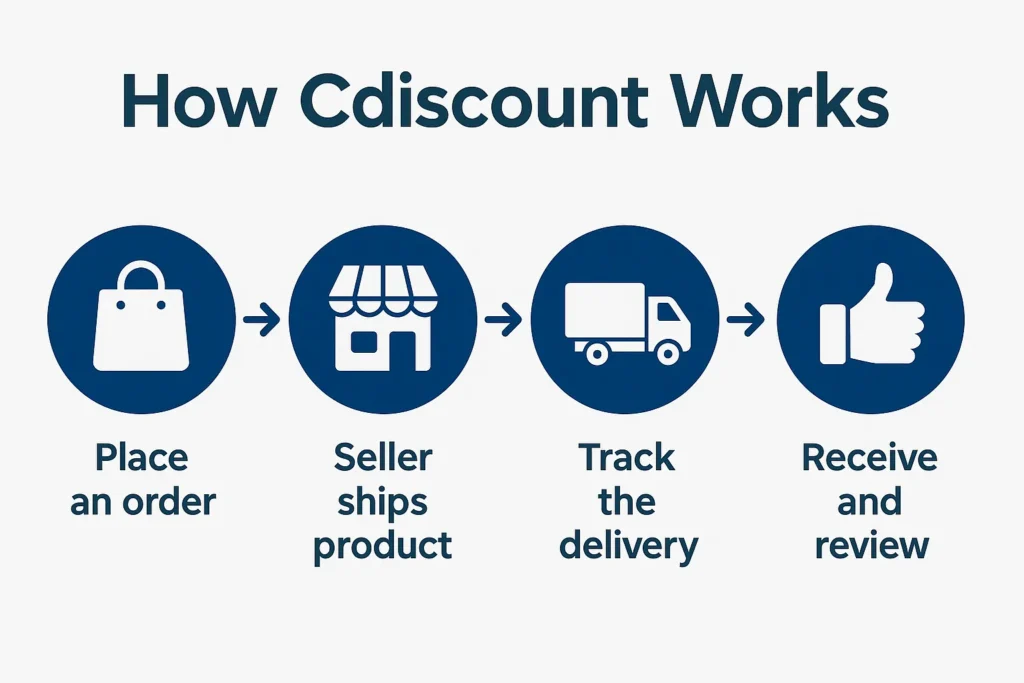
Cdiscount operates as a multi-vendor eCommerce marketplace. Shoppers browse products, compare sellers, place orders, and receive delivery fulfilled either by Cdiscount itself or by third-party vendors. Sellers use the platform to list products, manage orders, and reach millions of French customers.
For Users (Shoppers)
1. Account Creation Process
- Sign up using email or phone
- Add basic details (name, address, payment info)
- Optionally subscribe to Cdiscount à Volonté (CDAV) — a loyalty program offering free/fast delivery
- Start browsing categories or searching products
2. Main Features Walkthrough
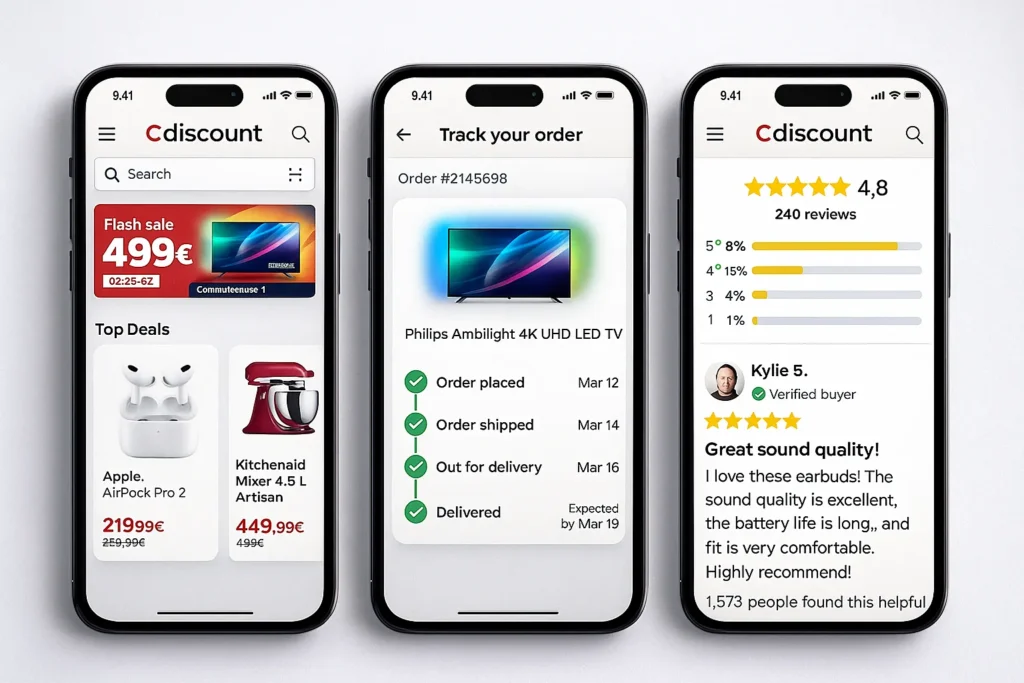
- Product Search & Filters: Category browsing, filters for price, brand, ratings, delivery options
- Price Comparison: Many products have multiple sellers; users can compare pricing
- Secure Checkout: Card, PayPal, bank transfer, installment payments
- Real-Time Tracking: Order tracking via app/web
- Returns & Support: Easy returns and customer service
- Deals & Promotions: Flash sales, daily deals, bundle offers
3. Typical User Journey (Example)
Scenario: Marie from Lyon wants to buy a new washing machine.
- Opens the Cdiscount app → searches “front-load washing machine”
- Compares price + store ratings + delivery time
- Selects a seller offering installation services
- Adds to cart → pays via installment plan
- Gets delivery + installation date
- Tracks order → completes delivery
- Leaves a review
A complete and seamless shopping flow.
4. Key Functionalities Explained
- Marketplace Listings: Multiple sellers offering the same product
- Fulfillment by Cdiscount (FBC): Optional logistics storage, packing, and delivery
- Installment Payments: “Pay in 4” or credit options
- CDAV Membership: Priority delivery + free shipping
- Large Appliance Services: Home delivery + installation support
For Sellers / Service Providers
1. Seller Onboarding Process
- Register business
- Submit KYC documents
- Add inventory
- Set pricing, delivery fees, and service levels
- Start receiving orders
2. How Sellers Operate on the Platform
- List products with photos, descriptions, stock
- Manage orders via Cdiscount Seller Portal
- Fulfill orders themselves or use FBC (Fulfilled by Cdiscount)
- Provide customer service when required
- Adjust pricing to stay competitive
3. Earnings & Commission Structure
- Sellers pay:
- Commission per sale (varies by category)
- Monthly subscription fee for seller account
- Optional logistics/storage fees for FBC
Cdiscount pays the seller after deducting fees.
Technical Overview (Simple)
Basic Architecture (No Jargon)
Cdiscount is built like a big digital mall:
- Users browse → servers show product listings
- Orders go through a secure checkout system
- Warehouse software manages the inventory
- Delivery system assigns drivers or carriers
- A seller portal handles vendor operations
Everything is connected but simplified so users never feel complexity.
Key Technologies Used (Simplified)
- Cloud hosting for speed
- Secure payment systems
- AI-based recommendation engine
- Search and filter algorithms
- Real-time delivery tracking
- Mobile apps (iOS + Android)
- Large database systems for millions of products
Miracuves
Go live with your Cdiscount-style marketplace in days, not months.
Understand how the Cdiscount model works end-to-end, then get a live demo, clear pricing, and a deployment roadmap tailored to your retail niche.
Deployment Cdiscount Clone • 3–8 days deployment
Chat on WhatsApp Book a build consultation
Cdiscount’s Business Model Explained
Cdiscount operates on a hybrid marketplace + retail model, earning revenue from product sales, marketplace commissions, logistics services, advertising, and subscriptions. This multi-stream structure has helped it stay profitable in France’s competitive eCommerce market.
How Cdiscount Makes Money (2025 Revenue Streams)
1. Marketplace Commissions (Primary Revenue)
Cdiscount earns a commission on every sale made by a third-party seller.
Commission varies by category, typically 5%–18%.
Examples:
- Electronics: ~7%–8%
- Home & Kitchen: ~12%
- Fashion: ~15%
- Furniture & Large Appliances: ~10%
2. Direct Retail Sales
Cdiscount still sells many products directly (like Amazon).
Profit comes from:
- Product margin
- Bulk supplier pricing
- Seasonal deal volume
3. Cdiscount Fulfillment Services (FBC)
Similar to FBA (Fulfilled by Amazon), sellers can store and ship via Cdiscount.
Charges include:
- Storage fees
- Picking & packing fees
- Delivery fees
- Returns handling
This is a major value-add revenue stream.
4. Advertising (Sponsored Listings)
Brands and sellers pay for:
- Sponsored product ads
- Display ads
- Search placement
- Brand stores
Ad revenue keeps growing as competition increases.
5. Cdiscount à Volonté (CDAV) Subscription
Users pay an annual fee (approx. €29–€49/year) for:
- Free/express shipping
- Early access deals
- Exclusive discounts
6. Financial Services
- Buy-Now-Pay-Later (BNPL)
- Installment credit (Pay in 3/4)
- Consumer credit loans
Cdiscount partners with financial institutions to earn fees & interest margins.
7. Logistics & Last-Mile Services
For heavy items (TVs, washing machines, furniture), Cdiscount offers:
- Delivery
- Assembly
- Installation
These services are charged additionally.
8. Marketplace Seller Subscriptions
Sellers pay a monthly account fee to list on the platform (typically €39/month).
Pricing Structure (2025)
Users:
- Free to use
- Shipping varies (€0–€6.99 generally)
- CDAV reduces delivery cost to nearly zero
Sellers:
- Monthly plan: ~€39
- Commissions: 5%–18%
- FBC storage + fulfillment fees
- Advertising optional
Market Size & Growth Stats
- Cdiscount remains among the top 3 marketplaces in France
- Marketplace accounts for over 50% of total product volume
- French eCommerce market exceeds €160+ billion in 2025
- Electronics + appliances are Cdiscount’s strongest categories
- Cdiscount serves millions of customers annually
Profit Margins Insights
Like most large marketplaces, margins are:
- Low on direct retail sales
- Higher on commissions, ads, and logistics
- Subscription revenue boosts predictability
Cdiscount Revenue Model Breakdown
| Revenue Stream | How It Works | Who Pays | Profit Level |
| Marketplace Commissions | Fee per sale | Sellers | High |
| Direct Retail | Cdiscount buys & sells products | Customers | Medium |
| Fulfillment (FBC) | Storage, shipping, logistics | Sellers | Very High |
| Advertising | Sponsored listings & ads | Sellers & brands | Very High |
| CDAV Subscription | Annual membership | Customers | High |
| BNPL & Credit | Installments financing | Customers | Medium |
| Seller Subscription | Monthly seller fee | Sellers | Medium |
Key Features That Make Cdiscount Successful
Cdiscount’s long-term success in France comes from a combination of value-driven pricing, huge product variety, strong logistics, and tech-enabled shopping experiences. Below are the 10 most important features that keep millions of French shoppers loyal.
1. Massive Product Catalog
Why it matters: Shoppers get everything in one place — electronics, appliances, fashion, home goods, groceries.
Benefit: Reduces the need to browse multiple websites.
Tech insight: Large-scale inventory indexing + category-wide seller integrations.
2. Competitive Pricing & Daily Deals
Why it matters: French customers love value pricing.
Benefit: Thousands of sellers compete, driving prices down.
Tech insight: Automated price comparison system ranks the best offers.
3. Cdiscount à Volonté (CDAV) Membership
Why it matters: Increases loyalty, reduces delivery cost.
Benefit: Free/express shipping, early-access deals.
Tech insight: Membership-driven personalization engine.
4. Fulfilled by Cdiscount (FBC) Logistics
Why it matters: Improves seller performance and customer satisfaction.
Benefit: Fast, reliable delivery with return management.
Tech insight: AI-powered warehouse routing + automated picking systems.
5. Real-Time Order Tracking
Why it matters: Transparency = trust.
Benefit: Users know exactly where orders are.
Tech insight: GPS + carrier API integration.
6. Secure & Flexible Payments
Why it matters: Encourages high-ticket purchases.
Benefit: BNPL, Pay in 3/4, credit options, PayPal, card, etc.
Tech insight: Encrypted payment gateway + risk scoring.
7. Multi-Seller Price Comparison
Why it matters: Helps users get the best price.
Benefit: Multiple sellers compete on each product page.
Tech insight: Real-time ranking of seller offers.
8. Large Appliance Delivery + Installation
Why it matters: Unique strength in France.
Benefit: Delivery + setup for fridges, washers, dryers, etc.
Tech insight: Route optimization + appointment scheduling systems.
9. AI-Powered Recommendations
Why it matters: Increases conversions and basket size.
Benefit: Personalized product suggestions based on behavior.
Tech insight: Machine learning models analyzing browsing + purchase history.
10. Seller Portal & Business Tools
Why it matters: Strong marketplace ecosystem = more sellers.
Benefit: Stock automation, pricing tools, analytics, performance dashboard.
Tech insight: Web-based vendor system integrated with order APIs.
Recent 2025 Updates
- Improved AI search recommendations
- Expanded green delivery and eco-friendly options
- More installment payment partnerships
- Enhanced seller fraud detection systems
- Faster delivery in Tier-2 French cities
AI/ML Integrations
- Product recommendation engine
- Automated customer support chat
- Dynamic pricing optimization for sellers
- Fraud prevention scoring
- Predictive delivery time estimates
What Truly Sets Cdiscount Apart in France
- Strong focus on value pricing
- Deep penetration into electronics & appliances
- Reliable one of the best logistics networks in the French eCommerce space
- A balance of retail + marketplace, not just one model
The Technology Behind Cdiscount
Cdiscount runs on a large-scale, enterprise-grade eCommerce architecture designed to handle millions of monthly visitors, peak-season traffic spikes, tens of thousands of sellers, and a catalog of millions of products. The platform blends reliability, speed, and smart automation — without overwhelming users with technical complexity.
Tech Stack Overview (Simplified)
While Cdiscount does not publicly disclose every piece of its stack, industry reports and observable patterns show it uses:
Frontend
- Responsive web apps (HTML5, CSS3, JavaScript frameworks)
- Likely React, Vue, or a hybrid micro-frontend approach
- Native mobile apps for iOS & Android
Backend
- High-performance server-side frameworks (Java, PHP, or Node-like microservices)
- Large API gateway for connecting sellers, payments, logistics
Database & Storage
- Distributed databases for product catalog & user data
- High-availability storage for images, videos, seller assets
Cloud Infrastructure
- Hosted on scalable cloud clusters
- Auto-scaling servers for high-traffic events (Black Friday, summer sales)
AI / ML Systems
- Product recommendations
- Search relevance tuning
- Fraud detection
- Dynamic pricing aids
Real-Time Features Explanation
1. Real-Time Inventory Updates
Customers instantly see:
- Stock availability
- Estimated delivery times
- Seller updates
Backed by fast API calls between sellers and Cdiscount’s servers.
2. Live Order Tracking
GPS + carrier API integrations show:
- “Order picked up”
- “In transit”
- “Out for delivery”
- “Delivered”
3. Real-Time Pricing Changes
Sellers can adjust prices instantly.
Platform updates product pages in milliseconds.
Data Handling & Privacy
Cdiscount follows GDPR (General Data Protection Regulation), meaning:
- Strict user data protection
- Consent-based tracking
- Encrypted storage of sensitive data
- Secure payment handling
- Right-to-access, modify, delete data
Customer payment info uses PCI-DSS–compliant gateways.
Scalability Approach
Cdiscount uses a modular system that scales as demand increases:
- Microservices allow individual components (search, checkout, seller portal) to scale independently
- Load balancers distribute traffic
- CDNs speed up content delivery
- Cloud auto-scaling prevents downtime during peak sales
This ensures smooth performance even with millions of visitors.
Mobile App vs Web Platform
Mobile App
- Optimized for quick browsing
- Push notifications for deals
- Faster checkout
- Camera-based search features (in newer versions)
Web Platform
- Ideal for detailed product comparison
- Rich seller dashboard
- Full category exploration
- Large appliance order customization
Most users in France use both, depending on purchase type.
API Integrations
Cdiscount integrates with:
- Payment gateways (cards, PayPal, BNPL providers)
- Logistics partners (Chronopost, Colissimo, internal fleet)
- Seller ERP systems
- Stock management tools
- Advertising platforms
- Recommendation engines
All these APIs ensure smooth data flow across the marketplace.
Why This Tech Matters for Business
Cdiscount’s technical foundation ensures:
- Fast product discovery
- Reliable checkout
- Minimal downtime
- Seamless order management
- Scalable logistics
- High seller satisfaction
- Faster innovation cycles
This is why it remains one of the strongest eCommerce platforms in France.
Read more: How to Market an e-commerce app Successfully After Launch
Cdiscount’s Impact & Market Opportunity
Cdiscount hasn’t just grown into one of France’s top eCommerce platforms — it has reshaped online shopping behavior, influenced logistics innovation, and opened massive opportunities for sellers, brands, and new entrepreneurs entering the marketplace business.
Industry Disruption Caused by Cdiscount
1. Price-Driven Retail Revolution
Cdiscount introduced aggressive discounting early in France, pushing traditional retailers to:
- Compete online
- Offer better deals
- Improve delivery services
2. Marketplace Ecosystem Growth
Thousands of French and international sellers now rely on Cdiscount to reach millions of customers without building their own eCommerce stores.
3. Logistics Innovation
Its Fulfilled by Cdiscount (FBC) model helped standardize:
- Faster last-mile delivery
- Wider heavy-appliance logistics
- Simplified returns
4. Digital Shopping Adoption
Many French households made their first big online purchase (like appliances, furniture) through Cdiscount due to trust and strong service.
Market Statistics & Growth (2025)
- French eCommerce is valued at €160+ billion
- Cdiscount ranks among France’s top 3 marketplaces by traffic
- Over 10+ million active shoppers annually
- Marketplace sales represent more than half of total volume
- Electronics, home appliances, and furniture are top-performing categories
- Mobile shopping on Cdiscount has grown 30% YoY
User Demographics & Behavior
Who Shops on Cdiscount?
- Families buying home essentials
- Young adults seeking deals on tech
- Budget-focused shoppers
- Heavy buyers of appliances & furniture
- Bargain hunters during flash sales
Behavior Patterns
- High engagement during promotions
- Strong mobile app usage
- Many shoppers compare 2–5 sellers before purchasing
- BNPL/Pay-in-4 usage is rapidly increasing
Geographic Presence
Cdiscount primarily serves:
- France (core market, strongest foothold)
- Monaco
- Select EU cross-border deliveries via partners
Its warehousing and logistics network focuses heavily on:
- Île-de-France
- Lyon
- Bordeaux
- Marseille
- Lille
Deep logistics coverage = faster delivery = higher retention.
Future Projections (2025–2030)
Analysts expect:
- More AI automation across search & fulfillment
- Growth in Cdiscount’s renewable/green delivery options
- Expanded marketplace categories
- Greater cross-border seller participation
- Stronger competition with Amazon France
- Higher revenue from subscriptions & logistics services
Opportunities for Entrepreneurs
Cdiscount’s model proves:
- A hybrid retail + marketplace system works extremely well
- Logistics services (FBC-style) generate huge profits
- A large catalog + seller ecosystem drives long-term growth
- Category-focused marketplaces (e.g., electronics-only, furniture-only) can thrive
- Regional marketplaces (serving one country) can beat Amazon in localized markets
There is massive room for:
- New marketplace startups
- Niche eCommerce platforms
- B2C marketplace clones
- Localized French or EU-focused online stores
- Hyper-specialized product verticals
Natural Transition to Next Section
This massive growth and proven success are exactly why many entrepreneurs today want to build their own Cdiscount-like eCommerce marketplace — with a faster, more affordable launch path using clone scripts and ready-made marketplace frameworks.
Building Your Own Cdiscount-Like Platform
Creating a Cdiscount-style eCommerce marketplace is one of the most profitable online business opportunities in 2025. Consumers want convenience, sellers want visibility, and marketplaces sit right at the center of this booming ecosystem. With the right foundation, you can build a powerful multi-vendor marketplace that mirrors Cdiscount’s success.
Why Businesses Want Cdiscount Clones
1. Proven, Low-Risk Model
Cdiscount’s hybrid retail + marketplace structure has a 20+ year track record of:
- Strong customer trust
- Category-wide scalability
- Predictable revenue
A ready-made clone lets new founders adopt a model already validated at massive scale.
2. Massive Market Demand
French and European shoppers increasingly prefer:
- Fast delivery
- Transparent pricing
- Marketplace-style options
- BNPL + flexible payments
A Cdiscount-like app aligns perfectly with these behaviors.
3. High Earnings Potential
Through:
- Marketplace commissions
- Seller subscription fees
- Fulfillment services
- Advertising
- Retail margins
Key Considerations Before Development
1. Product Categories Focus
Will your marketplace be:
- General (like Cdiscount)?
- Electronics-focused?
- Furniture & appliance-heavy?
- Fashion-focused?
2. Logistics Strategy
Decide whether to offer:
- Self-fulfillment (sellers deliver)
- Fulfillment services (FBC-style)
- Hybrid
3. Payment Options
Modern users expect:
- Pay in 3/4 installments
- Debit/Credit
- UPI/Wallets
- BNPL financing
4. Technology Stack
Ensure the platform supports:
- Multi-vendor architecture
- Real-time inventory
- Seller analytics
- API-driven logistics connectivity
- Mobile-first performance
5. Seller Tools
Critical for success:
- Inventory management
- Price automation
- Order dashboard
- Returns processing
Cost Factors & Pricing Breakdown
Cdiscount-Like App Development — Market Price
| Development Level | Inclusions | Estimated Market Price (USD) |
| Basic Marketplace MVP | Product listings, buyer/seller roles, simple checkout | $60,000 |
| Mid-Level Marketplace | Seller dashboards, shipping/payment integrations, reviews, mobile apps | $180,000 |
| Advanced Marketplace (Cdiscount-scale) | High concurrency backend, large catalog, logistics APIs, promotions engine, native apps | $250,000+ |
These amounts reflect the global market cost of building a Cdiscount-like ecommerce marketplace from scratch—typically requiring 6–12 months depending on logistics, catalog size, and integrations.
Miracuves Pricing for a Cdiscount-Like Platform
Miracuves Price: Starts at $2,899
This solution is built with robust frameworks — Web using PHP & MySQL and Apps using Flutter, ensuring strong performance, stability, smooth browsing, and a reliable multi-vendor ecommerce experience.
Note: This includes full non-encrypted source code, deployment support, backend setup, admin configuration, and publishing on Google Play & Apple App Store—delivering a complete, launch-ready ecommerce platform.
Delivery Timeline for Cdiscount
Because this is a mature, readymade solution, deployment takes only 3–9 days, covering branding, configuration, server setup, and app publishing.
Tech Stack
This solution is built with robust frameworks — Web using PHP, MySQL & Apps using Flutter, optimized for performance, stability, and easy maintenance. Other tech stacks can be discussed and arranged upon request — Contact us
Essential Features to Include
- Seller onboarding & KYC
- Multi-vendor product listings
- Price comparison engine
- Search & filtering
- Wishlist, cart, checkout
- Real-time inventory
- Delivery slot scheduling
- Installment payments
- Seller dashboards
- Analytics & reports
- User ratings & reviews
- Push notifications
- Admin + super admin dashboards
Conclusion
Cdiscount is a perfect example of how a marketplace can scale when smart technology, competitive pricing, and strong logistics come together. From its early days as a discount CD store to becoming one of France’s top eCommerce giants, Cdiscount shows what’s possible when a platform focuses relentlessly on customer trust, variety, and value.
Its success proves that shoppers want convenience, sellers need visibility, and marketplaces sit at the center of a booming digital economy — especially in 2025, where online shopping continues to grow faster than ever.
For entrepreneurs, Cdiscount offers a real blueprint:
A multi-vendor marketplace with strong seller tools, flexible payments, fast delivery, and a hybrid model that works across categories. With the right foundation, launching a similar platform is no longer a slow or expensive journey.
FAQs
Q:1 How does Cdiscount make money?
Cdiscount earns revenue through marketplace commissions, seller subscription fees, fulfillment services (FBC), advertising, direct retail sales, and BNPL financing partnerships.
Q:2 Is Cdiscount available in my country?
Cdiscount primarily serves France and Monaco, but select EU countries can receive deliveries through specific logistics partners depending on the seller.
Q:3 How much does Cdiscount charge users?
Using the platform is free. Delivery fees vary by product and seller. Users can also subscribe to Cdiscount à Volonté (CDAV) for €29–€49/year to access free and faster shipping.
Q:4 What’s the commission for Cdiscount sellers?
Cdiscount charges sellers 5% to 18% commission, depending on the product category, plus a monthly seller subscription fee (≈ €39/month).
Q:5 How does Cdiscount ensure safety?
Cdiscount follows strict GDPR policies, encrypted payments, seller verification (KYC), buyer protection, secure checkout, fraud-detection algorithms, and safe-delivery protocols.
Q:6 Can I build something similar to Cdiscount?
Yes. Many entrepreneurs launch Cdiscount-like platforms using ready-made marketplace scripts that include seller onboarding, product catalog systems, payments, logistics, and mobile apps.
Q:7 What makes Cdiscount different from competitors?
Cdiscount stands out for its aggressive pricing, strong marketplace ecosystem, FBC logistics, heavy appliance delivery + installation, and wide product categories.
Q:8 How many users does Cdiscount have?
Cdiscount has over 10+ million active customers and millions of monthly visitors, making it one of France’s largest eCommerce platforms.
Q:9 What technology does Cdiscount use?
Cdiscount uses a modern stack including cloud-based infrastructure, microservices, real-time APIs, AI-driven recommendations, secure payment systems, mobile apps, and scalable databases.
Q:10 How can I create an app like Cdiscount?
You can build a Cdiscount-like marketplace using ready-made multi-vendor clone solutions that come with buyer apps, seller panels, admin dashboards, logistics modules, and payment integrations — fully customizable for your business model.
Related Articles: