




What started as a simple WordPress plugin has quietly become the backbone of millions of online stores worldwide. WooCommerce today powers a massive share of global ecommerce websites, proving that flexible, open ecosystems often outperform rigid, closed platforms. In 2025, this success story matters more than ever for entrepreneurs who want ownership, customization, and long-term scalability instead of recurring platform lock-ins.
The global ecommerce market is projected to cross trillions in annual sales, and a significant portion of new online businesses are actively moving away from restrictive SaaS tools toward self-hosted, customizable commerce solutions. This shift has created a strong demand for WooCommerce Clone Script that combine modular architecture, plugin-based extensibility, and deep control over data, payments, and user experience.
For founders and digital agencies, understanding the WooCommerce clone model is no longer optional. It is a strategic advantage. A well-built WooCommerce clone in 2025 is not just an online store engine, but a complete ecommerce operating system that supports multi-vendor marketplaces, headless commerce, AI-driven personalization, and global payments at scale. This is where Miracuves steps in, helping entrepreneurs replicate the proven WooCommerce business logic while upgrading it for modern performance, security, and growth demands.
What Makes a Great WooCommerce Clone Script ?
A great WooCommerce clone in 2025 is no longer defined only by product listings and checkout flows. Entrepreneurs now expect a commerce engine that is fast, extensible, and capable of evolving alongside their business model. The original success of WooCommerce came from its modular architecture and developer-friendly ecosystem, and a modern clone must preserve that flexibility while significantly improving performance, scalability, and automation.
At its core, a high-quality WooCommerce clone should behave like a commerce framework rather than a fixed product. It must support everything from simple single-vendor stores to complex multi-vendor marketplaces, subscription-based businesses, and omnichannel selling. In 2025, founders also expect their platforms to be cloud-ready, API-first, and capable of integrating seamlessly with mobile apps, ERP tools, CRMs, and global payment gateways.
Performance is a major differentiator. Modern ecommerce users expect pages to load instantly and checkouts to complete without friction. A strong WooCommerce clone maintains an average API response time under 300ms, supports intelligent caching layers, and delivers 99.9% uptime even during traffic spikes caused by sales campaigns or influencer promotions. Without this foundation, growth quickly turns into churn.
Another defining factor is monetization readiness. A great clone is built with revenue models in mind from day one. Whether the founder plans to earn through commissions, subscriptions, premium plugins, vendor plans, or transaction fees, the architecture must support these models without heavy rework. This is where many low-quality clones fail and where Miracuves’ engineering approach stands apart.
What Defines a Great WooCommerce Clone in 2025
• Modular plugin-based architecture for fast feature expansion
• High-performance core with optimized database queries and caching
• Mobile-first and cross-platform compatibility
• Built-in monetization logic for vendors, subscriptions, and add-ons
• Strong security layers with role-based access control and audit logs
To better understand how modern WooCommerce-style platforms differ, here is a simplified comparison founders often evaluate before choosing a solution.
| Feature Area | Traditional Plugins | Modern WooCommerce Clone | Miracuves WooCommerce-Style Solution |
|---|---|---|---|
| Performance | Plugin-heavy, slower | Optimized core services | High-speed, modular architecture |
| Scalability | Limited by hosting | Cloud-scalable | Auto-scalable infrastructure |
| Customization | Code-heavy changes | Modular extensions | Rapid customization without rewrites |
| Monetization | Add-ons required | Built-in options | Revenue models ready from launch |
| Integrations | Manual setup | API-based | Pre-integrated third-party services |
By combining the proven flexibility of WooCommerce with modern engineering practices, Miracuves delivers clone solutions that are not just replicas, but significant upgrades designed for ambitious entrepreneurs building serious ecommerce businesses.
Essential Features Every WooCommerce Clone Must Have
A successful WooCommerce clone in 2025 is built like a layered ecosystem, not a simple shopping cart. Entrepreneurs who scale fastest are those who invest early in a feature set that supports growth, automation, and data-driven decisions. Each layer of the platform plays a critical role in delivering a seamless experience for users while giving founders full operational control.
From the user’s perspective, the platform must feel fast, intuitive, and personalized. Modern buyers expect smart product discovery, frictionless checkout, and consistent experiences across web and mobile. AI-driven recommendations, dynamic pricing rules, and personalized offers have moved from “nice-to-have” to “baseline expectations.” A well-designed WooCommerce clone uses behavioral data to increase conversion rates and repeat purchases without manual intervention.
Behind the scenes, the admin panel is where long-term scalability is decided. Founders need centralized dashboards that provide real-time visibility into sales, traffic, vendor performance, and inventory. Automation tools such as tax calculations, invoice generation, refund handling, and fraud alerts reduce operational overhead and allow small teams to manage large marketplaces efficiently.
For multi-vendor or service-driven commerce models, the vendor side of the platform is equally important. Vendors expect transparency, real-time order tracking, earnings analytics, and AI-based insights that help them optimize pricing and product listings. A clone that ignores the vendor experience struggles to retain sellers, no matter how strong customer demand may be.
Core Functional Layers in a WooCommerce Clone
User Side
• Fast product search with filters and smart suggestions
• Secure checkout with multiple payment options
• Order tracking, reviews, and loyalty programs
• AI-powered personalization and recommendations
Admin Panel
• Centralized order, vendor, and inventory management
• Advanced analytics and conversion tracking
• Automated tax, invoice, and compliance workflows
• Role-based access control and activity logs
Vendor / Seller Side
• Vendor dashboards with earnings and order insights
• Real-time inventory and pricing management
• Commission tracking and payout automation
• AI-driven recommendations for product optimization
In 2025, advanced features separate serious platforms from basic clones. These capabilities are increasingly expected by both users and investors.
Advanced 2025-Ready Features
• AI-based personalization and demand forecasting
• AR-powered product previews and onboarding flows
• Blockchain-based order verification and audit trails
• Headless commerce support for web, app, and POS
• Intelligent fraud detection and risk scoring
From a technical perspective, a WooCommerce clone must be built to handle scale from day one. This includes horizontal scalability, load balancing, secure API layers, and seamless third-party integrations with logistics, payments, CRM, and marketing tools. A robust system is designed to handle thousands of concurrent users without performance degradation.
| Feature Tier | Basic | Professional | Enterprise |
|---|---|---|---|
| User & Admin Panels | Yes | Yes | Yes |
| Multi-Vendor Support | No | Yes | Yes |
| AI Personalization | No | Limited | Advanced |
| Advanced Analytics | Basic | Advanced | Predictive |
| Blockchain Verification | No | No | Yes |
| Scalability & Load Handling | Limited | High | Enterprise-grade |
Miracuves implements these features using a future-ready architecture that balances performance, flexibility, and cost efficiency. Instead of forcing entrepreneurs into rigid templates, Miracuves delivers WooCommerce-style clone scripts that adapt to different business models, industries, and growth stages without requiring expensive rebuilds.
Cost Factors & Pricing Breakdown
WooCommerce-Like eCommerce Platform Development — Market Price
| Development Level | Inclusions | Estimated Market Price (USD) |
|---|---|---|
| 1. Basic eCommerce MVP | Product catalog, cart & checkout, basic store setup, user accounts, order management, payment integration, and a simple admin panel. | $50,000 |
| 2. Mid-Level Commerce Platform | Web UI/UX, theme customization, inventory management, coupons & discounts, tax & shipping rules, multiple payment gateways, notifications, and analytics dashboards. | $120,000 |
| 3. Advanced WooCommerce-Level Platform | Plugin-based architecture, subscription & membership modules, marketplace extensions, advanced reporting, performance optimization, multi-store support, and enterprise-grade scalability. | $240,000+ |
These figures represent the typical global investment required to build a flexible, plugin-driven eCommerce platform similar to WooCommerce — covering extensibility, performance, and merchant control.
Miracuves Pricing for a WooCommerce-Like Platform
Miracuves Price: Starts at $15,999
This package includes a complete eCommerce platform foundation with product & order management, checkout workflows, theme customization support, extensible plugin-ready architecture, merchant dashboards, and a unified admin backend — designed for long-term scalability and customization.
Note:
Includes full source code, backend setup, frontend integration, admin configuration, API connections, and deployment assistance — enabling you to launch a fully branded WooCommerce-style commerce platform with complete ownership.
Launch Your WooCommerce-Style eCommerce Platform — Contact Us Today
Delivery Timeline for a WooCommerce-Like Platform with Miracuves
The typical delivery timeframe is 30–90 days, depending on:
- Number of commerce features & extensions
- Plugin/module complexity
- Custom checkout & payment workflows
- Branding & UI/UX customization
- Performance and scalability requirements
- Third-party integrations
Tech Stack
Built using a JS-based architecture, ideal for modern, extensible commerce platforms that require modular design, API-first integrations, scalability, and high performance.
Customization & White-Label Option
Building a WooCommerce-style ecommerce platform isn’t just about enabling online selling — it’s about delivering a flexible, extensible commerce system that seamlessly integrates with content-driven websites while giving merchants full control over their store operations. A platform like this must balance simplicity for small businesses with customization depth for growing brands, agencies, and developers.
Miracuves delivers a fully white-label WooCommerce-style solution that allows deep customization across storefront design, product management, checkout workflows, integrations, and backend controls. Whether you’re targeting content creators, SMB merchants, agencies, or niche ecommerce businesses, the platform can be tailored to your exact commerce strategy.
Why Customization Matters
Merchants using content-first ecommerce models expect freedom. They want control over design, plugins, workflows, and integrations without being locked into rigid systems. Customization ensures your platform adapts to diverse selling models while maintaining performance, scalability, and ease of use.
What You Can Customize
Complete UI/UX Personalization
Customize admin dashboards, storefront layouts, themes, page builders, navigation menus, typography, color schemes, and onboarding flows to match your brand and merchant expectations.
Product & Store Management Workflows
Configure product types (physical, digital, services), variants, pricing rules, tax logic, shipping zones, inventory handling, coupons, and order management processes.
Feature-Level Adjustments
Enable or disable modules such as subscriptions, memberships, bookings, digital downloads, abandoned cart recovery, reviews, wishlists, and automation tools.
Commerce Model Options
Operate as a single-store platform, multi-store system, content-driven ecommerce solution, agency-focused builder, or niche commerce ecosystem.
White-Label Branding
Apply your own domain, platform name, UI labels, email templates, documentation, and brand identity to create a fully owned ecommerce product.
Backend & Integrations
Integrate payment gateways, shipping providers, ERP/CRM systems, marketing tools, analytics platforms, accounting software, and third-party plugins or APIs.
Monetization Upgrades
Enable subscription plans, plugin-based monetization, premium themes, transaction fees, feature-based pricing tiers, and agency reseller models.
How Miracuves Handles Customization
Miracuves follows a structured customization workflow designed for flexibility, reliability, and long-term scalability.
- Requirement Understanding
We analyze your target merchants, content-commerce needs, and extension requirements. - Planning & Breakdowns
Customization tasks are organized into modular, extensible components. - Design & Development
UI/UX enhancements, ecommerce workflows, and plugin-style extensions are implemented based on your roadmap. - Testing & Quality Assurance
Performance, security, usability, and compatibility testing ensure stability across stores and integrations. - Deployment
Your fully white-labeled ecommerce platform goes live with complete branding and configuration.
Real Examples from the Miracuves Portfolio
Miracuves has powered 9k+ successfully launched platforms, including:
- Content-driven ecommerce sites for bloggers and creators
- Agency-managed ecommerce ecosystems with custom extensions
- Niche online stores with plugin-based feature expansion
- White-label ecommerce solutions integrated with CMS platforms
These real-world deployments demonstrate how customization transforms a WooCommerce-style platform into a flexible, merchant-friendly ecommerce ecosystem.
Launch Strategy & Market Entry
Launching a WooCommerce-style ecommerce platform is as much a strategic exercise as it is a technical one. In 2025, the platforms that succeed are not always the most feature-heavy, but the ones that enter the market with clarity, focus, and a repeatable growth plan. Founders who treat launch as a process, not an event, consistently outperform those who rush to go live without preparation.
Before launch, every platform must pass a structured readiness checklist. Functional testing ensures that checkout, payments, and order flows work flawlessly under real-world conditions. Security audits validate that user data, transactions, and admin access are protected. Compliance checks, including tax configurations and regional regulations, prevent costly post-launch corrections. App store preparation and server optimization ensure that the platform performs reliably from day one.
Pre-Launch Checklist
• End-to-end functional and load testing
• Payment gateway and tax compliance validation
• Security hardening and role-based access checks
• App store and hosting environment setup
• Marketing funnel and analytics configuration
Market entry strategy varies significantly by region. In Asia and MENA, price-sensitive users respond well to discounts, referral programs, and social commerce integrations. In Europe, trust, data privacy, and localized payment options play a critical role. In the U.S., speed, UX quality, and subscription-based models often determine early traction. A WooCommerce clone must be flexible enough to adapt to these regional behaviors without requiring structural changes.
User acquisition in 2025 is driven by systems rather than isolated campaigns. Influencer-led launches generate early awareness, referral loops drive organic growth, and retention funnels turn first-time buyers into repeat customers. Successful platforms combine email, push notifications, and in-app personalization to increase lifetime value without increasing acquisition costs.
Monetization models proven to work well for WooCommerce-style platforms include vendor subscription plans, transaction-based commissions, premium plugin marketplaces, and value-added services such as analytics or fulfillment support. Choosing the right mix early helps founders reach break-even faster.
Miracuves supports entrepreneurs beyond development by offering end-to-end launch assistance. From server configuration and app store publishing to defining the first 90-day growth roadmap, the team ensures that technical readiness aligns with business execution. This integrated approach significantly reduces post-launch friction and helps founders focus on growth rather than firefighting.
Why Choose Miracuves for Your WooCommerce Clone
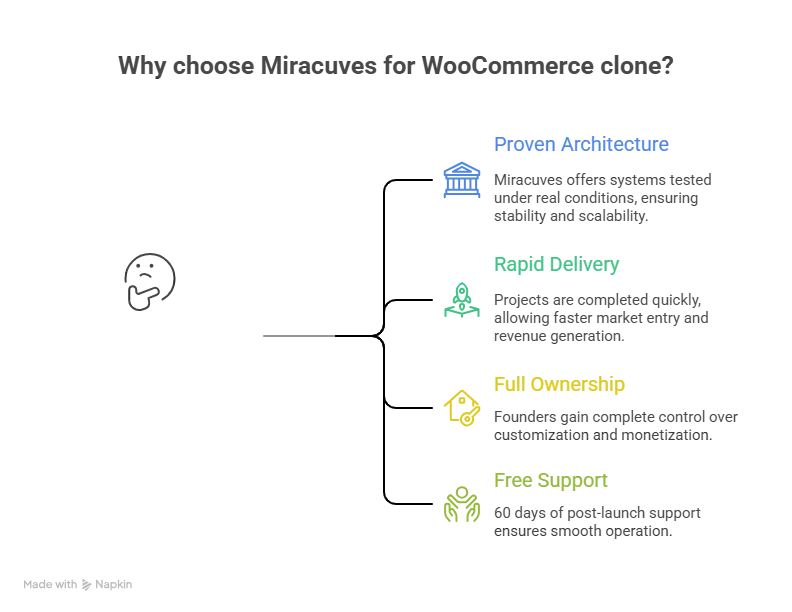
Every successful platform has a technology partner behind it that understands not just code, but business reality. In the WooCommerce ecosystem, countless founders fail not because of lack of demand, but because their platforms cannot scale, adapt, or monetize efficiently. Miracuves was built to solve exactly this problem by combining proven clone architecture with modern engineering and startup-focused execution.
With over 9k+ successful deployments, Miracuves has worked with founders across ecommerce, marketplaces, SaaS, and subscription platforms. This experience translates into systems that are production-ready from day one, not experimental builds that require constant fixes. Entrepreneurs benefit from frameworks that have already been tested under real traffic, real payments, and real operational pressure.
Speed is another decisive advantage. While traditional agencies take months just to finalize requirements, Miracuves follows a rapid delivery model. Most WooCommerce-style clone projects are delivered within a 30-90 day cycle, and even complex custom builds are completed within predictable timelines. This speed allows founders to validate ideas, onboard vendors, and start generating revenue far earlier than competitors.
What truly differentiates Miracuves is ownership and future-proofing. Every WooCommerce clone includes full source-code ownership, giving founders complete control over customization, scaling, and monetization. There are no recurring platform lock-ins, no forced upgrades, and no dependency on third-party vendors for core functionality.
Why Entrepreneurs Trust Miracuves
• 9k+ real-world deployments across industries
• Rapid delivery without compromising stability
• 60 days of free post-launch support
• Full non-encrypted source-code ownership
• Architecture designed for long-term scalability
Founders often share similar transformation stories. Agencies that struggled with plugin-heavy WooCommerce setups have moved to Miracuves-powered platforms to gain performance and flexibility. Startup teams that burned months on custom builds have relaunched faster with Miracuves and reached revenue milestones sooner. Marketplace founders have scaled vendor onboarding without rewriting their backend.
Final Thought
Building a WooCommerce-style platform in 2025 is no longer about copying an ecommerce plugin. It is about understanding the business logic that made WooCommerce successful and upgrading it for a market that demands speed, personalization, and ownership. Entrepreneurs who recognize this difference position themselves to launch faster, adapt quicker, and scale with far less friction.
When founders combine a proven commerce model with modern clone technology, they remove years of trial and error from their journey. Instead of struggling with limitations, they focus on customer acquisition, vendor growth, and revenue optimization. This strategic clarity is what separates short-lived online stores from scalable ecommerce businesses.
Miracuves empowers entrepreneurs to move with confidence. By delivering WooCommerce-style clone solutions that are flexible, future-ready, and fully owned, Miracuves enables founders to turn ideas into revenue-generating platforms without unnecessary delays or technical lock-ins. For startups aiming to dominate niche markets or expand globally, this approach creates a decisive competitive edge.
Ready to launch your WooCommerce clone? Get a free consultation and a detailed project roadmap from Miracuves — trusted by 1500+ entrepreneurs worldwide.
FAQs
How quickly can Miracuves deploy my WooCommerce clone?
Deployment timelines depend on customization scope. Standard setups can be delivered within days, while fully custom builds are completed within a 30–90 day window.
What’s included in the Miracuves clone package?
The package includes a complete ecommerce ecosystem with user, admin, and vendor panels, deployment support, backend setup, and app store publishing assistance.
Can I get full source-code access?
Yes. Miracuves provides full non-encrypted source-code ownership, ensuring complete control and long-term flexibility.
How does Miracuves ensure scalability?
The platform is built with modular services, scalable APIs, and cloud-ready infrastructure to handle traffic growth and feature expansion.
Does Miracuves assist with app store approval?
Yes. The team supports both Google Play Store and Apple App Store submission and approval processes.
Is post-launch maintenance included?
Miracuves offers 60 days of free post-launch support to ensure stability and smooth operation after launch.
Can Miracuves integrate custom payment gateways?
Yes. Custom and regional payment gateways can be integrated based on your business and target market.
What’s the upgrade and update policy?
The architecture supports smooth upgrades without breaking existing functionality, allowing features to be added as the business grows.
How does white-labeling work?
White-label deployment removes all third-party branding and delivers the platform as a fully proprietary solution under your brand.
What kind of ongoing support can I expect?
Beyond the free support period, Miracuves offers flexible maintenance and upgrade plans tailored to your growth needs.
Related Articles
- Best Faire Clone Scripts 2025: Build a B2B Wholesale Marketplace That Scales
- Best Shopify Clone Scripts 2025: Build a Scalable eCommerce Platform Faster
- Best Made-in-China Clone Scripts 2025: Build a Global B2B Wholesale Marketplace
- Best Temu Clone Scripts 2025: Launch a Next-Gen Social Commerce & Group-Buying Marketplace
- Best Wish Clone Scripts 2025: Build a High-Profit Social Commerce App
- Best DHgate Clone Scripts 2025: Build a Global B2B Wholesale Marketplace Faster
- Best BigCommerce Clone Scripts 2025: Build a Scalable SaaS Ecommerce Platform