


Key Takeaways
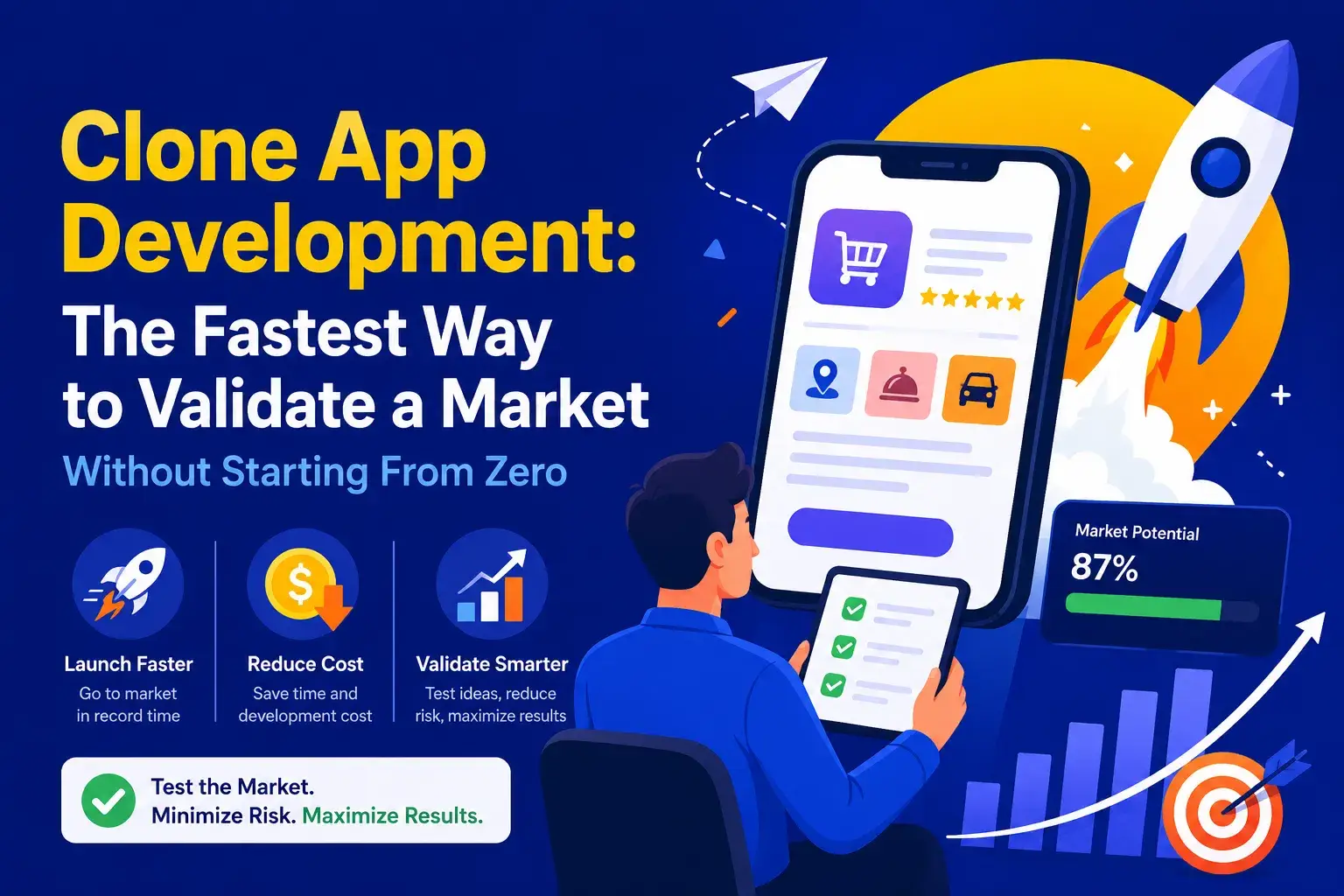
- Clone app development helps founders validate market demand faster by starting with a proven app model instead of building everything from zero.
- The goal is not to copy another app blindly; it is to use a tested workflow and customize it for a specific audience, region, brand, or business model.
- A validation-ready clone app should include user flows, admin controls, payment logic, analytics, notifications, and enough customization to test real demand.
- Founders can reduce risk by launching earlier, collecting user feedback, testing monetization, and improving the product based on actual market behavior.
- Long-term success depends on choosing the right clone model, adapting it to the target market, tracking the right signals, and scaling after validation.
Validation Signals
- Market validation becomes stronger when users register, complete actions, make payments, return to the app, and recommend it to others.
- Acquisition signals show whether the offer attracts users through ads, SEO, referrals, partnerships, communities, or local demand.
- Engagement signals reveal whether users understand the app, complete core actions, browse listings, book services, watch content, or interact with providers.
- Monetization signals show whether users are willing to pay, subscribe, order, book, upgrade, tip, or transact through the platform.
- Retention signals help founders understand whether the product has repeat value or only attracts one-time curiosity.
Real Insights
- A clone app becomes useful for validation only when it is connected to a clear business hypothesis, target audience, and launch plan.
- Founders should avoid over-customizing before launch because too many early changes can delay learning and increase unnecessary cost.
- The best clone app strategy is to launch with proven core flows first, then improve based on customer behavior, operational feedback, and revenue data.
- Admin dashboards, analytics, and reporting matter because founders need visibility into what users do after the product goes live.
- The strongest validation approach combines fast deployment, real user testing, measurable signals, founder control, and continuous product improvement.
Launching a new app business is exciting, but building every feature from zero can slow down the most important part of the journey: learning whether the market actually wants your product.
That is why clone app development has become a practical route for founders who want speed without losing control. A clone app is not about copying another platform blindly. It is about starting with a proven app model, adapting it to a specific audience, adding the right business logic, and launching faster with a validation-ready product foundation.
For many founders, the real question is not, “Can we build this app?” The better question is, “Can we test this market before spending months on assumptions?”
A ready-made and white-label approach from Miracuves helps founders move faster by using existing product logic, branded design, admin control, monetization workflows, and source-code ownership where relevant.
What Is Clone App Development?
Clone app development is the process of building an app based on the proven structure, workflows, and business model of an existing successful platform.
For example, a founder may want to launch:
- A ride-hailing platform inspired by Uber
- A food delivery platform inspired by Swiggy or Uber Eats
- A short video app inspired by TikTok
- A rental marketplace inspired by Airbnb
- A fintech wallet inspired by Revolut or Wise
- A service marketplace inspired by Fiverr or Upwork
The goal is not to duplicate another company’s code, brand, or protected assets. The goal is to use a familiar product pattern and customize it for a different audience, region, niche, or business model.
A good clone app includes your own:
- Brand identity
- UI and UX adjustments
- Feature priorities
- User roles
- Admin controls
- Monetization model
- Payment logic
- Business rules
- Growth strategy
- Security and scalability layer
This is why clone app development is often better understood as proven-model app development. The foundation is familiar, but the execution should be unique to your market.
Why Clone App Development Helps Founders Validate Demand Faster
Market validation is not only about asking users what they want. It is about putting a usable product in front of the market and seeing what people actually do.
When founders build from zero, they often spend months defining features, designing flows, hiring developers, testing architecture, and fixing basic workflows before real users can interact with the product.
Clone app development changes that sequence.
Instead of starting with a blank page, founders start with a working product pattern. This makes it easier to test:
- Whether users understand the app quickly
- Whether the core transaction flow works
- Whether vendors, drivers, creators, sellers, or service providers are willing to join
- Whether customers will pay, book, order, subscribe, or engage
- Which features matter most before heavy customization
- Which monetization model fits the market
The speed advantage matters because early-stage founders do not need endless theory. They need learning cycles.
A clone app gives them a faster path to answer business questions such as:
- Is there demand in this location?
- Will users pay for this service?
- Can we acquire supply-side partners?
- Does the commission model work?
- Which category should we focus on first?
- What operational problems appear after launch?
This is the difference between building for assumptions and building for evidence.
Clone App Development vs Building an App From Zero
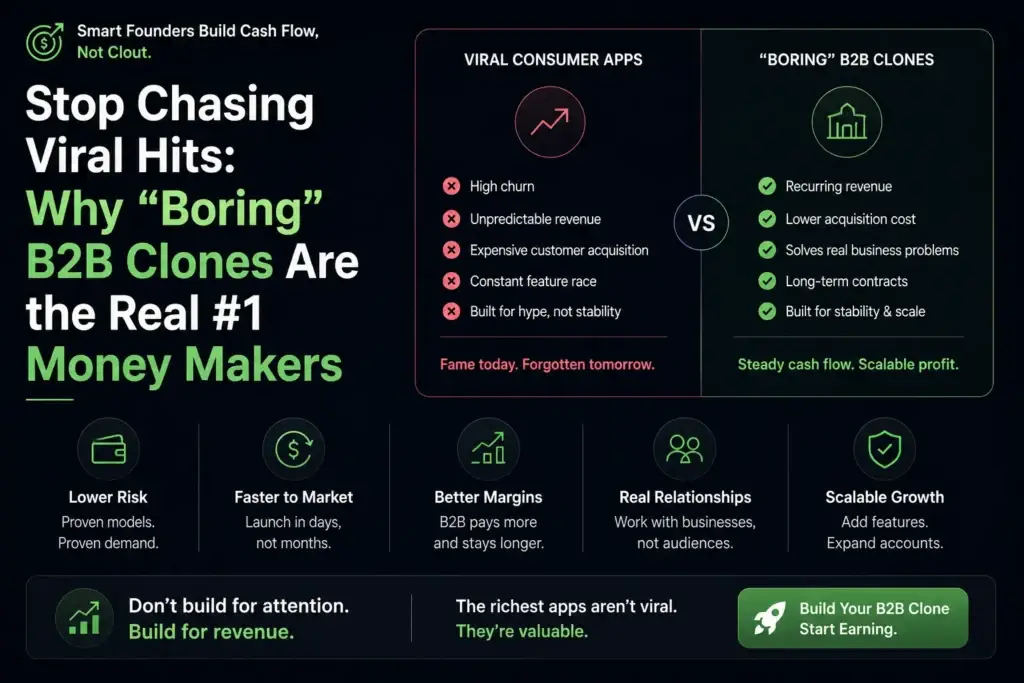
Building from zero can make sense when the product idea is completely new, technically unusual, or requires deep proprietary innovation. But many app businesses are not trying to invent a new category. They are trying to execute a proven model better for a specific audience.
That is where clone app development becomes useful.
| Factor | Clone App Development | Building From Zero |
|---|---|---|
| Launch speed | Faster because core workflows already exist | Slower because every module must be planned and built |
| Market validation | Easier to test demand earlier | Delayed until the product is usable |
| Cost efficiency | More cost-efficient for first market entry | Often requires a higher upfront investment |
| Feature clarity | Starts with proven feature patterns | Requires more discovery and experimentation |
| Customization | Can be customized around branding, workflows, and monetization | Fully custom from the beginning |
| Risk level | Lower early-stage execution risk | Higher risk if assumptions are wrong |
| Control | Strong if source code and admin access are provided | Strong, but usually takes longer to achieve |
| Best for | Founders validating proven app models | Businesses building highly unique platforms |
The stronger decision is not always the most custom build. The stronger decision is the build path that matches the founder’s stage, budget, market urgency, and validation goals.
How Clone App Development Reduces Founder Risk
Every app idea carries risk. The market may not respond. Users may ignore the product. Vendors may not onboard. The revenue model may need adjustment. The technology may become expensive to maintain.
Clone app development does not remove all risk, but it can reduce avoidable early-stage risk.
1. It reduces feature uncertainty
When an app model is already proven, founders do not need to guess every basic workflow. A ride-hailing app needs rider, driver, booking, map, fare, payment, rating, and admin workflows. A food delivery app needs customer, restaurant, delivery partner, menu, cart, order tracking, payment, and commission logic.
The founder can focus on what needs to be different for their market instead of debating every standard module from scratch.
2. It improves launch speed
Speed matters because markets do not wait. A founder who launches earlier can collect feedback, test pricing, onboard partners, and understand user behavior while another team is still finalizing wireframes.
This does not mean rushing blindly. It means avoiding unnecessary delay in the parts of the product that are already well understood.
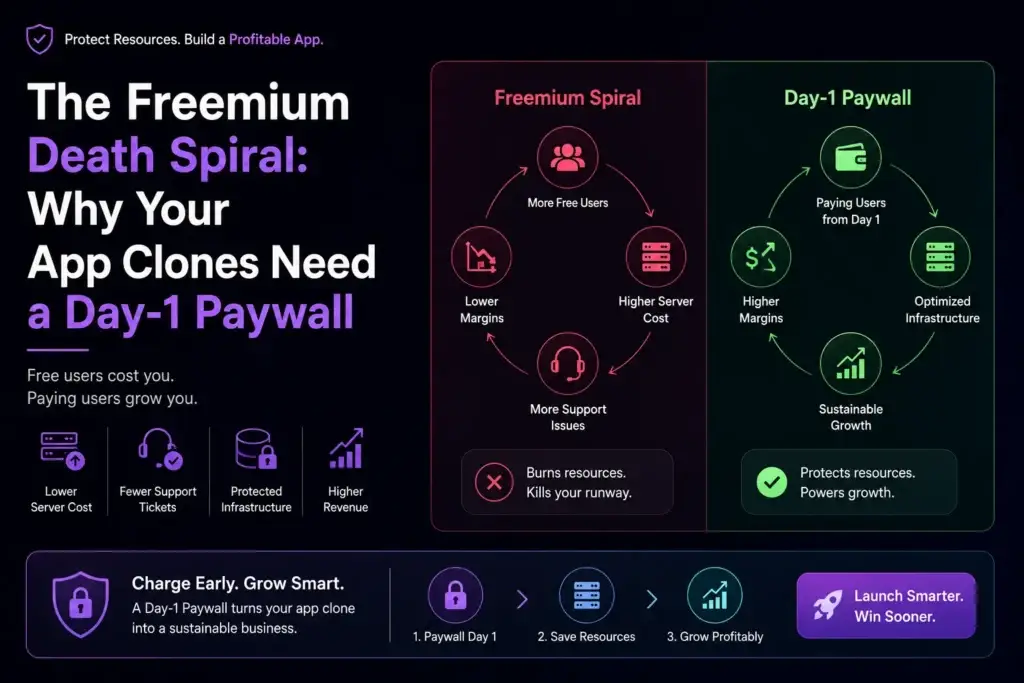
3. It protects capital for growth
Many founders spend too much of their early budget on foundational development. Then, by the time the app launches, they have limited capital left for marketing, onboarding, sales, customer support, or operations.
A ready-made clone app foundation can help founders reserve more resources for the activities that actually validate the business.
4. It supports faster iteration
The first launch is rarely the final version. Founders usually need to adjust commissions, onboarding flows, categories, pricing, user experience, notifications, or reporting after real users interact with the app.
This is why admin control and source-code ownership matter. A clone app should not trap the founder inside a rigid product. It should provide a foundation for learning and improving.
Core Features Every Validation-Ready Clone App Should Include
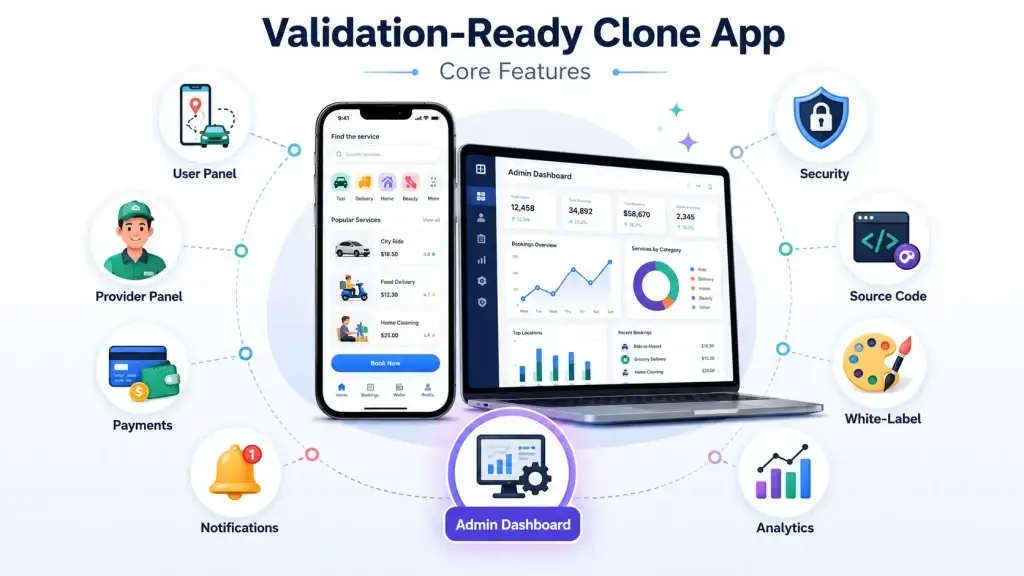
A clone app built for market validation needs more than screens. It needs operational logic. Founders should evaluate whether the app has the control layer required to run a real business.
| Feature | Business Value | Founder Impact |
|---|---|---|
| User app or user panel | Allows customers to browse, book, order, pay, chat, or engage | Helps test customer-side demand |
| Provider, vendor, driver, or creator panel | Supports the supply side of the platform | Helps validate partner onboarding |
| Admin dashboard | Controls users, listings, payments, commissions, disputes, content, and reports | Gives the founder operational control |
| Payment gateway integration | Enables transactions, subscriptions, deposits, or commissions | Supports revenue testing |
| Notification system | Sends order, booking, payment, reminder, and status alerts | Improves engagement and operational clarity |
| Rating and review system | Builds trust between users and providers | Helps maintain quality control |
| Analytics and reporting | Shows activity, transactions, user growth, and category performance | Helps founders make decisions based on data |
| White-label branding | Allows the app to launch under the founder’s brand | Builds market identity |
| Source-code ownership option | Gives long-term flexibility and technical control | Reduces dependency risk |
| Security basics | Protects user data, transactions, and platform access | Builds trust and reduces operational exposure |
The admin dashboard is especially important. Without it, the founder may need developer support for basic changes such as managing users, changing commissions, approving vendors, handling disputes, or reviewing platform activity.
A clone app without admin control is not a real business tool. It is only a front-end product.
Read More : The True Cost of Waiting : Why Fast App Development Beats Long Timelines
Popular Clone App Categories Founders Can Validate Faster
Clone app development is useful across many categories because many digital businesses follow repeatable transaction patterns.
On-Demand Delivery Apps
Food delivery, grocery delivery, pharmacy delivery, courier delivery, and quick commerce apps can be launched faster with prebuilt customer, merchant, delivery partner, order tracking, payment, and admin workflows.
These models are useful when a founder wants to test local demand, category density, delivery operations, and merchant onboarding.
Ride-Hailing and Mobility Apps
Uber-style, inDrive-style, taxi booking, bike taxi, carpooling, and driver marketplace apps need real-time booking, location tracking, fare logic, driver availability, payment, reviews, and trip history.
Clone app development helps founders test whether mobility demand exists in a city, region, or niche transportation segment.
Marketplace Apps
Marketplace apps such as service marketplaces, rental platforms, ecommerce marketplaces, freelancer platforms, and local listing apps depend on supply-demand matching.
Founders can validate whether users are willing to list, search, book, buy, rent, or hire through the platform.
Creator and Entertainment Apps
Short video apps, streaming platforms, subscription content apps, and creator communities need feeds, profiles, uploads, moderation, monetization, notifications, and engagement loops.
A founder can validate creator adoption, user retention, content supply, and monetization before investing in heavy custom infrastructure.
For example, founders exploring short video products can review Miracuves’ TikTok clone app solution for a more category-specific launch path:
Fintech and Wallet Apps
Fintech clone apps require more careful planning because wallet logic, user verification, transactions, risk controls, and compliance considerations are important. A founder can use a proven model to validate user demand, but must treat security and regulatory expectations seriously.
Miracuves also supports fintech-focused clone app categories such as:
Multi-Service Apps
A multi-service app combines several services such as ride booking, food delivery, grocery delivery, courier, home services, and more under one platform.
This can be powerful, but founders should avoid launching too many categories at once unless they have the operational capacity to manage them. A smarter approach is often to start with the strongest service category and expand after traction.
Founder Decision Signals: When Clone App Development Makes Sense
Clone app development is not right for every business. It works best when the founder has a clear market opportunity and wants to validate execution faster.
Founder Decision Signals
Speed
Clone app development makes sense when you need to launch faster because the market opportunity is time-sensitive or competitors are already moving.
Cost
It is useful when you want to avoid spending most of your early budget on foundational development before testing real demand.
Scalability
A clone app is a strong choice when the base model is proven but you still need the flexibility to customize, improve, and scale after launch.
Market Fit
It works well when your biggest question is not whether the app can be built, but whether your target users, vendors, or partners will adopt it.
Clone App Development Is Not the Same as Copying
One of the biggest misconceptions about clone app development is that it means copying another platform exactly.
That is the wrong way to think about it.
A strong clone app should use a proven model but still be different in the areas that matter:
- Different branding
- Different target market
- Different pricing strategy
- Different feature priorities
- Different onboarding flow
- Different vendor or partner model
- Different localization
- Different monetization logic
- Different admin rules
- Different user experience improvements
For example, a founder building a food delivery app may not need to compete with large platforms directly. They may focus on a specific city, cuisine, local merchant network, corporate meal segment, campus delivery model, or premium restaurant category.
The app model is proven. The market angle is unique.
That is where clone app development becomes strategic.
White-Label Clone App vs Custom Clone App Development
Founders often confuse white-label apps and custom development. The better question is not which one is universally better. The better question is which one matches the stage of the business.
| Approach | What It Means | Best For |
|---|---|---|
| White-label clone app | A ready-made app foundation rebranded for your business | Faster launch, market validation, early traction |
| Custom clone app development | A product inspired by a proven model but built with deeper custom workflows | Unique business logic, complex operations, funded growth |
| Hybrid approach | Start with a ready-made foundation and customize key modules | Founders who need speed plus flexibility |
A hybrid path is often the most practical. It allows the founder to avoid unnecessary foundational delay while still customizing the app for the business model.
Miracuves’ white-label app approach is built around this idea: launch faster, customize where it matters, and keep enough control to iterate after market feedback.
How to Validate a Market Using Clone App Development
Clone app development should not be treated as a one-time software purchase. It should be used as a market validation system.
Here is a practical validation path.
Step 1: Choose a proven model with clear demand signals
Start with a model where user behavior is already familiar. Examples include ordering food, booking rides, hiring freelancers, renting properties, subscribing to creators, or sending money.
The model should solve a real problem, not just look attractive.
Step 2: Narrow the market
Do not launch for everyone. Choose a specific audience, city, industry, category, or service segment.
A focused launch helps you learn faster because the user group is easier to reach and understand.
Step 3: Customize the app for your niche
Change the workflows that matter. This may include onboarding, commission logic, pricing rules, category structure, language, payment methods, vendor approval, or content moderation.
Step 4: Launch with measurable goals
Before launch, define what validation means. It may be:
- Number of user sign-ups
- Number of completed orders
- Vendor onboarding rate
- Repeat usage
- Booking conversion rate
- Subscription activation
- Average transaction value
- Customer acquisition cost
- Supply-side response rate
Step 5: Improve based on behavior, not assumptions
After launch, use real data to decide what to improve. The first version should teach you what users care about most.
This is where admin dashboards, analytics, and source-code flexibility become important.
Mistakes Founders Should Avoid With Clone Apps
Mistakes Founders Should Avoid
Choosing a clone app only because it looks popular
A popular app model does not automatically mean your market needs it. Founders should check local demand, user pain points, competition, and supply-side readiness before choosing a clone category.
Ignoring the admin dashboard
The admin dashboard controls the business. Without strong admin workflows, founders may struggle to manage users, vendors, payments, disputes, commissions, and reporting after launch.
Launching without a monetization plan
Clone apps should be built with revenue logic from the beginning. Commissions, subscriptions, listing fees, ads, delivery fees, and premium features must align with the market.
Over-customizing before validation
Too much customization before launch can slow down validation. Founders should customize what affects adoption, trust, payments, operations, and differentiation first.
What to Look for in a Clone App Development Company
Choosing the right clone app development company is as important as choosing the right app idea.
A founder should evaluate:
- Does the company offer white-label branding?
- Is source code available?
- Is the admin dashboard included?
- Can the app be customized for the target market?
- Are user, provider, vendor, driver, or creator panels included where needed?
- Does the company understand monetization workflows?
- Can the app support payment integrations?
- Are security basics considered?
- Is there post-launch support?
- Can the architecture scale if demand grows?
- Does the team understand the business model, not just the app screens?
A clone app should not lock the founder into a rigid product. It should create a faster path to launch while keeping room for improvement.
How Miracuves Helps Founders Launch Clone Apps Faster
Miracuves helps founders build ready-made and white-label app solutions for faster validation, branded market entry, admin control, and source-code ownership where relevant.
Instead of starting from a blank development plan, founders can begin with a launch-ready foundation and customize the app around their audience, industry, and revenue model.
This approach is useful for founders who want to validate app ideas in categories such as:
- Ride-hailing
- Food delivery
- Grocery delivery
- Pharmacy delivery
- Multi-service apps
- Marketplace apps
- Rental platforms
- Creator platforms
- Fintech and wallet apps
- Ecommerce platforms
- Booking apps
- Service marketplaces
Explore Miracuves’ broader solution ecosystem here.
Final Thoughts: Build Faster, Validate Smarter, and Avoid Starting From Zero
The real value of clone app development is not imitation. It is speed with structure.
Founders do not always need to spend months building basic workflows that already exist in proven app models. Many need a faster way to test demand, onboard users, validate transactions, adjust the business model, and learn what the market actually wants.
Clone app development gives founders that path.
The strongest clone app is not the one that copies the most. It is the one that adapts a proven model into a focused, branded, monetization-ready, and scalable product foundation.
For founders planning to launch faster, Miracuves offers ready-made and white-label app solutions that help turn proven app models into validation-ready businesses with better speed, control, and flexibility.
FAQs
What is clone app development?
Clone app development is the process of building an app based on the proven workflows and business model of an existing successful app. The goal is not to copy another company’s brand or code, but to create a customized version for a specific market, audience, or business opportunity.
Is clone app development legal?
Clone app development can be legal when it does not copy protected code, branding, trademarks, copyrighted assets, or proprietary technology. A safe clone app should use original branding, custom design elements, and independent development while taking inspiration from a proven business model.
Why do startups choose clone app development?
Startups choose clone app development because it helps them launch faster, reduce early-stage development uncertainty, and validate demand before investing heavily in a fully custom product. It is especially useful when the app model is already familiar to users.
Is clone app development better than custom app development?
It depends on the business stage. Clone app development is often better for faster validation and early launch. Custom app development is better when the product requires unique workflows, complex technology, or proprietary innovation from the beginning.
How does clone app development help with market validation?
Clone app development helps founders test real demand faster by launching a working product based on a proven model. Founders can measure user sign-ups, orders, bookings, vendor onboarding, payments, retention, and monetization before making larger development decisions.
What features should a clone app include?
A strong clone app should include user panels, provider or vendor panels where relevant, an admin dashboard, payment integration, notifications, ratings, reporting, white-label branding, and security basics. The exact features depend on the app category.
Can a clone app be customized?
Yes. A clone app should be customized for branding, target users, workflows, payment logic, categories, monetization, language, design, and operational rules. Customization is what turns a basic clone model into a market-ready business product.
Why is source-code ownership important in clone app development?
Source-code ownership gives founders more control over future customization, scaling, maintenance, and vendor flexibility. Without it, the founder may depend heavily on the original provider for changes, upgrades, or long-term product decisions.