


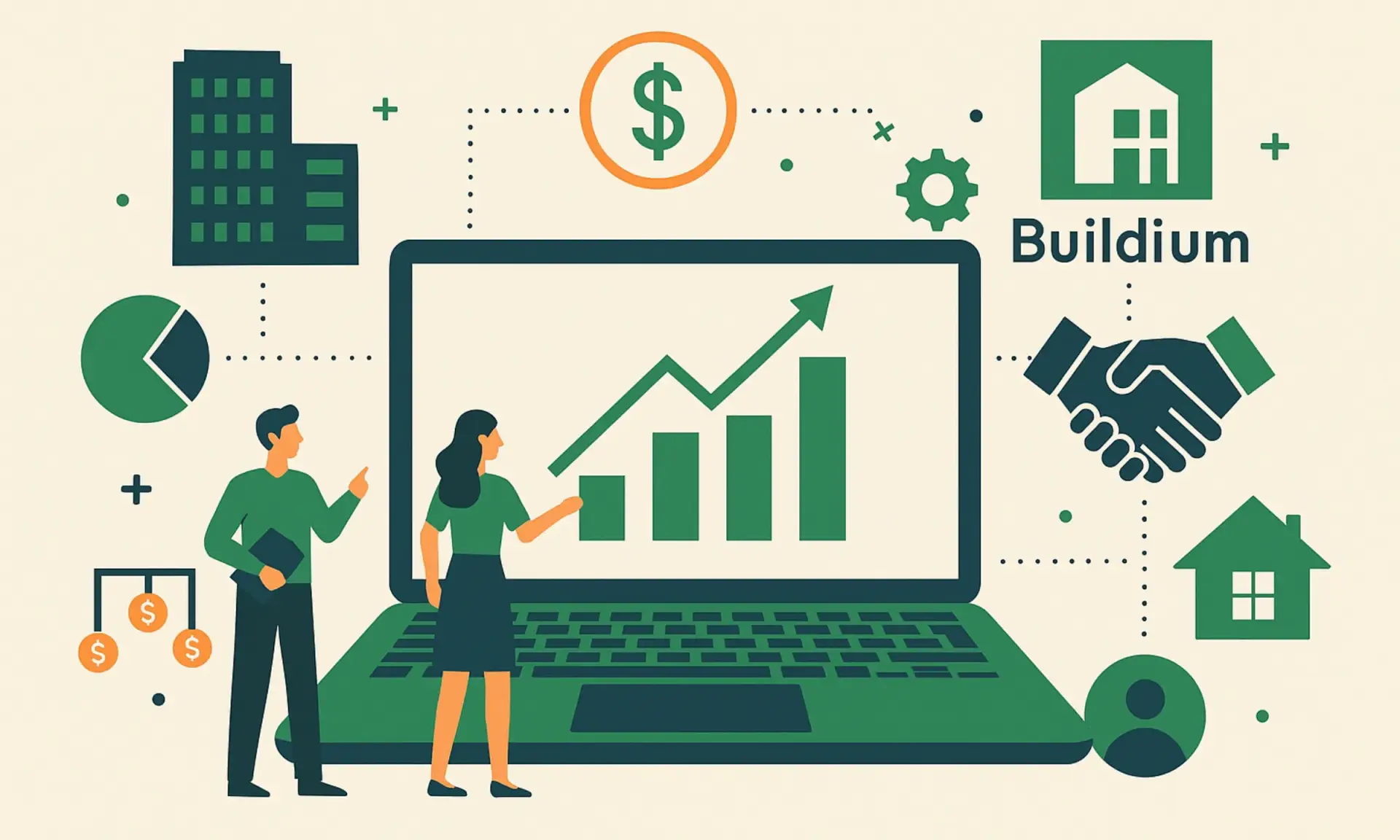
Discover how the Business Model of Buildium streamlines property management through SaaS innovation, automation, and data-driven growth in 2025.
From a Boston-based startup founded in 2004 to being acquired for $580 million by RealPage, Buildium has become one of the world’s leading property management software platforms — empowering over 17,000 real estate businesses to manage rentals worth billions.
Its success lies in a clear principle: make property management effortless through automation, transparency, and tenant satisfaction. In an industry once dominated by manual spreadsheets, Buildium digitized every process — from rent collection to maintenance requests — creating a new standard for the PropTech SaaS ecosystem.
How the Buildium Business Model Works
Buildium operates on a SaaS (Software-as-a-Service) model, offering property managers a cloud-based platform to manage rental listings, tenants, finances, and maintenance operations. Its success stems from addressing the complex needs of property owners, tenants, vendors, and accountants under one unified digital ecosystem.
Business Model Overview
At its core, Buildium delivers end-to-end workflow automation for property managers — simplifying repetitive manual tasks into structured, trackable digital processes.
It charges users on a recurring subscription basis, determined by the number of units managed and feature tiers.
Type of Model
- Primary Model: Subscription-based SaaS
- Secondary Components: Freemium trial → Upsell funnel to Pro & Premium tiers
- Hybrid Elements: Payment processing fees and partner integrations generate transaction-based revenue.
Value Proposition
For Propety Managers:
- Centralized dashboards for leases, tenants, and payments
- Automated rent reminders and maintenance tracking
- Integrated accounting tools for compliance-ready financials
For Tenants:
- Digital rent payments and maintenance requests
- Secure access to lease documents
- Communication and announcement tools
For Property Owners:
- Real-time financial performance reporting
- Transparency into property ROI
- Simplified communication with manager
Key Stakeholders
| Stakeholder | Role in Ecosystem |
| Property Managers | Core platform users handling daily operations |
| Tenants | End-users driving recurring transaction flows |
| Vendors & Service Providers | Linked through maintenance and payment modules |
| Accounting & Compliance Partners | Enable API and tax integration for seamless reporting |
| RealPage (Parent Company) | Provides capital, data analytics, and cross-product integrations |
Evolution of the Model
- 2004–2010: Core SaaS for small U.S. property managers
- 2011–2017: Expansion into multi-unit and HOA management
- 2019: Acquisition by RealPage → ecosystem integration
- 2023–2025: AI-driven maintenance prediction, tenant analytics, and automation API
Why It Works in 2025
- Shift toward remote property management and digital rent payments
- Inflation-driven cost pressures making automation essential
- Regulatory compliance complexity increasing demand for reliable SaaS
- Integration with IoT devices and predictive analytics improves tenant experience and retention
Target Market & Customer Segmentation Strategy
Buildium’s growth was driven by precise market segmentation and a deep understanding of the fragmented real estate management industry. Rather than targeting all property players, Buildium focused on mid-sized property management firms and independent managers underserved by legacy enterprise systems like Yardi or MRI.
Primary Customer Segments
- Independent Property Managers (50–5,000 units)
- Need affordable automation tools.
- Value simplicity over complex enterprise ERP systems.
- High retention due to operational dependency.
- HOA (Homeowners Association) & Condo Managers
- Require transparent accounting, fee tracking, and communication tools.
- Benefit from Buildium’s community engagement modules.
- Small Landlords & Real Estate Owners
- Seek DIY management with accounting integration.
- Enter through free trials → upgrade as portfolios expand.
Secondary Segments
- Real Estate Agencies: Use Buildium as a back-office system for managing listings and clients.
- Vendors & Service Providers: Plug into Buildium’s marketplace for maintenance, cleaning, or repairs.
Customer Journey Mapping
| Stage | Customer Behavior | Buildium’s Engagement Strategy |
| Discovery | Searches for “property management software” or “rent collection automation” | SEO-driven inbound content & referral marketing |
| Evaluation | Free trial (15 days) & feature comparison | Automated demo onboarding with live support |
| Conversion | Subscription tier selection | Transparent pricing calculator + guided setup |
| Retention | Daily operational use & integrations | Email support, webinars, and annual user conferences |
| Expansion | Add more units or modules | Dynamic pricing auto-adjusted by portfolio size |
Customer Acquisition Channels
- Content marketing & SEO (educational guides, webinars)
- Partner integrations with payment processors & real estate SaaS tools
- Word-of-mouth among regional property associations
- Targeted PPC campaigns on “property management automation” keywords
Market Positioning & Competitive Edge
Buildium positions itself as “the all-in-one, mid-market property management platform.”
Its brand voice focuses on reliability, ease of use, and compliance readiness — differentiating it from enterprise-heavy tools or small DIY apps.
Competitive Advantages
- Simple UX tailored for non-technical managers
- Transparent, scalable pricing model
- Native accounting + tenant experience features
- RealPage’s ecosystem integration providing enterprise-grade stability
Read more : Best Buildium Clone Scripts in 2025: Features & Pricing Compared
Revenue Streams and Monetization Design
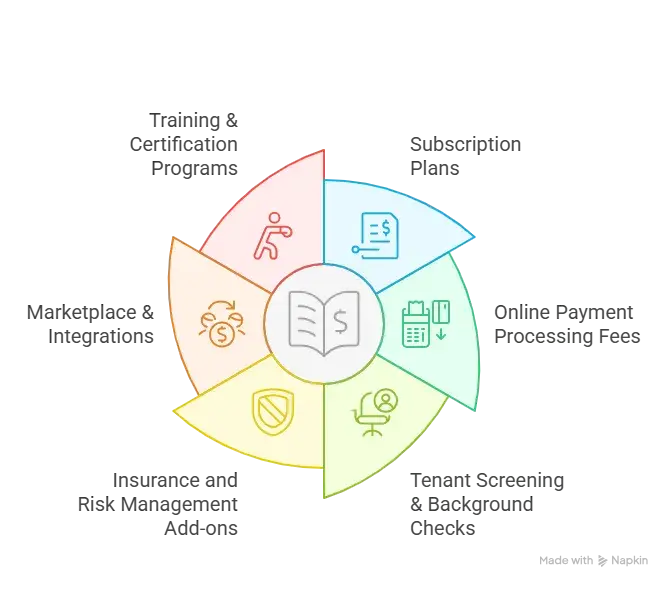
Buildium’s monetization model exemplifies the SaaS revenue flywheel — combining predictable recurring subscriptions with scalable add-on income sources. It’s designed for both stability and incremental growth, ensuring consistent ARR (Annual Recurring Revenue) while capturing value from every key user interaction.
Primary Revenue Stream : Subscription Plans
Buildium follows a tiered subscription model based on:
- Number of managed units (starting from 20+)
- Feature access (Core, Growth, Premium)
- Billing frequency (monthly or annual)
Secondary Revenue Streams
- Online Payment Processing Fees
- Small per-transaction fee (approx. 2.75%) on rent and HOA payments
- Shared revenue with integrated payment gateways
- Scales with tenant base — a natural growth lever
- Tenant Screening & Background Checks
- Pay-per-use service ($15–$30 per report)
- Generates steady transactional income
- Enhances trust and platform engagement
- Insurance and Risk Management Add-ons
- Partnered offerings for renters’ and liability insurance
- Commission-based revenue via RealPage partnerships
- Marketplace & Integrations
- Open API access to third-party tools (e.g., QuickBooks, HappyCo)
- Revenue sharing from premium integrations
- Training & Certification Programs
- “Buildium Academy” and webinars for property managers
- Premium courses and consulting generate small but strategic income
Monetization Strategy
Buildium’s model thrives on multi-layered monetization — where each core function generates both direct and indirect revenue streams.
- Core Subscription: Predictable ARR backbone
- Transactional Upsells: Payments, screenings, insurance
- Partnership Integrations: Expands ecosystem revenue
- Customer Lifetime Growth: Unit-based auto-scaling ensures revenue grows as clients scale portfolios
Psychology Behind Pricing
- Transparent calculator builds trust-driven conversions
- Volume-based tiers reduce churn and incentivize scaling
- Embedded upsells (e.g., payment modules) create seamless revenue expansion
Operational Model & Key Activities
Behind Buildium’s seamless property management experience lies a tightly orchestrated operational engine. Its model emphasizes automation, scalability, and customer enablement — enabling thousands of property managers to handle millions of tenant interactions daily without service friction.
Core Operations
- Platform Development & Maintenance
- Continuous SaaS updates, bug fixes, and new module releases
- Built on a cloud-native microservices architecture for reliability and uptime
- Integration of AI-driven analytics to predict maintenance needs and rent delinquency patterns
- Customer Support & Onboarding
- 24/7 live chat and email support teams
- In-app tutorials, webinars, and Buildium Academy resources
- Dedicated onboarding managers for large portfolios
- Data Security & Compliance Management
- SOC 2 Type II, GDPR, and CCPA compliance
- Regular penetration testing and encrypted data storage
- PCI DSS-certified payment infrastructure
- Marketing & Sales Enablement
- Automated funnel for free trials → conversions
- Product-led growth through usage-based feature discovery
- SaaS metrics tracking: CAC, LTV, MRR, churn, and activation rates
- Product R&D & Innovation
- Focus on predictive AI, IoT integrations, and tenant behavior analytics
- Collaboration with RealPage’s data science teams for shared insights
- Experiments with mobile-first UX for field managers
Resource Allocation (2025 Estimates)
| Category | Approx. Budget Allocation | Key Priorities |
| Technology & R&D | 40% | AI modules, integrations, data infrastructure |
| Marketing & Customer Success | 25% | Funnel automation, retention campaigns |
| Operations & HR | 20% | Support teams, SaaS uptime management |
| Partnership & Ecosystem Development | 10% | Payment, insurance, and API alliances |
| Compliance & Security | 5% | Certifications, audits, and risk control |
Regional Expansion Strategy
- North America (Core Market): Focus on retention and product depth
- UK, Canada, Australia (Emerging): Localization of payment, tax, and legal frameworks
- Asia-Pacific (Pilot phase): Partner-led SaaS distribution via property networks
Operational Philosophy
Buildium’s core philosophy is: “Automate what’s repetitive, enhance what’s human.”
Every operational decision — from onboarding design to customer retention — aims to make property management both efficient and emotionally intelligent.
Strategic Partnerships & Ecosystem Development
Buildium’s ecosystem strategy is one of its most powerful competitive assets.
Instead of attempting to build every service internally, Buildium mastered the art of platform orchestration — connecting a network of trusted partners that enhance functionality, compliance, and monetization.
Partnership Philosophy
Buildium’s partnerships are designed to extend platform capability while maintaining a seamless user experience.
By integrating specialized third-party services — payments, insurance, compliance, and communication tools — Buildium evolved from a “software provider” into a complete operational ecosystem for property managers.
Key Partnership Categories
- Technology & API Partners
- QuickBooks & Xero: Accounting synchronization
- HappyCo: Inspection and property condition reporting
- Mailchimp & HubSpot: Marketing automation integrations
- Zapier API: Custom workflows for enterprise clients
- Payment & Financial Partners
- Stripe & Dwolla: Digital rent collection and disbursement infrastructure
- BluePay: ACH and card processing with PCI compliance
- Revenue share on transaction processing ensures a scalable income stream.
- Insurance & Risk Management Alliances
- Partnered with Assurant and RealPage Insurance Services
- Offers embedded renters’ insurance, adding protection for tenants and owners alike
- Strengthens trust and adds a commission-based revenue layer
- Marketing & Distribution Partners
- Partnerships with real estate listing platforms (e.g., Zillow, Apartments.com)
- Expands listing reach and boosts lead generation for users
- Regulatory & Compliance Partners
- Collaborations with tax filing and accounting certification bodies
- Automated compliance with local landlord–tenant regulations
Ecosystem Value Creation
- For Users: One connected platform for all property management needs
- For Partners: Access to thousands of recurring B2B customers
- For Buildium: Increased stickiness, cross-sell potential, and defensibility
Strategic Outcome
This ecosystem-oriented approach has created strong network effects:
- The more partners Buildium adds, the more valuable the platform becomes for users.
- Every integration enhances retention and raises switching costs.
- As a result, Buildium transitioned from a SaaS tool into a PropTech hub for digital property operations.
Read more : How to Build an App Like Buildium — A Developer’s Guide
Growth Strategy & Scaling Mechanisms
Buildium’s expansion from a Boston startup to a global SaaS leader is a masterclass in strategic scaling — blending product-led growth, data-driven marketing, and ecosystem leverage. The company didn’t just grow through acquisition; it scaled through customer success and operational precision.
Core Growth Engines
- Product-Led Growth (PLG)
- Free trials, intuitive UX, and self-service onboarding convert users organically.
- In-app upsell triggers guide users to advanced modules (e.g., accounting, tenant screening).
- 30–35% of new accounts historically come via referral or peer recommendation.
- Organic & SEO Growth
- Content-driven authority with 1,000+ property management blogs, guides, and courses.
- Consistent top ranking for keywords like “property management software” and “rent collection tool.”
- Combined inbound and educational marketing reduces CAC by nearly 40%.
- Paid Marketing & Acquisition
- Targeted LinkedIn and Google PPC campaigns focused on “property automation” and “rental management tools.”
- Webinar funnels with 25% lead-to-demo conversion rate.
- Partnership co-marketing with RealPage products for bundled sales.
- Customer Expansion
- Unit-based pricing ensures automatic revenue scaling as clients grow portfolios.
- Customer success teams focus on feature adoption and portfolio expansion rather than upselling.
- Geographic Expansion
- Entered UK, Canada, and Australia with localized tax, banking, and compliance modules.
- Partner-led distribution networks reduce overhead in new territories.
Scaling Mechanisms
| Mechanism | Impact | Example |
| Modular Architecture | Enables seamless feature rollout | Launch of AI-based Maintenance Insights (2024) |
| Data-Driven Customer Retention | Predicts churn using usage metrics | Triggered retention offers & onboarding refreshers |
| RealPage Synergy | Shared tech infrastructure & cross-selling | Integration with RealPage Accounting APIs |
| Automation & AI | Reduces manual support costs | Chat-based support automation (2025 pilot) |
Scaling Challenges & Solutions
- Challenge: High integration complexity with partner APIs
Solution: Buildium launched a unified API gateway (2023) to simplify developer onboarding. - Challenge: International compliance adaptation
Solution: Established localized compliance modules and regional partner alliances. - Challenge: Maintaining brand differentiation post-acquisition
Solution: Continued independent branding under the “Buildium by RealPage” identity — preserving trust while leveraging scale.
Read more : Buildium Features List for Smarter Property Management
Competitive Strategy & Market Defense
In the increasingly crowded PropTech SaaS landscape, Buildium’s enduring success stems from a finely tuned mix of brand trust, feature depth, and defensibility. Its strategy focuses not just on innovation but on building switching barriers that make migration nearly impossible for competitors to exploit.
Core Competitive Advantages
- Network Effects within the Property Ecosystem
- Each new property manager brings tenants, vendors, and owners — expanding transactional volume and data insights.
- As participation grows, the ecosystem becomes smarter and more efficient, strengthening Buildium’s moat.
- Data-Driven Personalization
- Predictive algorithms analyze rent payment habits, maintenance frequency, and communication trends.
- Property managers receive actionable insights — improving efficiency and tenant satisfaction.
- Regulatory & Compliance Edge
- Continuous alignment with evolving laws (Fair Housing, GDPR, CCPA).
- Enterprise-grade audit trails attract larger management firms needing compliance-ready systems.
- Customer Trust & Longevity
- Over 70% of Buildium’s customers have stayed on the platform for more than three years.
- Strong brand equity built through education and consistent product reliability.
- Integration within RealPage Ecosystem
- Gives Buildium access to RealPage’s analytics, AI engines, and cross-product marketing channels.
- Enables shared data pools — creating insights smaller competitors can’t replicate.
Market Defense Tactics
| Challenge | Buildium’s Response |
| New Entrants (e.g., AppFolio, DoorLoop) | Compete via superior UX, transparent pricing, and integrated compliance tools. |
| Pricing Wars | Leverages RealPage infrastructure to reduce cost-per-user and maintain margins. |
| Feature Parity Threats | Aggressive innovation roadmap — quarterly updates and AI module rollouts. |
| Regional Disruption | Establishes localized versions with native tax and banking integrations. |
| Enterprise Encroachment | Retains agility with mid-market focus while expanding feature set upward. |
Innovation as Market Shield
Buildium’s AI-first roadmap (2024–2026) introduces:
- Predictive maintenance automation
- Voice-activated property insights for managers
- Smart chatbots for tenant communication
- Energy efficiency dashboards via IoT integration
These innovations not only expand product value but create defensible intellectual property within PropTech SaaS.
Strategic Acquisitions & Alliances
While Buildium itself was acquired by RealPage, it now participates in joint acquisitions — acquiring niche PropTech startups to integrate advanced modules (e.g., tenant screening or rent optimization tools).
This move creates an “ecosystem fortress” — blending RealPage’s scale with Buildium’s mid-market agility.Summary Insight:
Buildium’s true defense lies in ecosystem dependency. Once a property manager integrates Buildium across accounting, payments, and communication, the platform becomes the operational backbone — difficult to replace without major disruption.
Lessons for Entrepreneurs & Implementation
Buildium’s journey from a small SaaS startup to a globally trusted PropTech platform is a blueprint for vertical SaaS excellence — focusing on specialization, automation, and long-term customer retention. For founders and digital entrepreneurs, it’s a living case study on how to turn niche pain points into billion-dollar opportunities.
Key Success Factors Behind Buildium’s Growth
- Vertical Specialization
Buildium didn’t chase every SaaS market — it mastered one domain (property management) and built deep expertise before expanding. - Customer-Centric Product Design
Every feature originated from user pain points — not investor assumptions.
This built organic loyalty and minimized churn. - Scalable Pricing Architecture
Its tiered pricing grows automatically with the customer — a self-expanding revenue model that keeps LTV rising with zero friction. - Ecosystem Thinking
Instead of isolating its platform, Buildium integrated payments, insurance, marketing, and compliance tools — transforming into a full-stack ecosystem. - Data as a Growth Asset
With every rent payment, maintenance log, or tenant chat, Buildium collects structured data — creating a flywheel of predictive intelligence.
Replicable Principles for Startups
| Principle | Application for Entrepreneurs |
| Find a Niche Pain Point | Solve one major workflow inefficiency in a high-friction industry. |
| Design for Scale Early | Build modular infrastructure that supports feature expansion later. |
| Adopt Recurring Revenue | Prioritize predictability (subscriptions, usage tiers, renewals). |
| Integrate Partners, Don’t Compete | Leverage third-party APIs to extend platform value. |
| Focus on Retention Before Acquisition | Loyal customers are cheaper than constant new-user acquisition. |
Common Mistakes to Avoid
- Over-engineering early: Many startups build features before finding product–market fit.
- Ignoring compliance and security: Property and financial data demand top-grade security early on.
- Neglecting customer support: SaaS churn often begins where user frustration meets poor onboarding.
- Pricing too low: A sustainable SaaS model relies on pricing that funds both innovation and retention.
Adaptation Strategies for Local or Niche Markets
Entrepreneurs can replicate Buildium’s model across adjacent verticals:
- Healthcare facility management software
- Hotel or hostel operations platforms
- Community association (HOA) apps
- Commercial real estate leasing tools
Each sector mirrors property management’s need for automation, transparency, and compliance — the DNA of Buildium’s success.
Ready to implement Buildium’s proven SaaS model in your own niche?
Miracives builds scalable, white-label platforms modeled after industry leaders like Buildium — integrating automation, payments, and compliance from day one.
We’ve helped entrepreneurs launch profitable SaaS and marketplace solutions.
Get your free business model consultation today at Miracuves
Conclusion
Buildium’s story underscores a timeless business truth: the most powerful companies don’t just digitize industries — they simplify them.
By focusing on one niche and obsessively refining every workflow within it, Buildium redefined what efficiency and transparency mean in property management.
From 2004’s startup grind to its $580M acquisition and global SaaS footprint in 2025, Buildium exemplifies how execution, not just innovation, drives long-term success. Its model bridges three worlds — technology, human relationships, and data intelligence — creating a digital ecosystem that’s both profitable and profoundly useful.
For entrepreneurs, the takeaway is clear:
“Success isn’t about building a big product — it’s about building the right product for a specific pain point, then scaling it sustainably.”
As the platform economy of 2025 matures, Buildium’s approach will inspire the next generation of vertical SaaS startups — where automation, integration, and trust converge to power the future of digital operations.
FAQs
1. What type of business model does Buildium use?
Buildium operates on a SaaS (Software-as-a-Service) business model. It offers cloud-based tools for property management professionals through tiered subscription plans, supplemented by transactional revenue from online payments, tenant screening, and insurance services.
2. How does Buildium’s business model create value?
Buildium creates value by automating property operations — from rent collection to maintenance — reducing manual effort, ensuring compliance, and improving tenant–manager communication. This efficiency translates directly into cost savings and higher ROI for property managers.
3. What are Buildium’s key success factors?
Buildium’s success comes from its vertical focus on property management, scalable SaaS pricing, and strong partner integrations. Its predictive analytics, automation, and customer support drive long-term retention.
4. How scalable is Buildium’s business model?
The Business Model of Buildium is highly scalable due to its modular cloud infrastructure. As users add more units, revenue grows automatically, supporting consistent 20%+ annual ARR growth.
5. What are the biggest challenges Buildium faces?
Buildium struggles with complex regional compliance, growing PropTech competition, and integration management — while maintaining its identity post-acquisition by RealPage.
6. How can entrepreneurs adapt Buildium’s model to their region?
Entrepreneurs can localize the Buildium model by blending SaaS subscriptions with region-specific payment and compliance systems while customizing UX and pricing to local markets.
7. What are alternatives to Buildium’s business model?
Alternatives include freemium SaaS with ads, marketplaces connecting landlords and vendors, or enterprise licensing — each balancing scalability and monetization differently.
8. How has Buildium’s model evolved over time?
Buildium evolved from a simple SaaS tool (2004) to a global PropTech ecosystem under RealPage, now enhanced by AI automation, predictive analytics, and advanced integrations.
9. What can startups learn from Buildium’s success?
Start small, focus on one niche, and scale through automation and partnerships. The formula: focus + SaaS + scalability = sustainable success.
Related Articles :