

Key Takeaways
- Vacation rental platform development should begin with marketplace architecture and workflows rather than focusing only on screens, design, or individual features.
- A complete rental marketplace must connect guests, hosts, property listings, availability calendars, bookings, payments, payouts, reviews, communication, and admin operations.
- The booking engine is a critical backend layer because it controls availability, pricing, confirmation, payment states, cancellations, refunds, and host payouts.
- Host and admin workflows are as important as the guest experience because hosts control marketplace supply while admins manage day-to-day operations.
- Founders can choose custom, ready-made, or hybrid development based on workflow uniqueness, launch requirements, customization needs, and long-term platform control.
Architecture Signals
- The core architecture should connect frontend applications, backend APIs, databases, search, booking logic, calendars, payments, notifications, storage, analytics, and security.
- Availability calendars should manage open dates, blocked dates, booking windows, host rules, external synchronization, and reservation conflicts.
- Payment architecture should keep guest charges, platform commissions, service fees, refunds, cancellations, host payouts, and transaction records synchronized.
- Location discovery should combine search, maps, nearby properties, filters, dates, guest capacity, ratings, property types, and availability.
- Security and trust workflows should include verification, listing approval, secure payments, role-based access, activity logs, review moderation, reporting, and dispute management.
Real Insights
- A polished rental app can still fail operationally if guest, host, booking, payment, payout, and admin workflows are not connected correctly.
- Database planning matters because properties, bookings, payments, payouts, reviews, messages, commissions, and activity logs depend on clear relationships.
- Admin control reduces developer dependency by allowing operators to manage listings, users, commissions, payments, refunds, disputes, reports, and marketplace settings directly.
- A ready-made foundation can accelerate validation for standard rental workflows, while custom development is more suitable for highly unique booking models or complex integrations.
- The strongest development path is: map workflows → plan architecture → build core modules → protect booking accuracy → establish admin control → validate → customize and scale.
Building a vacation rental platform is not only a design or coding project. It is a marketplace architecture decision.
A successful rental marketplace needs to connect guests, hosts, listings, calendars, payments, payouts, reviews, support workflows, and admin operations inside one controlled system. If one layer is weak, the entire experience can suffer. Guests may see unavailable listings. Hosts may struggle to manage calendars. Payments may not match payout records. Admin teams may lose visibility when disputes or cancellations happen.
That is why vacation rental platform development should begin with architecture planning, not only screens.
Founders often start by asking, “Which app should we build?” But the stronger question is:
Which platform structure can support property discovery, booking accuracy, host operations, payment control, and future customization?
This guide explains the architecture, modules, workflows, and build-path decisions founders should understand before launching a vacation rental marketplace, short-term rental platform, villa booking app, homestay marketplace, serviced apartment platform, or property booking system.
What Makes Vacation Rental Platform Development Different From a Simple Booking App?
A simple booking app usually manages one business, one inventory source, and one operational workflow.
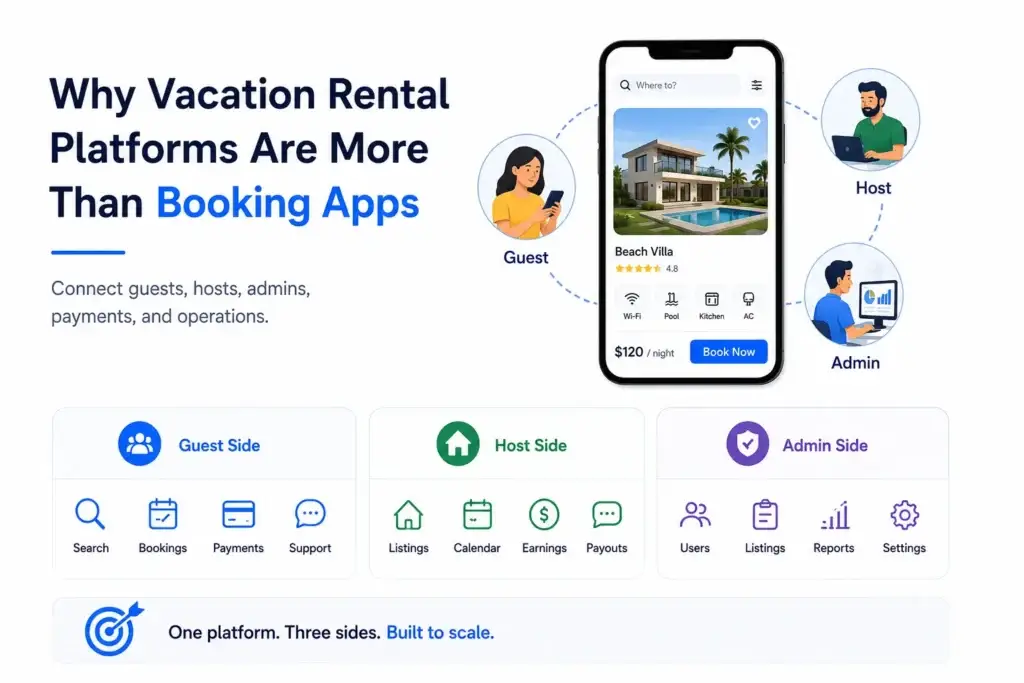
A vacation rental marketplace is different because it connects multiple independent users. Guests search and book. Hosts list and manage inventory. Admins control the marketplace. Payment systems handle guest charges and host payouts. Support teams manage disputes, cancellations, and refunds.
That makes the product more complex than a standard reservation tool.
For founders still comparing different rental marketplace directions, Miracuves offers multiple rental and property platform options across short-stay booking, real estate listings, property management, car rentals, boat rentals, and related marketplace models. This helps founders understand the wider rental ecosystem before choosing one platform direction.
A rental marketplace usually has three major sides:
Guest Side
Guests need to search, filter, compare, view property details, check availability, make payments, communicate with hosts, manage bookings, leave reviews, and access support.
Host Side
Hosts need to create listings, upload photos, set house rules, manage pricing, update calendars, respond to enquiries, approve or reject bookings, track earnings, and receive payouts.
Admin Side
Admins need to manage users, hosts, listings, commissions, payments, cancellations, disputes, refunds, reports, verification, content, and platform settings.
A strong vacation rental platform connects these sides without forcing the founder to manage everything manually.
The Architecture Layer: How the Platform Should Be Structured
Before choosing features, founders should understand the basic architecture of a property booking marketplace.
The platform usually includes:
- Frontend web or mobile apps
- Backend APIs
- Database layer
- Search and filter engine
- Booking engine
- Availability calendar logic
- Payment gateway integration
- Notification system
- Admin dashboard
- File storage for property images
- Analytics and reporting
- Security and access control
Each layer has a different job.
The frontend gives users the interface. The backend manages business logic. The database stores records. The booking engine protects availability and reservations. The payment system moves money. The admin dashboard gives operational control.
A practical architecture may look like this:
Guest App / Web
      ↓
Search + Listing APIs
      ↓
Booking Engine + Availability Calendar
      ↓
Payment Gateway + Payout Logic
      ↓
Database + Activity Logs
      ↓
Admin Dashboard + Reports
The exact technology can differ. Some platforms use Laravel, Node.js, React, Flutter, MySQL, PostgreSQL, MongoDB, cloud storage, or third-party integrations. The stronger decision is not choosing a trendy stack. It is choosing an architecture that can support real booking behavior.
Core Modules Every Rental Marketplace Needs
Vacation rental platform development should begin by separating essential modules from nice-to-have features.
Many founders want advanced filters, dynamic pricing, loyalty programs, multi-language support, and AI recommendations from day one. Those can be useful later. But the first serious launch needs reliable core workflows.
Core Modules in Vacation Rental Platform Development
| Module | What It Does | Founder Impact |
|---|---|---|
| Guest Accounts | Allows users to register, save searches, book stays, manage trips, and leave reviews. | Creates repeat booking potential and gives the platform user-level data. |
| Host Onboarding | Lets property owners or managers create profiles, add payout details, and submit listings. | Improves supply acquisition and reduces manual onboarding work. |
| Property Listings | Stores property details, images, amenities, rules, capacity, pricing, and location. | Forms the core inventory layer of the marketplace. |
| Search and Filters | Helps guests find stays by location, price, date, capacity, amenities, rating, and property type. | Improves discovery and reduces booking friction. |
| Map Discovery | Displays properties by location and helps users compare neighborhoods or nearby landmarks. | Supports location-based decision-making, especially in travel markets. |
| Availability Calendar | Tracks open dates, blocked dates, host rules, booking windows, and reservation conflicts. | Prevents confusion, double-bookings, and host dissatisfaction. |
| Booking Engine | Controls booking requests, instant booking, checkout, confirmation, cancellation, and status changes. | Turns discovery into transactions. |
| Payments and Payouts | Handles guest payments, platform fees, refunds, host payouts, and transaction records. | Supports monetization and operational trust. |
| Reviews and Ratings | Allows guests and hosts to build reputation after completed stays. | Strengthens trust and improves conversion. |
| Admin Dashboard | Gives the platform operator control over users, listings, bookings, disputes, payments, and reports. | Prevents daily operations from becoming developer-dependent. |
Founders who want to review the deeper product layer can explore this rental marketplace features, including search, booking flows, host tools, payment handling, admin controls, availability logic, and marketplace modules.
Guest Workflow: From Search to Completed Booking
The guest workflow is where the platform earns trust.
A strong guest journey should feel simple on the surface, even though many backend checks happen behind the scenes.
A typical guest booking flow includes:
- Search by location, date, guest count, or category.
- Apply filters such as price, amenities, property type, rating, or instant booking.
- Open a listing detail page.
- Review photos, rules, availability, pricing, fees, cancellation terms, and host information.
- Send a booking request or proceed to instant checkout.
- Pay securely.
- Receive booking confirmation.
- Communicate with the host before arrival.
- Complete the stay.
- Leave a review.
The business risk appears when this flow is not connected properly.
If availability is not checked before payment, guests may book unavailable dates. If fees are unclear, users may abandon checkout. If confirmation is delayed, support tickets increase. If reviews are weak or missing, trust suffers.
This is why guest workflow design should be connected to backend logic, not treated as only a UI design task.
Host Workflow: The Supply-Side Engine
No rental marketplace succeeds without reliable hosts.
The host side of the platform should make it easy for property owners, villa managers, apartment operators, homestay owners, or short-stay providers to manage inventory confidently.
A strong host workflow should include:
- Host registration and profile setup
- Property listing creation
- Image uploads
- Amenities and house rules
- Pricing controls
- Cleaning fees or additional charges
- Availability calendar
- Booking request management
- Messaging with guests
- Earnings overview
- Payout tracking
- Reviews received
- Listing status and performance insights
The host dashboard matters because hosts are not only users. They are supply partners.
If hosts cannot update dates, adjust pricing, track bookings, or understand payouts, they may stop using the platform. In vacation rental platform development, the host workflow must be simple enough for non-technical users and strong enough for operators managing multiple properties.
Booking Engine: The Most Important Backend Layer
The booking engine is the operational heart of the platform.
It decides whether a property can be booked, when the booking is confirmed, how pricing is calculated, how availability is blocked, when payments are captured, and how cancellation logic is applied.
Because availability errors can damage guest and host trust, founders should also understand how booking systems handle calendar conflicts. This calendar sync and double-booking prevention guide explains how real-time availability checks, booking locks, timezone handling, and external calendar updates protect rental marketplace bookings.
A reliable booking engine should manage:
- Date availability checks
- Check-in and check-out rules
- Guest capacity
- Price calculations
- Platform service fees
- Host fees
- Discounts or coupons
- Taxes where applicable
- Booking request or instant booking logic
- Payment status
- Booking confirmation
- Cancellation rules
- Refund status
- Host payout status
- Booking history
A weak booking engine can create operational problems quickly. Double-bookings, incorrect payouts, payment mismatches, and unclear cancellation status can damage both host and guest trust.
For founders, this is where development quality matters most.
The platform should not simply create a booking record. It should protect the booking journey from search to payment to confirmation to completion.
Database Planning: What the Platform Needs to Store
A rental marketplace database should reflect real business workflows.
At minimum, the data model may include:
- Users
- Hosts
- Properties
- Property images
- Amenities
- Locations
- Availability calendars
- Bookings
- Payments
- Payouts
- Reviews
- Messages
- Notifications
- Coupons or promotions
- Support tickets
- Admin users
- Commission settings
- Activity logs
The relationships between these records matter.
A property belongs to a host. A booking belongs to a guest and a property. A payment belongs to a booking. A payout belongs to a host. A review belongs to a completed stay. An admin action should be recorded for audit visibility.
If the database is poorly structured, future customization becomes harder. Adding new service types, payout rules, host plans, tax fields, local payment options, or reporting dashboards can become expensive.
This is why vacation rental platform development should treat database design as a product strategy decision.
Payment and Payout Logic: Where Trust Becomes Financial
Payments are not just checkout screens.
A rental marketplace needs to manage money across multiple parties: guests, hosts, and the platform operator. That makes the payment architecture more complex than a simple ecommerce transaction.
The platform may need to support:
- Guest payments
- Platform commissions
- Service fees
- Host payouts
- Refunds
- Cancellation charges
- Coupon adjustments
- Featured listing payments
- Subscription plans
- Wallet or transaction history
- Payment gateway callbacks
- Failed payment recovery
- Dispute-related holds
The key is consistency.
A confirmed booking should match the payment status. A host payout should match the booking status. A refund should update both the guest record and admin report. A commission should be traceable.
Once the payment flow is stable, founders should also decide how the platform earns. A clear rental marketplace revenue model can include booking commissions, host subscriptions, guest service fees, featured placements, payout logic, and other monetization controls.
Admin Dashboard: The Control Layer Founders Should Not Ignore
The admin dashboard is where the founder or platform operator controls the marketplace.
Many startups focus heavily on guest and host screens but underestimate admin requirements. That creates problems after launch because every operational issue becomes manual.
A practical admin dashboard should support:
- User management
- Host management
- Listing approvals
- Booking oversight
- Commission settings
- Payment and payout records
- Refund and cancellation control
- Dispute handling
- Review moderation
- Support requests
- Reports and analytics
- Platform settings
- Content management
- Role-based access control
- Activity logs
Admin control matters because a marketplace changes constantly.
Hosts need approval. Listings need moderation. Guests may dispute bookings. Payments may fail. Refunds may need review. Commission rules may change. New categories may be added. Reports may be needed for decision-making.
Without admin control, founders become dependent on developers for routine business actions.
Search, Maps, and Location-Based Discovery
Vacation rental users often search through location context.
They may want to stay near a beach, airport, business district, university, event venue, metro station, tourist area, hospital, or hiking route. This makes location-based discovery a key product layer.
A strong property discovery system may include:
- Location search
- Map view
- Nearby listings
- Neighborhood filters
- Price range
- Amenity filters
- Guest capacity
- Rating filters
- Date availability
- Property type
- Sorting by relevance or price
For larger platforms, map performance becomes important. The backend should avoid loading every listing at once. Instead, it should return relevant results based on search area, filters, and availability.
This is where architecture affects conversion. Users should be able to find the right stay quickly without feeling that the platform is slow, cluttered, or unreliable.
Messaging, Notifications, and Communication Flow
Rental marketplace communication must be clear before, during, and after the booking.
Guests may ask about check-in, parking, pet policies, amenities, arrival time, cancellation, or local guidance. Hosts may need to confirm rules, respond to requests, or coordinate stay details.
The platform should support:
- Host-guest messaging
- Booking status notifications
- Payment confirmations
- Cancellation alerts
- Check-in reminders
- Admin announcements
- Email notifications
- Push notifications
- SMS or WhatsApp integrations where relevant
The goal is to reduce uncertainty.
Poor communication creates support load. Strong communication keeps both sides informed and reduces failed bookings, confusion, and disputes.
Security, Verification, and Trust Workflows
Marketplace trust depends on identity, payment safety, transparent records, and platform control.
Vacation rental platforms may need verification and security workflows such as:
- User verification
- Host verification
- Property approval
- Secure payment gateway integration
- Role-based access control
- Encrypted data transfer
- Activity logs
- Review moderation
- Abuse reporting
- Dispute management
- Admin approval controls
- Secure API integration
Security should be treated as a foundation, not a marketing add-on.
Final compliance requirements depend on the target market, jurisdiction, payment partners, legal review, operating model, and integrations. Founders should avoid assuming that technology alone solves every legal or regulatory requirement.
Founder Decision Signals
Workflow Readiness
If guest, host, payment, and admin workflows are not clearly mapped, the platform may look complete but fail during real operations.
Booking Accuracy
If availability, checkout, and payment states are not connected, the platform can create double-bookings, failed confirmations, or refund confusion.
Operational Control
If admins cannot manage users, listings, payments, commissions, disputes, and reports, every issue becomes dependent on technical support.
Build Path
If the business model follows standard rental marketplace workflows, a ready-made foundation may help validate faster than starting from zero.
Build Path: Custom Development vs Ready-Made Foundation
Founders usually have two main build paths.
If you are comparing build paths, this ready-made rental marketplace script comparison can help you evaluate feature scope, launch readiness, pricing logic, and customization tradeoffs before deciding whether to build from scratch or start with an existing foundation.
They can build a custom platform from scratch, or they can start with a ready-made rental marketplace foundation and customize it.
Neither path is automatically right for every business.
| Build Path | Best For | Advantages | Risks |
|---|---|---|---|
| Custom development from scratch | Highly unique booking models, enterprise workflows, unusual inventory rules, or complex integrations | Maximum flexibility and architecture control | Longer timelines, higher planning load, more early-stage development risk |
| Ready-made foundation | Founders who need standard marketplace workflows and faster validation | Faster launch, existing modules, lower early build complexity, quicker market testing | Needs customization to avoid looking generic |
| Hybrid approach | Startups that want speed now and deeper customization later | Faster launch with future flexibility | Requires source-code ownership and clean architecture |
| No-code or low-code prototype | Early idea testing or internal validation | Fastest for mockups and simple workflows | Usually weak for real booking, payments, host payouts, and marketplace control |
The best build path depends on the business model.
If the platform needs very unique logic, custom development may be necessary. If the business needs standard booking, listing, payment, host, guest, and admin workflows, a ready-made foundation can reduce the time spent rebuilding common modules.
For many founders, the practical path is hybrid: launch faster with a strong foundation, then customize based on real host and guest behavior.
What to Customize First
A ready-made foundation should not mean a generic marketplace.
The platform still needs customization around the business model, market, inventory type, and user experience.
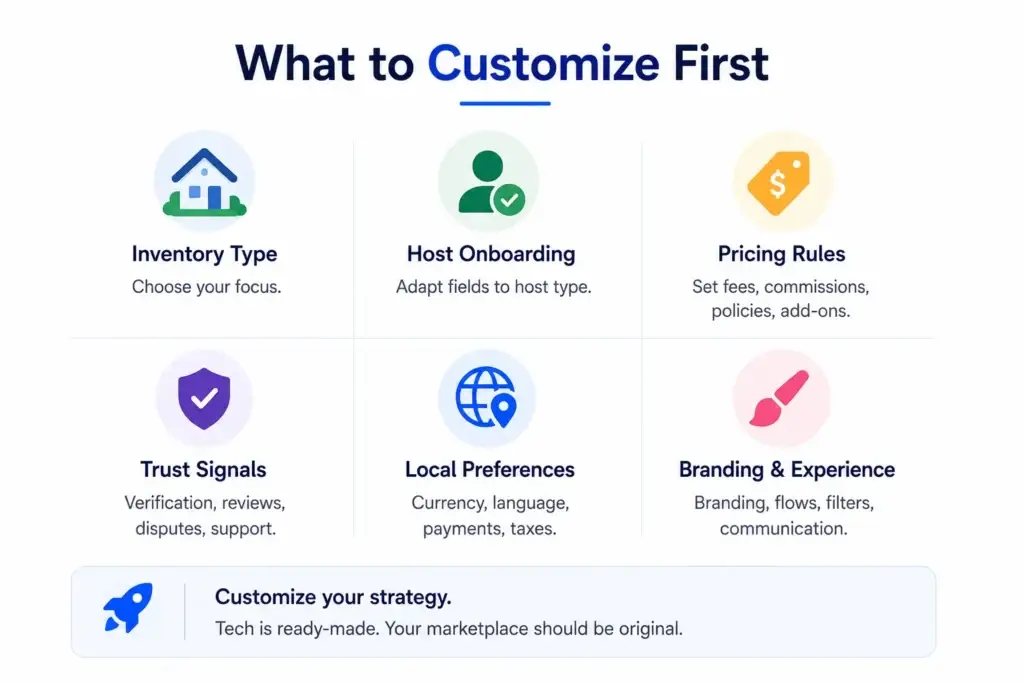
Founders should customize:
Inventory Type
Decide whether the platform focuses on villas, homestays, serviced apartments, pet-friendly stays, student housing, corporate rentals, vacation homes, cabins, local stays, or multi-category rentals.
Inventory strategy should be decided before adding too many advanced features. This guide on niche vacation rental marketplace strategy explains how focused supply, local density, host fit, and high-intent traveler segments can help founders build a stronger starting position.
Host Onboarding
Adapt listing fields based on the host type. A villa host may need amenities and concierge options. A student housing provider may need lease terms. A remote-work stay may need Wi-Fi and workspace details.
Pricing Rules
Set pricing logic, service fees, host commissions, cancellation policies, deposits, discounts, and add-on services based on the market.
Trust Signals
Add verification, reviews, host approval, property moderation, dispute workflows, and support policies.
Local Preferences
Support market-specific currency, language, payment methods, tax fields, cancellation expectations, and support channels where relevant.
Branding and Experience
Customize visual identity, onboarding flows, listing quality, search filters, and guest communication to match the platform’s positioning.
The technology foundation can be ready-made. The marketplace strategy should still be original.
Development Planning Checklist
Before starting vacation rental platform development, founders should answer these questions:
- Who are the main users: guests, hosts, property managers, agencies, or operators?
- What type of inventory will be listed first?
- Will bookings be instant, request-based, or both?
- How will availability be managed?
- Will hosts control calendars manually or through external sync?
- Which payment gateways are required?
- How will host payouts work?
- What fees or commissions will the platform charge?
- What happens when a guest cancels?
- What happens when a host cancels?
- How will disputes be handled?
- What data should admins control?
- What reports are needed from day one?
- What features are essential for launch?
- What can wait until after validation?
- Does the platform need source-code ownership?
- What customization is required before go-live?
These questions help prevent scope confusion. They also make it easier to decide whether the business needs custom development, a ready-made solution, or a hybrid path.
Mistakes Founders Should Avoid
Starting With Screens Instead of Workflows
A rental marketplace can look polished but still fail if guest, host, booking, payment, and admin workflows are not connected properly.
Underestimating Booking Logic
Availability, date rules, payment status, cancellations, refunds, and host payouts should be planned together. Treating them separately creates operational risk.
Ignoring the Admin Dashboard
Without admin control, the founder cannot manage listings, users, commissions, payments, disputes, or reports efficiently after launch.
Building Every Feature Before Validation
Early-stage platforms should prioritize booking readiness and market validation. Advanced features should follow real usage data, not assumptions.
Where Miracuves Fits Into Vacation Rental Platform Development
Miracuves helps founders launch rental marketplace platforms with ready-made, white-label solutions, source-code-owned foundations that can be customized for different inventory types, booking models, and business goals.
For founders planning vacation rental platform development, the value is not only faster deployment. It is starting with the core marketplace workflows already structured: guest journeys, host dashboards, listing management, booking logic, payments, payouts, reviews, admin control, and reporting.
A founder should not have to rebuild every standard module before testing whether hosts will list and guests will book. The stronger approach is to use a reliable foundation, customize it around the niche, and improve based on real market behavior.
If you are ready to move from architecture planning to solution evaluation, explore this launch-ready rental marketplace platform as the next step. This blog should remain focused on development planning, while the solution page handles direct product, demo, pricing, and purchase-intent details.
Before choosing a build partner, founders should also evaluate workflow depth, source-code ownership, admin control, calendar logic, payment handling, and post-launch support. This guide on choosing a rental marketplace development partner can help with that decision.
Final Thoughts: Build the Architecture Before Building the App
Vacation rental platform development is not just about launching an attractive app. It is about building a marketplace system where guests, hosts, bookings, payments, payouts, reviews, calendars, and admin controls work together.
The strongest founders do not begin by copying features. They begin by understanding workflows.
What does the guest need to book confidently? What does the host need to manage supply? What does the admin need to control operations? What does the payment system need to record? What does the booking engine need to protect?
Once those answers are clear, the build path becomes easier.
Some founders need a custom platform from the start. Others can move faster with a ready-made foundation and customize around their market. The right decision depends on how unique the business model is, how fast the founder needs to launch, and how much operational control the platform requires.
The goal is not to build everything from scratch. The goal is to launch the right foundation, validate faster, and improve with real marketplace data.
FAQs
What is vacation rental platform development?
Vacation rental platform development is the process of building a marketplace where guests can search and book stays while hosts can list properties, manage availability, receive payments, and communicate with guests. It usually includes booking logic, calendars, payments, payouts, reviews, messaging, and admin control.
What modules are needed in a rental marketplace?
Core modules include guest accounts, host onboarding, property listings, search filters, map discovery, availability calendars, booking engine, payments, payouts, reviews, messaging, notifications, admin dashboard, reports, and dispute management.
Why is architecture important before building a property booking platform?
Architecture is important because guest, host, booking, payment, and admin workflows are connected. Poor architecture can create double-bookings, payment mismatches, failed payouts, weak reporting, and difficult customization later.
Should founders build a rental marketplace from scratch?
A custom build is useful when the business model has unique workflows, complex integrations, or enterprise requirements. For standard rental marketplace workflows, a ready-made foundation can help founders launch faster and validate demand before deeper customization.
What is the most important backend module in a rental marketplace?
The booking engine is one of the most important backend modules because it manages availability, pricing, booking status, payments, cancellations, refunds, and host payouts. If booking logic is weak, the marketplace can lose trust quickly.
How should a rental marketplace handle payments and payouts?
The platform should connect guest payments, booking status, platform fees, host earnings, refunds, cancellations, and payout records. Every financial event should be traceable through admin reports and transaction history.
What should an admin dashboard include?
An admin dashboard should include user management, host management, listing approvals, booking oversight, commission settings, payment records, refund handling, disputes, review moderation, reports, platform settings, role-based access, and activity logs.
How does Miracuves support vacation rental platform development?
Miracuves helps founders launch ready-made, white-label rental marketplace platforms with source-code ownership, booking workflows, host and guest modules, payment handling, admin control, and customization support for faster market entry.
Miracuves is an independent software development company. We are not affiliated with, connected to, sponsored by, or endorsed by any company or product named in this article.
Terms such as “X Clone” are used descriptively. It is how the software industry refers to building a platform with functionality comparable to a known service, and how clients search for it.
The entire design and codebase of our products is built by our own team. Our products contain no code, design, graphics, or content originating from any third-party website or applications.
All third-party names and marks referenced in this article are the property of their respective owners, referenced solely to identify the services discussed.