
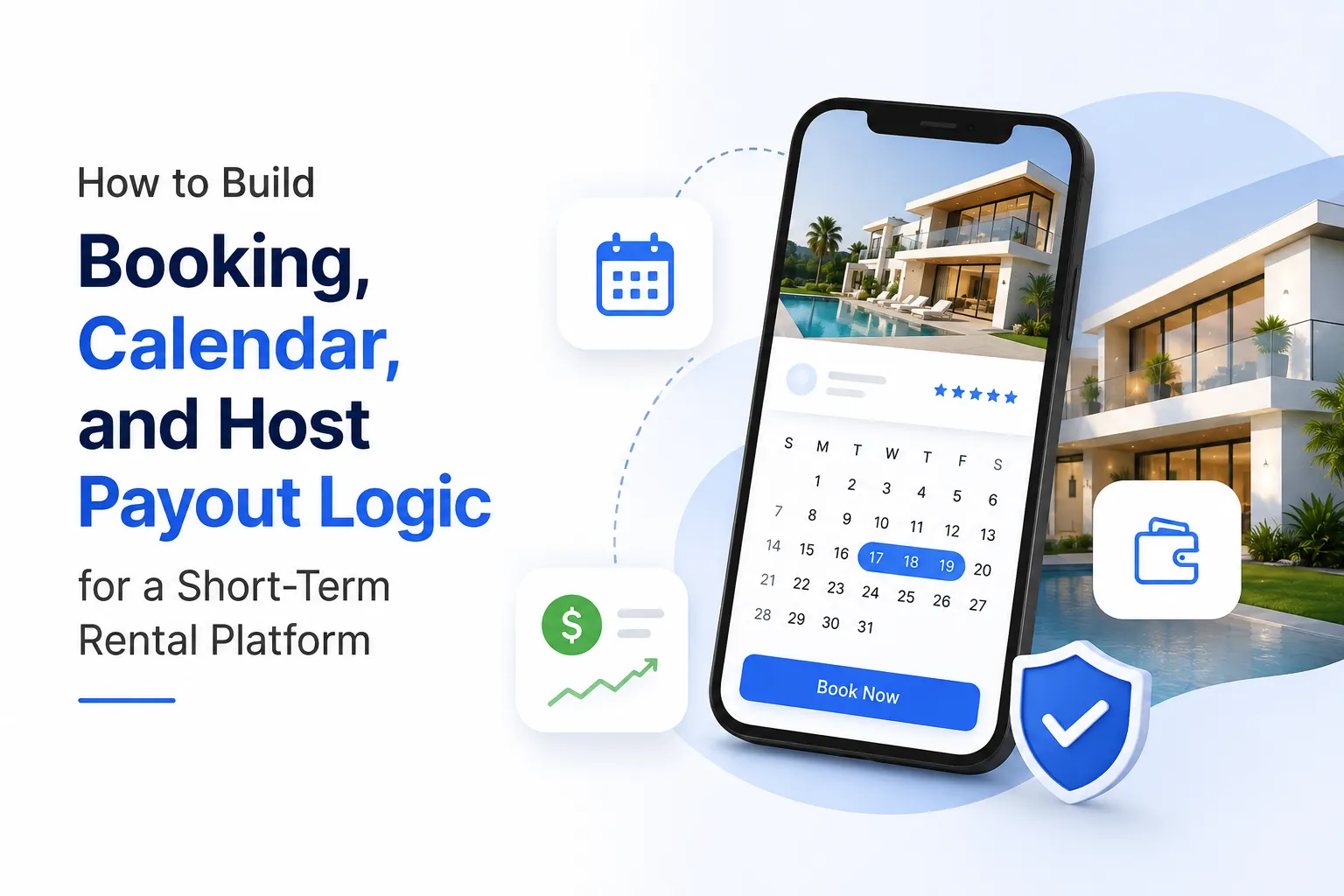
Key Takeaways
- Short-term rental booking system development depends on connecting availability, booking states, pricing, payments, cancellations, host earnings, and payouts as one coordinated workflow.
- Temporary checkout holds help prevent two guests from attempting to reserve the same inventory while payment is being processed.
- Pricing should be frozen at checkout so later host rate changes do not alter an already confirmed reservation.
- Unit-level calendars are important when properties contain multiple rooms, apartments, or separately bookable spaces.
- Host payouts work more reliably with ledger-based financial records that track earnings, commissions, refunds, adjustments, payout requests, and settlements.
Booking Signals
- A reliable booking flow follows: search → availability check → price quote → temporary hold → payment → confirmation → calendar update → payout record.
- Booking states can include Draft, Hold, Pending Payment, Confirmed, Cancelled, Completed, Disputed, and Refunded.
- Calendar rules should cover blocked dates, minimum and maximum stays, booking windows, temporary holds, maintenance blocks, and host restrictions.
- A pricing snapshot should preserve nightly rates, fees, commissions, discounts, taxes, guest totals, and net host earnings for every confirmed booking.
- Admin controls should provide visibility into booking status, calendar conflicts, refunds, disputes, host earnings, payout requests, failed settlements, and audit logs.
Real Insights
- The calendar is not simply a date picker; it acts as a business rules engine controlling inventory, availability, holds, booking restrictions, and conflicts.
- Booking, payment, and payout states should remain separate so delayed payments, refunds, disputes, and failed payouts can be managed accurately.
- Hosts should not always receive earnings immediately after guest payment because cancellation, stay completion, refund, and dispute conditions may affect payout eligibility.
- Technology stack matters less than having clear data models, reliable availability checks, pricing snapshots, ledger-based payouts, and strong admin controls.
- The strongest operational flow is: accurate availability → controlled booking states → secure payment → calendar lock → completed stay → payout eligibility → settlement.
Building a short-term rental booking system is not just about creating property listings and adding a payment button. The real complexity starts when guests search by date, hosts manage availability, prices change by season, bookings move through multiple states, cancellations trigger refunds, and hosts expect clear payout tracking.
For founders planning a 9flats alternative platform, the most important question is not, “Can we build a listing website?” The stronger question is, “Can we build a booking engine that prevents double bookings, protects guest payments, keeps hosts informed, and gives the platform operator full control?”
This guide breaks down the booking, calendar, and host payout logic behind a scalable rental marketplace. It is written for founders, product teams, and developers who want to understand the operational layer before choosing whether to build from scratch or start with a ready-made foundation.
Before going deeper into booking states and payout logic, it helps to understand the basic guest-host marketplace flow. A short-stay rental platform usually connects travelers with hosts, supports property discovery, manages bookings, enables payments, and gives the operator control through an admin system. For a simple overview of the concept, read this guide on how a short-stay rental platform works.
Why Booking Logic Matters More Than the Listing Page
Most rental marketplace ideas begin with property discovery. Founders think about beautiful listing pages, maps, filters, photo galleries, amenities, and guest reviews. These are important, but they are not the hardest part of the product.
The real product is the system behind the booking.
A rental platform must answer several questions instantly:
- Is the selected unit available for the full stay?
- Are check-in and check-out dates allowed?
- Has another guest already placed a temporary hold?
- What is the final price after seasonal rates, fees, taxes, discounts, and deposits?
- When should the host earn the money?
- What happens if the guest cancels?
- What happens if the host cancels?
- What should the admin see before approving a payout?
If these workflows are weak, the platform may still look polished, but hosts and guests will lose trust quickly. A calendar conflict, incorrect payout, or unclear refund status can create more damage than a missing design feature.
That is why booking, calendar, and payout logic should be planned as the foundation of the rental marketplace.
Core Data Model for a Short-Term Rental Booking System
Before choosing JavaScript, PHP, Laravel, Node.js, React, or any frontend framework, the team needs a clear data model. The stack matters, but the structure matters more.
A practical rental marketplace usually needs these core entities:
| Entity | What It Controls | Why It Matters |
|---|---|---|
| Guest | Search, booking, payment, messaging, reviews | Drives demand and booking volume |
| Host | Listings, calendar, pricing, earnings, payout requests | Drives supply and inventory quality |
| Listing | Property description, photos, location, amenities, rules | Creates marketplace inventory |
| Unit or Room | Bookable inventory inside a property | Prevents property-level calendar confusion |
| Availability Calendar | Open dates, blocked dates, minimum stay, booking window | Prevents double bookings |
| Booking | Date range, guest count, price quote, status, cancellation state | Tracks the reservation lifecycle |
| Payment | Guest payment, gateway transaction, refund status | Supports financial accuracy |
| Commission | Platform fee, host fee, service charge, coupon impact | Defines revenue logic |
| Payout | Host earnings, payout request, review, settlement, failure state | Builds host trust |
| Review | Guest and host feedback after completed stays | Supports marketplace trust |
For a simple property booking website, a listing table may be enough. For a marketplace, it is not. You need separate logic for inventory, booking state, payment state, and payout state.
Booking Flow: From Search to Confirmed Reservation
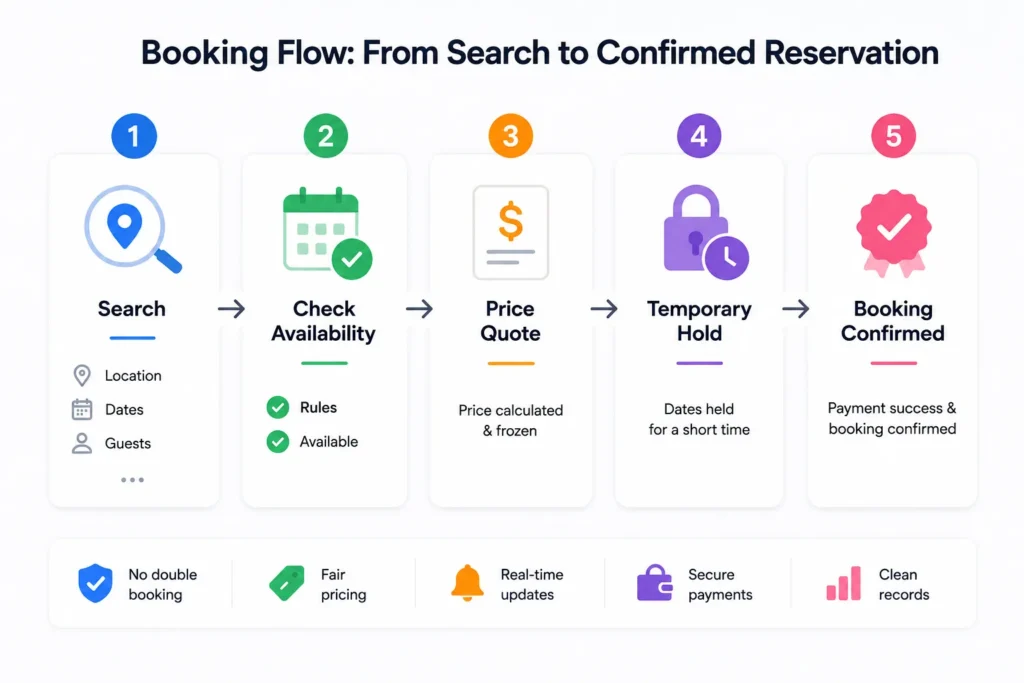
A strong booking engine should work as a sequence of controlled states. This helps developers avoid messy logic and helps admins understand what happened when a booking issue appears.
Guest Searches by Location, Date, and Guest Count
The first layer is search filtering. Guests usually search by:
- Location or destination
- Check-in and check-out date
- Number of guests
- Price range
- Property type
- Amenities
- Rating
- Cancellation flexibility
At this stage, the platform should not only show listings. It should show listings that are actually bookable for the selected dates.
A common mistake is showing all matching properties first and checking availability later. This creates friction because guests may click into a property only to discover that it cannot be booked.
Platform Checks Availability Before Checkout
Availability should be checked before the guest reaches payment. This check should validate:
- Selected dates
- Minimum stay rules
- Maximum stay rules
- Same-day booking restrictions
- Advance booking window
- Blocked dates
- Existing confirmed bookings
- Temporary checkout holds
- Host-specific rules
For example, if a host blocks December 24–27 or sets a three-night minimum for weekends, the booking engine should reject invalid date combinations before payment.
Price Quote Is Generated and Frozen
Once availability is confirmed, the platform should generate a price quote. This quote may include:
- Base nightly rate
- Weekend pricing
- Seasonal pricing
- Length-of-stay discount
- Cleaning fee
- Security deposit
- Guest service fee
- Platform commission
- Coupon or promotional discount
- Local tax or region-specific charge, where applicable
The important rule is simple: freeze the quote once the guest proceeds to payment.
If the host changes the nightly price while a guest is checking out, the confirmed booking should still use the quote generated at checkout. This protects both the guest experience and platform records.
Temporary Hold Prevents Booking Race Conditions
When a guest enters checkout, the platform should place a short temporary hold on the selected dates. This prevents two guests from paying for the same inventory at the same time.
A good hold system includes:
- Hold start time
- Hold expiry time
- Guest ID
- Listing or unit ID
- Date range
- Checkout session ID
- Automatic release if payment fails or expires
Without this layer, two guests can attempt payment at the same time. Even if one payment fails later, the platform may still create confusion in the calendar.
Payment Confirms the Booking
Once payment succeeds, the booking moves into a confirmed state. The platform should update:
- Booking status
- Payment status
- Calendar availability
- Host notification
- Guest confirmation
- Admin booking record
- Commission record
- Future payout record
A rental marketplace should not mark a booking confirmed until payment status is clear. If a gateway response is delayed, the booking can stay in a temporary payment-pending state until the system receives confirmation.
Recommended Booking Status Flow
A clean booking status flow reduces admin confusion and makes support easier.
| Booking Status | Meaning | Founder Impact |
| Draft | Guest selected dates but has not started checkout | Useful for abandoned booking tracking |
| Hold | Dates are temporarily reserved during checkout | Prevents double booking during payment |
| Pending Payment | Payment has started but is not confirmed | Helps handle delayed gateway responses |
| Confirmed | Payment is successful and dates are locked | Creates trusted guest-host commitment |
| Cancelled by Guest | Guest cancelled based on policy | Triggers refund and earnings adjustment |
| Cancelled by Host | Host cancelled the reservation | May trigger penalties or admin review |
| Completed | Stay has ended successfully | Makes review and payout logic available |
| Disputed | Guest, host, or admin opened an issue | Holds payout until resolution |
| Refunded | Full or partial refund has been processed | Keeps financial history clear |
This status model gives the admin panel a clear view of every reservation. It also helps developers avoid mixing payment, booking, and payout logic into one unreliable state.
Calendar Logic: The Real Trust Layer of a Rental Platform
Calendar reliability is one of the biggest trust signals in a short-term rental marketplace. Guests trust the platform when dates shown as available are genuinely available. Hosts trust the platform when their blocked dates, pricing rules, and external calendars are respected.
Use Unit-Level Calendar Logic
Many founders start with property-level availability. That works only when one property equals one bookable inventory unit.
But short-term rentals often include:
- Multiple rooms inside one property
- Hotel-style room categories
- Villas with multiple units
- Apartments with separate rentable spaces
- Mixed inventory such as rooms, apartments, and experiences
That is why a strong rental platform should support unit-level availability. Each room or inventory item should have its own calendar.
Calendar Rules Founders Should Plan
A scalable calendar system should support:
- Available dates
- Blocked dates
- Booked dates
- Temporary hold dates
- Maintenance blocks
- Minimum stay rules
- Maximum stay rules
- Check-in restrictions
- Check-out restrictions
- Advance booking window
- Same-day booking rules
- Seasonal availability
- Manual host blocks
- Admin override blocks
The calendar should not be treated as a visual widget. It is a business rules engine.
Preventing Double Bookings
Double bookings usually happen when the platform does not lock dates properly across booking, payment, and calendar updates.
To reduce this risk, the system should:
- Check availability before checkout
- Place a temporary hold during checkout
- Recheck availability before payment confirmation
- Lock dates after successful payment
- Release dates after failed or expired payment
- Record every calendar change in activity logs
- Sync external calendars where needed
For founders building a 9flats alternative platform, calendar confidence directly affects host retention. Hosts will not stay on a marketplace that creates avoidable booking conflicts.
Pricing Logic: How Rental Platforms Calculate the Final Booking Amount
Pricing in rental marketplaces is rarely a single nightly rate. A proper pricing engine should be flexible enough to support different host strategies and platform monetization models.
A booking engine should also connect directly to the platform’s revenue model. Service fees, host commissions, cleaning charges, featured listings, cancellation penalties, and promotional discounts all affect how the marketplace earns. Founders who want to understand how these revenue streams work together can explore the short-stay rental marketplace business model before finalizing pricing and payout rules.
Common Pricing Components
| Pricing Layer | Example | Why It Matters |
| Base Rate | ₹5,000 per night or $120 per night | Core host revenue |
| Seasonal Rate | Higher pricing during holidays | Helps hosts optimize demand |
| Weekend Rate | Friday/Saturday premium | Supports local travel patterns |
| Length Discount | Weekly or monthly discount | Encourages longer stays |
| Cleaning Fee | Fixed fee per booking | Covers host operating cost |
| Security Deposit | Refundable or held amount | Reduces damage risk |
| Guest Service Fee | Platform-side fee | Adds marketplace revenue |
| Host Commission | Deducted from host earnings | Creates platform monetization |
| Coupon | Discount applied at checkout | Supports acquisition campaigns |
| Tax or Local Charge | Based on region rules | Supports market-specific operations |
The pricing engine should store a full breakdown with every booking. This is important because hosts and guests may need to review the booking later.
Freeze the Pricing Snapshot
When a guest confirms a booking, the platform should save the exact pricing snapshot used at checkout.
This should include:
- Nightly rate used
- Number of nights
- Fees
- Commission percentage
- Discounts
- Taxes or local charges
- Refund policy applied
- Final guest total
- Net host earning
If the host changes the listing price later, the old booking should not change. This protects reconciliation and avoids disputes.
Host Payout Logic: From Completed Stay to Settlement
Host payout logic is where many rental marketplaces become operationally messy. The guest may pay upfront, but the host should not always receive earnings immediately.
A practical payout system should consider:
- Booking completion
- Cancellation window
- Refund eligibility
- Dispute status
- Platform commission
- Gateway fees
- Host penalties, where applicable
- Manual admin review
- Failed payout attempts
- Payout history
Recommended Host Payout Lifecycle
| Payout State | Meaning | Admin Action |
| Accrued | Host earning is recorded after booking confirmation | No payout yet |
| On Hold | Stay has not ended or dispute window is open | Monitor booking |
| Available | Stay completed and payout is eligible | Host can request payout |
| Requested | Host has requested withdrawal | Admin reviews |
| Under Review | Admin checks booking, refund, and dispute status | Approve or reject |
| Approved | Payout is ready to be processed | Send to payment method |
| Paid | Settlement completed | Record transaction ID |
| Failed | Transfer failed | Retry or request updated details |
| Reversed | Payout reversed due to dispute or error | Keep audit record |
This structure gives hosts visibility and gives the platform operator control.
Use a Ledger Instead of Simple Payment Records
A common mistake is calculating payouts directly from payment transactions. That may work at a very small scale, but it becomes risky when refunds, partial refunds, coupons, penalties, and manual adjustments enter the system.
A better model is to use a transaction ledger.
The ledger records every movement:
- Guest payment received
- Platform commission deducted
- Host earning created
- Coupon cost absorbed
- Refund issued
- Cleaning fee allocated
- Security deposit held
- Security deposit released
- Payout requested
- Payout completed
- Payout failed
- Manual adjustment added
This makes reconciliation easier and reduces dependency on spreadsheets.
Admin Controls Needed for Booking and Payout Management
A founder-focused rental platform should not depend on developers for every booking issue. The admin dashboard should give the platform operator enough control to manage daily operations.
Booking Admin Controls
The admin should be able to:
- View all bookings
- Filter by booking status
- Check payment status
- See calendar conflicts
- View booking timeline
- Review guest and host messages
- Trigger cancellation workflows
- Approve refunds
- Open or close disputes
- Export booking reports
Calendar Admin Controls
The admin should be able to:
- View availability by listing or unit
- See blocked dates
- See confirmed bookings
- Check temporary holds
- Override availability where appropriate
- Review external calendar sync status
- Investigate conflict logs
Payout Admin Controls
The admin should be able to:
- View host earnings
- See pending payout requests
- Check completed payouts
- Review failed payout attempts
- Hold payout during disputes
- Add manual adjustments
- Export payout history
- Track transaction IDs
- View audit logs
Admin controls are not only backend features. They reduce support load, protect trust, and help founders manage scale without rebuilding operations later.
JavaScript vs PHP Stack for Rental Marketplace Logic
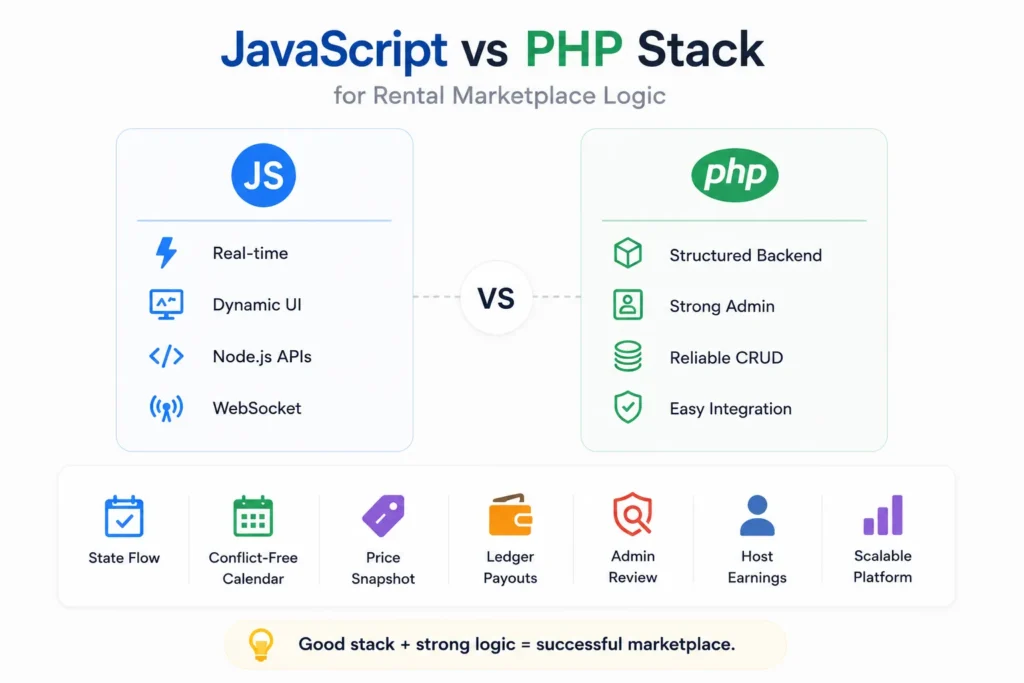
The old development question still matters: should you build rental marketplace workflows using JavaScript, PHP, or a mixed stack?
Technology choices also affect development cost. A simple booking website may cost less, but a marketplace with calendar rules, host dashboards, payment gateways, payout ledgers, dispute workflows, and admin controls requires deeper planning. Founders estimating budget can review the short-term rental platform development cost to understand what usually drives scope and pricing.
The answer depends on team skill, launch scope, integrations, and long-term maintenance.
When JavaScript Works Well
A JavaScript-heavy stack can work well when the product needs:
- Real-time booking updates
- Dynamic dashboards
- Fast frontend interactions
- Node.js APIs
- React or Next.js interfaces
- Event-driven workflows
- WebSocket-based notifications
JavaScript can be a strong fit for marketplaces where guest search, host dashboards, notifications, and admin panels need a modern interactive experience.
When PHP Works Well
PHP with Laravel or a similar framework can work well when the product needs:
- Structured backend development
- Strong admin panel workflows
- Reliable CRUD operations
- Faster marketplace module development
- Payment gateway integrations
- Role-based dashboards
- Mature hosting and maintenance options
PHP is often practical for founders who need a stable backend, clear data relationships, and cost-efficient customization.
What Matters More Than the Stack
For a rental marketplace, the most important development decisions are not only language-based. The bigger questions are:
- Is the booking flow state-based?
- Does the calendar prevent conflicts?
- Is pricing stored as a snapshot?
- Are payouts ledger-based?
- Can admins review refunds and disputes?
- Can hosts see calendar and earnings clearly?
- Can the system scale into more locations or property categories?
Some founders may need custom mobile workflows beyond a ready-made rental marketplace foundation, especially when the product requires unique booking rules, regional payment integrations, custom host apps, loyalty features, or advanced admin reporting. In that case, Miracuves’ custom mobile app development services can help shape the platform around a specific business model, user journey, and launch roadmap.
A good stack cannot fix weak booking logic. But strong product logic can be implemented well in either JavaScript or PHP when the architecture is planned correctly.
Founder Decision Signals Before You Build
Speed
If your business needs to validate supply and demand quickly, avoid spending months rebuilding common booking, calendar, and payout workflows from zero.
Cost
Custom development can become expensive when every booking state, refund rule, payout condition, and admin control is built separately.
Scalability
A scalable rental marketplace needs clean data models, reliable availability checks, role-based dashboards, and transaction history that can support growth.
Market Fit
Before adding advanced features, validate whether hosts can manage listings easily and guests can complete bookings without confusion.
Build From Scratch or Start With a Ready-Made Rental Marketplace Foundation?
Founders usually have two paths.
The first path is custom development. This gives full control, but it also means every booking, calendar, payout, refund, notification, dashboard, and admin workflow must be planned, built, tested, and improved.
Choosing the right development partner becomes important when your platform needs booking workflows, calendar accuracy, host payout visibility, admin review tools, and secure payment handling. A generic app team may build screens, but a marketplace-focused team understands how guest, host, and operator workflows connect. Founders comparing build partners can use this guide on choosing a short-stay rental platform development company to evaluate technical fit, product scope, and launch readiness.
The second path is starting with a ready-made rental marketplace foundation and customizing it for your target market. This can make sense when the business goal is not to invent a new booking engine, but to launch a branded marketplace faster with the right workflows already in place.
For example, a founder building a regional homestay network, boutique apartment marketplace, corporate stay platform, or 9flats alternative platform may not need to rebuild the entire reservation engine from zero. The stronger decision may be to start with proven listing, calendar, booking, payment, and payout workflows, then customize property types, branding, pricing rules, language, and market-specific operations.
Feature Checklist for Booking, Calendar, and Payout Logic
Booking, calendar, and payout logic should not be planned in isolation. They work best when connected with host dashboards, guest booking flows, admin controls, reviews, messaging, payment management, and dispute handling. For a deeper breakdown of the product modules founders should evaluate, review these short-term rental platform features.
Short-Term Rental Platform Logic Checklist
| Feature | Business Value | Founder Impact |
|---|---|---|
| Unit-level availability calendar | Prevents incorrect booking availability across rooms, apartments, or units | Reduces double-booking risk and host complaints |
| Temporary checkout holds | Locks dates while payment is in progress | Protects guest experience during checkout |
| Pricing snapshot | Stores the exact price breakdown at booking time | Improves transparency for guests, hosts, and admins |
| Cancellation and refund logic | Connects booking status with financial outcomes | Reduces manual support and dispute confusion |
| Host earnings dashboard | Shows hosts what they earned and what is pending | Improves host trust and long-term retention |
| Payout review queue | Lets admins approve, reject, or hold payouts | Gives the platform operator financial control |
| Transaction ledger | Records every financial movement | Makes reconciliation and reporting easier |
| Audit logs | Tracks important admin, host, booking, and payout actions | Improves accountability and operational trust |
When This Logic Becomes a Business Advantage
A rental marketplace becomes stronger when the operational layer works quietly in the background.
Guests do not want to think about calendar locks, gateway callbacks, booking states, or refund conditions. They simply want to search, trust the availability, pay securely, and receive confirmation.
Once booking reliability, calendar accuracy, and host payouts are stable, the next challenge is growth. A rental marketplace needs host acquisition, guest demand, destination-focused campaigns, trust signals, referral loops, and retention strategies. Founders planning post-launch growth can use this short-stay rental app marketing strategy to connect product readiness with user acquisition.
Hosts do not want to chase the platform operator for every update. They want to manage availability, control pricing, understand earnings, and track payouts.
The platform operator needs control over bookings, disputes, commissions, cancellations, refunds, and payout approvals without depending on developers for every small change.
That is where the business value of strong booking, calendar, and payout logic becomes clear. It improves trust, reduces operational pressure, and gives the founder a better foundation for growth.
Mistakes Founders Should Avoid
Security should be planned before the platform starts processing bookings and payouts. Rental marketplaces handle guest profiles, host details, payment records, booking history, payout data, dispute records, and admin access. To strengthen trust from the beginning, founders should review this short-stay rental app security guide and align the product with secure payment handling, role-based access, verification workflows, and activity logs.
Treating the Calendar as Only a UI Feature
The calendar is not just a date picker. It controls booking rules, blocked dates, inventory, holds, cancellations, and host trust. Weak calendar logic can create double bookings and support issues.
Calculating Host Payouts Manually
Manual payout calculations may work for the first few bookings, but they become risky when refunds, commissions, coupons, deposits, and disputes increase. A transaction ledger is safer.
Not Freezing Booking Prices
If the platform recalculates old bookings after a host changes rates, reconciliation becomes difficult. Every confirmed booking should store the exact price snapshot used at checkout.
Making the Host Dashboard Too Basic
Hosts need more than a listing form. They need calendar control, pricing rules, booking history, message access, earnings visibility, and payout tracking.
Miracuves Perspective: Build the Logic Before You Scale the Marketplace
For founders planning a 9flats alternative platform, the real advantage comes from building the operational foundation correctly before scaling listings and users. Booking states, availability calendars, pricing rules, refund flows, host earnings, and payout approvals must work together as one connected system.
Miracuves helps founders move faster with ready-made, white-label solutions that include guest, host, and admin workflows, giving businesses a launch-ready foundation they can customize for their market.
Instead of rebuilding every booking and payout module from zero, founders can focus on branding, supply acquisition, local pricing strategy, and marketplace growth. To explore a ready-made rental marketplace foundation, visit the Miracuves short-term rental platform solution.
Final Thoughts
The success of a short-term rental platform depends on more than property discovery. The real foundation is the logic that connects availability, booking confirmation, payment records, cancellation rules, host earnings, and payout settlement.
For founders, this is an important product decision. You can build every workflow from scratch, or you can start with a ready-made foundation and customize it for your market. The stronger choice depends on your timeline, budget, technical team, and launch strategy.
If your goal is to build a reliable rental marketplace, focus first on the systems that protect trust: accurate calendars, clear booking states, transparent host earnings, and admin-controlled payout workflows.
FAQs
What is booking logic in a short-term rental platform?
Booking logic is the workflow that manages search availability, selected dates, pricing, payment status, booking confirmation, cancellations, refunds, and stay completion. It ensures that guests can reserve properties accurately and hosts receive reliable booking information.
How does a rental platform prevent double bookings?
A rental platform prevents double bookings by checking availability before checkout, placing a temporary hold during payment, rechecking availability before confirmation, and locking dates only after successful payment. External calendar sync and activity logs can also reduce conflict risk.
What should a host payout system include?
A host payout system should include host earnings calculation, platform commission deduction, payout eligibility rules, payout request flow, admin review, settlement status, failed payout tracking, transaction IDs, and payout history.
Should host payouts happen immediately after guest payment?
Not always. Many rental marketplaces hold host earnings until the stay is completed or until the cancellation and dispute window has passed. This protects the guest, host, and platform operator.
Is JavaScript or PHP better for building a rental marketplace?
Both can work. JavaScript is useful for interactive dashboards, real-time updates, and modern frontend experiences. PHP, especially with Laravel, is useful for structured backend workflows, admin panels, and marketplace modules. The better choice depends on your team, architecture, and customization needs.
Can this guide help plan a 9flats alternative platform?
Yes. This guide helps founders understand the booking, calendar, pricing, and host payout workflows needed for a 9flats alternative platform. It focuses on operational logic rather than direct commercial product comparison.
What is the biggest technical risk in short-term rental marketplace development?
The biggest risk is weak coordination between calendar availability, payment confirmation, booking status, cancellation rules, and payout records. If these systems are not connected properly, the platform may face double bookings, refund confusion, payout disputes, and host churn.
When should founders consider a ready-made rental marketplace solution?
Founders should consider a ready-made solution when they want to launch faster, reduce development complexity, validate demand, and avoid rebuilding standard marketplace workflows such as listings, calendars, bookings, payments, host dashboards, and admin controls from zero.
Miracuves is an independent software development company. We are not affiliated with, connected to, sponsored by, or endorsed by any company or product named in this article.
Terms such as “X Clone” are used descriptively. It is how the software industry refers to building a platform with functionality comparable to a known service, and how clients search for it.
The entire design and codebase of our products is built by our own team. Our products contain no code, design, graphics, or content originating from any third-party website or applications.
All third-party names and marks referenced in this article are the property of their respective owners, referenced solely to identify the services discussed.