


Key Takeaways
What You’ll Learn
- Revolve’s business model is built around digital-first fashion commerce combining influencer marketing, premium fashion retail, and mobile-driven online shopping experiences.
- The company earns primarily through online product sales across fashion apparel, accessories, beauty products, footwear, and lifestyle collections.
- Influencer-driven marketing is Revolve’s biggest competitive advantage because social media creators and celebrity collaborations strongly influence purchasing behavior.
- Data-driven personalization improves customer retention through targeted recommendations, trend forecasting, curated collections, and digital engagement strategies.
- The biggest takeaway for founders is that digital fashion brands scale successfully when social commerce, influencer ecosystems, customer data, and mobile-first shopping experiences work together.
Stats That Matter
- The article positions Revolve as a digital-native fashion and lifestyle retailer focused on premium online shopping, influencer marketing, and social-commerce-driven customer acquisition.
- Core revenue comes from online fashion and beauty product sales including clothing, footwear, luxury accessories, skincare, and curated lifestyle collections.
- Additional monetization comes from exclusive collaborations and branded campaigns leveraging influencer partnerships, social media reach, and creator-driven marketing.
- The platform benefits from mobile-first shopping behavior as younger consumers increasingly discover and purchase fashion through social platforms and digital experiences.
- Revolve’s influencer ecosystem strengthens brand visibility and retention because creators continuously drive trend adoption, product discovery, and repeat engagement.
Real Insights
- Revolve succeeds because it blends fashion retail with social influence turning creators, influencers, and lifestyle content into direct commerce channels.
- The strongest growth driver is digital brand engagement because social media visibility, influencer campaigns, and trend-based marketing strongly influence customer acquisition.
- Customer data and personalization directly improve conversion since fashion platforms rely heavily on recommendation systems, trend forecasting, and curated shopping experiences.
- Mobile-first infrastructure is critical for scalability because modern fashion consumers increasingly browse, discover, and purchase products through smartphones and social apps.
- For entrepreneurs, the biggest lesson is to build a Revolve-style fashion platform around influencer ecosystems, digital commerce, personalized shopping, mobile-first UX, and scalable social-commerce infrastructure.
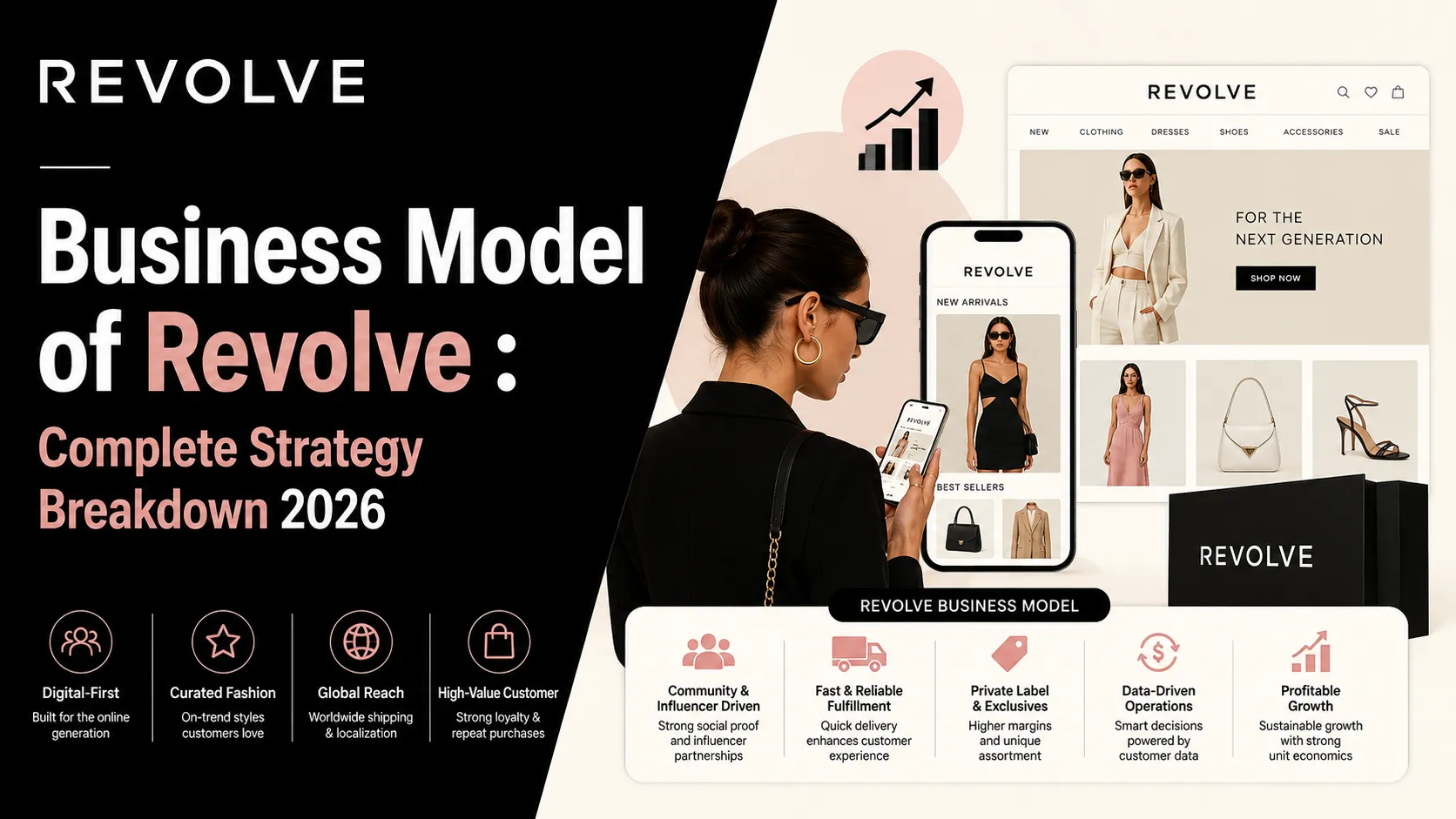
Revolve didn’t become a fashion powerhouse by simply selling clothes online. It built a modern ecommerce engine where brand, community, and data work together to drive repeat purchases. What makes Revolve different is that it sells a lifestyle as much as it sells products—using influencer culture, curated drops, and trend speed to stay relevant in a market where attention shifts fast. making the Business Model of Revolve a standout example in digital fashion.
In 2026, Revolve continues to win because it understands one key truth: fashion is emotional, social, and highly visual. By blending premium product curation with social-first marketing, Revolve turns browsing into aspiration—and aspiration into conversion. This is why the Business Model of Revolve creates stronger customer loyalty than many traditional retailers.
For entrepreneurs, Revolve is a masterclass in building a scalable digital ecosystem. It proves that a strong business model isn’t only about inventory and pricing—it’s about creating demand through content, trust, and community. If you’re building an ecommerce platform or brand-led marketplace, Revolve’s model offers powerful lessons in growth, monetization, and retention.
How the Revolve Business Model Works
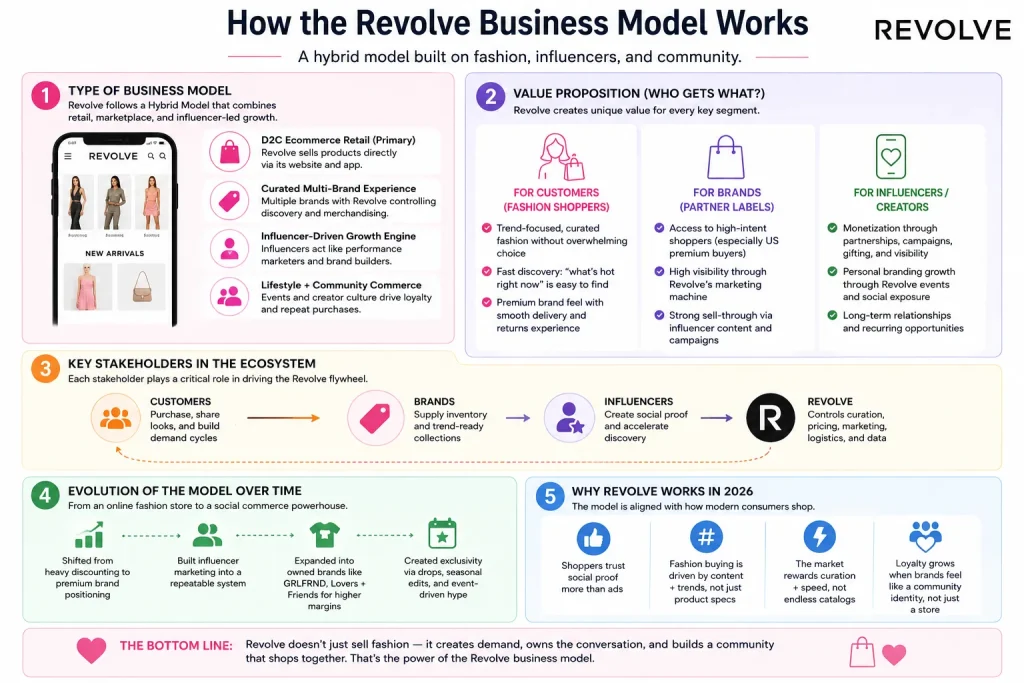
Revolve runs a hybrid ecommerce business model built around premium fashion retail + influencer-led demand generation. At its core, it sells fashion products directly to consumers through its online platform, but the real advantage comes from how it creates demand before it sells. Revolve doesn’t wait for trends to happen—it helps shape trends using creators, events, and social-first storytelling.
1) Type of Business Model
Revolve follows a Hybrid Model, combining:
- D2C Ecommerce Retail (Primary) → Revolve sells products directly via its website/app
- Curated Multi-Brand Marketplace Feel → Multiple brands, but Revolve controls discovery + merchandising
- Influencer-Driven Growth Engine → Influencers act like performance marketers + brand builders
- Lifestyle + Community Commerce → Events and creator culture fuel loyalty and repeat buying
2) Revolve’s Value Proposition (Who Gets What?)
Revolve delivers different value to each segment:
For Customers (Fashion Shoppers)
- Trend-focused, curated fashion without overwhelming choice
- Fast discovery: “what’s hot right now” is easy to find
- Premium brand feel with smooth delivery + returns experience
For Brands (Partner Labels)
- Access to high-intent shoppers (especially US premium buyers)
- High visibility through Revolve’s marketing machine
- Strong sell-through via influencer content + campaigns
For Influencers / Creators
- Monetization through partnerships, campaigns, gifting, and visibility
- Personal branding growth through Revolve events + social exposure
3) Key Stakeholders in the Ecosystem
Revolve’s ecosystem stays balanced because each stakeholder has a clear role:
- Customers → purchase, share looks, build demand cycles
- Brands → supply inventory and trend-ready collections
- Influencers → create social proof and accelerate discovery
- Revolve → controls curation, pricing strategy, marketing, logistics, and data
4) Evolution of the Model Over Time
Revolve evolved from “online fashion store” to a social commerce powerhouse by:
- Shifting from heavy discounting to premium brand positioning
- Building influencer marketing into a repeatable system
- Expanding into owned brands like GRLFRND, Lovers + Friends for higher margins
- Creating exclusivity via drops, seasonal edits, and event-driven hype
5) Why Revolve Works in 2026
In 2026, Revolve stays strong because consumer behavior supports its strengths:
- Shoppers trust social proof more than ads
- Fashion buying is driven by content + trends, not just product specs
- The market rewards curation + speed, not endless catalogs
- Loyalty grows when brands feel like a community identity, not just a store
Read more : What is REVOLVE and How Does It Work?
Target Market & Customer Segmentation Strategy
Revolve’s growth is powered by one thing it understands better than most fashion platforms: its customers don’t just shop—they follow trends, creators, and lifestyle identity. That’s why Revolve doesn’t market like a traditional ecommerce store. It markets like a culture brand, where the product is only one part of the experience.
1) Primary Customer Segments (Core Users)
Revolve mainly targets premium, trend-driven online shoppers, especially:
- Women aged 18–35 (core segment)
- Social-first buyers (Instagram, TikTok influenced)
- High interest in fashion drops, events, and celebrity looks
- Will pay more for brand + style relevance
- Social-first buyers (Instagram, TikTok influenced)
- Young working professionals
- Want “going out” and “occasion wear”
- Value fast delivery + premium feel
- Prefer curated shopping over endless scrolling
- Want “going out” and “occasion wear”
2) Secondary Customer Segments (Growth Segments)
Revolve expands revenue by serving additional segments:
- Men’s fashion buyers
- Smaller share than women but growing steadily
- Focus on streetwear, premium basics, sneakers
- Smaller share than women but growing steadily
- Luxury-leaning buyers
- Higher AOV customers who purchase premium labels
- More repeat-driven, less discount-sensitive
- Higher AOV customers who purchase premium labels
- Occasion shoppers
- Weddings, vacations, festivals, parties
- High purchase intent and urgency-based buying
- Weddings, vacations, festivals, parties
3) Customer Journey (Discovery → Conversion → Retention)
Discovery
Revolve is discovered through:
- Influencer outfits and tagged product links
- Viral “haul” videos and event photos
- Paid social campaigns with creator-style content
Conversion
Revolve converts users using:
- Trend-focused collections and edits (easy decision-making)
- Strong product photography + styling visuals
- Smooth checkout + fast shipping options
Retention
Revolve retains customers by:
- Constant newness (drops feel frequent and fresh)
- Personalized recommendations using browsing + purchase data
- Loyalty-like behavior created through brand attachment and social identity
4) Acquisition Channels by Segment
Revolve scales customer acquisition with different channels:
- Influencer marketing (core engine)
Drives trust + discovery faster than traditional ads - Performance ads (scaling lever)
Retargeting and lookalike audiences for conversion growth - Events + experiential marketing
Revolve Festival and creator trips build aspirational demand - Email + SMS lifecycle marketing
Drives repeat purchases, cart recovery, and seasonal reactivation
5) Market Positioning & Competitive Edge
Revolve positions itself as:
- Premium but accessible
- Trendy but curated
- Influencer-powered but performance-driven
Its key differentiation is that Revolve competes not just on product—but on attention + social proof + speed of trend capture. In a crowded ecommerce world, Revolve wins because it behaves like a media brand that sells fashion.
Revenue Streams and Monetization Design
Once you understand Revolve’s audience and why they stay loyal, the next question becomes simple: how does Revolve turn trend culture into consistent revenue?
Revolve’s monetization model is built like a modern ecommerce machine—product sales are the core, but profitability is strengthened through smart merchandising, owned brands, and high-retention customer behavior.
Primary Revenue Stream 1: Direct Product Sales (Core Engine)
Mechanism
Revolve earns revenue by selling fashion products directly to consumers through its website and app. This includes apparel, shoes, accessories, and occasion-based collections.
Pricing Model
- Premium mid-to-high pricing (not mass discount retail)
- Brand-led pricing control (Revolve sells many established labels)
- Seasonal promotions, but not dependent on extreme discounting
Revenue Contribution
- This is the largest revenue driver (core ecommerce sales)
- Strong repeat purchases increase lifetime value
Growth Trajectory
- Expansion across categories (dresses, luxury, men’s, accessories)
- Higher AOV through premium collections and styling bundles
- Stronger retention through trend drops and new arrivals
Why it works: Revolve doesn’t sell “cheap fashion.” It sells relevance + aspiration, which supports stronger margins and repeat buying.
Secondary Revenue Stream 2: Owned & Private Label Brands (Margin Booster)
Mechanism
Revolve earns higher margins through its in-house and owned brands (example: Lovers + Friends, GRLFRND, and more).
How it monetizes
- Better control over pricing and supply chain
- Higher gross margins than third-party brands
- Ability to launch trend-fast collections quickly
Why it matters
Owned brands reduce dependency on external labels and allow Revolve to scale profitability, not just sales volume.
Secondary Revenue Stream 3: Exclusive Drops & Limited Collections (Demand Multiplier)
Mechanism
Revolve creates urgency through limited availability and exclusive product drops.
Monetization effect
- Faster conversion cycles
- Lower reliance on discounting
- Higher full-price sell-through
This works because scarcity and trend timing are powerful psychological triggers in fashion buying.
Secondary Revenue Stream 4: Performance Marketing Efficiency (Indirect Monetization)
Revolve doesn’t “earn revenue” directly from ads like a media platform, but it monetizes by lowering customer acquisition cost (CAC) through influencer-led demand.
Why it matters
- Influencer content acts like “free distribution”
- Organic discovery reduces paid ad dependency
- Better ROI on retargeting campaigns
This makes Revolve’s growth more sustainable than brands that rely only on paid ads.
Secondary Revenue Stream 5: International Expansion & Premium Segments (Scaling Layer)
Revolve increases revenue by expanding:
- Global shipping and international buyers
- Higher-ticket premium fashion segments
- Occasion-driven shopping cycles (vacations, weddings, festivals)
This adds new revenue without needing to reinvent the model.
Read more ; Revolve Clone Revenue Model: How Revolve Makes Money in 2026
Operational Model & Key Activities
Revolve may look like a fashion ecommerce brand on the surface, but behind the scenes it operates like a high-speed retail + media + data company. Its success depends on executing daily operations with precision—because in fashion, being late by even a few weeks can mean missing the trend completely.
1) Core Operations (What Revolve Runs Every Day)
Platform Management & Tech Infrastructure
Revolve invests heavily in a smooth digital shopping experience:
- Website + app performance optimization
- Personalized product recommendations
- Search, filters, and category curation to reduce decision fatigue
- Checkout speed and payment reliability
Merchandising & Trend Curation
This is one of Revolve’s strongest operational advantages:
- Selecting the right brands and styles for the target audience
- Creating seasonal edits (party wear, vacation looks, festival fashion)
- Managing new arrivals frequency to keep the platform feeling “fresh”
Inventory & Supply Chain Operations
Since Revolve sells directly, it must balance availability and risk:
- Demand forecasting based on trend signals + past purchase data
- Stock planning to avoid over-inventory and markdown pressure
- Fast replenishment cycles for bestsellers
Logistics, Shipping & Returns
Customer trust depends on delivery experience:
- Reliable shipping timelines (especially in the US market)
- Smooth return handling (important for fashion fit issues)
- Packaging and delivery quality that matches premium positioning
Customer Support & Experience
Revolve maintains a high-service brand feel through:
- Quick resolution for order issues
- Size and product guidance support
- Refund and exchange processes that feel frictionless
Marketing & Content Production
Revolve runs content like a daily engine:
- Influencer collaborations and product seeding
- Photo shoots, styling content, campaign drops
- Social media distribution across platforms
2) Resource Allocation (Where the Business Spends Focus)
While exact internal percentages vary, Revolve’s operational priorities in 2026 typically lean toward:
- Tech & Product Development
- Recommendation engines
- Mobile-first shopping experience
- Data systems for personalization and forecasting
- Recommendation engines
- Marketing & Brand Demand Creation
- Influencer partnerships (core)
- Performance marketing (scaling)
- Events and experiential campaigns
- Influencer partnerships (core)
- Operations & Fulfillment
- Warehousing and shipping performance
- Returns efficiency (critical for fashion)
- Inventory accuracy and turnaround time
- Warehousing and shipping performance
- Talent & Creative Execution
- Merchandisers who understand trend cycles
- Creative teams for styling + campaigns
- Growth teams for performance optimization
- Merchandisers who understand trend cycles
3) Why Revolve’s Operational Model Works
Revolve wins operationally because it aligns everything around one goal:
“Get the right trend to the right buyer at the right moment.”
That requires:
- Strong demand sensing (social + data)
- Fast merchandising decisions
- Reliable fulfillment
- Content-driven marketing that keeps traffic warm
Strategic Partnerships & Ecosystem Development
Revolve’s business model becomes far more powerful when you look at it as an ecosystem, not just a store. It doesn’t grow only by adding more products—it grows by building partnerships that strengthen distribution, trust, trend access, and demand creation. In 2026, this partnership-led ecosystem is one of Revolve’s strongest competitive moats.
Revolve’s Collaboration Philosophy
Revolve partners with people and companies that help it win on two fronts:
- Trend speed (staying ahead of fashion cycles)
- Demand creation (turning attention into purchases)
Instead of relying on traditional celebrity endorsements, Revolve builds a scalable network of creators, brands, and service partners that continuously feed its growth engine.
1) Brand & Supplier Partnerships (Inventory + Exclusivity)
Revolve collaborates with:
- Premium and emerging fashion labels
- Trend-driven designers and fast-moving brands
- Category specialists (party wear, luxury basics, accessories)
Value created
- Revolve gets consistent newness and trend variety
- Brands get access to Revolve’s high-intent customer base
- Exclusive collections help Revolve differentiate from competitors
2) Influencer & Creator Partnerships (Demand Engine)
This is Revolve’s most strategic partnership layer.
Revolve works with:
- Fashion influencers and lifestyle creators
- Micro-influencers (high engagement, niche trust)
- Celebrity-linked creators for reach and credibility
Why it works
- Influencers act like distributed sales channels
- Content feels organic, not like traditional ads
- Social proof increases conversion without heavy discounting
Revolve doesn’t just “pay for posts”—it builds long-term creator relationships that continuously drive visibility.
3) Technology & Platform Partnerships (Performance + Scale)
To keep its ecommerce engine strong, Revolve depends on:
- Analytics and customer data platforms
- Personalization and recommendation tech
- Marketing automation tools (email, SMS, retargeting)
- Fraud prevention and checkout optimization tools
These partnerships improve:
- Conversion rates
- Customer retention
- Operational efficiency
4) Payment & Financial Partnerships (Trust + Conversion)
Fashion ecommerce relies heavily on smooth payments. Revolve benefits from:
- Payment gateway partners
- Digital wallet integrations
- Buy Now Pay Later options (where applicable)
Impact
- Reduces checkout friction
- Improves conversion for high-AOV products
- Supports premium positioning with flexible payment behavior
5) Logistics & Fulfillment Alliances (Delivery Reliability)
Delivery experience is part of the brand. Revolve’s partnerships may include:
- Shipping carriers and last-mile networks
- Warehousing and fulfillment infrastructure
- Reverse logistics partners (returns handling)
Why it matters
Fashion has high return rates, so Revolve must manage returns efficiently without damaging margins.
Ecosystem Insight: How Partnerships Create a Competitive Moat
Revolve’s ecosystem creates strong network effects:
- More creators → more demand
- More demand → better brand partnerships
- Better brand partnerships → more exclusive inventory
- Exclusive inventory → stronger loyalty and repeat buying
This partnership loop becomes hard for competitors to copy because it’s built on relationships, trust, and long-term brand positioning, not just budget.
Growth Strategy & Scaling Mechanisms
Revolve’s growth strategy is not based on “selling more products to more people” in the traditional retail sense. It scales by building a repeatable system that turns attention into demand, and demand into high-frequency purchasing behavior. In 2026, Revolve’s biggest strength is that its growth engine is both brand-led and performance-driven.
1) Growth Engines (What Drives Revolve Forward)
A) Organic Virality & Social Proof Loops
Revolve grows naturally because its products live inside social content:
- Influencers post outfits → followers discover products
- Customers share looks → creates lifestyle credibility
- Trend visibility increases → more people search and buy
This creates a loop where marketing becomes a part of culture, not just advertising.
B) Influencer-Led Demand Creation (Core Scaling System)
Revolve has built influencer marketing into a predictable model:
- Partner with creators consistently (not one-time posts)
- Align creators with seasonal campaigns (vacation, party, festival)
- Use events and trips to generate high-volume content
This reduces dependency on high-cost traditional media and builds long-term brand relevance.
C) Paid Performance Marketing (Acceleration Layer)
Revolve uses paid ads strategically:
- Retargeting visitors who already showed intent
- Lookalike audiences based on high-value buyers
- Product ads optimized for conversion, not just clicks
Paid marketing doesn’t replace the influencer engine—it amplifies it.
D) Product Expansion & Category Growth
Revolve increases revenue by expanding product depth:
- Men’s fashion growth
- Accessories and footwear scaling
- Higher-ticket premium collections
- Occasion-based shopping edits (weddings, travel, events)
This increases AOV and customer lifetime value without changing the model.
E) International Growth & Market Expansion
Revolve scales globally by:
- Expanding shipping and regional accessibility
- Marketing the “Revolve lifestyle” beyond the US
- Targeting premium urban buyers in international markets
Even small improvements in international conversion can unlock massive growth because fashion demand is global.
2) Scaling Challenges & How Revolve Solves Them
Challenge 1: Trend Volatility (Fashion Changes Fast)
Risk: inventory becomes outdated quickly
Solution:
- Data-driven forecasting based on real-time shopping behavior
- Fast merchandising cycles and frequent new arrivals
- Curation model reduces slow-moving product exposure
Challenge 2: High Return Rates in Fashion Ecommerce
Risk: returns can kill margins
Solution:
- Better product visuals and fit guidance
- Strong logistics + reverse logistics operations
- Customer experience focus to maintain loyalty even after returns
Challenge 3: Rising Customer Acquisition Costs
Risk: paid ads become expensive in competitive markets
Solution:
- Influencer ecosystem reduces paid dependency
- Community-driven brand identity increases organic demand
- Retention strategy improves LTV to justify CAC
Challenge 4: Maintaining Premium Brand Positioning
Risk: too many discounts can damage perception
Solution:
- Curated drops and exclusives drive full-price sell-through
- Owned brands improve margin flexibility
- Events and creator branding keep the platform aspirational
3) Why Revolve’s Scaling Model Works in 2026
Revolve scales because it treats growth as a system:
- Content creates attention
- Attention creates desire
- Desire creates conversion
- Conversion creates repeat behavior
- Repeat behavior compounds revenue
This is exactly the kind of scalable platform design Miracuves helps entrepreneurs build—where growth is engineered through strategy, not luck.
Competitive Strategy & Market Defense
Fashion ecommerce is one of the most competitive spaces in the world. New brands appear daily, trends change weekly, and customer loyalty can disappear overnight. Revolve stays ahead because it doesn’t compete like a normal retailer—it competes like a trend-driven digital ecosystem, where brand identity, social proof, and speed create a strong defense layer.
1) Revolve’s Competitive Advantages (Why It Stays Ahead)
A) Social Proof as a Moat
Revolve has built a business where customers trust what they see:
- Influencers wearing products creates instant credibility
- Real-world styling content reduces hesitation
- Fashion becomes “validated” through community visibility
This is hard to copy because it’s based on long-term creator relationships and brand positioning, not just money.
B) Trend Curation + Merchandising Speed
Instead of showing everything, Revolve focuses on:
- Curated selections that match what its audience wants
- Fast updates to collections based on trend signals
- Occasion-based edits that simplify shopping decisions
This makes the buying experience easier, faster, and more addictive.
C) Premium Brand Positioning
Revolve stays in a sweet spot:
- Not mass-market cheap
- Not ultra-luxury unreachable
- Premium enough to feel aspirational, accessible enough to buy frequently
This positioning supports stronger margins and repeat purchases.
D) Owned Brands + Exclusive Inventory
Revolve strengthens its control through:
- Owned/private labels for higher profitability
- Exclusive drops that competitors can’t easily match
- Better pricing flexibility without hurting brand perception
Owned brands also reduce dependence on external labels.
E) Data-Driven Personalization
Revolve improves conversion and retention by using data to:
- Recommend products based on browsing behavior
- Push relevant edits through email and SMS
- Retarget high-intent users with personalized product ads
This creates a smoother customer journey and increases LTV.
2) Market Defense Tactics (How Revolve Handles Threats)
A) Handling New Entrants
When new fashion brands enter the market, Revolve responds by:
- Strengthening influencer partnerships to keep attention locked
- Launching fresh edits and campaigns faster than competitors
- Using premium positioning to avoid price wars
Instead of fighting on price, it fights on relevance.
B) Managing Pricing Wars
Many ecommerce players grow by discounting heavily, but Revolve avoids damaging its brand by:
- Creating urgency through exclusives, not discounts
- Using limited drops and trend timing to sell at full price
- Building loyalty through experience, not cheap pricing
C) Strategic Feature Rollouts
Revolve defends market share by improving:
- Mobile shopping speed and UX
- Personalization and recommendation quality
- Customer experience around delivery and returns
These are “quiet upgrades” that improve conversion without needing loud marketing.
D) Ecosystem Defense Through Partnerships
Revolve’s partnership ecosystem acts like a wall:
- Creators keep content flowing
- Brands keep inventory fresh
- Logistics keeps experience reliable
This makes switching to competitors less attractive for customers.
Read more : Best Revolve Clone Scripts 2025: Launch a Premium Fashion E-Commerce Store That Scales
Lessons for Entrepreneurs & Implementation
Revolve’s business model is a powerful reminder that in modern ecommerce, the winner isn’t always the one with the biggest inventory—it’s the one with the strongest system for creating demand, converting attention, and retaining customers. If you’re a founder planning to build a fashion marketplace, ecommerce app, or even a niche lifestyle platform, Revolve offers a playbook you can adapt.
1) Key Factors Behind Revolve’s Success
Here’s what Revolve consistently gets right:
- Demand-first thinking
Revolve doesn’t rely on “hope people buy.” It creates desire first through creators and content. - Curation beats clutter
Customers don’t want endless options. They want confident recommendations and fast decisions. - Brand identity drives retention
Revolve sells a lifestyle, not just products. That emotional connection increases repeat buying. - Influencers as a distribution network
Revolve treats creators like long-term partners, not temporary advertising slots. - Strong operations protect the brand
Fast delivery, smooth returns, and a premium experience keep customers coming back.
2) Replicable Principles for Startups
You don’t need Revolve’s scale to apply Revolve’s strategy. You can start smaller by building the same structure:
- Start with a clear niche audience (example: party wear, modest fashion, streetwear, maternity, luxury basics)
- Build a curated catalog instead of trying to sell everything
- Use creator marketing as a core growth channel (micro-influencers are enough in the beginning)
- Invest early in:
- Mobile-first UX
- Fast checkout
- Trust-building visuals and content
- Mobile-first UX
3) Common Mistakes to Avoid
Many ecommerce founders fail because they copy the surface, not the system. Avoid these mistakes:
- Competing only on discounts
- Adding too many categories too early
- Ignoring retention and focusing only on traffic
- Spending on ads without building trust or brand identity
- Weak logistics and slow support that damages customer experience
4) Adaptation Strategy for Local or Niche Markets
Revolve’s model can be localized easily if you adjust it to your market reality:
- Use regional creators to build trust faster
- Build collections around local events and seasons
- Offer region-friendly payments (wallets, BNPL, COD if needed)
- Focus on 2–3 hero categories first, then expand
5) Implementation & Investment Priorities
A practical rollout plan for founders:
Phase 1 : Foundation
- Define niche + positioning
- Build ecommerce app/website with clean UX
- Set up catalog, payments, logistics, returns
Phase 2 : Growth Engine
- Start influencer partnerships
- Run performance ads + retargeting
- Launch email/SMS retention workflows
Phase 3 : Scale
- Expand categories based on data
- Add exclusives or private label products
- Improve personalization and repeat purchase loops
Ready to implement Revolve’s proven business model for your market? Miracuves builds scalable platforms with tested business models and growth mechanisms. We’ve helped entrepreneurs launch profitable apps. Get your free business model consultation today.
Conclusion :
Revolve’s business model proves that modern ecommerce success is no longer just about having great products—it’s about building a system that creates desire, earns trust, and repeats purchases at scale. What looks like “fashion retail” on the outside is actually a well-structured ecosystem of creators, curated merchandising, premium experience, and data-driven execution working together every day.
For entrepreneurs, the bigger lesson is clear: the future belongs to platforms that combine community + commerce + technology into one smooth journey. In 2026 and beyond, the strongest brands won’t be the ones shouting the loudest—they’ll be the ones building ecosystems that customers want to be part of.
FAQs
What type of business model does Revolve use?
Revolve uses a hybrid ecommerce business model. It combines direct-to-consumer online retail with influencer-led marketing and curated multi-brand shopping.
How does Revolve’s model create value?
Revolve creates value by offering trend-focused fashion with premium curation and fast discovery. Influencer content builds trust and drives faster buying decisions.
What are its key success factors?
Its biggest strengths are influencer partnerships, strong brand positioning, and trend-speed merchandising. It also wins through personalization and repeat customer retention.
How scalable is it?
Revolve’s model scales well because demand is driven by content and creators, not only ads. It can expand globally by adding categories, markets, and owned brands.
What are the biggest challenges?
Major challenges include trend volatility, high return rates, and rising customer acquisition costs. Inventory risk and maintaining premium positioning are also key issues.
How can entrepreneurs adapt it to their region?
Start with a niche audience and curated product catalog. Use local influencers, region-friendly payments, and fast delivery partnerships to build trust quickly.
What are alternatives to this model?
Alternatives include pure marketplace fashion platforms, subscription styling models, fast-fashion volume retail, or luxury resale marketplaces. Each has different margins and growth mechanics.
How has it evolved over time?
Revolve evolved from standard ecommerce into a social-first fashion platform. It strengthened growth through influencers, events, owned brands, and better personalization.
Related Article :
- What is Farfetch and How Does It Work?
- What is Wayfair and How Does It Work?
- Best Faire Clone Scripts 2025: Build a B2B Wholesale Marketplace That Scales
- Best WooCommerce Clone Scripts 2025: Build a Scalable Ecommerce Platform from Day One
- Best BigCommerce Clone Scripts 2025: Build a Scalable SaaS Ecommerce Platform