


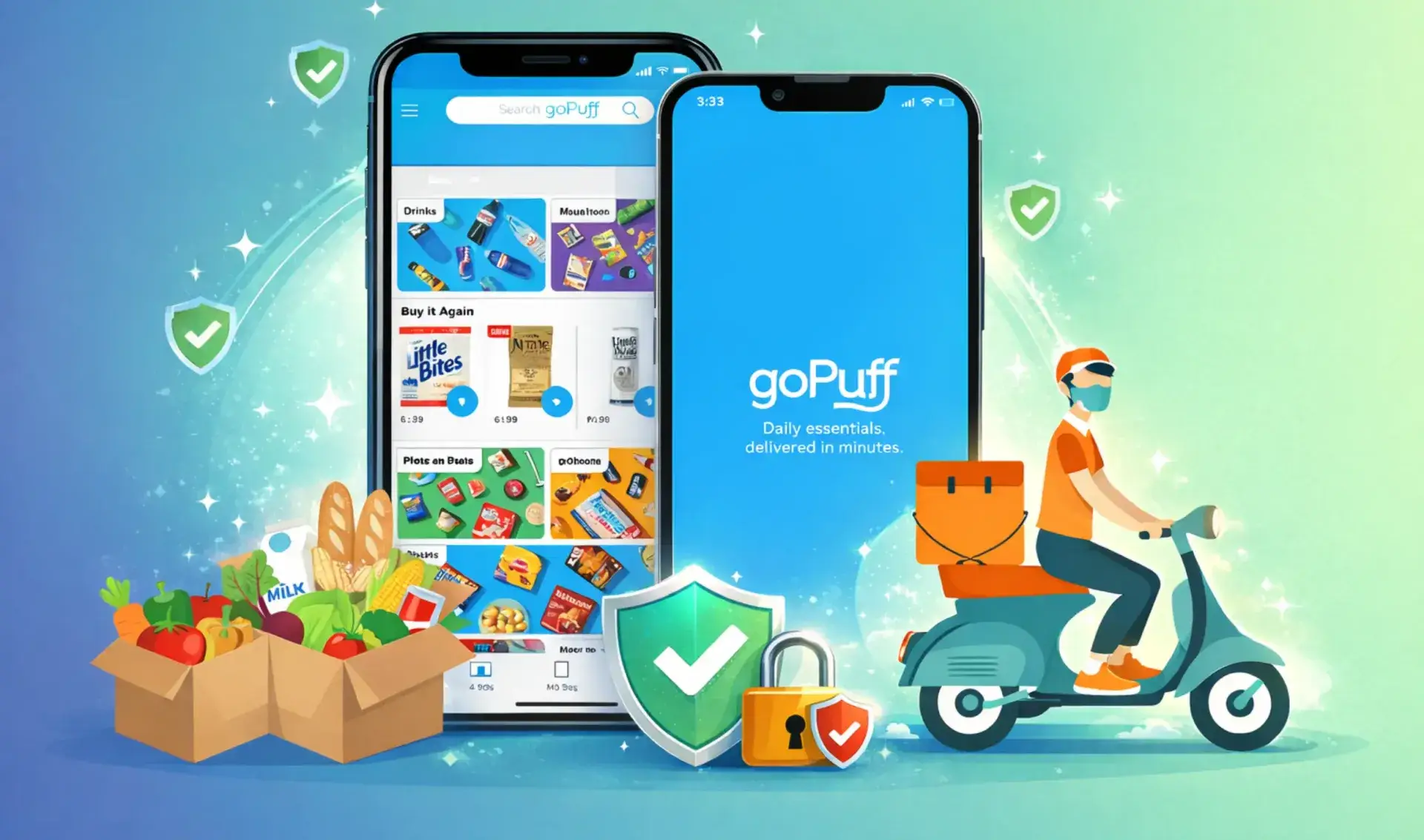
You’ve heard the horror stories about data breaches, leaked customer addresses, and payment fraud in delivery apps. In 2026, on-demand grocery and instant delivery platforms are prime targets for cybercriminals.
A white-label GoPuff app handles sensitive customer data — addresses, payment details, real-time location, and order history. One security mistake can cost millions in fines and permanent reputation damage. That’s why businesses increasingly rely on experienced providers like Miracuves, where security architecture is built into the foundation of every deployment.
In this guide, we’ll give you an honest assessment of white-label GoPuff app security, the real risks involved, and practical steps to ensure your platform stays protected and compliant — and how Miracuves helps businesses achieve enterprise-grade protection from day one.
Understanding White-Label GoPuff App Security Landscape
A white-label GoPuff app is a pre-built on-demand delivery platform customized with your branding. Security responsibility is shared between the development provider, hosting infrastructure, third-party integrations, and your internal team.
Security is not automatic. It depends entirely on architecture, compliance standards, and ongoing monitoring.
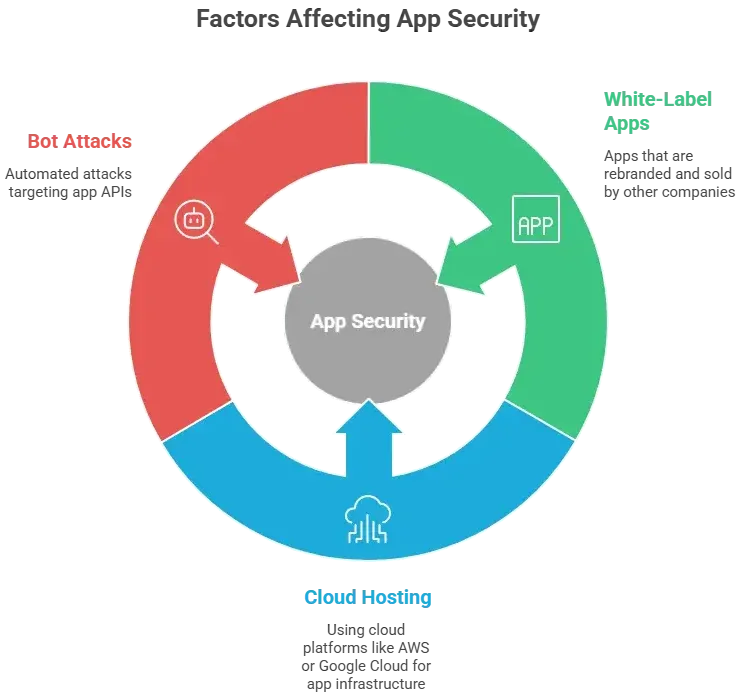
Why People Worry About White-Label Apps
- Shared codebase concerns
- Third-party payment integrations
- Location tracking sensitivity
- Fear of limited control over backend security
These concerns are valid — but manageable with the right provider.
Current Threat Landscape for Delivery-Type Platforms
On-demand grocery apps face:
- API abuse and bot attacks
- Payment fraud and chargeback scams
- Account takeover attacks
- Ransomware targeting cloud servers
- Data scraping of user addresses
According to IBM’s 2024 Cost of a Data Breach Report, the global average breach cost reached $4.45 million, with retail and service apps among the most targeted sectors.
Security Standards in 2026
Modern delivery apps must align with:
- Zero-trust architecture
- End-to-end encryption
- AI-driven fraud detection
- Mandatory data localization in some regions
- Strong identity verification systems
Security is no longer optional — it’s a competitive advantage.
Key Security Risks & How to Identify Them
High-Risk Areas in a White-Label GoPuff App
Data Protection & Privacy Risks
A GoPuff-style app processes highly sensitive data daily.
- User Personal Information: Names, phone numbers, home addresses, and delivery instructions. A breach exposes customers to identity theft and physical security risks.
- Payment Data Security: Card details must meet PCI DSS standards. Tokenization and encrypted storage are mandatory.
- Location Tracking Concerns: Real-time GPS tracking of users and drivers can be exploited if APIs are unsecured.
- GDPR / CCPA Compliance: Mishandling consent, data retention, or deletion requests can trigger heavy penalties — up to 4% of global annual turnover under GDPR.
Technical Vulnerabilities
Security failures often start at the technical layer.
- Code Quality Issues: Poor input validation leads to SQL injection and cross-site scripting attacks.
- Server Security Gaps: Misconfigured cloud storage is a leading cause of data leaks.
- API Vulnerabilities: Unauthenticated or weakly protected APIs allow data scraping and order manipulation.
- Third-Party Integrations: Payment gateways, SMS services, and analytics tools can introduce supply-chain risks.
Business Risks
Security incidents extend beyond technical damage.
- Legal Liability: Data protection violations result in regulatory investigations.
- Reputation Damage: Delivery apps depend heavily on trust and repeat customers.
- Financial Losses: Fraud, refunds, downtime, and legal fees add up quickly.
- Regulatory Penalties: Non-compliance with PCI DSS, GDPR, or regional laws can lead to significant fines.
White-Label GoPuff App Risk Assessment Checklist
Use this quick checklist:
- Is all sensitive data encrypted at rest and in transit?
- Are APIs protected with authentication and rate limiting?
- Is there a documented incident response plan?
- Are regular penetration tests conducted?
- Is GDPR/CCPA compliance formally documented?
- Are payment systems PCI DSS certified?
- Is role-based access control implemented internally?
If you cannot confidently answer yes to these, your app is exposed.
Security Standards Your White-Label GoPuff App Must Meet
Essential Certifications and Compliance Frameworks
ISO/IEC 27001 (Information Security Management System)
This is the most recognized security management standard. The 2022 version aligns Annex A to a streamlined set of 93 controls (reduced from 114), focusing on modern risks like cloud security, threat intelligence, and data leakage prevention.
SOC 2 Type II (Operational Security Controls Over Time)
SOC 2 is especially important if you handle customer data on behalf of business clients. Type II matters because it evaluates controls over a period of time, not just a point-in-time snapshot. SOC 2 is based on AICPA’s Trust Services Criteria (Security is core; others can be included based on scope).
GDPR (EU/EEA Users) and CCPA/CPRA (California Users)
If your GoPuff-style app has EU users (or processes EU personal data), GDPR applies. For serious violations, fines can reach €20 million or 4% of global annual turnover, whichever is higher.
For US privacy, CCPA/CPRA typically requires strong transparency, consent choices, and deletion/access workflows (especially around data sharing and tracking).
HIPAA (Only if You Handle Protected Health Information)
A typical instant-delivery grocery app usually doesn’t fall under HIPAA. But if your platform delivers prescriptions or integrates with covered healthcare workflows that involve PHI, HIPAA security and privacy obligations may apply.
PCI DSS (Payments)
If you accept card payments, PCI DSS is not optional. PCI DSS v4.0 became the industry standard after v3.2.1 retirement, and v4.0 requirements became mandatory by March 31, 2025 (with a limited revision v4.0.1 released June 11, 2024).
Technical Requirements to Treat as Non-Negotiable
End-to-End Encryption
- Encrypt data in transit (TLS) and at rest (database/storage encryption)
- Strong key management (rotation, least-privilege access)
Secure Authentication (2FA/OAuth)
- Support OAuth where relevant
- Require 2FA for admin and high-risk roles
- Enforce strong password policy + rate limiting + bot protection
Regular Security Audits and Penetration Testing
- Quarterly vulnerability scanning
- At least annual independent penetration testing (more often if high growth or frequent releases)
SSL/TLS Certificates
- TLS everywhere (app, API, admin panel)
- HSTS + modern cipher suites
Secure API Design
- Strong auth (JWT best practices, short-lived tokens)
- Input validation, schema validation
- Rate limits, anomaly detection, anti-scraping defenses
- Proper authorization checks for every object (avoid IDOR)
Security Standards Comparison Table
| Standard / Certification | What it protects you from | Who needs it most | Typical proof you should demand |
|---|---|---|---|
| ISO/IEC 27001 | Weak governance, inconsistent security controls | Teams scaling fast, enterprise deals | ISO certificate + ISMS scope statement |
| SOC 2 Type II | “We say we’re secure” claims without evidence | B2B clients, enterprise partnerships | SOC 2 Type II report + auditor letter |
| GDPR | Consent, deletion failures, unlawful processing | Any EU/EEA data processing | DPIA templates, ROPA, DPA, breach process |
| HIPAA (if applicable) | PHI exposure + regulatory action | Health-delivery workflows | BAAs, security rule controls, audit trails |
| PCI DSS v4.0 | Card data theft and payment fraud exposure | Any card acceptance flow | AOC/ROC, scope diagram, tokenization proof |
Red Flags: How to Spot Unsafe White-Label Providers
Choosing the wrong white-label GoPuff app provider can expose your business before launch.
Warning Signs You Should Never Ignore
No Security Documentation
If they cannot provide:
- Security architecture overview
- Data flow diagram
- Compliance certificates
Walk away.
Cheap Pricing Without Explanation
Enterprise-grade security costs money. Extremely low pricing often means:
- Shared insecure infrastructure
- No dedicated security team
- No penetration testing
No Compliance Certifications
If they claim “GDPR compliant” but have no documentation, audits, or legal review — that’s marketing, not compliance.
Outdated Technology Stack
Old frameworks, unsupported libraries, or no patch management process create direct vulnerability exposure.
Poor Code Quality
No code review process, no version control transparency, and no documented development lifecycle (SDLC) are major risks.
No Security Updates Policy
Ask how frequently security patches are deployed. If updates are irregular, risk increases monthly.
No Data Backup System
No automated encrypted backups = permanent data loss after ransomware or server failure.
No Insurance Coverage
Cyber liability insurance shows maturity. A serious provider carries coverage.
Evaluation Checklist Before Signing a Contract
Questions to Ask Providers
- Do you follow ISO 27001 controls?
- Do you have SOC 2 Type II certification?
- How often do you conduct penetration testing?
- How is user data encrypted?
- Who handles incident response?
Documents to Request
- Compliance certificates
- Data Processing Agreement (DPA)
- Security audit reports
- PCI DSS Attestation of Compliance
- Backup and disaster recovery plan
Testing Procedures
- Request staging access for security review
- Conduct independent vulnerability scan
- Perform API security testing
- Verify role-based access controls
Due Diligence Steps
- Legal compliance review
- Infrastructure security audit
- Review third-party integrations
- Confirm data hosting location
- Validate SLA for security incidents
Security due diligence before launch is far cheaper than post-breach recovery.
Read more : – Business Model of GoPuff : Complete Strategy Breakdown 2025
Best Practices for Secure White-Label GoPuff App Implementation
Security is not a one-time setup. It is a structured process before and after launch.
Pre-Launch Security
Security Audit Process
- Conduct full vulnerability assessment
- Perform third-party penetration testing
- Review access control policies
- Validate encryption implementation
Code Review Requirements
- Secure coding standards (OWASP guidelines)
- Static and dynamic code analysis
- Dependency vulnerability scanning
Infrastructure Hardening
- Firewall configuration
- Web Application Firewall (WAF) deployment
- Database access restrictions
- Secure cloud configuration (no public buckets)
Compliance Verification
- Confirm GDPR/CCPA workflows
- Validate PCI DSS scope
- Prepare incident response documentation
- Document data retention policies
Staff Training Programs
- Phishing awareness training
- Secure admin access policies
- Incident escalation procedures
Post-Launch Monitoring
Continuous Security Monitoring
- 24/7 server monitoring
- Intrusion detection systems
- Real-time fraud monitoring
Regular Updates and Patches
- Monthly security patch cycle
- Emergency patch deployment for critical vulnerabilities
Incident Response Planning
- Defined breach response workflow
- 72-hour GDPR notification readiness
- Internal communication protocols
User Data Management
- Role-based data access
- Automated deletion workflows
- Consent tracking logs
Backup and Recovery Systems
- Daily encrypted backups
- Geo-redundant storage
- Disaster recovery testing every quarter
Security Implementation Timeline
| Phase | Key Actions | Timeline |
|---|---|---|
| Planning | Risk assessment, compliance mapping | Week 1–2 |
| Development Review | Code audit, vulnerability scan | Week 3–4 |
| Infrastructure Setup | Cloud hardening, WAF setup | Week 5 |
| Compliance Validation | GDPR/PCI verification | Week 6 |
| Pre-Launch Testing | Penetration testing, load testing | Week 7 |
| Launch + Monitoring | Go live with 24/7 monitoring | Ongoing |
A structured implementation plan drastically reduces breach probability.
Legal & Compliance Considerations
Security without legal compliance is incomplete. A white-label GoPuff app must align with regional data protection laws and industry regulations.
Regulatory Requirements
Data Protection Laws by Region
- European Union (GDPR): Requires lawful basis for processing, user consent tracking, breach notification within 72 hours, and data minimization.
- United States: CCPA/CPRA (California) mandates disclosure of data collection and user rights to delete or opt-out. Other states (Virginia, Colorado, Texas) have active privacy laws in 2026.
- United Kingdom: UK GDPR mirrors EU GDPR with local enforcement.
- India: Digital Personal Data Protection Act (DPDP Act) requires consent-based processing and strong data safeguards.
- Middle East (UAE, Saudi Arabia): Data protection regulations now enforce cross-border data controls and breach reporting.
If your delivery app operates internationally, compliance must be mapped country by country.
Industry-Specific Regulations
- PCI DSS v4.0 for payment processing
- Local e-commerce regulations
- Consumer protection laws
- Electronic transaction laws
User Consent Management
- Clear opt-in mechanisms
- Cookie consent banners
- Location tracking disclosure
- Easy withdrawal of consent
Privacy Policy Requirements
Your policy must clearly define:
- What data is collected
- Why it is collected
- Data retention period
- Third-party sharing details
- User rights and contact process
Terms of Service Essentials
- Limitation of liability
- Dispute resolution process
- Refund and cancellation rules
- Platform usage restrictions
Liability Protection
Insurance Requirements
- Cyber liability insurance
- Errors & omissions insurance
- Data breach response coverage
Legal Disclaimers
- Delivery liability boundaries
- Service interruption clauses
- Fraud prevention terms
User Agreements
- Explicit data processing consent
- Arbitration clauses (where applicable)
- Age restrictions
Incident Reporting Protocols
- Internal escalation structure
- Legal counsel notification
- Regulatory reporting timeline
- Customer communication templates
Regulatory Compliance Monitoring
- Annual legal compliance review
- Quarterly privacy audits
- Monitoring updates in data protection laws
Compliance Checklist by Region
| Region | Key Law | Must-Have Controls |
|---|---|---|
| EU | GDPR | Consent logs, DPO (if required), 72-hour breach reporting |
| USA (California) | CCPA/CPRA | Data disclosure, opt-out system, deletion workflow |
| UK | UK GDPR | Local data compliance, breach reporting |
| India | DPDP Act | Explicit consent, grievance officer |
| UAE | PDPL | Cross-border transfer safeguards |
Legal compliance is not optional. It directly protects your revenue, reputation, and expansion strategy.
Why Miracuves White-Label GoPuff App is Your Safest Choice
When security is treated as a feature instead of a foundation, businesses suffer. At Miracuves, security is engineered into the architecture from day one.
Miracuves Security Advantages
Enterprise-Grade Security Architecture
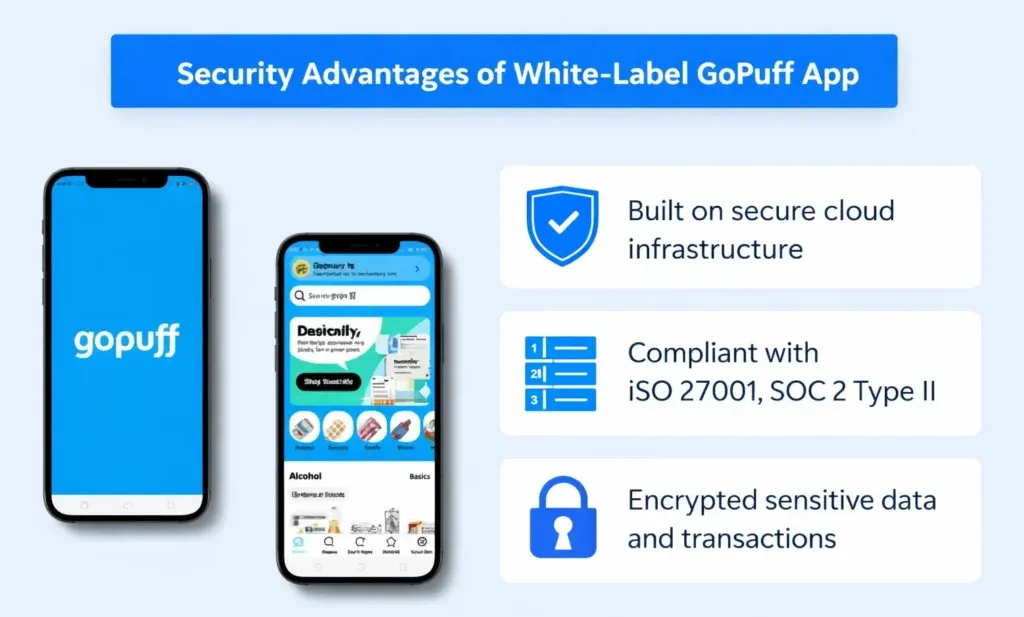
Built on secure cloud infrastructure with hardened servers, strict access controls, and zero-trust principles.
Regular Security Audits and Certifications
Periodic vulnerability assessments and independent penetration testing ensure continuous protection alignment with global standards.
GDPR and CCPA Compliance by Default
Built-in consent management, data access logs, and deletion workflows help you stay compliant across regions.
24/7 Security Monitoring
Real-time threat detection, intrusion monitoring, and proactive mitigation reduce breach risks.
Encrypted Data Transmission
TLS encryption for data in transit and strong encryption standards for stored data.
Secure Payment Processing
PCI DSS-aligned payment integrations with tokenization and fraud detection layers.
Regular Security Updates
Ongoing patch management and proactive vulnerability remediation.
Insurance Coverage Included
Cyber liability coverage and structured incident response planning add an extra layer of business protection.
Final Thought
Our 9k+ successful projects have maintained zero major security breaches. Get a free security assessment and discover why businesses trust Miracuves for safe, compliant delivery platforms.
Security is not an add-on for a white-label GoPuff app — it is the backbone of your business. In 2026, customers choose platforms they trust with their data, payments, and location.
FAQs
1. Is a white-label GoPuff app as secure as custom development?
Yes — if built under proper security standards like ISO 27001, SOC 2 Type II, and PCI DSS. Security depends on implementation, not the development model.
2. What happens if there is a security breach?
You must activate your incident response plan, isolate systems, notify regulators (within 72 hours under GDPR if applicable), and inform affected users.
3. Who is responsible for security updates?
The development provider manages core infrastructure updates, while business owners must ensure policy enforcement and compliance monitoring.
4. How is user data protected in a white-label app?
Through encryption at rest and in transit, role-based access control, secure APIs, and strict authentication mechanisms.
5. What compliance certifications should I look for?
ISO 27001, SOC 2 Type II, PCI DSS v4.0, and GDPR compliance documentation.
6. Can a white-label GoPuff app meet enterprise security standards?
Yes, if designed with zero-trust architecture, regular audits, and penetration testing.
7. How often should security audits be conducted?
At least annually, with quarterly vulnerability scans and continuous monitoring.
8. What is included in Miracuves security package?
Encrypted infrastructure, compliance-ready workflows, payment security alignment, monitoring, and regular updates.
9. How do you handle security in different countries?
By mapping regional data protection laws and configuring consent, storage, and reporting accordingly.
10. What insurance is needed for app security?
Cyber liability insurance and data breach response coverage are essential.
Related Articles