


Key Takeaways
What You’ll Learn
- DoorDash Mart operates as a quick-commerce model where the platform controls inventory, fulfillment, and last-mile delivery for faster order execution.
- Unlike the standard marketplace model, DoorDash Mart follows a more vertically integrated approach with owned or managed dark stores.
- The revenue model combines product margins with delivery-based earnings, creating a hybrid between retail and logistics monetization.
- Speed and convenience are the core value drivers, enabling customers to order groceries, snacks, and essentials with rapid delivery times.
- The model depends on efficient operations, including inventory management, demand forecasting, and delivery network optimization.
Stats That Matter
- Quick-commerce platforms generate revenue from both product sales and delivery fees, unlike pure marketplace models that rely mainly on commissions.
- Inventory control improves pricing flexibility, allowing platforms to manage margins and offer targeted promotions.
- Faster delivery times increase order frequency, making repeat purchases a key driver of revenue growth.
- Operational costs are higher due to warehousing, inventory management, and logistics coordination.
- A quick-commerce model becomes sustainable when order density, supply chain efficiency, and delivery speed are optimized together.
Real Insights
- DoorDash Mart works because it controls the full delivery experience, from inventory to last-mile logistics, rather than relying only on third-party merchants.
- Owning inventory increases margins, but also adds complexity and operational risk compared to asset-light marketplace models.
- Speed is the biggest competitive advantage, as customers value rapid delivery for everyday essentials.
- Scaling this model requires strong logistics infrastructure, because delays or stock issues can directly affect customer satisfaction.
- For entrepreneurs, the key lesson is that a DoorDash Mart–style model can be highly profitable when execution is strong, but it demands tighter operational control than traditional delivery platforms.
DoorDash reported approximately $10–10.5 billion in revenue in 2026, and within that massive figure, DashMart has quietly evolved into one of the company’s most strategic growth engines. While restaurant delivery fueled DoorDash’s early scale, DashMart represents its shift toward higher-margin, repeat-use commerce built around everyday essentials.
Unlike traditional food delivery marketplaces that depend heavily on commissions from third-party restaurants, DoorDash Mart operates as an inventory-owned instant commerce model. By owning the products, pricing, and fulfillment flow, DoorDash captures retail margins, controls the customer experience, and reduces its dependence on partner fees—fundamentally changing its unit economics.
For entrepreneurs and founders planning to build a DoorDash clone, DashMart offers a powerful lesson in modern commerce. It shows how owning supply chains, leveraging demand data, and optimizing hyperlocal fulfillment can transform delivery platforms from low-margin intermediaries into scalable, profit-oriented retail businesses within the quick commerce ecosystem.
DoorDash Mart Revenue Overview – The Big Picture
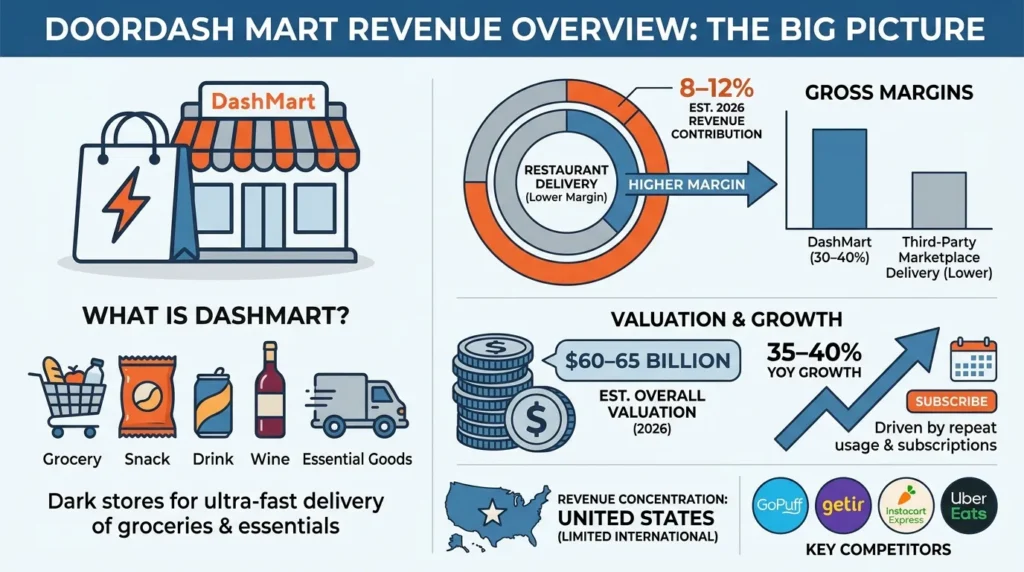
DoorDash Mart, commonly branded as DashMart, is DoorDash’s network of dark stores offering groceries, snacks, beverages, alcohol, and daily essentials with ultra-fast delivery.
In 2026, DashMart contributed an estimated 8–12% of DoorDash’s total revenue, but more importantly, it delivered significantly higher gross margins than restaurant delivery.
DoorDash’s overall valuation in 2026 hovered around $60–65 billion, supported by diversification beyond food delivery. DashMart’s year-over-year growth is estimated at 35–40%, driven by repeat usage and subscription customers.
Revenue is heavily concentrated in the United States, with limited international expansion. Gross margins range between 30–40%, outperforming third-party marketplace delivery. Competitors include GoPuff, Getir, Instacart Express, and Uber Eats convenience verticals.
Read More: How Safe is a White-Label DoorDash App? Security Guide 2025
Primary Revenue Streams Deep Dive
DashMart’s monetization strategy is built around margin ownership and frequency, not commissions.
Revenue Stream #1: Inventory Sales & Retail Margins
DashMart purchases goods wholesale and sells them directly to consumers.
This allows DoorDash to capture retail margins similar to convenience stores while leveraging its logistics network. Markups vary by category, with snacks, beverages, and private-label products generating the highest margins.
This stream alone accounts for more than half of DashMart’s total revenue.
Revenue Stream #2: Delivery Fees
Customers pay delivery fees on each order unless covered by DashPass.
Fees are dynamically adjusted based on demand, time of day, and distance. While lower than restaurant delivery fees, the volume makes this a meaningful contributor.
Revenue Stream #3: DashPass Subscriptions
DashPass offers free or discounted delivery for a monthly fee of around $9.99.
Subscribers order more frequently, increasing overall lifetime value and stabilizing revenue. DashPass also reduces price sensitivity across other revenue streams.
Revenue Stream #4: Advertising & Sponsored Listings
Consumer packaged goods brands pay to promote products within DashMart.
Sponsored listings, banner placements, and targeted ads turn DashMart into a retail media network, one of the fastest-growing monetization layers.
Revenue Stream #5: High-Value Categories & Add-ons
Alcohol, health products, and late-night essentials carry higher average order values and margins, boosting profitability per delivery.
Revenue Streams Breakdown
| Revenue Stream | Share of DashMart Revenue |
|---|---|
| Inventory margins | 55–60% |
| Delivery fees | 14–16% |
| DashPass subscriptions | 9–11% |
| Advertising & promotions | 8–10% |
| Alcohol & premium add-ons | 5–7% |
The Fee Structure Explained
DashMart’s fee model is intentionally simple for users but layered underneath.
User-Side Fees
Customers may pay a delivery fee, a small service fee, and surge pricing during peak hours. These fees are often waived or reduced for DashPass members.
Provider-Side Fees
There are no merchant commissions because DoorDash owns the inventory directly.
Hidden Revenue Layers
DashMart benefits from wholesale rebates, supplier-funded promotions, and private-label margins that are invisible to end users.
Regional Pricing Variations
Urban areas typically feature lower delivery fees but higher order frequency, while suburban regions rely on higher fees and larger basket sizes.
Fee Structure by User Type
| User Type | Fees Paid | Monetization Logic |
|---|---|---|
| Regular customers | Delivery + service fees | Transaction-based revenue |
| DashPass members | Subscription fee | Recurring revenue + higher LTV |
| Brands & suppliers | Ad spend | High-margin retail media income |
How DoorDash Mart Maximizes Revenue Per User
DashMart is engineered to increase order frequency rather than order size alone.
Customer segmentation targets late-night users, families, and repeat essentials buyers. Upselling is driven through smart bundles, while cross-selling integrates DashMart items into restaurant orders.
Dynamic pricing adjusts delivery fees and product pricing in real time. Retention is powered by DashPass, which locks users into habitual ordering behavior.
Psychological pricing strategies such as $9.99 bundles, free-delivery thresholds, and limited-time deals increase conversion. DashPass users place more than twice as many monthly orders compared to non-subscribers.
Cost Structure & Profit Margins
DashMart’s cost structure is heavier than a marketplace but more defensible.
Key costs include dark-store leases, utilities, cold storage, last-mile delivery incentives, inventory spoilage, and technology investments. Marketing spend focuses on in-app promotions rather than external advertising, lowering CAC over time.
With average order values between $28–35, mature DashMart locations achieve positive contribution margins. Profitability improves with store density, private-label expansion, and automation in fulfillment.
Read More: Best DoorDash Clone Script 2025 — Launch Your Food Delivery App
Future Revenue Opportunities & Innovations
DashMart’s future lies in scaling efficiency and data monetization.
AI-driven demand forecasting reduces inventory waste. Private-label expansion improves margins. Advertising is expected to exceed 15% of DashMart revenue by 2027.
Expansion into health, wellness, and B2B essentials presents new growth channels. Automation and micro-fulfillment centers will further reduce per-order costs.
For founders, the biggest opportunity lies in localized instant commerce platforms outside saturated metro markets.
Global Cost of Development for a DoorDash Mart-Like App
DoorDash Mart-Like Quick Commerce App Development — Market Price by Tech Stack
The tech stack affects product browsing, inventory updates, order processing, live delivery tracking, and payment flow in a DoorDash Mart-like app. PHP/Laravel works well for cost-effective launches, Node.js/React.js supports real-time orders and inventory sync, while Go microservices suit high-volume, multi-location quick-commerce platforms.
PHP/Laravel is often the most practical choice for launching a DoorDash-like platform quickly and affordably. Node.js/Python fits real-time tracking and data-intensive delivery operations, while Go microservices are better suited for enterprise platforms with high concurrency, multi-city scale, and complex infrastructure requirements.
These values reflect global development cost estimates. Final pricing varies based on customer and driver apps, product catalogs, inventory management, dark-store operations, live tracking, payments, subscriptions, offers, admin controls, and platform complexity.
Miracuves DoorDash Mart-Like Platform Solution Cost and Tech Stack
Miracuves Pricing for a DoorDash Mart-Like Instant Grocery and Convenience Delivery Platform App developed in PHP/Laravel with Flutter Apps for $3,399 USD (One-Time Price) in just 6 days
Get a fully developed, deployment-ready quick-commerce platform modeled after DoorDash Mart. Built on a stable PHP foundation, this complete package includes everything you need to launch and scale an inventory-led delivery business for groceries, household essentials, snacks, beverages, personal care products, and everyday convenience items:
- Core Workflows: Customer registration, product browsing, category management, cart checkout, order placement, inventory updates, dark store assignment, delivery partner allocation, live order tracking, and customer notifications.
- Built-in Revenue Logic: Product retail margins, delivery charges, service fees, small-order fees, subscription benefits, promoted products, brand advertising, surge pricing, and convenience-based monetization.
- Management Hub: Centralized admin dashboard, customer management, inventory control, warehouse or dark store management, product management, order monitoring, delivery partner management, payment records, refund handling, and commerce analytics.
- Launch-Ready: Fully prepared for your custom branding, configuration, payment gateway setup, product catalog setup, delivery zone configuration, inventory onboarding, and immediate market entry.
Why Is DoorDash Mart-Like Platform Development More Affordable?
Most quick-commerce platforms become expensive when businesses choose fully custom development from scratch. A DoorDash Mart-style platform usually needs customer apps, inventory systems, dark store controls, product catalogs, delivery partner workflows, order dispatch, real-time tracking, payments, refunds, promotional tools, and admin operations. Building all of this separately can increase both development cost and launch time.
We took a smarter, more practical approach:
- You Aren’t Paying for Ground-Up Development: Our quick-commerce delivery engine is already developed, tested, and ready to deploy. You skip the inflated cost and long waiting period usually required for building an instant retail delivery platform from scratch.
- The Power of PHP: We built this solution on a reliable and cost-effective PHP architecture. This keeps the upfront price affordable while supporting essential quick-commerce workflows such as product management, inventory control, dark store operations, customer ordering, delivery assignment, payments, tracking, and admin management.
You get a launch-ready DoorDash Mart-like platform with practical inventory, retail, delivery, and monetization features, source code access, and faster deployment without the high custom development price tag.
Note: This cost is for the solution, re-branding, deployment, and source code only.
Lessons for Entrepreneurs & Your Opportunity
DashMart proves that owning supply chains unlocks margin control.
Founders can replicate dark-store logistics, focus on high-frequency SKUs, and bundle subscriptions for predictable revenue. Major gaps exist in Tier-2 cities and vertical-specific quick commerce like pharmacy, office supplies, and campus delivery.
Platforms that prioritize frequency and convenience can scale faster than traditional marketplaces.
Conclusion
DashMart proves that delivery platforms do not need to depend on commissions forever. By owning inventory, pricing, and fulfillment, a DoorDash-like app can evolve from being a middleman into a retail operator with stronger control over margins, product availability, and the overall customer experience.
The real advantage lies in frequency. Daily essentials, rapid fulfillment, and subscription-driven behavior can turn occasional users into habitual buyers, significantly improving customer lifetime value while reducing long-term acquisition costs.
For entrepreneurs, DashMart highlights the power of vertical focus and localized execution. Success does not require national scale from day one—dense delivery coverage, smart SKU selection, and operational efficiency matter far more. Miracuves helps businesses turn this model into a scalable, market-ready quick commerce platform tailored to their goals. Let’s build together.
FAQs :-
1. How much does DoorDash Mart make per transaction?
Around $8–12 gross profit per order in mature markets.
2. What’s DashMart’s most profitable revenue stream?
Inventory margins, especially private-label products.
3. How does DashMart’s pricing compare to competitors?
Slightly higher than supermarkets but competitive with GoPuff.
4. What percentage does DoorDash take from providers?
None, as DoorDash owns the inventory.
5. How has DashMart’s revenue model evolved?
From delivery commissions to margin-led retail and advertising.
6. Can small platforms use similar models?
Yes, especially in focused local markets.
7. What’s the minimum scale for profitability?
Dense urban coverage with repeat users.
8. How to implement similar revenue models?
Combine dark stores, subscriptions, and data-driven pricing.
9. What are alternatives to DashMart’s model?
Pure marketplace delivery or hybrid commission-retail models.
Miracuves is an independent software development company. We are not affiliated with, connected to, sponsored by, or endorsed by any company or product named in this article.
Terms such as “X Clone” are used descriptively. It is how the software industry refers to building a platform with functionality comparable to a known service, and how clients search for it.
The entire design and codebase of our products is built by our own team. Our products contain no code, design, graphics, or content originating from any third-party website or applications.
All third-party names and marks referenced in this article are the property of their respective owners, referenced solely to identify the services discussed.