





















Key Takeaways
- Trust and security in an on-demand food delivery platform should protect customer accounts, restaurant access, rider identities, payments, order data, location information, payouts, and administrative actions.
- Layered protection can combine secure authentication, multi-factor verification, encryption, payment tokenization, role-based access, fraud monitoring, session controls, and audit logging.
- Security should follow the entire delivery journey, from login and checkout to restaurant acceptance, rider assignment, live tracking, delivery confirmation, refunds, and settlement.
Account & Payment Security Signals
- Customer account protection can include password security, MFA, device recognition, suspicious-login alerts, account recovery safeguards, session expiry, and controls for sensitive profile changes.
- Payment security should use trusted gateway integrations, encrypted communication, tokenized payment details, transaction verification, refund controls, idempotency, and monitoring for abnormal payment behavior.
- Operators should monitor failed logins, repeated payment failures, unusual order values, refund abuse, account takeovers, suspicious device activity, and mismatches between payment and order status.
Restaurant & Delivery Operations Insights
- Restaurant dashboards should use verified onboarding, staff permissions, payout-change protection, approval rules, secure sessions, and audit trails for menu, pricing, order, and financial changes.
- Delivery operations can use rider identity verification, device binding, GPS controls, pickup and delivery confirmation, proof of delivery, payout protection, fraud detection, and restricted access to customer data.
- Miracuves develops customizable food delivery platforms with secure accounts, payment integrations, restaurant permissions, rider verification, fraud monitoring, audit logs, payouts, analytics, and admin controls.
An on-demand food delivery platform does more than accept orders and send them to restaurants. It handles customer accounts, saved addresses, payment flows, restaurant dashboards, delivery partner activity, refunds, payouts, disputes, location data, support actions, and admin decisions.
That is why trust and security cannot be treated as a single feature. They need to be designed into every part of the platform.
For founders, this matters because users may forgive a small design flaw, but they rarely forgive payment confusion, account misuse, wrong refunds, exposed addresses, fake delivery updates, or unclear restaurant payouts. Trust is not built only through branding. It is built through controls that protect every role in the marketplace.
Founders evaluating a ready-made food delivery platform foundation should look beyond customer ordering screens and check whether the backend can support secure payments, restaurant permissions, delivery proof, refunds, payouts, and admin-level control.
A secure delivery platform should answer four practical questions:
- Can customers order and pay safely?
- Can restaurants manage orders, menus, and payouts without risk?
- Can delivery operations be tracked and verified properly?
- Can the platform operator control refunds, disputes, access, and payouts with clear records?
This guide explains the security layers founders should evaluate before launching or upgrading a food delivery marketplace.
Why Trust Is a Core Product Layer in Food Delivery Marketplaces
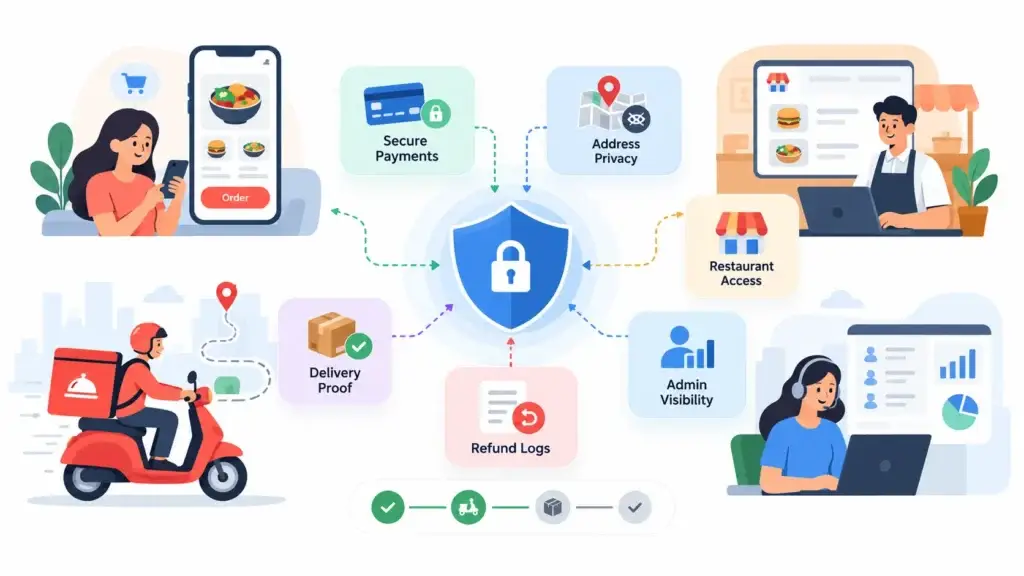
Food delivery is time-sensitive, location-based, and transaction-heavy. A single order may involve a customer, restaurant, delivery partner, payment gateway, support team, and platform admin.
This creates more risk points than a simple ecommerce checkout.
A customer may worry about payment safety or address privacy. A restaurant may worry about unauthorized staff changing menu prices or payout details. A delivery partner may need clear pickup and delivery proof. The platform operator may need reliable logs for refunds, disputes, cash reconciliation, and suspicious activity.
That is why trust should be designed as a complete operating layer, not as an afterthought.
Founders comparing a ready-made delivery system can use this topic as a practical review checklist before moving to a commercial decision. For example, the ready-made multi-market delivery platform foundation from Miracuves can be evaluated through the same lens: account control, payment handling, restaurant access, delivery workflows, and admin visibility.
The Four Trust Zones Every Food Delivery Platform Must Protect
A strong food delivery platform should separate security into four connected zones.
| Trust Zone | What It Protects | Why It Matters |
|---|---|---|
| Customer accounts | Login, saved addresses, orders, refunds, payments | Protects user confidence and repeat ordering |
| Payment flows | Cards, wallets, cash, refunds, payouts, gateway records | Reduces financial risk and dispute confusion |
| Restaurant access | Menus, prices, staff roles, order acceptance, payout details | Prevents operational mistakes and unauthorized changes |
| Delivery operations | Delivery partner identity, live tracking, pickup, proof of delivery, cash settlement | Improves accountability and reduces fraud |
These trust zones become easier to manage when the platform’s core food delivery platform features already include customer ordering flows, restaurant dashboards, delivery apps, payment rules, zone controls, cash handling, and operator-level visibility.
These zones should not work separately. A refund decision may depend on payment records, restaurant preparation status, delivery proof, and support notes. A payout dispute may depend on restaurant commission settings, order status, cash collection, and admin approval history.
The more connected the control layer is, the easier it becomes for the platform operator to manage growth without losing visibility.
Customer Account Security: Protecting Login, Address, and Order Data
Customer account security starts with identity. A food delivery platform should support secure signup, login verification, account recovery, and session management.
This is especially important because customer accounts may contain phone numbers, saved addresses, order history, refund records, loyalty balances, wallet balances, and payment references.
Useful customer-side controls include:
- OTP or email verification during signup
- Strong password and account recovery flows where passwords are used
- Device and session management
- Rate limits for repeated login attempts
- Suspicious login alerts
- Order-level authorization
- Saved address controls
- Secure logout across devices
Security guidance from OWASP recommends stronger authentication for sensitive actions, risk-based reauthentication, secure session handling, generic authentication error messages, login throttling, and account lockout decisions that balance protection with usability.
Why order-level authorization matters
Every customer should only see their own orders. This sounds obvious, but it is one of the most important rules in delivery marketplace security.
The platform should not expose another user’s invoice, address, phone number, delivery status, refund details, or support ticket because someone changes an order ID in a URL or API request.
Order-level authorization should apply across:
- Order history
- Live tracking
- Payment records
- Refund requests
- Support tickets
- Saved addresses
- Delivery instructions
- Notifications
This protects both privacy and platform credibility.
Payment Security: Cards, Wallets, Cash, Refunds, and Reconciliation
Payments are one of the most sensitive parts of a food delivery platform. Customers want smooth checkout, restaurants want predictable settlement, delivery partners need accurate earnings, and operators need clean transaction records.
A secure payment layer should include:
- Secure payment gateway integration
- Tokenized payment flows where applicable
- Payment status matching with order status
- Failed payment handling
- Refund approval rules
- Transaction logs
- Wallet or credit balance records where used
- Cash collection tracking where cash orders are active
- Payout and settlement reporting
Tokenization replaces sensitive payment account data with a token and may reduce the amount of cardholder data stored in merchant systems, though it does not remove the need for applicable payment security and compliance responsibilities.
Digital payment controls
For digital payments, the platform should avoid unnecessary storage of sensitive card data. It should rely on trusted gateway workflows, payment references, transaction logs, and reconciliation records.
A good checkout flow should also handle failed payments carefully. If payment fails but the order is still created, the customer, restaurant, and support team may all see conflicting information. This creates confusion and operational risk.
The order system and payment system should stay synchronized.
Refund controls
Refunds should not depend only on manual judgment. A reliable platform should connect refunds to:
- Order status
- Payment status
- Restaurant acceptance
- Delivery progress
- Customer complaint reason
- Support notes
- Delivery proof
- Admin approval history
High-value refunds, repeated refund requests, and unusual refund patterns should require stronger review.
Cash order controls
In many markets, cash payment remains important. Cash creates a different type of trust challenge because the platform must track money collected outside the digital gateway.
Cash order controls should include:
- Cash collected per order
- Delivery partner cash balance
- Settlement due to platform
- Restaurant payout impact
- Cash limits by zone or order value
- Admin reconciliation
- Dispute history
Payment protection also connects with the platform’s delivery marketplace revenue and payout model, because commissions, delivery fees, refunds, cash balances, restaurant settlements, service charges, and promotional credits all need clear records.
If cash is not tracked properly, the platform may lose visibility into real earnings, unpaid balances, and delivery partner settlement.
Restaurant Access Security: Menus, Orders, Staff Roles, and Payout Details
Restaurants need control over their daily operations, but that control should be structured carefully.
A restaurant dashboard may include menu items, prices, add-ons, availability, opening hours, order acceptance, cancellations, staff roles, sales reports, and payout records. If the platform gives every restaurant user the same access, small mistakes can become expensive.
Restaurant verification before activation
Before a restaurant goes live, the platform should support an approval workflow. The exact documents depend on the operating market, but the process may include business information, owner details, payout account details, store location, tax information, food license information, and admin review.
Verification helps the platform reduce fake listings and build restaurant accountability.
Staff-level permissions
Restaurants often have multiple users. The owner, manager, kitchen staff, and accountant should not all have the same access.
| Restaurant Role | Access Needed | Access to Restrict |
|---|---|---|
| Owner | Business profile, staff access, payouts, menu, reports | Platform-wide admin controls |
| Manager | Menu availability, order acceptance, opening hours | Payout account changes |
| Kitchen staff | Incoming orders and preparation status | Pricing, reports, and staff settings |
| Accountant | Settlement reports and payout history | Menu editing and order cancellation |
This protects restaurants from internal mistakes and gives the platform clearer accountability.
Menu and price change logs
Menu changes affect live customer ordering. If a restaurant changes pricing, taxes, add-ons, item names, availability, or operating hours, the platform should record who made the change and when.
Audit logs help answer questions such as:
- Who changed this item price?
- When was this dish marked unavailable?
- Who changed the restaurant’s payout account?
- Was this discount applied manually?
- Why was this order cancelled?
These records are operational safeguards, not just technical logs.
Delivery Operations Security: Identity, Location, Pickup, and Proof
Delivery operations are where digital trust meets real-world movement. A delivery partner accepts an order, reaches the restaurant, confirms pickup, travels to the customer, completes handoff, and may collect cash depending on the market.
A secure delivery workflow should create accountability at each step.
Delivery partner verification
Before activation, delivery partners should go through identity and profile verification. Depending on the operating model, this may include phone verification, document upload, vehicle details, service area selection, payout details, and admin approval.
The goal is to make sure the platform knows who is handling orders and how to contact, monitor, and settle with them.
Pickup and delivery proof
Delivery proof reduces disputes between customers, restaurants, delivery partners, and support teams.
Common proof options include:
- Pickup confirmation from the restaurant
- Delivery OTP
- Photo proof
- Customer signature
- QR code scan
- GPS-based completion check
- Timestamped status updates
The right proof method depends on local customer behavior, order value, delivery density, and support cost.
Location access controls
Live location is useful during active delivery, but it should not become uncontrolled tracking.
A privacy-conscious platform should limit location use to operational needs such as assignment, route progress, estimated arrival, pickup, and delivery completion. Delivery partners should not see unnecessary customer data after the order is completed, and customers should only see tracking that is relevant to their active order.
Admin Panel Security: The Control Room of the Platform
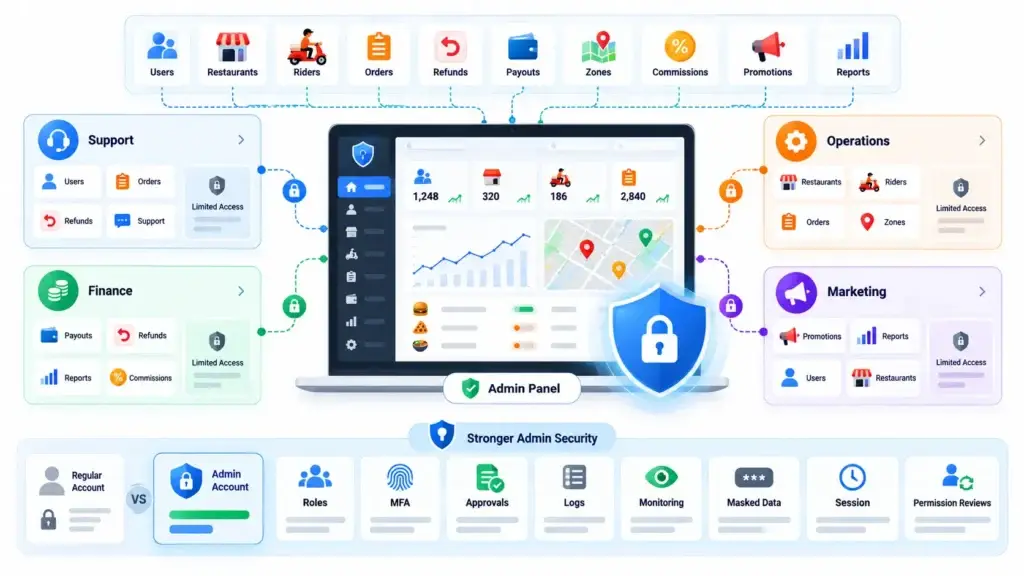
The admin panel is where the platform operator manages users, restaurants, delivery partners, orders, refunds, payouts, zones, commissions, support actions, promotions, and reports.
Because it controls so many sensitive workflows, admin security should be stronger than ordinary account security.
Important admin controls include:
- Role-based admin permissions
- Stronger login protection for sensitive roles
- Approval workflows for refunds and payout changes
- Action logs for important changes
- Support access limits
- Data masking where appropriate
- Session expiry
- Activity monitoring
- Permission reviews
OWASP guidance notes that MFA is a critical security control and may be especially important for sensitive actions such as changing account settings, disabling MFA, or elevating a session to administrative access.
Admin roles should be separated
A support user may need order history and complaint details. A finance user may need settlement records. An operations user may need restaurant approvals and delivery activity. A marketing user may need promotions and banners.
They do not all need full platform access.
Separating admin roles helps prevent accidental changes, internal misuse, and unnecessary exposure of sensitive data.
Trust Controls Across the Full Order Lifecycle
Security should follow the order from start to finish. Readers who want a simpler operational overview can first understand how an on-demand delivery platform works across ordering, restaurant acceptance, dispatch, tracking, support, refunds, and settlement.
| Order Stage | Trust Risk | Control Needed |
|---|---|---|
| Signup | Fake accounts or account takeover | Verification, session control, suspicious login checks |
| Browse and cart | Pricing mismatch or unavailable items | Menu sync, availability controls, restaurant logs |
| Checkout | Failed payment or payment mismatch | Gateway records, order-payment matching |
| Restaurant acceptance | Incorrect acceptance or cancellation | Status permissions and cancellation rules |
| Pickup | False pickup claim | Pickup confirmation and timestamps |
| Delivery | Wrong handoff or fake completion | OTP, proof, GPS, or customer confirmation |
| Refund | Refund abuse or unclear responsibility | Reason codes, support review, approval logs |
| Payout | Restaurant or delivery partner dispute | Settlement history and reconciliation |
This lifecycle view helps founders avoid building security in disconnected pieces.
Founder Decision Signals Before Launch
Speed
Launch speed is valuable only when the core workflows already include account, payment, restaurant, delivery, and admin controls.
Control
The platform operator should be able to manage users, restaurants, delivery partners, refunds, payouts, disputes, and permissions from the backend.
Scalability
Security should scale with more restaurants, more zones, more delivery partners, more payment methods, and higher order volume.
Market Fit
The right trust controls depend on local payment habits, cash usage, restaurant workflows, delivery density, and support expectations.
What Founders Should Check Before Choosing a Delivery Platform
Before choosing a ready-made or custom food delivery platform, founders should ask practical security questions.
When comparing platform options, founders should also review how the team handles architecture, ownership, integrations, launch support, and market-specific configuration before choosing the right delivery app development partner
1. Does each role have separate permissions?
Customers, restaurants, delivery partners, support teams, finance users, and platform admins should not share broad access.
2. Are sensitive actions logged?
Refund approvals, payout changes, menu edits, commission updates, account suspensions, and delivery status changes should be traceable.
3. Can restaurants manage staff safely?
A restaurant should not need to share one login across owners, managers, kitchen staff, and accountants.
4. Is payment data handled carefully?
The platform should use secure payment gateway workflows and avoid unnecessary storage of sensitive payment data.
5. How are delivery disputes resolved?
There should be pickup confirmation, delivery proof, timestamps, status history, and support notes.
6. Can cash orders be reconciled?
If cash is part of the market, the platform should track cash collected, delivery partner balances, settlement due, and admin reconciliation.
7. Does the operator own the source code?
Source-code ownership matters because trust and security needs evolve. A founder may later need new payment rules, access roles, compliance workflows, fraud checks, or reporting layers.
How Miracuves Supports Faster Launch With Control
Miracuves helps founders launch food delivery platforms using ready-made and white-label app foundations that can be customized for brand, market, payment flow, restaurant operations, delivery workflow, and admin control.
For founders who want to avoid building every module from zero, aready-made multi-market delivery platform foundation can reduce execution time while still allowing business-specific configuration around restaurants, zones, payments, payouts, and delivery operations.
Miracuves can support 6-day solution delivery for ready-made builds where the selected scope, branding, integrations, and customization requirements fit the launch path. For founders budgeting the launch, it is useful to compare security requirements with delivery app development cost and launch scope, especially when payment gateways, restaurant access, delivery workflows, admin permissions, cash handling, and reporting affect the final build.
Mistakes Founders Should Avoid
Treating security as a final testing task
Security should be part of the product foundation. If access control, payment records, audit logs, and dispute workflows are added later, the platform may already have operational gaps.
Giving every admin user full access
Support, finance, operations, and marketing teams need different permissions. Full access should be limited to a small number of trusted platform operators.
Ignoring restaurant staff roles
A single shared restaurant login can create problems with menu changes, order cancellations, payout visibility, and staff accountability.
Weak delivery proof
If pickup and delivery cannot be verified clearly, disputes become harder to resolve and refund decisions become less reliable.
Poor cash reconciliation
Cash orders can work well in the right market, but only when cash collected, delivery partner balances, settlement, and reconciliation are visible.
Security Checklist for an On-Demand Food Delivery Platform
| Control Area | Customer App | Restaurant Panel | Delivery Operations | Admin Panel |
|---|---|---|---|---|
| Login security | OTP, session control, recovery flow | Staff login and access roles | Verified login and device checks | Stronger login for sensitive users |
| Access control | Own orders only | Own menu, orders, reports | Assigned orders only | Role-based permissions |
| Payment safety | Secure gateway flow | Settlement visibility | Cash collection records | Refund and payout approvals |
| Privacy | Address and order privacy | Limited customer details | Limited post-delivery access | Data masking where needed |
| Audit logs | Order and refund history | Menu and payout change logs | Pickup and delivery status logs | Admin action history |
| Disputes | Complaint submission | Order issue response | Delivery proof | Review and resolution tools |
| Reporting | Payment and refund view | Sales and settlement reports | Earnings and cash records | Platform-wide analytics |
Related reading: ride-hailing app safety guide and dating app safety and compliance guide.
Final Thoughts
Trust is one of the strongest foundations of a food delivery platform. Customers need safe ordering. Restaurants need controlled access and predictable settlement. Delivery partners need clear workflows. Operators need visibility over refunds, payouts, disputes, roles, and platform changes.
A platform that gets these controls right is easier to operate, easier to support, and easier to scale.
Security is also part of launch readiness. A strong food delivery launch strategy should make sure restaurants, delivery partners, payments, refunds, support workflows, and zone-level operations are reliable before the platform expands into new markets.
The goal is not to add security as a surface-level feature. The goal is to build a delivery marketplace where payments, accounts, restaurant access, and delivery operations work together with clear control.
For founders planning a faster launch, Miracuves offers a white-label food delivery app solution and ready-made delivery marketplace foundations that can support branding, source-code ownership, admin control, and 6-day solution delivery where the project scope fits.
FAQs
What is trust and security in a food delivery platform?
Trust and security in a food delivery platform refers to the controls that protect customer accounts, payments, restaurant access, delivery operations, refunds, payouts, location data, and admin workflows.
Why is payment security important in food delivery apps?
Payment security protects customers, restaurants, delivery partners, and platform operators. It helps prevent payment confusion, refund abuse, transaction mismatch, exposed payment data, and settlement disputes.
How can a food delivery platform protect customer accounts?
A platform can protect customer accounts through OTP verification, secure login, session control, suspicious login checks, safe account recovery, order-level authorization, and address privacy controls.
What security controls should restaurant dashboards include?
Restaurant dashboards should include owner verification, staff permissions, menu change logs, payout account protection, order status controls, settlement reports, and admin approval for sensitive changes.
How can delivery operations be made more secure?
Delivery operations can be secured through delivery partner verification, pickup confirmation, delivery OTP, photo proof, GPS-based status updates, cash tracking, and dispute history.
Why are admin panel controls important?
The admin panel controls users, restaurants, delivery partners, refunds, payouts, commissions, support actions, and reports. Strong admin permissions and audit logs help prevent misuse and operational errors.
Should a ready-made food delivery platform include source code?
Source-code ownership is valuable because founders may need to customize access rules, payment flows, reports, compliance workflows, delivery logic, or integrations as the business grows.
Can Miracuves help launch a secure food delivery platform quickly?
Yes. Miracuves helps founders launch ready-made and white-label food delivery platforms with branding, source code, admin control, and 6-day solution delivery where the selected scope and integrations fit.
Miracuves is an independent software development company. We are not affiliated with, connected to, sponsored by, or endorsed by any company or product named in this article.
Terms such as “X Clone” are used descriptively. It is how the software industry refers to building a platform with functionality comparable to a known service, and how clients search for it.
The entire design and codebase of our products is built by our own team. Our products contain no code, design, graphics, or content originating from any third-party website or applications.
All third-party names and marks referenced in this article are the property of their respective owners, referenced solely to identify the services discussed.