
Key Takeaways
- The handover is the only part of a delivery your system does not record, which is why a missing order is the hardest dispute you will ever have to settle.
- Delivered means a button was pressed by the person paid on completion, so it is an assertion rather than a record, and it should be named that way in the database.
- Every rung of the evidence ladder buys certainty and charges the customer friction, and for an ordinary food order the honest line sits at a photo rather than a code.
- A photo proves an attempt and not a receipt, because it cannot show that the door was the right door or that anyone inside ever picked the bag up.
- One missing order is noise and a repeat source is a signal, but a driver’s claim rate means nothing until it is normalized against the buildings that driver actually served.
- Rider account sharing turns identity verification into decoration, because the person at the door is then not the person you checked at signup.
- A customer’s home address is the most sensitive thing the app discloses routinely, so release it at assignment, remove it at completion and mask the phone number behind a relay.
Doorstep Evidence Signals
- Attach a coordinate and a stationary duration to the delivered tap before you add anything more expensive.
- Capture delivery photos inside the app with their own metadata, never from the device gallery.
- Make the evidence standard a setting per zone, per basket value and per address instead of a constant.
- Append delivery events rather than overwriting an order status column, so reversals survive in the record.
- Write the refund policy on a quiet day, naming who decides, on what evidence and inside how many hours.
Real Insights
- The interval between arrived at the customer and handed over is the sharpest anomaly on the whole timeline, because a four second gap means the tap fired before anyone could have opened a door.
- Contactless delivery removed the one moment when two people confirmed the same fact to each other, and the dispute rate moved with it.
- A large distance between the typed address and the map pin is a free signal that predicts disputes, and almost nobody computes it.
- An emergency control in the rider app is only as real as the shift standing behind it, and couriers work out very quickly which kind they have.
- Miracuves builds food delivery dispatch platforms with named lifecycle timestamps, in-app delivery evidence and configurable handover rules already in place, and eligible ready-made scopes follow a 6-day deployment path for the build itself.
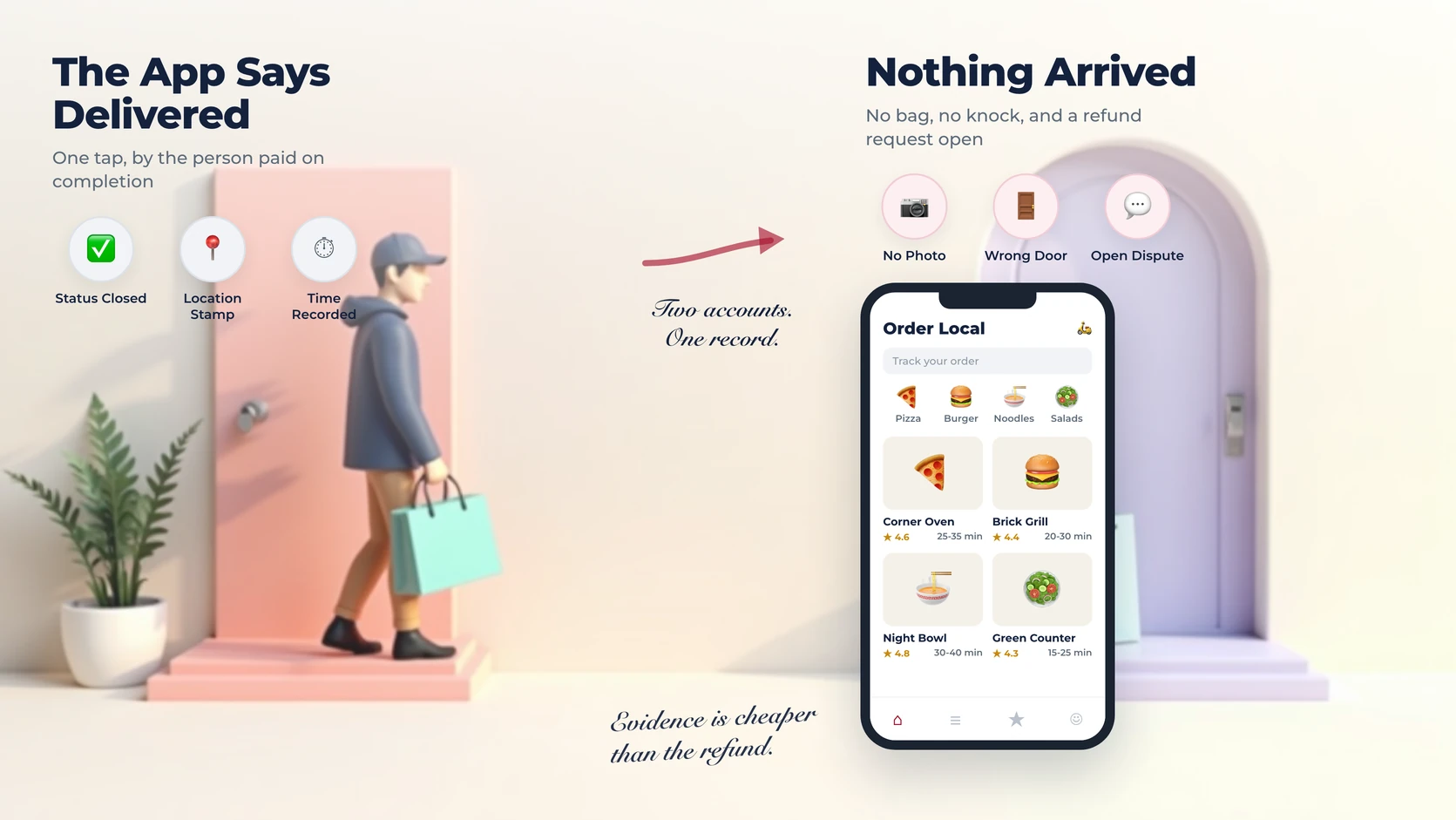
At 7:42 the driver’s app moved the order to delivered. At 7:51 the customer opened a chat and wrote that nothing had arrived. Both statements are now rows in your database, both are timestamped, and they cannot both be true.
The agent handling it has two accounts of the same thirty seconds and no third one. The driver is two drops away and will not remember this building tomorrow. The food is gone whatever happened. The kitchen cooked it, the driver was paid, and somebody absorbs the cost of a meal nobody can locate.
That handover is the least instrumented moment in the system. Everything before it is recorded to the second, then the bag changes hands in a corridor and the record goes quiet. This article is about the doorstep on a food delivery dispatch app, and about the evidence that settles an argument when the only two witnesses disagree. It then covers the rest of the security surface the operation carries: rider account sharing, chargebacks on money already paid out, and the customer address you hand to a stranger several times a week.
Grubhub tracks an order in detail right up to the doorstep, and the doorstep itself is where the evidence stops.
The Untracked Thirty Seconds in Food Delivery Dispatch
A platform like Grubhub can show a map for the whole journey and still have nothing to show for its final moment.
Trace a disputed order backwards and the strangeness shows. The record is dense almost the whole way, then thins to a single bit of information exactly where you need it thickest.
Everything Upstream Is Already Recorded
Placement, payment authorization, the restaurant accepting, the offer going out, the driver accepting, arrival at the kitchen, collection. Each is a row with a name, an actor and a time, and between them sit location updates every few seconds for the whole trip, a well understood engineering problem, as Sub-2 Second Tracking: Load-Testing GPS Delivery Updates on Flutter and Laravel sets out.
By the time a driver turns into the right street you hold hundreds of data points about one bag of food: when it was cooked, who carried it, what route it took, how long it waited.
Then the Bag Changes Hands in a Corridor
At the door, the only sensor you have is a thumb. No camera, no second party pressing anything, no signal from the customer’s device. One tap, and the whole physical transfer is compressed into a status change.
Everything afterwards is reconstruction. This is why doorstep disputes feel harder than late orders, which the lifecycle already explains. Lateness has a record. Absence does not.
Why a Missing Order Is the Costliest Delivery Dispatch Failure
Most operational failures degrade something. A late order annoys a customer. A wrong item costs one dish. A missing order is different in kind: the value has already left the building and no outcome recovers it.
Four Parties, One Loss, No Agreement
The restaurant bought ingredients, used a station during its busiest hour and packed a bag. The driver spent fuel and time on the trip. Both have incurred their costs and expect to be paid. The customer paid and has no dinner.
So the platform sits between three parties each, by their own account, owed something. Refund the customer and you are short. Charge it to the restaurant and you damage a relationship that took months to build. Deduct it from the driver and you have made an accusation you cannot support.
It Stops Being an Edge Case at Volume
Take an operator running four thousand deliveries a week. If half of one percent end in a never arrived claim, that is twenty meals a week cooked, carried and paid for with nothing to show. Over a year, more than a thousand.
That is illustrative arithmetic, not a measured rate. A fraction of a percent is a rounding error in a spreadsheet and a real line in a profit and loss statement, which puts it in the same conversation as the way the revenue model is put together rather than in a support backlog.
What Delivered Means in a Food Delivery Dispatch Database
Every platform has a delivered state. Few founders can say what it asserts, who asserted it, or what would have to be true for it to be wrong.
A Status Set by the Person With the Most Reason to Set It
On most systems, delivered means a driver pressed a button. That driver is paid on completion, measured on completion rate, and cannot start the next trip until this one closes. Every incentive pushes toward the tap.
This is not mainly a story about dishonesty, and treating it as one will cost you good drivers. The common case is an honest tap on a wrong assumption: the wrong block, a neighbour who said she would pass it on, a reception desk that never called upstairs. It was delivered somewhere.
An Assertion Is Not a Record
A record is something an uninvolved person can read later and draw a conclusion from. An assertion is one party’s claim. The delivered flag is an assertion wearing the clothes of a record, sitting in the same table as facts that really are facts, which is how it comes to be trusted more than it deserves.
Name the field for what it is. A column called driver_marked_delivered_at reads very differently in a support tool than one called delivered_at, and that changes how an agent weighs it against a customer’s account.
The Proof of Delivery Evidence Ladder, Honestly Ranked
There is a ladder of proof at the door. Each rung buys certainty and charges the customer friction, and the exchange rate worsens as you climb. The useful skill is knowing which rung a bag of food is worth.
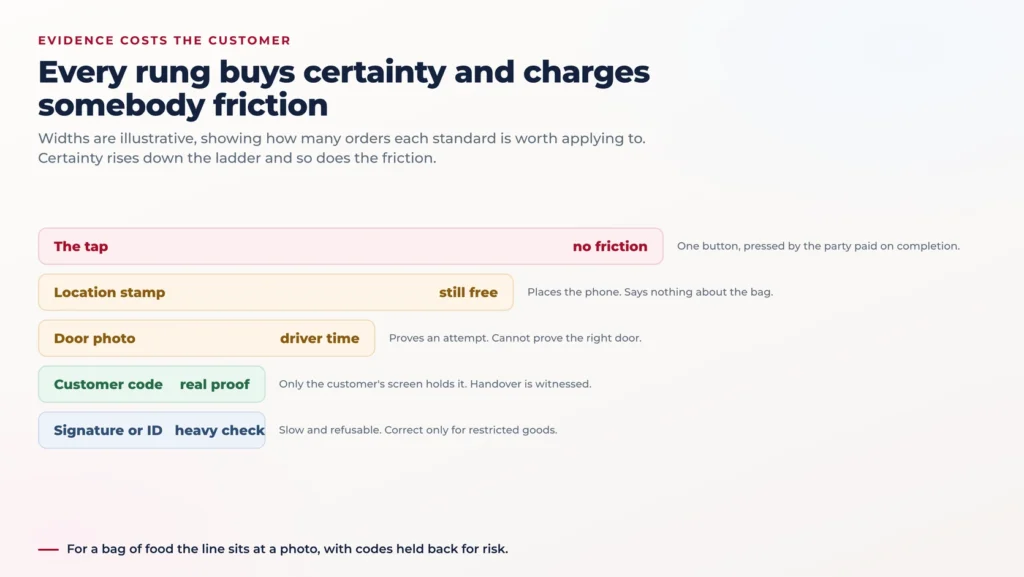
Image Source: AI-generated visual by Miracuves
Rungs One and Two: The Tap and the Coordinate
The tap costs the customer nothing and proves almost nothing. It tells you a driver considered the job finished, which is worth what one party’s word is worth. Not zero, and not enough to decline a refund on.
Capturing where the device was at that moment, and how long it had been stationary, also costs the customer nothing and is the highest return addition most platforms can make. It proves presence rather than handover, and presence separates a tap from two streets away at speed from a tap after four minutes stationary at the pin.
Rung Three: A Photo at the Door
The first rung that produces something a third party can look at. A photo of the bag where it was left, taken in the app rather than picked from a gallery, with its own coordinate and time.
Friction here falls on the driver, not the customer, which is why it became the norm for unattended drops. Fifteen seconds a delivery is a real cost at volume, and still the best value on the ladder.
Rung Four: A Code From the Customer’s Screen
A short code appears in the customer’s app and the driver types it to close the order. This is the first rung proving a handover rather than an attempt, because the code exists only on a device the customer holds.
It also breaks in ordinary situations. The customer sends a flatmate down. The phone is charging upstairs. Design the exception before you ship the rule: a clear fallback to a photo drop, recorded as a fallback, so the record shows which standard was actually met instead of implying the code path completed.
Rung Five: A Signature or an Identity Check
A finger smear on a screen is weak evidence and heavy friction, a bad combination. An identity check is genuinely strong and genuinely intrusive, and belongs only where the law or the value of the goods demands it. On a routine order it makes the customer feel accused and turns the driver into an inspector.
Where the Line Sits for an Ordinary Bag of Food
Say it plainly, because vagueness produces inconsistent policy later. For a normal food order the default is a tap plus a coordinate, plus a photo when the order is left unattended. Codes belong on high value baskets, repeat dispute addresses and orders your risk rules flag. Identity checks belong on restricted goods only.
Anything stronger applied universally is a tax on ninety-nine honest deliveries to catch one bad outcome. The standard should be a variable operations can raise per zone, per basket value or per address, never a constant fixed in the codebase. The features page shows where those controls sit in the console.
Contactless Removed the Handover and Kept the Liability
Leaving food at a door became normal in a single season and never went back. It is faster, a large share of customers prefer it, and it quietly deleted the one moment where two people confirmed the same fact to each other.
What a Photo Proves
It proves a bag existed, that it was somewhere at a given moment, and that the driver was there to photograph it. Against a claim that the driver never came, or never collected the food at all, a photo is close to decisive. That is a large category of dispute closed cheaply.
What a Photo Does Not Prove
It does not prove the door is the right door. Most front doors look like most others, and a bag on a mat is compatible with the bag sitting outside the wrong flat in the wrong building.
It does not prove receipt either. Between the photo and the customer opening the door there is an unwitnessed interval in a shared corridor, and in some buildings that is where the food goes. It also says nothing about whether the bag was full.
Treat the photo as strong evidence of an attempt and weak evidence of a receipt. Capture the customer’s drop instruction alongside it, unedited, because “leave by the blue door” and a photo of a blue door are together stronger than either alone.
The Wrong Door Is a Data Problem Before It Is a Dispute
A meaningful share of missing orders are not missing. They were delivered accurately to an address that was wrong, or to a coordinate that never matched the address in the first place.
The Pinned Coordinate Versus the Typed Address
Your system holds two representations of one place: a string a human typed, and a point a map produced. They disagree more often than founders expect, especially in fast growing cities where addressing is informal and a building may have stood longer than the street has had a name.
Decide which one the driver navigates to, and make that choice visible rather than implicit in the code. Then record the distance between the two. A large gap on an order that later goes into dispute is among the most useful signals you will have, and it costs nothing to compute. It is designed in early or bolted on badly, which is the argument in Migrating from SaaS to Owned Infrastructure: A Peak-Hour Performance Comparison.
Buildings Where the Pin Is Meaningless
A tower, a gated compound, a campus, a market with numbered shops behind an unnumbered entrance. The pin lands on a roof, the driver stands at a perimeter with no obvious way in, loses minutes on every visit, and hands the bag to whoever seems official.
The fix is not a better map. It is asking the driver to record the entrance once per building and reusing it forever. Which gate, which lobby, whether the guard accepts bags, whether the lift needs a resident. Pay a small bonus and attach it to the building, not the order. Never require it on every drop, because a mandatory field at the end of a shift produces garbage.
Named Timestamps Are the Spine of Every Dispute
When the argument arrives six weeks later, the only thing that settles it is a sequence of events that each carry a name, a time and an actor. Everything else is two people remembering a Tuesday.
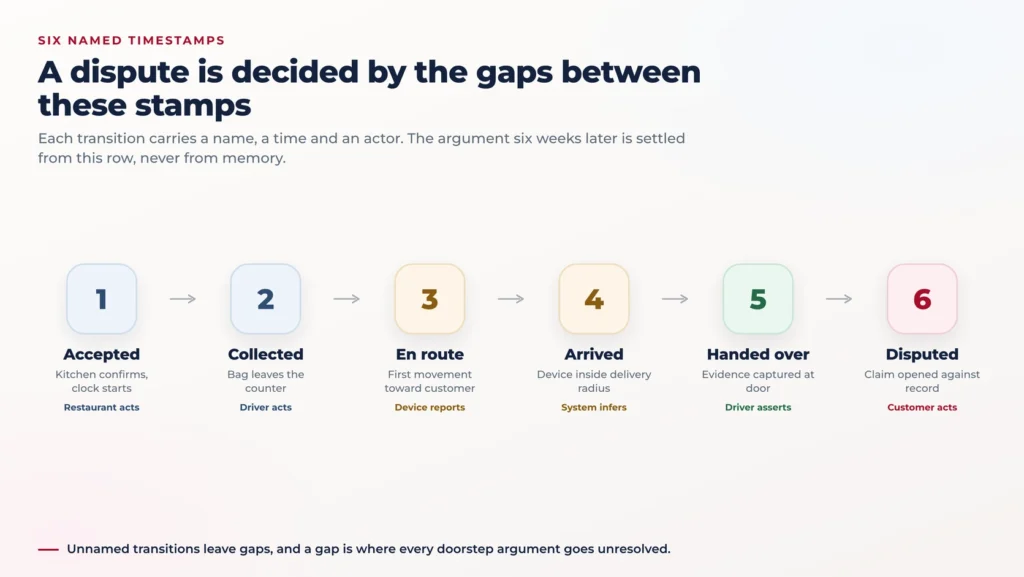
Image Source: AI-generated visual by Miracuves
Each Transition Needs a Name, a Time and an Actor
Accepted by the restaurant. Assigned to a driver. Arrived at the restaurant. Collected. Departed. Arrived at the customer. Evidence captured. Handed over. Eight rows, each naming who created it, none of them ever edited afterwards.
The actor matters as much as the time. Arrived at the customer inferred from a geofence is a different quality of fact from arrived at the customer because a driver pressed something, and a support agent has to tell them apart at a glance rather than by reading code.
The Gaps Carry as Much Information as the Stamps
Collected at 7:19 and handed over at 7:41 with eleven stationary minutes between reads like a normal delivery. Collected at 7:19 and handed over at 7:21, in a zone where nothing is two minutes from anything, is a record that asks a question.
Arrived at the customer and handed over firing four seconds apart is the most useful anomaly on the timeline. The tap happened on arrival, before anyone could plausibly have answered a door. It proves nothing alone, and across thousands of orders it is a sharp pattern.
Write Once, Never Overwrite
A status column updated in place destroys the thing you need. If a driver marks delivered, support reverses it, then a manager reinstates it, all three are facts and the column holds only the last one. Append events and derive the current state from them. That is the difference between a dispute you can settle and one you can only apologize for.
The Refund Decision Has to Exist Before the First Dispute
Almost every operator writes this policy during the first bad week, under pressure, in a chat thread, and then lives with it for two years. Write it on a quiet day instead, when nobody is angry and no individual customer is in the room.
Who Decides, on What Evidence, in What Time
Four questions, and the fourth is the one people forget. A decision taking four days is a bad decision even when correct, because the customer has already told people about it. Set an outer limit in hours and make most cases automatic.
Automatic is not the same as generous. It means the rules are written down and applied consistently, so two customers with identical evidence get identical answers regardless of which agent picked up the chat.
Where the Loss Lands, by What the Record Shows
| What the record shows | Sensible default | Who absorbs it |
|---|---|---|
| Nothing beyond a tap, first claim from this customer | Refund without argument | Platform, the cost of a weak standard |
| Photo at a plausible door, drop instruction matches | Decline, with the photo shown | Customer, with a route to appeal |
| Tap fired two streets from the pin while moving | Refund, and flag the delivery for review | Platform now, driver record noted |
| Order never left the restaurant, no collection stamp | Refund and cancel the item payout | Restaurant, per the commercial terms |
| Typed address and map pin disagree by a long way | Refund, then correct the address record | Platform, and fix the underlying data |
Who Actually Eats the Cost
Settle this before launch and put it in the restaurant agreement and driver terms in plain language. The default that holds up is that the party whose record failed carries it, and where none failed, the platform carries it, because it chose the evidence standard.
Never deduct from a driver on a single disputed order with no supporting evidence. It is the fastest way to lose your most experienced couriers and it is unfair often enough to be indefensible.
One Missing Order Is Noise, Twenty From One Source Is a Signal
Single incidents are unresolvable by design, and resolving each one perfectly is how support teams burn out. The information lives in the aggregate, a much more forgiving place to work.
Repeat Claimants
A customer reporting a fifth missing order in two months is telling you something, and not necessarily that they are dishonest. They may live where a shared lobby swallows bags, a real and fixable problem a refund policy never surfaces.
Respond with escalating evidence rather than escalating suspicion. Move that address to a code handover and say why in one honest sentence. If the claims stop once proof of receipt is required, you have your answer without accusing anybody. If they continue, you have a building problem worth solving.
Repeat Sources on the Other Side
The same logic runs in the opposite direction and needs more care, because a person’s income is attached to it. One driver generating a disproportionate share of claims is a signal. It is also what happens to whoever works the tower blocks on the night shift, which is the route nobody else wants.
Normalize before you conclude. Compare claim rate against the zones and buildings that driver actually served, not the fleet average, then read the timestamp shape, because the interval between arrival and handover is harder to explain away than a raw count. Then have a conversation, not a deactivation email. Operators running a white-label delivery app feel this most, since courier and brand are one thing to the customer.
Age-Restricted and High-Value Items Turn a Drop Into a Check
Once alcohol, tobacco, certain medicines or an expensive basket enter the order, the handover stops being a transfer and becomes a verification. Many operators discover this when a category is added to the catalogue and the delivery flow is not changed to match.
The Check Has to Be Genuinely Refusable
A check the driver cannot fail is theatre, and worse than nothing, because it creates a record suggesting diligence that did not occur. The rider app needs a refuse and return path as easy to reach as the complete path, with a reason attached.
Drivers also need to know they will be supported when they refuse. If refusing costs them a completion, a rating and an argument, they will stop refusing within a week and you will not hear about it. Legal obligations differ by jurisdiction and are the operator’s own to meet, so the control has to be configurable per market, which is worth settling with the team building the platform before launch.
What Happens to the Order When the Check Fails
This is the part that gets left out. Write the rule: which items are removed, what is refunded, whether the driver is paid, and where the returned goods go. Unattended drops are not available for restricted goods, and if a customer selects leave at door on such a basket, the interface has to say so at checkout rather than at the doorstep.
The Other Half of Doorstep Risk Is the Person Carrying the Bag
Every conversation about proof of delivery is about protecting the order. The same thirty seconds carries a risk to the courier, and that one appears on no dashboard unless you build it deliberately.
Lone Workers, Night Shifts, Unfamiliar Buildings
A courier works alone, at night, entering places they have never been, carrying something worth taking and sometimes cash. In most other industries that combination triggers a formal lone worker procedure. In delivery it is the ordinary shift.
An Emergency Control That Reaches a Human
One control in the rider app, reachable in two taps from any screen, opening a channel to a named person who is awake. It should share live location, the current order and the driver’s details with whoever answers, and it should never route into a ticket queue.
Then it needs a shift behind it. An emergency button reaching an unstaffed inbox at 1 a.m. is a liability dressed as a feature, and drivers work that out quickly. Keeping three sides of an operation working at once is the standing problem described in How to Keep Restaurants, Riders, and Customers Happy Simultaneously.
Never Route Someone Back Somewhere They Flagged
If a courier reports an address, a building or a customer as unsafe, that report has to reach the assignment engine. A driver who flags a place and receives an order to the same door a fortnight later has learned that reporting is pointless, and will stop.
Keep the exclusion quiet on the customer’s side, because a flag is a report and not a finding. The order simply routes to someone else. Repeated flags from unrelated couriers about one address is a much louder signal, and deserves a human decision about whether you serve it at all.
Friction Is the Currency You Are Spending
Every rung on the ladder is paid for by people who did nothing wrong. That is the trade, and it should be made consciously rather than accumulating one incident at a time until ordering dinner feels like collecting a parcel from a depot.
No evidence standard eliminates disputes. A platform that makes every delivery feel like a security checkpoint loses customers faster than it recovers losses, and it loses the frequent orderers first. The realistic goal is to make common disputes cheap to settle and rare ones survivable.
So spend the friction where the loss is: high value baskets, restricted goods, addresses with a history, and zones where the data says something is wrong. Everywhere else, stay invisible. That discipline separates a considered build from a template, which is the argument running through Ready-Made Delivery Food delivery dispatch app vs Custom Development: What Should Food Delivery Startups Choose?.
Founder Decision Signals
Speed
A coordinate and a stationary duration attached to the delivered tap is a small change that settles a large share of disputes on the day they open.
Cost
Photo capture costs about fifteen seconds a drop and removes an entire class of claim. It is the best value rung on the ladder for an ordinary food order.
Scalability
Make the evidence standard a setting per zone, per basket value and per address rather than a constant, so operations can tighten one street without taxing a city.
Market Fit
Customers accept a code where money or restricted goods are involved and resent it on a routine dinner. Match the check to what is actually at stake.
What to Log So an Argument Six Weeks Later Is Settleable
The test is simple. Someone who was not there, reading only the record, should reach the same conclusion a fair observer standing at that door would have reached. Most systems fail that test by a wide margin.
The Record Has to Outlast the Memory
Store the full event sequence with actors, the coordinate and accuracy radius at the delivered tap, how long the device had been stationary, the photo with its metadata, the drop instruction exactly as written, the distance between typed address and pin, which evidence standard applied, and every later state change including reversals.
Then put it on one screen. An agent who opens four tools to build a timeline will guess instead, and guessing is how identical cases get opposite answers. The surfaces that need this view are covered in Which Features Does a Food Delivery Dispatch App Need for Order Assignment, Rider Tracking, and Fleet Control?.
Retention, and Who Gets to See It
Keep delivery evidence long enough to cover payment disputes, which run months rather than days, and no longer. Doorstep photographs are images of where people live, so they need a defined retention window, restricted access and an audit trail on views.
Software gives you those controls. It does not give you a certification, and no vendor can hand you one, because certification is granted to an organization after an audit of how it operates. What a good food delivery app development engagement provides is the mechanism and the configuration. The policy stays yours.
The Security Surface Beyond the Doorstep
Proof of delivery is the dispute a food delivery app has most often and budgets for least. It is not the whole of security. Three other surfaces decide whether a platform survives its first bad month, and none of them shows up in a delivery argument.
Three Account Types, Three Different Attacks
A food delivery platform issues accounts to diners, to restaurants and to riders, and each is attacked for a different reason. A diner account is worth a saved card. A restaurant account is worth the menu and the payout details. A rider account is worth the work itself, and that is the one most operators underestimate.
Rider account sharing is the common case rather than the exotic one. An approved rider lends credentials to someone who was never checked, and the platform’s identity verification quietly becomes decoration: the person at the door is not the person on file. The defences are practical rather than clever. Re-verify identity periodically instead of only at signup, check again when the device changes, and require a live selfie at the start of a shift for the orders where it matters. Each one adds friction, so apply the strongest checks to high-value and age-restricted orders rather than to every shift.
Chargebacks, Refund Abuse and Money You Have Already Paid Out
A delivery dispatch app has a problem a shop does not. By the time a dispute arrives, the restaurant has been paid and the rider has been paid, so the money going back to the customer comes out of the platform. That makes payment abuse a margin problem rather than a fraud problem, and it is why the threshold matters more than the technology.
Tokenize cards and let the gateway hold them, which keeps card data out of your systems and limits what any breach can expose. It does not make the platform certified against any standard, and saying so would be a claim you cannot support. Then spend the real effort on patterns, because the loss concentrates in a small number of accounts: repeated non-delivery claims from one account, one address or one payment instrument, claims clustered on a single rider, and new accounts that dispute their very first order. Count those per entity rather than per order, and set the point at which a claim needs a human before it needs a refund.
The Customer’s Address Is the Most Exposed Thing You Hold
A food delivery app hands a customer’s home address, and usually their phone number, to a stranger, several times a week, by design. That is the most sensitive routine disclosure in the business, and it deserves an explicit decision rather than a default.
Release the address when the order is assigned and not before, remove it from the rider app once the order closes, and mask the phone number behind a relay so a rider can call without keeping the number afterwards. Decide how long location traces are retained, because a rider’s trace is also a record of where customers live, and both are personal data. Choosing a retention period deliberately is not a compliance posture. It is the difference between an incident that exposes last week and one that exposes three years.
Who May Reassign, Refund or Export
Support tooling on a food delivery platform is powerful. It can reassign an order, cancel it, refund it, read a customer’s address and follow a rider’s location. Powerful tooling needs named roles rather than a single admin level, and every use of it needs a row naming the person, the time and what changed.
The actions worth gating are the ones that move money or reveal a person: a refund above a set value, a change to a payout destination, an export of a customer or rider list, and viewing a customer’s address with no active order attached. That last one is the check almost no platform adds at the start and the one every investigation eventually asks for.
None of this replaces the evidence work above. It is the same instinct applied earlier in the order: decide what gets recorded before you need it, because every control here fails the same way, quietly and only in hindsight.
Mistakes That Turn a Dispute Into a Loss
Each of these is cheap to avoid in the design and expensive to correct once a few thousand orders have run through the wrong version of it, which is a good reason to check them against whatever you are buying from the wider solutions catalogue before you commit.
Treating the delivered flag as a fact
It is one party’s claim, made by the party paid on completion. Name the field accordingly and weigh it accordingly.
Adding a photo but not a coordinate
The coordinate is free and separates a tap at the door from a tap two streets away. Many platforms add the expensive rung and skip the cheap one.
Overwriting order status in place
A single status column erases the reversals and reinstatements a dispute turns on. Append events and derive current state from them.
Writing the refund policy during the first bad week
A policy written under pressure, in a chat thread, for one angry customer becomes the precedent for the next two years of decisions.
Deducting from a driver on a single claim
One disputed order proves nothing about a person. Act on patterns that survive normalization by zone and building, and start with a conversation.
Shipping an emergency button with nobody behind it
A control reaching an unstaffed queue at night is worse than none, because it promises help that never arrives and is discovered at the worst moment.
Related reading: e-commerce marketplace security guide.
Final Thoughts: The Door Is Where the Record Has to Be Strongest
What Grubhub and every delivery platform has to settle is the minute nobody recorded.
A doorstep dispute is not really an argument about one bag of food. It is an argument about whose account of thirty seconds your system chose to preserve, and that choice was made months earlier by whoever decided what a delivered tap would write.
None of it is expensive at the start. A coordinate on a tap, an in-app camera, a documented code fallback, an append-only event log and one support view showing all of it are a week of work early and a migration later. If you are buying rather than building, ask to see a disputed order, not a happy path, and check it against our food delivery solution and the build window on the facts page.
If you are designing the handover now, or have found that your record goes quiet at exactly the wrong moment, the fastest way forward is to walk through your own delivery lifecycle with someone who has built one before. Book a consultation and bring one disputed order with you.
FAQs
What are the security risks in a Grubhub-style delivery dispatch app?
On most platforms it proves only that a driver pressed a button. That driver is paid on completion, measured on completion rate, and cannot start the next trip until the current one closes, so every incentive points at the tap. It is one party’s claim rather than a record an uninvolved person could read and draw a conclusion from. Naming the field driver_marked_delivered_at rather than delivered_at changes how a support agent weighs it.
What is the proof of delivery evidence ladder in dispatch?
A tap, a timestamped coordinate, a photo at the door, a code read from the customer’s screen, and a signature or identity check. Each rung buys more certainty and charges more friction, and the exchange rate worsens as you climb. The coordinate is the best value because it costs the customer nothing. The identity check is the strongest and also the most intrusive, which is why it belongs only on restricted goods.
How much evidence should an ordinary food order require?
A tap plus a coordinate, plus a photo whenever the order is left unattended. Codes belong on high value baskets, on addresses with a dispute history and on orders your own risk rules flag. Identity checks belong on restricted goods only. Anything stronger applied to every delivery is a tax on ninety-nine honest handovers to catch one bad outcome, and you lose more in repeat orders than you recover.
Does a delivery photo settle a missing order dispute?
Partly. It is close to decisive against a claim that the driver never came or never collected the food, which closes a large category of dispute cheaply. It does not prove the door was the right door, since most front doors look alike, and it does not prove receipt, because the interval between the photo and someone opening the door is unwitnessed. Treat it as strong evidence of an attempt and weak evidence of a receipt.
Which timestamps should a food delivery dispatch app record?
Accepted by the restaurant, assigned, arrived at the restaurant, collected, departed, arrived at the customer, evidence captured and handed over. Each needs a name, a time and the actor who created it, because a geofence inference and a driver’s tap are different qualities of fact. Append these as events rather than overwriting a status column, so that reversals and reinstatements survive and a dispute can be settled from the record.
Who should absorb the cost of an order that never arrived?
Decide before launch and write it into the restaurant agreement and the driver terms. The default that holds up is that the party whose record failed carries the loss, and where no record failed, the platform carries it, because the platform chose the evidence standard. Never deduct from a driver on a single disputed order with no supporting evidence. That is how you lose experienced couriers and it is often simply unfair.
How do you handle a customer who reports missing orders repeatedly?
With escalating evidence rather than escalating suspicion. A fifth claim in two months may mean a shared lobby is swallowing bags, which is real and fixable. Move that address to a code handover and explain why in one honest sentence. If the claims stop the moment proof of receipt is required, you have an answer without accusing anyone. If they continue, you have a building problem worth solving.
What does rider safety have to do with proof of delivery?
They occupy the same thirty seconds. A courier works alone, at night, in unfamiliar buildings, carrying something worth taking. The platform cannot make the street safe, but it can provide an emergency control reachable in two taps that opens a channel to a named person who is awake, with a shift behind it. It must also stop routing anyone back to an address they flagged, or they stop reporting.
Miracuves is an independent software development company. We are not affiliated with, connected to, sponsored by, or endorsed by any company or product named in this article.
Terms such as “X Clone” are used descriptively. It is how the software industry refers to building a platform with functionality comparable to a known service, and how clients search for it.
The entire design and codebase of our products is built by our own team. Our products contain no code, design, graphics, or content originating from any third-party website or applications.
All third-party names and marks referenced in this article are the property of their respective owners, referenced solely to identify the services discussed.