


Key Takeaways
What You’ll Learn
- Fintech app development needs payments, security, and compliance planning.
- PayPal-like apps focus on wallets, transfers, and user payments.
- Stripe-like apps focus on payment APIs and merchant transactions.
- Secure architecture protects users, merchants, and financial data.
- Scalable backend supports transactions, payouts, reports, and growth.
Stats That Matter
- Core modules include onboarding, KYC, wallet, payments, and dashboard.
- API integrations connect banks, cards, gateways, and merchants.
- Fraud detection improves transaction safety and platform trust.
- Admin tools manage users, transactions, disputes, fees, and reports.
- Compliance readiness supports safer fintech operations and expansion.
Real Insights
- Fintech apps need more than a payment button.
- Trust is built through speed, security, and reliability.
- Payment flows must be simple for users and merchants.
- Backend logic matters for settlements, refunds, and risk control.
- The best build combines payments, APIs, compliance, security, and scalable infrastructure.
Fintech app like PayPal and Stripe have transformed how individuals and businesses handle payments, transfers, and financial operations. From seamless peer-to-peer transfers to global payment processing, these platforms have set new standards for speed, security, and user experience.
If you’re planning to build a fintech app like PayPal or Stripe, you’re not just creating another mobile application—you’re building a system that must handle sensitive financial data, comply with regulations, and scale reliably.
This guide breaks down everything you need to know, from core features and architecture to compliance, development steps, and practical considerations.
Understanding the Fintech App Model
Before starting development, it’s important to understand how platforms like PayPal and Stripe operate.
Core Functions of Fintech Apps
- Digital wallet management
- Payment processing (online & offline)
- Peer-to-peer money transfers
- Merchant payment gateways
- Subscription and recurring billing
- Multi-currency support
- Fraud detection and security
PayPal vs Stripe: Key Differences
| Feature | PayPal | Stripe |
| Primary Focus | Consumer + Business | Developer-focused payments |
| Integration | Ready-to-use | Highly customizable APIs |
| Use Case | Wallet + transfers | Payment infrastructure |
| Target Users | General users & SMBs | Businesses & developers |
Understanding this difference helps you define your product direction early.
Read more: Financial App Encryption Best Practices: How to Secure Data in Wise Clone Platforms
How a Fintech App Like PayPal or Stripe Works
A fintech app connects multiple systems to enable secure transactions in real time.
Basic Flow
- User initiates a payment or transfer
- App verifies user identity
- Payment gateway processes transaction
- Bank or card network authorizes payment
- Funds are transferred
- Confirmation is sent to both parties
Must-Have Features in a Fintech App
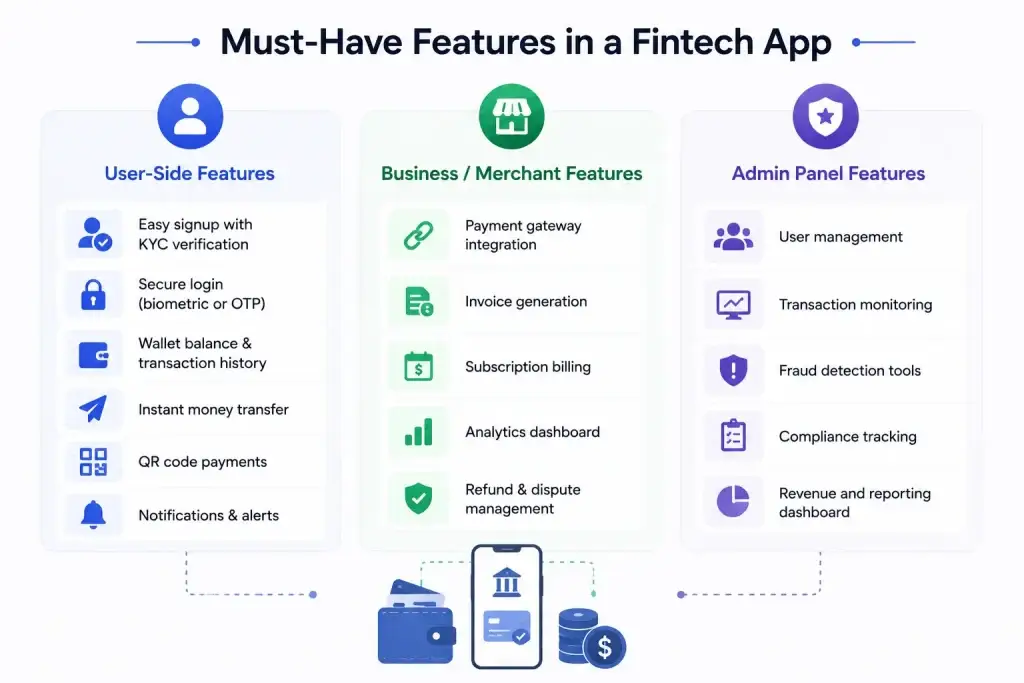
User-Side Features
- Easy signup with KYC verification
- Secure login (biometric or OTP)
- Wallet balance & transaction history
- Instant money transfer
- QR code payments
- Notifications & alerts
Business/Merchant Features
- Payment gateway integration
- Invoice generation
- Subscription billing
- Analytics dashboard
- Refund & dispute management
Admin Panel Features
- User management
- Transaction monitoring
- Fraud detection tools
- Compliance tracking
- Revenue and reporting dashboard
Technology Stack for Fintech App Development
Choosing the right tech stack ensures performance, scalability, and security.
Recommended Stack
| Layer | Technology Options |
| Frontend | React Native, Flutter |
| Backend | Node.js, Python (Django), Java |
| Database | PostgreSQL, MongoDB |
| Payment Integration | Stripe API, PayPal API |
| Cloud | AWS, Google Cloud |
| Security | OAuth 2.0, SSL, Encryption protocols |
Security and Compliance: The Foundation of Fintech Apps
Security is non-negotiable in fintech.
Key Security Measures
- End-to-end encryption
- Tokenization of sensitive data
- Multi-factor authentication (MFA)
- Real-time fraud detection
- Secure APIs
Compliance Requirements
Depending on your region and audience, you may need:
- KYC (Know Your Customer)
- AML (Anti-Money Laundering)
- PCI DSS compliance
- GDPR or local data protection laws
Ignoring compliance can lead to serious legal and financial consequences.
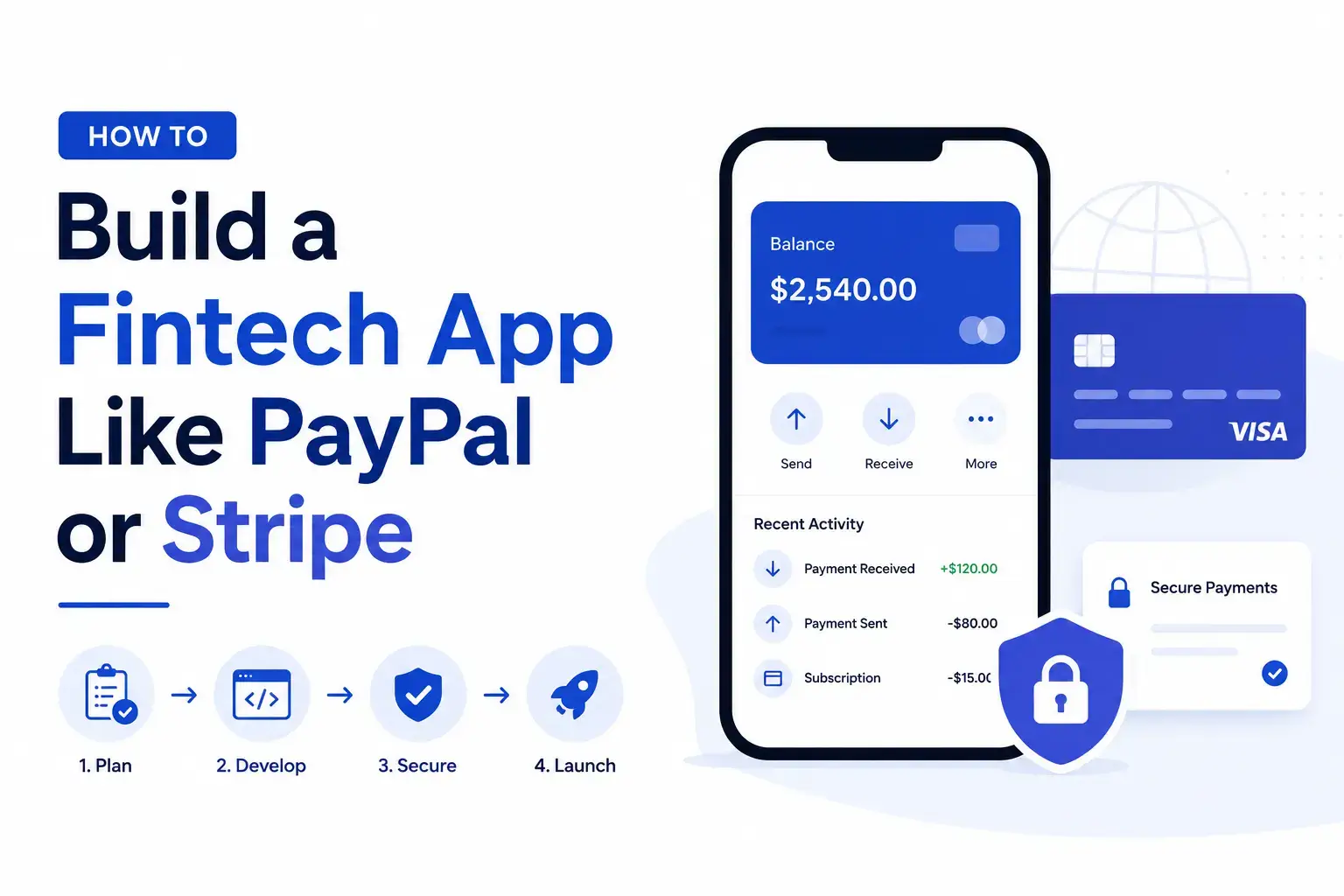
Step-by-Step Process to Build a Fintech App
1. Define Your Niche and Use Case
Decide whether your app will focus on:
- P2P payments
- Business payments
- Cross-border transfers
- Subscription billing
Clarity here reduces development complexity later.
2. Plan Features and User Journey
Map out:
- User onboarding
- Payment flows
- Merchant integrations
- Admin operations
Create wireframes and prototypes before development.
3. Choose Development Approach
You can:
- Build from scratch
- Use ready-made fintech solutions
- Customize a white-label platform
Each option has different cost, time, and flexibility trade-offs.
4. Develop the Core System
Focus on:
- Secure backend architecture
- API integrations
- Payment processing logic
- Scalable infrastructure
5. Integrate Banking and Payment Systems
This includes:
- Card networks (Visa, Mastercard)
- Bank APIs
- Payment processors
This step often requires partnerships and approvals.
6. Implement Security and Compliance
- Add KYC/AML verification
- Enable encryption and authentication
- Conduct security audits
7. Test Thoroughly
Perform:
- Functional testing
- Security testing
- Load testing
- Compliance checks
8. Launch and Monitor
After launch:
- Monitor transactions
- Track performance
- Handle customer support
- Continuously improve features
Common Challenges in Fintech App Development
Regulatory Complexity
Different regions have different laws, making expansion difficult.
Security Risks
Fintech apps are prime targets for cyber attacks.
User Trust
Building trust takes time and consistent performance.
Integration Issues
Connecting with banks and payment networks can be complex.
Best Practices for Building a Successful Fintech App
- Start with a focused MVP
- Prioritize security from day one
- Keep the user experience simple
- Use scalable cloud infrastructure
- Continuously update compliance standards
- Monitor fraud and suspicious activity
Ready to Build Your Fintech App?
If you’re planning to launch a fintech platform, working with the right development partner can significantly reduce risk and time to market.
Miracuves helps businesses build secure, scalable fintech applications—from MVP to full-scale platforms—with a focus on performance, compliance, and future growth.
Contact us to turn your fintech idea into a real, market-ready product.
Conclusion
Building a fintech app like PayPal or Stripe demands more than strong technology alone. Success depends on combining security, compliance, scalability, and seamless user experience into one reliable platform. When these elements are planned correctly, businesses can create a payment solution that earns user trust, supports long-term growth, and stays competitive in a rapidly evolving fintech market.
The key is to start with a clear use case, build a reliable foundation, and evolve your platform based on user needs and market demands.
FAQs
1. Is it necessary to get a financial license?
Yes, in most cases you need licenses or partnerships with licensed financial institutions.
2. Can I start with a basic version?
Yes, starting with an MVP helps validate your idea and reduce initial investment.
3. What is the biggest challenge in fintech app development?
Security and regulatory compliance are the most complex and critical challenges.
4. Can fintech apps scale globally?
Yes, but expansion requires adapting to local laws, currencies, and payment systems.
Related Article :