


Key Takeaways
- A digital banking platform architecture should connect wallets, accounts, cards, transfers, FX, compliance workflows, business finance, security, and administrative operations through shared financial services.
- Core architecture may include ledger services, transaction processing, payment orchestration, card integrations, currency conversion, identity verification, APIs, notifications, reconciliation, and reporting.
- A modular approach allows banking features to scale independently while maintaining consistent balances, transaction records, permissions, limits, fees, and compliance controls across the platform.
Architecture & Integration Signals
- Wallet and account services should manage balances, ledger entries, deposits, withdrawals, beneficiaries, transaction histories, multi-currency holdings, and account-level limits.
- Card, transfer, and FX services can connect issuing partners, payment rails, beneficiary validation, exchange-rate providers, conversion logic, fees, authorization events, settlement, and reconciliation.
- API gateways, event queues, databases, caching, encryption, monitoring, webhooks, retry logic, and third-party financial integrations help coordinate activity across distributed banking modules.
Operations & Compliance Insights
- Compliance architecture can support KYC, AML screening, transaction monitoring, risk rules, account restrictions, audit logs, case review, approval workflows, and suspicious-activity investigation.
- Business finance modules may add team accounts, expense controls, payment approvals, invoicing, bulk transfers, role-based permissions, reporting, and multi-user administrative workflows.
- Miracuves develops customizable digital banking platforms with wallets, cards, transfers, FX, compliance workflows, business finance, transaction monitoring, integrations, analytics, and admin controls.
A digital banking platform is not just a mobile app with a clean dashboard. The visible interface is only one layer. Behind it, the platform must manage wallet balances, user identity, card controls, transfers, foreign exchange, business finance workflows, transaction records, compliance queues, admin permissions, provider integrations, and audit trails.
For fintech founders, this architecture matters because financial products fail when the backend cannot handle real money movement safely. A simple wallet screen may look ready, but the platform still needs accurate ledger logic, secure API connections, transaction monitoring, provider callbacks, failed-payment handling, reconciliation, and role-based operations.
This guide explains the core architecture of a modern digital banking platform in a practical way. It is written for founders, product teams, CTOs, agencies, and fintech operators who want to understand what sits behind a launch-ready neobank, multi-currency wallet, business finance app, or Banking-as-a-Service-enabled platform.
If you are already evaluating a ready-made product route, you can also review Miracuves’ launch-ready digital banking platform after reading this architecture guide. This article explains how the system should work. The product page helps you evaluate how quickly that foundation can be deployed.
What Digital Banking Platform Architecture Really Means
Digital banking platform architecture is the structure that decides how every financial action moves through the product.
When a user signs up, the identity layer verifies them. When the user adds money, the payment layer routes the request. When funds appear in the wallet, the ledger records the balance movement. When the user spends through a card, the card service checks limits, authorization rules, and available balance. When currency is exchanged, the FX layer calculates the rate, spread, fees, and postings. When something looks suspicious, the risk layer flags it for review. When the business team needs control, the admin dashboard gives them access to users, limits, fees, disputes, and reports.
That is why architecture is a founder-level decision, not just a developer decision. The wrong foundation can create balance mismatches, failed transfers, slow investigations, support overload, and expensive rebuilds. The right foundation gives the business more control, cleaner scaling, and better readiness for banking partners, compliance teams, and users.
Founders planning a broader fintech product can also explore Miracuves’ fintech app development expertise to understand how wallets, payments, compliance workflows, business finance tools, and admin operations fit into a complete financial product roadmap.
A strong digital banking architecture usually includes:
| Architecture Layer | What It Controls | Why It Matters for Founders |
|---|---|---|
| User app and web app | Onboarding, accounts, cards, transfers, balances, statements | Defines user trust and daily engagement |
| Identity and verification | KYC, KYB, user risk status, document checks | Controls who can access financial features |
| Wallet and ledger | Balances, postings, reversals, transaction records | Protects financial accuracy |
| Card services | Virtual cards, physical cards, card limits, freezes, authorizations | Enables spending and monetization |
| Transfer engine | Internal transfers, bank transfers, cross-border movement, payouts | Powers money movement |
| FX engine | Exchange rates, spreads, fees, currency balances | Enables multi-currency revenue logic |
| Compliance and risk | AML workflows, monitoring, alerts, audit records | Reduces operational and regulatory risk |
| Business finance | team cards, permissions, invoices, expense controls, reports | Supports SME and company users |
| Admin dashboard | Users, transactions, fees, disputes, providers, reports | Gives operators day-to-day control |
| API and provider layer | BaaS, payment gateways, card processors, KYC tools | Connects the platform to financial infrastructure |
Wallet and Ledger Architecture: The Financial Source of Truth
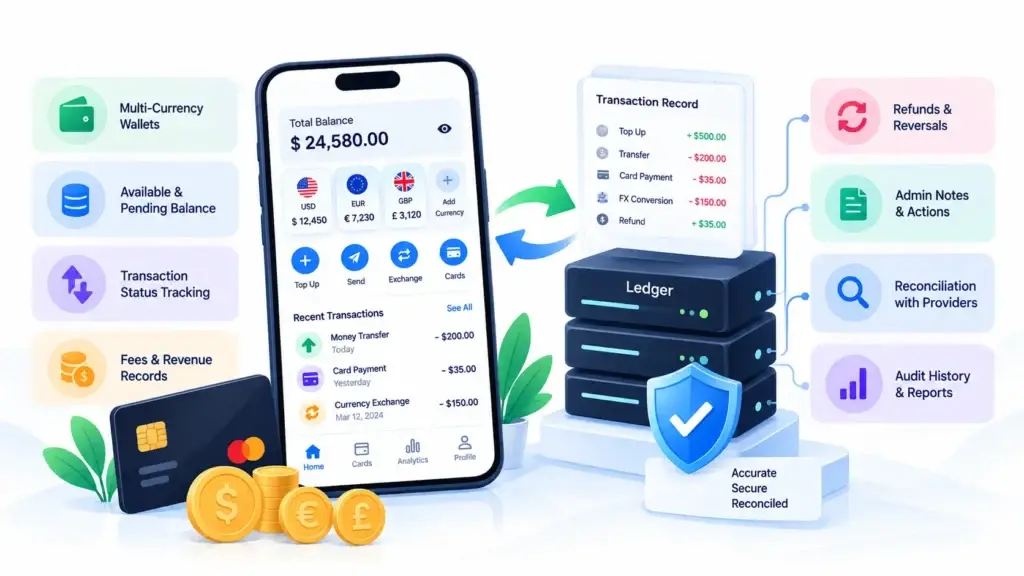
The wallet is what users see. The ledger is what the business must trust.
In a digital banking platform, the ledger records every movement of value. A top-up, transfer, withdrawal, fee, refund, card authorization, FX conversion, or reversal should create a clear transaction trail. Without strong ledger architecture, the platform may show one balance to the user, another balance to the provider, and a different number in the admin report.
That is a serious operational risk.
A reliable wallet and ledger architecture should support:
- User wallet balances by currency
- Available balance and pending balance separation
- Transaction status such as pending, successful, failed, reversed, or under review
- Fee postings and platform revenue records
- Refunds, chargebacks, reversals, and adjustments
- Admin notes and reason-based actions
- Reconciliation against external providers
- Audit history for financial investigation
For a deeper module-level view, the wallet and transaction feature stack shows how user wallets, cards, transfers, admin controls, compliance workflows, and finance modules can be organized inside a launch-ready fintech platform.
For founders, the key point is simple: never treat wallet balance as just a number stored in a user profile. A wallet balance should be the result of controlled transaction records. This makes the platform easier to investigate, reconcile, and scale.
A multi-currency platform also needs separate balance logic for each currency. If a user holds USD, EUR, GBP, or local currency balances, the platform must know which funds are held, which funds are converted, which rates were used, and which fees were applied.
Account Structure: Personal Users, Business Users, and Admin Roles
Digital banking products usually serve more than one type of user. A personal finance user may only need wallet balance, transfers, card controls, and statements. A business user may need team permissions, multiple cards, spending rules, invoices, reports, and finance workflows. The admin team needs deeper control over onboarding, transactions, providers, fees, and compliance queues.
This is why account architecture should separate roles clearly.
A practical account structure may include:
| User Type | Core Needs | Architecture Requirement |
|---|---|---|
| Personal user | Wallets, transfers, cards, FX, statements | Simple app journeys with strong authentication |
| Business user | Business balances, employee cards, permissions, reports | Organization-level account structure and access control |
| Finance manager | Expenses, limits, transaction exports, invoices | Permission-based dashboards |
| Compliance reviewer | KYC cases, transaction flags, document review | Review queues, audit logs, and decision records |
| Platform admin | Fees, users, limits, disputes, providers | Central control panel with role-based access |
This separation matters because fintech platforms become difficult to manage when every user is treated the same way. Business finance workflows need deeper permissions than personal banking. Compliance teams need access to risk information without exposing unnecessary business settings. Support teams need enough visibility to solve user problems, but not unlimited control over sensitive financial actions.
A strong digital banking architecture avoids this problem by designing role-based access from the beginning.
Card Architecture: Virtual Cards, Physical Cards, Limits, and Controls
Cards are often one of the most visible features in a digital banking app. Users expect to create virtual cards, order physical cards, freeze or unfreeze cards, set spending limits, view card transactions, and manage card security.
But card architecture is more complex than a card image on the screen.
A card module usually needs to coordinate with card issuing providers, payment networks, risk rules, wallet balances, and transaction notifications. When a card payment happens, the system may need to check available balance, spending limits, merchant category restrictions, location rules, card status, and fraud signals before approving or rejecting the transaction.
Important card architecture components include:
- Virtual card creation
- Physical card ordering and activation
- Card freeze and unfreeze controls
- Spending limits by day, month, user, or business team
- Card authorization handling
- Card transaction history
- Failed authorization records
- Refund and chargeback workflows
- Card replacement and cancellation
- Admin-level card controls
If you want to compare card controls, wallet flows, user features, business finance modules, and admin-side capabilities together, this digital banking app features list is a useful supporting read.
For business finance use cases, card architecture becomes even more important. A company may want employee cards, department budgets, approval rules, receipt uploads, and spending reports. These workflows require permission logic, expense categorization, and admin visibility.
This is where founders should think beyond “card feature included.” The better question is: can the card module support real user control, business spending rules, transaction investigation, and future provider integration?
Transfers and Payment Rails: Moving Money Safely Across Systems
Transfers are the movement layer of a digital banking platform. They may include wallet-to-wallet transfers, bank transfers, cross-border transfers, business payouts, card top-ups, withdrawals, bill payments, or provider-based payment flows.
The challenge is that money movement does not always happen instantly inside one system. Some providers confirm transactions immediately. Some use webhooks. Some transactions enter pending status. Some fail after being initiated. Some need manual review. Some require additional checks based on amount, location, user risk level, or destination account.
A strong transfer architecture should handle:
- Internal transfers between platform users
- Bank account top-ups and withdrawals
- Cross-border transfer requests
- Payment gateway integrations
- Transfer limits and fee rules
- Beneficiary management
- Pending, failed, successful, and reversed states
- Provider callbacks and webhook events
- Duplicate request prevention
- Reconciliation and settlement reports
The transfer system should never assume that every request succeeds immediately. It should be designed around transaction states. This allows the platform to show users accurate progress, reduce support confusion, and protect the ledger from incorrect updates.
For founders, transfer architecture directly affects trust. Users want to know where their money is, what fee was charged, when the transfer will complete, and what happened if the transaction failed.
FX Engine Architecture: Rates, Spreads, Fees, and Multi-Currency Control
A digital banking platform with multi-currency wallets needs a clear FX engine. Currency exchange is not just a calculator. It affects pricing, revenue, settlement, compliance, reporting, and user trust.
The FX engine should define:
- Supported currency pairs
- Exchange rate source
- Rate refresh logic
- Platform spread or markup
- Fixed and percentage-based fees
- Quote expiry rules
- Currency conversion records
- Wallet debit and credit postings
- Failed conversion handling
- Admin control over pricing logic
For example, when a user converts one currency to another, the platform should show the rate, fee, source amount, destination amount, and final confirmation before execution. Once confirmed, the ledger should record the debit from one currency wallet and credit the converted amount to another currency wallet.
If business users are involved, FX workflows may also support invoices, supplier payments, international transfers, or company-level currency balances.
The founder decision here is not whether FX is available. The real decision is whether the platform gives enough control over rates, fee visibility, provider routing, and reconciliation.
Compliance Architecture: KYC, AML, Risk, and Audit Readiness
Compliance should not be added at the end of fintech development. It should be part of the product architecture from the first version.
A digital banking platform commonly needs identity verification, business verification, transaction monitoring, suspicious activity flags, document review, admin approval queues, and audit logs. The exact requirements depend on the target market, financial partners, licensing model, and legal review, but the product foundation should be designed to support compliance workflows.
Important compliance architecture layers include:
- KYC onboarding for individual users
- KYB onboarding for business accounts
- Document upload and verification status
- User risk level and account restrictions
- AML workflow support
- Transaction monitoring hooks
- Sanctions and watchlist screening integrations where required
- Admin review queues
- Reason-based approval and rejection actions
- Audit logs for sensitive actions
- Role-based access control
- Data privacy and secure record handling
For founders who want to go deeper into secure onboarding, transaction monitoring, role-based access, encrypted data handling, and audit trails, the white-label fintech security guide expands this topic in more detail.
A good compliance workflow also controls what users can do at different verification levels. For example, an unverified user may be allowed to create an account but not send funds. A partially verified user may have lower limits. A fully verified user may access broader financial features. A high-risk transaction may require manual review before completion.
This approach helps founders prepare for serious fintech operations without claiming that the software alone guarantees regulatory approval. Final compliance depends on jurisdiction, legal review, financial partners, integrations, and the operating model.
Business Finance Architecture: Accounts, Team Cards, Expenses, and Reporting
Consumer banking features are only one side of a modern digital banking platform. Business finance can create stronger monetization because companies often need deeper workflows, higher transaction volume, team access, and better reporting.
Business finance architecture may include:
- Business account creation
- KYB onboarding
- Team member roles
- Employee card controls
- Department-level spending limits
- Expense categories
- Invoice and payment records
- Supplier payments
- Account statements
- Downloadable reports
- Admin approval workflows
- Business subscription plans
The architecture should separate personal wallets from business workspaces. A founder building for freelancers, agencies, SMEs, exporters, creators, or remote teams may need different workflows from a purely consumer-focused wallet.
This is also where monetization becomes more flexible. Business finance platforms can generate revenue through subscription plans, card-related revenue, transfer fees, FX margins, premium reporting, invoice tools, payment services, and partner integrations.
For founders, business finance is not just an extra feature category. It changes the way accounts, permissions, dashboards, billing, reports, and support workflows are designed.
Admin Dashboard Architecture: The Control Layer Founders Often Underestimate
The admin dashboard is where the platform operator runs the business. Many founders focus heavily on the user app but underinvest in the admin layer. That creates problems later because every issue requires developer intervention.
A strong admin dashboard should help the team manage:
- User profiles and verification status
- Business accounts and team permissions
- Wallet balances and transaction records
- Transfer limits and fee settings
- Card status and card controls
- FX rate settings and spreads
- Provider configurations
- Compliance review queues
- Disputes and support cases
- Refunds and reversals
- Notifications and alerts
- Reports and analytics
- Role-based staff access
- Audit logs
This control layer matters because fintech operations move quickly. If a transaction is stuck, the admin team needs visibility. If a user fails verification, the compliance team needs a workflow. If fees need to change, the business team should not depend on code changes every time. If a provider has downtime, the team needs diagnostics and operational alerts.
For a launch-ready fintech product, admin architecture is not optional. It is the difference between a nice demo and an operational platform.
API and Banking-as-a-Service Integration Layer
Most digital banking platforms depend on external providers for regulated financial services, payment rails, card issuing, identity verification, account issuance, or transaction monitoring. The platform architecture must therefore be API-first and integration-ready.
The provider layer may connect with:
- Banking-as-a-Service providers
- Card issuing processors
- KYC and KYB verification tools
- Payment gateways
- Bank transfer rails
- FX rate providers
- Notification services
- Fraud monitoring tools
- Accounting and reporting systems
- Cloud and infrastructure services
The important architectural decision is to avoid locking the entire product into one provider’s structure. A cleaner approach is to create a provider abstraction layer. This allows the platform to connect with one provider today and add or replace providers later without rebuilding the entire app experience.
This is especially useful for founders planning to launch in stages. The first market may require one payment partner. The second market may require another. The architecture should be flexible enough to support future expansion without making the first launch unnecessarily slow.
Security Architecture: Authentication, Encryption, Permissions, and Monitoring
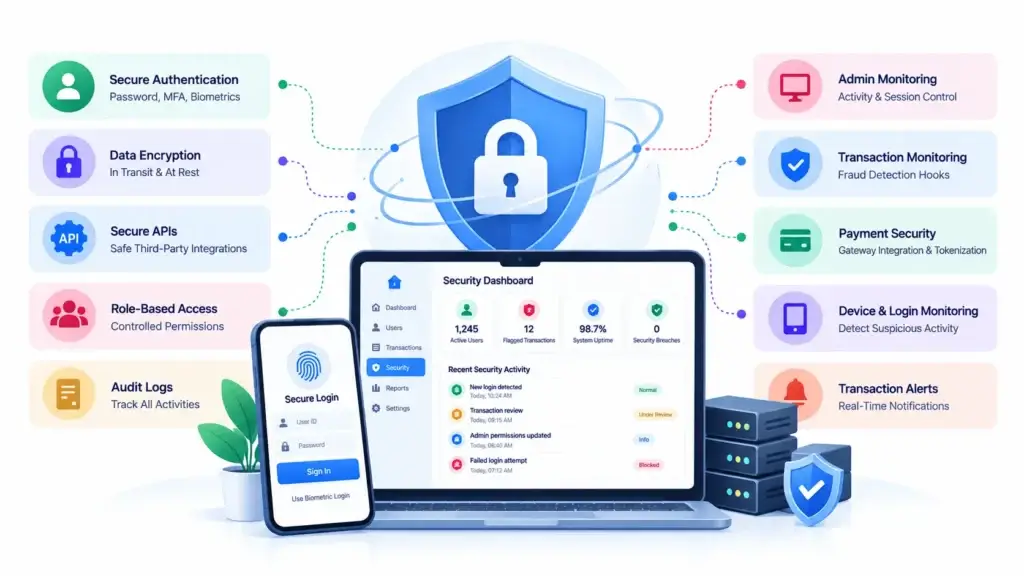
Security should be treated as a foundation, not a feature label.
A digital banking platform handles sensitive user data, account records, transaction histories, financial documents, payment events, and admin actions. That requires careful security planning across the frontend, backend, database, APIs, and operations dashboard.
Core security architecture should include:
- Secure authentication
- Multi-factor authentication where relevant
- Encrypted data transfer
- Encrypted data storage
- Secure API integration
- Role-based access control
- Permission-based dashboards
- Audit logs
- Admin activity records
- Session management
- Device and login monitoring
- Transaction alerts
- Secure payment gateway integration
- Tokenized payment handling where supported
- Fraud monitoring hooks
For fintech founders, security affects more than technical protection. It also affects user confidence, partner readiness, operational trust, and long-term scalability.
A strong security architecture should answer practical questions: Who can access financial records? Who can approve a flagged transaction? Who changed a user’s limit? What happened before a failed transfer? Which provider event updated the transaction status? Can sensitive admin actions be reviewed later?
If the platform cannot answer those questions, it is not ready for serious financial operations.
Data, Reporting, and Reconciliation Architecture
A digital banking platform needs clean data architecture because finance teams, compliance reviewers, support agents, and business owners all depend on accurate records.
Important reporting and reconciliation workflows include:
- User transaction statements
- Wallet balance reports
- Provider settlement reports
- Fee revenue reports
- FX conversion reports
- Card transaction reports
- Failed transaction reports
- Refund and reversal reports
- Compliance review records
- Business account reports
- Admin activity logs
Reconciliation is especially important because external providers and internal ledgers may not always update at the same time. A transaction may be initiated in the app, processed by a provider, settled later, and reported through a separate file or API event. The system must be able to compare internal records with provider records and flag mismatches.
This is where many fintech products become difficult to manage after launch. They can process transactions, but they cannot explain them clearly. Strong architecture makes financial activity visible, traceable, and easier to resolve.
Build From Zero or Start With a Launch-Ready Foundation?
Once founders understand the architecture, the next decision is how to build.
A custom build gives maximum control, but it usually requires longer planning, architecture design, engineering, provider integration, testing, security review, and launch preparation. This route may make sense when the product has a highly unusual model, deep proprietary workflows, or enterprise-level internal systems that must be designed from scratch.
A launch-ready foundation can help founders move faster because the core workflows are already structured. Wallets, cards, transfers, FX, user apps, web access, admin control, compliance workflows, and API-ready architecture can be customized instead of being built entirely from zero.
| Build Route | Best For | Main Advantage | Main Risk |
|---|---|---|---|
| Fully custom development | Unique fintech products with complex proprietary workflows | Maximum flexibility from the first line of code | Longer build cycle and higher planning risk |
| Launch-ready digital banking foundation | Founders who want faster validation with core fintech modules already available | Faster market entry, source-code ownership, and proven product structure | Customization scope must be clearly defined |
| Hybrid approach | Teams that want a ready foundation plus custom modules | Balanced speed and flexibility | Requires strong product planning |
If your team is still comparing build routes, this guide on ready-made fintech foundation versus a custom build can help you evaluate speed, ownership, customization, launch control, and long-term product flexibility.
Miracuves supports founders who want to move faster with a source-code-owned, white-label digital banking foundation that can be aligned with brand, market, integrations, and business model. For teams evaluating budget and scope, the digital banking platform development cost guide explains how features, integrations, compliance needs, branding, infrastructure, and support can affect final pricing.
Founder Decision Signals
Speed
If your goal is market validation, a launch-ready foundation can reduce the time spent rebuilding standard fintech flows from zero.
Control
Source-code ownership matters when you need long-term freedom over features, integrations, infrastructure, and product roadmap.
Compliance Readiness
The platform should support KYC, AML workflows, audit logs, role-based access, and transaction monitoring without claiming automatic regulatory approval.
Monetization
Wallets, FX, cards, subscriptions, transfers, and business finance modules should connect clearly to revenue logic.
Monetization Architecture for Digital Banking Platforms
A digital banking platform should not add monetization after launch as an afterthought. Revenue logic affects the product architecture because fees, limits, subscriptions, FX margins, business plans, and card controls must be connected to the ledger and admin dashboard.
Before choosing revenue streams, founders should understand how monetization connects with wallet activity, FX pricing, card usage, subscriptions, business finance tools, and transfer flows. For a deeper breakdown, review the digital banking business model guide.
Common monetization options include:
| Revenue Stream | How It Works | Architecture Requirement |
|---|---|---|
| Subscription plans | Users or businesses pay for premium features | Plan management, billing rules, feature access control |
| Transfer fees | Platform charges for certain money movements | Fee engine connected to transfer workflows |
| FX margin | Platform applies a spread on currency exchange | FX rate logic, quote expiry, ledger postings |
| Card-related revenue | Revenue from card usage or premium card plans | Card controls, transaction records, plan rules |
| Business finance tools | Paid access to business accounts, team cards, reports, or invoice tools | Organization accounts, roles, permissions, reporting |
| Partner integrations | Revenue through financial or operational partners | API integration, tracking, settlement logic |
The best monetization model depends on the audience. A consumer wallet may rely more on cards, FX, subscriptions, and transfers. A business finance platform may rely more on monthly plans, employee card controls, international payments, and reporting tools.
For founders, this means monetization should be planned alongside architecture. The platform must know when to charge, what to charge, who pays, which wallet or account is affected, and how the revenue is recorded.
Common Architecture Mistakes Founders Should Avoid
Treating the wallet as a simple balance field
A wallet balance should be supported by structured transaction records, status tracking, reversals, fees, and reconciliation. Simple balance storage creates serious risk when real transactions begin.
Adding compliance workflows too late
KYC, AML support, transaction monitoring, audit logs, and admin review queues should be part of the product foundation. Adding them later usually creates workflow gaps and expensive rework.
Underbuilding the admin dashboard
Without strong admin controls, every dispute, failed transfer, fee change, or verification issue becomes harder to manage. The admin layer should support real operations from day one.
Depending too heavily on one provider structure
External providers are necessary, but the product should not become trapped inside one integration pattern. A modular API layer gives the business more flexibility over time.
These issues often appear when founders focus on frontend speed but ignore financial operations, provider readiness, admin control, compliance workflows, and transaction accuracy. The guide on common fintech launch mistakes explains these risks from a startup execution perspective.
How Miracuves Helps Founders Launch Digital Banking Platforms Faster
Building a digital banking platform from zero can be a long process because the product needs more than screens. It needs wallet logic, card workflows, transfer handling, FX controls, compliance-ready workflows, admin dashboards, reporting, and secure API integrations.
Miracuves helps founders reduce that starting friction with a ready-made, white-label fintech foundation. The platform can be customized around your branding, modules, workflows, target market, and integration requirements. Where relevant, Miracuves can support a 6-day solution delivery path for launch-ready deployments, while deeper customizations, provider integrations, and compliance-heavy requirements may need additional scope planning.
This gives founders a practical route: understand the architecture, define the business model, review the product foundation, and move toward launch without rebuilding every standard banking module from zero.
Final Thoughts
Digital banking platform architecture is where product vision becomes operational reality. Wallets, cards, transfers, FX, compliance, business finance, admin control, and provider integrations cannot be treated as separate features. They must work together as one financial operating system.
For founders, the strongest decision is not always to build the longest feature list. The stronger decision is to build a platform foundation that can support accurate balances, secure transactions, clear permissions, compliance workflows, revenue logic, and future growth.
If you are still in the research stage, use this guide to understand the architecture. If you are ready to evaluate a faster launch route, review Miracuves’ white-label digital banking solution and compare how a ready-made foundation can fit your fintech roadmap.
FAQs
What is digital banking platform architecture?
Digital banking platform architecture is the technical and operational structure behind a fintech product. It connects user apps, wallets, ledgers, cards, transfers, FX, compliance workflows, admin dashboards, APIs, and provider integrations so users can manage money safely.
What are the core modules of a digital banking platform?
The core modules usually include user onboarding, KYC or KYB verification, wallets, transaction ledger, card management, transfers, FX conversion, business finance tools, notifications, reports, admin dashboard, compliance workflows, and API integrations.
Why is wallet ledger architecture important?
Wallet ledger architecture is important because it keeps financial records accurate. Every top-up, transfer, fee, refund, reversal, card transaction, and currency conversion should be traceable. Without a strong ledger, the platform may face balance mismatches and reconciliation problems.
How do cards connect with digital wallets?
Cards connect with digital wallets through authorization, balance checks, card limits, provider integrations, and transaction records. When a user spends through a card, the platform must check available balance, card status, limits, and risk rules before the transaction is approved or rejected.
What does an FX engine do in a digital banking platform?
An FX engine manages currency conversion. It controls supported currency pairs, exchange rates, spreads, fees, quote expiry, wallet debit and credit records, and reporting. A strong FX engine helps founders offer multi-currency features while keeping pricing and transaction history clear.
Why should compliance be planned early in fintech architecture?
Compliance should be planned early because user verification, transaction monitoring, audit logs, role-based access, and risk controls affect how the entire platform works. Adding these workflows late can create security gaps, operational delays, and expensive redevelopment.
Is a ready-made fintech foundation better than custom development?
A ready-made fintech foundation is useful when founders want faster launch, lower starting complexity, and existing modules that can be customized. Custom development may be better for highly unique workflows. The right choice depends on the product scope, target market, integrations, compliance needs, and launch strategy.
Can Miracuves help launch a digital banking platform?
Yes. Miracuves helps founders launch white-label, source-code-owned digital banking platforms with wallet workflows, cards, transfers, FX logic, business finance tools, admin control, and compliance-ready workflows. For launch-ready deployments, Miracuves can support a 6-day delivery path where the selected scope fits the ready-made foundation.
Miracuves is an independent software development company. We are not affiliated with, connected to, sponsored by, or endorsed by any company or product named in this article.
Terms such as “X Clone” are used descriptively. It is how the software industry refers to building a platform with functionality comparable to a known service, and how clients search for it.
The entire design and codebase of our products is built by our own team. Our products contain no code, design, graphics, or content originating from any third-party website or applications.
All third-party names and marks referenced in this article are the property of their respective owners, referenced solely to identify the services discussed.