


Key Takeaways
What You’ll Learn
- An Airbnb clone grows through trust systems, not just property listings.
- Identity verification improves booking confidence for both hosts and guests.
- Dynamic pricing helps protect host earnings and platform revenue.
- Safety workflows and dashboard clarity improve long-term platform reliability.
- Global-ready architecture supports expansion without rebuilding the product later.
Stats That Matter
- Trust, booking, revenue, operations, safety, and scale are treated as the main platform layers.
- Identity verification is presented as the first growth asset in a serious rental marketplace.
- Dynamic pricing uses demand, seasonality, events, and occupancy signals to guide rates.
- Safety logic includes dispute handling, damage claims, cancellation rules, and reporting tools.
- Global scale features include multi-language, multi-currency, and local payment support.
Real Insights
- Hosts and guests return when the platform feels safe, not only when it looks good.
- Transparent pricing reduces confusion and supports stronger conversions.
- Operational dashboards matter because both sides need clear booking visibility.
- Safety should be built into the platform from day one, not added later.
- The strongest rental platforms are built for trust, revenue, and expansion together.
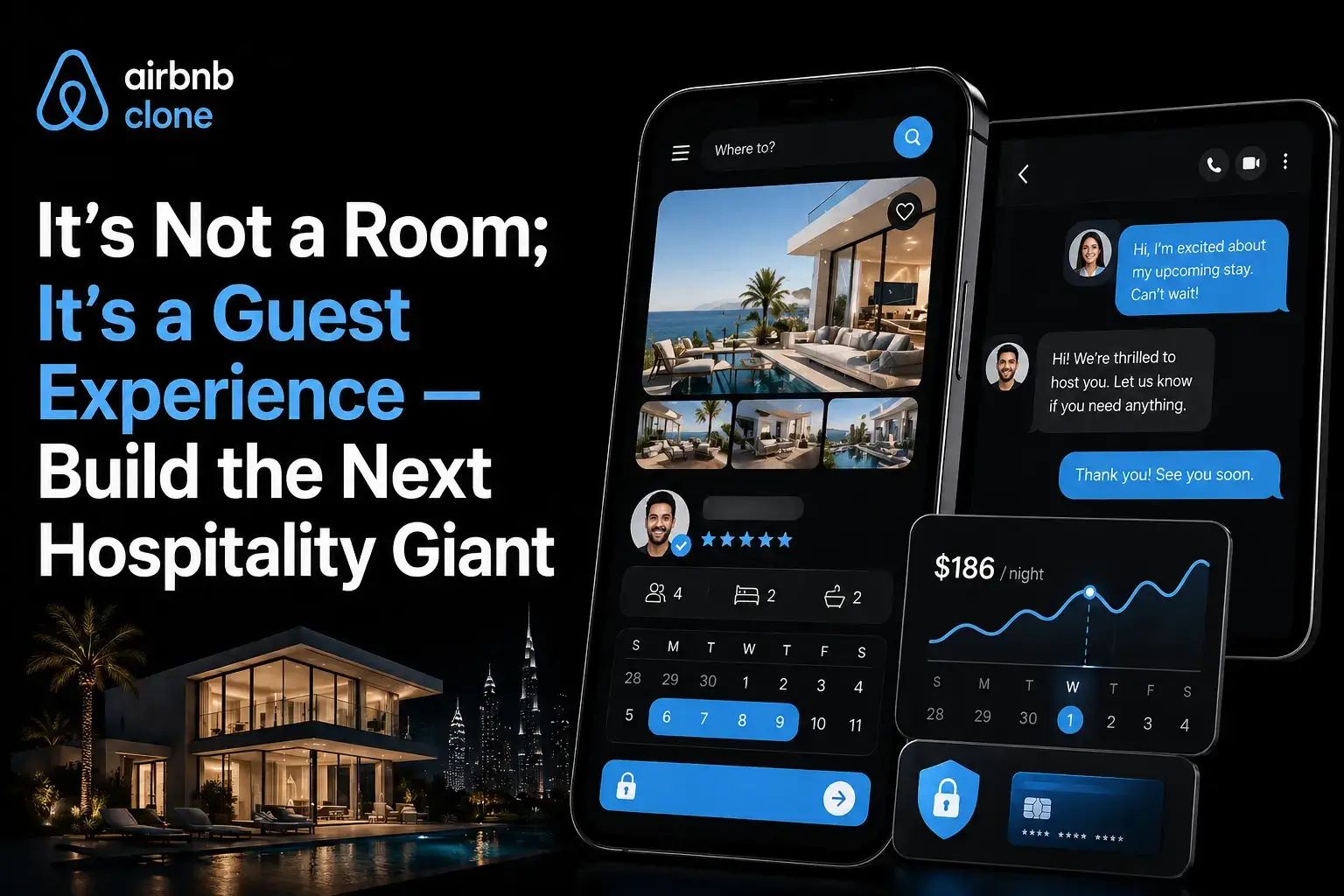
The short-term rental market is one of the most competitive and commercially rewarding spaces in digital product building today. Airbnb did not succeed simply by connecting property owners with travelers. It succeeded by building a system of trust between strangers — supported by product decisions that made both sides of every transaction feel protected, fairly treated, and confident enough to return.
That shift from transactional to experiential is what separates a rental marketplace that grows from one that plateaus after early traction.
For founders planning to enter this space, the most important question is not which features to build. The real question is which systems to get right before launch. Identity verification, pricing intelligence, dashboard design, safety architecture, and global readiness are not secondary concerns to be addressed later. They are the core product. The hospitality market rewards platforms that take credibility seriously from the beginning, and it consistently punishes those that treat trust as something to layer on after the users arrive.
Building an Airbnb Clone in 2026 is a strong opportunity. But the founders who capture that opportunity will be the ones who understand that the real product is not a listing page — it is a system that makes every interaction between hosts and guests feel safe, fair, and worth repeating.
Why the Short-Term Rental Market Rewards Platforms That Get the Fundamentals Right
Most property rental platforms are built around the assumption that listing volume and user acquisition will carry the platform forward. The technology goes live, hosts are onboarded, guests begin browsing, and growth becomes the primary focus. The structural problems surface later — when a dispute arises with no clear resolution path, when a fraudulent listing damages a guest’s trust, or when a host leaves the platform because their earnings visibility is poor and their questions go unanswered.
Fixing trust after it breaks is significantly more expensive than building it correctly from the start. It costs more in support operations, more in reputational recovery, and more in user re-acquisition than the original investment would have required.
Trust in a short-term rental platform operates at two distinct levels. The first is transactional trust — users need to know that payments are secure, bookings will be honored, and that what they see in a listing reflects what they will experience in person. The second is relational trust — hosts and guests need confidence that the other party has been verified, that conduct standards are enforced, and that the platform will stand behind them if something goes wrong.
A well-built Airbnb addresses both levels as a product priority, not as a customer service response.
How Identity Verification Turns Unknown Users Into Trusted Hosts and Guests
No short-term rental platform can grow for long without knowing who its users are. In an Airbnb clone platform, identity verification is not just a security step — it is the first signal that tells hosts and guests whether the marketplace is serious, safe, and professionally managed.
When users are booking real homes, sharing personal details, making payments, and meeting strangers through the platform, trust cannot be based on appearance alone. It needs proof.
What a Complete Verification System Should Cover
A strong verification system works across multiple layers. Each layer protects a different part of the booking journey.
Key verification layers include:
- Government ID verification to confirm that the user is a real and traceable person.
- Host property verification to check whether the listed property is genuine and the host is authorized to rent it.
- Profile completeness checks including verified photo, phone number, email, and basic user details.
- Review and rating history to create accountability based on past behavior.
- Admin verification controls so the platform team can approve, reject, or re-check suspicious accounts and listings.
| Verification Layer | What It Protects Against | Who It Builds Trust For |
|---|---|---|
| Government ID check | Fake accounts and identity fraud | Hosts accepting bookings |
| Property verification | Fake, duplicate, or misrepresented listings | Guests making booking decisions |
| Profile completeness | Anonymous or low-effort accounts | Both hosts and guests |
| Review history | Repeated bad behavior | Overall platform reputation |
| Admin verification control | Suspicious users and risky listings | Platform operators |
When a guest sees a verified host badge, complete property details, and strong review history, the booking decision feels safer. When a host sees a verified guest with positive past reviews, accepting the booking becomes easier.
This is where verification becomes more than a security feature. It becomes a conversion feature.
Why Skipping Verification at Launch Is a Strategic Mistake
Many founders delay verification because they want faster sign-ups and lower user friction. On the surface, this feels practical. Fewer steps can mean more registrations in the early stage.
But in a short-term rental marketplace, low-friction growth can become high-risk growth.
Without verification, the platform becomes easier for bad actors to misuse. Fake listings, false identities, payment disputes, property damage, and guest complaints can appear before the brand has enough trust to absorb them.
The real risks include:
- Fake hosts uploading properties they do not own
- Guests booking under false or incomplete identities
- Duplicate or misleading property listings
- Higher dispute volume for the support team
- Lower confidence among premium hosts
- Reputation damage that affects future bookings
A single serious incident can damage user confidence faster than paid marketing can rebuild it. That is why verification should not be treated as a future upgrade.
For a serious Airbnb clone app, verification should be built into the product from day one. It creates safer bookings, stronger marketplace quality, and a foundation for long-term growth.
Read More : How to Build an App Like Airbnb Clone Developer Guide
How Dynamic Pricing Helps Hosts Earn More and Keeps Bookings Competitive
Pricing is one of the most commercially consequential features in a short-term rental platform. Implemented correctly, it helps hosts maximize their earnings, keeps occupancy rates competitive, and makes the platform financially attractive to property owners across different market conditions. Implemented poorly, it produces confusion, erodes trust, and drives both hosts and guests toward competitors with more transparent and intelligent pricing systems.
A serious Airbnb Clone requires dynamic pricing logic that responds to real-world demand signals rather than relying entirely on hosts to manage their rates manually and indefinitely.
How Smart Pricing Logic Works for Both Hosts and Guests
Dynamic pricing in a vacation rental platform draws on several data inputs to recommend or automatically adjust nightly rates based on what the market is actually doing:
- Seasonal demand patterns allow the platform to increase rates during peak travel periods and adjust downward in slower months, keeping listings competitive in occupancy without leaving revenue on the table during high-demand windows
- Event-based pricing detects local demand spikes driven by concerts, sporting events, conferences, or public holidays and adjusts rates in relevant zones to capture the increased willingness to pay during those specific periods
- Day-of-week differentiation recognizes that urban properties tend to perform better mid-week for business travelers while leisure-oriented properties peak on weekends — rate logic should reflect these behavioral patterns rather than applying uniform pricing across all nights
- Occupancy-based adjustment automatically lowers rates when a property’s vacancy window is approaching, reducing the risk of empty nights that generate zero revenue
- Host-controlled rate boundaries allow property owners to set a minimum and maximum rate range, ensuring that automated pricing adjustments always operate within parameters the host has approved
| Pricing Factor | Impact on Host Revenue | Impact on Guest Experience |
| Seasonal adjustment | Maximizes earnings during high-demand periods | Fair rates relative to market conditions |
| Event-based pricing | Captures short-window revenue spikes | Transparent reason for rate changes |
| Occupancy-based logic | Reduces empty nights and lost revenue | Better availability at accessible rates |
| Day-of-week differentiation | Optimizes rates by traveler segment | Predictable pricing for planners |
| Host-controlled boundaries | Maintains pricing control and confidence | Rates that stay within expected ranges |
Why Pricing Transparency Is a Conversion Feature, Not Just an Ethical One
One of the most consistent sources of guest dissatisfaction in the short-term rental space is the gap between the advertised nightly rate and the total checkout cost. A guest who sees a competitive listing rate and then encounters a sequence of cleaning fees, service charges, and taxes at the final payment screen does not feel informed — they feel misled. Even when every charge is technically disclosed, the experience damages conversion and repeat usage.
A well-designed Airbnb Clone surfaces the complete cost of a booking — including all applicable fees, taxes, and service charges — before the confirmation step. This does not reduce conversions. Research consistently shows that guests who understand exactly what they are paying complete bookings at higher rates than guests who feel surprised at checkout.
Pricing intelligence is a revenue feature. Pricing transparency is the feature that turns first-time bookers into repeat customers.
Why Better Dashboards Keep Hosts Active and Guests Coming Back
A short-term rental platform is a two-sided marketplace. Both sides need a product experience that gives them clarity, operational control, and the confidence to stay engaged. The dashboard is where that experience is built — and where many platforms fail by over-investing in one side while treating the other as secondary.
What the Host Dashboard Must Deliver to Keep Supply Healthy
Hosts are the supply side of the platform. Without engaged, well-supported hosts, there are no listings — and without listings, there is no platform. The host dashboard must function as a complete property management tool, not just a notification center:
- Listing creation and management with full control over property photos, descriptions, amenities, house rules, check-in instructions, and availability settings across one or multiple properties
- Calendar management with real-time availability visibility, automated booking conflict prevention, and the ability to block dates for personal use or maintenance
- Earnings and payout transparency showing current period income, historical revenue, upcoming scheduled payouts, and a clear breakdown of platform commission — hosts who can see their earnings clearly are far less likely to seek alternative platforms
- Booking management that surfaces new requests, upcoming check-ins, active stays, and past bookings in a single organized interface with guest details and communication history attached
- Performance analytics giving hosts visibility into their occupancy rate, average nightly rate, listing search ranking, and review score trends — data that helps hosts make informed decisions about pricing and property presentation
| Host Dashboard Feature | Why It Matters for Platform Retention |
| Earnings visibility | Hosts who see clear income stay on the platform longer |
| Calendar management | Reduces booking errors and host frustration |
| Booking control | Gives hosts confidence in managing their property remotely |
| Performance analytics | Helps hosts improve, which improves platform quality overall |
| Multi-property management | Retains professional hosts who manage multiple listings |
What the Guest Dashboard Must Deliver to Keep Demand Returning
Guests evaluate a platform not just on the booking experience, but on everything that happens after they confirm. The guest dashboard must make the post-booking experience as seamless as the discovery and booking process:
- Booking history with complete records of past, current, and upcoming stays — including confirmation details, check-in instructions, host contact information, and property address
- Payment clarity showing exactly what was charged, when, through which payment method, and with downloadable receipts available for business travelers who need documentation for expense reporting
- Host communication through a structured in-app messaging system that keeps all stay-related conversation in one place rather than fragmented across email, phone, and app notifications
- Review management that allows guests to leave feedback after each stay, view reviews left for them by hosts, and build a reputation record that improves their future booking success
- Support access that is visible, clearly labeled, and fast — not buried in a submenu or defaulting to a generic FAQ before connecting the user to real assistance
When both dashboards work well, the platform operates smoothly with less manual support intervention. When either dashboard falls short, that side of the marketplace becomes dissatisfied — and a two-sided marketplace cannot grow with a problem on either side.
How Strong Safety Systems Protect Your Marketplace Before Problems Escalate
Identity verification confirms who joins the platform. Safety logic defines what happens when something goes wrong after the booking starts. In a short-term rental marketplace, this matters because the platform handles real homes, real guests, real money, and real trust.
A strong Airbnb clone platform should not wait for disputes, damage claims, or guest complaints before building safety systems. These systems must be part of the platform from the beginning.
Safety Features Every Rental Marketplace Should Build Before Launch
Safety does not stop at user onboarding. It continues throughout the full booking journey.
Key safety layers include:
- Damage protection and security deposits to help hosts manage property damage claims with clear rules and evidence.
- Dispute resolution workflows to give both hosts and guests a fair process for complaints, refunds, and booking issues.
- Emergency support access so users can reach real assistance during urgent stay-related problems.
- Review integrity controls to prevent false, abusive, or retaliatory reviews from damaging trust.
- Host and guest conduct policies to define acceptable behavior, cancellation rules, and consequences.
| Safety Layer | What It Protects | Why It Matters |
|---|---|---|
| Damage protection | Host property and financial claims | Reduces host fear and improves listing confidence |
| Dispute resolution | Guest and host complaints | Prevents small issues from becoming public brand damage |
| Emergency support | Urgent stay-related issues | Builds confidence during high-risk moments |
| Review integrity | Platform ratings and reputation | Keeps feedback fair and trustworthy |
| Conduct policies | Marketplace behavior | Creates accountability for both sides |
For hosts, safety systems create confidence to list better properties. For guests, they create confidence that the platform will support them if the stay does not match expectations.
Founders often treat these features as future upgrades because serious incidents may seem rare in the early stage. But safety infrastructure takes time to build correctly. The moment a serious dispute happens is not the right time to design the process.
A single unresolved damage claim, unsafe stay complaint, or viral guest issue can damage the platform more than months of marketing can repair.
Safety is not only a support function. It is a product decision. The best short-term rental platforms protect trust before an incident forces them to.
Read More : How Airbnb Makes Money: The Complete Business Model Behind the Short-Term Rental Giant
How to Prepare Your Airbnb Clone for New Markets Without Rebuilding Later
Most short-term rental startups begin with one city, one region, or one travel market. That is a smart launch strategy because it keeps operations focused and easier to manage. But even if the first launch is local, the platform should not be built with a local-only mindset.
The real problem appears when founders plan expansion later but build the product without multi-market readiness. When they try to enter a new country or region, they discover that currency, language, payments, tax rules, and booking logic were never designed to scale.
At that stage, expansion becomes expensive because the platform needs rebuilding instead of simple market configuration.
Why Localization Is More Than Translation
Localization is not only about changing the app language. It affects pricing, payments, compliance, taxes, support, communication, and user trust.
A scalable vacation rental app should plan for:
- Multi-currency support for listing prices, guest payments, host payouts, refunds, and financial reports.
- Multi-language interfaces so hosts and guests can use the platform in their preferred language.
- Regional tax and compliance logic to support rental rules, tourist taxes, and local reporting needs.
- Local payment gateway integration to accept trusted payment methods in each market.
- Time zone management for booking confirmations, calendar blocks, check-in reminders, and payout reports.
| Localization Component | Why It Matters | Risk If Ignored |
|---|---|---|
| Multi-currency support | Handles prices, payouts, refunds, and reports in local currency | Financial logic becomes difficult to rebuild later |
| Multi-language interface | Improves comfort and adoption in new markets | Poor user experience in regional markets |
| Regional compliance logic | Supports local rental rules and tax requirements | Legal and operational risk |
| Local payment gateways | Increases checkout trust and booking conversion | Users may abandon payment |
| Time zone management | Keeps bookings and communication accurate | Booking confusion and support issues |
Multi-currency support is especially important because guests may pay in one currency while hosts expect payouts in another. If this logic is missing, refunds, commissions, and financial reporting become complicated.
Multi-language support also needs more than basic translation. Property descriptions, booking policies, notifications, support messages, and admin settings should feel natural for each market.
Regional compliance is another major factor. Short-term rental rules can vary by city and country. Some markets may require tourist taxes, host documentation, registration numbers, or reporting rules.
Local payment gateways directly affect conversion. Users are more likely to complete bookings when the platform supports payment methods they already trust.
Platforms that build localization into the architecture from the beginning can expand faster and more confidently. Platforms that treat localization as a future translation task often face technical, legal, and operational problems in every new market they enter.
Read More : Top Airbnb Features Every Vacation Rental App Needs
Build an Airbnb Clone with Miracuves for Trust, Bookings, and Scalable Growth
Building a short-term rental platform is not just about adding property listings, booking calendars, and payment screens. The real challenge is creating a marketplace where hosts trust the platform, guests feel confident before booking, and the business owner can manage operations without losing control as demand grows.
Miracuves helps founders build an Airbnb Clone with this complete marketplace logic in place. Instead of focusing only on app screens, the platform is structured around the systems that support real bookings, secure transactions, smooth host-guest communication, and long-term scalability.
| Platform Layer | What It Includes | Business Impact |
|---|---|---|
| Trust Layer | Host verification, guest verification, profile checks, review history | Builds confidence before booking |
| Booking Layer | Property listings, availability calendar, reservation flow | Makes search, selection, and booking smoother |
| Revenue Layer | Dynamic pricing, commissions, service fees, payouts | Helps manage platform earnings and host income |
| Operations Layer | Host dashboard, guest dashboard, admin panel, support tools | Keeps daily marketplace management easier |
| Safety Layer | Dispute workflows, damage claims, cancellation rules, reporting | Protects user trust and platform reputation |
| Scale Layer | Multi-language, multi-currency, local payment options | Supports expansion into new cities or countries |
With Miracuves, founders can start with a ready-made Airbnb Clone foundation and customize it based on their target market, rental category, branding, and revenue model.
This makes the platform suitable for different business ideas, such as:
- Vacation rental marketplaces
- Short-term apartment booking platforms
- Luxury villa rental platforms
- Homestay and guesthouse booking apps
- Regional Airbnb alternative platforms
- Property rental marketplaces for specific cities or countries
The real advantage is not only faster launch. Miracuves gives founders a structured base for host onboarding, guest booking, secure payments, dashboard management, communication, reviews, and admin control — while still allowing custom features and market-specific changes.
| Founder Need | How Miracuves Supports It |
|---|---|
| Faster launch | Ready-made platform foundation reduces development effort |
| Stronger trust | Verification, reviews, and profile systems support safer transactions |
| Better revenue control | Commission, pricing, and payout logic help manage monetization |
| Easier operations | Dashboards and admin tools simplify platform management |
| Future expansion | Scalable architecture supports new markets and features |
| Brand flexibility | UI, workflows, and business rules can be customized |
For founders planning to enter the short-term rental or vacation rental market, Miracuves offers more than a basic Airbnb Clone app. It provides a scalable product foundation designed to support trust, bookings, revenue, operations, and future growth from the beginning.
Conclusion
The short-term rental market does not reward platforms that simply display property listings and process payments. It rewards platforms that make every interaction between hosts and guests feel safe, transparent, and worth repeating.
Identity verification creates the credibility that makes strangers willing to transact. Dynamic pricing ensures that both the platform and its hosts generate intelligent, consistent revenue. Dual-sided dashboards give hosts and guests the operational clarity they need to stay engaged over time. Safety logic protects the platform’s reputation when real-world situations become complicated. And global scale architecture ensures that success in one market can extend into many without requiring a product rebuild each time.
These are not optional features to plan for a future version. They are the foundational product logic that determines whether an Airbnb like app becomes a serious, scalable business or a well-designed platform that stops growing after its first market.
If you are planning to build a short-term rental or vacation rental platform, the architecture and product decisions you make today will define how trustworthy, scalable, and commercially viable your platform becomes over time. Miracuves builds Airbnb Clone platforms designed for real operational demands — structured for growth from the first line of architecture. Reach out to the Miracuves team and start with a product conversation, not just a feature list.
FAQs
Why is identity verification important in an Airbnb clone?
Identity verification ensures that both hosts and guests are real, traceable users. It reduces fraud, builds trust, and makes users more confident in completing bookings.
How does dynamic pricing improve platform revenue?
Dynamic pricing adjusts rates based on demand, seasonality, and events. This helps hosts maximize earnings while keeping listings competitive for guests.
What features should a host dashboard include?
A host dashboard should provide listing management, calendar control, earnings visibility, booking tracking, and performance analytics to help hosts manage properties efficiently.
What do guests expect from their dashboard?
Guests need clear booking history, payment details, communication with hosts, and easy access to support for a smooth post-booking experience.
What is safety logic in a rental platform?
Safety logic includes systems like dispute resolution, damage protection, emergency support, and review moderation to handle real-world issues effectively.
Why is pricing transparency important for conversions?
When guests see the full cost upfront, they are more likely to trust the platform and complete bookings without hesitation.
Related Articles