

Key Takeaways
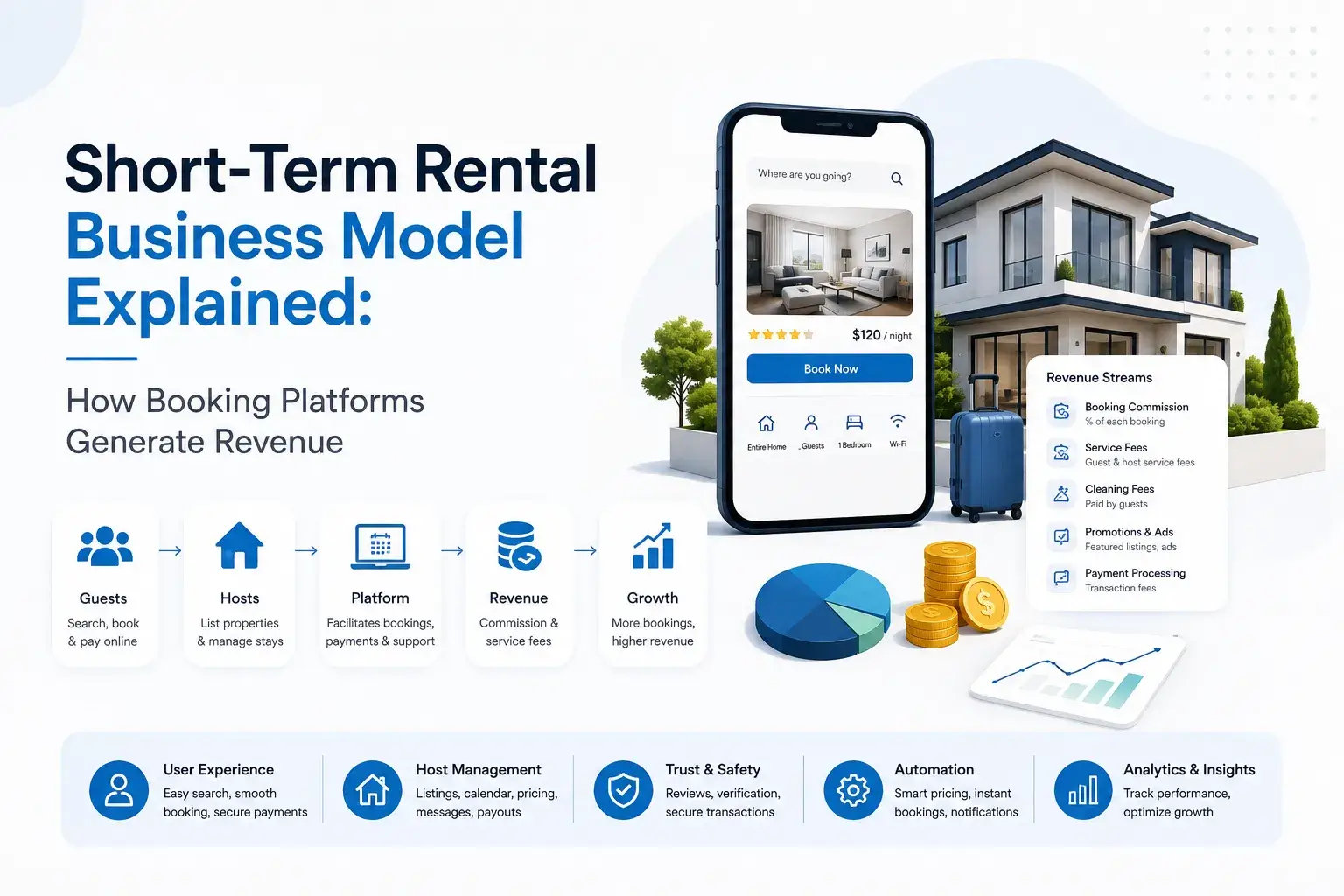
- A short-term rental marketplace connects property owners with guests without owning the listed inventory.
- Primary revenue streams include host commissions, guest service fees, split fees, and booking charges.
- Additional income can come from subscriptions, featured listings, insurance, cleaning, and other add-on services.
- The chosen fee structure directly affects booking conversion, host participation, and marketplace trust.
- Revenue rules should be planned before development because they influence payments, payouts, refunds, and admin controls.
Business Model Signals
- Decide whether hosts, guests, or both sides will pay the platform fee.
- Define commission rates, service charges, cancellation fees, refunds, taxes, and payout rules.
- Give administrators control over fees, coupons, subscriptions, listing promotions, and financial reports.
- Track booking value, commission revenue, repeat bookings, host earnings, cancellations, and refund rates.
- Keep monetization settings configurable so the business can test different fee structures without rebuilding the platform.
Real Insights
- An asset-light marketplace still requires strong control over listings, payments, disputes, and host quality.
- Higher commissions do not guarantee better revenue if they reduce host participation or booking conversion.
- Transparent pricing helps prevent checkout abandonment and protects guest confidence.
- Reliable transactions and repeat bookings create more sustainable revenue than adding excessive fees.
- Miracuves develops rental marketplace platforms with configurable commissions, booking workflows, host payouts, and admin controls.
Short-term rental booking platforms have changed how people discover, compare, and book temporary stays. Instead of relying only on hotels or traditional rental agencies, guests can now book apartments, villas, homestays, serviced spaces, cabins, vacation homes, boutique stays, and niche properties through digital marketplaces.
For founders, the real lesson is not just that travel rentals are popular. The deeper lesson is that the short-term rental business model works because it connects two sides of the market: property owners who want income and guests who want flexible accommodation.
The platform does not always need to own the properties. It creates the digital infrastructure for discovery, booking, payments, reviews, communication, trust, support, and payouts. Revenue is generated when the platform successfully facilitates a transaction.
That makes the model attractive for entrepreneurs planning a rental marketplace. But it also creates important product decisions. The way a platform charges hosts, displays guest fees, handles cancellations, manages payouts, and controls disputes directly affects trust, retention, and profitability.
This guide explains how booking platforms make money, what founders should learn from marketplace fee structures, and how the business model can be adapted for niche rental platforms.
Why the Short-Term Rental Business Model Works
The short-term rental business model works because it turns underused property inventory into bookable supply. A property owner may have an apartment, vacation home, villa, room, cabin, or serviced space that is not used every day. A guest may need temporary accommodation for travel, business, events, relocation, remote work, or local stays.
The platform creates value by matching both sides.
For hosts, the platform offers visibility, booking tools, payment collection, calendar management, guest communication, and review credibility. For guests, it offers search, filters, location discovery, photos, pricing clarity, reviews, secure checkout, and booking confidence.
The marketplace becomes valuable when it reduces friction. A guest should not need to call multiple property owners manually. A host should not need to manage every enquiry through scattered messages and offline payments. The platform earns revenue by making the transaction easier, safer, and more scalable.
This is why marketplace trust is central to the model. A rental platform does not only sell accommodation access. It sells confidence: confidence that the listing is real, the price is clear, the booking will be honored, the payment is secure, and support exists if something goes wrong.
Read More: Vacation Rental Marketplace Features and Pricing: What Founders Should Evaluate Before Launch
How Booking Platforms Generate Revenue Without Owning Inventory
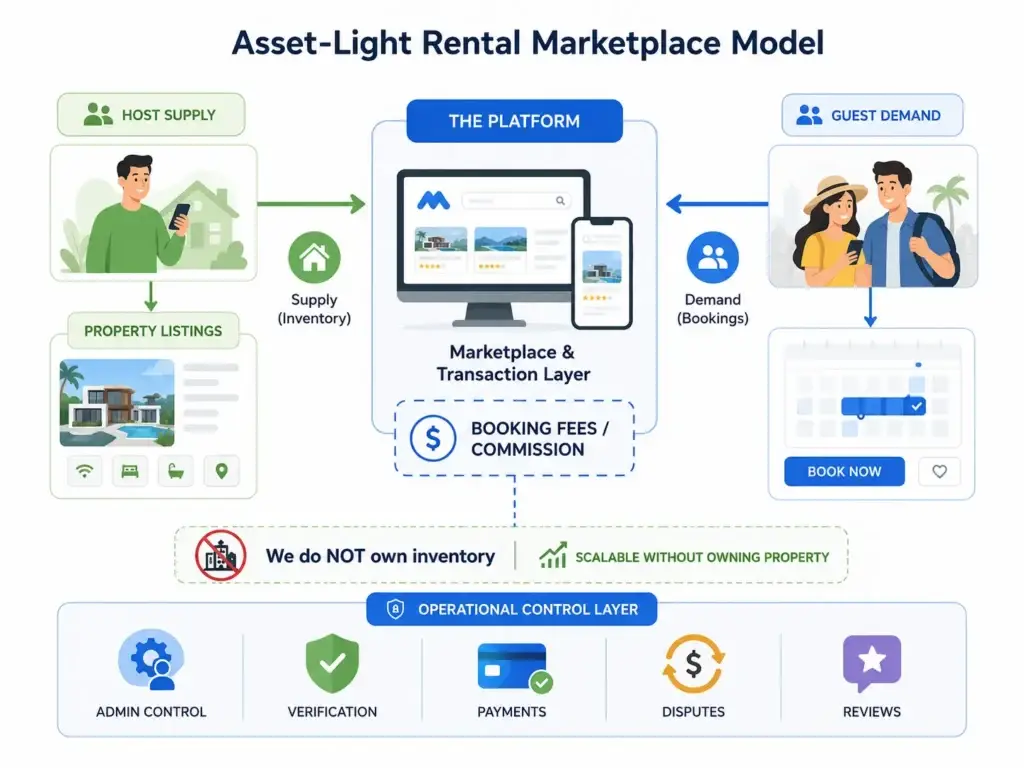
Image Source: AI-generated visual by Miracuves
A short-term rental marketplace can generate revenue without owning properties because the inventory is supplied by hosts. The platform focuses on the transaction layer instead of the asset layer.
This asset-light structure gives the business model several advantages:
- The platform can expand supply without buying real estate.
- Hosts handle property ownership, furnishing, and local operations.
- Guests create demand through bookings.
- The platform earns revenue from successful transactions.
- The business can scale across niches, regions, or property categories.
However, asset-light does not mean operation-light. The platform still needs strong systems for listing approval, availability control, pricing, payments, refunds, reviews, complaints, fraud prevention, and host quality.
For founders, this is the first strategic lesson. The business does not require property ownership, but it does require marketplace control. Without good admin tools, verification workflows, payment rules, and dispute management, the platform can lose trust quickly.
Read More: How Niche Rental Marketplaces Are Changing the Modern Travel Booking Experience
Core Revenue Streams in a Short-Term Rental Marketplace
A rental booking platform can generate revenue in more than one way. The strongest models usually combine a primary transaction fee with optional secondary revenue streams.
Short-Term Rental Marketplace Revenue Streams
| Revenue Stream | How It Works | Founder Impact |
|---|---|---|
| Host Commission | The platform deducts a percentage from the host payout after a confirmed booking. | Useful when the founder wants hosts to pay for access to demand. |
| Guest Service Fee | The guest pays a service charge above the booking subtotal during checkout. | Can improve platform revenue but must be displayed transparently to avoid checkout drop-offs. |
| Split Commission | Both host and guest pay a percentage of the booking value. | Balances monetization across both sides but requires careful fee communication. |
| Host-Only Fee | The platform charges the host a larger fee while showing fewer separate charges to guests. | Can simplify guest pricing, but hosts may adjust nightly rates to protect earnings. |
| Featured Listings | Hosts pay to promote selected listings in search results or category pages. | Creates advertising-style revenue once the platform has enough demand. |
| Subscription Plans | Hosts pay monthly or yearly for premium tools, lower commissions, or better visibility. | Works best for professional hosts, property managers, or high-volume listing owners. |
| Cancellation or Processing Fees | The platform may charge fees based on cancellation rules, refunds, or payment processing logic. | Needs clear policy design to avoid damaging trust. |
| Add-On Services | The platform earns from cleaning, insurance, guest verification, experiences, local services, or concierge options. | Useful for increasing revenue per booking after the core marketplace is stable. |
Host Fees, Guest Fees, and Split Commission Models Explained
The most important revenue decision for a rental booking platform is who pays the platform fee.
Some marketplaces charge the host. Some charge the guest. Some split the fee between both sides. Each model affects marketplace behavior differently.
A major short-term rental marketplace explains that service fees help cover platform operations such as payment processing, marketing, and customer support. Its host resources also describe a common split-fee structure where a host fee is deducted from the host payout and a guest fee is added to the guest-facing price.
For a founder, the question is not simply “Which model earns more?” The better question is “Which model creates the least friction for my market?”
Host Fee Model
In a host fee model, the platform deducts a commission from the host’s payout after the booking is confirmed.
This model feels simple for guests because they may see fewer platform charges at checkout. However, hosts may increase their listed price to protect their earnings. If the host fee is too high, supply acquisition can become harder.
Best suited for:
- Professional hosts
- Property managers
- Markets where guest price transparency is important
- Platforms that want cleaner checkout pricing
Guest Fee Model
In a guest fee model, the platform adds a service fee to the guest’s booking total.
This model allows hosts to keep more of their visible listing price, but it can create checkout friction if guests feel surprised by extra charges. Guests usually compare the final price, not only the nightly rate.
Best suited for:
- High-demand destinations
- Platforms with strong brand trust
- Markets where guests are used to platform service charges
- Businesses that can clearly explain the value of the fee
Split Commission Model
In a split commission model, both host and guest pay part of the platform fee.
This spreads the monetization burden across both sides. It can work well when the platform offers enough value to justify the fee to both users. The challenge is communication. If both sides feel overcharged, the platform may struggle with retention.
Best suited for:
- Mature marketplaces
- Platforms with strong support and trust systems
- Niches where both sides benefit from verified transactions
- Founders who want flexible take-rate control
Host-Only Model
Some platforms simplify pricing by moving most of the platform fee to the host side. This can make guest pricing appear cleaner, but hosts need enough booking volume to accept the higher deduction.
A recent platform resource explains a simplified fee example where the host sets a price, the guest sees a price after the guest fee is added, and the host earns after the host fee is deducted.
For founders, the key takeaway is that fee structure is not only a revenue decision. It is a conversion decision, supply decision, and trust decision.
What Founders Should Learn From Booking Fee Structures
A marketplace fee looks simple from the outside, but it controls many parts of the business.
When a guest books a stay, the platform may need to calculate:
- Nightly rate
- Cleaning fee
- Extra guest fee
- Discount or coupon
- Platform service fee
- Host commission
- Taxes where applicable
- Security deposit where applicable
- Refund rules
- Payment gateway charges
- Host payout
- Platform earnings
If this logic is not planned properly, the founder may face problems after launch. A small change in commission rules can require backend changes. A new subscription plan may affect listing visibility. A refund policy may affect revenue recognition. A local payment gateway may require a different payout flow.
That is why monetization strategy should be defined before development starts.
A founder should answer:
- Will the platform charge hosts, guests, or both?
- Will commission be fixed or category-based?
- Will premium hosts get lower commission?
- Will featured listings be paid or algorithmic?
- Will refunds affect platform fees?
- Will the platform support partial payments or deposits?
- Will the admin be able to adjust fees without developer support?
- Will hosts see transparent payout breakdowns?
- Will guests see the full price before checkout?
The answers shape the product architecture.
Revenue Model vs Product Architecture: Why Monetization Must Be Built Into the Platform
Many founders treat monetization as a marketing decision. In reality, it is also a technical decision.
A short-term rental marketplace needs revenue rules inside the platform backend. The admin dashboard should allow the platform operator to configure commissions, service fees, coupons, host plans, cancellation rules, payouts, taxes where relevant, refunds, and reports.
If these rules are not built correctly, the business becomes dependent on manual calculations or developer changes. That slows down iteration.
For example, a founder may launch with a 10% host commission, then later test a lower rate for verified professional hosts. Another founder may want to add paid listing boosts for high-demand cities. Another may want to charge different fees for villas, apartments, boats, event spaces, or co-living stays.
These are business experiments, but the platform must support them technically.
A good rental marketplace foundation should make monetization configurable, not hard-coded.
Key Features That Support Rental Marketplace Revenue
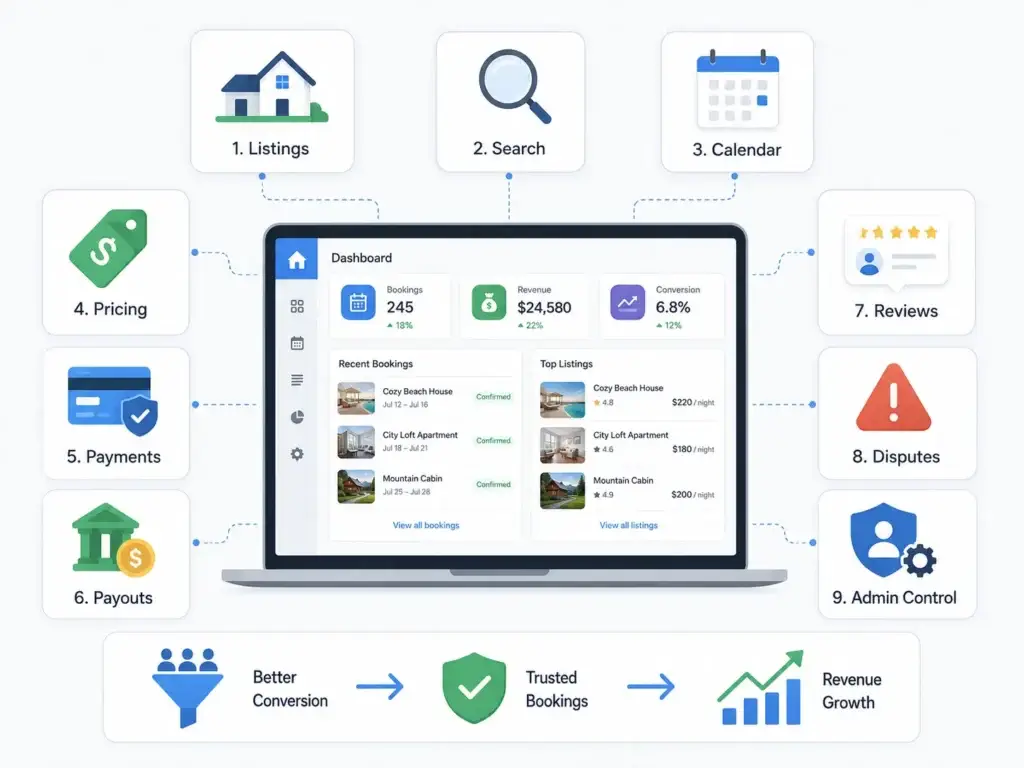
Image Source: AI-generated visual by Miracuves
Revenue does not come only from adding fees. Revenue comes from completed, trusted, repeatable transactions. That means the platform must support both conversion and control.
1. Listing Management
Hosts need to create listings with photos, descriptions, amenities, location, availability, pricing, rules, and cancellation terms. The stronger the listing quality, the easier it is for guests to make booking decisions.
2. Search and Filters
Guests need to find the right stay quickly. Location search, date filters, price filters, amenities, property type, guest count, ratings, and map-based discovery can improve conversion.
3. Availability Calendar
The platform must prevent double bookings and show accurate availability. This is especially important when hosts manage listings across multiple channels.
4. Dynamic Pricing and Fee Calculation
The system should calculate nightly rates, seasonal rates, discounts, extra charges, platform fees, host commission, and final payable amount clearly.
5. Secure Payment Gateway Integration
The marketplace needs reliable payment collection, transaction records, refunds, and payout workflows. Secure payment gateway integration also improves user trust.
6. Host Payout Management
The platform should track host earnings, deductions, commissions, refunds, and payout status. Hosts need clarity on how much they earned and when they will receive payment.
7. Reviews and Ratings
Reviews help guests trust hosts and help hosts build credibility. They also help the platform identify quality issues.
8. Dispute and Refund Management
Disputes are part of any rental marketplace. The admin dashboard should help manage cancellation issues, refund cases, guest complaints, host disagreements, and booking records.
9. Admin Controls
The admin panel is where the platform operator manages users, hosts, listings, bookings, fees, commissions, payouts, disputes, reports, and platform settings. For a marketplace business, this control layer is critical because monetization rules may need to change after launch.
Read More: Vacation Rental Marketplace Feature Checklist for Faster Booking Validation
Founder Decision Signals Before Launching a Rental Booking Platform
Speed
If the market opportunity is time-sensitive, founders should avoid spending months rebuilding common booking flows from zero. A launch-ready foundation can help validate demand faster.
Cost
Pricing depends on features, integrations, tech stack, customization, and launch scope. Founders should budget for the full marketplace workflow, not only screens.
Scalability
The platform should support more listings, more bookings, different property types, flexible fee rules, and stronger admin reporting as the marketplace grows.
Market Fit
The strongest rental marketplaces usually start with a focused niche, clear host supply, guest demand, and a reason to book through the platform instead of offline channels.
Mistakes Founders Should Avoid When Planning Marketplace Monetization
Copying a Broad Marketplace Without Choosing a Niche
A new rental platform should not try to serve every property type from day one. A focused niche such as villas, serviced apartments, homestays, student stays, workation spaces, boats, or event spaces can help founders build supply and demand more clearly.
Adding Fees Without Explaining Value
Guests and hosts are more likely to accept platform fees when they understand the value: secure payments, verified listings, support, dispute handling, reviews, and reliable booking workflows.
Ignoring Payout and Refund Logic
Revenue is not complete when payment is collected. The platform also needs rules for host payouts, cancellations, partial refunds, payment failures, and disputes.
Building Commission Rules Too Rigidly
Founders may need to test different fee models after launch. If commission rules are hard-coded, every pricing experiment becomes a development task.
How Miracuves Supports Founders Planning a Rental Marketplace Platform
Once the revenue model is clear, the next challenge is execution. Founders need to turn booking fees, host payouts, guest payments, listing rules, and marketplace workflows into a product that users can trust and operate smoothly.
A strong rental marketplace is not built from separate features alone. The main product layers must work together as one connected system, including:
- Guest search and property discovery
- Host listing management
- Booking calendars and availability control
- Secure payment workflows
- Commission and service fee settings
- Host payout tracking
- Reviews and ratings
- Notifications and booking updates
- Dispute and refund management
- Admin reporting and marketplace controls
Miracuves helps founders create ready-made, white-label, source-code-owned rental marketplace platforms that can be customized around:
- Specific rental niches
- Regional payment requirements
- Brand identity and UI preferences
- Host and guest fee structures
- Booking, cancellation, and payout workflows
- Admin dashboard controls
For founders moving from business-model planning to product execution, Miracuves’ rental marketplace product foundation can support the next step.
Final Thoughts: Revenue Strategy Comes Before Marketplace Scale
The short-term rental business model is powerful because it does not depend on owning every property. It depends on connecting the right hosts with the right guests, creating a trusted booking experience, and earning revenue from successful transactions.
For founders, the biggest opportunity is not to copy a large travel marketplace. The stronger opportunity is to choose a focused rental niche, define a clear fee model, build trust into the booking journey, and create enough admin control to adapt the business after launch.
Revenue strategy should come before development. When the platform’s commission rules, payout flows, refund logic, listing controls, and trust systems are planned properly, the business has a stronger foundation for validation and growth.
Miracuves helps founders move from marketplace strategy to launch faster with ready-made, white-label, source-code-owned rental marketplace solutions built for branding, admin control, monetization, and scalable booking workflows.
FAQs
What is a short-term rental business model?
A short-term rental business model connects property owners or hosts with guests who want temporary accommodation. The platform usually earns revenue through booking commissions, host fees, guest fees, subscriptions, featured listings, or add-on services.
How do booking platforms generate revenue?
Booking platforms generate revenue by charging a fee when a transaction happens. This may come from the host, the guest, or both. Some platforms also earn from premium listings, subscriptions, cancellation charges, local services, insurance, or payment-related add-ons.
What is the difference between host fees and guest fees?
A host fee is deducted from the host’s payout after a booking. A guest fee is added to the guest’s total price during checkout. Some rental marketplaces use both, while others prefer a host-only or guest-only fee model.
Which revenue model is best for a rental marketplace?
There is no single best model for every marketplace. A host commission model may work well for professional hosts, while a split-fee model can balance revenue across both sides. The right choice depends on host supply, guest demand, price sensitivity, and marketplace positioning.
Can a rental marketplace make money without owning properties?
Yes. A rental marketplace can generate revenue without owning properties by facilitating bookings between hosts and guests. The platform focuses on discovery, payments, reviews, communication, trust, support, and payout workflows.
Why is fee transparency important in rental booking platforms?
Fee transparency helps guests understand the final price before checkout and helps hosts understand their actual earnings. Hidden or confusing fees can reduce trust, increase booking abandonment, and create support issues.
What features are needed to support rental marketplace monetization?
Important features include listing management, availability calendars, dynamic pricing, platform fee settings, payment gateway integration, host payout management, reviews, refunds, dispute handling, coupon rules, and admin reporting.
How can founders launch a rental marketplace faster?
Founders can launch faster by starting with a ready-made marketplace foundation that already includes core booking, listing, payment, commission, host, guest, and admin workflows. Miracuves helps customize this foundation for branding, niche categories, and monetization needs.
Miracuves is an independent software development company. We are not affiliated with, connected to, sponsored by, or endorsed by any company or product named in this article.
Terms such as “X Clone” are used descriptively. It is how the software industry refers to building a platform with functionality comparable to a known service, and how clients search for it.
The entire design and codebase of our products is built by our own team. Our products contain no code, design, graphics, or content originating from any third-party website or applications.
All third-party names and marks referenced in this article are the property of their respective owners, referenced solely to identify the services discussed.