


Key Takeaways
- A vacation rental marketplace should validate the complete booking journey, including property discovery, availability, pricing, reservations, payments, host communication, and cancellations.
- Core marketplace features include property listings, search filters, availability calendars, instant booking, secure payments, reviews, messaging, host dashboards, and admin controls.
- Feature validation helps founders identify whether guests can book smoothly, hosts can manage inventory efficiently, and admins can control marketplace operations without unnecessary complexity.
Booking Validation Signals
- Search, filters, maps, property details, pricing breakdowns, availability calendars, and booking confirmation should help guests move from discovery to reservation with minimal friction.
- Host onboarding, listing management, calendar updates, reservation approval, pricing controls, payouts, messaging, and cancellation workflows should be tested as one connected process.
- Payment status, booking conflicts, refund rules, reviews, notifications, identity checks, and admin intervention should be validated before adding advanced marketplace features.
Founder Insights
- Founders should prioritize features that prove guest demand, host participation, successful bookings, payment completion, and repeat marketplace usage before expanding the product.
- A focused MVP can validate listing quality, booking conversion, host response, cancellation behavior, payment reliability, and operational gaps faster than an overloaded feature set.
- Miracuves develops customizable vacation rental marketplaces with property listings, booking workflows, host management, payments, calendars, messaging, reviews, analytics, and admin controls.
Building a vacation rental marketplace is not just about creating property listings and adding a booking button. A strong rental platform needs clear guest flows, reliable host tools, accurate booking logic, secure payments, admin control, and trust-building features that make users comfortable enough to complete a reservation.
For founders, the feature checklist matters because every feature affects validation. If guests cannot find the right property, they leave. If hosts cannot manage availability, the platform becomes unreliable. If admins cannot control bookings, payments, disputes, and commissions, the business becomes difficult to operate after launch.
This guide explains the essential vacation rental marketplace features founders should prioritize before launching or improving a rental booking platform. The focus is not on copying a popular platform. The focus is on understanding which features help validate demand faster, improve trust, and make the business easier to manage.
Why Feature Planning Matters Before Launching a Rental Marketplace
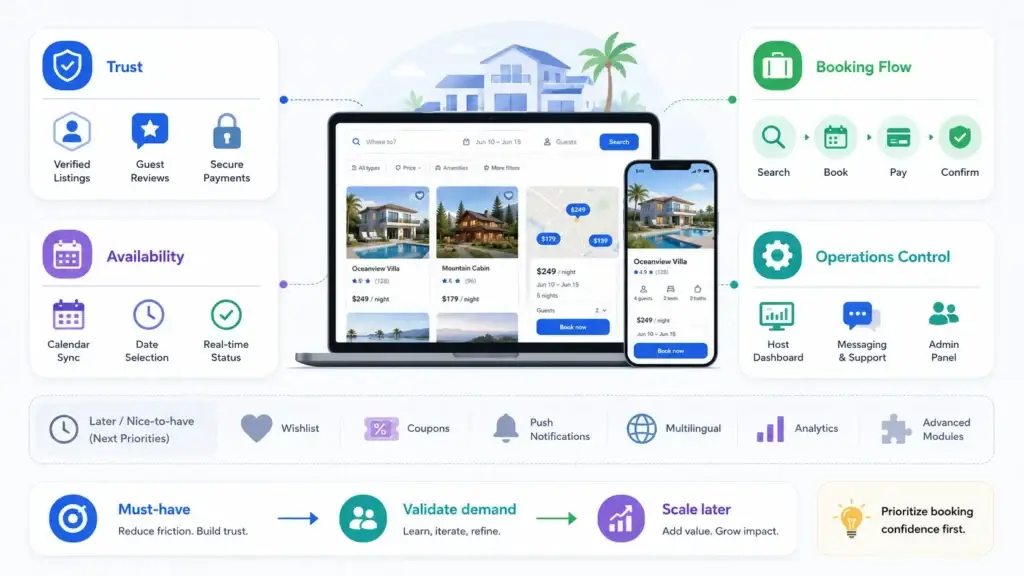
Many founders begin with a long list of possible features. Search, map view, wishlists, messaging, reviews, calendar sync, coupons, loyalty programs, analytics, and automated recommendations all sound useful. But not every feature has the same value in the early stage.
The first goal of a vacation rental marketplace is to prove that guests are willing to book and hosts are willing to list. That means the first version should focus on trust, availability, booking completion, payment reliability, and operational control.
A strong feature plan helps founders decide what to build first and what to add later. Instead of delaying launch by trying to include every advanced feature, founders can focus on the workflows that directly support booking validation.
The best question is not “How many features can we add?” The better question is “Which features help users complete real bookings and help the business operate smoothly?”
The Three Core User Groups Your Feature Checklist Must Cover
A rental marketplace has three main user groups: guests, hosts, and admins. Each group needs a different set of features, but all three must work together for the marketplace to function properly. Founders planning broader travel, rental, or property-listing products can also explore Miracuves’ rental marketplace solutions to understand how listing-based platforms are structured.
Guests need search, filters, property details, pricing transparency, booking flow, payment options, reviews, and support access. Their experience decides whether browsing turns into a completed reservation.
Hosts need listing management, availability control, pricing settings, guest communication, booking history, and payout visibility. Their experience decides whether the platform can build and maintain enough reliable supply.
Admins need control over users, listings, bookings, payments, commissions, refunds, disputes, content, and reports. Their experience decides whether the business can scale without depending on manual work for every issue.
If one side is weak, the marketplace suffers. A good guest app cannot succeed if hosts do not update calendars. A strong host dashboard cannot help if guests do not trust listings. A beautiful interface is not enough if the admin cannot control operations.
Guest Features That Help Visitors Move From Search to Booking
Guest-side features are important because they shape the first impression of the marketplace. When users search for a stay, they want speed, clarity, trust, and confidence. If the experience feels confusing, they may leave before reaching checkout.
Location-Based Search
Location-based search helps guests find properties based on destination, city, area, landmark, or nearby location. This is usually one of the first interactions a guest has with the platform, so it should be simple and accurate.
A strong search experience should allow users to enter a destination, select dates, add guest count, and browse relevant listings. For marketplaces with many properties, map-based browsing and location search can also help users understand where each property is located and compare stays by distance, nearby landmarks, or preferred travel areas.
For founders, this feature is valuable because search behavior reveals demand patterns. If users repeatedly search for specific neighborhoods, travel zones, or property types, that data can guide supply acquisition and marketing decisions.
Filters and Sorting Options
Filters help users narrow down their choices. A guest may want a specific price range, number of bedrooms, property type, rating, amenities, cancellation policy, or distance from a location.
Sorting is also useful because different users make decisions differently. Some may sort by price. Others may sort by rating, popularity, newest listings, or recommended stays.
These features improve the guest experience because users do not want to scroll through irrelevant options. For the business, filters also provide insight into what users actually care about before booking.
Property Listing Pages
The property listing page is where trust is built. A guest should be able to understand what the property offers, where it is located, what it costs, what rules apply, and whether previous guests had a good experience.
A strong listing page should include property images, title, description, amenities, guest capacity, bedrooms, bathrooms, location details, host profile, reviews, availability, pricing, and cancellation rules.
Founders who want to compare these elements with a ready product structure can review Miracuves’ rental marketplace feature modules to understand how guest, host, booking, payment, and admin workflows can be organized.
If the listing page does not answer important questions, users may hesitate. Clear listing content can improve booking confidence and reduce unnecessary support questions.
Wishlist or Saved Properties
A wishlist feature allows guests to save properties and return later. This matters because vacation rental decisions are often not instant. Users may compare multiple stays, discuss options with family, wait for travel confirmation, or return after checking prices.
Saved properties also create useful re-engagement opportunities. The platform can remind users about saved stays, send availability updates, or encourage them to complete a booking before dates are unavailable.
For early validation, wishlist activity can also help founders understand which properties attract interest even before bookings happen.
Transparent Pricing Breakdown
Pricing transparency is one of the most important conversion factors in a rental booking platform. Guests should clearly understand the nightly rate, cleaning fee, platform fee, taxes, discounts, and final payable amount before checkout.
Unexpected charges at the final step can reduce trust and increase drop-offs. A clear pricing breakdown helps users feel more confident because they know what they are paying for.
For founders, this also reduces support friction. When pricing is visible and easy to understand, fewer users ask questions about hidden fees or payment confusion.
Booking Features That Improve Reservation Reliability
The booking system is the transaction layer of the marketplace. It turns user interest into actual business activity. If the booking flow is slow, unclear, or unreliable, the marketplace will struggle to validate demand.
Availability Calendar
An availability calendar shows which dates are open, booked, blocked, or unavailable. This feature is essential because vacation rentals depend on accurate date management.
If the calendar is inaccurate, double bookings can happen. This damages guest trust, creates host frustration, and increases admin workload.
This is why preventing double bookings with calendar sync should be treated as a core reliability requirement, not an advanced feature that can be ignored during early planning.
For a first launch, founders should prioritize a simple but reliable calendar. Advanced calendar tools can be added later, but basic availability accuracy should be part of the core product foundation.
Instant Booking and Request-Based Booking
Different properties may need different booking flows. Some hosts may allow instant booking, while others may prefer to approve requests before confirming a reservation.
Instant booking is useful when hosts are comfortable accepting bookings automatically. Request-based booking works better for premium stays, unique properties, long-term rentals, or hosts who want more control.
A flexible booking system gives founders room to test both models. This can help identify which booking flow works best for the target market.
Booking Confirmation Flow
After payment or approval, guests should receive a clear booking confirmation. The confirmation should include booking ID, property details, guest information, check-in and check-out dates, payment summary, cancellation policy, and support access.
This confirmation flow reduces confusion. It also creates a clear record for guests, hosts, and admins.
A good confirmation experience reassures users that the reservation is complete and that the platform has recorded the transaction properly.
Cancellation and Refund Rules
Cancellation rules should be visible before payment. Guests need to know whether they can cancel, when refunds apply, and whether any fees are deducted.
Hosts also need clear cancellation controls because different properties may have different policies. Some may allow flexible cancellation, while others may follow stricter rules.
Admins need visibility into cancellation and refund requests so they can manage disputes, exceptions, and support cases properly.
Host Features That Help Build Supply Faster
A rental marketplace depends on supply. If hosts do not find the platform easy to use, they may not list properties or keep listings updated. That directly affects guest experience and booking volume.
Host Registration and Profile
Host registration should be simple but trustworthy. Hosts should be able to create an account, add basic details, upload profile information, and complete any required verification steps.
A host profile helps guests understand who they are booking from. It may include a profile image, short bio, verification status, response rate, reviews, and hosting history.
This feature supports trust on both sides. Guests feel more confident, and hosts get a professional identity inside the marketplace.
Property Listing Management
Hosts need an easy way to create and manage listings. The listing workflow should help them add property details, images, address, pricing, availability, amenities, house rules, and cancellation terms.
The easier this process is, the faster the marketplace can grow supply. If listing creation is confusing or too long, hosts may abandon the process before publishing.
For founders, the host listing flow should be clear enough for individual property owners and flexible enough for property managers with multiple units.
Calendar and Availability Control
Hosts should be able to update availability, block dates, view upcoming bookings, and avoid scheduling conflicts. This feature is important because guests rely on accurate availability before making a booking.
A poor calendar experience creates operational risk. If a host forgets to update availability or cannot manage bookings easily, the platform may face cancellations and disputes.
Strong calendar control helps maintain supply quality and improves trust between guests and hosts.
Pricing and Discount Controls
Hosts may need control over nightly rates, weekend rates, seasonal prices, long-stay discounts, and special offers. Pricing flexibility helps hosts remain competitive and respond to demand changes.
The platform can also allow admins to create platform-wide coupons or promotional campaigns. This gives the marketplace more control over growth and user acquisition.
For validation, pricing behavior can reveal which property types, locations, or stay durations generate the best response from guests.
Host Messaging
Messaging allows guests and hosts to communicate before or after a booking. Guests may ask about check-in, parking, amenities, local rules, or special requests.
For hosts, messaging helps clarify expectations before the guest arrives. For admins, message records can support dispute resolution if issues occur later.
A clean messaging system keeps communication inside the platform instead of pushing users to external channels too early.
Earnings and Payout Dashboard
Hosts need visibility into their earnings. A payout dashboard should show completed bookings, pending payouts, deductions, platform fees, and payout history.
This improves host confidence because they can clearly see how much they earned and when payments are expected.
For founders, payout transparency helps reduce support questions and improves long-term host retention.
Admin Features That Help Founders Control the Business
The admin panel is the control center of the rental marketplace. It helps the platform operator manage users, hosts, listings, bookings, payments, commissions, disputes, and reports from one place.
A weak admin panel creates manual work. A strong admin panel helps founders operate the business with better visibility and faster decision-making.
User and Host Management
Admins should be able to view, approve, edit, suspend, or manage guests and hosts. This is important for quality control, fraud prevention, support, and platform safety.
As the marketplace grows, the admin team needs quick access to user activity, booking history, verification status, and support issues.
Without user and host management, even small operational problems can become difficult to handle.
Listing Approval and Moderation
Not every property listing should go live automatically. Admins may need to review images, descriptions, pricing, location details, amenities, house rules, and verification documents.
Listing moderation helps reduce fake, incomplete, misleading, or low-quality properties. It also improves trust for guests who depend on listing accuracy before booking.
For a rental marketplace, listing quality is directly connected to conversion and reputation.
Booking and Payment Management
Admins need visibility into all bookings and payments. This includes booking status, payment status, cancellation requests, refund activity, host payouts, and transaction history.
This feature helps founders understand where users face friction. For example, if many users start bookings but do not complete payment, checkout may need improvement.
Booking and payment management also helps the business resolve support cases faster.
Commission and Fee Controls
A rental marketplace can generate revenue through host commissions, guest service fees, featured listings, subscriptions, or promotional placements. These models need admin-level control. Founders can also review a complete rental marketplace monetization model to understand how different revenue streams can work together without confusing guests or hosts.
Admins should be able to manage commission settings, platform fees, and payout deductions based on business rules.
Clear commission logic is important because it affects revenue, host trust, accounting, and reports.
Dispute and Refund Management
Disputes can happen in any rental platform. A guest may report a property issue. A host may report damage. A refund may need manual review.
The admin panel should support dispute tracking, booking records, payment details, support notes, and resolution status.
This helps the business manage issues professionally instead of handling everything through scattered messages or spreadsheets.
Reporting and Analytics
Analytics help founders understand whether the marketplace is moving in the right direction. Useful reports may include total users, active hosts, published listings, booking volume, revenue, cancellation rate, refund volume, top locations, and popular property types.
These insights help founders make better decisions about marketing, supply acquisition, feature improvements, and monetization.
Without analytics, founders may rely on assumptions instead of real marketplace behavior.
Trust and Safety Features That Improve Booking Confidence
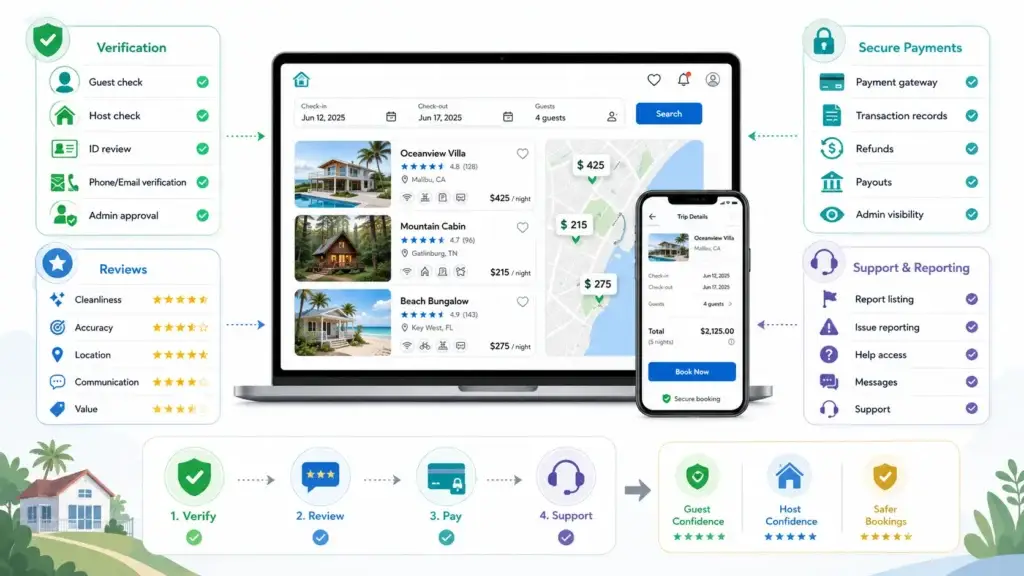
Trust is one of the most important parts of a vacation rental marketplace. Guests are paying for a place they have not physically visited. Hosts are allowing unknown guests into their property.
The platform should reduce uncertainty for both sides.
Guest and Host Verification
Verification can include email verification, phone verification, identity checks, host document review, or manual admin approval. The level of verification depends on the target market and operating model.
The goal is not to create unnecessary friction. The goal is to build enough confidence for both guests and hosts to transact safely.
For founders, verification helps protect marketplace quality as more users join.
Ratings and Reviews
Ratings and reviews help guests evaluate properties and hosts. They also help hosts build credibility over time.
A strong review system should ideally be connected to completed bookings. This helps reduce fake or irrelevant reviews.
Review categories may include cleanliness, accuracy, location, communication, check-in experience, and value.
Secure Payment Flow
A rental marketplace should support secure payment gateway integration, transaction records, refund logic, payout tracking, and admin visibility.
Guests need confidence that their payment is processed safely. Hosts need confidence that payouts will be handled according to platform rules.
Payment trust affects conversion, host retention, and long-term platform reputation.
A practical rental marketplace security checklist can also help founders think through payments, verification, reporting, admin access, and user safety before launch.
Abuse Reporting and Support Access
Users should be able to report suspicious listings, inappropriate behavior, payment issues, or booking problems.
Support access should be easy to find from booking pages, messages, profiles, and help sections.
This becomes more important as the marketplace grows and the founder cannot personally monitor every interaction.
Feature Priority Table for Faster Booking Validation
| Feature Area | Must-Have for Validation | Add After Initial Traction | Business Reason |
|---|---|---|---|
| Guest Search | Destination, dates, guests, filters | Personalized recommendations | Helps guests find relevant properties faster |
| Listings | Images, description, amenities, pricing | Virtual tours and advanced media | Builds trust before booking |
| Booking | Calendar, checkout, confirmation | Advanced packages and loyalty credits | Converts interest into reservations |
| Host Tools | Listing creation, calendar, pricing, messages | Bulk uploads and advanced automation | Helps build and manage supply |
| Payments | Gateway, booking records, payout tracking | Wallets and split payment options | Supports trust and revenue control |
| Admin Panel | Users, listings, bookings, payments, commissions | Advanced automation and custom reports | Gives the operator business control |
| Trust Features | Verification, reviews, reporting | Risk scoring and automated moderation | Reduces fraud and misuse |
| Growth Features | Coupons, saved properties, basic referrals | CRM workflows and advanced campaigns | Supports acquisition and retention |
What Founders Should Build First
For the first version of a vacation rental marketplace, founders should avoid building every advanced feature immediately. The early product should prove that guests can find listings, hosts can manage properties, bookings can happen reliably, and the admin can control operations.
A practical first version should include search, filters, listing pages, availability calendar, booking flow, secure payments, host dashboard, messaging, reviews, admin controls, and basic commission settings.
Advanced features such as AI recommendations, loyalty programs, complex pricing automation, CRM workflows, and advanced analytics can be added after real usage patterns appear.
This approach helps founders reduce unnecessary development time while still launching with enough functionality to validate demand.
For businesses that want to move faster, a ready-made rental marketplace solution from Miracuves can provide a launch-ready foundation with guest, host, booking, payment, and admin workflows that can be customized around the target market.
Common Feature Planning Mistakes Founders Should Avoid
Building Too Many Advanced Features Too Early
Advanced features may sound attractive, but they should not delay the first launch if the core booking journey is not yet validated.
Before expanding the feature scope, founders should also review rental app development cost planning so they can separate must-have launch features from expensive nice-to-have modules.
Before adding complex automation, founders should first prove that users are willing to search, book, pay, and return.
A focused launch is often better than a delayed product with too many unused features.
Ignoring the Host Experience
Many founders focus heavily on the guest side because it is more visible. However, hosts create the supply that makes the marketplace valuable.
If hosts cannot list properties, update availability, manage pricing, and understand payouts easily, the platform will struggle to grow.
A strong host dashboard is not optional. It is one of the most important parts of the marketplace.
Treating the Admin Panel as a Small Back-Office Tool
The admin panel is not just a backend screen. It is the control layer of the business.
Admins need to manage users, listings, bookings, payments, commissions, disputes, refunds, and reports. Without these controls, the business becomes dependent on manual work.
A strong admin panel helps founders operate the marketplace with more confidence.
Making Pricing Unclear
Guests want to know the final price before booking. Hosts want to understand platform deductions and payouts. Admins need to manage fees and commissions clearly.
If pricing is unclear, every side of the marketplace becomes frustrated.
Transparent pricing helps improve trust and reduces support friction.
Skipping Trust and Safety Features
Trust features should not be treated as optional. Verification, reviews, listing moderation, secure payments, reporting, and dispute management help protect the platform.
Rental marketplaces depend on reputation. If users do not trust the platform, growth becomes harder.
How This Checklist Helps With Faster Booking Validation
Feature planning is not only a development task. It is a validation strategy.
When founders choose the right vacation rental marketplace features, they can test demand faster. They can learn which locations attract users, which property types convert, which hosts stay active, which pricing models work, and which trust signals matter most.
After the core booking journey is validated, founders can use a focused vacation rental app marketing strategy to attract guests, onboard hosts, and improve repeat bookings.
A rental marketplace does not need the longest feature list to validate demand. It needs the right features working together.
The strongest early feature set should support guest discovery, host supply, booking completion, secure payments, admin control, and trust.
For founders planning to move from idea to launch, Miracuves helps build white-label rental marketplace platforms with source-code ownership, branded design, admin dashboards, and customizable workflows for specific business models.
Final Thoughts
Vacation rental marketplace features should not be planned as a random checklist. They should be planned around the business outcome founders need most: faster booking validation.
Guests need clear search, useful filters, trusted listings, transparent pricing, secure payments, and simple booking flows. Hosts need listing tools, calendar control, pricing settings, guest communication, and payout visibility.
Admins need control over users, listings, bookings, payments, commissions, refunds, disputes, and platform performance. When these layers work together, the marketplace becomes easier to launch, test, manage, and improve.
The smarter feature strategy is not to copy every feature from larger platforms. It is to start with the features that prove demand, protect trust, and give the operator enough control to grow without unnecessary friction.
For founders who want to move from planning to execution, Miracuves helps build ready-made rental marketplace solutions with guest workflows, host dashboards, booking systems, payment flows, admin control, and source-code ownership, so the platform can be customized around the target market instead of being built from zero.
FAQs
What features should a vacation rental marketplace include?
A vacation rental marketplace should include guest search, property listings, availability calendars, booking flow, secure payments, host dashboards, messaging, reviews, admin controls, commission settings, dispute management, and reporting. These features help guests book confidently, hosts manage properties, and admins operate the platform.
Which features are most important for early booking validation?
The most important early features are location search, listing pages, availability calendar, pricing breakdown, booking confirmation, host property management, payment processing, reviews, and admin control. These features directly affect whether users can complete real bookings.
Why is the host dashboard important in a rental booking platform?
The host dashboard helps property owners add listings, update availability, manage pricing, respond to guests, view bookings, and track payouts. A weak host dashboard makes it harder to build reliable supply, which can slow marketplace growth.
How does an admin panel help a rental marketplace founder?
The admin panel helps the founder manage users, hosts, listings, bookings, payments, commissions, cancellations, refunds, disputes, and reports. It gives the operator control over the business without depending on manual spreadsheets or developer support for every operational issue.
Should founders launch with all advanced rental platform features?
No. Founders should launch with the features needed to validate demand first. Advanced features such as AI recommendations, loyalty systems, deep automation, and complex pricing tools can be added after real users and hosts show clear behavior patterns.
What trust features are important for rental marketplaces?
Important trust features include guest verification, host verification, listing approval, ratings, reviews, secure payments, transparent cancellation policies, abuse reporting, and dispute management. These features help reduce uncertainty for both guests and hosts.
How can a rental marketplace make money?
A rental marketplace can generate revenue through host commissions, guest service fees, subscription plans, featured listings, cancellation fees, advertising, value-added services, or partner integrations. The right model depends on the target market and operating strategy.
How can founders move faster from feature planning to launch?
Founders can move faster by prioritizing core booking workflows first and using a ready-made rental marketplace foundation when speed matters. This helps reduce development effort while still allowing customization for branding, location, pricing, and business model needs.
Miracuves is an independent software development company. We are not affiliated with, connected to, sponsored by, or endorsed by any company or product named in this article.
Terms such as “X Clone” are used descriptively. It is how the software industry refers to building a platform with functionality comparable to a known service, and how clients search for it.
The entire design and codebase of our products is built by our own team. Our products contain no code, design, graphics, or content originating from any third-party website or applications.
All third-party names and marks referenced in this article are the property of their respective owners, referenced solely to identify the services discussed.