
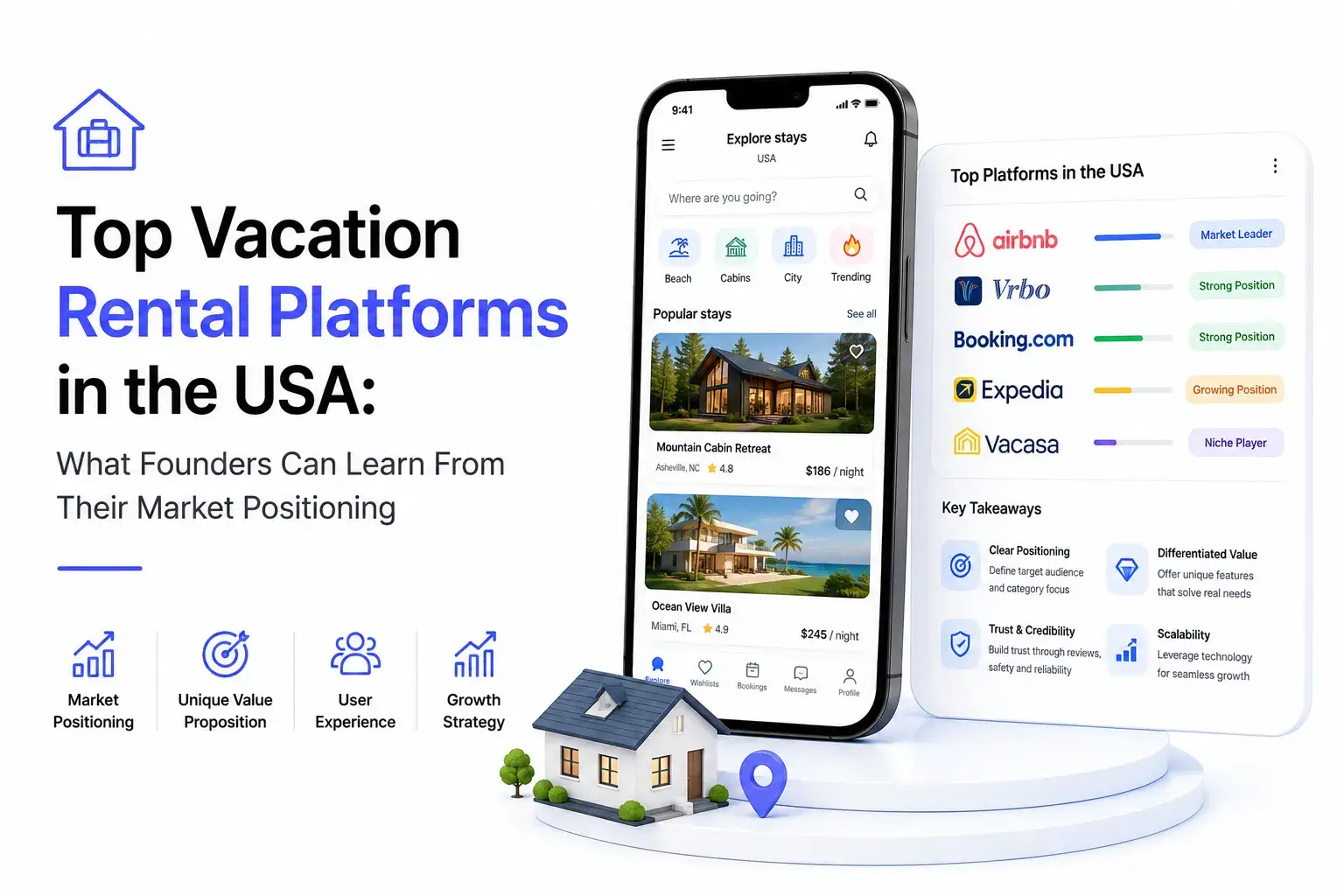
Key Takeaways
- Leading vacation rental platforms in the USA compete through property selection, traveler segments, booking convenience, host supply, trust signals, and brand positioning.
- Airbnb emphasizes broad and distinctive stays, Vrbo is strongly associated with whole-home rentals, while broader travel platforms use accommodation variety, loyalty programs, and travel ecosystems to attract guests.
- For founders, the key lesson is to define a clear marketplace position instead of building another generic vacation rental app with the same listings, features, and target audience.
Market Positioning Signals
- Successful platforms differentiate around traveler type, property category, location coverage, pricing transparency, cancellation flexibility, rewards, and booking experience.
- Strong marketplace positioning also depends on host acquisition, inventory quality, reviews, search visibility, recommendations, secure payments, and reliable guest-host communication.
- Niche vacation rental platforms can compete by focusing on specific segments such as family stays, luxury homes, urban rentals, extended stays, regional inventory, or professionally managed properties.
Founder Insights
- Founders should define their target guests, host proposition, inventory strategy, commission model, geographic focus, trust framework, and acquisition channels before scaling the marketplace.
- Features such as smart search, maps, availability calendars, instant booking, reviews, payments, messaging, pricing tools, and host dashboards should reinforce the platform’s chosen market position.
- Miracuves develops customizable vacation rental platforms with property listings, booking workflows, host management, payments, search and discovery, reviews, analytics, and admin controls.
The vacation rental market in the USA is no longer a single-platform story. Travelers now compare platforms based on stay type, trust, flexibility, pricing, property quality, loyalty benefits, and the kind of experience they want from a trip.
For founders, this shift matters more than the list of apps itself. The real lesson is not “which platform is popular?” The better question is: why does each platform win a specific type of traveler or host?
Some platforms focus on whole-home stays for families and groups. Some combine vacation homes with hotels, flights, and car rentals. Some focus on luxury curation. Others win by owning outdoor stays, glamping, cabins, RV parks, or private land camping.
That is where the opportunity sits. A new rental marketplace does not need to copy the largest player in the market. It needs to understand where traveler demand, host supply, trust, pricing, and niche positioning intersect.
This guide breaks down leading vacation rental platforms in the USA and explains what founders can learn from their market positioning.
Why Vacation Rental Platforms Compete on Positioning, Not Just Inventory
A vacation rental platform may look simple from the outside: users search, compare, book, pay, and review. But the business is more complex.
At a broader level, vacation rental products belong inside the larger listings platform ecosystem, where users search, filter, compare, and act on structured listings across rentals, real estate, travel, ecommerce, jobs, and services.
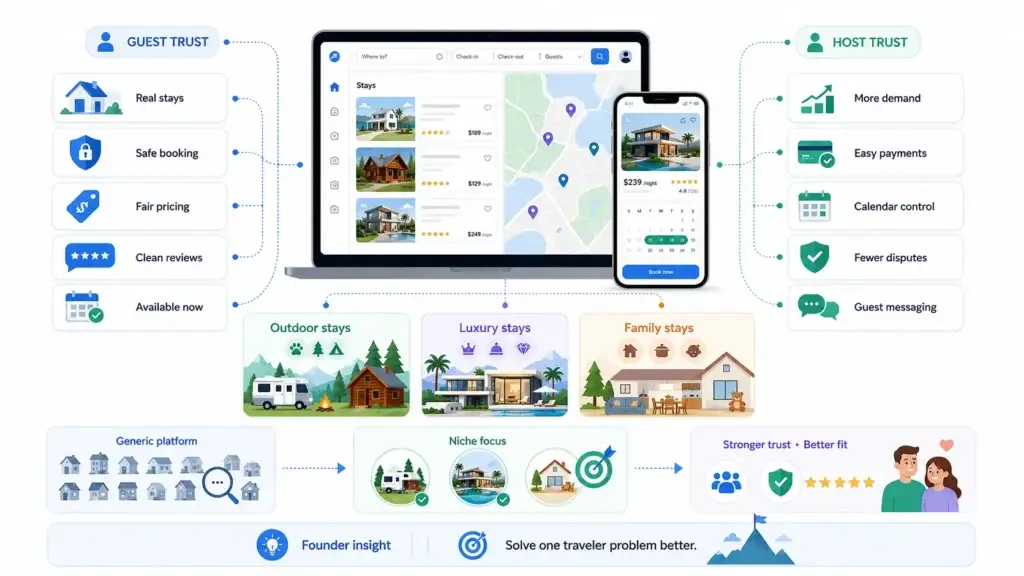
Every rental marketplace needs two types of trust. Guests need to trust that the property is real, safe, clean, priced fairly, and available as promised. Hosts need to trust that the platform can bring demand, process payments, reduce disputes, and give them enough control over calendars, pricing, rules, and communication.
This is why positioning matters. A broad platform attracts a wide audience, but a niche platform can often build stronger trust within a smaller segment.
For example, a platform focused on outdoor stays can build filters for RV sites, glamping tents, cabins, private campsites, pet policies, and nature-based experiences. A luxury-focused platform can build trust through curation, professional vetting, premium photography, concierge support, and higher stay standards. A family-focused platform can prioritize whole-home listings, kitchens, extra bedrooms, safety filters, and group planning.
For founders, the lesson is clear: a rental marketplace should not begin with “we will list every property for everyone.” It should begin with a sharper question: which traveler problem can we solve better than a generic platform?
Vacation Rental Platform Comparison for Founders
| Platform | Market Positioning | Best Known For | Founder Lesson |
|---|---|---|---|
| Vrbo | Whole-home vacation rentals | Family and group stays | Own a clear stay category instead of serving every use case |
| Booking.com | Broad accommodation marketplace | Hotels, apartments, vacation homes, transport options | Convenience and inventory variety can become a competitive moat |
| Expedia | Full-trip planning ecosystem | Flights, hotels, vacation homes, cars, packages | Bundling can increase order value and user retention |
| Plum Guide | Curated luxury stays | Vetted premium homes | Quality control can justify premium positioning |
| Hipcamp | Outdoor and nature-based stays | Campsites, RV parks, cabins, glamping | Niche supply can create strong differentiation |
| Homes & Villas by Marriott Bonvoy | Premium home rentals connected to loyalty | Curated homes and brand trust | Loyalty programs can reduce acquisition friction |
1. Vrbo: The Power of Owning a Clear Stay Category
Vrbo’s positioning is built around whole-home vacation rentals, making it especially relevant for families and groups looking for privacy, space, kitchens, and shared living areas. Vrbo also describes itself as one of the original vacation rental marketplaces and emphasizes private whole-home stays.
For founders, Vrbo shows the value of category clarity. Instead of trying to serve every accommodation type equally, it owns a specific use case: people who want an entire place rather than a shared or mixed accommodation experience.
That positioning affects product decisions. Search filters, property pages, group planning, cancellation visibility, guest messaging, and amenities need to serve people booking for more than one guest. A couple planning a weekend trip may care about design and location. A family booking a summer rental may care more about bedrooms, pet policies, kitchen access, laundry, parking, and safety.
Founder lesson: clear positioning makes product decisions easier. When the audience is defined, the platform can build better filters, better onboarding, better trust signals, and better host education.
A new platform could learn from this by focusing on one strong stay category first: family vacation homes, pet-friendly stays, remote-work cabins, furnished monthly rentals, lake houses, accessible stays, or regional tourism rentals.
2. Booking.com: The Advantage of Broad Inventory and Booking Convenience
Booking.com is known for broad travel accommodation coverage, including hotels, apartments, vacation homes, villas, flights, car rentals, taxis, attractions, and other travel services. Its own company information describes it as a leading online travel platform connecting travelers with places to stay, experiences, and transportation options.
This positioning is different from a niche rental marketplace. Booking.com wins through convenience, inventory depth, search familiarity, and the habit of comparing many types of stays in one place.
For founders, the lesson is not to copy broad inventory immediately. Most startups cannot begin with that level of supply. The lesson is to understand why users value convenience. A traveler may not want to move across five websites to compare apartments, hotels, villas, and flexible cancellation options.
A smaller rental marketplace can borrow this lesson by making the user journey easier within a niche. For example, a regional stay platform can combine boutique rentals, local experiences, airport transfers, and destination guides. A corporate housing platform can combine furnished units, monthly pricing, relocation support, utilities, and invoices.
Founder lesson: convenience can be built vertically, not only horizontally. You do not need to serve every travel category. You need to reduce friction for the specific audience you serve.
3. Expedia: How Bundling Creates a Stronger Travel Ecosystem
Expedia positions itself as a broader travel planning platform where users can book flights, hotels, vacation rentals, cars, cruises, and packages. Expedia also promotes bundle-and-save options where users can book multiple trip parts together.
This is important for founders because it shows how a travel platform can move beyond a single booking transaction. When users book a stay, they may also need transport, local experiences, insurance, activities, or longer-trip planning.
Bundling increases the business opportunity. It can improve average order value, create cross-sell opportunities, and give users fewer reasons to leave the platform after booking accommodation.
A startup does not need to launch with flights, hotels, cars, tours, and packages all at once. But it can design the platform foundation in a way that supports future expansion. For example, a vacation rental marketplace focused on coastal destinations could later add boat rentals, guided tours, airport pickup, surf lessons, or local event tickets.
Founder lesson: a rental platform can become a travel ecosystem if the backend supports multiple inventory types, commissions, booking rules, and vendor payouts.
This is where technology decisions matter. A basic listing website may work for early discovery, but a serious marketplace needs booking rules, calendars, payments, guest communication, vendor controls, and admin visibility from the start.
4. Plum Guide: Premium Positioning Through Curation and Quality Control
Plum Guide focuses on luxury vacation homes and emphasizes professional vetting, handpicked homes, and quality standards. Its pages highlight expert-vetted homes and a selective approach to rental quality.
This gives founders a useful lesson: not every marketplace needs the largest inventory. Some marketplaces win by reducing uncertainty.
In premium travel, users may not want thousands of options. They want confidence. They want to know the home will match the photos, the location is strong, the support is reliable, and the stay experience will feel worth the price.
A curated marketplace needs a different operating model from an open marketplace. It may require host screening, property inspection, quality scoring, better content, stricter listing rules, cancellation safeguards, and high-touch support.
Founder lesson: quality control can be a marketplace moat. If a founder can consistently deliver better trust and selection in a valuable niche, the platform does not need to compete on volume alone.
This applies beyond luxury. The same principle can work for verified family stays, accessible rentals, pet-friendly homes, workation-friendly apartments, student housing, senior-friendly stays, or religious tourism accommodations.
5. Hipcamp: Winning Through Outdoor and Experience-Led Supply
Hipcamp positions itself around outdoor stays, including tent campsites, RV resorts, glamping, cabins, treehouses, and private land camping experiences. Its own about page describes the platform as a way to discover and book outdoor stays across the United States and other markets.
This is one of the strongest examples of niche-led marketplace positioning. Hipcamp does not simply compete on accommodation. It competes on a lifestyle: nature, camping, land access, outdoor trips, and unique stays.
For founders, this is a powerful reminder that inventory type can shape brand identity. A platform focused on cabins, farm stays, glamping, or RV experiences can build a very different product from a general accommodation marketplace.
The filters change. The photos change. The host onboarding changes. The payment rules may change. The safety and cancellation policies may change. Even the content strategy changes because users may search by national parks, forests, lakes, campfire rules, pet policies, road access, and seasonal conditions.
Founder lesson: a strong niche gives the platform a reason to exist. Without niche clarity, a new rental marketplace becomes just another search-and-book website.
6. Homes & Villas by Marriott Bonvoy: Brand Trust and Loyalty as Market Positioning
Homes & Villas by Marriott Bonvoy positions itself as a curated collection of premium and luxury home rentals. Marriott’s help center describes the product as a curated global collection of premium and luxury home rentals, and the platform is connected to the Marriott Bonvoy ecosystem.
This model shows how brand trust can support rental marketplace growth. Travelers who already trust a hospitality brand may feel more comfortable booking a home rental through that brand’s ecosystem. Loyalty programs can also influence repeat booking behavior.
For founders, this is especially relevant if they already own a customer base, hospitality network, destination brand, corporate travel audience, or regional tourism community.
A new platform does not need to be a global hotel group to apply this lesson. It can build trust through local authority, verified hosts, transparent policies, strong support, curated inventory, and repeat-user benefits.
Founder lesson: trust can come from brand equity, verification, community, or ownership of a specific audience. The platform should make that trust visible at every step of the booking journey.
What These Platforms Teach About Rental Marketplace Strategy
The strongest vacation rental platforms do not win for the same reason. Each one has a different center of gravity.
Vrbo wins through whole-home positioning. Booking.com wins through breadth and convenience. Expedia wins through trip bundling. Plum Guide wins through quality control. Hipcamp wins through outdoor niche ownership. Marriott’s rental offering wins through brand trust and loyalty.
For founders, the lesson is not to choose the biggest market. The lesson is to choose the clearest wedge.
A wedge is the first segment where your platform can be meaningfully better. It could be a geographic market, a property type, a traveler segment, a host segment, or an operational pain point.
Examples include:
- Pet-friendly short stays in major US cities
- Verified family vacation homes near beaches and lakes
- Remote-work cabins with monthly pricing
- Furnished mid-term rentals for relocating professionals
- Glamping and outdoor stays in regional tourism markets
- Luxury homes with concierge-level quality control
- Religious, medical, or event-driven travel accommodations
- Corporate housing for teams and project-based workers
A focused wedge helps you acquire hosts, write better content, define product features, and speak to travelers with a clearer message.
This is also why founders should study the wider rental solutions category before choosing a product direction. The same rental marketplace foundation can support short-term stays, long-term leases, vehicle rentals, property rentals, and niche booking models when the positioning is clear.
Once the wedge is clear, founders should connect positioning with acquisition, host onboarding, and demand generation through a focused rental app marketing strategy.
Founder Decision Signals Before Building a Rental Marketplace
Supply Access
Do you already have access to property owners, managers, hosts, hotels, cabins, or local operators? A marketplace without supply will struggle even if the app looks polished.
Audience Focus
Can you define the traveler better than broad platforms do? Strong niches usually start with a clear guest problem, not a generic rental idea.
Trust Layer
How will users know listings are real, payments are safe, reviews are useful, and cancellation rules are clear? Trust is part of the product foundation.
Monetization Path
Will the platform earn through booking commissions, host plans, featured listings, service fees, add-ons, or bundled travel services? Revenue logic should be planned early.
Core Features Founders Should Notice Across Successful Rental Platforms
A founder should not study vacation rental platforms only as a traveler. Study them as product systems.
Behind every smooth booking experience, there are operational layers that decide whether the marketplace can scale.
| Feature Layer | Why It Matters | Founder Impact |
| Search and filters | Helps users find relevant stays quickly | Better discovery improves conversion |
| Listing quality | Gives guests confidence before booking | Better content reduces support friction |
| Calendar availability | Prevents double bookings and confusion | Hosts need control and accuracy |
| Secure payments | Protects both guests and hosts | Payment trust affects repeat usage |
| Host dashboard | Lets hosts manage listings, pricing, and bookings | Supply retention depends on host experience |
| Reviews and ratings | Builds marketplace credibility | Social proof reduces booking hesitation |
| Cancellation rules | Sets expectations before payment | Clear policies reduce disputes |
| Admin controls | Lets operators manage users, listings, payouts, and issues | The business needs backend visibility |
| Commission settings | Supports monetization control | Founders need flexible revenue options |
| Dispute workflows | Helps resolve failed stays, refunds, and complaints | Trust improves when problems are handled well |
Calendar availability deserves special attention because weak sync logic can create booking conflicts, refund issues, and poor guest experience. This technical guide explains calendar sync and double-booking prevention for rental marketplaces.
The mistake many founders make is focusing only on the guest-facing app. For a deeper planning view, this guide on vacation rental app features explains which product modules support guest trust, host growth, secure payments, listing quality, reviews, and admin control. In reality, the admin layer, host tools, payout logic, and dispute workflows are just as important as the mobile interface.
Founders who want to move from market research into product planning can review the full rental marketplace feature set to understand how guest search, host dashboards, booking calendars, payment flows, reviews, and admin controls connect inside a scalable rental product.
How Founders Can Find Gaps in the Vacation Rental Market
The USA vacation rental market is competitive, but that does not mean every segment is fully solved.
Large platforms often serve broad demand. That leaves room for focused marketplaces that understand specific audiences better.
Founders can look for gaps across five areas.
1. Property-Type Gaps
Some users want more than standard apartments or vacation homes. They may search for cabins, houseboats, farm stays, luxury villas, lake homes, long-stay apartments, event spaces, or pet-friendly homes.
If a property type has strong demand and weak discovery, it can become a marketplace opportunity.
2. Location Gaps
National platforms cover many locations, but regional trust can still matter. A local platform can win by knowing neighborhoods, seasonal pricing, regulations, local events, transport options, and host relationships better than a broad platform.
This is especially useful for tourism boards, destination operators, property managers, and local travel startups.
3. Guest Segment Gaps
Different travelers have different priorities. Families want safety and space. Remote workers want Wi-Fi, desks, longer stays, and quiet areas. Luxury travelers want quality control. Pet owners want transparent pet rules. Corporate users want invoices and policy-friendly bookings.
A strong marketplace can start by solving one guest segment deeply.
4. Host Operation Gaps
Hosts may need better calendar control, payout visibility, pricing tools, guest screening, document uploads, tax logic, multi-property management, or support workflows.
A marketplace that helps hosts operate better can build stronger supply retention.
5. Trust and Safety Gaps
Trust remains one of the biggest friction points in peer-to-peer rentals. A focused platform can differentiate through verified hosts, identity checks, property approval workflows, transparent cancellation rules, secure payments, review moderation, and dispute handling.
Trust is not just a feature. It is a market-positioning strategy. For platforms handling bookings, payments, host verification, guest communication, refunds, and disputes, a practical rental marketplace security checklist can help founders plan safer workflows early.
Monetization Models Used by Rental Marketplaces
A rental marketplace can make money in several ways. The right model depends on the platform’s audience, property category, and operating model.
| Monetization Model | How It Works | Best For |
| Booking commission | The platform takes a percentage from each completed booking | Most short-term rental marketplaces |
| Host subscription | Hosts pay monthly or annually for listing access or premium tools | B2B-heavy rental platforms |
| Guest service fee | Guests pay a platform fee during checkout | High-demand travel marketplaces |
| Featured listings | Hosts pay for better visibility | Competitive destination markets |
| Add-on services | Insurance, cleaning, local experiences, transport, or concierge services | Platforms expanding beyond stays |
| Vendor partnerships | Local operators pay to offer tours, rentals, events, or services | Destination and tourism platforms |
| Corporate plans | Businesses pay for managed stay access or employee relocation support | Corporate housing platforms |
For founders planning revenue logic before launch, this booking platform business model guide explains how commissions, host subscriptions, guest service fees, featured listings, add-ons, and payout workflows can shape a rental marketplace.
Founders should avoid choosing monetization only after launch. Revenue rules affect checkout design, host onboarding, payout flows, invoices, tax handling, and the admin dashboard.
This is why a rental marketplace foundation should be monetization-ready from the beginning.
Mistakes Founders Should Avoid When Studying Vacation Rental Platforms
Mistake 1: Trying to Serve Everyone From Day One
A broad platform requires broad supply, strong brand trust, large marketing budgets, and deep operational support. Most founders are better off starting with a niche where they can build liquidity faster.
Mistake 2: Copying Features Without Understanding Positioning
The same feature can serve different goals. A filter for “whole home” supports family privacy. A filter for “verified luxury home” supports premium trust. A filter for “RV hookup” supports outdoor travel. Features only matter when they match positioning.
Mistake 3: Ignoring Host Experience
Hosts are the supply side of the marketplace. If listing creation, calendar control, pricing, messages, payouts, and support are weak, hosts will not stay active.
Mistake 4: Treating Admin Controls as Optional
The admin panel is where the platform operator manages listings, users, payouts, commissions, disputes, reviews, refunds, reports, and platform rules. Without strong admin control, every operational issue becomes manual.
Mistake 5: Building Without a Monetization Strategy
Commission, subscriptions, featured listings, service fees, and add-ons all require different backend logic. Deciding late can create expensive rework.
Where Miracuves Fits for Founders Exploring Rental Marketplace Opportunities
Studying vacation rental platforms is useful, but research only becomes valuable when it informs execution.
Miracuves helps founders launch a launch-ready rental marketplace solution with guest flows, host tools, booking logic, admin dashboards, payment workflows, source-code ownership, and faster deployment. This gives founders a stronger execution path after they identify the right rental niche, audience, and marketplace positioning.
For founders, this means the early focus can shift from rebuilding common marketplace infrastructure to validating the niche, signing supply, designing the brand, and improving the business model.
A ready-made foundation is not about copying a market leader. It is about starting with proven booking, listing, payment, and admin workflows, then customizing the platform for a specific audience or region.
For example, a founder could use the same foundation to launch:
- A family-focused vacation rental marketplace
- A pet-friendly stay platform
- A furnished monthly rental platform
- A cabin and outdoor stay marketplace
- A local tourism booking platform
- A luxury curated home rental platform
- A multi-service destination marketplace with stays, tours, events, and transport
Final Thoughts: The Best Rental Platform Strategy Starts With Positioning
The best vacation rental platforms in the USA are not successful because they all offer the same thing. They are successful because each one gives users a clear reason to choose it.
Some win through whole-home stays. Some win through broad travel convenience. Some win through curated quality. Some win through outdoor experiences. Some win through loyalty and hospitality trust.
For founders, this is the most important takeaway: do not start with a generic rental marketplace. Start with a market position.
Know who you serve. Know what inventory you can access. Know what trust problem you solve. Know how hosts will manage supply. Know how the platform will earn.
Once that clarity exists, the product becomes easier to shape. The features become more focused. The internal operations become more realistic. And the marketplace has a stronger chance of becoming useful before it tries to become large.
If the next step is choosing an execution partner, founders can evaluate a rental marketplace development company based on source-code ownership, admin control, launch support, customization flexibility, and marketplace experience.
Miracuves can support that journey with a launch-ready rental marketplace foundation that helps founders move faster, customize smarter, and focus on the market gap instead of rebuilding the same booking infrastructure from zero.
FAQs
What are the top vacation rental platforms in the USA?
Some of the most recognized vacation rental and stay-booking platforms in the USA include Vrbo, Booking.com, Expedia, Plum Guide, Hipcamp, and Homes & Villas by Marriott Bonvoy. Each platform has a different positioning strategy, such as whole-home rentals, broad accommodation search, luxury curation, outdoor stays, or loyalty-backed premium rentals.
What can founders learn from leading vacation rental platforms?
Founders can learn that positioning matters more than copying features. Successful platforms usually own a clear segment, such as family stays, premium homes, outdoor trips, flexible bookings, or full-trip planning. This helps them design better search filters, trust workflows, host tools, and monetization models.
Is a niche rental marketplace still a good startup opportunity?
Yes, a niche rental marketplace can still be a strong opportunity if it solves a specific problem better than broad platforms. Examples include pet-friendly stays, regional tourism rentals, remote-work cabins, furnished monthly stays, accessible rentals, luxury homes, or outdoor accommodations.
What features should a vacation rental marketplace include?
A vacation rental marketplace should include property listings, search filters, calendar availability, booking workflows, secure payments, reviews, guest-host messaging, host dashboards, commission settings, cancellation rules, dispute handling, and admin controls.
How do rental marketplaces make money?
Rental marketplaces usually make money through booking commissions, guest service fees, host subscriptions, featured listings, add-on services, vendor partnerships, or corporate plans. The best model depends on the audience, property type, and operating strategy.
Why is host experience important in a rental platform?
Host experience is important because hosts provide the supply. If hosts cannot easily manage listings, pricing, calendars, bookings, messages, and payouts, they may stop using the platform. Strong host tools improve supply retention and marketplace reliability.
What is the safest way to launch a rental marketplace faster?
The safest approach is to start with a clear niche, validate supply access, define monetization, and use a launch-ready platform foundation where core booking, listing, payment, host, and admin workflows are already built. This reduces avoidable development risk and helps founders focus on market validation.
How can Miracuves help with rental marketplace development?
Miracuves helps founders launch white-label rental marketplace platforms with source-code ownership, branded design, booking workflows, host tools, admin dashboards, payment logic, and faster deployment. The platform can be customized around short-stay rentals, furnished housing, destination booking, luxury stays, or other rental marketplace models.
Miracuves is an independent software development company. We are not affiliated with, connected to, sponsored by, or endorsed by any company or product named in this article.
Terms such as “X Clone” are used descriptively. It is how the software industry refers to building a platform with functionality comparable to a known service, and how clients search for it.
The entire design and codebase of our products is built by our own team. Our products contain no code, design, graphics, or content originating from any third-party website or applications.
All third-party names and marks referenced in this article are the property of their respective owners, referenced solely to identify the services discussed.