


The business model of Zerodha is one of the most powerful examples of how a fintech company can scale massively without venture capital, hype marketing, or celebrity endorsements. Starting as a bootstrapped brokerage in 2010, Zerodha became a dominant force in India’s investing ecosystem by focusing on what customers truly wanted: simple pricing, reliable technology, and total transparency.
In a market once dominated by confusing fee structures and traditional brokers, Zerodha disrupted the industry through flat-fee brokerage, zero commission equity delivery, and a tech-first platform experience. Instead of competing through aggressive advertising, it built trust through product performance, education, and customer-first execution.
By 2026, Zerodha is no longer just a trading app—it’s a full financial ecosystem supporting investing, learning, portfolio insights, and fintech infrastructure. For entrepreneurs building scalable platforms, Zerodha offers a blueprint in sustainable growth, operational efficiency, and layered monetization. At Miracuves, we help founders implement similar high-trust, scalable models to launch profitable fintech and marketplace platforms.
How the Zerodha Business Model Works
Zerodha’s business model is deceptively simple on the surface—cut costs, go digital, serve traders and investors—but under the hood it’s a finely engineered ecosystem aligned with modern fintech economics.
Core Model Overview
At its core, Zerodha operates a hybrid fintech model combining:
- Transaction-based revenue (brokerage & fees)
- Subscription services
- Value-added financial products
- Technology-platform licensing
This mix lets Zerodha earn while keeping costs predictable and value compelling for users.
Model Breakdown
Type of Model:
- Hybrid brokerage + SaaS + fintech enablement
Value Proposition:
- Retail investors/traders: Low cost, transparent pricing, powerful tools
- Active traders: Advanced analytics & charting
- Investors: Seamless investing across equities, mutual funds, bonds
- Developers/partners: APIs and infrastructure to build financial tools
Key Stakeholder Roles
| Stakeholder | Role in Ecosystem |
| Clients (Retail) | Pay brokerage/fees, drive volume |
| Partners (APIs/Tech) | Integrate Zerodha tech into other services |
| Regulators/BSE/NSE/MCX | Provide market access & compliance framework |
| Team/Community (Traders Q&A) | Support & evangelize platform |
This triangle of customers → platform → partners creates network effects—more users increase data, liquidity, and engagement.
How the Model Evolved
Zerodha didn’t start with everything at once. Its evolution tracks:
- 2010: Brokerage disruptor with flat pricing
- 2015: Kite trading platform (mobile + web)
- 2016: Coin launched for direct mutual funds
- 2020s: APIs, educational ecosystem (Varsity), tech infra
- 2024–26: Expansion into wealth tech, passive products, B2B APIs
This staged build balanced growth with revenue diversification—unlike fintechs that chase every line too early.
Why It Works in 2026
Zerodha’s strengths are especially potent today because:
- India’s retail investing base surpassed 30M accounts in 2025
- Mobile and digital payments reduced friction
- Regulation encouraged transparency and competition
- Customers reward predictable pricing over hidden fees
This matches the Miracuves principle: Build platform economies with trust, clarity, and scalable monetization.
Read more : What is Zerodha and How Does It Work?
Target Market & Customer Segmentation Strategy
Zerodha didn’t scale by trying to serve “everyone.”
It scaled by obsessing over one high-value segment first—India’s active retail traders—then expanding outward into long-term investors, new-age earners, and fintech builders.
That sequencing is one of the most underrated reasons it dominates in 2026.
Primary & Secondary Customer Segments
1) Primary Segment: Active Traders
These are users who trade frequently (daily/weekly), and drive most platform volume.
Who they are:
- 20–40 age group
- High engagement
- Often trade intraday, F&O, commodities
- Extremely price-sensitive
- Tool-obsessed (charts, speed, reliability)
Why they stay:
- Low brokerage caps
- Fast order execution + stable app performance
- Clean UI (Kite)
- Add-ons like advanced charting tools
2) Secondary Segment: Long-Term Investors
This segment became Zerodha’s scale engine over time.
Who they are:
- Salaried professionals
- New retail investors post-2020
- SIP + mutual fund buyers
- Equity delivery investors
Why they stay:
- Zero brokerage on equity delivery
- Direct mutual funds via Coin
- Trust and simplicity
- Educational support (Varsity)
3) Emerging Segment: “New India” Investors
In 2026, this segment is exploding.
Who they are:
- Tier 2 & Tier 3 cities
- First-time investors
- Mobile-first
- Influenced by creators/communities
Why they stay:
- Easy onboarding + KYC
- Low-cost entry into markets
- Community + learning-driven confidence
4) Strategic Segment: Developers & Fintech Partners
This is where Zerodha quietly becomes more than a broker.
Who they are:
- Algo trading builders
- Portfolio trackers
- Fintech startups needing broker infrastructure
Why they stay:
- APIs
- Reliable infra
- Brand trust and compliance backbone
Customer Journey: Discovery → Conversion → Retention
Discovery
Zerodha doesn’t “advertise” like others. It wins through:
- Word of mouth (trader communities)
- Organic SEO (Varsity + blog content)
- YouTube creators and finance influencers
- Trust-driven referrals
Conversion
The conversion is optimized through:
- Fast digital onboarding
- Transparent pricing page
- Minimal sales friction
- Strong “first trade” experience
Retention
Retention is built using:
- Product stickiness (Kite + Coin + Console)
- Portfolio tracking dashboards
- Educational loops (Varsity)
Add-ons and tools for power users
Revenue Streams and Monetization Design
Now we get to the real genius of Zerodha.
Most people think Zerodha is “cheap,” so it must make less money.
In reality, Zerodha is a high-margin revenue architecture disguised as a low-cost platform.
It wins because it monetizes where users naturally create value: transactions, engagement, and premium tooling—without pushing aggressive selling.
Zerodha’s Core Revenue Streams (2026)
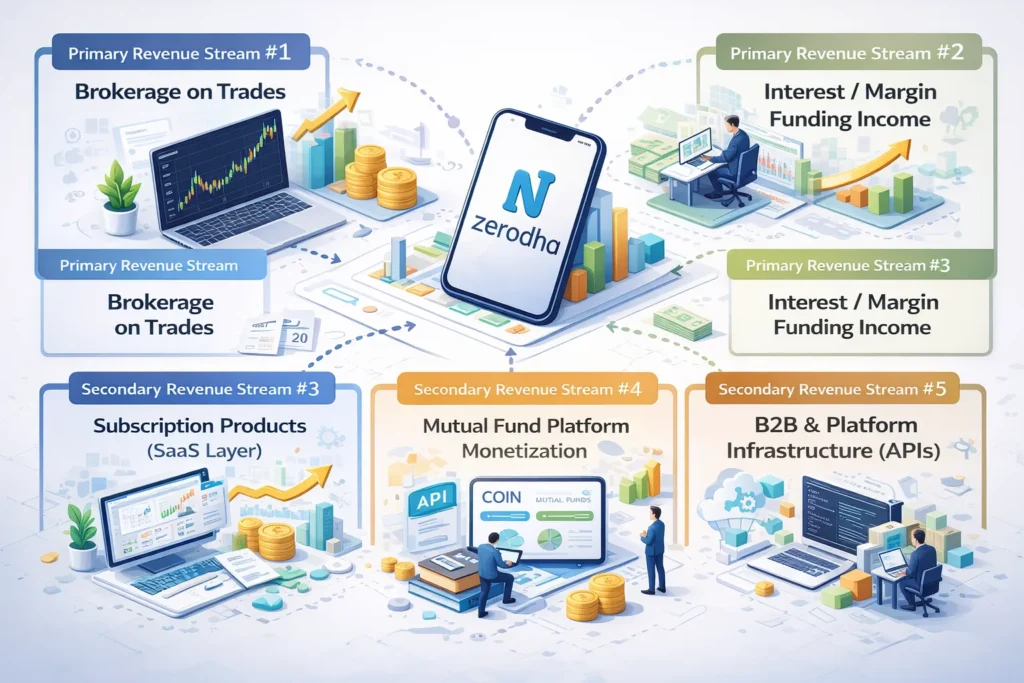
Primary Revenue Stream #1: Brokerage on Trades
This is the engine.
Zerodha charges:
- ₹0 brokerage on equity delivery
- Flat fee (up to ₹20 per order) on:
- Intraday
- Futures & Options (F&O)
- Commodities
- Currencies
- Intraday
Why it’s powerful:
- Active traders place many orders
- Zerodha earns per order, not per profit
- Revenue scales with volume, not with market direction
Strategic advantage:
This pricing is simple, predictable, and “feels fair,” which increases trust and retention.
Primary Revenue Stream #2: Interest / Margin Funding Income
Zerodha earns through:
- Margin lending mechanisms
- Interest on leveraged positions
- Funding-related charges
This becomes especially meaningful in volatile markets, when traders demand leverage.
Secondary Revenue Streams
Stream #3: Subscription Products (SaaS Layer)
Zerodha monetizes premium tooling through products like:
- Advanced analytics
- Trading utilities
- Data tools and add-ons
Instead of upselling users with noise, Zerodha sells tools that improve performance.
This is where fintech becomes SaaS.
Stream #4: Mutual Fund Platform Monetization
Zerodha’s Coin offers direct mutual funds (low-cost for users).
Even though Zerodha doesn’t take distributor commissions like regular mutual fund agents, it benefits through:
- Ecosystem stickiness
- Cross-sell into trading accounts
- Higher lifetime value per user
So Coin acts as a retention and LTV multiplier, not just a revenue line.
Stream #5: B2B & Platform Infrastructure (APIs)
This is one of Zerodha’s most underestimated revenue levers.
By offering:
- APIs
- Partner integrations
- Trading infrastructure
Zerodha can monetize fintech builders who need brokerage rails.
Pricing Psychology Behind Zerodha’s Model
Zerodha wins because:
- Users hate hidden fees
- Traders want predictable costs
- “₹20 per order” is a simple mental anchor
- “₹0 delivery brokerage” feels like a massive win
- The product feels premium even when pricing is minimal
This is why it converts even against bigger banks and VC-funded rivals.
Read more : Zerodha Revenue Model: How Zerodha Makes Money in 2026
Operational Model & Key Activities
If revenue is the visible engine, operations are the invisible discipline behind Zerodha’s profitability.
Unlike many fintech startups chasing scale with massive teams and burn rates, Zerodha operates with extreme operational efficiency. In 2026, despite serving over 13 million clients, its team size remains lean compared to traditional financial institutions.
That’s not accidental. It’s design.
Core Operations
Zerodha’s daily operations revolve around five high-impact pillars:
Platform & Infrastructure Management
- Maintaining Kite (web + mobile)
- Handling millions of daily order requests
- Ensuring low-latency execution
- Managing cloud + server architecture
- Continuous cybersecurity upgrades
Reliability is non-negotiable.
Even small downtimes can cost users money — and trust.
Regulatory & Compliance Management
Operating in financial markets means:
- SEBI compliance
- Exchange coordination (NSE, BSE, MCX)
- Risk monitoring
- Audit controls
- KYC and AML processes
In fintech, compliance is not overhead — it’s a competitive moat.
Customer Support & Education
Instead of aggressive sales teams, Zerodha invests in:
- Support teams trained in trading nuances
- Self-service help centers
- Varsity educational platform
- Community-driven knowledge loops
Education reduces support load while increasing user confidence — a smart operational flywheel.
Product Development & Engineering
Zerodha’s real edge is product.
Continuous improvements in:
- UI/UX simplicity
- Charting tools
- Data dashboards
- Portfolio insights
- API capabilities
Engineering drives retention more than marketing does.
Risk Management Systems
Especially in derivatives trading:
- Margin calculations
- Exposure controls
- Circuit breaker integrations
- Fraud detection algorithms
Risk discipline protects both users and the company.
Resource Allocation Strategy (2026 Lens)
While Zerodha doesn’t publicly disclose granular budget splits, industry estimates and operational patterns suggest:
- Technology & Engineering: 35–45% focus
- Compliance & Risk: 15–20%
- Customer Support: 15–20%
- Marketing: Minimal compared to competitors
- R&D & New Products: Strategic reinvestment from profits
Unlike VC-backed fintechs spending heavily on ads, Zerodha reinvests profits into product stability and ecosystem expansion.
That’s a long-term compounding strategy.
Regional Expansion Strategy
Zerodha scales digitally rather than through physical branches.
Key approach:
- Pan-India digital onboarding
- Minimal physical offices
- Support scaling through centralized systems
- Expansion via regulatory compliance rather than geographic infrastructure
This reduces fixed costs dramatically.
Strategic Partnerships & Ecosystem Development
Zerodha’s ecosystem isn’t built by doing everything alone.
Its partnership philosophy is subtle but powerful:
Own the core platform experience — partner for everything else.
This keeps Zerodha lean, focused, and scalable while still delivering a full-stack financial experience to users.
Zerodha’s Collaboration Philosophy
Unlike many fintechs that try to vertically integrate every feature (banking, insurance, credit, investing, wealth, etc.), Zerodha plays a smarter game:
- Build the best trading + investing rails
- Provide clean APIs and integrations
- Let partners extend the ecosystem
This creates an “ecosystem advantage” without bloating operations.
Key Partnership Types
1) Technology & API Partners
Zerodha enables an entire developer economy through:
- Trading APIs
- Algo trading integrations
- Portfolio analytics tools
- Tax reporting and P&L tools
Why it matters:
Developers create value-added services that make Zerodha more sticky — without Zerodha building every feature in-house.
2) Payment & Banking Alliances
To support onboarding and account operations, Zerodha relies on:
- Payment gateways
- Banking partners for fund transfers
- KYC and verification partners
- UPI/Netbanking integrations
In fintech, frictionless money movement is as important as the product UI.
3) Marketing & Distribution Partners
Zerodha doesn’t run traditional ads, but it benefits massively from:
- Creator ecosystems (YouTube, X, Instagram finance creators)
- Community partnerships (trader groups, education forums)
- Referral-driven distribution
These are not “paid partnerships” in the usual sense — they’re trust-based distribution channels.
4) Regulatory & Expansion Alliances
Zerodha’s ability to scale is tied to how well it collaborates with:
- SEBI frameworks
- Exchanges (NSE/BSE/MCX)
- Depositories (CDSL/NSDL)
- Clearing corporations
These relationships ensure:
- operational continuity
- compliance readiness
- faster product rollouts
Ecosystem Strategy: The Real Competitive Moat
Zerodha’s ecosystem creates compounding value through:
Network Effects
More users → more community content → more trust → more new users.
Even though it’s not a “social network,” Zerodha still benefits from behavioral network effects.
Monetization Within the Ecosystem
Partnerships help Zerodha monetize indirectly:
- Higher retention through better tools
- More trading volume due to advanced integrations
- Higher LTV from cross-product usage (Kite + Coin + Console + APIs)
Competitive Moats via Strategic Tie-Ups
Zerodha’s partnerships protect it by making the ecosystem harder to replicate.
Competitors can copy pricing.
They can copy UI.
But replicating:
- trust
- developer integrations
- platform reliability
- regulatory maturity
takes years.
That’s the moat.
Miracuves Connection (Founder Takeaway)
For entrepreneurs, the Zerodha lesson is clear:
Don’t build everything. Build the platform core, then architect partnerships to scale the ecosystem.
At Miracuves, we help founders do exactly that:
- platform-first architecture
- partner-ready APIs
- scalable ecosystem design
- monetization-ready integrations
Growth Strategy & Scaling Mechanisms
Zerodha’s growth story is one of the most interesting scaling playbooks in modern fintech because it doesn’t follow the “VC hypergrowth” script.
Instead, Zerodha built a growth engine based on:
- trust
- product-led adoption
- cost leadership
- community-driven distribution
- compounding retention
In 2026, this is exactly the kind of strategy founders are trying to replicate—because it’s profitable, resilient, and scalable.
Zerodha’s Core Growth Engines
1) Organic Virality & Referral Loops
Zerodha grew through the strongest marketing channel in fintech:
Traders talking to other traders.
This is amplified by:
- Community forums
- Telegram/WhatsApp trading groups
- Finance creators reviewing platforms
- Word-of-mouth from pricing simplicity
Why it works:
When money is involved, people trust real user recommendations more than ads.
2) Product-Led Growth (PLG)
Zerodha invests in product stability and user experience so heavily that:
- The product becomes the acquisition channel
- The UI becomes the retention engine
- Feature depth becomes the conversion hook
Key PLG elements:
- Simple onboarding
- Fast execution
- Clean interface
- Minimal clutter
- Transparent pricing
3) Paid Marketing (Strategically Minimal)
Zerodha is famous for not doing aggressive paid marketing.
But it does invest in:
- content marketing
- SEO
- education-driven acquisition (Varsity)
- brand credibility through consistency
This keeps CAC (Customer Acquisition Cost) low—one of its biggest structural advantages.
4) New Product Lines & Market Entries
Instead of expanding into unrelated fintech verticals too early, Zerodha expands in a “tight ecosystem” way:
- Trading → Investing → Mutual funds → Analytics → APIs
- Product depth > product sprawl
This creates cross-product stickiness, where one user ends up using multiple Zerodha products.
5) Geographic Expansion Model
Zerodha’s geographic strategy is a digital-first masterclass:
- No heavy branch expansion
- No city-by-city physical rollout
- Scale through compliance + onboarding systems
- Win Tier 2/Tier 3 through simplicity and trust
This is exactly how platform companies win emerging markets in 2026.
Founder Insight: Why Zerodha’s Scaling Strategy Wins in 2026
Zerodha proves:
In platforms, growth is not a marketing game. It’s a systems + trust game.
At Miracuves, we apply the same scaling approach when building marketplace and fintech platforms:
- build scalable infrastructure early
- design retention loops inside the product
- create trust through transparency
expand through ecosystem depth, not feature overload
Competitive Strategy & Market Defense
Zerodha isn’t just winning because it’s cheaper.
It’s winning because it has built a defensive moat that is extremely hard to attack in fintech—especially in 2026, where customer trust, uptime, and compliance are as important as features.
Zerodha’s Core Competitive Advantages
1) Network Effects (Behavioral, Not Social)
Zerodha benefits from a unique kind of network effect:
- More users → more community learning → more trust → more users
- More traders → more discussion → more referrals
- More developers → more tools → more stickiness
Even without a “social feed,” Zerodha has ecosystem compounding.
2) Switching Barriers
Switching brokers is easy technically.
But psychologically? Not so much.
Zerodha’s switching barriers include:
- Familiarity with Kite UI
- Saved watchlists, setups, and workflows
- Trust in stability during volatile markets
- Comfort with reporting, tax statements, P&L dashboards
For serious traders, workflow stability matters more than small price differences.
3) Brand Equity Built on Trust
Zerodha’s brand is positioned as:
- transparent
- founder-led
- no-nonsense
- user-first
- stable
In 2026, when fintech scandals and mis-selling still happen across markets, Zerodha’s “trust brand” becomes a growth asset.
4) Innovation in Product + UX
Zerodha’s innovation isn’t flashy.
It’s operational innovation:
- better UX
- faster performance
- fewer bugs
- simpler flows
- consistent platform experience
That’s exactly what keeps retention high.
5) Data-Driven Personalization & Risk Control
Zerodha has deep user behavior data:
- trading patterns
- portfolio insights
- risk exposure trends
- onboarding drop-off points
This allows:
- better product decisions
- better risk management
- smarter nudges and educational prompts
And because it operates in a regulated environment, its compliance maturity becomes part of its competitive defense.
Market Defense Tactics
1) Handling New Entrants & Pricing Wars
In India, competitors repeatedly launched:
- zero brokerage models
- free F&O promotions
- cashback-based acquisition
Zerodha’s defense:
- doesn’t panic
- keeps pricing stable
- doubles down on reliability + trust
- lets competitors burn cash
This is how bootstrapped companies survive price wars:
they outlast the burn.
2) Strategic Feature Rollouts
Zerodha’s product strategy is defensive and offensive:
- release features that matter to core users
- avoid feature bloat
- ship improvements in speed, stability, and clarity
Competitors often release “more features.”
Zerodha releases “more confidence.”
3) Ecosystem Expansion as Defense
Zerodha protects market share by expanding ecosystem depth:
- Kite (trading)
- Coin (mutual funds)
- Console (reports + insights)
- Varsity (education)
- APIs (developers)
This creates a multi-product retention loop.
Even if a competitor matches one product, matching the full ecosystem is difficult.
4) Partnership & Acquisition Moves (Soft Defense)
Zerodha’s ecosystem also makes it a “default partner” for:
- fintech builders
- analytics tools
- trading communities
So even when new startups emerge, many end up integrating with Zerodha instead of replacing it.
Lessons for Entrepreneurs & Implementation
This is the part where Zerodha stops being “a successful company” and becomes a blueprint.
Because Zerodha’s biggest gift to entrepreneurs isn’t just its revenue numbers—it’s proof that you can build a dominant platform by being:
- disciplined
- product-first
- trust-obsessed
- ecosystem-smart
without burning investor money.
Let’s translate Zerodha’s success into a practical playbook.
Key Factors Behind Zerodha’s Success
1) Radical Pricing Simplicity
Zerodha made pricing a marketing weapon.
Instead of complex brokerage slabs, it offered:
- ₹0 delivery brokerage
- Flat capped fee for trades
This immediately created:
- trust
- adoption
- referrals
2) Product-Led Growth Over Paid Growth
Zerodha built a product so strong that:
- users market it
- creators review it
- traders recommend it
This reduced CAC massively.
3) Bootstrapped Discipline
Because it didn’t raise VC capital, Zerodha had:
- no pressure to burn
- no need for fake growth metrics
- no urgency to expand into random verticals
That discipline made it profitable at scale.
4) Education as a Growth Flywheel
Varsity isn’t just content.
It’s:
- onboarding
- retention
- customer support reduction
- trust-building
Most fintechs underestimate education. Zerodha made it a strategic asset.
Replicable Principles for Startups
Here’s what founders can directly copy:
- Build pricing transparency into your core brand
- Focus on one power user segment first
- Create retention loops (dashboards, history, saved setups, community)
- Monetize with layered streams (transactions + subscriptions + ecosystem)
- Treat compliance, security, and trust as product features
- Scale systems before scaling headcount
Implementation Timeline + Investment Priorities
Here’s a practical founder roadmap inspired by Zerodha:
Phase 1 : Core Platform
Priorities:
- MVP product
- compliance-ready architecture
- payments + onboarding flow
- pricing structure
Phase 2 : Trust + Retention
Priorities:
- reporting dashboards
- customer support systems
- education content layer
- stability + performance
Phase 3 : Monetization Expansion
Priorities:
- subscriptions or premium tooling
- ecosystem partners
- APIs and integrations
- cross-sell product layers
Phase 4 (18+ months): Scaling the Ecosystem
Priorities:
- new verticals adjacent to core
- partnerships
- geographic scaling
- operational automation
Ready to implement Zerodha’s proven business model for your market?
Miracuves builds scalable platforms with tested business models and growth mechanisms.
We’ve helped 200+ entrepreneurs launch profitable apps.
Get your free business model consultation today.
Conclusion
Zerodha’s business model is proof that in platform economies, the biggest winners aren’t always the loudest or the most funded.They win by building a compounding machine where trust is the brand, product is the marketing, pricing is the differentiator, systems are the scale engine, and ecosystem is the moat.
In 2026, when fintech is crowded, customer acquisition is expensive, and regulation is tightening globally, Zerodha stands out because it chose the hardest path early:
The future of platform economies won’t be dominated by companies that “grow fastest.”
It will be dominated by companies that build the most resilient business models—where innovation and execution reinforce each other year after year.
FAQs
1) What type of business model does Zerodha use?
Zerodha uses a hybrid fintech model. It combines low-cost brokerage, premium tool subscriptions, and ecosystem products like mutual funds and APIs.
2) How does Zerodha’s model create value?
It creates value through transparent pricing, fast execution, and a smooth user experience. Users trust Zerodha because it removes hidden charges and simplifies investing.
3) What are Zerodha’s key success factors?
Its success comes from product-led growth, low-cost operations, and trust-driven branding. It also builds strong retention through Kite, Coin, Console, and Varsity.
4) How scalable is Zerodha’s business model?
Zerodha is highly scalable because it’s digital-first with low fixed costs. It scales through technology and automation instead of physical branches.
5) What are Zerodha’s biggest challenges?
Major challenges include regulatory compliance, platform stability during high market volatility, and customer support at scale. Competition from brokers and banks is also constant.
6) How can entrepreneurs adapt it to their region?
Founders can adapt it by focusing on simple pricing, trust-building, and one strong core segment first. Expand into ecosystem products only after strong product-market fit.
7) What are alternatives to Zerodha’s model?
Alternatives include full-service brokers, bank-led investment apps, subscription-based advisory platforms, or creator-led investing communities. Each differs in pricing and monetization depth.
8) How has Zerodha evolved over time?
Zerodha evolved from a discount broker into a full ecosystem with trading, investing, mutual funds, education, reporting, and APIs. The expansion stayed tightly aligned with its core users.