


Key Takeaways
- Discount brokerage platforms can generate revenue through brokerage fees, account-related charges, margin services, premium tools, partner products, and other transaction-based services.
- Pricing logic depends on trading volume, customer segments, order types, service costs, product mix, platform usage, and competitive positioning.
- A sustainable brokerage business model balances low-cost trading with diversified revenue streams, efficient operations, user retention, and strong platform engagement.
Revenue & Pricing Signals
- Brokerage charges, account maintenance fees, margin-related income, transaction services, premium subscriptions, and value-added tools can create multiple revenue streams.
- Flat-fee, transaction-based, subscription, and hybrid pricing models can be structured around active traders, long-term investors, and premium users.
- Revenue performance is influenced by active accounts, trading frequency, average transactions, funded balances, premium feature adoption, and customer retention.
Founder Insights
- Founders should define the brokerage model, target users, pricing structure, regulatory requirements, operating costs, and monetization strategy before scaling the platform.
- Low brokerage pricing alone is not enough; reliable execution, transparent fees, strong retention, risk management, and efficient back-office operations support long-term economics.
- Miracuves develops customizable discount brokerage platforms with trading workflows, pricing controls, portfolio tools, payments, risk management, reporting, analytics, and admin dashboards.
Discount brokerage businesses have changed how people approach stock trading. Instead of relying on heavy commissions on every trade, they focus on low-cost access, simple digital onboarding, faster execution, and higher user activity.
At first, the model may seem difficult to understand. If trading fees are low, how does the business generate enough revenue to cover technology, compliance, support, market data, payment operations, and platform maintenance?
The answer is that discount brokerage businesses do not depend on a single income source. They usually combine flat brokerage fees, premium tools, account services, API access, partner income, interest-linked products, and operational efficiency. The model becomes stronger when the platform attracts active users, controls operating costs, and builds trust through transparent pricing.
For founders, this is the real lesson: a low-fee trading business is not only a pricing decision. It is a complete product, operations, and monetization strategy working together.
What Is a Discount Brokerage Business?
A discount brokerage business allows users to trade or invest at lower fees compared with traditional full-service brokers. The business usually focuses on self-directed investors and traders who prefer digital tools over relationship-led advisory services.
Instead of charging a percentage-based commission on every transaction, many discount brokers use flat fees, low-cost plans, or free delivery-style investing. The platform becomes attractive because users feel they have more control over costs.
The model depends on three things:
First, the platform must make trading and investing easy enough for users to self-serve. Second, the business must process high transaction volumes efficiently. Third, the platform must create additional revenue opportunities without damaging user trust.
That is why discount brokerage is not only about reducing fees. It is about building a leaner digital brokerage experience.
Founders who want to understand the complete operating layer can also read this guide on how online discount brokerage platforms work, including trading accounts, order flows, Demat workflows, and back-office operations.
Why Low Trading Fees Can Still Create a Profitable Business
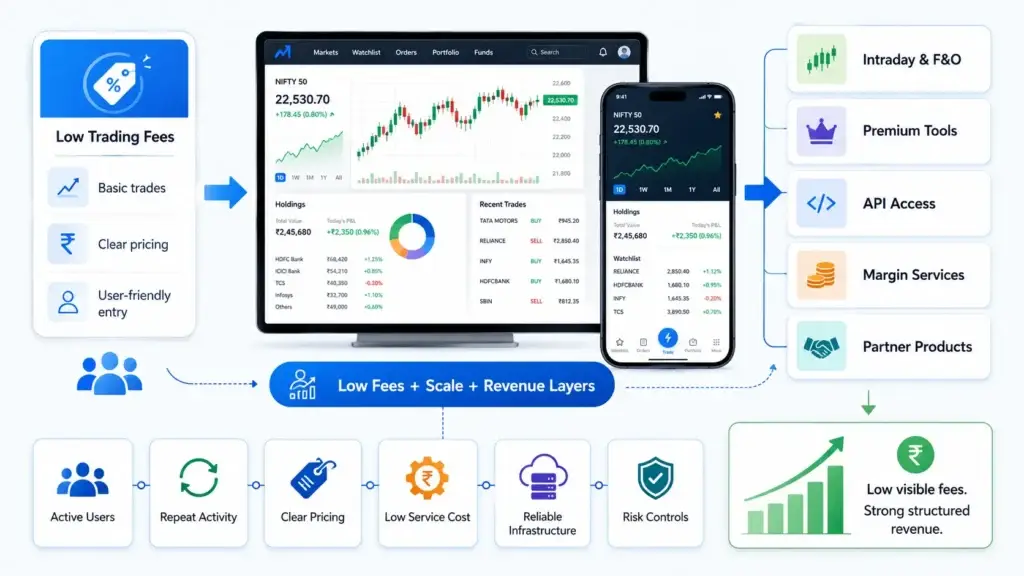
Low fees do not automatically mean low revenue. A brokerage business can reduce visible trading charges while earning from multiple connected activities around the trading journey.
For example, a user may not pay a high fee for a basic equity trade. But the same user may later use intraday trading, derivatives, premium charts, market data tools, API access, margin services, reports, or partner financial products. Each layer can create revenue if the platform is designed properly.
The model works best when the platform has:
- A large active user base
- Repeat trading activity
- Clear pricing
- Low manual servicing cost
- Reliable transaction infrastructure
- Strong admin and risk controls
- Revenue streams beyond basic brokerage
For founders, the key lesson is simple: a low-fee model needs scale and structure. It cannot survive only on branding or interface design.
Main Revenue Streams in a Discount Brokerage Business
A discount brokerage business usually earns through a mix of direct and indirect revenue streams. Not every business uses every model, and the final structure depends on licensing, market rules, product scope, user segment, and operating geography.
| Revenue Stream | How It Works | Founder Insight |
|---|---|---|
| Flat brokerage fees | Users pay a fixed fee for certain trades or segments | Works well when trading volume is high |
| Premium tools | Users pay for advanced charts, analytics, alerts, or screeners | Helps monetize serious traders |
| API access | Developers and advanced traders pay for programmatic access | Useful for power users and institutional workflows |
| Account services | Charges may apply for reports, statements, account maintenance, or value-added services | Should be transparent to avoid trust issues |
| Margin-linked income | Platforms may earn through financing-related products where legally allowed | Requires strong risk and compliance workflows |
| Partner products | Revenue may come from mutual funds, insurance, bonds, loans, or other financial products | Works when recommendations remain trust-focused |
| Subscription plans | Users pay monthly or annual fees for bundled benefits | Helps create predictable revenue |
| Data and research access | Users pay for premium insights or market intelligence | Strong fit for active traders |
To connect these revenue layers with product planning, founders can review this trading platform business model breakdown and understand how different revenue streams can be sequenced inside a launch-ready platform.
Brokerage Fees: Small Charges Can Scale With Volume
Brokerage fees remain one of the most direct revenue streams. Instead of charging high percentage-based fees, discount brokers often use flat or low-cost pricing for certain types of transactions.
This works because active traders may place multiple orders over time. Even a small fee can become meaningful when the platform processes a large number of trades.
For founders, the lesson is not to simply copy a low-fee structure. The important decision is to understand which user segment will drive activity.
Long-term investors may trade less often. Intraday traders may be more active. Derivatives traders may need more advanced tools. New users may care more about simple onboarding and trust. Each segment has a different revenue profile.
A smart brokerage product should therefore connect pricing with user behavior.
Premium Tools Help Monetize Serious Traders
Not every user needs advanced tools on day one. Many beginners want simple watchlists, order placement, portfolio tracking, and basic charts. Serious traders, however, often need deeper functionality.
Premium tools can include:
- Advanced charting
- Technical indicators
- Strategy alerts
- Options analytics
- Market screeners
- Portfolio insights
- Backtesting tools
- Priority support
- Custom reports
This creates a practical freemium structure. Basic access keeps the platform approachable, while premium capabilities help monetize users who need more control.
These paid capabilities should be mapped into the wider trading app feature stack so free access, premium tools, reports, alerts, portfolio views, and admin controls support the same revenue strategy.
For a founder, this is one of the most important monetization lessons. If every feature is free, the business may struggle to increase average revenue per user. If every feature is paid, new users may hesitate to join. The right model usually separates essential access from advanced decision-support tools.
API Access Can Become a High-Value Revenue Layer
API access is especially useful for advanced traders, developers, algorithmic trading teams, fintech partners, and businesses that want to connect trading workflows with their own systems.
A brokerage platform may offer APIs for:
- Order placement
- Portfolio data
- Market data
- Webhooks
- Account information
- Strategy execution
- Reporting
- Partner integrations
API monetization works because power users often value reliability, documentation, speed, and uptime more than casual users. They may be willing to pay for access if the platform saves them engineering effort.
But API revenue requires discipline. Poorly managed APIs can create security, abuse, and infrastructure risks. Founders should think about authentication, rate limits, audit logs, usage tracking, error handling, and permission-based access early.
Account Services and Operational Fees
Some revenue may come from account-related services. These can include statement requests, document processing, account maintenance, payment-related services, or other value-added operational tasks.
This revenue stream should be handled carefully. Users trust low-fee platforms because pricing feels simple. Hidden or confusing charges can damage that trust.
The better approach is transparent service-based pricing. If a user pays for a specific report, premium account feature, or operational request, the value should be clear.
From a product perspective, this means the admin dashboard must allow the business team to manage fee rules, refunds, user queries, transaction records, and dispute workflows without depending on developers for every small change.
Partner Products Can Expand Revenue Beyond Trading
A brokerage business does not have to stop at trading. Once users trust the platform, the business may expand into related financial products.
Common partner-led opportunities include:
- Mutual funds
- Bonds
- Insurance
- Loans
- Wealth products
- Tax tools
- Research subscriptions
- Educational products
- Financial planning services
This can create partner commissions, referral income, distribution revenue, or bundled subscription value depending on the market and regulatory structure.
The risk is over-commercialization. If users feel the platform is pushing products only for revenue, trust can decline. The better strategy is to recommend products carefully, disclose terms clearly, and keep user outcomes at the center.
For founders, partner revenue should support the platform’s credibility, not weaken it.
Margin-Linked Revenue Requires Strong Risk Controls
Margin-related services can become a revenue stream when users borrow or use funded trading facilities, depending on the rules of the target market. This type of revenue can be attractive, but it also introduces higher risk.
The platform needs:
- User eligibility checks
- Risk limits
- Real-time exposure tracking
- Margin alerts
- Automated square-off logic where applicable
- Admin monitoring
- Audit logs
- Clear user communication
- Compliance-ready reporting
Founders should not treat margin-linked revenue as a simple feature toggle. It affects risk, support, operations, legal review, and user trust.
If a trading business plans to include financing-linked products, the foundation must be built with strong controls from the start.
Subscription Plans Can Add Predictable Revenue
Subscription pricing helps brokerage businesses reduce dependence on transaction activity alone. Users may pay monthly or yearly for premium benefits.
A subscription plan can include:
- Advanced analytics
- Premium market data
- Research tools
- Lower transaction charges
- Priority support
- Strategy tools
- API access
- Education modules
- Portfolio insights
This works especially well when the platform serves active users who want better tools, not just cheaper trades.
For founders, subscriptions also make revenue forecasting easier. Transaction revenue can fluctuate with market activity, but subscription revenue can provide a more stable base if the value is strong enough.
Market Data and Research Can Become Paid Value
Market data is expensive to deliver reliably. Real-time prices, historical data, charts, indices, news, and analytics require integrations, infrastructure, licensing, and performance optimization.
A brokerage platform can monetize market intelligence through:
- Premium data feeds
- Advanced chart packages
- Research dashboards
- Sector reports
- Options analytics
- Trading signals where legally permitted
- Screener tools
- Investor education
The important point is that users should not feel forced to pay for basic access. Paid research and data should offer clear additional value.
This is where product packaging matters. The platform should define what is free, what is premium, and what is reserved for professional or high-frequency users.
Why Operational Efficiency Is Part of the Revenue Model
Revenue does not only come from what users pay. It also comes from what the business saves.
A discount brokerage can survive on lower fees only when operations are efficient. Manual onboarding, manual reconciliation, weak support systems, fragmented broker integrations, poor reporting, and slow issue resolution can quietly increase costs.
Important operational systems include:
- Digital onboarding
- KYC workflow support
- Payment reconciliation
- Broker or exchange integration monitoring
- Order logs
- Support ticket workflows
- Admin approvals
- User segmentation
- Transaction reporting
- Fraud and abuse monitoring
Founders often focus on frontend features because those are visible. But profitability depends heavily on backend control. If the operations team cannot manage users, orders, payments, reports, disputes, and risk from a central admin layer, the business becomes expensive to run.
Founder Decision Signals Before Choosing This Business Model
Revenue Clarity
Do not launch with only one revenue assumption. Map flat fees, subscriptions, premium tools, APIs, partner products, and account services before development begins.
User Segment
Long-term investors, intraday traders, derivatives users, and API users behave differently. Your monetization model should match the user segment you want to serve first.
Operational Control
Low-fee businesses need efficient admin workflows. Manual support, reconciliation, and risk handling can reduce margins quickly.
Trust and Compliance
Transparent pricing, audit logs, secure integrations, and compliance-ready workflows are essential because financial users are highly sensitive to trust.
Revenue Model Comparison for Discount Brokerage Platforms
| Model | Best For | Strength | Risk |
| Flat brokerage fee | Active traders | Simple and scalable | Depends on trading volume |
| Free basic access + paid tools | Mixed user base | Strong user acquisition | Premium value must be clear |
| Subscription plan | Serious traders | Predictable revenue | Weak if tools are not differentiated |
| API pricing | Advanced users and fintech partners | High-value revenue layer | Needs strong security and uptime |
| Partner products | Investors and wealth users | Expands revenue beyond trading | Can reduce trust if poorly positioned |
| Margin-linked services | Experienced traders | Higher revenue potential | Requires strong risk controls |
| Data and research plans | Analytical users | Adds value beyond execution | Content and data quality must stay high |
The strongest approach is usually a hybrid model. A brokerage platform may start with simple pricing, then add premium tools, APIs, and partner products as the user base matures.
Common Mistakes Founders Should Avoid
Mistake 1: Depending Only on Brokerage Fees
If the entire business depends on transaction fees, revenue can become sensitive to market cycles. When trading activity slows, income may drop. Founders should design additional revenue layers early.
Mistake 2: Making Pricing Too Complicated
Low-fee platforms attract users because pricing feels simple. If the fee structure becomes confusing, users may lose trust. Keep the core pricing easy to understand.
Mistake 3: Launching Without Admin Control
A trading business needs backend control over users, orders, payments, reports, support, risk, and compliance workflows. Without strong admin control, the business may depend too much on developers for daily operations.
Mistake 4: Treating Compliance as an Afterthought
Financial products need careful legal, operational, and security review. The platform can support compliance workflows, but final compliance depends on jurisdiction, integrations, legal review, and the operating model.
Mistake 5: Copying a Business Model Without Understanding the User Segment
A pricing model that works for high-frequency traders may not work for long-term investors. Founders should define their first user segment before choosing monetization logic.
What Founders Should Plan Before Launching a Low-Fee Brokerage Product
Before building or customizing a trading platform, founders should answer these questions:
- What user segment are we serving first?
- Will revenue come from brokerage, subscriptions, tools, APIs, partner products, or a hybrid model?
- Which features should be free, and which should be paid?
- What admin controls are required for support, payments, risk, and reporting?
- What security and compliance workflows must be configured for the target market?
- What integrations are required for market data, orders, payments, KYC, and reporting?
- What operating team will manage users after launch?
These questions help founders avoid a common mistake: building features before understanding the business model.
Once the business model is clear, founders should also review the major trading platform development cost factors, especially broker integrations, real-time market data, KYC workflows, admin control, risk configuration, and testing.
Turning Revenue Logic Into a Product Foundation
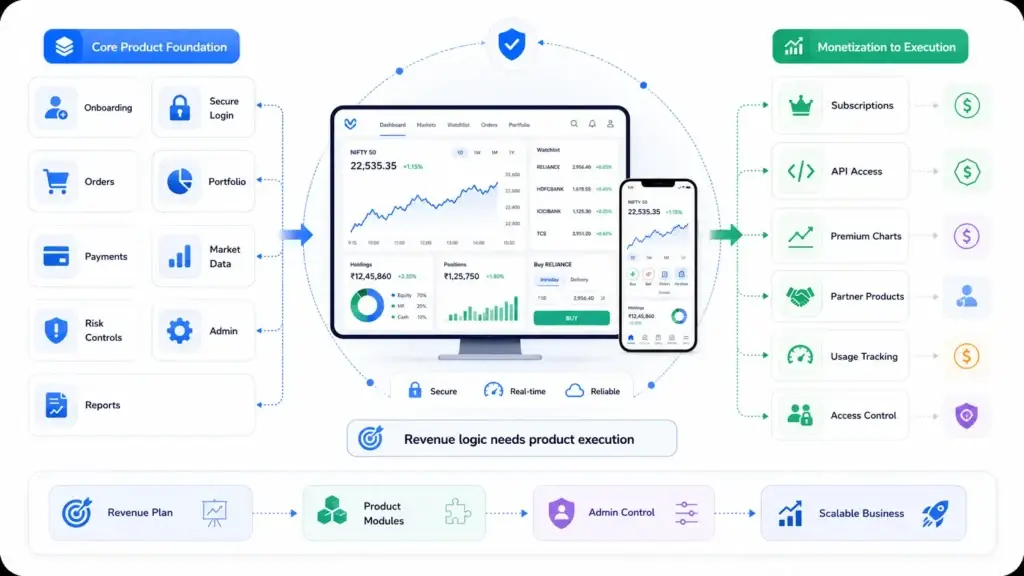
A discount brokerage business needs more than a clean interface. It needs user onboarding, secure authentication, order workflows, portfolio tracking, payment flows, market data integrations, risk controls, admin dashboards, reporting, and monetization configuration.
This is where the revenue model connects with product execution.
For a deeper execution roadmap, this guide on how to build a modern stock trading app explains the product, architecture, onboarding, market data, order workflows, portfolio dashboard, security, and admin layers founders should plan before launch.
For example, if the business wants subscription revenue, the platform needs subscription management. If it wants API revenue, the platform needs developer access, usage tracking, and rate limits. If it wants premium charting, the product needs feature-level access control. If it wants partner revenue, the admin dashboard should support product placement, tracking, and reporting.
Founders planning a trading product can explore a ready-made stock trading app foundation from Miracuves when they want to move from revenue planning to execution faster.
How Miracuves Supports Founders Planning Trading App Businesses
Miracuves helps founders turn a discount brokerage revenue strategy into a launch-ready trading product with source-code ownership, branded user experience, admin control, and monetization-ready workflows.
For a discount brokerage-style business, the app is only one part of the model. The real foundation includes user onboarding, portfolio tracking, trading workflows, payment flows, premium tools, reporting, and trust-building controls that support both users and platform operators.
A ready-made foundation can reduce avoidable development effort because the core product flows are already planned. Final integrations, security requirements, broker connections, payment setup, and compliance workflows should still be reviewed based on the target market and operating model.
This also gives founders more flexibility during early validation. Instead of spending time rebuilding standard trading workflows from zero, they can focus on refining pricing, user experience, premium tools, and revenue logic based on how their target users actually trade and invest.
For a broader launch perspective, founders can also read this guide on faster app market validation before deciding how much to build, customize, or validate first.
If founders are comparing execution partners, they should evaluate broker integration depth, audit-trail design, source-code ownership, support, and deployment process before choosing a trading app development team.
Final Thoughts
Discount brokerage businesses prove that high trading fees are not the only way to build revenue. The model works when the platform combines transparent pricing, active users, premium tools, API access, partner products, account services, and efficient operations.
For founders, the most important lesson is that monetization should be designed before the product goes live. A low-fee trading business needs more than users. It needs the right revenue layers, the right admin controls, the right compliance workflows, and the right technology foundation.
The strongest approach is not to copy another brokerage blindly. It is to understand the economics, choose the right user segment, and build a platform that can support revenue, trust, and scale from the beginning. For founders who want to move from revenue planning to execution, Miracuves can help turn that strategy into a launch-ready trading product with source-code ownership, branded workflows, and admin control.
FAQs
How do discount brokerage businesses make money?
Discount brokerage businesses make money through flat brokerage fees, premium trading tools, API access, account services, subscription plans, partner products, margin-linked services where permitted, and operational efficiency.
Can a brokerage business survive with low trading fees?
Yes, but only when the business has multiple revenue streams and strong cost control. Low fees work best when the platform has high user activity, repeat transactions, efficient operations, and paid value-added services.
What is the most common revenue stream for discount brokers?
Yes, but only when the business has multiple revenue streams and strong cost control. Low fees work best when the platform has high user activity, repeat transactions, efficient operations, and paid value-added services.
Why do some trading apps offer free or low-cost investing?
Low-cost investing helps attract users and build trust. The platform may then earn from active trading segments, premium tools, subscriptions, APIs, partner products, or other value-added services.
Are premium tools important for brokerage app monetization?
Yes. Premium tools help monetize serious traders who need advanced charts, alerts, screeners, analytics, research, or API access. This allows the platform to keep basic access affordable while charging for advanced value.
What should founders consider before launching a brokerage-style app?
Founders should define the target user segment, revenue streams, pricing logic, compliance workflows, broker or market data integrations, admin controls, payment flows, and support operations before launching.
Is API access a good revenue model for trading platforms?
API access can be a strong revenue model for advanced traders, developers, fintech partners, and institutions. It requires secure authentication, rate limits, usage tracking, documentation, and reliable infrastructure.
How can a founder turn a brokerage revenue model into a product?
A founder should map each revenue stream to required product workflows. For example, subscriptions need plan management, API revenue needs developer access controls, and premium tools need feature-level permissions.
Miracuves is an independent software development company. We are not affiliated with, connected to, sponsored by, or endorsed by any company or product named in this article.
Terms such as “X Clone” are used descriptively. It is how the software industry refers to building a platform with functionality comparable to a known service, and how clients search for it.
The entire design and codebase of our products is built by our own team. Our products contain no code, design, graphics, or content originating from any third-party website or applications.
All third-party names and marks referenced in this article are the property of their respective owners, referenced solely to identify the services discussed.