


Key Takeaways
What You’ll Learn
- Scaling a short video app requires balancing backend performance with a smooth user experience.
- Fast playback, low buffering, and responsive feeds are essential for user retention.
- CDN delivery, caching, adaptive streaming, and optimized APIs help maintain speed at scale.
- Recommendation systems and engagement tracking must scale without slowing the app.
- The goal is to support growing users, creators, and videos without breaking the viewing experience.
Stats That Matter
- Short video apps process continuous uploads, views, likes, shares, comments, and watch-time signals.
- Performance issues like buffering, feed lag, and slow uploads can reduce engagement quickly.
- Video delivery depends on cloud storage, CDN networks, compression, and transcoding pipelines.
- Personalized feeds require fast data processing and scalable recommendation infrastructure.
- Scalable architecture becomes critical as creator activity, media files, and traffic volume grow.
Real Insights
- User experience should guide every scaling decision, not just server expansion.
- A modular backend helps scale video processing, feeds, analytics, notifications, and moderation separately.
- Caching popular content reduces infrastructure load and improves playback speed.
- Real-time monitoring helps identify bottlenecks before users face lag or downtime.
- Long-term success depends on balancing speed, reliability, personalization, and infrastructure cost.
Short video platforms are growing faster than almost every other category in the mobile app ecosystem. What begins as a lightweight MVP with a few thousand users can quickly turn into a platform serving millions of video requests every hour.
The challenge is that growth often damages user experience before founders even realize what is happening.
Playback buffering, delayed uploads, slow recommendations, broken infinite scrolling, and lagging feeds immediately reduce retention. Modern users already expect the speed and responsiveness they experience on TikTok, Instagram Reels, and YouTube Shorts. Even a one-second delay in playback can reduce engagement significantly.
That is why short video app scalability has become one of the most important technical priorities for startups building video-first applications.
Scaling a short video platform is no longer only about adding more servers. It involves scalable video infrastructure, distributed backend systems, intelligent caching, feed optimization, adaptive streaming, video processing pipelines, and real-time recommendation systems working together continuously.
Many startups now explore scalable deployment strategies with platforms like Miracuves because backend scalability planning is becoming essential much earlier in the product lifecycle.
This guide explains how modern short video platforms scale rapidly without damaging playback quality, feed performance, upload speed, or overall user experience.
Why Scaling a Short Video App Is Technically Difficult
Scaling a short video platform is far more complex than scaling a traditional social media application. Unlike text-based platforms, short video apps continuously process uploads, playback delivery, recommendations, engagement tracking, AI moderation, and personalization simultaneously.
Every user interaction creates backend activity instantly. When users watch videos, the platform tracks watch time, replay behavior, scrolling speed, engagement patterns, and recommendation signals in real time. As traffic grows, infrastructure complexity increases rapidly across every system layer.
Major Scalability Challenges
- Infinite scrolling creates continuous backend requests
- Concurrent viewers increase playback traffic heavily
- Real-time recommendations require massive AI processing
- Video uploads create storage and transcoding pressure
- Global playback delivery increases CDN infrastructure demand
- Engagement tracking overloads analytics and database systems
If feed responsiveness slows even slightly, retention drops immediately. That is why scalable architecture planning must begin before virality starts.
Read More :- It’s Not Just a Video Platform; It’s a Recommendation Engine Built for Viral Growth
Why Modern Short Video Apps Need Distributed Backend Infrastructure
Many startups initially launch with monolithic backend systems because they are easier to build quickly. However, centralized systems become difficult to scale once traffic increases rapidly.
Modern short video platforms rely on distributed backend infrastructure where each service operates independently. This allows platforms to scale only the systems experiencing heavy demand instead of scaling the entire application together.
Common Microservices Used in Video Platforms
- Authentication service
- Upload service
- Video transcoding pipeline
- Feed generation engine
- Recommendation system
- Notification service
- Analytics infrastructure
- AI moderation pipeline
Why Microservices Matter
| Infrastructure Benefit | Business Impact |
|---|---|
| Independent scaling | Better traffic handling |
| Fault isolation | Improved reliability |
| Faster deployments | Easier updates |
| Flexible infrastructure | Lower operational bottlenecks |
For example, during viral spikes, video delivery infrastructure may require massive scaling while authentication systems remain stable. Distributed systems help platforms manage these situations more efficiently without unnecessary infrastructure duplication.
Why Monolithic Systems Fail During Viral Growth
Monolithic systems struggle during rapid growth because every component depends on centralized infrastructure. If one service becomes overloaded, the entire application performance can decline.
Common Problems in Monolithic Architectures
- Shared infrastructure load causes system-wide slowdowns
- Centralized scaling increases server costs
- Heavy deployments increase operational risk
- Backend bottlenecks lead to feed lag and buffering
Short video platforms cannot tolerate these issues because users expect instant playback, smooth scrolling, and uninterrupted feeds continuously.
Core Infrastructure Behind Scalable Short Video Platforms
Modern short video ecosystems rely on multiple infrastructure layers working together in real time to support millions of concurrent users.
Key Infrastructure Components
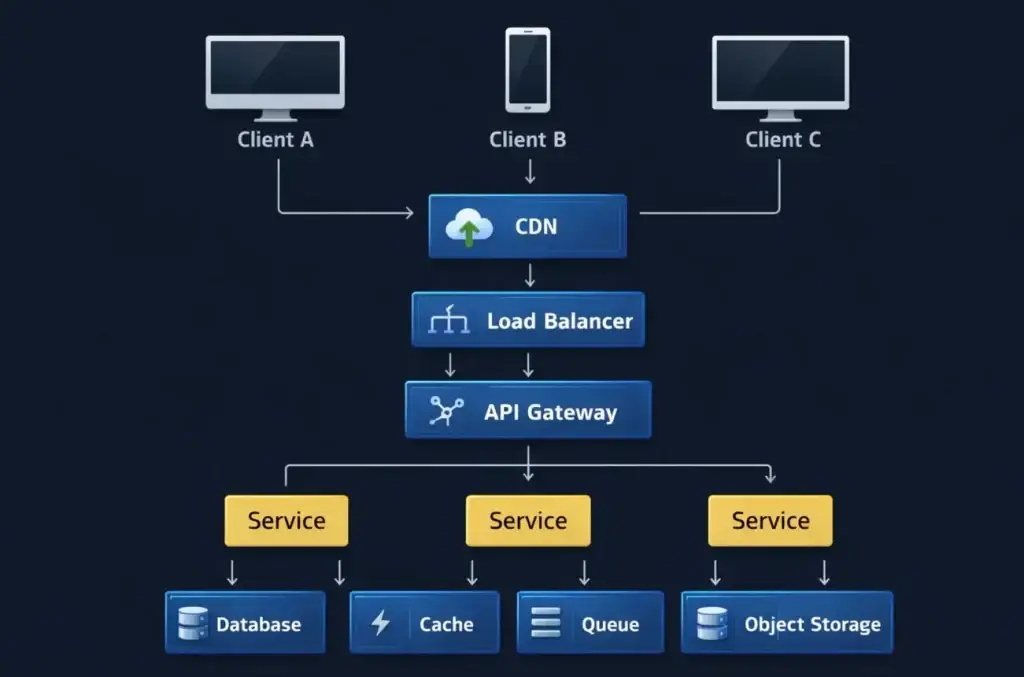
- API gateways for request routing
- Load balancers for traffic distribution
- CDN edge networks for faster playback delivery
- Queue systems for asynchronous processing
- Kubernetes for autoscaling orchestration
- Distributed databases for high-volume data handling
- Cloud infrastructure for flexible scaling
These technologies help maintain low-latency performance even during rapid traffic growth and heavy playback demand.
Why Infinite Scrolling Is Technically Challenging
Infinite scrolling may appear simple from the user side, but it is one of the most infrastructure-intensive systems inside short video platforms.
Every swipe can trigger multiple backend actions within milliseconds.
Backend Processes Triggered During Scrolling
- Recommendation generation
- Feed refresh requests
- Metadata loading
- Video playback delivery
- Behavioral tracking
- Cache synchronization
All of these operations must complete almost instantly to maintain a smooth user experience.
Feed Optimization Priorities
| Optimization Strategy | User Experience Benefit |
|---|---|
| Video preloading | Instant playback |
| Recommendation caching | Faster feed loading |
| Lazy loading | Lower mobile bandwidth usage |
| Edge caching | Reduced latency |
Platforms like TikTok heavily invest in feed optimization because smooth scrolling directly affects engagement, retention, and session duration.
Why Recommendation Systems Create Massive Computational Demand
Recommendation engines are among the most technically demanding systems inside short video applications. These systems continuously analyze user behavior to personalize feeds in real time.
User Signals Continuously Analyzed
- Watch time
- Replay activity
- Completion rates
- Scroll behavior
- Likes and shares
- Search patterns
This creates enormous AI processing demand because recommendations must constantly adapt to changing user interests.
Infrastructure Needed for Recommendation Scaling
- GPU acceleration for faster AI inference
- Recommendation caching to reduce latency
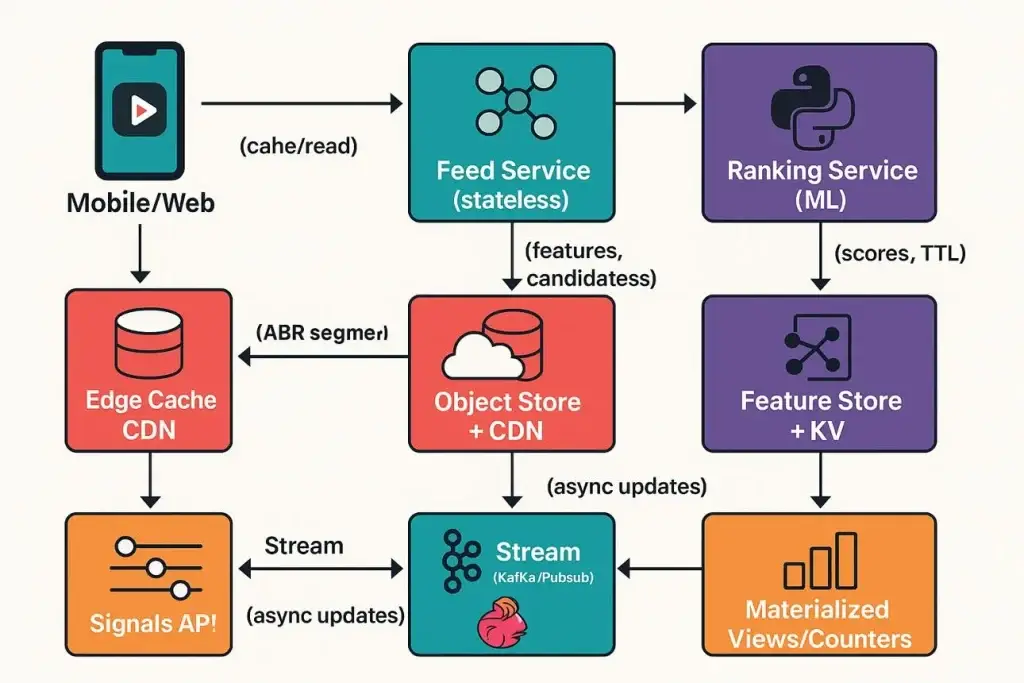
- Distributed ML pipelines for real-time personalization
- Event streaming systems for behavioral processing
Even small recommendation delays can negatively affect feed responsiveness and retention. That is why scalable AI infrastructure has become essential for modern short video platforms.
Why CDN Infrastructure Matters for Video Performance
The success of a short video platform depends heavily on how fast videos load and how smoothly feeds respond during scrolling. Users today expect instant playback. The moment buffering appears or feed transitions feel delayed, engagement drops immediately.
This is why CDN infrastructure has become one of the most important components behind modern video-first applications.
A Content Delivery Network helps platforms distribute videos across multiple edge servers located in different geographic regions. Instead of delivering every request from one centralized origin server, users receive content from nearby infrastructure nodes. This significantly reduces latency and improves playback responsiveness.
For short video platforms handling millions of daily views, this architecture becomes essential. Without CDN optimization, platforms quickly face playback interruptions, unstable feed performance, server overload, and poor scrolling experience during traffic spikes.
How Edge Delivery Improves Playback Experience
Edge delivery improves performance by moving content closer to users.
Traditional centralized systems increase latency because all users request videos from one server location. As traffic grows, the infrastructure becomes congested, which creates buffering delays and unstable playback performance.
Edge infrastructure solves this problem by caching videos across distributed edge servers. When users scroll through feeds, content loads from the nearest available server instead of a distant origin system.
Platforms like TikTok aggressively optimize edge delivery because smooth playback directly affects retention and session duration.
Key Advantages of CDN Infrastructure
| Infrastructure Layer | Performance Impact |
|---|---|
| Edge Caching | Faster video startup |
| Distributed Delivery | Reduced buffering |
| Regional Servers | Lower latency |
| Load Distribution | Better traffic handling |
| CDN Optimization | Smooth infinite scrolling |
Efficient CDN systems allow platforms to maintain fast playback even during viral traffic surges where millions of users watch content simultaneously.
Adaptive Streaming Systems Behind Modern Video Apps
Short video platforms serve users across different devices, internet speeds, and mobile network conditions. A user streaming videos on unstable mobile data requires a completely different playback experience compared to someone connected to high-speed WiFi.
To solve this challenge, modern video platforms use adaptive streaming technologies such as HLS and MPEG-DASH.
These systems divide videos into smaller segments and dynamically adjust playback quality depending on bandwidth availability and device performance. Instead of forcing every user to stream identical resolutions, adaptive systems intelligently optimize playback quality in real time.
This creates a much smoother viewing experience while reducing buffering interruptions.
Why Adaptive Streaming Matters
Adaptive streaming helps platforms maintain:
- Stable playback quality
- Faster loading speed
- Better mobile performance
- Lower buffering rates
- Consistent user experience
Without adaptive streaming infrastructure, short video feeds quickly become unstable during changing network conditions.
Video Processing Pipelines Behind Short Video Platforms
Video processing is one of the most infrastructure-intensive operations inside scalable short video ecosystems.
Every upload immediately triggers multiple backend workflows simultaneously. As upload traffic increases, platforms must continuously process enormous amounts of content without affecting creator experience.
Modern processing pipelines commonly handle:
| Processing Stage | Purpose |
|---|---|
| Upload Ingestion | Accept user uploads |
| Compression | Reduce file size |
| Transcoding | Generate multiple resolutions |
| Thumbnail Generation | Create preview images |
| Metadata Extraction | Analyze content details |
| AI Moderation | Detect unsafe content |
| Audio Optimization | Improve playback quality |
Efficient processing infrastructure becomes extremely important because upload delays directly impact creator retention and content consistency.
Why Asynchronous Processing Is Essential
One of the biggest scalability mistakes startups make is relying on synchronous processing systems.
In synchronous workflows, uploads remain blocked until backend processing finishes completely. During traffic spikes, this creates severe delays and unstable creator experience.
Modern scalable platforms solve this problem using asynchronous queue systems.
Instead of processing every task instantly, workloads are distributed independently across backend infrastructure. This allows uploads to continue smoothly while optimization tasks run in the background.
Technologies such as Kafka, RabbitMQ, and AWS SQS are commonly used to stabilize large-scale processing environments.
Transcoding Infrastructure for Multi-Device Playback
Modern short video applications must support playback across different screen sizes, devices, and bandwidth conditions.
A single video format cannot efficiently support every environment. That is why scalable platforms rely heavily on transcoding infrastructure.
When users upload content, backend systems automatically generate multiple optimized resolutions suitable for different playback conditions.
This allows adaptive streaming systems to dynamically deliver the most suitable video quality depending on network speed and device capability.
Why Transcoding Is Important
| Transcoding Benefit | User Experience Impact |
|---|---|
| Multiple Resolutions | Better device compatibility |
| Optimized File Delivery | Faster loading |
| Adaptive Playback | Reduced buffering |
| Bandwidth Optimization | Stable mobile streaming |
As platforms scale globally, transcoding becomes one of the most demanding infrastructure operations inside video-first applications.
AI Moderation Workflows in Modern Platforms
AI moderation has become a core part of modern short video infrastructure.
Large-scale platforms process enormous volumes of user-generated content every day, making manual moderation impossible at scale.
Modern AI moderation systems analyze uploads for policy violations, harmful content, spam activity, and copyright issues automatically.
These systems often require scalable GPU infrastructure because AI inference workloads are computationally expensive.
Modern AI Moderation Systems Commonly Handle
- NSFW detection
- Violence detection
- Copyright scanning
- Spam analysis
- Speech recognition
- Policy enforcement checks
Fast moderation infrastructure helps platforms maintain safety while preserving smooth creator experience.
Read More: Reasons startup choose our Tiktok clone over custom development
Feed Optimization for Infinite Scroll Performance
Infinite scrolling is the core engagement mechanism behind modern short video applications.
The speed and smoothness of feed delivery directly affect retention, engagement quality, and session duration. If videos fail to load instantly or scrolling feels delayed, users quickly abandon the platform.
This is why feed optimization becomes one of the highest infrastructure priorities inside scalable short video ecosystems.
Modern platforms optimize feeds using lightweight APIs, recommendation caching, edge delivery, session prediction systems, and next-video preloading infrastructure.
Next-Video Preloading Systems
Most large-scale platforms preload upcoming videos before users even scroll to them. This creates seamless playback transitions during continuous scrolling sessions.
Without preloading systems, users frequently experience blank loading states, delayed playback, and interrupted scrolling behavior.
Preloading significantly improves perceived responsiveness and keeps users engaged for longer sessions.
Recommendation Caching for Faster Personalized Feeds
Recommendation systems continuously generate personalized feeds using behavioral signals such as watch time, replay activity, and engagement history.
However, recalculating recommendations for every request creates enormous infrastructure pressure.
To improve performance, scalable platforms temporarily cache recommendation results instead of processing recommendation pipelines repeatedly.
Benefits of Recommendation Caching
| Infrastructure Benefit | Platform Impact |
|---|---|
| Faster Recommendation Delivery | Smooth scrolling experience |
| Reduced API Pressure | Lower backend load |
| Lower Latency | Faster feed responsiveness |
| Improved Scalability | Better retention performance |
Recommendation caching becomes especially important during viral traffic spikes when millions of users request personalized feeds simultaneously.
Low-Latency Feed APIs
Feed APIs are one of the most important infrastructure layers inside modern short video platforms.
Poorly optimized APIs increase response latency, rendering delays, backend pressure, and mobile bandwidth usage. These issues negatively affect infinite scrolling performance and overall user experience.
Modern scalable platforms prioritize lightweight APIs optimized specifically for fast content delivery.
Efficient APIs improve instant playback, feed responsiveness, scrolling smoothness, and infrastructure efficiency simultaneously.
Database Scaling Strategies That Power Viral Short Video Growth
Database scalability becomes one of the biggest technical priorities once a short video platform starts attracting large traffic volumes. Every like, replay, share, and comment creates backend activity that must be processed instantly.
As user engagement increases, infrastructure pressure grows rapidly. Without scalable backend systems, platforms often experience feed lag, playback buffering, slow recommendations, and unstable performance.
Modern short video platforms solve this challenge using distributed databases, intelligent caching systems, autoscaling infrastructure, and cloud-native deployment environments.
Why Traditional Databases Struggle During Viral Growth
Traditional relational databases work efficiently during early-stage traffic. However, once millions of users begin interacting simultaneously, centralized systems struggle to handle real-time engagement activity.
A single viral video can suddenly generate massive spikes in:
- Feed refresh requests
- Recommendation updates
- Engagement tracking
- Notification activity
This creates significant infrastructure bottlenecks that directly affect user experience.
| Infrastructure Challenge | Impact on User Experience |
|---|---|
| Centralized database load | Slow feed performance |
| Heavy engagement traffic | Delayed interactions |
| Limited scaling capacity | Platform instability |
That is why scalable short video apps rely heavily on distributed database architecture instead of single-server systems.
Database Sharding and Replication
Database sharding helps distribute platform data across multiple servers instead of storing everything in one environment. One database may handle user accounts while another processes engagement activity and analytics workloads.
Replication systems create synchronized copies of databases across different regions, improving availability and reducing downtime during traffic spikes.
This helps platforms achieve:
- Faster query performance
- Better traffic distribution
- Improved fault tolerance
- Higher scalability
Large-scale video apps also separate read and write operations to prevent engagement spikes from slowing feed responsiveness.
Caching Systems That Keep Video Apps Fast
Caching is one of the most important performance layers inside scalable short video infrastructure. Without caching systems, backend servers become overloaded because every request directly hits databases and APIs.
Modern platforms use technologies like Redis caching, CDN edge caching, and recommendation caching to improve playback speed and reduce latency.
Why Hot Content Caching Matters
Trending videos often generate millions of simultaneous playback requests. Instead of repeatedly processing identical requests through backend systems, cached infrastructure delivers content instantly from memory or edge locations.
This improves:
- Playback responsiveness
- Feed loading speed
- Infrastructure efficiency
- Viral traffic handling
CDN Edge Caching for Faster Playback
Content Delivery Networks distribute video assets across edge servers located closer to users. This reduces latency and improves playback quality globally.
| CDN Benefit | User Experience Improvement |
|---|---|
| Edge delivery | Faster playback |
| Distributed caching | Reduced buffering |
| Regional optimization | Better global performance |
Modern short video apps prioritize CDN optimization because even small playback delays can reduce retention significantly.
Handling Viral Traffic Without Breaking User Experience
Viral traffic spikes can easily overload poorly optimized infrastructure. Many short video platforms fail because backend systems cannot handle sudden increases in playback traffic, uploads, recommendation workloads, and feed requests.
That is why scalable apps rely heavily on autoscaling infrastructure and queue-based processing systems.
Autoscaling Infrastructure
Cloud autoscaling dynamically increases infrastructure capacity whenever traffic spikes unexpectedly. This allows platforms to handle influencer traffic bursts, trending content waves, and marketing campaigns without major service interruptions.
Queue Management Systems
Queue systems stabilize backend infrastructure during high-traffic periods by distributing workloads gradually across backend services.
Popular technologies include:
- Kafka
- RabbitMQ
- AWS SQS
These systems help prevent:
- Upload failures
- Feed lag
- Backend overload
- Notification delays
Failover Infrastructure
Modern scalable platforms also rely on failover infrastructure to maintain uptime during outages or unexpected traffic surges.
This commonly includes:
- Backup databases
- Multi-region deployment
- Redundant CDN providers
- Intelligent traffic routing
These systems help maintain stable performance during viral traffic periods.
Recommendation Engine Scaling Challenges
Recommendation systems are among the most computationally demanding components inside modern short video platforms. These systems continuously analyze watch time, replay activity, engagement behavior, and scroll patterns to personalize feeds in real time.
Even small recommendation delays can negatively affect:
- Feed responsiveness
- User retention
- Session duration
- Engagement quality
Modern recommendation infrastructure relies heavily on GPU acceleration, distributed machine learning pipelines, and recommendation caching systems.
Real-Time Behavioral Processing
Recommendation systems process millions of behavioral signals continuously.
Common signals include:
- Replay frequency
- Watch completion rates
- Scroll velocity
- Pause duration
- Engagement timing
As personalization becomes more advanced, infrastructure complexity continues increasing rapidly.
Common Infrastructure Mistakes That Damage User Experience
Many startups focus heavily on frontend UI while ignoring backend scalability during early development stages. This often creates serious performance problems later.
Most Common Scalability Mistakes
| Mistake | Result |
|---|---|
| Weak CDN setup | Playback buffering |
| Poor caching systems | Slow feed loading |
| Monolithic backend systems | App instability |
| Heavy APIs | Laggy scrolling |
These problems directly affect engagement, creator growth, and monetization performance.
Future of Short Video App Scalability
The future of scalable video infrastructure is evolving rapidly as platforms compete for lower latency and faster personalization.
Emerging technologies such as edge computing, predictive caching, AI infrastructure automation, and serverless processing pipelines are reshaping how scalable short video ecosystems operate.
These technologies will help platforms deliver:
- Faster playback
- Smarter recommendations
- Better autoscaling
- Lower infrastructure latency
As competition inside the creator economy grows, infrastructure efficiency will become one of the biggest differentiators between successful and failing short video platforms.
Why Choose Miracuves for Scalable Short Video App Development
Launching a short video platform today is not only about building an attractive mobile app. Modern users expect instant playback, smooth scrolling, fast uploads, and personalized recommendations without delays.
As traffic grows, even small infrastructure problems can reduce retention and engagement quickly. That is why scalability planning has become one of the most important parts of modern short video app development.
Miracuves helps businesses build scalable TikTok-like ecosystems with infrastructure-ready architecture designed for long-term performance and future growth.
What Makes Miracuves a Strong Choice
Miracuves focuses on building scalable backend ecosystems prepared for real-world traffic growth instead of lightweight demo-level applications.
The platform focuses on:
- Distributed microservices architecture
- CDN-ready video delivery systems
- Feed optimization for smooth scrolling
- Video processing and transcoding pipelines
- Cloud-native deployment infrastructure
- Recommendation scalability planning
This helps businesses prepare their platforms for high user activity, viral traffic spikes, and long-term creator engagement.
Built for Modern User Expectations
Modern short video users expect platforms to work instantly without interruptions. Slow feeds, playback buffering, and unstable uploads can immediately reduce session duration and retention.
That is why scalable infrastructure has become essential from the MVP stage itself instead of after traffic problems begin.
Businesses increasingly explore platforms like Miracuves because backend scalability, feed performance, and reliable video delivery now directly affect platform growth and monetization.
Read More :- How to Build a Short Video App Like TikTok
Conclusion
Short video app scalability directly affects retention, engagement, monetization, and long-term platform success. Fast playback, smooth scrolling, stable uploads, and low-latency recommendations all depend on scalable backend infrastructure operating efficiently behind the scenes.
Modern short video platforms require distributed backend systems, intelligent caching, optimized feed infrastructure, scalable databases, and strong CDN delivery prepared for rapid growth.
As competition inside the creator economy continues increasing, infrastructure quality is becoming one of the biggest differences between successful and failing platforms.
Businesses planning to launch scalable TikTok-like applications increasingly evaluate infrastructure-focused development partners such as Miracuves because modern short video platforms require much more than UI design. Long-term success depends heavily on scalable backend systems, intelligent feed optimization, CDN performance, and reliable video infrastructure prepared for viral growth from the beginning.
Want to build a scalable short video platform without compromising user experience? Schedule a consultation with Miracuves to explore scalable architecture strategies, video infrastructure planning, and faster launch readiness for your platform.
FAQs :-
What is short video app scalability?
Short video app scalability refers to the ability of a platform to handle increasing users, uploads, playback requests, and engagement activity without reducing performance or user experience.
Why do short video apps lag during growth?
Apps usually lag because of poor caching, weak CDN configuration, overloaded databases, inefficient APIs, and insufficient backend scaling infrastructure.
How does CDN improve video performance?
A video CDN reduces latency by delivering content from nearby edge servers, improving playback speed and reducing buffering during scrolling.
Which database is best for short video apps?
Many scalable platforms combine SQL and NoSQL databases. Popular options include Cassandra, MongoDB, DynamoDB, and CockroachDB depending on workload requirements.
How do TikTok-like apps handle millions of users?
They use distributed backend systems, CDN edge delivery, intelligent caching, autoscaling infrastructure, recommendation engines, and scalable video processing pipelines to maintain stable performance during rapid growth.
Why is caching important in short video apps?
Caching helps reduce server load and improves playback speed by temporarily storing frequently accessed content such as feeds, recommendations, and trending videos closer to users.
What is adaptive streaming in video apps?
Adaptive streaming automatically adjusts video quality based on internet speed and device performance to reduce buffering and maintain smooth playback.
Why do short video platforms use microservices architecture?
Microservices allow different platform components such as uploads, recommendations, notifications, and analytics to scale independently for better performance and reliability.
How does infinite scroll affect short video app performance?
Infinite scroll requires continuous feed loading, video preloading, and low-latency APIs. Poor optimization can cause lag, delayed playback, and reduced user engagement.
What role does AI play in scalable short video platforms?
AI helps power recommendation engines, content moderation, personalization, behavioral analysis, and feed ranking systems that improve engagement and user retention at scale.
Related Articles :-
Miracuves is an independent software development company. We are not affiliated with, connected to, sponsored by, or endorsed by any company or product named in this article.
Terms such as “X Clone” are used descriptively. It is how the software industry refers to building a platform with functionality comparable to a known service, and how clients search for it.
The entire design and codebase of our products is built by our own team. Our products contain no code, design, graphics, or content originating from any third-party website or applications.
All third-party names and marks referenced in this article are the property of their respective owners, referenced solely to identify the services discussed.