

Key Takeaways
- A ready-made short-form video platform gives startups prebuilt modules for vertical video feeds, uploads, editing, discovery, engagement, moderation, monetization, and admin management.
- Compared with custom development, an existing platform foundation can reduce repeated engineering work across video processing, recommendations, creator workflows, notifications, and social interactions.
- Source-code ownership, customization flexibility, streaming performance, scalability, security, integrations, and long-term product control should guide the final development decision.
Ready-Made Platform Signals
- Prebuilt features can include vertical feeds, video recording, uploads, filters, likes, comments, shares, follows, hashtags, search, notifications, creator profiles, and moderation tools.
- Founders can customize branding, feed logic, video categories, creator tools, monetization rules, advertising, virtual gifts, subscriptions, recommendations, and engagement workflows.
- Modular architecture makes it easier to add live streaming, AI recommendations, advanced editing, creator analytics, loyalty features, localization, and new monetization models as usage grows.
Startup Decision Insights
- Startups should compare development effort, video infrastructure, customization depth, source-code access, moderation needs, scalability, integrations, maintenance, and total ownership requirements.
- Custom development may suit highly differentiated video products, while a customizable ready-made platform can help teams validate content supply, engagement, retention, and monetization without rebuilding standard modules from scratch.
- Miracuves develops customizable short-form video platforms with vertical feeds, creator tools, video processing, recommendations, engagement features, monetization, analytics, moderation, and admin controls.
Startups building a short-form video business usually face one major question early: should they build everything from scratch, or start with a ready-made short-form video platform and customize it for their audience?
At first, custom development may sound like the stronger option because it gives complete freedom. But for many early-stage founders, freedom is not the only priority. Speed, cost control, market validation, creator onboarding, monetization, and operational control matter just as much.
A ready-made short-form video platform gives startups a faster way to launch the core product experience: vertical video feeds, creator profiles, uploads, engagement tools, moderation, monetization, analytics, and admin control. Instead of spending months rebuilding familiar product flows, founders can focus on the real business challenge: attracting the right users and creators.
That is why many startups now compare ready-made platforms against custom builds before making a development decision. The goal is not to copy another app. The goal is to use a proven product foundation and shape it into a distinct platform for a specific market.
Ready-Made Short-Form Video Platform vs Custom Development: What Is the Real Difference?
A custom-built short-form video app starts from a blank product plan. The team must define the architecture, design the interface, develop the user app, build creator tools, create the admin dashboard, integrate video processing, set up storage, configure feeds, add moderation, test security, and deploy the full system.
A ready-made video sharing platform starts from an existing product foundation. The major workflows are already available, and the startup customizes the brand, user experience, feature scope, monetization model, integrations, and launch settings instead of building every standard video workflow from zero.
The difference is not simply “fast vs slow.” It is about where the startup wants to spend its early time and budget.
| Decision Area | Ready-Made Platform | Custom Development |
|---|---|---|
| Launch speed | Faster because core modules already exist | Longer because every layer is built from scratch |
| Cost control | More predictable when scope is clear | Can increase as features and testing expand |
| Product flexibility | Customizable within the existing foundation | Highest flexibility, but requires more time and planning |
| Market validation | Strong for testing audiences, creators, and revenue models | Better when the product requires unique technology |
| Technical risk | Lower for standard workflows | Higher because each module must be designed and tested |
| Best fit | Startups that need faster launch and practical validation | Businesses with unusual workflows or proprietary systems |
For most startups, the key question is not “which option sounds more advanced?” The better question is: what truly needs to be unique in the first release?
If the differentiation comes from niche positioning, creators, regional content, creator rewards, community design, or monetization strategy, a ready-made foundation is often the more practical path. If the technology itself is the product, custom development may be justified.
Why Speed Matters More Than Founders Realize
Speed is not only about launching earlier. It affects learning, positioning, funding conversations, creator acquisition, and product-market clarity.
A startup that waits months for a custom build may delay the most valuable part of the journey: real user feedback. Short-form video platforms depend on behaviour that cannot be fully predicted in planning documents. Founders need to see what people watch, what creators upload, where users drop off, which content categories perform, and which monetization flows feel natural.
A faster launch helps startups answer practical questions:
- Which creator category should we prioritize?
- Which type of content drives repeat sessions?
- Do users engage more with challenges, live sessions, niche communities, or curated feeds?
- Which monetization model should come first?
- Where does moderation need to be stricter?
- What should be customized after launch?
This is where a launch-ready platform becomes useful. Miracuves can help startups move faster with a white-label short-video product foundation that supports branding, admin control, creator workflows, and source-code ownership. When the project follows the existing solution scope, Miracuves highlights 6-day delivery as a key advantage for founders who want to validate faster.
What a Ready-Made Short-Form Video Platform Should Include
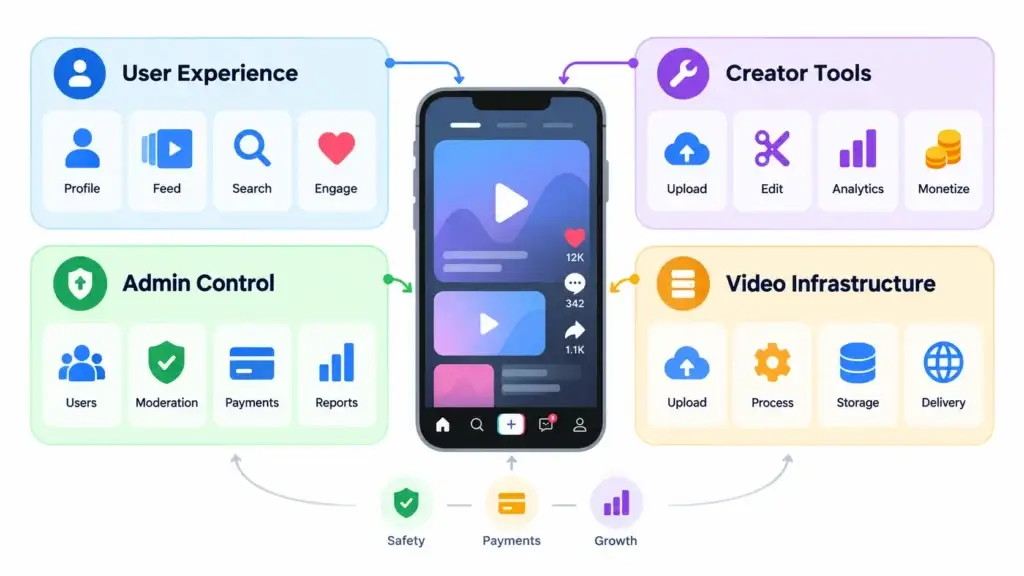
A short-form video business is not just a mobile app with upload and playback features. It needs multiple connected layers that support viewers, creators, administrators, payments, safety, and growth.
Before selecting any product foundation, founders should review the complete short-video platform features to understand what is already included across user flows, creator tools, video uploads, engagement, moderation, admin control, and monetization.
User Experience Layer
The user-facing experience should feel smooth from the first session. Viewers should be able to register, create profiles, browse vertical feeds, search content, follow creators, like videos, comment, share, receive notifications, and discover relevant content.
For startups, this layer matters because user retention is fragile. If playback is slow, navigation feels confusing, or the feed lacks engagement loops, users may not return.
Creator Experience Layer
Creators need more than an upload button. A practical creator layer may include video publishing, basic editing tools, profile management, performance insights, live interaction, wallet activity, subscriptions, gifts, or other monetization features depending on the business model.
A startup’s supply side depends on creator trust. If creators cannot publish easily, track performance, or understand earning opportunities, the platform may struggle to build content volume.
Admin Control Layer
The admin dashboard is where the business operates the platform. It should help manage users, creators, videos, reports, comments, payments, monetization settings, notifications, analytics, categories, and staff permissions.
This control layer is often underestimated. Without strong admin workflows, the startup may need developer support for routine operational decisions.
Video Infrastructure Layer
Short-form video apps are infrastructure-heavy. Uploads, compression, storage, content delivery, caching, playback, thumbnails, and analytics must work together. As usage grows, backend performance becomes a business issue, not only a technical issue. Founders can explore the backend architecture for video platforms to understand how feeds, uploads, engagement, storage, and scaling logic work behind the scenes.
Founders who want to understand this layer more deeply can connect this article with Miracuves’ guide on video streaming infrastructure for short video apps, which explains upload, processing, CDN delivery, playback, and performance logic in more detail.
Why Startups Avoid Building Standard Modules From Scratch
Custom development can be valuable, but rebuilding standard modules is not always the best use of early-stage capital.
Most short-form video platforms need similar foundational workflows:
- User registration
- Creator profiles
- Video upload
- Vertical feed
- Likes, comments, and follows
- Push notifications
- Search and discovery
- Moderation tools
- Admin dashboard
- Analytics
- Payment or wallet workflows
- Creator monetization settings
The startup’s real differentiation usually does not come from rebuilding these common modules. It comes from the audience it serves, the creators it attracts, the brand it builds, the revenue model it tests, and the operating discipline behind the platform.
If budget planning is one of the main decision factors, founders should review the key video platform cost factors before choosing between a ready-made foundation and full custom development.
A ready-made short-form video platform allows founders to start with these core workflows already available and then invest more attention into the areas that actually create market separation.
When Ready-Made Development Is the Better Startup Choice
A ready-made short-form video platform is usually the stronger choice when the startup wants to launch quickly, test demand, and avoid unnecessary development risk.
This route works well when the business needs:
- A branded short-video app experience
- Creator profiles and publishing workflows
- Vertical video feed and content discovery
- Engagement tools such as likes, comments, follows, and sharing
- Admin control over users, creators, content, and monetization
- Moderation and reporting workflows
- Payment, wallet, gift, or subscription options
- Room for future customization
- Source-code ownership for long-term flexibility
A ready-made route is especially useful for founders targeting a niche community, regional entertainment audience, creator-led education model, social-commerce concept, fan engagement platform, or local content network.
The startup can begin with a working foundation, launch faster, collect feedback, and improve based on real usage instead of trying to perfect every feature before entering the market.
When Custom Development Still Makes Sense
A ready-made platform is not automatically the right answer for every startup.
Custom development may be better when the product depends on technology that is deeply different from a standard short-video experience. For example, a startup may need a proprietary recommendation system, unusual video editing engine, complex rights-management workflow, custom creator-contract logic, advanced enterprise controls, or a highly specialized interaction model.
Custom development may also make sense when the company already has a strong technical team, a larger budget, a detailed product specification, and a long runway for development and testing.
The decision should come down to what genuinely needs to be custom. If the uniqueness is in the market, brand, content niche, creator strategy, or monetization model, ready-made development can be the better first step. If the uniqueness is in the core technology itself, custom development deserves serious consideration.
Source-Code Ownership Protects Long-Term Flexibility
Startups should not evaluate a ready-made platform only by how fast it launches. They should also check what happens after launch.
Source-code ownership matters because it gives the business more control over future changes. As the platform grows, founders may want to modify onboarding, change feed logic, add payment providers, introduce new creator tools, refine moderation, expand regions, or connect analytics systems.
Without source-code access, the startup may become dependent on the provider for every major product decision. With a source-code-owned foundation, the business has more flexibility to customize, extend, and maintain the platform over time.
This is one reason founders should review the Miracuves short-video product foundation after understanding the comparison. The money page is better suited for reviewing the actual platform, feature depth, delivery scope, and product fit.
Monetization Should Be Planned Before Launch
A short-form video platform does not become a business only because people upload videos. The monetization layer should be planned before launch, even if all revenue features are not activated immediately.
Founders should map the creator platform business model before launch because monetization affects feature priority, creator incentives, admin controls, payment workflows, and long-term platform growth. Common monetization options include:
- In-feed advertising
- Sponsored creator campaigns
- Virtual gifts and coin-based rewards
- Creator subscriptions
- Premium live sessions
- Paid content promotion
- Brand partnerships
- Platform commissions
- Social-commerce integrations
The first release does not need every revenue model. In fact, too many monetization options can distract the startup. A better approach is to choose one or two models that match the target audience and make sure the product foundation can support expansion later.
For example, a regional entertainment platform may begin with ads and sponsored campaigns. A creator education platform may focus on subscriptions or premium live sessions. A fan community may prioritize gifts, wallets, and creator payouts.
The platform should support monetization logic, but the business should still validate which model users and creators actually adopt.
Admin Control Is Where the Business Runs
Founders often focus heavily on the viewer app because it is the most visible part of the product. But the admin dashboard is what allows the business to manage the platform after launch.
A strong admin panel should help the platform operator:
- Manage users and creators
- Review uploaded videos and reported content
- Control comments, accounts, warnings, and restrictions
- Configure monetization settings
- Track payments, wallets, and creator payouts
- Manage categories, languages, campaigns, and notifications
- Review analytics and user activity
- Control staff permissions
- Monitor platform performance
For a startup, admin control reduces operational dependency. The team can manage content safety, creator activity, monetization, and support workflows without asking developers to make every small backend change.
Security and Content Safety Cannot Be Added Later
Short-form video platforms handle user accounts, uploaded media, comments, creator activity, payments, payouts, and administrative access. This means security and content safety must be treated as product foundations, not afterthoughts.
Important controls include encrypted data transfer, secure API communication, protected sessions, role-based access control, activity logs, abuse reporting, content moderation queues, spam controls, creator verification where relevant, and payment monitoring.
A practical creator platform security checklist can help founders review moderation, admin access, user safety, payment protection, reporting workflows, and operational risk before launch.
Founders should also define content rules before launch. A platform without clear moderation workflows can face trust issues quickly, especially when users and creators begin publishing at scale.
Compliance depends on the target market, data practices, age policies, payment flows, content categories, legal review, and operating model. No platform should be treated as automatically compliant everywhere without proper review.
Founder Decision Signals Before Choosing a Development Route
Speed
Choose a ready-made platform when early market validation matters more than building every standard module from zero.
Cost Control
Use a ready-made foundation when you want to reserve more budget for branding, creators, marketing, and launch operations.
Scalability
Check whether the platform supports video processing, storage, content delivery, analytics, moderation, and future growth.
Market Fit
Custom development is stronger when the product depends on unique technology. Ready-made development is stronger when differentiation comes from audience, niche, creator strategy, and execution.
What Startups Should Check Before Selecting a Ready-Made Platform
Not every ready-made platform offers the same level of quality, control, or flexibility. Before choosing a solution, founders should review the product carefully.
Check whether the platform includes:
- Android, iOS, and web support
- White-label branding
- Source-code ownership
- Creator profiles and publishing tools
- Vertical feed and discovery workflows
- Content moderation and reporting
- Admin dashboard
- Analytics and user activity tracking
- Monetization options
- Payment and payout workflows
- Scalable video infrastructure
- Deployment support
- Post-launch maintenance options
- Customization flexibility
Once the product route is clear, the next step is choosing a short-video platform development partner that understands creator workflows, video infrastructure, admin control, monetization, content safety, and post-launch scalability.
A demo is useful, but founders should go deeper than screens. Ask how the backend works, what can be customized, how deployment is handled, what support is included, and whether the product can grow beyond the first release.
Where Miracuves Fits Into This Decision
Miracuves helps startups launch ready-made and white-label app platforms with source-code ownership, custom branding, admin dashboards, monetization-ready workflows, and faster deployment.
For short-form video businesses, the advantage is not just speed. It is the ability to start from a working product foundation while still customizing the platform around a specific niche, region, creator model, brand identity, and revenue strategy.
When the selected requirements align with the existing solution foundation, Miracuves offers 6-day delivery. If the startup needs deeper custom features, new integrations, or complex workflow changes, the timeline can extend based on the final scope.
Founders who are comparing build routes can use this article as the decision guide, then review the launch-ready short-video solution to evaluate the product modules, delivery approach, and fit for their market.
Final Thoughts: Choose the Route That Protects Your Market Opportunity
The strongest development route is not always the longest or most expensive one. For many startups, the smarter move is to launch with a ready-made short-form video platform, validate the audience, understand creator behaviour, test monetization, and improve based on real usage.
After launch, founders should also connect product readiness with a clear creator platform launch strategy so user acquisition, creator onboarding, content supply, and retention grow together.
Custom development remains valuable when the platform depends on unique technology or workflows that cannot be achieved through customization. But when the business advantage comes from niche focus, community growth, creator partnerships, brand positioning, and speed of execution, a ready-made foundation can reduce avoidable risk.
Miracuves gives founders a practical path to move from idea to launch faster with a white-label, source-code-owned short-video platform foundation that can be customized around the business model.
FAQs
What is a ready-made short-form video platform?
A ready-made short-form video platform is a launch-ready product foundation that includes core video, creator, user, admin, moderation, and monetization workflows. Startups can customize the branding, features, integrations, and business model instead of building everything from scratch.
Why do startups choose ready-made video platforms over custom development?
Startups choose ready-made platforms because they can launch faster, reduce development risk, control early costs, validate demand sooner, and focus more on creators, users, monetization, and growth.
Is a ready-made short-video platform customizable?
Yes. A ready-made short-video platform can usually be customized with brand identity, onboarding flows, content categories, languages, creator tools, monetization options, payment integrations, moderation rules, and niche-specific features.
When should a startup choose custom development instead?
Custom development is better when the product requires unusual workflows, proprietary video technology, highly specialized recommendation systems, complex compliance needs, or a technical architecture that cannot be supported by an existing product foundation.
How fast can Miracuves deliver a ready-made short-video platform?
Miracuves offers 6-day delivery for its ready-made short-video platform when the selected requirements follow the existing product foundation. Additional customizations, integrations, or complex feature changes can extend the timeline.
Why is source-code ownership important for a short-video startup?
Source-code ownership gives the startup more control over future customization, integrations, maintenance, scaling, and product roadmap decisions. It also reduces long-term dependency on a single provider.
What features should a short-form video platform include?
A practical platform should include user registration, creator profiles, video uploads, a vertical feed, likes, comments, follows, sharing, notifications, moderation, analytics, monetization workflows, and admin controls.
How does a short-form video platform make money?
It can generate revenue through advertising, sponsored campaigns, virtual gifts, subscriptions, premium live sessions, paid promotions, platform commissions, and social-commerce integrations. The right model depends on the target audience and creator strategy.
Miracuves is an independent software development company. We are not affiliated with, connected to, sponsored by, or endorsed by any company or product named in this article.
Terms such as “X Clone” are used descriptively. It is how the software industry refers to building a platform with functionality comparable to a known service, and how clients search for it.
The entire design and codebase of our products is built by our own team. Our products contain no code, design, graphics, or content originating from any third-party website or applications.
All third-party names and marks referenced in this article are the property of their respective owners, referenced solely to identify the services discussed.