



Picture this: it’s raining, you’re late, taxis are nowhere, and public transport is packed. You open DiDi, drop a pin, choose a ride type, and a driver shows up—often with live tracking, ETA updates, and in-app payment. That “tap → ride arrives” convenience is the core reason DiDi became a daily habit for millions.
DiDi started as a ride-hailing platform in China and expanded into a broader mobility technology company offering app-based transportation services (ride-hailing, taxi-hailing, and more) across multiple markets outside China, including parts of Latin America and Asia-Pacific. In recent company reporting, DiDi highlighted large platform scale and growth metrics like gross transaction value (GTV) and transaction volumes across China Mobility and its International segment.
By the end of this guide, you’ll understand:
- what DiDi is in simple terms,
- how the app works for riders and drivers,
- how DiDi makes money (fees, commissions, and pricing logic),
- the key features that drive trust and repeat usage,
- and what it takes to build a DiDi-like mobility platform with Miracuves.
What Is DiDi? The Simple Explanation
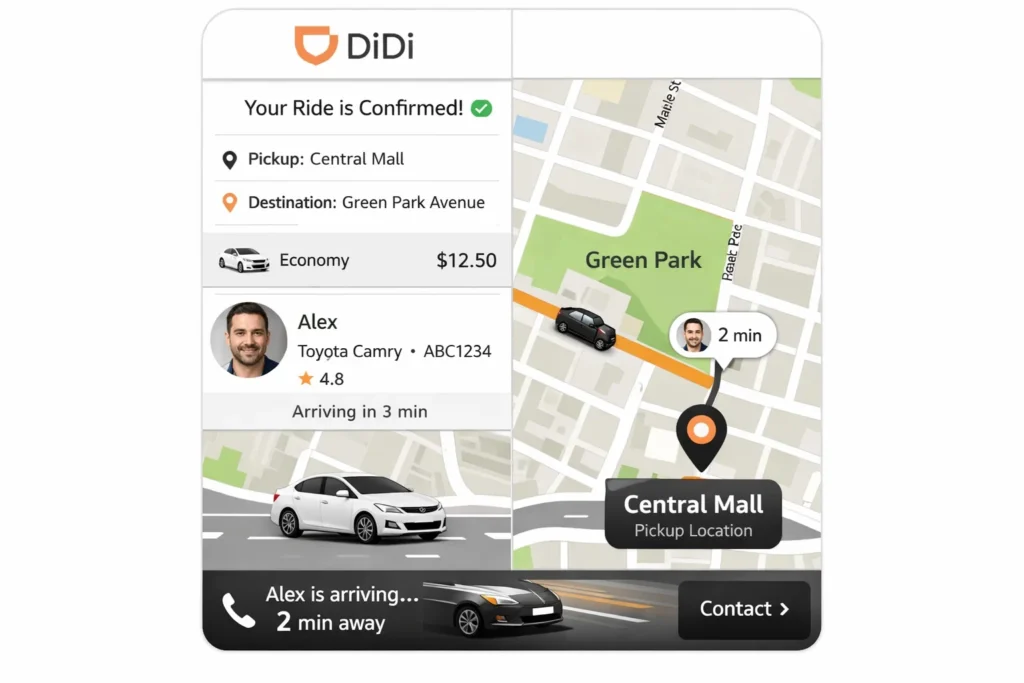
DiDi is a ride-hailing and mobility platform that connects passengers with drivers through a mobile app. In simple terms, it lets people book rides, track drivers in real time, pay digitally, and reach their destination without hailing a cab on the street.
The Core Problem DiDi Solves
In many cities, finding reliable transportation can be slow, inconvenient, or unpredictable. DiDi solves this by using location data, smart matching, and digital payments to make rides faster, more transparent, and easier for both riders and drivers.
Target Users and Use Cases
DiDi is used by:
• Everyday commuters traveling to work or school
• People booking quick city rides or longer trips
• Drivers looking to earn income using their own vehicles
• Users needing alternatives to traditional taxis
• Cities where app-based mobility is replacing street hailing
Current Market Position
DiDi is one of the largest mobility platforms in the world, with strong dominance in China and an active presence in several international markets. It competes globally with platforms like Uber, Grab, and Bolt, especially in high-density urban regions.
Why It Became Successful
DiDi succeeded by focusing on local needs—multiple ride options, competitive pricing, deep integration with local payments, and strong operational scale. Its ability to match riders and drivers quickly, even during peak demand, helped it become a default transportation app in many cities.
How DiDi Works — Step-by-Step Breakdown
For Riders (Passengers)
Account Creation
Users download the DiDi app and sign up using a mobile number. Location permissions are enabled so the app can detect pickup and drop-off points accurately. Payment methods (digital wallets, cards, or local payment options) are added for seamless checkout.
Booking a Ride
To book a ride, a rider:
- Enters a pickup location and destination
- Chooses a ride type (economy, premium, taxi, shared ride, etc.)
- Sees an estimated fare and ETA
- Confirms the booking
DiDi’s system instantly searches for nearby drivers and assigns the best match.
Live Tracking & Ride Experience
Once a driver accepts the request, the rider can:
- Track the driver’s location in real time
- See arrival time updates
- Contact the driver through in-app chat or call
- Follow the route during the trip
Payment & Rating
After the ride ends, payment is processed automatically through the app. Riders can rate the driver and leave feedback, which helps maintain service quality.
Example Rider Journey
A user opens DiDi → enters destination → selects a ride → tracks driver → completes trip → pays digitally → rates the experience.
For Drivers (Service Providers)
Driver Onboarding
Drivers sign up by submitting required documents such as driver’s license, vehicle details, and identity verification. Once approved, they can go online to start receiving ride requests.
Accepting & Completing Rides
Drivers receive ride requests with pickup location, distance, and fare estimate. They can accept or reject requests, navigate using in-app maps, and complete trips with automatic fare calculation.
Earnings & Payouts
Drivers earn money per completed ride. DiDi deducts a service commission and transfers earnings to the driver’s linked account, with options for regular payouts.
Technical Overview (Simplified)
DiDi operates through a real-time matching system that includes:
- GPS-based rider–driver matching
- Dynamic pricing algorithms
- Route optimization and navigation
- In-app payments and wallets
- Ratings, reviews, and safety monitoring systems
All of this works together to make ride booking fast, reliable, and scalable.
Read More :- How to Launch a Successful Logistics & Package Delivery App Business
DiDi’s Business Model Explained
How DiDi Makes Money
DiDi follows a marketplace-based ride-hailing business model. It doesn’t own cars or employ drivers directly. Instead, it earns revenue by facilitating rides between passengers and independent drivers.
The main revenue streams include:
- Commission from drivers: DiDi takes a percentage from each completed ride
- Dynamic pricing margins: Earnings increase during peak demand through surge pricing
- Premium ride services: Higher commissions on premium or specialized ride categories
- Corporate and enterprise mobility services: Business travel and fleet solutions
- Value-added services: Advertising, insurance, and data-driven mobility services
This model allows DiDi to scale rapidly without heavy asset ownership.
Pricing Structure
Ride prices are calculated based on:
- Base fare
- Distance traveled
- Time taken
- Demand and supply conditions (dynamic pricing)
Users see the estimated fare before confirming a ride, creating transparency and trust.
Commission / Fee Breakdown
- Driver commission: A percentage of the total fare
- Service fees: Applied in certain markets or ride categories
- Peak pricing uplift: Higher fares during high demand periods
Exact commission rates vary by city, ride type, and local regulations.
Market Size and Growth Opportunity
Urban mobility is a massive global market driven by population density, smartphone adoption, and declining private car ownership in cities. DiDi benefits from high ride frequency, repeat usage, and strong network effects in dense markets.
Profitability Insights
DiDi’s profitability levers include:
- High transaction volume
- Optimized driver–rider matching to reduce idle time
- Dynamic pricing to balance supply and demand
- Expansion into higher-margin services beyond basic rides
Revenue Model Breakdown
| Revenue Stream | Description | Who Pays | Nature |
|---|---|---|---|
| Ride Commissions | Percentage per completed trip | Drivers | Transaction-based |
| Premium Rides | Higher-end ride categories | Riders | Margin-based |
| Dynamic Pricing | Surge during peak demand | Riders | Variable |
| Enterprise Services | Business mobility solutions | Companies | Contract-based |
| Value-Added Services | Ads, insurance, partnerships | Partners | Ancillary |
Also Read :- How to Start a Ride-Hailing Platform Business
Key Features That Make DiDi Successful
Multiple Ride Options
DiDi offers a wide range of ride types to match different budgets and needs. Users can choose from economy rides, taxis, premium cars, shared rides, and region-specific services, making the app flexible for everyday use.
Real-Time Matching & Tracking
The platform uses GPS and real-time data to quickly match riders with nearby drivers. Live tracking allows users to see the driver’s route and arrival time, reducing uncertainty and wait times.
Dynamic Pricing
DiDi adjusts prices based on demand and supply. During peak hours or bad weather, higher prices attract more drivers, helping balance the marketplace and reduce wait times.
Seamless In-App Payments
Payments are handled automatically through the app using cards, wallets, or local payment methods. This cashless flow makes rides faster and more convenient.
Driver Navigation & Route Optimization
Drivers get in-app navigation with optimized routes, traffic updates, and turn-by-turn guidance. This helps reduce travel time and fuel costs.
Ratings & Feedback System
After each trip, riders and drivers rate each other. This two-sided feedback system improves service quality and accountability across the platform.
Safety Features
DiDi includes safety tools such as:
- Trip sharing with contacts
- Emergency assistance buttons
- Driver and vehicle verification
- In-app chat and call masking
These features build trust and encourage repeat usage.
Localized Experience
DiDi tailors its services to local markets by supporting regional payment methods, languages, and regulations, which has been key to its success across different countries.
High-Volume Scalability
DiDi’s platform is built to handle millions of ride requests daily, ensuring consistent performance even during peak demand.
Ecosystem Expansion
Beyond ride-hailing, DiDi has expanded into broader mobility services in some markets, reinforcing its position as a mobility technology platform rather than just a taxi app.
The Technology Behind DiDi
Tech stack overview (simplified)
DiDi is basically three big systems working together in real time:
- Passenger app + Driver app (booking, navigation, payments, support)
- Dispatch + pricing brain (matching riders and drivers + deciding ETAs and prices)
- Safety + trust layer (monitoring trips, emergency tools, identity checks, fraud/risk controls)
Under the hood, DiDi relies on real-time GPS positioning and trajectory tracking, plus big data analysis and intelligent strategy engines to coordinate trips at massive scale.
Real-time features explained
1) Live location and ETA updates
Your phone shares your pickup point, the driver’s phone shares their position, and the platform continuously recalculates the best route + ETA. This is why the driver marker moves smoothly and arrival times keep updating.
2) Rider–driver matching (dispatch)
When you request a ride, DiDi’s dispatch system chooses a driver based on distance, predicted time, traffic, driver availability, and marketplace balance. DiDi has published/been cited in research for using advanced optimization and reinforcement-learning style dispatching approaches to improve matching efficiency.
3) Dynamic pricing
Prices change based on supply vs demand (peak hour, rain, events). The goal is to reduce long wait times by encouraging more drivers to go online when demand spikes.
Payments and data flow
DiDi needs reliable payment flows (cards/wallets depending on country), instant receipt generation, dispute handling, refunds, and driver payouts. That’s why ride-hailing apps are engineered like payment platforms, not just maps.
Safety, privacy, and trip monitoring
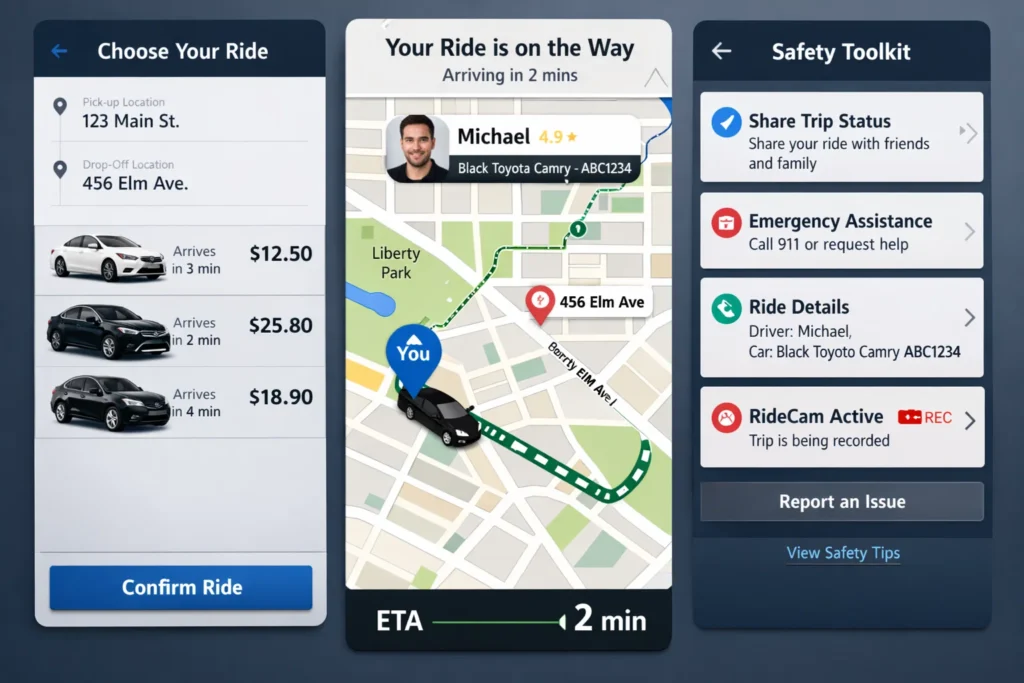
Safety is a core product feature in ride-hailing, not an add-on. DiDi markets a “Safety Toolkit” style approach in multiple countries, including share trip features using live GPS tracking.
DiDi’s public safety pages also highlight features like SOS emergency buttons and other in-trip safety tools in certain markets.
Scalability approach
DiDi must survive huge traffic spikes (rush hours, storms, major events). That usually means:
- Systems that can scale quickly when ride requests surge
- Separate services for dispatch, maps, payments, messaging, and support (so one spike doesn’t crash everything)
- Strong monitoring so failures are caught early
Mobile app vs web platform
Ride-hailing is mobile-first:
- Riders: booking, tracking, payments, safety tools
- Drivers: navigation, earnings, acceptance, incentives, compliance prompts
Web tends to be used more for business dashboards, support, and corporate accounts (where applicable).
API integrations
A DiDi-like platform typically integrates with:
- Maps + navigation services
- Payments and payout rails
- SMS/push notification services
- Customer support/CRM tooling
- Risk and verification services (depending on market rules)
Why this tech matters for business
DiDi’s technology is what makes the marketplace work:
- Better dispatch = shorter ETAs and higher ride completion
- Better pricing = balanced supply and demand
- Better safety tooling = stronger trust and repeat usage
DiDi’s Impact & Market Opportunity
Industry disruption caused
DiDi reshaped urban transportation by moving it from street-based hailing to app-based, on-demand mobility. In cities where taxis were hard to find or inconsistent, DiDi introduced predictable pricing, live tracking, and digital payments—changing how people plan daily travel.
It also transformed driving into a flexible income opportunity. By lowering entry barriers and optimizing ride distribution, DiDi enabled large numbers of drivers to earn through the platform, especially in dense urban markets.
Market statistics and growth drivers
Urban mobility is one of the largest and most frequently used digital services globally. Ride-hailing benefits from:
- High population density in cities
- Smartphone and GPS adoption
- Declining private car ownership in urban centers
- Demand for flexible, on-demand transportation
DiDi’s scale in China and expansion into international markets shows how strong network effects can create dominant local platforms.
User demographics and behavior
DiDi users typically include:
- Daily commuters
- Office workers and students
- Night-time and short-distance travelers
- Users who prefer cashless, app-based services
Drivers often use DiDi as either a primary income source or a flexible side income, logging in during peak demand hours to maximize earnings.
Geographic presence
DiDi has a strong base in China and operates internationally in selected markets across Asia-Pacific and Latin America. Its market-by-market approach allows it to adapt pricing, features, and regulations locally rather than applying a one-size-fits-all model.
Future projections
The future of platforms like DiDi points toward:
- Deeper integration with public transport and multimodal mobility
- Improved AI-driven dispatch and pricing
- More safety and compliance tooling
- Expansion into logistics, deliveries, and enterprise mobility
Opportunities for entrepreneurs
There are clear opportunities to build DiDi-like platforms for:
- Regional or city-specific ride-hailing markets
- Corporate and employee transportation
- Electric vehicle–focused ride platforms
- Women-only or safety-first ride services
- Logistics and last-mile delivery
This massive success is why many entrepreneurs aim to build ride-hailing ecosystems—because once a city reaches scale, network effects become very strong.
Building Your Own DiDi-Like Platform
Why businesses want DiDi-style mobility platforms
DiDi proves that transportation can be turned into a scalable digital marketplace. Entrepreneurs are attracted to this model because:
- It solves a daily, high-frequency problem (getting from A to B)
- Network effects grow quickly once riders and drivers reach balance
- It scales city by city without owning vehicles
- Multiple revenue streams can be layered on top (rides, premium services, enterprise mobility)
- Technology, not physical assets, becomes the core advantage
Key considerations before development
To build a DiDi-like platform, these decisions are critical early on:
- Market focus: single city, region, or country
- Ride types: taxi, private car, shared rides, premium, EV-only
- Driver model: full-time, part-time, fleet partnerships
- Regulatory requirements: local transport rules, driver verification
- Pricing logic: base fares, distance/time pricing, surge rules
- Safety framework: SOS, trip sharing, verification, monitoring
- Payments: local wallets, cards, cash alternatives (if needed)
Cost Factors & Pricing Breakdown
DiDi-Like App Development — Market Price
| Development Level | Inclusions | Estimated Market Price (USD) |
|---|---|---|
| Basic Ride-Hailing MVP | Core passenger & driver apps, registration & login, basic KYC, simple ride booking, pickup/drop location selection, fare estimate, live status updates, trip history, cash/one digital payment method, basic ratings, standard admin panel | $70,000 |
| Mid-Level Ride-Hailing & Fleet Platform | Advanced matching & routing, multi-city support, surge/dynamic pricing logic, multiple payment methods, wallet, promo codes, driver onboarding & document management, earnings dashboard, dispute & support flows, richer analytics, polished mobile-first UX (iOS, Android, web panel) | $150,000 |
| Advanced DiDi-Level Mobility Ecosystem | Large-scale multi-region platform, high-availability dispatch engine, pooled/shared rides, scheduled rides, fleet & operator management, incentives & gamification for drivers, fraud & risk controls, deep mapping/telemetry integrations, cloud-native, highly scalable architecture | $250,000+ |
DiDi-Style Ride-Hailing App Development
The prices above reflect the global market cost of developing a DiDi-like ride-hailing and mobility platform — typically ranging from $70,000 to over $250,000, with a delivery timeline of around 4–12 months for a full, from-scratch build. This usually includes real-time dispatch and routing logic, passenger and driver apps, payments and wallet flows, safety and support features, analytics, and the infrastructure needed to operate at city or multi-city scale.
Miracuves Pricing for a DiDi-Like Custom Platform
Miracuves Price: Starts at $14,999
This is positioned for a feature-rich, JS-based DiDi-style ride-hailing platform that covers core journeys such as passenger onboarding, driver onboarding, real-time ride booking and matching, live trip tracking, digital payments and basic wallet, ratings & feedback, promotions, analytics, and a modern admin/operations console plus mobile apps for both passengers and drivers. From this foundation, the solution can be extended into pooled rides, scheduled trips, fleet/owner modules, incentive programs, and deeper risk & compliance tooling as your mobility business scales.
Note: This includes full non-encrypted source code (complete ownership), complete deployment support, backend & API setup, admin panel configuration, and assistance with publishing on the Google Play Store and Apple App Store—ensuring you receive a fully operational ride-hailing ecosystem ready for launch and future expansion.
Delivery Timeline for a DiDi-Like Platform with Miracuves
For a DiDi-style, JS-based custom build, the typical delivery timeline with Miracuves is 30–90 days, depending on:
- Depth of ride-hailing features (matching, routing, surge pricing, incentives, etc.)
- Number and complexity of payment, mapping, KYC and notification integrations
- Complexity of fleet/operator modules, support workflows, and analytics dashboards
- Scope of web portal, passenger and driver apps, branding requirements, and long-term scalability targets
Tech Stack
We preferably will be using JavaScript for building the entire solution (Node.js/Nest.js/Next.js for the web backend + frontend) and Flutter / React Native for mobile apps, considering speed, scalability, and the benefit of one codebase serving multiple platforms.
Other technology stacks can be discussed and arranged upon request when you contact our team, ensuring they align with your internal preferences, compliance needs, and infrastructure choices.
Essential features to include
A strong DiDi-style MVP should include:
- Rider and driver mobile apps
- Real-time ride booking and tracking
- Fare estimation and dynamic pricing
- In-app payments and receipts
- Driver earnings dashboard
- Ratings and reviews
- Safety features (SOS, trip sharing)
- Admin panel for users, rides, disputes, and compliance
Optional but high-impact additions:
- Multiple ride categories
- Driver incentives and bonuses
- Corporate ride accounts
- EV and sustainability features
- Analytics for demand forecasting
Read Also :- Drivers, Demand & Disruption: The New Business Case for Rideshare Uber Startups
Conclusion
DiDi demonstrates how powerful technology can be when it solves a real, everyday problem at massive scale. By combining real-time location data, smart matching, digital payments, and safety systems, it turned transportation into a reliable on-demand service rather than a guessing game.
For entrepreneurs, DiDi’s journey shows that local focus, operational excellence, and strong technology can create dominant platforms city by city. When a mobility app becomes the default way people move around, it gains trust, frequency, and long-term value that few other platforms can match.
FAQs :-
How does DiDi make money?
DiDi earns revenue mainly by taking a commission from each completed ride. Additional income comes from premium ride categories, enterprise mobility services, and value-added offerings like insurance and partnerships.
Is DiDi similar to Uber?
Yes. DiDi and Uber follow a similar ride-hailing marketplace model. The main difference is DiDi’s strong dominance in China and its market-by-market localization strategy globally.
How does DiDi calculate ride prices?
Ride prices are based on base fare, distance, time, and demand–supply conditions. During peak demand, dynamic pricing may apply to attract more drivers.
Is DiDi available outside China?
Yes. DiDi operates in several international markets, particularly in Latin America and parts of Asia-Pacific, though availability varies by country.
How do drivers earn money on DiDi?
Drivers earn a fare for each completed ride. DiDi deducts a platform commission, and the remaining amount is paid out to the driver through linked payout methods.
What safety features does DiDi offer?
DiDi includes safety tools such as real-time trip tracking, SOS emergency buttons, driver verification, masked communication, and trip sharing with trusted contacts.
Can riders pay cash on DiDi?
Payment methods depend on the market. In many regions, DiDi supports digital wallets and cards, while some locations may also allow cash or local payment options.
What makes DiDi different from other ride-hailing apps?
DiDi stands out due to its scale, localization, multiple ride options, and strong focus on safety and data-driven dispatch—especially in dense urban markets.
Does DiDi own vehicles or employ drivers?
No. DiDi is a platform marketplace. Drivers are independent service providers using their own vehicles or fleet arrangements.
Can I build a platform like DiDi?
Yes. Ride-hailing platforms can be built for specific cities, regions, or niches with the right technology, compliance setup, and marketplace balance.
How can Miracuves help build a DiDi-like platform?
Miracuves helps founders launch DiDi-style ride-hailing platforms in 30-90 days, offering rider and driver apps, real-time GPS tracking, dynamic pricing, safety features, admin dashboards, and full customization to fit your target market.
Related Articles:-
- What is Uber App and How Does It Work?
- What is Lyft App and How Does It Work?
- What is Bolt App and How Does It Work?
- What is Careem App and How Does It Work?
/