
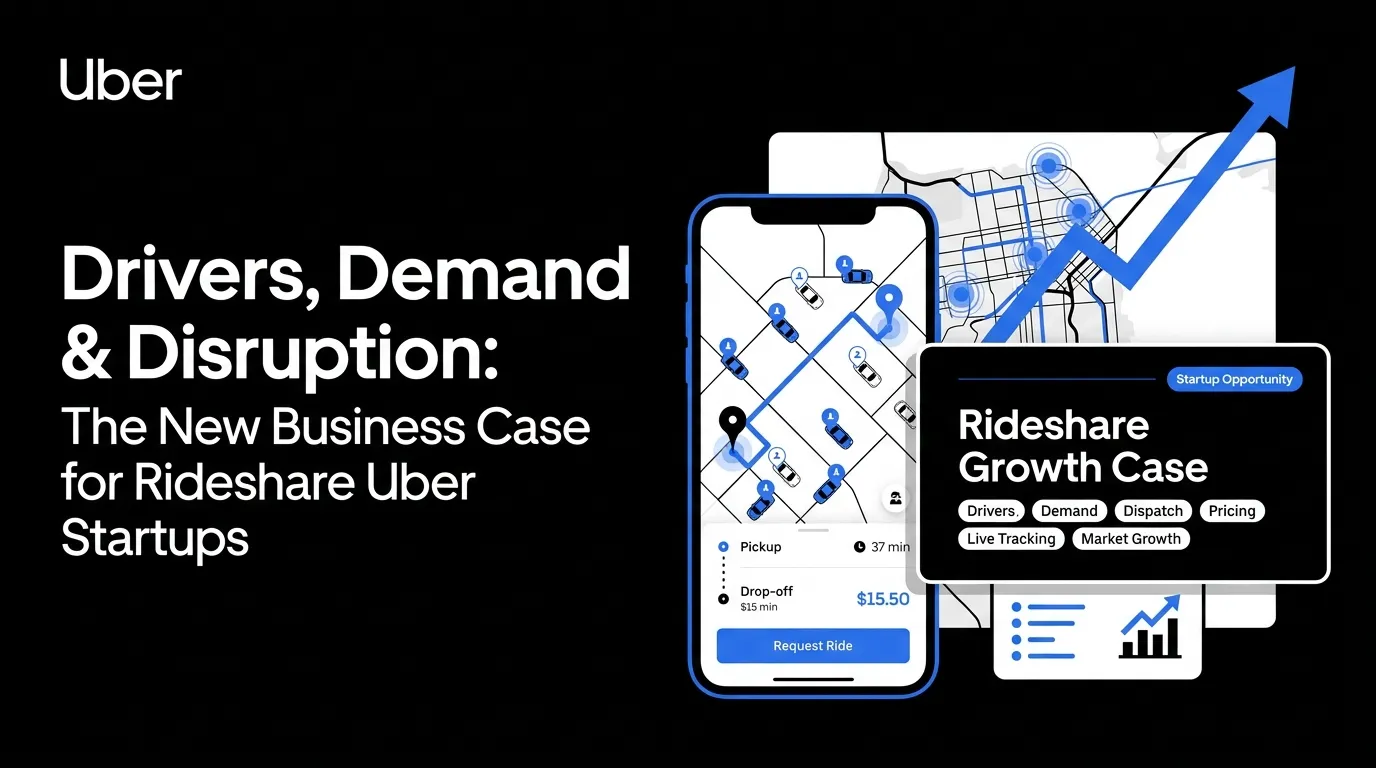
Key Takeaways
- Ride-hailing startups still have opportunities in niche markets, underserved cities, and specialized mobility segments.
- Riders, drivers, dispatch teams, payment partners, and admins need connected platform workflows.
- Ride booking, driver matching, live tracking, fare calculation, payments, and ratings are core features.
- Success depends on local demand, driver supply, pricing strategy, safety, and reliable trip operations.
- A focused ride-hailing platform can help startups compete by solving specific mobility problems instead of copying Uber directly.
Opportunity Signals
- Riders need simple onboarding, pickup selection, fare estimates, ride booking, secure checkout, and real-time tracking.
- Drivers need ride requests, navigation, availability control, trip status updates, earnings, and payout visibility.
- Admins need control over riders, drivers, fares, commissions, zones, payments, disputes, and platform reports.
- Niche options like women-only rides, corporate transport, airport transfers, and local taxi networks can create differentiation.
- Real-time notifications keep riders, drivers, and admins updated on bookings, arrivals, cancellations, payments, and trip completion.
Real Insights
- A ride-hailing startup does not need to beat Uber everywhere; it needs to win one clear market or mobility use case first.
- Weak driver supply can create long wait times, cancellations, and poor rider retention.
- Clear fares, driver verification, trip visibility, and support workflows help users trust a new mobility platform.
- Founders should validate demand, driver availability, pricing, and city-level regulations before scaling.
- Miracuves builds ride-hailing apps with rider apps, driver apps, dispatch logic, payments, live tracking, and admin control.
In 2015, getting a cab meant tapping a button and waiting five minutes. Today? You are lucky if the fare does not spike mid-click or the driver does not cancel twice. We have gone from convenience to chaos — and that, dear founder, is where the opportunity begins.
Startup founders, mobility operators, and local transport businesses are rethinking what a modern ride-hailing business should look like. The opportunity is no longer just about copying large platforms. It is about building a more focused, transparent, and locally relevant taxi booking platform for markets where riders and drivers still feel underserved.
That is where a ready-made Uber-style app foundation can help founders move from research to execution faster. Instead of spending months building rider apps, driver apps, dispatch logic, live tracking, payment flows, and admin controls from zero, founders can start with a customizable ride-hailing app foundation and adapt it to their market.
For founders exploring a product-ready route, Miracuves offers an Uber Clone solution that supports branded ride-hailing launches with user, driver, dispatcher, fleet, and admin workflows.
But here is the kicker: demand has not disappeared. It is shifting across tier-2 cities, niche communities, business travel segments, airport routes, women-focused mobility, bike taxis, and local transport use cases traditional platforms often fail to serve properly.
If there was ever a moment for next-generation ride-hailing startups to build smarter, more local, and more driver-friendly platforms, it is now.
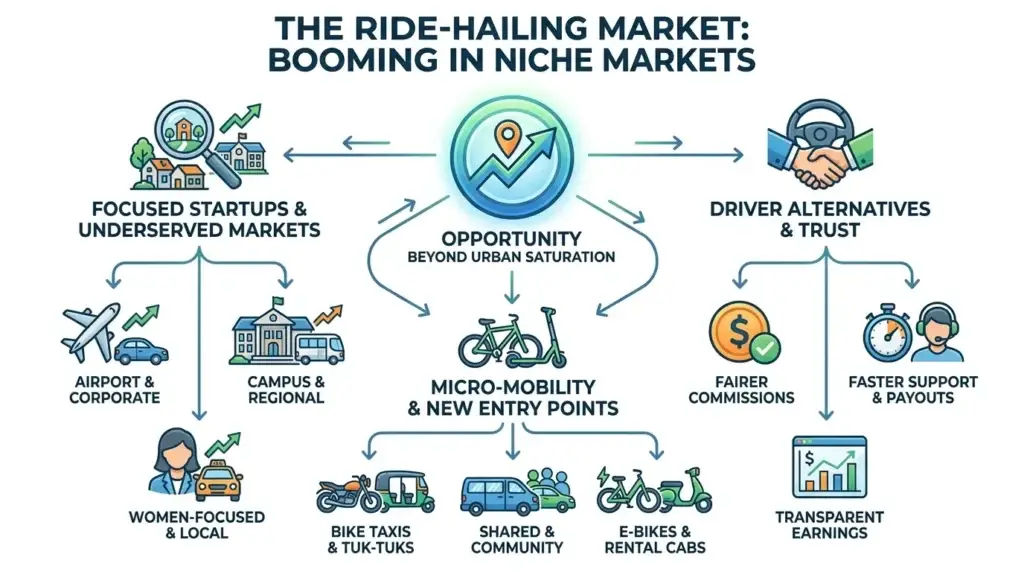
The Ride-Hailing Market Is Still Booming — Just Not Where You Think
Saturation Does Not Mean Stagnation
Yes, the Ubers and Lyfts of the world dominate many major urban hubs. But dominance in large cities does not mean every transport problem is solved.
In many semi-urban, suburban, tourist, campus, industrial, and regional markets, riders still struggle with unreliable availability, inconsistent pricing, limited ride categories, weak customer support, and poor local payment support.
That gap creates room for more focused ride-hailing startups.
A founder does not always need to compete with a global app across every city. A stronger starting point may be a specific geography, a specific customer type, or a specific ride category.
Examples include:
- Airport taxi booking platforms
- Corporate employee transport apps
- Bike taxi platforms
- Women-focused ride services
- Campus ride-sharing apps
- Local cab aggregator platforms
- Regional fleet booking systems
- Outstation and rental ride platforms
- Driver-friendly subscription-based taxi apps
The opportunity is no longer “build another Uber.” The opportunity is “build the right ride-hailing platform for a market that still feels ignored.”
Micro-Mobility Is Creating New Entry Points
Electric bikes, tuk-tuks, bike taxis, community carpools, shared pools, local vans, and rental cabs are no longer fringe models. These are practical mobility formats in markets where full-size cars may not be the most affordable or accessible option.
Large ride-hailing platforms often struggle to serve these formats efficiently because their systems are built for scale, not local nuance.
A founder can build a leaner platform around one or two mobility models first, then expand once supply, demand, pricing, and operations become predictable.
Drivers Want Alternatives
Drivers are one of the most important sides of any ride-hailing marketplace. Without reliable driver supply, even the best rider app fails.
Many drivers look for alternatives when they face high commissions, unclear incentives, limited support, delayed payouts, weak dispute resolution, or unpredictable ride allocation. A new ride-hailing startup can earn driver trust by offering transparent pricing, fairer commissions, faster support, and clearer earnings logic.
This is where smaller platforms can compete. They may not have the biggest brand on day one, but they can build stronger relationships with drivers in a specific city, segment, or fleet network.
Read More:The Future of Ride-Hailing Apps: Why Uber Clone is Leading the Charge
Founder Opportunity: Build Around the Gaps Big Platforms Ignore
The strongest opportunity for new ride-hailing startups is not always in competing head-to-head with global apps. It is often in serving a narrower market better.
A founder can build around gaps such as local payment preferences, regional languages, driver-friendly commission models, women-focused rides, corporate commuting, student transportation, airport transfers, bike taxis, rentals, outstation trips, or fleet-managed taxi services.
This matters because ride-hailing is not only a consumer app. It is an operational business. The app must help the platform owner manage drivers, pricing, trips, disputes, payouts, promotions, and customer support from one control layer.
Without that backend discipline, even strong rider demand can turn into operational chaos.
The Broken Economics of Big Rideshare Apps
Commissions Can Damage Trust
Traditional rideshare platforms often rely on commission-heavy models. For drivers, this can feel painful when they are already managing fuel, vehicle maintenance, insurance, financing, and time between trips.
High commission pressure can create a chain reaction:
- Drivers become less loyal.
- Riders face higher fares.
- Platforms need more incentives to keep supply active.
- Support complaints increase.
- Retention becomes expensive.
For a new ride-hailing startup, the opportunity is to design a business model that feels more transparent to both sides.
That does not always mean taking the lowest commission. It means making the rules clear.
Pricing Confusion Hurts Loyalty
Riders may accept dynamic pricing when demand is unusually high, but they do not like feeling tricked. If a ride costs one amount one minute and a much higher amount moments later, trust begins to drop.
The same problem affects drivers. If ride allocation, incentives, penalties, and earnings feel unclear, drivers may stop treating the platform as a dependable income channel.
A ride-hailing startup can differentiate by making pricing, cancellation policies, earnings, and support workflows easier to understand.
What This Means for a New Ride-Hailing Business Model
If riders distrust pricing and drivers distrust earnings, a new platform must compete on clarity. That does not always mean lower fares. It means predictable rules.
Founders can explore models such as fixed commissions, driver subscriptions, transparent surge rules, corporate ride packages, local fleet partnerships, and premium ride categories.
The right model depends on the market.
A price-sensitive city may respond well to flat pricing or fare negotiation, while a corporate mobility segment may care more about reliability, reporting, and scheduled rides.
The business model should be decided before development because it affects app logic, admin controls, fare calculation, payout workflows, and promotional tools.
Read More: Logistics Is the New Marketing: Build an Uber Clone That Wins on Speed
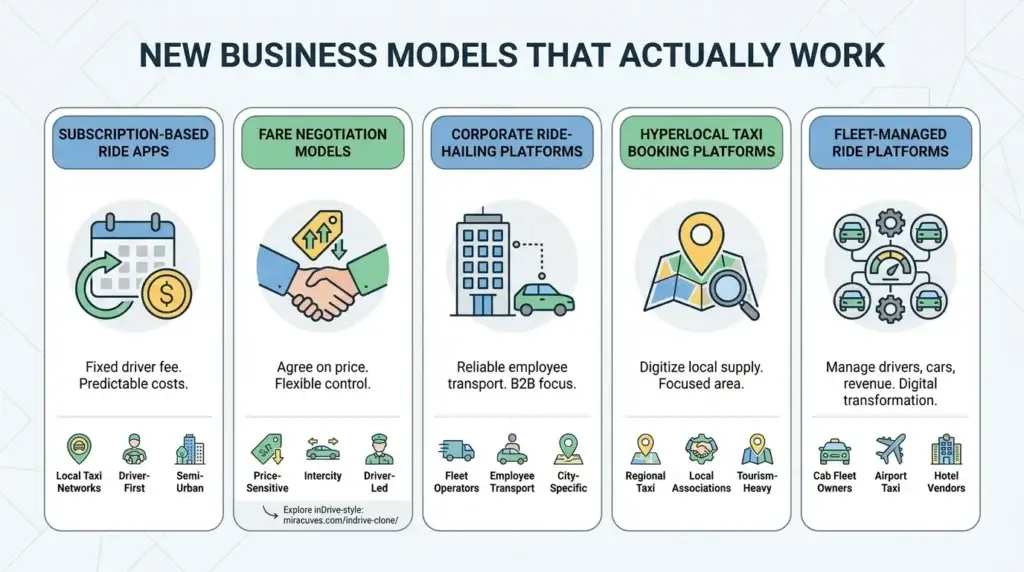
New Business Models That Actually Work
1. Subscription-Based Ride Apps
Instead of taking a high percentage from every ride, some platforms charge drivers a fixed daily, weekly, or monthly subscription.
This model can work when drivers want predictable platform costs and the founder wants to position the business as driver-friendly.
Best for:
- Local taxi networks
- Driver-first platforms
- Semi-urban ride-hailing apps
- Markets where high commissions create dissatisfaction
2. Fare Negotiation Models
Fare negotiation allows riders and drivers to agree on pricing before the ride begins. This model can be useful where riders expect flexibility and drivers want more control over earnings.
Best for:
- Price-sensitive markets
- Intercity rides
- Outstation taxis
- Driver-led marketplaces
- Regions where bargaining is already part of local transport behavior
For founders interested in this approach, an inDrive-style fare negotiation model can be explored through Miracuves’ inDrive Clone page: https://miracuves.com/indrive-clone/
3. Corporate Ride-Hailing Platforms
Corporate mobility is a strong opportunity because businesses often need reliable employee transportation, scheduled rides, billing reports, safety workflows, and admin visibility.
Instead of competing only for individual riders, a founder can target offices, factories, coworking hubs, airports, schools, hospitals, and hotels.
Best for:
- B2B mobility startups
- Fleet operators
- Employee transport businesses
- City-specific transport providers
4. Hyperlocal Taxi Booking Platforms
A local taxi booking platform can focus on one city, district, airport zone, tourist area, or business corridor.
This model works when local supply is strong but fragmented. The founder’s job is to digitize booking, pricing, driver allocation, payments, and support.
Best for:
- Regional taxi businesses
- Local transport associations
- Travel operators
- Tourism-heavy cities
- Tier-2 and tier-3 mobility markets
5. Fleet-Managed Ride Platforms
Fleet owners can use ride-hailing technology to manage drivers, cars, bookings, revenue, commissions, payouts, and reporting.
This is not only a startup opportunity. It is also a digital transformation opportunity for existing taxi businesses.
Best for:
- Cab fleet owners
- Airport taxi operators
- Hotel transport vendors
- Corporate mobility providers
- Rental car businesses
Ride-Hailing Monetization Models Founders Can Test
| Monetization Model | How It Works | Best For | Product Requirement |
|---|---|---|---|
| Commission per ride | Platform earns a percentage from each completed ride | Standard taxi booking platforms | Fare calculation, wallet, payout, commission controls |
| Driver subscription | Drivers pay a recurring fee to access leads or premium visibility | Driver-friendly marketplaces | Subscription plans, driver ranking, admin approval |
| Corporate ride plans | Businesses pay for employee transportation packages | B2B mobility startups | Corporate accounts, billing reports, scheduled rides |
| Surge or dynamic pricing | Fares adjust based on demand, location, or time | High-demand city routes | Pricing rules, admin control, demand monitoring |
| Featured driver or fleet listings | Drivers or fleet owners pay for higher visibility | Competitive local markets | Promotion tools, fleet dashboard, listing controls |
| Ads and local partnerships | Platform monetizes through local promotions | High-traffic consumer apps | Banner slots, campaign management, analytics |
The important point is simple: monetization should not be added after launch as an afterthought. It should be planned into the ride-hailing app architecture from the beginning so the admin panel can control fares, commissions, payouts, promotions, and reports without constant developer dependency.
What Riders Really Want From a Ride-Hailing App
Transparency Over Tricks
Riders want to know what they are paying for and why. This includes upfront fares, clear cancellation charges, driver details, ratings, ride history, and support access.
A ride-hailing startup can build trust by avoiding unnecessary complexity in the booking flow and keeping payment communication clear.
Speed and Simplicity
The fastest booking experience often wins.
If onboarding is complicated, pickup selection is confusing, payment fails frequently, or ride confirmation takes too long, users may leave before the first trip.
The rider app should make the basic journey simple:
- Open the app.
- Choose pickup and drop.
- View fare estimate.
- Select ride type.
- Confirm booking.
- Track the driver.
- Pay and rate the ride.
Hyperlocal Relevance
Local relevance can become a strong competitive advantage.
A ride-hailing platform built for a specific market should consider regional languages, preferred payment methods, local ride types, common pickup points, cultural expectations, driver behavior, and support workflows.
For example, a city may need bike taxis more than sedans. Another market may need cash payments, regional wallet support, or dispatcher-assisted booking. A corporate mobility platform may need scheduled rides and billing reports more than discount coupons.
Read More: Uber Clone App Guide: Key Features for a Successful Ride-Sharing Platform
Rider Expectations vs. Platform Features
| What Riders Expect | What the Platform Needs |
| Fast booking | Simple pickup/drop flow, nearby driver matching, quick ride confirmation |
| Transparent pricing | Fare estimate, pricing rules, receipt generation, cancellation policy |
| Safer rides | Driver verification, SOS option, trip history, ratings, support access |
| Local convenience | Regional language support, local payment methods, familiar ride categories |
| Reliable availability | Driver onboarding, fleet management, dispatcher support, active ride monitoring |
| Support when something goes wrong | In-app support, dispute handling, refund workflows, admin visibility |
A ride-hailing startup wins when the rider experience and the operator dashboard work together. The front end gets users to book. The backend helps the business keep promises after the ride starts.
Core Features Every Ride-Hailing Startup Should Plan
A ride-hailing app should not be treated as one app. It is usually a connected ecosystem of rider, driver, dispatcher, fleet, and admin workflows.
Rider App Features
The rider app should support fast booking, fare estimates, live tracking, multiple payment options, booking history, ratings, notifications, saved locations, cancellation flows, and support access.
Useful rider features include:
- User registration and login
- Pickup and drop selection
- Fare estimate
- Ride category selection
- Real-time driver tracking
- Cash, card, wallet, or local payment options
- Trip history
- Ratings and reviews
- Promo code support
- Help and support access
- Notifications and booking updates
Driver App Features
The driver app should help drivers accept rides, navigate routes, track earnings, manage availability, and handle trip status updates.
Useful driver features include:
- Driver onboarding
- Document verification support
- Online/offline status
- Ride request alerts
- Accept/reject ride flow
- Navigation support
- Trip start and end controls
- Earnings dashboard
- Ratings and reviews
- Cancellation reason flow
- Driver support access
Dispatcher Panel
A dispatcher panel is useful when the business needs manual ride assignment, call-based booking, fleet operations, airport rides, or corporate transport support.
A dispatcher can help assign rides, track driver availability, support customers, and manage special cases where automation alone is not enough.
Fleet Panel
Fleet owners may need a separate panel to manage vehicles, drivers, earnings, commissions, and reports. This is especially useful for taxi businesses, rental operators, and corporate mobility providers.
Admin Panel
The admin panel is the control center of the platform. It helps the business owner manage users, drivers, rides, pricing, commissions, payouts, disputes, promotions, service locations, reports, and operational settings.
For a ride-hailing startup, the admin panel is not a secondary feature. It is the layer that decides whether the platform can scale without depending on developers for every operational change.
Read More: Why PHP/Laravel and Flutter Scale Smarter at 10,000 Concurrent Orders
Why the Admin Panel Matters for Ride-Hailing Growth
Many founders focus heavily on rider app design. That is important, but the admin panel decides how the business actually runs.
A strong admin panel should help the platform operator answer questions such as:
- How many rides are active right now?
- Which drivers are online?
- Which locations have low driver availability?
- Which ride categories are generating revenue?
- What is the cancellation rate?
- Which users or drivers need review?
- Are payouts pending?
- Which promotions are working?
- Are there disputes or refund requests?
- Is surge pricing active in the right locations?
Without this visibility, the founder may be running the business blind.
For a ride-hailing startup, backend control is what turns an app into an operating system for mobility.
Security and Trust Layers Founders Should Not Ignore
Ride-hailing apps handle sensitive user, driver, location, payment, and trip data. That makes security and operational trust essential from the beginning.
Important security and trust layers include:
- Secure payment gateway integration
- Driver verification workflows
- Role-based admin access
- Activity logs
- Trip history records
- SOS or emergency support options
- Dispute management
- Review and rating moderation
- Privacy-conscious data handling
- Secure API integrations
- Controlled dashboard permissions
- Payout and transaction visibility
Security should not be treated as a marketing add-on. It is part of the product foundation.
Final compliance, data protection, and legal requirements depend on the operating region, business model, integrations, and legal review. Founders should configure the platform based on the rules of their target market.
Read More: Best Uber Clone script in 2026: Features & Pricing Compared
The Product Foundation Behind a Scalable Ride-Hailing Startup
A ride-hailing startup does not need to start with every advanced feature on day one. But it does need the right product foundation.
At minimum, the platform should include a rider app, driver app, admin dashboard, real-time location tracking, fare calculation, ride history, payment gateway integration, ratings, notifications, support workflows, and driver management.
For more operational control, founders should also consider dispatcher access, fleet management, promotional tools, payout tracking, cancellation rules, and reports.
This is where a ready-made taxi booking platform becomes useful. It gives founders a launch-ready structure that can be customized around their business model, branding, ride categories, pricing logic, and market rules.
Miracuves helps founders launch ride-hailing platforms with white-label branding, source-code ownership, admin control, and faster deployment. The goal is not to copy another company blindly. The goal is to start with a proven mobility workflow and customize it into a business-ready platform for your target market.
Explore the taxi booking platform here.
Custom Development vs Ready-Made Ride-Hailing Platform
| Build Option | What It Means | Best For | Founder Consideration |
| Custom development | Building the ride-hailing platform from zero | Unique or complex business models | More control, but usually requires more time, planning, and budget |
| Ready-made ride-hailing platform | Starting with an existing app foundation and customizing it | Faster launch, validation, local taxi platforms, fleet businesses | Faster execution if the existing modules match the business model |
| Hybrid approach | Using a ready-made foundation and adding custom workflows | Founders who need speed plus differentiation | Useful when core ride-hailing workflows are standard but market rules are specific |
The right choice depends on your launch goal.
If the founder is testing a market, a ready-made platform can reduce avoidable development delays. If the business has highly unique logistics, compliance, or dispatch requirements, deeper customization may be needed.
Cost Factors in Building a Ride-Hailing App
The cost of launching a ride-hailing app depends on scope. Founders should avoid relying on generic estimates without mapping the actual modules required.
Key cost factors include:
- Rider app features
- Driver app features
- Admin dashboard depth
- Dispatcher panel
- Fleet management module
- Real-time GPS tracking
- Payment gateway integration
- Wallet and payout logic
- Ride categories
- Fare calculation rules
- Surge pricing or fare negotiation
- Promotions and referral system
- Language and currency support
- Branding and UI customization
- App store publishing support
- Security and testing requirements
- Post-launch support
A ready-made Uber-style app can be more cost-efficient when the core workflows are already available and the founder mainly needs branding, configuration, integrations, and market-specific customization.
For exact pricing, founders should confirm the latest quote based on modules, customization, integrations, and launch scope.
Launch Process: From Ride-Hailing Idea to Market-Ready Platform
A practical ride-hailing launch should move through five stages.
1. Define the Market
Start with the target geography, ride category, customer segment, and driver supply.
A bike taxi model, airport transfer platform, corporate shuttle service, and local cab marketplace all need different operating rules.
2. Choose the Business Model
Decide whether the platform will earn through ride commissions, driver subscriptions, corporate accounts, surge pricing, ads, or fleet partnerships.
This decision affects app architecture, admin settings, driver workflows, and payout logic.
3. Finalize the Core App Modules
Prioritize rider app, driver app, admin panel, live tracking, fare calculation, payments, ratings, notifications, and support workflows.
Add dispatcher or fleet modules if your operating model requires manual ride allocation or vehicle management.
4. Customize Branding and Workflows
Adapt the platform around your brand colors, logo, language, ride categories, fare rules, payment options, cancellation logic, and service locations.
A white-label ride-hailing solution should not feel generic after launch. It should feel like your own mobility brand.
5. Test, Deploy, and Improve
Before launch, test booking flow, driver matching, payment handling, cancellation cases, notifications, admin reporting, and support workflows.
After launch, use real trip data to improve pricing, driver availability, rider retention, and driver satisfaction.
Read More: Uber Clone vs. Indrive Clone: Which Ride-Hailing Platform is More Scalable?
Mistakes to Avoid When Launching a Ride-Hailing Startup
Overbuilding Too Early
You do not need every advanced feature on day one. Focus first on the flows that create liquidity: rider booking, driver availability, tracking, payments, admin visibility, and support.
Advanced features such as loyalty systems, gamification, AI-based pricing, or complex subscriptions can come later if the business case is clear.
Ignoring Driver Experience
A bad driver app creates poor supply. Poor supply creates longer wait times. Longer wait times reduce rider retention.
Driver onboarding, ride acceptance, navigation, earnings visibility, cancellation flow, and support access must be simple.
Burning Cash on User Acquisition Too Soon
Spending heavily before supply, pricing, and support workflows are stable can waste money.
Founders should first build a strong local launch plan through driver partnerships, community groups, fleet operators, local businesses, referral programs, and high-frequency ride corridors.
Forgetting Customer Support
One unresolved ride issue can damage trust. Ride-hailing is a real-world service business, not just an app.
The platform should support complaints, cancellations, refunds, driver issues, payment questions, and emergency cases.
Ignoring Admin Control
A ride-hailing app without strong backend controls can become difficult to operate. Founders need visibility into users, drivers, live trips, pricing, commissions, cancellations, refunds, disputes, and reports.
Treating Security as Optional
Ride-hailing platforms handle user identities, driver data, trip locations, payments, and support records. The platform should support secure payment integration, role-based access, driver verification, activity logs, and privacy-conscious data handling.
Choosing Features Before Choosing the Business Model
A subscription-led driver model, commission-based taxi platform, corporate ride solution, and fare-negotiation model all require different workflows.
Decide the business model before finalizing features.
How Miracuves Supports Ride-Hailing Founders
Miracuves helps founders, agencies, and transport businesses launch ready-made and white-label ride-hailing platforms with source-code ownership, branded design, admin control, and customization support.
A founder planning a ride-hailing startup can use Miracuves to move faster from idea to execution while still adapting the platform around market-specific needs.
This is especially useful when the business needs:
- Rider and driver apps
- Dispatcher workflow
- Fleet management
- Admin dashboard
- Payment integration
- Real-time tracking
- Branding and white-labeling
- Source-code access
- App publishing support
- Custom ride categories
- Post-launch technical support
The stronger decision is not always to build everything from zero. For many founders, the stronger decision is to start with a reliable product foundation and customize it around a clear business model.
Final Thoughts: The Opportunity Is Real, but Execution Decides the Winner
Ride-hailing is not dead. The generic, one-size-fits-all model is what feels tired.
Founders still have room to build profitable mobility platforms when they focus on underserved markets, driver trust, transparent pricing, local payment habits, operational control, and strong admin visibility.
The business opportunity is not just in launching an app. It is in launching a ride-hailing system that can handle real users, real drivers, real payments, and real support issues.
If you are planning a taxi booking platform, the smarter path is to validate the market with a strong product foundation instead of building every workflow from zero.
Miracuves can help you explore a white-label, source-code-owned Uber-style ride-hailing solution that is customizable for your brand, business model, and launch goals.
Talk to Miracuves experts here.
FAQs
Is ride-hailing still a good startup opportunity?
Yes, ride-hailing can still be a strong startup opportunity when the business focuses on underserved markets, local transport gaps, transparent pricing, driver trust, and operational control. The opportunity is strongest when founders avoid copying large platforms blindly and instead build around a specific market need.
What features should a ride-hailing startup launch with first?
A ride-hailing startup should begin with rider registration, driver registration, pickup and drop selection, fare calculation, real-time tracking, payment integration, trip history, ratings, notifications, support workflows, and an admin dashboard. Dispatcher and fleet modules can be added when the business model requires manual ride allocation or fleet management.
How does an Uber-style app help founders launch faster?
An Uber-style app gives founders a ready-made foundation for common ride-hailing workflows such as rider booking, driver matching, live GPS tracking, payments, fare rules, ratings, and admin management. This can reduce the need to build every basic module from scratch and help founders focus on market fit, branding, pricing, and driver acquisition.
What is the role of the admin panel in a taxi booking platform?
The admin panel is the control center of a taxi booking platform. It helps the business manage users, drivers, vehicles, live rides, fare settings, commissions, cancellations, disputes, reports, promotions, and payouts. Without a strong admin panel, day-to-day ride-hailing operations become difficult to manage at scale.
How do ride-hailing apps make money?
Ride-hailing apps can make money through ride commissions, booking fees, driver subscriptions, surge pricing, corporate ride plans, fleet partnerships, ads, and promotional listings. The right revenue model depends on the target market, driver supply, rider behavior, and local pricing expectations.
How much does it cost to launch a ride-hailing app?
The cost depends on features, platform scope, branding, integrations, customization, support, and whether the founder chooses custom development or a ready-made solution. Founders should confirm the latest quote based on required modules such as rider app, driver app, admin panel, dispatcher panel, fleet management, payment gateway, and custom workflows.
Can Miracuves help with a ready-made taxi booking platform?
Yes. Miracuves helps founders launch white-label taxi booking and ride-hailing platforms with rider and driver workflows, admin control, branding support, source-code ownership, and customization options.
What security features matter in a ride-hailing platform?
Important security features include driver verification, secure payment gateway integration, role-based admin access, trip history, activity logs, dispute management, emergency/SOS support, privacy-conscious data handling, and controlled access to operational dashboards. Final compliance requirements depend on the operating region, legal review, and selected integrations.
Miracuves is an independent software development company. We are not affiliated with, connected to, sponsored by, or endorsed by any company or product named in this article.
Terms such as “X Clone” are used descriptively. It is how the software industry refers to building a platform with functionality comparable to a known service, and how clients search for it.
The entire design and codebase of our products is built by our own team. Our products contain no code, design, graphics, or content originating from any third-party website or applications.
All third-party names and marks referenced in this article are the property of their respective owners, referenced solely to identify the services discussed.