Key Takeaways
What You’ll Learn
- White-label app ownership becomes more valuable when businesses control the complete source code.
- Source-code ownership improves scalability, customization flexibility, long-term control, and platform independence.
- Many branded-only white-label systems limit backend access, infrastructure decisions, and feature expansion.
- Founders increasingly prioritize ownership because digital products evolve continuously after launch.
- The goal is to help businesses understand why app ownership matters beyond branding and visual customization.
Stats That Matter
- Many startups initially choose white-label platforms to reduce launch time and development costs.
- Businesses without source-code ownership often face limitations when scaling features or changing infrastructure.
- Modern digital products require continuous updates, integrations, analytics improvements, and feature expansion.
- Ownership flexibility becomes increasingly important as products grow across users, markets, and monetization models.
- Scalable app ecosystems usually require deeper backend control than simple branding-only solutions provide.
Real Insights
- Brand customization alone does not guarantee long-term business flexibility or technical independence.
- Source-code ownership allows companies to modify architecture, integrations, security systems, and user workflows freely.
- Dependency on closed systems can slow innovation, increase vendor lock-in, and limit scalability planning.
- Modern founders increasingly treat software ownership as a strategic business asset instead of only a development shortcut.
- Long-term product growth depends on balancing launch speed, ownership control, scalability, and future customization needs.
White-label app solutions are often sold as the fastest way to launch a digital product. For founders, agencies, and growing businesses, that promise is attractive: skip the long build cycle, apply your branding, configure the features, and enter the market faster.
But there is one question that decides whether a white-label app becomes a real business asset or just another rented technology layer:
Do you own the app source code?
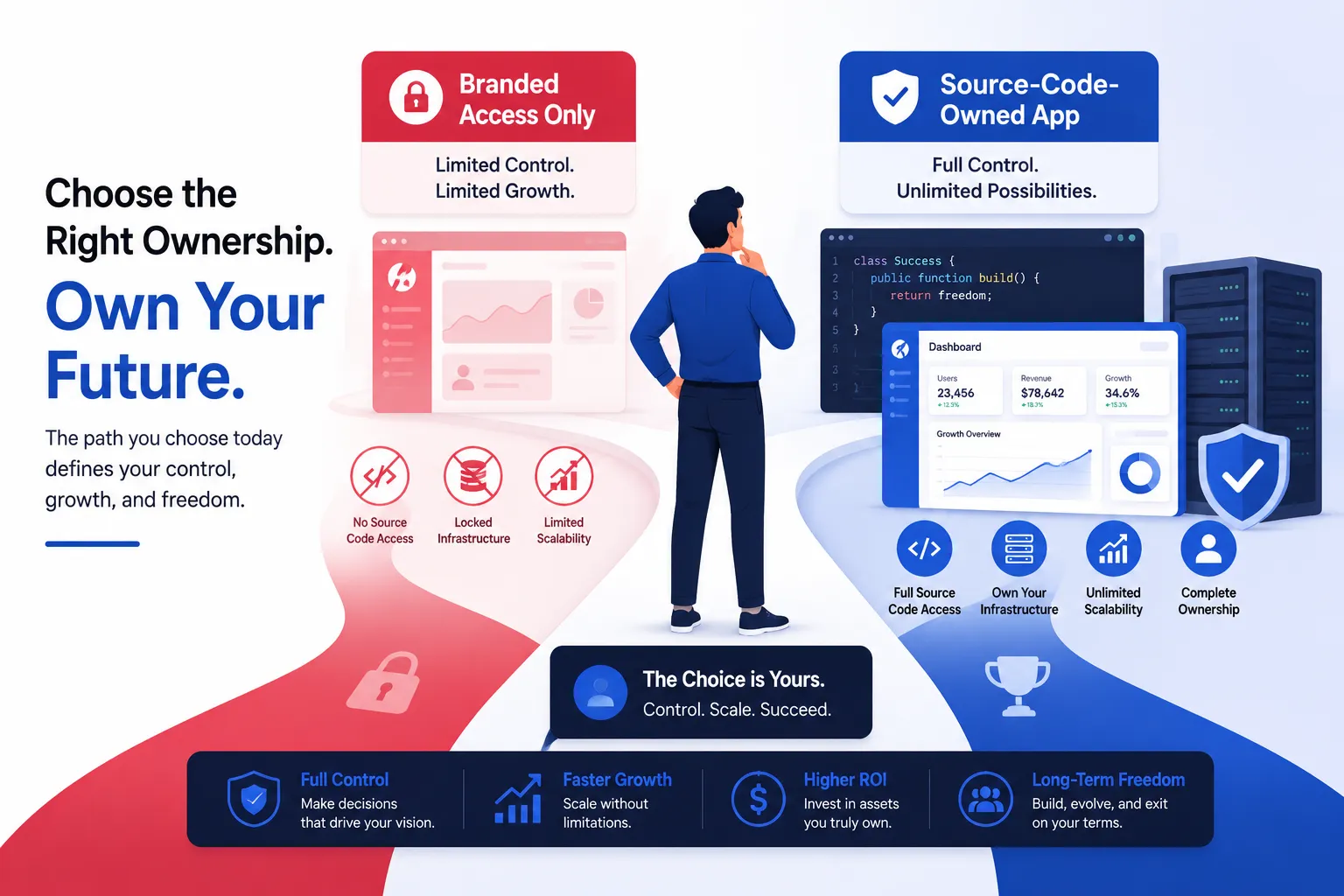
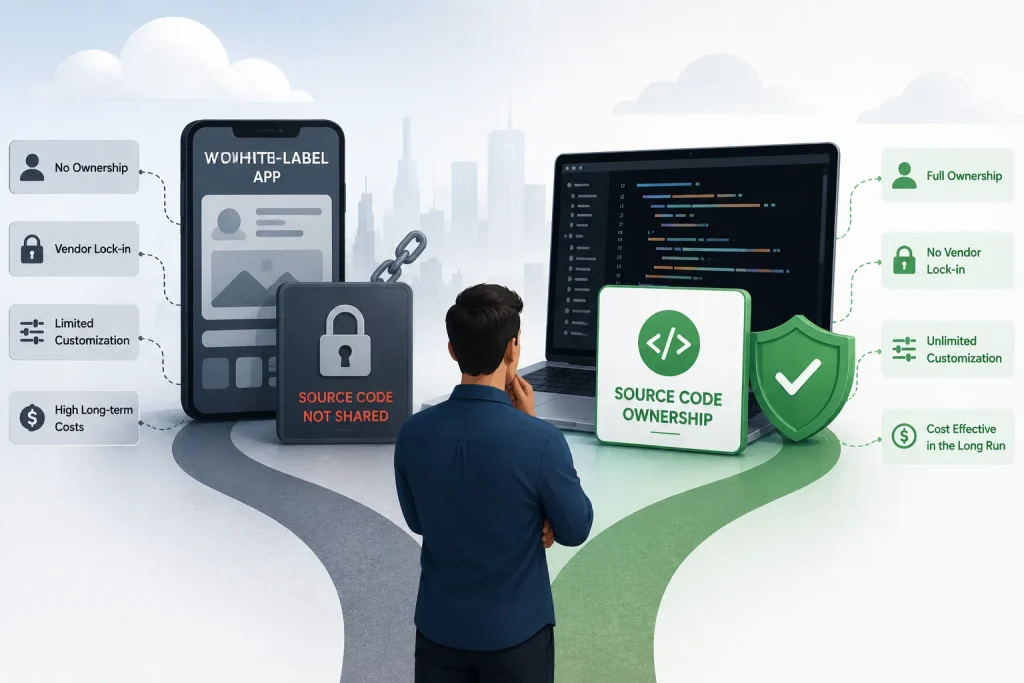
This is where many founders make an expensive mistake. They assume that because the app carries their logo, colors, domain, and brand name, they own the product. In reality, branding and ownership are not the same thing. A white-label app can look like yours on the outside while still being controlled by the vendor underneath.
That difference matters.
If you do not own or control the source code, your ability to customize, scale, migrate, audit, integrate, and maintain the app may depend entirely on the vendor’s rules. For a simple launch test, that may feel acceptable. But for a serious business, long-term dependency can limit growth.
Miracuves helps founders launch ready-made and white-label app solutions with a stronger focus on source-code ownership, admin control, branded experience, and faster market validation. The goal is not just to launch an app quickly. The goal is to launch with a product foundation you can actually control.
A white-label app solution is a pre-built software product that can be rebranded and customized for another business. Instead of developing every feature from zero, the founder starts with an existing app foundation and adapts it for a specific market, brand, and business model.
For example, a business may use a white-label app to launch:
- a food delivery marketplace
- a taxi booking platform
- a grocery delivery app
- a short video platform
- a fintech wallet
- a rental marketplace
- an on-demand service app
- a healthcare booking platform
- a creator monetization app
The advantage is speed. The product foundation already includes many common workflows such as user login, dashboards, payments, notifications, admin controls, order or booking flows, and role-based panels.
But white-label does not automatically mean full ownership.
Some providers offer a hosted subscription model where the business only rents access. Some provide branding but keep the core code private. Some allow limited customization but restrict backend changes. Others provide complete app source code handover, giving the buyer more control over future development.
That is why founders need to evaluate white-label app solutions not only by design, features, and price, but by ownership depth.
The Ownership Gap Most Founders Miss
The biggest misunderstanding in white-label app development is assuming that “my logo on the app” means “my app.”
That is not always true.
There are different levels of ownership:
| Ownership Layer | What It Means | Why It Matters |
|---|---|---|
| Brand ownership | Your logo, colors, app name, and domain are used | Helps you launch under your identity |
| User ownership | You control customer relationships and user records | Helps build long-term business value |
| Data ownership | You can access, export, and manage platform data | Important for analytics, compliance, and migration |
| Admin ownership | You control operations through dashboards | Helps manage users, payments, listings, disputes, and content |
| Source code ownership | You own or receive the app source code | Gives deeper control over customization, hosting, scaling, and future development |
| IP rights | Legal ownership or usage rights are clearly defined | Reduces disputes and protects the business asset |
A founder who owns only the branding layer may still be dependent on the vendor for every meaningful product change. A founder who owns the app source code has more flexibility to improve the product, hire another development team, migrate infrastructure, review security, and adapt the platform as the business grows.
This is why source code ownership should not be treated as a technical footnote. It is a business control issue.
Why App Source Code Matters More Than Most Founders Realize
App source code is the human-readable foundation developers use to build, modify, debug, and extend your software. Without it, you may be able to operate the app, but you may not be able to fully control how it evolves.
For founders, app source code matters in five practical ways.
1. Source Code Ownership Protects Future Customization
Your first launch version is rarely your final product. After launch, users will ask for changes. Vendors may need new workflows. Payment rules may evolve. Admin reporting may need more detail. Your market may demand features that were not obvious at the beginning.
If you do not own or control the code, customization depends on the vendor’s willingness, pricing, queue, and technical limitations.
With source code ownership, your business has more freedom to adjust:
- user flows
- commission rules
- booking logic
- marketplace workflows
- payment integrations
- subscription plans
- admin permissions
- analytics dashboards
- third-party APIs
- mobile app experiences
This does not mean every change becomes easy or instant. Good development still requires planning, testing, and technical review. But source code ownership gives you a stronger foundation for product evolution.
2. Source Code Ownership Reduces Vendor Lock-In
Vendor lock-in happens when switching away from a provider becomes difficult, expensive, or operationally risky.
In white-label apps, lock-in can happen when:
- the vendor controls the source code
- the vendor controls the hosting
- the vendor controls the database
- the vendor controls app updates
- the vendor controls API access
- the app depends on proprietary modules
- export options are limited
- documentation is weak
- the buyer has no repository access
At the beginning, this may not feel serious. The app works, the design looks fine, and the vendor is responsive. But once users, transactions, vendors, content, and operational processes grow inside the platform, moving away becomes harder.
Source-code-owned white-label app solutions reduce that risk because the business is not fully trapped inside a closed vendor system.
3. Source Code Ownership Improves Investor and Acquisition Readiness
Investors, acquirers, and serious business partners often look beyond app screens. They want to understand what the business actually controls.
If your app is only a subscription on someone else’s platform, the technology may not be viewed as a strong owned asset. If your business owns the app source code, documentation, deployment access, user data, and operational workflows, the product foundation becomes easier to evaluate.
This can matter during:
- fundraising
- business acquisition
- technical due diligence
- partnership discussions
- enterprise sales
- franchise or reseller expansion
- regional scaling
A strong product asset is not only what users see. It is also what the business can prove it owns and controls.
4. Source Code Ownership Supports Security Review
Security should never be treated as a marketing add-on. It is part of the product foundation.
When you own or can access the source code, your team can review how sensitive workflows are handled. Depending on the app category, this may include payments, personal data, identity verification, role-based access, logs, content moderation, and provider verification.
For fintech, healthcare, marketplace, and user-generated content platforms, this becomes even more important. A responsible app foundation may need encrypted data transfer, role-based access control, audit logs, secure payment gateway integration, user verification, fraud monitoring, abuse reporting, and permission-based dashboards. Final compliance depends on jurisdiction, legal review, integrations, and operating model.
Without code access, security review becomes more dependent on vendor claims.
5. Source Code Ownership Gives You More Maintenance Control
Apps require maintenance after launch. Operating systems change. App stores update policies. Payment gateways change requirements. Security patches become necessary. User expectations evolve.
If the vendor owns everything, you must wait for the vendor to maintain the system. If your team owns the code, you can plan updates with your own developers or with a technology partner.
This becomes especially important when your app starts generating revenue. At that stage, downtime, delayed fixes, or blocked changes are no longer small inconveniences. They affect business operations.
Read More :- How to Become a White Label Reseller and Launch Your Own App Business with Miracuves
White-Label App Solutions vs SaaS App Builders vs Custom Development
Founders often compare three routes: SaaS app builders, white-label app solutions, and custom development. Each has a place, but they serve different business goals.
White-Label App vs SaaS App Builder vs Custom Development
| Build Option | How It Works | Best For | Ownership Risk | Founder Impact |
|---|---|---|---|---|
| SaaS App Builder | You rent access to a hosted platform and configure your branded app. | Simple business tests, internal tools, basic branded apps. | Higher if source code, hosting, and database remain vendor-controlled. | Fast setup but limited long-term product control. |
| White-Label App Solution Without Source Code | You get a branded app based on a ready-made system, but the vendor keeps core code ownership. | Short-term validation where deep customization is not required. | Medium to high depending on contract, hosting, data export, and update rights. | Useful for speed, but future changes may depend heavily on the vendor. |
| Source-Code-Owned White-Label App | You start with a ready-made foundation and receive source code ownership or source code handover rights. | Founders who want faster launch with long-term control. | Lower if IP rights, repository access, documentation, and deployment access are clear. | Balances speed, customization, and business ownership. |
| Custom App Development | The app is built from scratch around your exact requirements. | Highly unique workflows, complex enterprise systems, deeply differentiated products. | Lower if contracts clearly assign IP and code ownership. | Maximum flexibility, but usually longer development and higher upfront planning effort. |
The strongest option for many founders is not always a fully custom build. It may be a source-code-owned white-label solution that gives them speed today and flexibility tomorrow.
That is the key difference.
A weak white-label product only gives you a branded surface. A stronger white-label product gives you a launch-ready foundation with ownership, control, and customization potential.
What You Should Actually Own in a White-Label App
Before choosing a white-label app provider, founders should ask what is included beyond the visible app screens.
A serious white-label app agreement should clarify the following ownership layers.
App Source Code
This is the most important layer. Ask whether you receive the mobile app source code, backend source code, admin panel source code, and any web app source code included in the product.
Also ask whether the code is:
- fully handed over
- licensed for lifetime use
- restricted by vendor terms
- dependent on proprietary modules
- available in a repository
- documented for future developers
The answer determines how much control you really have.
IP Rights and Usage Rights
Source code access and legal ownership are related but not always identical. Some providers give source code access but restrict resale, redistribution, or modification rights. Others provide full IP transfer for customized work but retain rights to the base product.
This is not something founders should assume. It should be written clearly in the contract.
Database and User Data
Your users, transactions, vendors, listings, orders, bookings, content, chats, reports, and analytics can become some of your most valuable business assets.
Ask:
- Can you export user data?
- Who controls the database?
- Where is the data hosted?
- Can you migrate the data later?
- Are backups available?
- Are access roles clearly defined?
- What happens if the contract ends?
A white-label app without data control is risky for any founder planning to build a serious platform.
Admin Dashboard
The admin panel is where the platform operator controls the business. It should not be treated as a minor backend screen.
Depending on the app category, the admin dashboard may control:
- users
- vendors
- providers
- drivers
- creators
- merchants
- listings
- orders
- bookings
- payments
- commissions
- disputes
- refunds
- reports
- content
- roles and permissions
- app settings
For founders, admin control matters because it decides how quickly the business can respond to operational problems without depending on developers for every small change.
Hosting and Deployment Access
Some providers keep the app hosted on their own infrastructure. Others deploy it to your server or cloud account.
For long-term control, ask whether you can access:
- hosting environment
- cloud account
- deployment pipeline
- domain settings
- app store accounts
- API keys
- environment variables
- server logs
- backup systems
If the vendor controls all deployment access, you may still be dependent even if the app carries your brand.
Documentation
Source code without documentation can still create friction. A strong handover should include setup instructions, architecture notes, deployment steps, API documentation, admin guide, and third-party integration details.
Documentation helps future developers understand the product faster. It also reduces dependency on the original vendor.
Read More :-White-Label Solutions vs Custom Development: How to Choose the Smarter Path
Why Source Code Ownership Is a Trust Signal
When a white-label app provider gives clear source code ownership terms, it signals confidence. It shows the vendor is not trying to trap the buyer inside an opaque system.
For founders, this creates trust in three ways.
First, it gives operational transparency. You can understand what the app is built on and how it can be maintained.
Second, it supports commercial independence. Your business is not fully dependent on one vendor for every future decision.
Third, it makes the product more credible as a long-term asset. You are not just renting a branded interface. You are building on a controllable foundation.
This is why Miracuves positions source-code-owned app solutions as a smarter route for founders who want faster launch without giving up long-term control.
How App Source Code Ownership Affects Customization
Customization is often used loosely in white-label app sales. Some vendors mean “we can change your logo and colors.” Others mean “we can modify workflows, business rules, integrations, and modules.”
These are very different promises.
Surface-level customization includes:
- app name
- logo
- color palette
- splash screen
- domain
- basic content
- app store listing
Deeper customization includes:
- user journey changes
- custom dashboards
- payment flow changes
- commission logic
- subscription models
- booking rules
- wallet workflows
- recommendation logic
- verification steps
- multi-role permissions
- third-party integrations
- reporting modules
- marketplace rules
If you own the app source code, deeper customization becomes more realistic. Your roadmap is not limited to what the vendor’s shared platform allows.
This matters because founders rarely win by launching the same generic product as everyone else. They win by adapting a proven product pattern to a specific market, niche, user behavior, and monetization model.
The Real Cost of Not Owning Your App Source Code
A white-label app without source code ownership may appear cost-efficient at first. But the real cost often appears later.
You may face hidden costs such as:
- paid customization for every small change
- dependency on vendor support timelines
- limited ability to switch development teams
- migration fees
- restricted API access
- recurring licensing costs
- delayed security fixes
- limited feature roadmap
- difficulty integrating new tools
- inability to audit the code
- re-building from scratch when the platform outgrows the vendor
This is why the cheapest route is not always the most cost-efficient route. The better question is: “Which option gives us the right balance of speed, ownership, and future flexibility?”
Founder Decision Signals: When Source Code Ownership Is Non-Negotiable
Founder Decision Signals
Speed
If you need to launch quickly, white-label app solutions can reduce development effort. But speed should not come at the cost of long-term control.
Cost
If your budget is limited, avoid paying repeatedly for preventable dependency. Source code ownership can reduce future switching and customization risk.
Scalability
If you expect more users, regions, vendors, or integrations, owning the code gives your team more freedom to optimize architecture and workflows.
Market Fit
If your product will evolve after user feedback, app source code ownership gives you a stronger base for iteration and market-specific changes.
Source code ownership is especially important when your app involves payments, user data, marketplace operations, financial workflows, content moderation, healthcare records, booking history, creator payouts, or logistics coordination.
In those cases, the app is not just a digital brochure. It is the operating system of your business.
Questions to Ask Before Buying a White-Label App
Before choosing a vendor, ask direct questions. Do not rely on vague words like “fully customizable” or “complete ownership” unless they are clearly defined.
Use this checklist during vendor evaluation:
| Question | Why It Matters |
|---|---|
| Will I receive the complete app source code? | Confirms whether you can control future development |
| Does source code include mobile apps, backend, web panel, and admin dashboard? | Prevents partial handover confusion |
| Do I receive repository access? | Helps your technical team manage future updates |
| Are IP rights clearly transferred or licensed? | Prevents legal ambiguity |
| Can I host the app on my own server or cloud account? | Reduces infrastructure dependency |
| Can I export user and transaction data? | Protects migration and analytics control |
| Are third-party APIs under my account or the vendor’s account? | Prevents operational dependency |
| Is documentation included? | Helps future developers maintain the product |
| What support is included after launch? | Clarifies maintenance expectations |
| What customization is included and what costs extra? | Prevents scope surprises |
A trustworthy vendor should answer these clearly. If the answer is vague, that is a risk signal.
Mistakes Founders Should Avoid When Choosing White-Label App Solutions
Mistakes Founders Should Avoid
Assuming Branding Means Ownership
A branded app can still be vendor-controlled. Always check app source code, IP rights, hosting access, database access, and documentation before signing.
Choosing Only by Lowest Price
A lower upfront price can become expensive if every customization, integration, migration, or update requires vendor approval and extra fees.
Ignoring Backend and Admin Control
The visible app is only one part of the product. The admin dashboard, backend workflows, reporting, permissions, and payment logic decide how the business operates.
Skipping Legal Ownership Terms
Ask whether source code ownership, IP rights, usage rights, resale limits, and modification rights are clearly written in the agreement.
Why Source-Code-Owned White-Label Apps Are Stronger for Agencies
White-label app solutions are not only useful for founders. Agencies can also use them to serve clients faster.
But for agencies, ownership clarity is even more important. If an agency resells or deploys white-label apps for clients, unclear source code rights can create delivery risk, support issues, and client trust problems.
A source-code-owned app foundation helps agencies:
- customize apps for different client industries
- create branded deployments
- manage technical handover clearly
- reduce dependency on one vendor
- offer post-launch support
- build reusable delivery workflows
- protect client relationships
- avoid awkward ownership disputes
For agencies, the app is not just a product. It is part of service credibility.
White-Label Apps Are Not About Copying. They Are About Faster Product Foundations
A strong white-label strategy does not mean copying another business blindly. It means using a proven product foundation to reduce avoidable development risk.
For example, a delivery app needs customer, merchant, delivery partner, and admin workflows. A taxi app needs rider, driver, booking, fare, tracking, and admin workflows. A marketplace app needs listings, vendors, payments, reviews, disputes, and reporting.
Building these common modules from zero can be slow and expensive. White-label app solutions allow founders to start from a launch-ready base and then customize based on their market.
The key is not whether the app began from a ready-made foundation. The key is whether the founder can control what happens next.
That is where app source code ownership becomes important.
Read More :-How Miracuves Delivers Enterprise-Grade Apps in Just 6 Days Without Cutting Corners
How Miracuves Helps Founders Launch With More Control
Miracuves helps founders, startups, agencies, and businesses launch digital products faster using ready-made, white-label, source-code-owned clone app solutions and custom app development services.
For founders, the Miracuves approach is useful because it focuses on practical launch needs:
- white-label branding
- source-code ownership
- admin dashboard control
- business model clarity
- monetization-ready workflows
- scalable backend foundation
- faster market validation
- customization support
- post-launch support where applicable
For ready-made Miracuves solutions, a 6-day launch can be relevant depending on the selected app category, feature scope, branding, integrations, and customization requirements. Final pricing and delivery scope should always be confirmed based on the selected modules and launch requirements.
Final Thoughts: Own the Foundation, Not Just the Brand
White-label app solutions can be a smart way to launch faster, validate demand, and reduce development effort. But the real value depends on what you own after launch.
If you only own the logo and user-facing brand, your business may still depend on the vendor for every major product decision. If you own the app source code, admin layer, data, deployment access, and documentation, the product becomes a stronger long-term asset.
The truth is simple: white-label apps are not risky by default. Poor ownership terms are risky.
For founders, the better decision is not just to ask, “How fast can we launch?” It is to ask, “Will we still control this product when it starts growing?”
Miracuves helps founders launch faster with white-label app solutions designed around practical control, source-code ownership, branded user experiences, and scalable product foundations. Talk to Miracuves experts to explore faster deployment strategies built for long-term growth and customization.
FAQs :-
What are white-label app solutions?
White-label app solutions are pre-built software products that can be rebranded and customized for another business. They help founders launch faster because core features, workflows, panels, and backend logic are already developed.
Do I always own the app source code in a white-label app?
No. Some white-label vendors provide only branding and hosted access, while others provide app source code ownership or source code handover. Founders should confirm whether mobile app code, backend code, admin panel code, database access, and IP rights are included.
Why does app source code ownership matter?
App source code ownership matters because it gives your business more control over customization, maintenance, security review, integrations, hosting, migration, and future development. Without source code access, you may remain dependent on the original vendor.
Is a white-label app better than custom app development?
A white-label app can be better when speed, cost-efficiency, and faster market validation matter. Custom app development may be better when the product requires highly unique workflows or complex architecture. A source-code-owned white-label app can offer a practical middle path.
What is vendor lock-in in white-label app development?
Vendor lock-in happens when a business becomes dependent on one provider for code, hosting, data, updates, integrations, or support. This can make switching vendors difficult, expensive, or risky.
What should I check before buying a white-label app?
Check source code ownership, IP rights, repository access, database control, hosting access, admin dashboard features, documentation, third-party integrations, customization limits, and post-launch support terms.
Can I customize a white-label app after launch?
Yes, but the level of customization depends on your ownership rights and the app architecture. If you own the app source code, deeper customization is usually more practical than with a closed SaaS-style white-label platform.
Does Miracuves provide white-label app solutions with source code?
Miracuves offers ready-made and white-label app solutions focused on branded launch, admin control, customization, and source-code ownership where applicable. Final scope, pricing, and delivery details depend on the selected app category and customization requirements.
Related Articles :-
Miracuves is an independent software development company. We are not affiliated with, connected to, sponsored by, or endorsed by any company or product named in this article.
Terms such as “X Clone” are used descriptively. It is how the software industry refers to building a platform with functionality comparable to a known service, and how clients search for it.
The entire design and codebase of our products is built by our own team. Our products contain no code, design, graphics, or content originating from any third-party website or applications.
All third-party names and marks referenced in this article are the property of their respective owners, referenced solely to identify the services discussed.