


You’ve heard the horror stories.
Fashion apps leaking customer data. Payment information getting compromised. Entire platforms going offline due to security loopholes.
If you’re planning to launch a white-label Myntra like app in 2026, one question naturally comes first:
“Is it actually safe?”
This concern is valid. Fashion commerce apps handle sensitive user data every day — personal profiles, addresses, payment details, order history, and behavioral data. A single security failure can destroy trust, invite legal trouble, and damage your brand permanently.
In 2026, app security is no longer optional or “nice to have.” It is a business survival requirement.
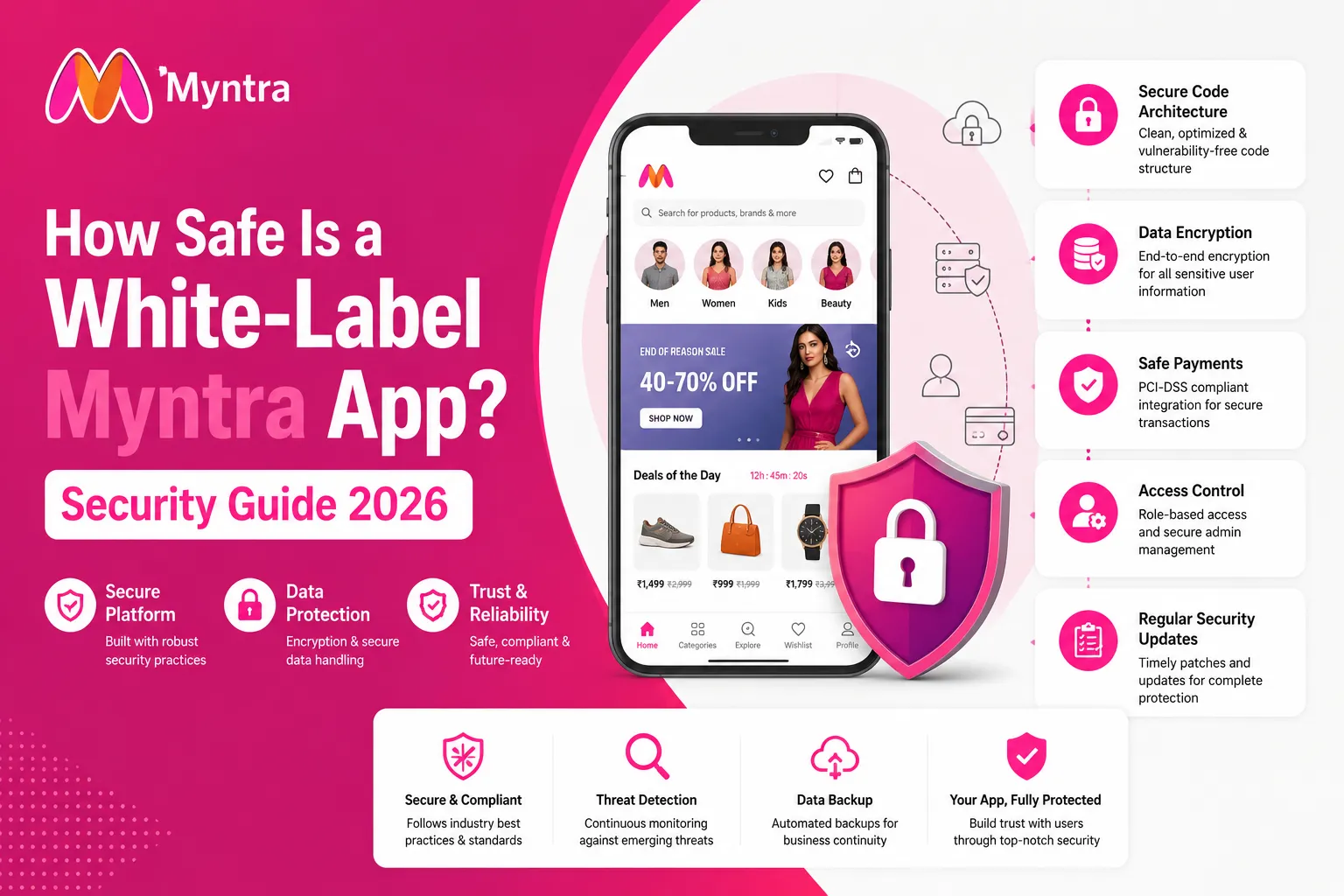
This guide gives you an honest, no-hype assessment of white-label Myntra app safety. We’ll break down real risks, real standards, and practical steps — while also helping founders understand how the Myntra app works from a business and technology perspective. It also shows how a security-first approach, like the one followed by Miracuves, can make white-label apps just as safe as enterprise platforms when done correctly.
Understanding White-Label Myntra App Security Landscape
What “White-Label Myntra App Security” Really Means
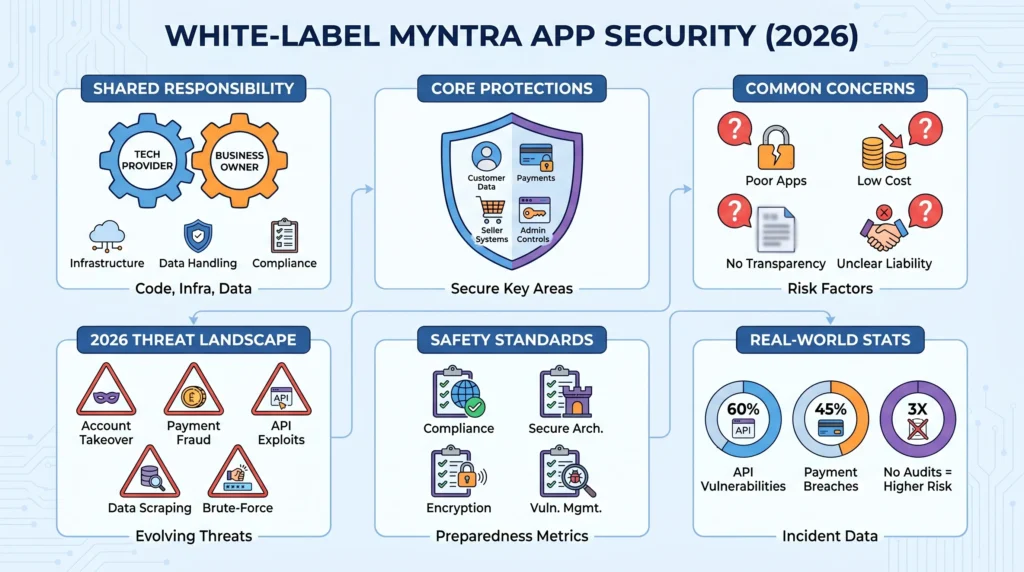
White-label Myntra app security refers to the protection measures built into a ready-made fashion marketplace app that is customized and launched under your brand. In 2026, security is not just about the app code. It includes infrastructure, data handling practices, compliance readiness, and ongoing risk management.
A secure white-label Myntra app must protect:
- Customer personal data
- Payment and transaction information
- Seller dashboards and inventory systems
- Admin controls and analytics access
Security responsibility is shared between the technology provider and the business owner, making provider selection critical.
Why Businesses Worry About White-Label Myntra Apps
Concerns around white-label Myntra apps usually come from:
- Past incidents involving poorly built apps
- Low-cost providers cutting security corners
- Lack of transparency about data handling
- Unclear responsibility during breaches
In 2026, these fears are justified because regulatory penalties and consumer awareness are higher than ever.
Current Threat Landscape for Fashion Commerce Apps in 2026
Fashion marketplace apps face specific threats, including:
- Account takeover attacks using credential stuffing
- Payment fraud and fake refund abuse
- API exploitation through mobile apps
- Data scraping of product and user data
- Admin panel brute-force attempts
According to 2026 industry security reports, commerce apps experience over 35 percent more credential-based attacks compared to content platforms.
Security Standards That Define Safety in 2026
A white-label Myntra app in 2026 is considered safe only when it aligns with:
- International data protection regulations
- Secure mobile and web app architecture
- Encrypted communication standards
- Proactive vulnerability management
Security today is measured by preparedness, not promises.
Real-World App Security Incident Statistics
Recent 2026 data shows:
- Over 60 percent of app breaches originate from API vulnerabilities
- Nearly 45 percent of commerce app breaches involve payment-related exposure
- Apps without regular security audits are three times more likely to be compromised
These numbers explain why serious businesses now demand documented security processes from white-label providers.
Read more : – Myntra Marketing Strategy: Lessons for Fashion Startups
Key Security Risks & How to Identify Them
High-Risk Area 1: Data Protection and Privacy
Fashion commerce apps collect more sensitive data than most businesses realize. In a white-label Myntra app, this includes customer profiles, order history, saved addresses, and behavioral data. In 2026, improper handling of this information is one of the biggest security risks.
User Personal Information
Weak access controls or improper database encryption can expose names, phone numbers, and addresses. This is a direct violation of data protection laws and often leads to customer trust loss.
Payment Data Security
If payment workflows are not isolated and PCI DSS compliant, attackers can intercept transaction data. Many insecure apps store tokens incorrectly or rely on unsafe third-party gateways.
Location and Behavioral Tracking
Fashion apps increasingly use location and behavior data for personalization. In 2026, this data must be anonymized and protected to avoid regulatory penalties.
GDPR and Global Privacy Compliance
Failure to implement consent management, data deletion, and user access controls makes the app legally vulnerable in multiple regions.
High-Risk Area 2: Technical Vulnerabilities
Code Quality Issues
Poorly written or reused code increases exposure to SQL injection, cross-site scripting, and logic flaws.
Server and Infrastructure Gaps
Unpatched servers, open ports, and weak firewall rules remain a leading cause of breaches in commerce apps.
API Vulnerabilities
APIs power mobile apps, seller panels, and admin dashboards. In 2026, insecure APIs are the most exploited attack surface.
Third-Party Integrations
Analytics tools, logistics services, and payment providers can introduce risks if not properly vetted and isolated.
High-Risk Area 3: Business and Operational Risks
Legal Liability
A data breach can trigger lawsuits, penalties, and contract violations with sellers and payment providers.
Reputation Damage
Trust is everything in fashion commerce. One security incident can permanently reduce repeat customers.
Financial Losses
Fraud, chargebacks, downtime, and recovery costs can exceed initial development budgets.
Regulatory Penalties
Non-compliance in 2026 can result in fines reaching millions depending on jurisdiction.
White-Label Myntra App Security Risk Assessment Checklist
- Is all user data encrypted at rest and in transit?
- Are payment workflows PCI DSS compliant?
- Are APIs authenticated and rate-limited?
- Is access to admin and seller panels restricted and logged?
- Are regular security audits conducted?
- Is there a documented incident response plan?
- Are backups encrypted and tested?
If any of these answers are unclear, the app carries elevated risk.
Security Standards Your White-Label Myntra App Must Meet
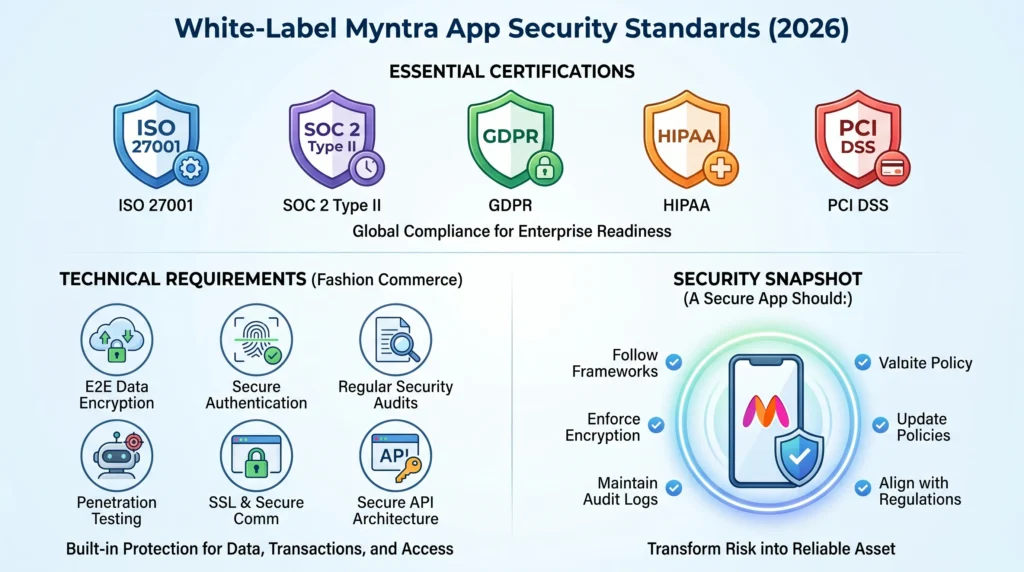
Essential Security Certifications in 2026
In 2026, a white-label Myntra app is only considered enterprise-ready when it aligns with recognized global security certifications. These certifications prove that security is built into processes, not added as an afterthought.
ISO 27001 Compliance
This standard ensures that information security is managed systematically. It covers data handling, access control, risk management, and incident response across the entire app lifecycle.
SOC 2 Type II
SOC 2 Type II validates how user data is protected over time. For fashion commerce apps handling continuous transactions, this certification is critical for long-term trust.
GDPR Compliance
GDPR applies to any app serving users in Europe. In 2026, it also influences global privacy expectations, requiring consent management, data portability, and user deletion rights.
HIPAA (When Applicable)
While not mandatory for fashion apps, HIPAA becomes relevant if health-related data such as wellness wearables or medical fashion integrations are involved.
PCI DSS for Payments
Any white-label Myntra app processing payments must follow PCI DSS standards. Secure tokenization, gateway isolation, and audit trails are non-negotiable.
Technical Security Requirements for Fashion Commerce Apps
End-to-End Data Encryption
All sensitive data must be encrypted during storage and transmission. This includes user profiles, order details, and seller information.
Secure Authentication Mechanisms
Multi-factor authentication, OAuth-based logins, and strong password policies are standard expectations in 2026.
Regular Security Audits
Automated scans and manual testing help identify vulnerabilities before attackers do.
Penetration Testing
Ethical hacking simulations expose real-world weaknesses in apps, APIs, and infrastructure.
SSL and Secure Communication
SSL certificates and secure headers prevent man-in-the-middle attacks and data interception.
Secure API Architecture
APIs must use authentication tokens, access scopes, and rate limits to prevent abuse.
Security Standards Comparison Overview
A secure white-label Myntra app in 2026 should:
- Follow international compliance frameworks
- Enforce encryption across all data flows
- Maintain audit logs and access controls
- Update security policies regularly
- Align with evolving regulatory requirements
Meeting these standards transforms a white-label app from a risk into a reliable business asset.
Red Flags: How to Spot Unsafe White-Label Providers
Warning Signs You Should Never Ignore
In 2026, most security failures do not happen because businesses ignore security entirely. They happen because early warning signs are overlooked while choosing a white-label Myntra app provider.
No Security Documentation
If a provider cannot clearly explain how data is stored, encrypted, and protected, security is likely not a priority.
Unrealistically Cheap Pricing
Extremely low pricing often means shortcuts in infrastructure, audits, or long-term maintenance, which directly increases risk.
No Compliance Certifications
Providers without ISO, SOC, or payment compliance proof expose your business to legal and operational threats.
Outdated Technology Stack
Old frameworks and unsupported libraries are common entry points for attackers in fashion commerce apps.
Poor Code Quality
Hard-coded credentials, lack of modular architecture, and copied code indicate weak development practices.
No Defined Security Update Policy
Apps without scheduled updates remain vulnerable to newly discovered threats.
No Backup or Recovery System
Insecure providers rarely invest in encrypted backups or disaster recovery planning.
No Cyber Insurance Coverage
In 2026, serious technology providers carry insurance to mitigate breach-related liabilities.
Evaluation Checklist for White-Label Myntra App Providers
Questions You Must Ask
- How is customer and seller data encrypted?
- What compliance standards does the app meet?
- How often are security audits conducted?
- Who is responsible during a security incident?
- What is the update and patching frequency?
Documents to Request
- Security architecture overview
- Compliance certificates
- Data processing agreements
- Incident response policies
- Backup and recovery documentation
Testing and Validation
- Request vulnerability scan reports
- Review API security measures
- Test admin and seller access controls
- Verify payment security workflows
Due Diligence Steps
A safe white-label Myntra app decision in 2026 requires verification, not assumptions. Providers who welcome scrutiny are usually the safest choice.
Read more : – Myntra App Features Explained
Best Practices for Secure White-Label Myntra App Implementation
Pre-Launch Security Practices
Launching a white-label Myntra app in 2026 without structured security preparation significantly increases risk. Security must be treated as a launch prerequisite, not a post-launch fix.
Security Audit Before Launch
A complete security audit should be conducted across app code, APIs, servers, and databases to identify vulnerabilities early.
Code Review and Quality Checks
Independent code reviews help detect logic flaws, insecure dependencies, and unsafe development patterns.
Infrastructure Hardening
Servers must be configured with firewalls, intrusion detection systems, and restricted access controls.
Compliance Verification
All legal and regulatory requirements must be validated before onboarding users and sellers.
Team and Staff Security Training
Human error remains a major threat in 2026. Admins and support teams must understand security protocols and data handling rules.
Post-Launch Security Monitoring
Continuous Threat Monitoring
Real-time monitoring tools help detect suspicious activity, failed login attempts, and abnormal traffic patterns.
Regular Updates and Patch Management
Security vulnerabilities evolve constantly. Apps must be updated proactively, not reactively.
Incident Response Planning
A documented response plan ensures faster recovery and regulatory compliance during security incidents.
User Data Management
Clear data retention, access, and deletion policies protect both users and the business.
Backup and Disaster Recovery
Encrypted backups and tested recovery processes ensure business continuity during failures or attacks.
Security Implementation Timeline for 2026
- Pre-development security architecture planning
- Pre-launch audits and compliance checks
- Launch with monitoring and access controls
- Ongoing monthly vulnerability assessments
- Quarterly penetration testing
- Annual compliance reviews
A disciplined security lifecycle ensures that a white-label Myntra app remains resilient as it scales.
Global Cost of Development for a Myntra-Like App
Myntra-Like Fashion E-commerce App Development — Market Price by Tech Stack
The tech stack affects product browsing speed, user data protection, payment security, order flow, and marketplace scalability in a Myntra-like fashion app. PHP/Laravel works well for cost-effective fashion app launches, Node.js/React.js supports faster catalog browsing, cart updates, and real-time notifications, while Go microservices suit large e-commerce platforms with high traffic, secure transactions, and multi-vendor operations.
PHP/Laravel is often the most practical choice for launching a Myntra-like app quickly and affordably. Node.js/Python fits better when real-time shopping activity and data-heavy personalization become more important, while Go microservices are better suited for enterprise-scale fashion ecommerce platforms with higher concurrency and more complex infrastructure needs.
These values reflect global development cost estimates. Final pricing varies based on product catalogs, user profiles, seller panels, payment gateways, order tracking, recommendation systems, security layers, admin controls, compliance needs, and platform complexity.
Miracuves Myntra-Like App Solution Cost and Tech Stack
Miracuves Pricing for a Myntra-Like Fashion E-Commerce App developed in PHP/Laravel with Flutter Apps for $2,499 USD (One-Time Price) in just 6 days
Get a fully developed, deployment-ready fashion commerce platform modeled after Myntra. Built on a stable PHP foundation, this complete package includes everything you need to launch and scale an online fashion marketplace:
- Core Workflows: Customer registration, product browsing, category management, size and color variants, cart checkout, order placement, wishlist, order tracking, returns, refunds, and customer notifications.
- Built-in Revenue Logic: Product commissions, seller fees, featured product placements, promotional campaigns, discount coupons, delivery charges, subscription-based seller plans, and marketplace service fees.
- Management Hub: Centralized admin dashboard, customer management, seller management, product approval, inventory control, order monitoring, payment records, refund handling, return requests, and fashion marketplace analytics.
- Launch-Ready: Fully prepared for your custom branding, configuration, payment gateway setup, product category setup, seller onboarding, and immediate market entry.
Why Is Myntra-Like App Development More Affordable?
Most fashion e-commerce apps become expensive when businesses choose fully custom development from scratch. A Myntra-style platform usually needs customer apps, seller panels, product catalogs, inventory systems, order management, payments, returns, refunds, coupons, reviews, and admin controls. Building all of this separately can increase both development cost and launch time.
We took a smarter, more practical approach:
You Aren’t Paying for Ground-Up Development: Our fashion e-commerce marketplace engine is already developed, tested, and ready to deploy. You skip the inflated cost and long waiting period usually required for building a Myntra-style platform from scratch.
The Power of PHP: We built this solution on a reliable and cost-effective PHP architecture. This keeps the upfront price affordable while supporting essential fashion marketplace workflows such as product listings, seller management, checkout, payments, order tracking, returns, refunds, and admin operations.
You get a launch-ready Myntra-like fashion e-commerce platform with practical marketplace features, source code access, and faster deployment without the high custom development price tag.
Note: This cost is for the solution, re-branding, deployment, and source code only.
Legal & Compliance Considerations
Regulatory Requirements in 2026
Legal compliance is one of the most underestimated aspects of white-label Myntra app safety. In 2026, fashion commerce apps operate across regions, making regulatory readiness essential.
Data Protection Laws by Region
Apps serving users in different countries must follow region-specific data protection laws such as GDPR in Europe, CCPA and CPRA in the United States, and emerging privacy frameworks in Asia and the Middle East.
Industry-Specific Regulations
While fashion apps are not heavily regulated like finance, integrations involving payments, logistics, or cross-border trade introduce additional compliance obligations.
User Consent Management
Clear consent mechanisms for data collection, tracking, and communication are mandatory in 2026. Users must be able to withdraw consent easily.
Privacy Policy Requirements
Privacy policies must clearly explain data usage, storage duration, third-party sharing, and user rights.
Terms of Service Essentials
Terms must define platform responsibilities, seller obligations, dispute resolution processes, and limitation of liability.
Liability Protection Strategies
Cyber Insurance Coverage
Cyber insurance helps cover breach response costs, legal fees, and regulatory fines.
Legal Disclaimers and User Agreements
Well-drafted agreements reduce legal exposure and clarify roles during incidents.
Incident Reporting Protocols
In 2026, many regulations require breach notification within strict timelines.
Ongoing Compliance Monitoring
Compliance is not a one-time task. Continuous reviews are required as laws evolve.
Compliance Checklist by Region
- User consent and data rights support
- Secure payment and refund workflows
- Data localization where required
- Breach notification readiness
- Documented compliance policies
Strong legal foundations protect both the app and the business behind it.
Read more : – How to Hire the Best Myntra Clone Developer
Why Miracuves White-Label Myntra App Is Your Safest Choice
Miracuves Security-First Approach in 2026
In 2026, safety is not defined by features alone. It is defined by how deeply security is embedded into the app’s architecture, processes, and long-term maintenance. This is where Miracuves positions itself differently from generic white-label providers.
Miracuves designs its white-label Myntra app with a security-first mindset from day one, ensuring that protection scales along with business growth.
Enterprise-Grade Security Architecture
Miracuves uses a layered security model that protects data at every level:
- Secure app architecture with isolated services
- Hardened server environments
- Encrypted databases and file storage
- Restricted admin and seller access controls
This reduces single-point failures, which are a major cause of breaches in fashion commerce apps.
Compliance-Ready by Default
Miracuves white-label Myntra apps are built to align with:
- GDPR and global data protection laws
- Secure payment handling standards
- Industry-recognized security frameworks
Instead of retrofitting compliance later, Miracuves integrates it during development, reducing legal and operational risk in 2026.
Continuous Monitoring and Updates
Security threats evolve constantly. Miracuves maintains:
- Ongoing vulnerability monitoring
- Regular security updates and patches
- Proactive incident detection systems
This ensures that the app does not become outdated or exposed over time.
Secure Payment and Data Handling
All sensitive data flows are protected through:
- Encrypted data transmission
- Secure authentication mechanisms
- Isolated payment processing environments
This approach significantly reduces the risk of financial fraud and data leaks.
Trust Built Through Experience
With hundreds of successfully deployed platforms, Miracuves has refined its security processes through real-world usage. In 2026, this operational maturity becomes a major advantage over untested providers.
Final Thought
Don’t compromise on security. Miracuves white-label Myntra app solutions come with enterprise-grade protection built in from the start. With a proven delivery record and security-focused architecture, Miracuves helps businesses launch fashion platforms that are safe, compliant, and trusted in 2026.
When security is built correctly from the start, a white-label app can be just as safe as enterprise platforms. Choosing a security-first provider like Miracuves turns risk into confidence and allows you to focus on growth instead of damage control. Let’s build together.
FAQs
1. How secure is a white-label Myntra app compared to custom development in 2026?
A properly built white-label Myntra app can be equally secure or more secure than custom development because it benefits from repeated testing, audits, and proven security architecture.
2. What happens if there is a security breach?
In 2026, a secure provider follows a documented incident response plan that includes containment, user notification, regulatory reporting, and recovery support.
3. Who is responsible for security updates?
Security responsibility is shared, but the provider must handle core app updates, patches, and infrastructure security on an ongoing basis.
4. How is user data protected in a white-label Myntra app?
User data is protected through encryption, access controls, secure APIs, and compliance-driven data handling practices.
5. What compliance certifications should I look for?
At minimum in 2026, look for ISO 27001 alignment, GDPR readiness, and PCI DSS compliance for payment handling.
6. Can white-label Myntra apps meet enterprise security standards?
Yes. When built with proper architecture, audits, and monitoring, white-label apps can meet enterprise-grade security expectations.
7. How often should security audits be conducted?
In 2026, vulnerability scans should run continuously, with formal audits and penetration testing conducted at least quarterly.
8. What is included in Miracuves’ security package?
Miracuves includes secure architecture, compliance readiness, encrypted data handling, regular updates, and ongoing monitoring.
9. How do you handle security across different countries?
Compliance frameworks are adapted by region, ensuring data protection laws, consent requirements, and hosting regulations are respected.
10. What insurance is needed for app security?
Cyber liability insurance is recommended in 2026 to cover breach response costs, legal fees, and regulatory penalties.
Related Articles: