Launching a fashion ecommerce marketplace is only the beginning. The real challenge is creating a platform where fashion brands consistently attract buyers, customers discover products they actually want, and first-time purchases develop into long-term shopping relationships.
Successful fashion marketplaces demonstrate that growth is not driven by advertising alone. A strong fashion marketplace marketing strategy combines relevant brand partnerships, curated product discovery, personalized shopping experiences, creator-led content, seasonal campaigns, and customer retention.
For emerging fashion startups, these principles are especially important. Unlike a single-brand online store, a multi-brand marketplace must attract both sellers and shoppers while maintaining product quality, reliable fulfillment, and a consistent customer experience.
A marketplace with too few brands struggles to attract customers. A marketplace with insufficient customer demand struggles to retain brands. Even when both sides are growing, excessive acquisition spending, poor personalization, and frequent returns can undermine profitability.
This guide explores how fashion ecommerce businesses can address these challenges through three connected growth pillars: brand acquisition, personalized merchandising, and repeat purchases. It also explains how customer acquisition, operational reliability, and data-driven decision-making support sustainable growth.
Key Takeaways
- A successful fashion ecommerce marketplace must attract both relevant fashion brands and shoppers.
- Strategic brand acquisition improves assortment quality, product availability, and customer acquisition opportunities.
- Personalized product discovery helps shoppers find relevant products and reduces unnecessary browsing friction.
- Creator partnerships, editorial content, and seasonal campaigns can build awareness and generate demand.
- Repeat purchases depend on product satisfaction, reliable fulfillment, customer trust, and relevant lifecycle marketing.
- Marketplace operators should measure contribution margins, return rates, acquisition costs, and customer lifetime value rather than relying on sales volume alone.
Why Fashion Ecommerce Marketplace Growth Requires a Different Strategy
A traditional ecommerce retailer generally controls its product selection, inventory, branding, and customer relationships. A multi-brand fashion marketplace operates differently because independent brands participate in supplying products, managing inventory, and fulfilling customer expectations.
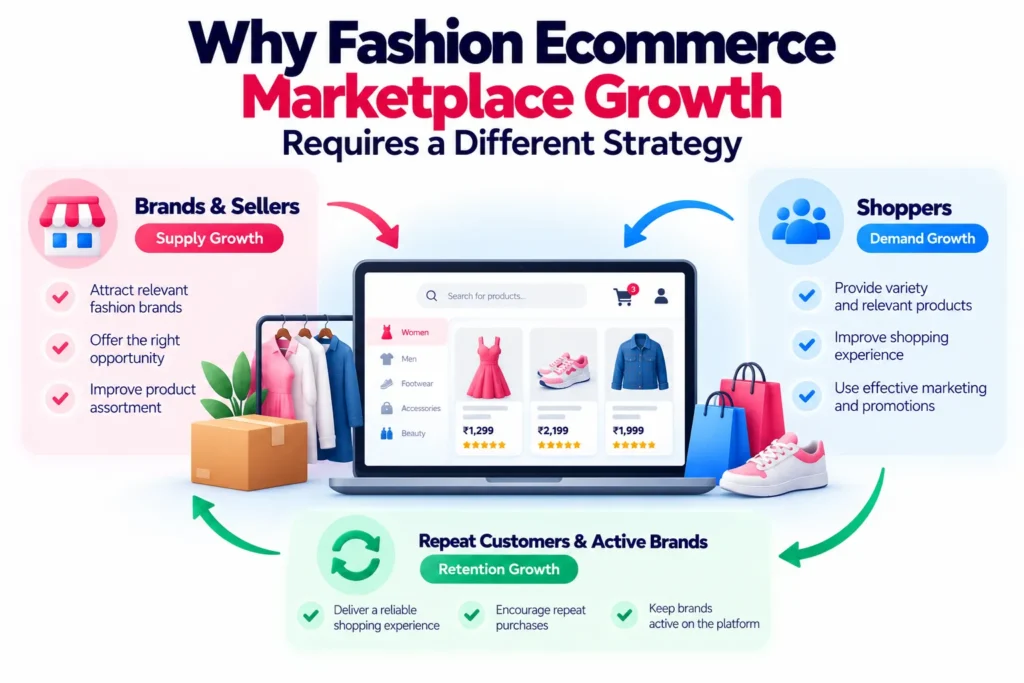
This creates a two-sided growth challenge. The platform must give brands a compelling reason to participate while offering shoppers enough variety, convenience, and trust to make purchases.
Adding more products does not automatically solve this problem. An oversized catalog filled with similar products, inconsistent descriptions, unavailable sizes, and unreliable sellers can make shopping more difficult.
Fashion also has category-specific challenges. Customer preferences change with seasons and trends, sizing is difficult to standardize, and purchase decisions are influenced by visual presentation, affordability, personal style, and delivery expectations.
As a result, marketplace growth requires coordination across three areas:
- Supply growth: Attracting fashion brands that improve the marketplace’s assortment and positioning.
- Demand growth: Reaching shoppers through effective marketing, product discovery, and relevant promotions.
- Retention growth: Delivering an experience that motivates customers to return and encourages brands to remain active.
These activities reinforce one another. Better brands create more compelling shopping experiences. Satisfied customers generate demand for participating brands. Stronger seller performance makes the marketplace more attractive to additional fashion partners.
The objective is to develop this reinforcing relationship rather than pursuing customer acquisition and seller onboarding as unrelated activities.
Build a Brand Acquisition Strategy Around Marketplace Positioning
Brand acquisition is one of the most important foundations of a multi-brand fashion marketplace. Without suitable brands and a relevant assortment, even an effective marketing campaign may struggle to convert visitors into paying customers.
However, marketplace operators should not treat the number of onboarded sellers as their primary measure of success. The quality of the brands, their product availability, pricing, fulfillment capabilities, and alignment with customer demand matter considerably more.
Identify the Right Fashion Brands for Your Target Audience
Before approaching fashion brands, marketplace founders should define the type of customer they want to attract.
A platform targeting budget-conscious students will require a different assortment from one focused on premium occasion wear. Similarly, a marketplace specializing in sustainable fashion should prioritize brands whose products, sourcing practices, and positioning match its value proposition.
Founders can develop an acquisition profile by evaluating the following factors:
- Primary customer demographics and shopping preferences.
- Product categories and average selling prices.
- Brand identity and differentiation.
- Inventory consistency and available size ranges.
- Product photography and catalog quality.
- Fulfillment capabilities and return-handling processes.
- Potential to participate in campaigns and promotional activities.
Consider a marketplace focused on contemporary workwear for young professionals. It may generate more relevant demand by onboarding a smaller selection of brands offering office clothing, footwear, bags, and accessories than by adding hundreds of unrelated fashion sellers.
The goal is to build a recognizable assortment that gives the marketplace a clear position in the customer’s mind.
Give Brands a Clear Commercial Reason to Join
Fashion brands evaluate marketplaces based on the business opportunities and operational commitments involved. A platform promising visibility without explaining how it intends to generate relevant demand may struggle to attract established sellers.
A compelling brand acquisition proposition should address the specific benefits of participation.
- Audience access: The opportunity to reach shoppers who may not already know the brand.
- Product discovery: Visibility through relevant categories, search results, curated collections, and campaigns.
- Brand identity: A presentation that communicates the brand’s positioning and product range.
- Operational clarity: Transparent rules for orders, fulfillment, returns, and payments.
- Performance insights: Access to information that helps sellers understand product demand and customer behavior.
- Growth opportunities: Participation in seasonal promotions, category campaigns, and relevant marketing collaborations.
These benefits should be communicated realistically. A new marketplace cannot promise immediate sales, but it can establish clear expectations about how participating brands will be presented, supported, and evaluated.
Create a Repeatable Brand Onboarding Process
Brand acquisition does not end when a seller agrees to join. The onboarding experience determines how quickly the brand can become an active participant in the marketplace.
Founders should establish a consistent process for seller verification, catalog preparation, product categorization, pricing information, inventory updates, shipping responsibilities, and return policies.
Fashion-specific catalog information deserves particular attention. Size charts, fabric descriptions, product dimensions, multiple images, and care instructions can help shoppers make more informed purchasing decisions.
An incomplete product catalog can reduce conversion even when the brand itself is attractive. For example, a shopper interested in a jacket may abandon the product page if the fit, material, or available sizes are unclear.
A structured onboarding process helps brands become commercially active while supporting a consistent experience across the marketplace.
Measure Brand Acquisition Beyond Seller Count
Marketplace operators should distinguish between brands that have registered and brands that contribute to customer demand.
Useful indicators include the percentage of onboarded brands with active listings, average time to the first order, product availability, order cancellation rates, return rates, and ongoing seller participation.
These measurements help identify whether the marketplace is attracting suitable brands or simply expanding its seller database.
For a deeper examination of the platform economics associated with brand participation, commissions, and commercial arrangements, explore our fashion marketplace business model analysis.
Use Personalization to Improve Fashion Product Discovery
Fashion shoppers rarely make purchasing decisions based on price alone. They consider appearance, fit, color, occasion, styling preferences, and how a product complements their existing wardrobe.
This makes personalization particularly valuable for fashion marketplaces. A personalized experience helps shoppers navigate a large assortment without feeling overwhelmed by irrelevant products.
For marketplace operators, the purpose of personalization should be to make discovery more useful, improve shopping confidence, and increase the likelihood of relevant purchases.
Start With Customer Segmentation
Advanced personalization does not necessarily require a sophisticated recommendation engine from the beginning. Founders can start by grouping customers according to their shopping behavior and expressed preferences.
Useful segmentation signals include:
- Frequently browsed categories.
- Preferred brands and price ranges.
- Previously purchased products.
- Saved items and wishlist activity.
- Preferred sizes and colors where known.
- Seasonal or occasion-based interests.
- Purchase frequency and customer lifecycle stage.
For example, customers who frequently browse activewear may respond better to new fitness apparel collections than to generic promotions covering every category.
Similarly, a customer who regularly purchases formal clothing may find coordinated footwear and accessories more useful than unrelated product recommendations.
Segmentation gives marketplace operators a practical foundation for more relevant merchandising and marketing.
Personalize Product Recommendations Using Shopping Intent
Recommendation systems become more useful when they consider the context behind customer behavior rather than simply promoting popular products.
A shopper browsing summer dresses may benefit from recommendations for similar styles, complementary sandals, and lightweight accessories. Someone comparing running shoes may prefer relevant sportswear and fitness accessories.
Different recommendation approaches can support different stages of the shopping journey.
- Related-product recommendations: Show products that share relevant characteristics with the item being viewed.
- Complementary-product recommendations: Suggest products that can be used or styled together.
- Behavior-based recommendations: Use previous browsing or purchasing activity to identify relevant items.
- New-arrival recommendations: Introduce customers to new products in their preferred categories.
- Contextual recommendations: Highlight products based on the current shopping session, season, or occasion.
Marketplace founders should begin with recommendation logic that can be supported by their available catalog and customer data. As shopping activity increases, they can evaluate whether more advanced personalization offers enough additional business value to justify the investment.
Improve Discovery Through Search, Filters, and Merchandising
Personalization should complement effective product discovery rather than compensate for a poorly organized catalog.
Fashion marketplaces need clear categories, consistent product attributes, relevant search results, and practical filters for characteristics such as size, color, material, price, brand, and availability.
Curated collections can also help shoppers navigate the marketplace. Examples include seasonal essentials, occasion wear, workwear, travel collections, and coordinated outfits.
These collections provide an editorial layer that makes product discovery feel more intentional while allowing marketplace operators to introduce customers to suitable brands.
Product availability must also influence merchandising decisions. Promoting an item that is unavailable in the customer’s preferred size can create frustration and waste valuable marketing opportunities.
Use Personalization Without Compromising Customer Trust
Personalized shopping experiences depend on customer data, making privacy-conscious data handling an essential part of the growth strategy.
Marketplace operators should collect information for legitimate business purposes, communicate how it is used, honor applicable consent requirements, and provide appropriate controls over marketing preferences.
Personalization should improve the shopping experience rather than create excessive notifications or make customers uncomfortable about how their behavior is being tracked.
Start with transparent preferences and relevant recommendations. Expand personalization only when the data, customer expectations, and operational capabilities support it.
Build a Customer Acquisition Strategy Around Fashion Discovery
A strong assortment and personalized shopping experience create the foundation for conversion, but customers still need a reason to discover the marketplace.
Fashion customer acquisition is particularly visual and influenced by trends, social proof, styling inspiration, and brand identity. Marketplace marketing should reflect these characteristics rather than treating fashion products as interchangeable commodities.
Use Creator Partnerships to Reach Relevant Audiences
Fashion creators can help marketplaces introduce products in a way that feels more natural than conventional advertising.
Styling demonstrations, outfit combinations, product reviews, seasonal recommendations, and occasion-based content can help shoppers understand how products fit their needs.
However, founders should select creators based on audience relevance rather than follower count alone. A creator with a smaller but highly engaged audience may be more suitable for a specialized marketplace than a broadly popular personality whose followers have limited interest in the available products.
A practical creator acquisition strategy includes defining the target audience, selecting appropriate creators, agreeing on content expectations, using attributable campaign links or codes where appropriate, and measuring the resulting customer behavior.
Performance should be evaluated through qualified traffic, product engagement, purchases, acquisition cost, and subsequent customer retention—not simply impressions or engagement counts.
Develop Shoppable Content Around Customer Intent
Fashion content is most valuable when it connects inspiration with relevant products.
A marketplace can create editorial content around specific shopping situations, such as choosing outfits for a professional event, preparing a seasonal wardrobe, or styling a limited collection of versatile clothing.
Each piece of content should lead customers toward a relevant category, curated collection, or product selection.
Useful content formats include styling guides, short-form videos, editorial collections, seasonal lookbooks, product comparisons, and customer-generated styling content.
These formats can support organic discovery, creator campaigns, email marketing, and on-platform engagement.
For early-stage founders, maintaining a consistent publishing schedule around a few commercially relevant themes is generally more manageable than producing large quantities of unrelated content.
Use Search Marketing to Capture Existing Shopping Demand
Social content can generate interest, while search marketing helps capture demand from shoppers who already know what they are looking for.
Fashion marketplaces can organize their search strategy around specific product categories, styles, occasions, materials, and customer needs.
For example, a marketplace specializing in contemporary fashion may prioritize category and editorial content for office wear, evening outfits, seasonal clothing, and complementary accessories.
Search-friendly category pages need descriptive titles, useful introductory content, clear navigation, relevant filters, and accurate product information. Editorial articles should support these pages by answering related shopping questions.
Paid search can supplement organic visibility when the expected contribution from acquired customers supports the advertising expense.
Make Seasonal Campaigns Part of a Planned Merchandising Calendar
Seasonal promotions are an established part of fashion retail, but a successful campaign requires more than a prominent discount banner.
Marketplace operators should coordinate campaigns with participating brands, verify inventory availability, establish promotional rules, and prepare customer communications before launching a sale.
Campaigns can focus on seasonal transitions, festive shopping, special occasions, new collections, or the clearance of suitable inventory.
Rather than discounting the entire catalog indiscriminately, founders can use customer preferences and product performance to identify the categories and collections most appropriate for each campaign.
They should also evaluate the financial effect of discounts, shipping costs, cancellations, and returns. A campaign that generates a high order volume but weak contribution margins may not create sustainable growth.
Turn First-Time Buyers Into Repeat Customers
Customer acquisition creates the opportunity for growth. Repeat purchases determine whether that growth can become financially sustainable.
A customer who purchases once and never returns contributes only a limited amount of value. A customer who repeatedly finds relevant products and enjoys a reliable shopping experience may generate additional orders, explore new categories, and recommend the marketplace to others.
For founders, the objective is not to encourage customers to purchase as frequently as possible. It is to create relevant reasons for them to return when they have another shopping need.
Make the First Purchase Experience Reliable
The strongest retention strategy begins before the first order is delivered.
Customers develop confidence when product descriptions are accurate, payment and delivery information is clear, orders arrive as expected, and support is available when something goes wrong.
Fashion marketplaces should pay particular attention to sizing accuracy, fabric descriptions, product images, order tracking, and transparent return policies.
A customer who receives a product that does not match its description may be reluctant to purchase again, even if the marketplace offers an attractive discount.
Similarly, an easy and transparent return experience can protect customer trust, although operators must manage return-related expenses carefully.
Product satisfaction and operational reliability should therefore be treated as retention investments, not merely customer service responsibilities.
Create a Post-Purchase Engagement Journey
After a customer completes an order, the marketplace has an opportunity to establish a relationship that extends beyond the initial transaction.
A post-purchase engagement journey can begin with an order confirmation, followed by useful delivery updates, product-care information, an appropriate review request, and relevant recommendations.
For example, a customer purchasing a formal shirt may later appreciate suggestions for complementary trousers, footwear, or accessories. A shopper purchasing seasonal clothing may respond better to recommendations when the next relevant collection becomes available.
The timing of these communications should reflect customer behavior, product category, fulfillment status, and marketing preferences.
Operators should avoid sending a new purchase promotion while an existing order remains unresolved or a refund is pending. Such communication can appear insensitive to the customer’s immediate concerns.
Use Loyalty Programs to Reward Meaningful Engagement
A loyalty program can provide customers with an additional reason to maintain their relationship with a marketplace.
However, loyalty programs should offer benefits that customers genuinely value rather than introducing complicated point systems with limited practical use.
Potential benefits include redeemable rewards, access to selected promotions, early access to collections, relevant member offers, and special shopping experiences.
Founders should evaluate the financial impact of these benefits. Rewards should support incremental customer value rather than simply subsidizing purchases that would have occurred anyway.
Return handling is equally important. When an order is refunded, the associated rewards and promotional adjustments should be handled consistently to protect the marketplace’s financial records.
Segment Retention Campaigns by Customer Lifecycle
Not every customer needs the same communication. A first-time buyer, a regular shopper, and a customer who has been inactive for several months have different relationships with the marketplace.
Lifecycle segmentation helps operators communicate more appropriately at each stage.
- New customers: Focus on product satisfaction, delivery confidence, and introducing relevant categories.
- Second-purchase candidates: Recommend complementary products or new arrivals based on the first completed purchase.
- Active repeat buyers: Highlight relevant collections, loyalty benefits, and personalized shopping opportunities.
- Category-specific shoppers: Share updates when products aligned with their demonstrated interests become available.
- Inactive customers: Test relevant re-engagement messages, preference updates, or carefully selected offers.
These campaigns can be delivered through suitable channels, including email, opted-in messaging, push notifications, and in-app communication.
The objective is to remain useful without overwhelming customers with repetitive promotional messages.
Connect Brand Acquisition, Personalization, and Retention Into One Growth System
Brand acquisition, personalization, and customer retention should not operate as independent departments with disconnected performance goals.
Each activity generates information and opportunities that can strengthen the others.
For example, customer search behavior can reveal demand for a product category that is poorly represented in the marketplace. The brand acquisition team can use that information to identify suitable partners. Newly onboarded products can then be introduced through curated collections, personalized recommendations, and relevant marketing campaigns.
As customers purchase those products, the marketplace can evaluate satisfaction, returns, and subsequent purchasing behavior to determine whether the assortment is meeting expectations.
This creates a continuous process in which customer demand informs supply decisions and supply improvements create new acquisition and retention opportunities.
How the Three Growth Pillars Work Together
| Growth pillar | Primary activity | Business impact | Key measurement |
|---|---|---|---|
| Brand acquisition | Attract relevant fashion sellers and improve assortment | Greater product relevance and availability | Active brands and productive listings |
| Personalization | Improve discovery and product recommendations | More relevant shopping experiences | Conversion and recommendation engagement |
| Customer retention | Encourage satisfaction and relevant repeat purchases | Greater long-term customer value | Repeat purchase rate and customer lifetime value |
A coordinated strategy also helps avoid common conflicts. For example, the marketing team should not promote products that sellers cannot fulfill, and the brand acquisition team should not prioritize categories without evidence of relevant demand.
Founders who connect these decisions can allocate resources more effectively and build a marketplace that improves through customer and seller feedback.
Measure the Metrics That Actually Indicate Sustainable Growth
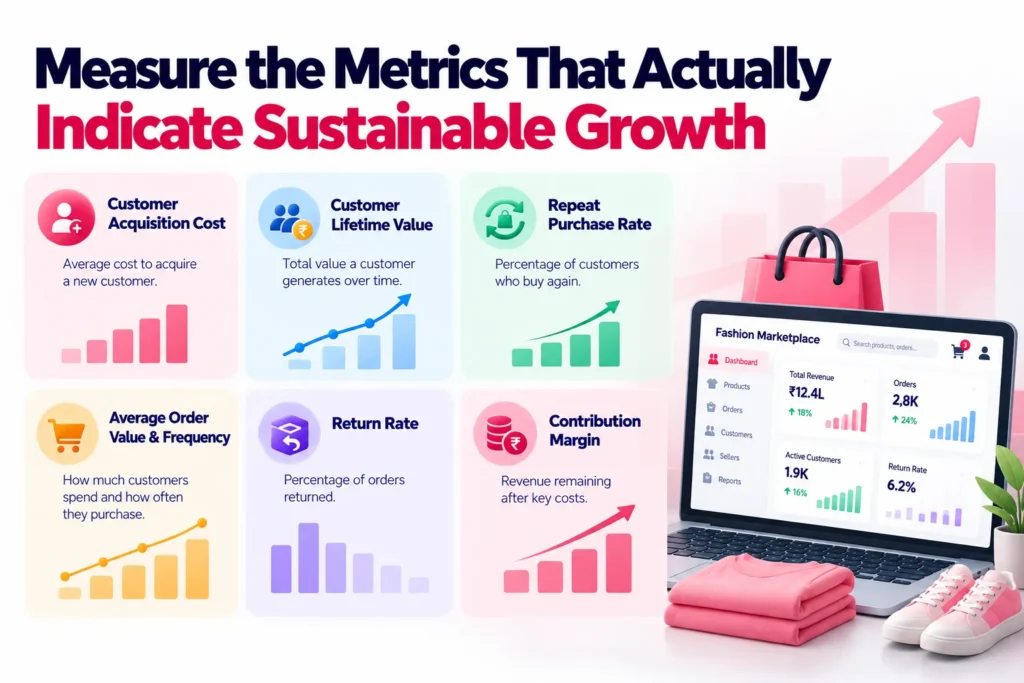
Traffic, downloads, registered sellers, and gross order volume can provide useful information, but they do not independently demonstrate that a marketplace is growing sustainably.
Marketplace operators need to understand whether their acquisition investments generate customers who complete profitable orders, whether brands remain active, and whether the shopping experience produces repeat demand.
Customer Acquisition Cost
Customer acquisition cost measures the average acquisition expenditure required to obtain a new customer.
For example, if a campaign spends ₹50,000 and acquires 200 new customers, the campaign’s acquisition cost is ₹250 per customer.
Founders should apply a consistent definition of acquisition expenditure and distinguish new customers from returning customers when comparing campaigns.
Customer Lifetime Value
Customer lifetime value estimates the economic value generated by a customer over the course of their relationship with the marketplace.
For a multi-brand platform, operators should distinguish the total value of customer purchases from the revenue and contribution actually retained by the marketplace.
Customer lifetime value becomes more useful when it accounts for commission or other retained revenue, discounts, rewards, fulfillment expenses, and return-related costs.
Repeat Purchase Rate
Repeat purchase rate measures the proportion of customers who place more than one qualifying order within a defined period.
For example, if 1,000 customers make a purchase during a defined cohort period and 250 of those customers complete another qualifying purchase within the measurement window, the repeat purchase rate is 25%.
Operators should use consistent cohort definitions and decide how canceled or fully refunded orders are treated. Comparing cohorts over similar periods is more informative than mixing customers who have had different amounts of time to return.
Average Order Value and Purchase Frequency
Average order value measures the average monetary value of qualifying orders, while purchase frequency indicates how often customers purchase during a defined period.
These metrics can help identify whether coordinated collections, complementary recommendations, and retention campaigns are changing customer purchasing behavior.
However, higher order values are not automatically beneficial if they are driven by excessive discounts, high return rates, or products with weak contribution margins.
Return Rate and Contribution Margin
Returns have a particularly important effect on fashion marketplace economics. A high volume of completed checkouts can create a misleading impression of growth when a substantial proportion of orders are subsequently refunded.
Founders should monitor return rates by product, size, category, brand, and reason where the available data supports that level of analysis.
They should also examine the contribution remaining after relevant variable expenses, including promotional subsidies, payment processing, fulfillment responsibilities, and return-related costs.
These indicators help determine whether a marketing campaign or product category contributes meaningful economic value rather than simply increasing reported transaction volume.
Treat Localization and Mobile Commerce as Growth Enablers
Fashion preferences vary across regions, customer demographics, climates, price segments, and cultural occasions. A marketplace that treats every customer as part of the same audience may overlook commercially important differences.
Localization should therefore extend beyond translating interface text. It can influence the product assortment, promotional calendar, content themes, delivery expectations, supported payment methods, and customer communication.
For example, a fashion marketplace expanding into a new region may discover stronger demand for different fabrics, seasonal products, sizes, or occasion-specific clothing.
Regional demand data can help founders adjust their brand acquisition strategy and merchandising priorities before committing substantial marketing expenditure.
Create a Mobile-First Shopping Experience
Mobile commerce is especially relevant to fashion discovery because customers frequently encounter products through social content, creator recommendations, messages, and other mobile interactions.
A mobile-first experience should make it easy to browse products, compare styles, check availability, save favorites, understand delivery information, and complete purchases.
Product images should load efficiently without sacrificing the visual clarity needed to evaluate garments and accessories. Navigation should remain intuitive even when the catalog contains numerous brands and categories.
Marketplace operators should also ensure that mobile marketing campaigns lead to relevant destinations. Sending a customer who selects a specific product promotion to a generic homepage creates unnecessary friction.
Mobile performance is therefore both a customer-experience consideration and an important part of marketing efficiency.
Build Trust Through Consistent Marketplace Operations
Trust is an essential growth factor for any marketplace in which customers purchase products from multiple independent sellers.
Customers expect consistent information about product quality, delivery, payment security, and return eligibility regardless of which brand supplies their order.
Marketplace operators should establish clear seller standards, verify brands where appropriate, moderate misleading product information, and maintain transparent customer service procedures.
Customer reviews can provide valuable product feedback, but review authenticity and moderation are important. Reviews should help shoppers evaluate products rather than create a misleading impression of quality.
Payment handling also requires appropriate safeguards, including secure payment integration, access controls, and reliable transaction records.
Founders should treat operational trust as part of their growth strategy because unresolved disputes, inaccurate listings, delayed fulfillment, and payment concerns can undermine the value of customer acquisition spending.
For a closer look at the technical and operational considerations behind marketplace trust, read our fashion marketplace security guide.
Develop a Practical 90-Day Fashion Marketplace Growth Roadmap
Founders do not need to activate every acquisition and retention strategy simultaneously. A phased approach makes it easier to identify what is working, control expenditure, and improve the marketplace before expanding into additional categories or customer segments.
The following 90-day framework is an illustrative planning model for an early-stage fashion marketplace. Actual priorities and timelines should reflect the platform’s launch readiness, existing supply, available resources, and target market.
Days 1–30: Establish a Relevant Assortment and Reliable Shopping Journey
The first phase should concentrate on the fundamentals that make customer acquisition worthwhile.
Define the target audience and priority product categories. Identify suitable brands, establish onboarding standards, prepare product catalogs, and verify that key shopping and fulfillment processes work as intended.
During this phase, founders should also establish a basic reporting framework for seller activation, customer acquisition, product engagement, order completion, and returns.
A controlled launch can help identify operational issues before the business commits to larger marketing campaigns.
Days 31–60: Test Customer Acquisition and Personalized Merchandising
Once the marketplace has a dependable initial assortment, the next phase can focus on bringing relevant shoppers to the platform.
Test a limited number of acquisition channels, such as creator partnerships, organic search content, targeted advertising, and coordinated brand promotions.
At the same time, introduce curated collections and basic personalized recommendations using available category, product, and customer preference data.
Evaluate campaigns according to acquisition cost, customer engagement, completed purchases, and early product satisfaction. Avoid increasing expenditure solely because a campaign generates inexpensive traffic.
Days 61–90: Strengthen Retention and Expand Proven Activities
The third phase should use the initial operating data to identify opportunities for improvement.
Introduce relevant post-purchase communications, evaluate customer feedback, and test retention activities for customers who have completed their first order.
Review which brands and product categories generate productive demand, which campaigns attract valuable customers, and where returns or fulfillment issues reduce profitability.
Expand the initiatives that demonstrate positive results while improving or discontinuing those that create activity without meaningful business value.
At the end of this period, founders should have a clearer understanding of their target customers, strongest acquisition channels, most productive brands, and early retention opportunities.
Founder Decision Signals: When Should You Scale?
Customer Demand
Are customers consistently discovering relevant products and completing purchases without relying entirely on discounts?
Brand Performance
Are participating brands maintaining product availability, fulfilling orders reliably, and remaining commercially active?
Retention
Are customers returning, exploring additional categories, and showing confidence in the marketplace after their initial purchase?
Economics
Does customer value justify acquisition spending after accounting for marketplace revenue, promotions, and relevant operating costs?
Common Fashion Marketplace Growth Mistakes Founders Should Avoid
Growth challenges often arise when founders prioritize visible activity over the underlying quality of the marketplace. The following mistakes can weaken customer trust, seller participation, and long-term profitability.
Acquiring Too Many Brands Without a Clear Assortment Strategy
Rapid seller onboarding can produce a large catalog without creating a compelling shopping experience. Duplicate products, inconsistent quality, and irrelevant categories make product discovery more difficult.
Prioritize brands that address demonstrated customer needs and maintain acceptable operational standards. Expand the assortment based on demand and category performance rather than seller registrations alone.
Depending on Discounts to Generate Every Purchase
Promotions can encourage trials and create seasonal demand, but excessive discounting can train customers to purchase only during sales and weaken marketplace economics.
Balance promotions with product differentiation, helpful merchandising, reliable fulfillment, and customer satisfaction. Evaluate campaign profitability rather than focusing exclusively on order growth.
Investing in Personalization Before Establishing Data Quality
Recommendation systems depend on useful product information and reliable customer signals. Inconsistent categories, incomplete attributes, inaccurate stock information, and limited behavioral data can reduce their effectiveness.
Improve catalog structure and implement straightforward recommendation logic before investing in more advanced capabilities.
Ignoring Returns When Evaluating Marketing Performance
Campaigns that generate substantial gross sales may appear successful even when many orders are returned. This creates a risk of investing further in products or audiences that contribute limited economic value.
Analyze acquisition and merchandising performance using consistent order, return, revenue, and contribution measurements.
Treating Retention as a Marketing Automation Problem
Automated messages cannot compensate for inaccurate listings, unreliable delivery, poor product quality, or unresolved customer complaints.
Establish a satisfactory shopping experience first. Use lifecycle marketing to reinforce that experience and introduce relevant reasons for customers to return.
Build a Technology Foundation That Supports Your Growth Strategy
A fashion marketplace’s growth strategy depends partly on whether its operating systems can support the demands created by additional brands, products, customers, and transactions.
For example, onboarding brands becomes difficult when product and inventory information must be managed manually. Personalized merchandising is harder to implement without consistent product attributes and accessible customer preference data. Retention campaigns become less effective when order, return, and customer communication records are disconnected.
Founders should therefore evaluate their technology foundation in relation to the growth activities they intend to pursue.
Important operational capabilities include consistent catalog management, seller administration, accurate inventory information, reliable order and return records, customer communication workflows, and access to relevant performance data.
These capabilities do not replace the need for a compelling brand proposition or effective marketing. They make it easier to implement growth activities without introducing unnecessary operational complexity.
For founders evaluating their product foundation, Miracuves offers a ready-made fashion marketplace platform designed around multi-brand commerce, including seller management, catalog operations, order processing, and administrative control.
Its ready-made approach includes a six-working-day deployment offering for the defined base solution. Additional customization, integrations, and business-specific requirements should be evaluated separately.
The objective is to establish a dependable platform so that founders can focus their ongoing efforts on brand relationships, customer acquisition, merchandising, and retention.
Final Thoughts: Sustainable Fashion Marketplace Growth Starts With Better Decisions
Building a successful fashion ecommerce marketplace requires more than attracting visitors, increasing seller registrations, or introducing frequent promotions.
The strongest growth strategy brings together relevant fashion brands, customer-focused merchandising, personalized discovery, effective acquisition channels, and a dependable shopping experience.
Brand acquisition improves the assortment and creates new reasons for customers to visit. Personalization helps shoppers discover products that match their needs. Customer satisfaction and relevant lifecycle marketing create opportunities for repeat purchases.
These activities become more valuable when founders measure their performance through customer lifetime value, acquisition costs, return rates, seller productivity, and contribution margins.
For startups, the most practical approach is to begin with a focused audience and relevant assortment, establish reliable operations, validate a small number of acquisition channels, and expand based on demonstrated customer demand.
Miracuves helps founders establish the underlying marketplace foundation, allowing them to concentrate on developing the brand relationships, merchandising decisions, and customer experiences that support long-term growth.
FAQs
What is the most effective growth strategy for a fashion ecommerce marketplace?
An effective fashion marketplace growth strategy combines relevant brand acquisition, targeted customer acquisition, personalized product discovery, reliable fulfillment, and customer retention. Founders should measure repeat purchases, seller performance, acquisition costs, returns, and contribution margins to identify sustainable growth opportunities.
How can a new fashion marketplace attract established brands?
A new marketplace can attract brands by defining a relevant target audience, presenting a clear commercial value proposition, offering transparent operating terms, maintaining consistent catalog standards, and demonstrating a credible customer acquisition plan. Founders should prioritize suitable brand partnerships rather than focusing exclusively on seller numbers.
How does personalization improve fashion ecommerce sales?
Personalization helps customers discover relevant products using their preferences, shopping behavior, product interests, and purchase history. Useful recommendations, relevant collections, and well-organized search experiences can reduce browsing friction and support conversion. Results depend on data quality and the relevance of the recommendations.
How can fashion ecommerce businesses increase repeat purchases?
Fashion ecommerce businesses can encourage repeat purchases by providing accurate product information, reliable fulfillment, transparent returns, relevant post-purchase communication, personalized recommendations, and meaningful loyalty benefits. Customer satisfaction should come before promotional automation.
Which marketing channels should fashion startups prioritize?
Fashion startups should select marketing channels based on their target audience, product positioning, available resources, and expected customer value. Creator partnerships, search marketing, editorial content, targeted advertising, and lifecycle email campaigns are useful options. Founders should test a limited channel mix before increasing expenditure.
What metrics should fashion marketplace founders track?
Important metrics include customer acquisition cost, customer lifetime value, repeat purchase rate, average order value, purchase frequency, active brand participation, return rate, and contribution margin. These indicators provide a more complete picture of growth than traffic or gross sales alone.
Why is brand acquisition important for a multi-brand fashion marketplace?
Brand acquisition determines the relevance, depth, and differentiation of the marketplace’s assortment. Suitable brands help attract target customers, improve product discovery, support coordinated campaigns, and create additional purchasing opportunities. Brand quality and ongoing participation matter more than registration volume alone.
Can a fashion marketplace grow without relying on heavy discounts?
Yes. A marketplace can develop demand through differentiated brands, helpful shopping content, relevant product recommendations, reliable fulfillment, creator partnerships, organic discovery, and customer loyalty. Promotions can support growth, but founders should evaluate their effect on long-term purchasing behavior and profitability.
Miracuves is an independent software development company. We are not affiliated with, connected to, sponsored by, or endorsed by any company or product named in this article.
Terms such as “X Clone” are used descriptively. It is how the software industry refers to building a platform with functionality comparable to a known service, and how clients search for it.
The entire design and codebase of our products is built by our own team. Our products contain no code, design, graphics, or content originating from any third-party website or applications.
All third-party names and marks referenced in this article are the property of their respective owners, referenced solely to identify the services discussed.