Fashion ecommerce is not only about uploading products and accepting payments. A successful fashion marketplace has to help users discover styles faster, feel confident about fit, receive relevant recommendations, trust sellers, complete checkout smoothly, and return when new collections arrive.
That is why the strongest fashion shopping platforms feel different from ordinary online stores. They do not just show products. They guide shoppers from inspiration to selection, from uncertainty to confidence, and from browsing to buying.
For founders planning to launch or improve a fashion ecommerce marketplace, the real question is not “How many features should we add?” The better question is: Which features actually improve discovery, fit confidence, personalization, conversion, and repeat purchase behavior?
This guide explains the most important fashion marketplace features through a founder-focused lens, using the live slug intent of Myntra app features explained while keeping the article focused on broader marketplace feature strategy.
Key Takeaways
- Fashion ecommerce marketplace features should be prioritized around discovery, fit confidence, personalization, checkout conversion, and retention.
- Product search, smart filters, category navigation, visual merchandising, and curated collections help users find relevant products faster.
- Size guides, fit recommendations, reviews, return visibility, and product media reduce purchase hesitation in fashion shopping.
- Personalization works best when it connects browsing behavior, wishlists, purchase history, price preference, style interest, and product availability.
- Conversion depends on trust signals, smooth checkout, secure payments, transparent delivery timelines, and easy post-order support.
- Miracuves helps founders move faster with ready-made and white-label app solutions that can be adapted for fashion marketplace models.
Why Fashion Marketplace Features Need a Different Strategy
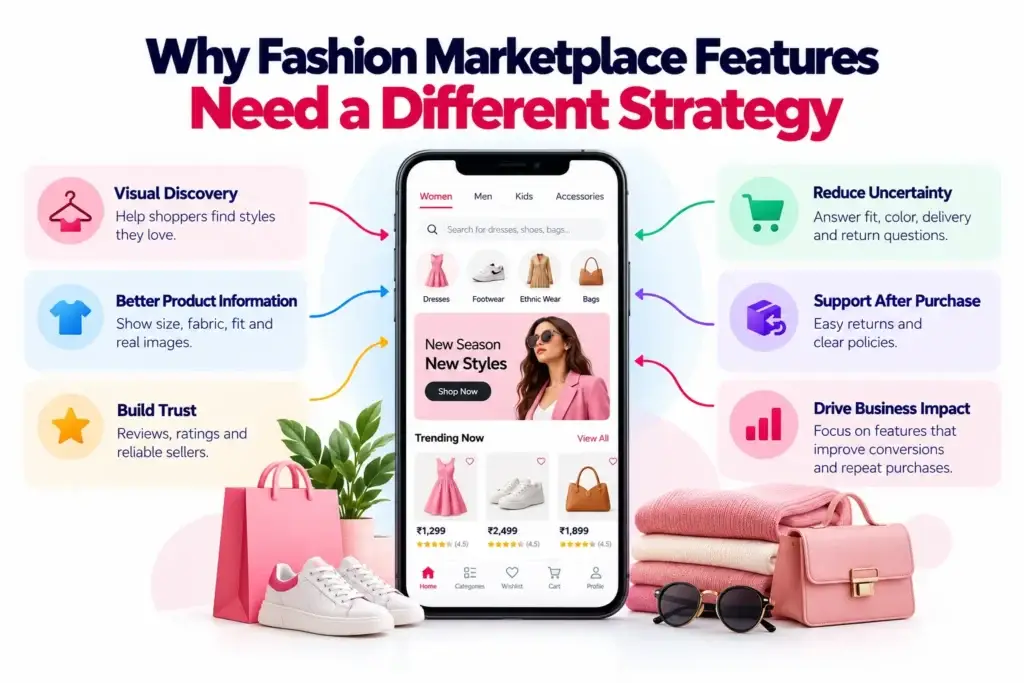
A normal ecommerce platform can often succeed with product listings, categories, cart, checkout, and payments. Fashion ecommerce is more complex because shoppers are not only buying a functional product. They are buying style, identity, comfort, occasion-fit, brand trust, and visual confidence.
A user looking for a phone charger may already know what they need. A user looking for a dress, sneakers, ethnic wear, office outfit, activewear, or accessories may need inspiration before they even search. That makes discovery a core revenue function, not just a design choice.
Fashion also has a high uncertainty layer. Users ask questions such as: Will this fit me? Will the color look the same? Is the fabric comfortable? Can I return it? Is the seller reliable? Are the reviews real? Will the product arrive before the event?
The right feature stack reduces this uncertainty. It helps the buyer feel informed before purchase and supported after purchase. For founders, this means fashion marketplace features should be evaluated by business impact, not by trend value alone.
The Four Feature Pillars of a Fashion Ecommerce Marketplace
A fashion marketplace becomes stronger when its features are organized around four core pillars: discovery, fit, personalization, and conversion. These pillars help founders decide what to build first, what to improve later, and what should be avoided until the platform has enough traffic and data.
Fashion Marketplace Feature Pillars
| Feature Pillar | What It Solves | Business Impact |
|---|---|---|
| Discovery | Helps users find products, brands, collections, and trends faster. | Improves browsing depth, session quality, and product visibility. |
| Fit Confidence | Reduces uncertainty around size, fabric, color, style, and return risk. | Improves purchase confidence and can reduce avoidable returns. |
| Personalization | Shows products based on user behavior, preferences, price range, and style signals. | Improves relevance, repeat engagement, and cross-selling opportunities. |
| Conversion | Removes friction from cart, checkout, payments, delivery, and post-order support. | Improves completed purchases, trust, and repeat orders. |
Product Discovery Features That Help Users Find the Right Style Faster
Discovery is the first major challenge in a fashion marketplace. A user may enter the app with a clear search query, a vague style idea, or no intent at all. Your feature stack should support all three behaviors.
Strong discovery features help users move from “I want something new” to “This is what I want to buy.” In fashion ecommerce, this journey often begins with visual inspiration, seasonal collections, brand browsing, influencer-led content, occasion-based shopping, or category exploration.
Smart Search With Fashion-Specific Queries
Search is not just a text box. In fashion ecommerce, search has to understand product types, styles, colors, fabrics, occasions, sizes, brands, price ranges, and user intent.
A useful fashion search system should support queries such as “black party dress,” “white sneakers under 3000,” “cotton kurta for office,” “oversized t-shirt,” “wedding guest outfit,” or “running shoes for men.” The more accurately the search layer understands these patterns, the faster users reach relevant products.
Founders should also think about search recovery. If users misspell a brand, use regional terms, or search with vague language, the app should still guide them toward useful results instead of showing an empty screen.
Advanced Filters That Match How Fashion Buyers Think
Filters are especially important in fashion because users compare products across many variables. A shopper may filter by brand, size, color, fabric, discount, occasion, neckline, sleeve length, fit type, delivery time, rating, price, or return availability.
However, adding too many filters without logic can overwhelm users. The best filter experience changes based on category. A shoe category needs size, brand, sole type, sport type, and closure. A dress category may need length, fabric, pattern, neckline, sleeve, occasion, and fit.
This is where fashion marketplaces need category-aware filtering instead of one generic filter panel for every product type.
Curated Collections and Occasion-Based Shopping
Many fashion buyers do not shop only by product category. They shop by occasion, mood, trend, season, or identity. A marketplace can support this behavior through curated collections such as festive wear, office essentials, summer edits, wedding guest looks, vacation outfits, gym wear, party styles, or minimalist wardrobe basics.
For founders, curated collections create a business advantage because they allow merchandising teams to influence product visibility. Instead of relying only on search, the platform can promote new brands, seasonal inventory, high-margin categories, and campaign-specific products.
Brand and Seller Discovery
A multi-brand fashion marketplace should not treat brands as invisible suppliers. Many shoppers follow brands, compare brand quality, and return to familiar labels. A strong brand discovery system includes brand pages, seller ratings, brand story sections, product grouping, offers, and follow or favorite options.
This matters because brand-level discovery helps both users and marketplace operators. Users can shop with more confidence, while operators can build stronger relationships with sellers and increase repeat brand engagement.
Fit Confidence Features That Reduce Purchase Hesitation
Fit is one of the biggest decision barriers in online fashion shopping. Even when users like a product, they may delay purchase because they are unsure about size, fabric, color, comfort, or return flexibility.
Fit confidence features are not just user-experience improvements. They directly influence conversion, return rates, support tickets, and customer trust.
Size Guides That Are Useful, Not Generic
A basic size chart is helpful, but a category-aware and brand-aware size guide is stronger. Fashion sizes vary across brands, product types, and regions. A user who wears medium in one brand may need large in another.
A strong marketplace should allow product-specific size information, measurement units, fit notes, model information, and seller-provided sizing guidance. For example, a product page can mention whether the fit is slim, regular, relaxed, oversized, or stretchable.
The goal is to reduce guesswork. When users feel that the platform is helping them choose correctly, they are more likely to proceed to checkout.
Fit Recommendation and Previous Purchase Signals
As a platform collects more user behavior, it can improve fit guidance by using previous purchases, returns, preferred sizes, category behavior, and brand interactions. For example, if a user often returns shoes because of size issues, the app can surface fit warnings or recommend checking brand-specific sizing before purchase.
Even without advanced AI at launch, founders can start with simple rules: size saved in profile, category-specific size preferences, brand-level fit notes, and return-reason tracking. These features create a foundation for smarter personalization later.
Product Media That Answers Real Buyer Questions
Fashion products need richer media than many other ecommerce categories. Users want to see how fabric falls, how color looks under different light, how the item fits on a person, how details appear up close, and how the product can be styled.
Useful product media can include multiple images, zoom view, short product videos, model photos, fabric close-ups, user-uploaded review images, and styling suggestions. These assets help users evaluate the product before buying.
For marketplace operators, media quality also affects seller standards. The admin system should allow the platform team to define image requirements, reject poor-quality uploads, and maintain a consistent shopping experience.
Transparent Return and Exchange Information
Fashion purchases often involve uncertainty. A visible and simple return or exchange policy helps reduce buyer hesitation. Users should not have to search deeply to understand whether an item is returnable, exchangeable, final sale, or eligible for pickup.
Return transparency is also important for trust. A fashion marketplace that hides return conditions may see short-term conversions but can lose repeat customers if buyers feel surprised after purchase.
Personalization Features That Make the Marketplace Feel Relevant
Personalization is one of the most powerful layers in fashion ecommerce, but it only works when it is based on meaningful user signals. Showing random “recommended products” is not enough. The experience should adapt to the user’s style interest, browsing history, wishlist activity, price comfort, preferred brands, size behavior, and purchase intent.
Personalized Homepage Feeds
A personalized homepage can show recently viewed items, similar products, trending styles, new arrivals from preferred brands, saved categories, seasonal collections, and relevant offers. The purpose is to reduce the effort required to start shopping.
For new users, personalization can begin with onboarding choices such as gender preference, style interest, categories, sizes, budget range, and favorite brands. For returning users, behavior data can gradually improve recommendations.
Wishlist and Save-for-Later Signals
A wishlist is more than a convenience feature. It is a strong intent signal. Users often save products while comparing sizes, waiting for discounts, planning purchases, or sharing options with friends.
Marketplace operators can use wishlist behavior to power restock alerts, price-drop notifications, cart reminders, personalized recommendations, and demand forecasting. When used carefully, wishlist data helps the platform understand what users want before they buy.
Recommendation Logic Based on Style and Behavior
Fashion recommendations should not depend only on product popularity. A product may be popular but irrelevant to a user’s size, budget, region, gender preference, or style pattern.
Better recommendation logic can include:
- Products similar to recently viewed items
- Items from saved brands or categories
- Complementary products for complete outfits
- New arrivals matching user preferences
- Products available in the user’s preferred size
- Price-drop items from wishlist activity
- Trending products in the user’s location or category interest
The founder takeaway is simple: personalization should improve relevance, not just increase screen activity. A user should feel that the marketplace understands their taste and shopping context.
Shoppable Content and Style Inspiration
Fashion discovery is increasingly content-led. Users may discover products through outfit ideas, short videos, lookbooks, creator edits, seasonal campaigns, or styling guides. Shoppable content connects inspiration with purchase by allowing users to move from visual content to product pages quickly.
This feature is especially useful for fashion marketplaces that want to build repeat engagement. Instead of waiting for users to search, the app can create reasons to browse regularly.
Conversion Features That Turn Browsing Into Orders
Discovery brings users in, fit confidence reduces hesitation, and personalization increases relevance. Conversion features complete the journey by making purchase simple, trustworthy, and fast.
In fashion ecommerce, conversion is not only about checkout design. It includes pricing clarity, discount logic, inventory accuracy, delivery expectations, payment trust, return confidence, and post-order visibility.
Cart and Checkout Designed for Low Friction
A strong cart experience should allow users to review size, color, quantity, delivery estimate, discount, shipping fee, return eligibility, and final price without confusion. Users should also be able to move items between cart and wishlist easily.
Checkout should support common payment options, address management, coupon application, order summary, secure payment gateway integration, and clear confirmation after payment. Every unclear step increases the chance of drop-off.
Secure Payments and Trust Signals
Fashion marketplaces must make payment feel safe. Useful trust layers include secure payment gateway integration, encrypted data transfer, clear refund status, order history, invoice access, user account protection, and transparent support workflows.
Trust also depends on seller-side governance. Users should be able to see product ratings, seller reliability where relevant, return rules, verified reviews, and clear communication from the marketplace.
Inventory Accuracy at Size and Color Level
Fashion inventory is complex because one product often has many variants. A shirt is not just one product. It may include different colors, sizes, stock levels, prices, discounts, and availability rules.
If inventory is not managed at the right level, users may add a product to cart only to discover that the selected size is unavailable. This creates frustration and reduces trust. A strong fashion marketplace should treat size and color variants as sellable units with their own stock status.
Delivery Visibility and Order Tracking
After checkout, users want confidence that the order is moving. Order tracking, delivery estimates, shipment updates, cancellation windows, return pickup status, and notification alerts help users stay informed.
For founders, the post-order experience is part of conversion strategy. A smooth post-purchase journey increases the likelihood that users will buy again.
Marketplace Operator Features That Users Do Not See but Businesses Depend On
Many fashion app feature discussions focus only on the customer experience. But a marketplace also needs a strong control layer for the operator, sellers, support teams, delivery workflows, payments, refunds, and reporting.
Without these backend features, the customer-facing app may look attractive but become difficult to manage once orders, returns, sellers, discounts, and disputes increase.
Admin Dashboard for Marketplace Control
The admin dashboard is the operating center of the fashion marketplace. It should help the platform team manage users, sellers, products, categories, orders, discounts, payments, refunds, delivery status, disputes, reviews, banners, and reports.
For founders, admin control matters because it reduces dependency on developers for daily operations. The team should be able to adjust business rules, approve content, monitor activity, and respond to issues quickly.
Seller or Brand Panel
A fashion marketplace grows when sellers and brands can manage their catalogues efficiently. A seller or brand panel should support product uploads, inventory updates, variant management, pricing, order management, return handling, payout visibility, and performance tracking.
The easier it is for sellers to manage products, the faster the marketplace can expand its catalogue without creating operational overload for the central team.
Discount, Campaign, and Merchandising Controls
Fashion ecommerce depends heavily on campaigns. Seasonal sales, festive offers, end-of-season discounts, new brand launches, and category-specific promotions require flexible campaign controls.
The admin layer should allow teams to create banners, collection pages, coupon rules, featured products, brand promotions, category offers, and targeted notifications. These controls turn the marketplace into a growth engine instead of a static catalogue.
Returns, Refunds, and Dispute Management
Returns are not an exception in fashion ecommerce. They are part of the business model. A strong marketplace should support return requests, reason capture, pickup status, refund processing, seller communication, dispute tracking, and admin resolution.
This is especially important because return quality affects buyer trust, seller accountability, and platform profitability. Poor return handling can damage repeat purchase behavior even when the product catalogue is strong.
Retention Features That Bring Fashion Shoppers Back
A fashion marketplace should not depend only on new user acquisition. Repeat purchases, seasonal shopping, wishlist reminders, loyalty benefits, and personalized campaigns are important for long-term growth.
Retention features help the marketplace stay relevant after the first order. They remind users about saved products, new arrivals, price drops, back-in-stock items, festive collections, and personalized offers.
Push Notifications With Real Shopping Context
Push notifications can improve engagement, but only when they are relevant. Generic daily notifications often lead users to mute the app. Better notifications are based on behavior and timing.
Examples include:
- “Your saved item is back in stock.”
- “The shoes in your wishlist now have a price drop.”
- “New arrivals from a brand you follow are live.”
- “Your return pickup is scheduled for tomorrow.”
- “Complete your look with matching accessories.”
The key is to make notifications helpful instead of noisy.
Loyalty, Wallet, and Store Credit Features
Loyalty points, wallet balance, store credit, coupons, and referral rewards can encourage repeat purchases. But these features should be easy to understand. If users do not know how rewards are earned or redeemed, the feature loses value.
For marketplace operators, loyalty systems can support retention, campaign planning, refund management, and controlled discounting. Store credit can also reduce refund friction when used transparently.
Review and Rating Loops
Ratings and reviews influence fashion purchases because users want proof from other buyers. Reviews with photos, fit feedback, fabric comments, and size notes are especially useful.
A strong review system should encourage detailed feedback while allowing moderation for spam, abuse, or irrelevant content. This protects both user trust and seller reputation.
Feature Priority Framework for Fashion Marketplace Founders
Not every feature needs to be built at the same time. Founders should prioritize features based on launch stage, business model, user expectations, seller complexity, and operational capacity.
The goal is to launch with a strong enough foundation, then improve the experience using real user data. Building advanced personalization before basic product, checkout, and return flows are stable can create unnecessary complexity.
Founder Decision Signals
Speed
If your goal is market validation, prioritize catalogue, search, filters, wishlist, cart, checkout, payments, orders, returns, and admin control before adding advanced experimental features.
Cost
Feature scope affects development cost. Start with features that directly improve browsing, trust, order completion, and operations before investing in complex personalization layers.
Scalability
Fashion marketplaces need strong variant, inventory, return, and seller workflows because operational complexity increases as catalogue size and order volume grow.
Market Fit
Use early user behavior to decide what to improve next. Wishlist activity, search queries, abandoned carts, return reasons, and repeat purchases reveal real market signals.
Launch-Ready Features
These are the features most fashion marketplaces should have from the beginning:
- User registration and profile management
- Product catalogue with categories and subcategories
- Size and color variants
- Search and filters
- Wishlist and cart
- Secure checkout and payment integration
- Order tracking
- Return and refund workflows
- Ratings and reviews
- Seller or brand panel
- Admin dashboard
- Basic notifications
Growth-Stage Features
These features become more useful when the platform has user behavior, seller activity, and enough catalogue depth:
- Personalized homepage feeds
- Advanced recommendation logic
- Price-drop and back-in-stock alerts
- Shoppable content
- Loyalty and referral programs
- Advanced merchandising tools
- Seller analytics
- Customer segmentation
- Campaign automation
Advanced Differentiation Features
These features can help a fashion marketplace stand out, but they should be added when the business has clarity on user demand and operational readiness:
- AI-based styling assistant
- Virtual try-on experiences
- Creator-led shoppable feeds
- Predictive size recommendations
- Dynamic pricing logic
- Advanced fraud monitoring
- Automated seller performance scoring
- Deep personalization by style profile
Common Feature Mistakes Founders Should Avoid
Feature planning becomes risky when founders copy visible features without understanding the operational system behind them. A fashion marketplace can look polished on the surface and still struggle if catalogue, inventory, returns, seller workflows, and admin control are weak.
Mistakes Founders Should Avoid
Adding advanced features before fixing the core shopping flow
Personalization, shoppable content, and styling assistants are useful, but they cannot compensate for poor search, weak filters, confusing checkout, inaccurate stock, or unclear returns.
Treating fashion products like simple catalogue items
Fashion products need variant-level thinking. Size, color, stock, price, discount, and return rules must be handled carefully to avoid order errors and customer frustration.
Ignoring seller and admin workflows
A marketplace is not only a customer app. Sellers need product and order control, while operators need dashboards for approvals, payments, refunds, disputes, campaigns, and reporting.
Using generic notifications instead of intent-based messaging
Notifications should be linked to real shopping behavior such as wishlist updates, price drops, back-in-stock items, order movement, and personalized recommendations.
How These Features Support a Fashion Marketplace Business Model
Feature decisions should connect directly to revenue and operations. A fashion marketplace typically earns through commissions, seller plans, featured listings, advertisements, delivery fees, loyalty programs, brand campaigns, or promotional placements.
Discovery features support product visibility. Fit confidence supports purchase trust. Personalization supports repeat engagement. Conversion features support completed orders. Admin and seller features support operational scale. Together, these features create the platform foundation needed for monetization.
For example, curated collections can support paid brand placements. Wishlist data can inform restock campaigns. Seller dashboards can support premium seller tools. Loyalty features can increase repeat purchase frequency. Review systems can improve trust for new brands.
This is why feature planning should not be separated from business model planning. The strongest fashion marketplaces connect customer experience, seller value, and operator control into one system.
Where a Ready-Made Fashion Marketplace Foundation Can Help
Building every fashion marketplace module from zero can take time, especially when the platform needs buyer flows, seller controls, variant logic, payments, order tracking, returns, admin dashboards, and campaign management. A ready-made foundation can help founders move faster when the goal is to validate demand, customize the brand experience, and avoid rebuilding standard marketplace workflows from scratch.
Miracuves helps founders build launch-ready, white-label app solutions with source-code ownership, admin control, branded design, and customization support. For ready-made solutions, Miracuves can support faster deployment, including a 6-day launch path where the chosen scope matches the available product foundation.
If you are evaluating a fashion marketplace app foundation, you can explore Miracuves’ ready-made fashion marketplace solution to understand how catalogue, variant, checkout, returns, seller, and operator workflows can fit together.
For broader ecommerce planning, you may also review Miracuves’ ecommerce app development services and retail ecommerce development expertise.
Final Thoughts: Fashion Marketplace Features Should Reduce Friction, Not Add Noise
The most valuable fashion ecommerce marketplace features are not always the most complex. The strongest features help shoppers discover relevant products, choose the right size, trust the seller, complete checkout, track orders, return items when needed, and come back for future purchases.
For founders, the practical path is to prioritize features that support real buying behavior. Start with discovery, fit confidence, conversion, seller workflows, and admin control. Then use marketplace data to improve personalization, retention, and advanced shopping experiences.
A fashion marketplace does not win because it has every possible feature. It wins when the right features work together to create confidence, convenience, trust, and repeat value.
FAQs
What are the most important features in a fashion ecommerce marketplace?
The most important features include smart search, advanced filters, product categories, size and color variants, wishlist, cart, secure checkout, payment integration, order tracking, returns, reviews, seller panels, and admin dashboards. For growth, personalization, shoppable content, loyalty, and campaign tools become important.
Why is product discovery important in a fashion shopping app?
Product discovery helps users find relevant styles faster. Fashion buyers often browse by occasion, trend, color, brand, size, or mood. Strong discovery features increase browsing depth, improve product visibility, and help users move from inspiration to purchase.
How can a fashion marketplace improve fit confidence?
A fashion marketplace can improve fit confidence with detailed size guides, brand-specific fit notes, product videos, model information, user review photos, fabric details, return visibility, and previous purchase-based size suggestions. These features reduce uncertainty before checkout.
What personalization features work best for fashion ecommerce?
Useful personalization features include personalized homepage feeds, recently viewed products, wishlist-based suggestions, price-drop alerts, brand recommendations, similar products, complementary outfit suggestions, and new arrivals based on user preferences.
Which features help improve conversion in a fashion marketplace?
Conversion improves when users get clear product information, accurate inventory, simple cart management, secure payments, visible delivery timelines, transparent return rules, trust-building reviews, and a smooth checkout flow.
Do fashion marketplaces need seller or brand dashboards?
Yes. Seller or brand dashboards are important for product uploads, inventory updates, pricing, order management, returns, payouts, and performance tracking. Without seller controls, the marketplace operator may struggle to scale catalogue and order operations.
Should founders build advanced fashion app features from day one?
Founders should first build core shopping, catalogue, checkout, payment, return, seller, and admin workflows. Advanced features such as AI styling, predictive fit, and shoppable content are useful after the platform has enough users, catalogue depth, and behavior data.
How can Miracuves help with a fashion ecommerce marketplace?
Miracuves helps founders create ready-made and white-label app solutions with source code, branded design, admin dashboards, and customization support. For suitable ready-made solution scopes, Miracuves can support faster deployment, including a 6-day launch path.
Miracuves is an independent software development company. We are not affiliated with, connected to, sponsored by, or endorsed by any company or product named in this article.
Terms such as “X Clone” are used descriptively. It is how the software industry refers to building a platform with functionality comparable to a known service, and how clients search for it.
The entire design and codebase of our products is built by our own team. Our products contain no code, design, graphics, or content originating from any third-party website or applications.
All third-party names and marks referenced in this article are the property of their respective owners, referenced solely to identify the services discussed.