


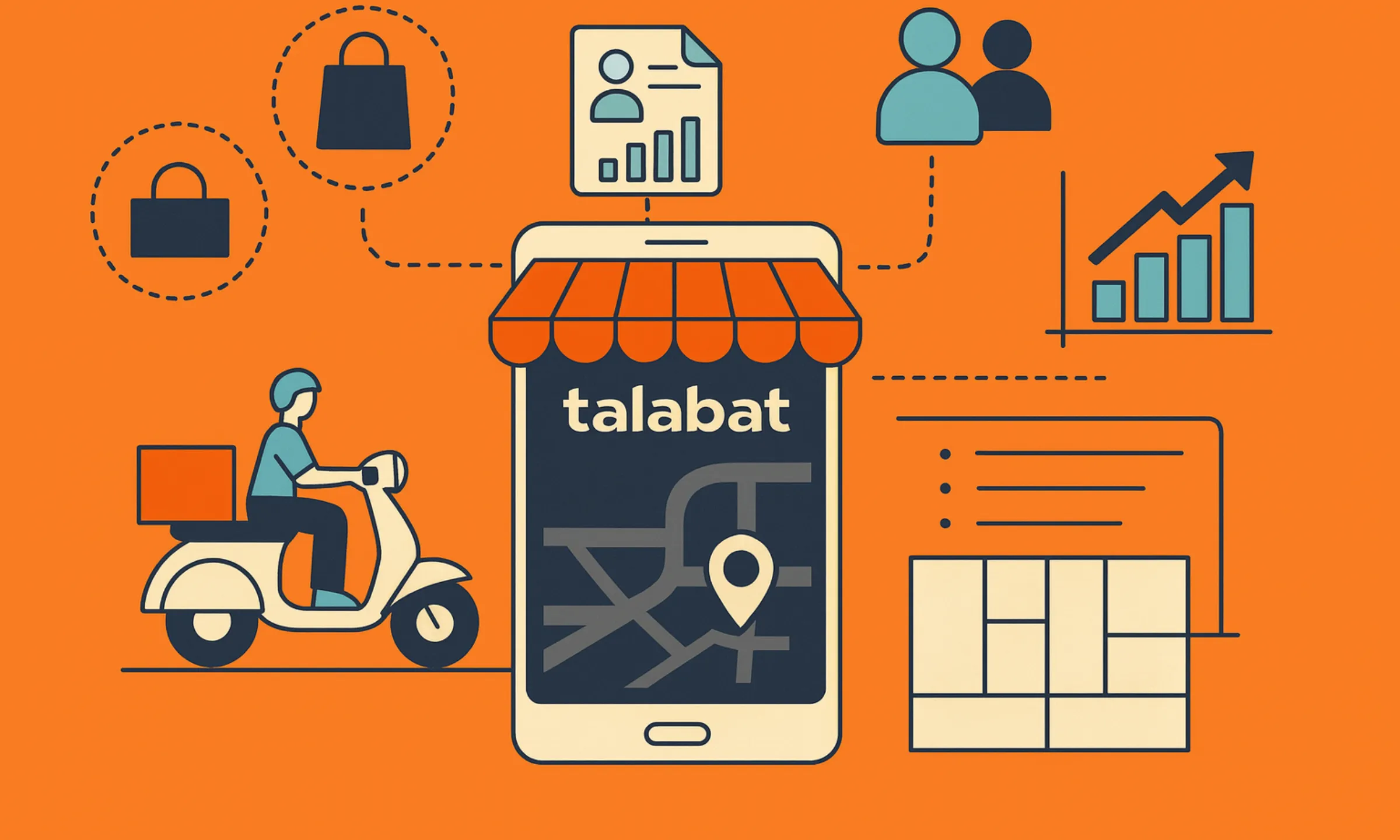
From a small Kuwait-based startup in 2004 to a billion-dollar regional leader operating in 9 countries, Talabat has redefined food delivery in the Middle East. Its rise showcases how localized adaptation, logistics innovation, and ecosystem integration can outperform global giants like Uber Eats and Deliveroo in emerging markets.
Studying Talabat’s business model reveals the blueprint of how a platform can scale regionally by mastering customer trust, delivery optimization, and merchant partnerships rather than just technology. In 2025, with competition intensifying in last-mile logistics and quick commerce, Talabat’s success offers valuable lessons for founders building delivery or marketplace-based startups.
Its model proves that regional dominance doesn’t require reinventing the wheel — it demands deep localization, ecosystem control, and operational efficiency.
How the Talabat Business Model Works
At its core, Talabat operates as a multi-sided marketplace platform connecting customers, restaurants, grocery stores, and delivery partners across the Middle East and North Africa (MENA).
Unlike a simple aggregator, Talabat has evolved into a full-stack digital ecosystem — integrating food delivery, grocery services (Talabat Mart), and cloud kitchen operations to ensure speed, reliability, and customer retention.
Type of Model
Primary: Two-Sided Marketplace
Secondary: Aggregator + Logistics Hybrid
Extended Verticals:
- Talabat Mart: Inventory-based dark store network for instant grocery delivery.
- Talabat Cloud Kitchens: Shared kitchen spaces enabling restaurants to expand without physical outlets.
- Quick Commerce (Q-Commerce): 15–30 minute express delivery service powered by localized fulfillment centers.
This structure allows Talabat to monetize multiple layers of the supply chain — from order placement to last-mile delivery.
Value Proposition
| Stakeholder | Value Proposition |
| Customers | Convenience, variety, real-time tracking, and localized offers. |
| Restaurants & Merchants | Digital visibility, delivery infrastructure, and data-driven insights. |
| Delivery Partners | Flexible earning model and route optimization support. |
| Talabat | Centralized control of data, operations, and service quality. |
Stakeholders & Ecosystem Balance
Talabat maintains a three-way equilibrium:
- Consumers drive demand through loyalty and convenience.
- Vendors sustain platform diversity and competitive pricing.
- Riders ensure service consistency and speed.
Its algorithmic dispatch system ensures balanced incentives across all three, reducing churn and maximizing operational density.
Evolution Over Time
2004–2015: Marketplace aggregator (restaurant listings + third-party delivery).
2015–2019: Acquired by Delivery Hero, expanded into logistics and cloud infrastructure.
2020–2023: Entered quick commerce and grocery delivery under Talabat Mart.
2024–2025: Introduced AI-based demand prediction and dark store automation, integrating with payment gateways and local fintechs.
Why It Works in 2025
- Localized leadership in the Gulf region (Kuwait, UAE, Qatar, Oman, Bahrain).
- Cultural and language adaptability across markets.
- Strong logistics network leveraging Delivery Hero’s global backbone.
- High digital penetration and smartphone usage in GCC countries.
- AI-driven optimization for delivery time, routing, and inventory stocking.
Read more : What is Talabat App and How Does It Work?
Target Market & Customer Segmentation Strategy
Talabat’s market approach is built on deep localization and consumer behavior mapping. Instead of adopting a one-size-fits-all strategy, it tailors experiences to match regional cultures, income levels, and purchasing habits — which is why it dominates the GCC despite global players entering the same space.
Primary Customer Segments
| Segment | Demographics | Behavioral Traits | Key Value Drivers |
| Urban Professionals (Ages 22–40) | High-income individuals in cities like Dubai, Kuwait City, Doha | Frequent orders (3–5/week), demand speed, convenience, and cashback offers | Time-saving, reliability, premium UX |
| Families & Households | Middle- to upper-income families | Bulk grocery and meal orders, repeat loyalty | Variety, affordability, delivery reliability |
| Students & Young Adults | College-goers and budget users | Price-sensitive, use promotions heavily | Discounts, food variety, app gamification |
| Expat Community | Foreign professionals across GCC | Diverse cuisine preferences | Multilingual app experience, secure payments |
Secondary Segments
- Small restaurants and cloud kitchen brands seeking delivery infrastructure.
- Retail chains leveraging Talabat Mart’s logistics.
- Corporate clients using Talabat for employee meal management and catering.
Customer Journey: From Discovery → Retention
- Discovery: App installs via Google Play, Apple Store, social ads, or influencer marketing.
- Conversion: Users drawn in by first-order discounts, free delivery offers, and fast checkout.
- Engagement: Personalized push notifications, localized menus, and AI-driven recommendations.
- Retention: Subscription plans, loyalty points, and seasonal campaigns.
- Advocacy: Referrals and social media integration promoting organic virality.
Talabat’s in-app UX is designed to minimize friction — average checkout time is under 50 seconds, enhancing repeat order probability.
Market Positioning & Differentiation
- Brand Position: “The trusted food and grocery delivery app of the Middle East.”
- Differentiator: Hyperlocal focus with multi-language and multi-currency support.
- Competitive Edge: Logistics speed, region-specific partnerships, and cultural relevance.
- Market Share (2025): Estimated 55–60% of GCC online food delivery market
Talabat sustains dominance not just by customer acquisition but by locking in retention loops — offering an ecosystem rather than a single service.
Revenue Streams and Monetization Design
Talabat’s revenue architecture is a multi-stream engine designed to extract value from every layer of its ecosystem — users, merchants, and delivery partners.
By combining commissions, delivery fees, advertising, and subscription models, Talabat has created a self-sustaining business model that thrives on both volume and margin optimization.
Primary Revenue Stream #1: Commission on Orders
- Mechanism: Talabat charges restaurants and merchants a percentage fee for every completed order.
- Typical Range: 20% – 30% per order, depending on order volume and exclusivity.
- Revenue Contribution: ~60–65% of total revenue (2025 estimate).
- Rationale: Commission-based income scales automatically with GMV (Gross Merchandise Value), creating a predictable revenue flow.
This model ensures Talabat earns from every transaction without directly managing inventory — optimizing scalability and profit margins.
Secondary Revenue Streams
- Delivery Fees (Logistics Income)
- Customers pay variable delivery charges based on distance, time, and city.
- Dynamic pricing increases efficiency during peak hours.
- Encourages users to upgrade to Talabat Plus (subscription plan).
- Talabat Plus (Subscription Program)
- Monthly/annual plan offering free deliveries, priority support, and exclusive discounts.
- Increases order frequency by ~25%.
- Recurring, high-margin revenue stream ideal for customer retention.
- Sponsored Listings & Advertising
- Restaurants pay for top placement or banner ads within the app.
- Ads are AI-targeted by cuisine, time of day, and order history.
- Contributes 10–12% of total revenue in 2025.
- Talabat Mart (Q-Commerce Vertical)
- Direct inventory ownership with optimized dark stores.
- Average basket value 1.8× higher than food orders.
- Offers cross-sell potential (snacks, essentials, drinks).
- B2B & API Integrations
- Corporate meal partnerships, white-label delivery for restaurants.
- Integration with fintechs and e-wallets for transaction commissions.
Overall Monetization Strategy
Talabat’s revenue ecosystem is designed for synergy — each stream feeds the others:
- Commission and delivery fees drive core volume revenue.
- Ads and subscriptions increase profitability per user.
- Q-commerce diversifies risk and enables inventory control.
- B2B partnerships strengthen ecosystem stickiness.
Their pricing psychology is built around perceived convenience — customers pay slightly higher fees but value reliability, speed, and trust more than cost.
Read more : How to Create an App Like Talabat: Essential Steps, Costs, and Features

Operational Model & Key Activities
Behind Talabat’s sleek app interface lies a complex operational backbone built on technology, logistics, and regional partnerships.
The company functions as both a tech platform and a logistics orchestrator, ensuring real-time coordination between customers, merchants, and riders across 9 countries.
Core Operations
- Platform Management
- Maintains a scalable cloud infrastructure (powered by AWS and Delivery Hero’s global architecture).
- Handles millions of concurrent users with low latency and 99.9% uptime.
- Supports multilingual (Arabic, English, Turkish) and multi-currency systems.
- Merchant Onboarding & Relationship Management
- Dedicated merchant success teams in every major city.
- Digital dashboards for restaurant analytics, performance reports, and menu management.
- Compliance checks for food safety and hygiene standards.
- Delivery Network Optimization
- AI-driven dispatch and route optimization ensuring <30-minute delivery times.
- Rider app integration for tracking, incentives, and dynamic routing.
- Geo-zoning to balance order density and minimize idle time.
- Customer Support & Quality Control
- 24/7 multilingual chat and call support.
- Automated refund and issue resolution workflows.
- Data-driven review monitoring to maintain service standards.
- Marketing & Brand Operations
- Multi-channel marketing: digital ads, influencer collaborations, and Ramadan-themed campaigns.
- Local event sponsorships to build emotional brand resonance.
Resource Allocation (2025 Snapshot)
| Operational Area | Approx. Budget Share | Key Focus |
| Technology & Infrastructure | 35% | Cloud scaling, AI integration, backend optimization |
| Marketing & Growth | 25% | Retention, referral loops, brand visibility |
| R&D & Innovation | 15% | Q-commerce automation, predictive analytics |
| HR & Training | 10% | Rider management, local team scaling |
| Regional Expansion | 15% | Penetration in North Africa and secondary GCC cities |
This disciplined allocation allows Talabat to remain cash-efficient yet innovation-heavy, balancing growth with operational stability.
Efficiency Enablers
- Automation: Predictive demand forecasting and dynamic order assignment.
- Data Science: User clustering for hyper-personalized recommendations.
- Sustainability: Electric bike pilots and green packaging initiatives in UAE & Qatar.
Strategic Partnerships & Ecosystem Development
Talabat’s rise isn’t just due to its technology — it’s built on a powerful partnership ecosystem. The company understands that scaling in diverse MENA markets requires collaboration over competition — forming strategic alliances with restaurants, fintechs, logistics providers, and government bodies to strengthen its network effects and operational moat.
Partnership Philosophy
Talabat operates on a “shared growth” principle — empowering its ecosystem partners to grow with the platform. By aligning incentives (like faster payouts, lower commission tiers, and exclusive visibility), Talabat creates mutual dependency loops that are hard for competitors to disrupt.
Its partnerships are multi-layered, spanning technology, logistics, finance, and social impact.
Key Partnership Types
- Technology & API Partners
- Integration with Google Maps, AWS, and Delivery Hero’s logistics engine for real-time optimization.
- Collaboration with CRM and POS providers like Toast and Oracle for seamless restaurant operations.
- Fintech integrations with Apple Pay, PayPal, and local e-wallets (STC Pay, BenefitPay, Payit) for secure digital payments.
- Payment & Logistics Alliances
- Strategic tie-ups with regional courier fleets and last-mile delivery startups in Egypt and Jordan.
- Partnerships with fuel card companies and insurance providers for rider benefit programs.
- Exclusive collaborations with supermarkets and hypermarkets for instant grocery fulfillment (e.g., Lulu, Carrefour).
- Marketing & Distribution Partners
- Co-branding campaigns with beverage and FMCG brands (e.g., Pepsi, Red Bull, Nestlé).
- Event sponsorships during Ramadan and National Day festivals for cultural connection.
- Influencer and celebrity tie-ups to localize brand storytelling.
- Regulatory & Expansion Alliances
- Works closely with municipalities and ministries for food regulation compliance.
- Partnerships with chambers of commerce for vendor onboarding and expansion rights.
- CSR collaborations with charities to deliver surplus food through Talabat Charity Drive initiatives.
- Ecosystem Strategy Insights
Talabat’s ecosystem thrives on mutual enablement:
- Restaurants grow digitally and rely on Talabat’s delivery network.
- Fintechs and logistics firms gain recurring transactions and visibility.
- Governments support Talabat for promoting digital economy goals.
This creates network effects where every new partner increases the platform’s value exponentially.
By 2025, Talabat’s ecosystem involves over 40,000+ restaurants, 10,000+ riders, and 100+ strategic brand partners across MENA.
Competitive Moat from Partnerships
- Exclusivity contracts with top-tier restaurants in UAE and Kuwait.
- Local loyalty integrations (e.g., Talabat points linked with telecom reward systems).
- API-based partnerships making it easier for third parties to plug into Talabat’s logistics infrastructure.
These alliances act as defensive walls, protecting market share and amplifying brand equity.
Read more : Talabat App Marketing Strategy: How to Build & Grow a Food Delivery
Growth Strategy & Scaling Mechanisms
Talabat’s journey from a Kuwaiti startup to the #1 delivery platform in the Middle East was no accident — it’s a masterclass in strategic scaling.
The company’s growth is powered by three engines: localized expansion, logistics innovation, and data-driven marketing.
Its scaling playbook focuses on regional depth before regional width — ensuring market dominance city by city before entering new territories.
Growth Engines
- Organic Virality & Referral Loops
- Word-of-mouth and referral incentives drive sustained organic growth.
- Talabat leverages culturally relevant campaigns during Ramadan, Eid, and national holidays to boost engagement.
- In-app gamification (streaks, loyalty rewards, cashback spins) creates repeat behavior.
- Paid Marketing & Acquisition Campaigns
- Heavy investment in social, influencer, and performance marketing across Meta, TikTok, and Google Ads.
- App Store Optimization (ASO) and localized creatives in Arabic, English, and Urdu.
- Tiered city-level acquisition — focusing on new GCC districts with high delivery density potential.
- New Product Lines & Vertical Expansion
- Talabat Mart (Q-Commerce): Expanding dark stores in UAE, Kuwait, and Egypt for 15-minute grocery delivery.
- Cloud Kitchens: Enabling small brands to enter new cities without physical outlets.
- Corporate & Catering Services: Partnering with offices and events for bulk meal orders.
- Geographic Expansion Model
- Operates in 9 countries: UAE, Kuwait, Bahrain, Oman, Qatar, Jordan, Egypt, Iraq, and Saudi Arabia.
- Uses hub-and-spoke scaling — UAE and Kuwait serve as innovation hubs; nearby markets replicate proven systems.
- 2025 focus: deeper penetration in North Africa and Tier-2 cities in the GCC.
Scaling Challenges & Solutions
| Challenge | Impact | Talabat’s Solution |
| Operational Complexity | Difficulty maintaining service quality across regions | Regional ops centers, unified tech stack |
| High Rider Churn | Inconsistent delivery experience | Rider loyalty programs, insurance, and training |
| Regulatory Barriers | Licensing and taxation differences | Local partnerships with regulators |
| Competition from Zomato, Careem NOW, Deliveroo | Market fragmentation | Exclusive partnerships and loyalty retention |
| Profitability Pressure | Thin margins in delivery | High-margin Q-commerce & subscription plans |
Talabat combines AI forecasting with modular operations to overcome scaling friction — adjusting pricing, staffing, and delivery routes dynamically.
Growth Highlights (2024–2025 Snapshot)
- 50M+ app downloads across iOS & Android.
- 400% Q-commerce growth since 2022.
- 70% order retention rate within 30 days of signup.
- 60,000+ active merchants and 12,000+ delivery partners.
- Average delivery time: <28 minutes across major GCC cities.
Competitive Strategy & Market Defense
In an industry dominated by global heavyweights like Uber Eats, Zomato, and Deliveroo, Talabat’s ability to retain leadership in the GCC and North Africa demonstrates a powerful competitive strategy — one built on local depth, operational mastery, and adaptive innovation.
Talabat doesn’t just compete on delivery speed; it competes on trust, convenience, and cultural fit, which are deeply embedded in the MENA market.
Core Competitive Advantages
- Localized Brand Equity
- Talabat resonates with Arabic-speaking audiences through localized content, holiday campaigns, and bilingual interfaces.
- It has become synonymous with “food delivery” in key regions like Kuwait and Qatar — a rare linguistic advantage over global apps.
- Network Effects & Scale Economics
- With 60,000+ merchants and millions of active customers, Talabat benefits from two-sided network effects.
- More merchants attract more customers → more customers attract more delivery partners → reducing per-order costs and increasing service density.
- Logistics & Technology Differentiation
- AI dispatch engine predicts high-demand zones and pre-positions riders.
- Uses predictive data for menu optimization and restaurant recommendations.
- Proprietary logistics tech from Delivery Hero’s global R&D enhances scalability.
- Brand Loyalty & Customer Trust
- Talabat Plus subscription locks customers into the ecosystem.
- Consistent delivery experience and customer-first refund policies build retention.
- Gamified loyalty programs and referral systems deepen emotional connection.
- Regulatory Adaptability
- Maintains compliance leadership in food safety and rider regulations across GCC nations.
- Active engagement with ministries to influence future delivery policies — positioning itself as a policy partner, not just a market player.
Market Defense Tactics
| Threat | Response Strategy |
| New Entrants / Global Competitors | Fast localization, partnerships with exclusive merchants, and government alignment. |
| Price Wars | Differentiation via loyalty perks, reliability, and Q-commerce integration instead of unsustainable discounts. |
| Platform Switching | Unified subscription (Talabat Plus) and seamless app UX reduce user churn. |
| Technological Copycats | Investment in AI, predictive logistics, and data infrastructure. |
| Customer Fatigue | Gamification, in-app challenges, and social commerce-style experiences. |
Innovation & Market Adaptation
Talabat continues to innovate in three defensive dimensions:
- Product Innovation: Dark kitchens, in-app livestream cooking promotions, and smart grocery fulfillment.
- Partnership Innovation: Telecom bundles with free Talabat Plus for mobile users.
- Sustainability Innovation: EV deliveries and carbon-neutral initiatives.
By continuously evolving, Talabat prevents market saturation and keeps competitors chasing its lead rather than overtaking it.
Lessons for Entrepreneurs & Implementation
Talabat’s success offers blueprint-level lessons for founders looking to build scalable, regionally dominant digital platforms.
From its Kuwait roots to becoming a MENA-wide powerhouse, Talabat demonstrates how execution, adaptability, and ecosystem thinking can turn a simple marketplace idea into a billion-dollar enterprise.
Key Factors Behind Talabat’s Success
- Localization Over Globalization
- Talabat mastered hyperlocal personalization — everything from languages to cuisines and payment methods.
- Lesson: A platform doesn’t have to go global fast; it has to go deeply local first.
- Ecosystem Thinking
- Instead of being a delivery-only company, Talabat built a connected ecosystem of restaurants, riders, fintechs, and regulators.
- Lesson: Don’t just serve users — serve entire value chains.
- Operational Discipline
- The brand invests heavily in process automation, quality control, and feedback loops.
- Lesson: The best marketing is flawless execution — consistent service builds brand loyalty faster than advertising.
- Strategic Partnerships
- Collaborations with tech, retail, and payment firms unlocked new monetization layers.
- Lesson: Partnerships multiply growth faster than ad spend.
- Technology as an Enabler, Not the Product
- Talabat’s tech backbone exists to enhance convenience and trust — not to replace human connection
- Lesson: Founders should use tech to amplify experience, not just automate processes.
Replicable Principles for Startups
| Principle | How Entrepreneurs Can Apply It |
| Start with a focused niche | Launch in one market, prove traction, then replicate. |
| Build brand trust before scaling | Focus on reliability, reviews, and customer service early. |
| Leverage data for decisions | Use analytics for route optimization, menu curation, or pricing. |
| Retain via value, not discounts | Create subscription or reward programs to lock in loyalty. |
| Diversify gradually | Add new verticals like groceries or cloud kitchens after mastering core delivery. |
Common Mistakes to Avoid
- Scaling before achieving operational maturity.
- Ignoring regional compliance and logistics laws.
- Over-relying on discounts to acquire users.
- Failing to localize UX and payment options.
Adaptation Strategies for Local or Niche Markets
Entrepreneurs building food delivery or hyperlocal apps in 2025 can replicate Talabat’s core strengths:
- Micro-market focus: Dominate one city before multiple.
- Smart logistics stack: Use AI-based delivery optimization.
- Subscription and loyalty loops: Ensure recurring revenue.
- Partner network model: Collaborate with retailers, pharmacies, or local stores for expansion.
Implementation Timeline & Investment Priorities
| Phase | Focus Area | Estimated Timeline | Investment Focus |
| Phase 1 | MVP development + pilot city launch | 3–4 months | App development, merchant onboarding |
| Phase 2 | Logistics scaling + brand awareness | 6–9 months | Delivery fleet setup, marketing |
| Phase 3 | Ecosystem partnerships | 9–12 months | Fintech & retail integrations |
| Phase 4 | Subscription & loyalty rollouts | 12–18 months | Retention tech, customer analytics |
Ready to implement Talabat’s proven business model for your market?
Miracuves specializes in scalable, white-label delivery and marketplace platforms — helping entrepreneurs launch apps in just 3–9 days with full customization.
We’ve helped over 200+ founders build profitable food delivery, grocery, and Q-commerce solutions.
Get your free business model consultation today at Miracuves
Conclusion :
The story of Talabat is a masterclass in how regional understanding, customer obsession, and operational precision can outperform even global competitors. What started as a small Kuwaiti delivery platform has evolved into a multi-vertical tech ecosystem serving millions across MENA — proving that adaptability wins over scale alone.
In today’s platform-driven economy, speed matters, but local relevance and executional excellence determine who endures. Talabat’s growth shows how cultural empathy, AI-enabled logistics, and strategic partnerships create a sustainable moat in highly competitive markets.
For entrepreneurs, the Business Model of Talabat delivers one clear lesson: true success comes from building for people, not just markets. As digital ecosystems converge in 2025 and beyond, Miracuves empowers founders to replicate this excellence — helping you build, scale, and localize your own on-demand success story.
FAQs :
1. What type of business model does Talabat use?
Talabat operates on a two-sided marketplace business model that connects customers with restaurants, grocery stores, and delivery partners. It’s a hybrid aggregator + logistics model supported by its own fleet and dark-store network.
2. How does Talabat model create value?
Talabat creates value by simplifying on-demand food and grocery delivery through fast logistics, local partnerships, and reliable service. Customers get convenience, restaurants get digital reach, and riders earn flexible income — forming a win-win ecosystem.
3. Key success factors behind Talabat’s growth
Talabat’s success stems from deep localization, AI-powered delivery optimization, exclusive restaurant partnerships, and customer loyalty through subscriptions — all backed by constant innovation via Talabat Mart.
4. Scalability of Talabat’s business model
Its modular, cloud-based system allows rapid expansion into new cities and verticals like groceries and retail with minimal additional cost, making the model highly scalable and regionally adaptable.
5. Biggest challenges Talabat faces
Managing multi-country operations, retaining riders, facing aggressive competitors like Zomato and Deliveroo, and maintaining profitability amid rising delivery costs remain key challenges.
6. How entrepreneurs can adapt the model
Start small with local restaurants and regional payments, build a reliable logistics base, and later expand into groceries or essentials using Miracuves’ ready-made Talabat Clone framework.
7. Resources and timeframe to launch
With Miracuves’ Talabat Clone, entrepreneurs can launch a fully branded, multi-app delivery platform in just 3–9 days at a fraction of traditional costs — complete with full support
8. Alternatives to Talabat’s business model
Entrepreneurs can explore Zomato or Uber Eats’ commission models, DoorDash’s logistics-driven hybrid, or Instacart’s retail partnership model — depending on local market dynamics.
9. Evolution of Talabat business model
Talabat evolved from a basic aggregator to a logistics powerhouse post-Delivery Hero acquisition, expanding into quick commerce and AI-driven fintech integrations by 2025.
10. Biggest lesson for entrepreneurs
Success comes from local insight and operational excellence — technology scales the impact, but trust, reliability, and cultural relevance secure long-term dominance.
Related Article :