
Key Takeaways
- An on-demand food delivery platform growth strategy should balance restaurant supply, local customer demand, rider availability, order density, delivery performance, and repeat orders.
- Growth becomes stronger when customers have enough restaurant choice while participating restaurants receive consistent orders and riders have sufficient delivery opportunities within each service zone.
- Sustainable expansion should focus on marketplace liquidity and retention rather than relying only on discounts, paid acquisition, or rapid geographic expansion.
Restaurant & Local Demand Signals
- Restaurant supply can grow through local outreach, category diversification, onboarding support, commission incentives, promotional tools, performance analytics, and partnerships with high-demand food brands.
- Local demand can be developed through neighborhood campaigns, referral programs, search visibility, first-order offers, location-based promotions, restaurant-led marketing, and personalized recommendations.
- Operators should track active restaurants, menu availability, restaurant acceptance rate, orders per zone, customer acquisition cost, rider supply, delivery time, cancellations, and local order density.
Repeat Order Insights
- Personalized restaurant discovery, reorder shortcuts, loyalty rewards, subscriptions, relevant offers, saved addresses, reliable delivery, and timely notifications can encourage repeat ordering.
- Teams should monitor repeat order rate, order frequency, customer retention, restaurant retention, average order value, delivery reliability, promotion dependency, and contribution margin by cohort.
- Miracuves develops customizable on-demand food delivery platforms with restaurant onboarding, customer ordering, rider operations, dispatch, promotions, loyalty features, payments, analytics, and admin controls.
Building an on-demand food delivery platform is not only a marketing challenge. It is a marketplace density challenge.
A founder can spend heavily on ads, launch referral offers, onboard dozens of restaurants, and still struggle if customers open the app and see poor restaurant choice, slow delivery coverage, unclear pricing, or weak repeat-order reasons. In food delivery, growth happens when restaurant supply, local demand, delivery availability, and customer habit formation move together.
This is why the strongest food delivery platforms are not built around one-time launch campaigns. They are built around local execution systems. Each delivery zone needs the right restaurants, enough delivery coverage, clear offers, operational reliability, and reasons for customers to order again.
For founders planning a regional delivery marketplace, the real question is not “How do we get more downloads?” The better question is: “How do we create enough local value that customers keep ordering without needing discounts every time?” A strong food delivery app development strategy should connect restaurant supply, local customer demand, delivery density, and repeat-order behavior from the beginning.
Why Food Delivery Growth Starts With Marketplace Balance
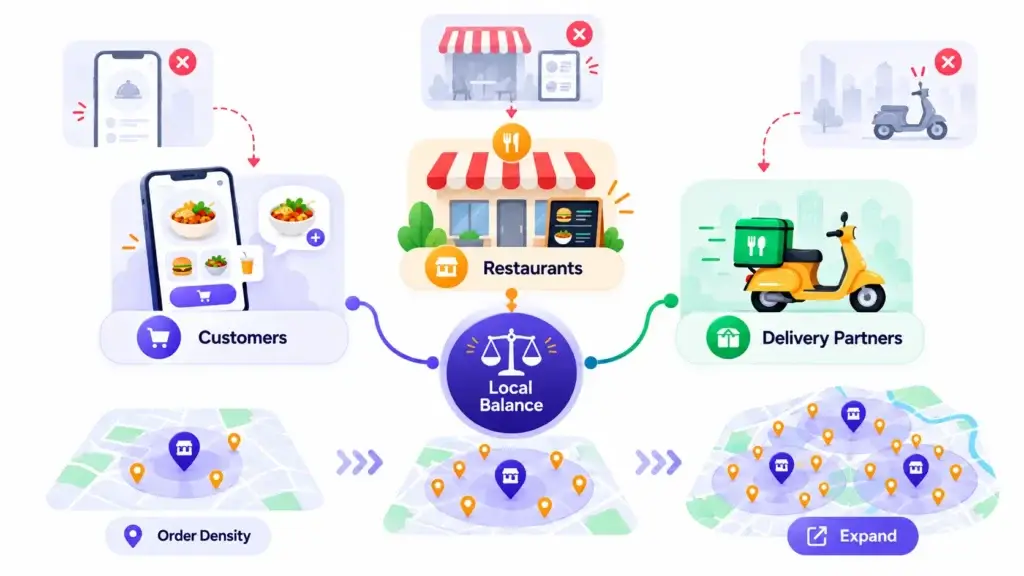
A food delivery platform has three active sides: customers, restaurants, and delivery partners. If one side grows faster than the others, the marketplace becomes unstable.
If customers arrive before enough restaurants are active, the app feels empty. If restaurants join before demand exists, they lose interest. If delivery partners are not available during peak hours, restaurants prepare food that waits too long and customers lose trust.
This is why early growth should be planned around local balance instead of broad visibility. A smaller delivery zone with strong restaurant availability, realistic delivery time, and repeat customers is healthier than a larger zone with weak fulfilment.
For a founder, this changes the marketing question. Instead of asking how to promote the app everywhere, the focus should be on creating reliable order density in one area before expanding wider.
Build Restaurant Supply Before You Push Demand
Restaurant onboarding is not only about signing partners. It is about creating active supply that customers can actually use.
A food delivery platform may show 100 restaurants on paper, but the useful number is smaller if many restaurants are closed, have incomplete menus, reject orders, delay preparation, or operate only during limited hours. Customers do not judge supply by partner count. They judge it by what they can order right now.
Strong restaurant supply includes:
- Popular local restaurants that already have customer trust
- Affordable daily-order options for lunch and dinner
- Fast-preparation categories for repeat weekday orders
- Premium restaurants for higher basket value
- Late-night or weekend options where local demand exists
- Accurate menus, pricing, photos, add-ons, and availability
- Restaurant staff trained to accept, prepare, and update orders quickly
A founder should avoid launching demand campaigns before this supply layer is ready. Marketing can bring users into the app, but only supply quality can convince them to order again.
What Restaurant Supply Really Means in a Delivery Marketplace
Restaurant supply should be measured by usefulness, not volume.
A marketplace with fewer but active restaurants can outperform a larger marketplace where many listings are unavailable. The first customer experience depends on whether users can quickly find something they want, at a price they accept, with delivery time they trust.
| Supply Metric | Why It Matters | What Founders Should Track |
|---|---|---|
| Active restaurants by time slot | Shows whether users have real options during demand peaks | Breakfast, lunch, dinner, late-night availability |
| Cuisine coverage | Prevents the platform from feeling repetitive | Local food, fast food, healthy meals, desserts, beverages |
| Order acceptance rate | Reveals whether restaurants are operationally ready | Accepted orders vs rejected or missed orders |
| Preparation time | Impacts delivery ETA and customer satisfaction | Average prep time by restaurant and category |
| Menu accuracy | Reduces cancellations and support issues | Out-of-stock items, wrong prices, missing add-ons |
| Repeat restaurant orders | Shows which partners drive loyalty | Reorders by customer and restaurant |
This is where platform control matters. A strong delivery app feature stack helps founders manage restaurant onboarding, menu control, order acceptance, delivery tracking, payouts, promotional offers, and admin reporting from one operational layer. A ready-made food delivery marketplace solution from Miracuves can help operators start with these core workflows already prepared instead of building every operational layer from zero.
Create Local Demand Zone by Zone
Food delivery demand is local. A customer does not care how many restaurants exist across the city if only five deliver to their address.
This is why growth campaigns should be planned by delivery zone. A zone can be a neighborhood, business district, residential cluster, campus area, or high-density apartment region. Each zone has different order times, cuisine preferences, income patterns, delivery expectations, and promotional sensitivity.
A strong local demand strategy starts with questions like:
- Which area has enough restaurants and customers close together?
- Where are lunch and dinner orders most likely to repeat?
- Which residential or office clusters can create daily ordering habits?
- Which restaurant categories are missing in the current supply?
- Where can delivery partners complete more orders per hour?
- Which offers can encourage trial without damaging margins?
The goal is not to cover every location immediately. The goal is to win a zone deeply enough that supply, demand, and delivery movement become predictable.
Demand Generation Channels That Work for Local Food Delivery
Food delivery marketing should feel local, useful, and timely. Generic app promotion usually performs weaker because hunger is situational. People order when they are busy, tired, working late, hosting friends, craving something specific, or looking for convenience.
Useful demand channels include:
Local SEO and Search Visibility
Customers often search for food options near them. Blog content, location pages, restaurant category pages, and search-friendly web storefronts can help capture high-intent demand. Searches such as “food delivery near me,” “late-night food delivery,” “lunch delivery in [area],” and “order food online in [city]” can bring users who already want to order.
Restaurant-Led Promotion
Restaurants already have customers. Co-branded offers, counter cards, receipt QR codes, WhatsApp broadcasts, and social media posts can move existing restaurant customers into the platform.
Apartment and Office Cluster Campaigns
Dense residential and office clusters can create repeat orders faster than scattered city-wide campaigns. Founders can use launch offers, group-order promotions, meal-time campaigns, and local partnerships to build demand in these clusters.
Referral Offers With Order Conditions
Referral offers work better when they reward completed orders, not just signups. This protects the platform from empty user growth and connects acquisition spend to actual marketplace activity.
Time-Based Push Notifications
Push notifications should be tied to real order intent. Lunch reminders, dinner deals, weekend specials, rain-day comfort food, and reorder prompts perform better than random discount messages.
Turn First Orders Into Repeat Orders
The first order proves that a customer was willing to try the platform. The second and third orders prove that the platform is becoming a habit.
Repeat orders are created through reliability. If the first order is late, cold, incorrect, or difficult to track, the customer may not give the platform another chance. If the experience is smooth, the user becomes easier to retain.
Repeat-order drivers include:
- Fast reorder from previous meals
- Personalized restaurant suggestions
- Saved addresses and payment preferences
- Loyalty credits or delivery passes
- Accurate delivery ETA
- Reliable refunds and support
- Favorite restaurants and dishes
- Occasion-based offers
- Clear order tracking
- Consistent delivery partner availability
Food delivery retention is not only about discounts. Discounts may create trial, but reliability creates routine.
The Repeat Order Loop Founders Should Build
A healthy food delivery platform should move users through a repeat loop:
- User discovers a relevant restaurant.
- User places the first order with low friction.
- Restaurant accepts and prepares the order on time.
- Delivery partner completes the order within the expected window.
- User receives a prompt to rate, reorder, or save the restaurant.
- The platform uses behavior data to personalize the next offer.
- User returns because the second order feels easier than the first.
When this loop works, customer acquisition becomes more efficient. The platform does not need to keep buying the same user again.
Use Offers Carefully: Discounts Should Build Habits, Not Dependency
Founders should connect every campaign to a clear food delivery business model. Discounts, delivery fees, restaurant commissions, sponsored listings, loyalty credits, and subscription-style benefits should work together instead of operating as random promotions.
Promotions are useful in food delivery, but uncontrolled discounts can hide weak operations. If customers only order when prices are heavily reduced, the platform is not building durable demand.
Founders should use promotions with clear intent:
| Offer Type | Best Use | Risk if Misused |
|---|---|---|
| First-order discount | Encourage trial in a new zone | Attracts one-time bargain users |
| Free delivery threshold | Increase basket size | Can hurt margins if threshold is too low |
| Restaurant-funded offer | Promote specific partners | May reduce partner trust if forced |
| Loyalty credits | Encourage repeat orders | Can become costly without limits |
| Meal-time campaign | Activate demand during peak slots | Can overload restaurants and riders |
| Subscription-style benefit | Build order frequency | Works only after users already trust service |
Every offer should answer one question: does this campaign help create repeat behavior, or does it only create temporary order volume?
Delivery Density Is the Hidden Growth Engine
Delivery cost can quietly decide whether a food delivery platform scales profitably.
If riders travel long distances for low-value orders, the economics become weak. If orders are concentrated in dense zones, delivery partners can complete more orders with less idle time. That improves delivery speed, rider utilization, and platform margins.
This is why zone planning matters. A food delivery platform should avoid expanding too widely before it has enough order density. A large service area may look impressive, but it can increase late deliveries, rider shortages, refunds, and customer complaints.
Founders should track:
- Orders per delivery partner per hour
- Average pickup distance
- Average drop distance
- Late delivery percentage
- Unassigned orders during peak hours
- Delivery cost per order
- Refunds caused by delay
- Repeat orders by delivery zone
Growth becomes healthier when a platform learns where density already exists and expands around it.
Founder Decision Signals
Supply Readiness
Do not increase demand spend until restaurants are active, menus are accurate, and order acceptance is reliable during peak slots.
Local Demand
Promote by delivery zone, not by broad city awareness. Dense neighborhoods and office clusters create faster repeat behavior.
Delivery Density
Track delivery partner utilization, pickup distance, drop distance, and late orders before expanding into wider areas.
Repeat Orders
Measure whether customers place a second and third order. Retention shows whether the platform is becoming useful, not just visible.
What to Measure Weekly in a Food Delivery Platform
Founders should avoid measuring only total orders and app downloads. These numbers can rise while the marketplace remains weak.
As order volume grows, founders also need strong food delivery platform security and trust controls for payments, refunds, disputes, restaurant verification, delivery partner access, customer data, and admin permissions.
A better weekly dashboard should include:
| Growth Area | Metrics to Track | Why It Matters |
|---|---|---|
| Restaurant supply | Active restaurants, acceptance rate, menu accuracy | Shows whether users have reliable options |
| Customer demand | First orders, repeat orders, reorder rate | Shows whether marketing creates habit |
| Delivery operations | Late orders, unassigned orders, rider utilization | Shows whether fulfilment can scale |
| Unit economics | Average order value, delivery cost, refund rate | Shows whether growth is financially healthy |
| Zone performance | Orders by zone, repeat rate by zone, supply gaps | Shows where to expand or pause |
| Support quality | Complaints, cancellation reasons, refund causes | Reveals operational friction |
A founder who reviews these numbers weekly can improve the marketplace before problems become reputation issues.
Mistakes Founders Should Avoid
Launching Demand Before Supply Is Ready
Paid campaigns can bring customers into the app, but weak restaurant availability turns that traffic into disappointment. Supply should be tested before large promotions begin.
Expanding Too Many Zones Too Early
Wide coverage can increase delivery delays, rider idle time, and refund pressure. Dense local execution is usually stronger than thin city-wide presence.
Using Discounts Without Retention Logic
Discounts should move users toward repeat behavior. If every order requires a heavy offer, the platform may be buying transactions instead of building loyalty.
Ignoring Restaurant Operations
Menu accuracy, preparation time, payout clarity, and order acceptance directly affect customer experience. Restaurant success is platform success.
How Technology Supports Food Delivery Growth
Growth strategy becomes easier when the platform has the right operational foundation.
Founders need more than customer-facing ordering screens. They need restaurant dashboards, delivery partner apps, admin controls, zone management, payment settings, promotional tools, order tracking, payout reporting, and customer support workflows. If the reader is still learning the platform flow, this guide on how an on-demand food delivery platform works explains the customer, restaurant, delivery partner, and admin journey in more detail.
A scalable delivery platform should help the operator:
- Add and approve restaurants
- Manage menus, variations, add-ons, and availability
- Define delivery zones and charges
- Track orders from placement to delivery
- Assign delivery partners efficiently
- Manage refunds, cancellations, and complaints
- Create offers by restaurant, customer segment, or zone
- Monitor repeat orders and customer behavior
- Handle payouts and commission reports
- Review performance by location and partner
For founders who want to move faster, Miracuves offers a delivery platform foundation that can support customer, restaurant, delivery partner, and admin workflows with white-label branding, source-code ownership, and 6-day solution delivery.
When a Ready-Made Delivery Platform Makes Sense
A ready-made platform is useful when the founder wants to focus on supply, demand, partnerships, and operations instead of spending months building the basic product from scratch.
A white-label food delivery platform makes sense when the founder wants branded apps, admin control, restaurant workflows, delivery partner tools, and faster launch without building every module from scratch.
It makes sense when:
- The business model is already clear
- The founder wants to launch in a defined market quickly
- Restaurant onboarding needs to begin soon
- The team needs customer, restaurant, delivery, and admin workflows together
- The platform requires branding and customization
- The founder wants source-code ownership
- The growth strategy depends on testing real market behavior
Custom development may still be useful for highly specialized models, but many founders do not need to delay launch for standard food delivery workflows. Before finalizing the build route, founders should also understand the main food delivery app development cost factors, including features, integrations, delivery logic, customization, branding, and launch scope. The stronger decision is to choose a reliable foundation that lets the business start learning from real users faster.
For readers evaluating the build side, explore Miracuves’ ready-made food delivery marketplace solution here: delivery platform foundation.
Practical 90-Day Growth Plan for a New Delivery Zone
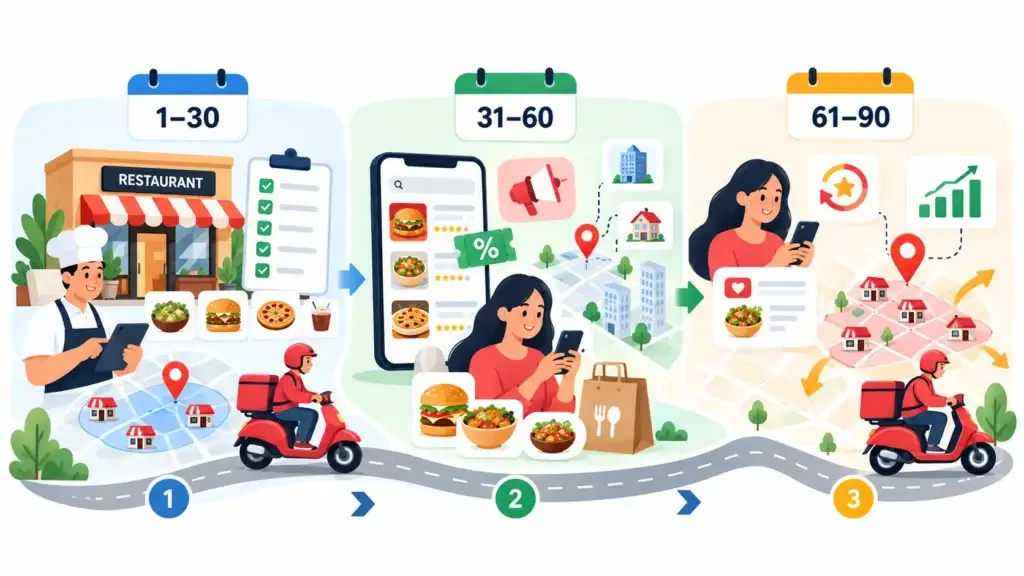
A food delivery platform can use a phased growth plan instead of trying to solve everything at once.
Days 1–30: Supply Foundation
During the first month, focus on restaurant quality and operational readiness.
Priorities:
- Choose one dense delivery zone
- Onboard the first set of reliable restaurants
- Build cuisine variety across daily-use categories
- Verify menus, pricing, photos, and opening hours
- Train restaurants on order acceptance and preparation updates
- Test delivery partner availability during lunch and dinner
- Run internal test orders before public campaigns
The goal is to make sure the first customer experience is strong enough to repeat.
Days 31–60: Local Demand Activation
Once supply is stable, start controlled demand generation.
Priorities:
- Launch location-specific first-order offers
- Promote through restaurant partners
- Target apartment clusters and office areas
- Use meal-time campaigns for lunch and dinner
- Track conversion from app visit to first order
- Watch cancellation, delay, and refund patterns
- Adjust offers based on basket size and repeat behavior
The goal is not just to increase orders. It is to understand which customers and restaurants create healthy order loops.
Days 61–90: Retention and Expansion Readiness
Once orders begin to repeat, shift focus toward retention and zone learning.
Priorities:
- Add reorder prompts and favorite restaurant flows
- Create loyalty offers for second and third orders
- Identify top-performing restaurants
- Improve delivery partner allocation
- Review zone-level profitability
- Expand restaurant categories where demand is missing
- Decide whether to deepen the current zone or open the next one
The goal is to scale from evidence, not excitement.
Internal Growth Framework: Supply, Demand, Repeat
A simple food delivery growth framework can be built around three questions:
1. Supply: Can users find what they want?
If not, improve restaurant quality, menu completeness, cuisine coverage, operating hours, and local favorites.
2. Demand: Are the right users discovering the platform?
If not, improve local SEO, restaurant-led promotion, office and residential partnerships, referral design, and time-based campaigns.
3. Repeat: Are users coming back without heavy discounts?
If not, improve delivery reliability, reorder convenience, personalization, support experience, and loyalty logic.
This framework keeps growth practical. It helps founders avoid chasing surface metrics while ignoring the marketplace mechanics that actually create long-term value.
Miracuves Perspective: Growth Needs Both Strategy and Product Control
A food delivery business grows when strategy and software support each other. A founder can design excellent campaigns, but if the platform cannot manage zones, restaurant performance, delivery workflows, payments, offers, and reporting, execution becomes slow.
Miracuves helps founders launch faster with white-label delivery app solutions that can be customized for local food delivery models. The advantage is not only speed. It is the ability to start with a working operational base and spend more founder energy on restaurants, customers, delivery performance, and repeat orders.
If you are planning to launch or expand an on-demand food delivery platform, a multi-zone delivery app setup can help you test local demand faster while keeping operational control in one place.
Final Thoughts
Food delivery growth is not driven by promotions alone. Ads and discounts can bring users in, but long-term growth depends on active restaurant supply, reliable delivery coverage, local demand, and repeat orders.
Founders should focus on building strong delivery zones before expanding too widely. The goal is to onboard the right restaurants, create enough local demand, maintain delivery reliability, and give customers a reason to order again.
This is where a strong product foundation also matters. When the platform has the right restaurant tools, delivery workflows, admin controls, offer management, and reporting systems, founders can make better growth decisions instead of depending only on guesswork.
The stronger strategy is simple: build supply before demand, build density before expansion, and build repeat orders before scaling marketing spend.
FAQs
What is the best growth strategy for an on-demand food delivery platform?
The best growth strategy is to build one strong delivery zone at a time. Start with reliable restaurant supply, create local demand through targeted campaigns, maintain delivery reliability, and encourage repeat orders through personalization, loyalty, and reorder convenience.
How do food delivery platforms get more restaurants?
Food delivery platforms can get more restaurants by offering clear commission terms, simple onboarding, menu management tools, reliable payouts, local demand generation, and visibility inside the app. Restaurants join faster when they see real order potential and operational support.
Why are repeat orders important in food delivery?
Repeat orders reduce dependence on paid acquisition. If customers order again without needing heavy discounts every time, the platform has stronger retention, better demand predictability, and healthier long-term economics.
Should a food delivery platform expand city-wide immediately?
Founders should consider a ready-made platform when they want to launch faster, test real market demand, onboard restaurants quickly, and operate with customer, restaurant, delivery, and admin workflows already prepared.
What metrics should founders track after launch?
Founders should track active restaurants, order acceptance rate, preparation time, first orders, repeat orders, late deliveries, delivery cost per order, refunds, cancellations, and zone-level performance.
How can local demand be created for a food delivery app?
Local demand can be created through restaurant-led promotions, apartment and office campaigns, local SEO, referral offers, first-order incentives, meal-time push notifications, and partnerships in high-density areas.
When should founders consider a ready-made food delivery platform?
Founders should consider a ready-made platform when they want to launch faster, test real market demand, onboard restaurants quickly, and operate with customer, restaurant, delivery, and admin workflows already prepared.
How does Miracuves support food delivery platform founders?
Miracuves helps founders build ready-made and white-label delivery platforms with source code, branding, admin dashboards, restaurant workflows, delivery partner apps, and faster solution delivery so they can focus more on growth execution.
Miracuves is an independent software development company. We are not affiliated with, connected to, sponsored by, or endorsed by any company or product named in this article.
Terms such as “X Clone” are used descriptively. It is how the software industry refers to building a platform with functionality comparable to a known service, and how clients search for it.
The entire design and codebase of our products is built by our own team. Our products contain no code, design, graphics, or content originating from any third-party website or applications.
All third-party names and marks referenced in this article are the property of their respective owners, referenced solely to identify the services discussed.