


Key Takeaways
- An on-demand food delivery platform architecture should connect customer ordering, restaurant operations, rider dispatch, live tracking, payments, notifications, refunds, payouts, and admin management.
- Core backend services can include order management, restaurant APIs, dispatch logic, location tracking, payment orchestration, databases, caching, event queues, notifications, and analytics.
- A modular architecture allows ordering, restaurant, delivery, and payment services to scale independently while keeping menus, order status, rider activity, and financial records synchronized.
Architecture & Fulfillment Signals
- The ordering layer should manage restaurant discovery, menus, item availability, carts, pricing, coupons, checkout, order validation, customer addresses, and status updates.
- Dispatch services can use rider availability, preparation time, delivery zones, distance, active workloads, batching rules, and route conditions to assign orders efficiently.
- Live tracking can combine GPS updates, geofencing, ETA calculations, event streams, push notifications, and real-time order states so customers, restaurants, riders, and operators share the same delivery view.
Payments & Restaurant Operations Insights
- Payment services should coordinate customer charges, taxes, delivery fees, discounts, restaurant commissions, refunds, rider earnings, payout records, and transaction reconciliation.
- Restaurant operations should support onboarding, menu updates, item availability, order acceptance, preparation status, operating hours, promotions, cancellations, earnings, and payout management.
- Miracuves develops customizable on-demand food delivery platforms with ordering, restaurant management, dispatch, live tracking, payments, commissions, payouts, analytics, integrations, and admin controls.
An on-demand food delivery platform looks simple from the outside. A customer opens the app, chooses a restaurant, places an order, tracks the rider, and receives the food.
For readers who are still learning how large multi-service delivery platforms work, this guide on how food ordering and delivery marketplace platforms operate gives useful background before going deeper into platform architecture.
Behind that simple journey is a complex operating system.
A strong food delivery platform must connect customers, restaurants, delivery partners, payments, dispatch logic, support teams, and admin controls in real time. If any part of this architecture is weak, the business starts leaking revenue through failed orders, delayed preparation, poor rider assignment, refund disputes, inaccurate menus, or payment reconciliation issues.
That is why founders should not think of a food delivery app as only a customer-facing mobile application. The real product is the full delivery operating layer: ordering, restaurant workflows, dispatch, tracking, payments, payouts, support, reporting, and platform governance. Founders evaluating food delivery app development services should look beyond app screens and check whether the platform can manage real ordering, restaurant, rider, payment, and admin workflows together.
This guide breaks down the core architecture of an on-demand food delivery platform and explains what founders should understand before building, buying, or customizing a launch-ready delivery solution.
What Is On-Demand Food Delivery Platform Architecture?
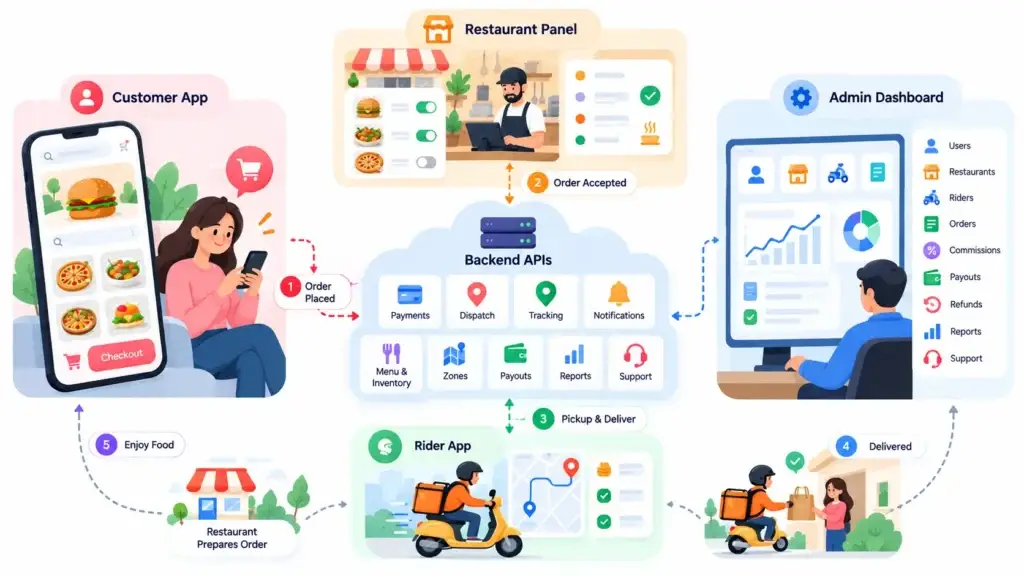
On-demand food delivery platform architecture is the technical and operational structure that allows customers, restaurants, riders, and admins to work together inside one delivery ecosystem.
It includes the visible interfaces users interact with, such as mobile apps and web ordering screens. It also includes the invisible backend logic that controls order routing, delivery zones, payment status, restaurant availability, payout records, notifications, taxes, commissions, refunds, and operational reporting.
A complete platform usually includes:
- Customer app or web ordering storefront
- Restaurant dashboard or store panel
- Delivery partner application
- Admin dashboard for platform operators
- Backend APIs
- Payment gateway integrations
- Real-time tracking system
- Dispatch and order allocation engine
- Menu and inventory management
- Commission, payout, and reporting modules
- Notification and support workflows
For founders, this matters because food delivery is an execution-heavy business. The app does not only need to look polished. It must keep orders moving accurately from cart to kitchen to rider to customer.
Why Architecture Matters More Than App Screens
Many founders begin with screens. They ask what the homepage should look like, how restaurant cards should appear, or what filters customers should use.
Those details matter, but they are not the foundation.
The stronger question is: what happens after a customer places an order?
The platform must check whether the restaurant is open, whether the customer address falls inside a serviceable delivery zone, whether the selected items are available, whether payment is successful, whether the restaurant accepts the order, whether a delivery partner can be assigned, whether tracking updates are visible, and whether the payout records are accurate.
If that chain breaks, the customer experience breaks.
A beautiful interface cannot fix poor dispatch logic. A polished restaurant listing cannot fix inaccurate preparation times. A discount campaign cannot fix failed payment callbacks. This is why platform architecture should be planned before design polish.
Core Modules of an On-Demand Food Delivery Platform
A scalable food delivery platform normally works through four connected product layers: customer, restaurant, delivery partner, and admin.
Each layer needs its own workflows, permissions, and data visibility.
| Platform Layer | Core Function | Business Value |
|---|---|---|
| Customer App | Ordering, search, checkout, tracking, support | Drives demand and repeat orders |
| Restaurant Panel | Menu control, order acceptance, preparation, payouts | Keeps supply active and accurate |
| Delivery Partner App | Job acceptance, route view, status updates, proof of delivery | Controls fulfillment speed and delivery visibility |
| Admin Dashboard | Users, restaurants, zones, commissions, payments, reports | Gives the operator control over the entire marketplace |
The best architecture connects these modules without making them dependent on manual coordination. A restaurant should not need to call support to update a menu. A rider should not need manual assignment for every order. An admin should not need spreadsheets to calculate payouts.
Before finalizing the product scope, founders should map these layers against the core food delivery platform features needed across customer ordering, restaurant control, delivery partner workflows, payment handling, and admin-level operations.
Customer Ordering Architecture
The ordering layer is where demand enters the platform.
A customer ordering flow usually includes location detection, restaurant discovery, menu browsing, cart management, promo code application, payment selection, order confirmation, tracking, ratings, and support.
The important architectural decision is that ordering should be location-aware. Customers should only see restaurants that can actually deliver to their address. This prevents failed checkouts, inaccurate delivery promises, and support tickets caused by unavailable restaurants.
A strong ordering architecture includes:
- Address-based restaurant availability
- Cuisine, rating, price, and delivery-time filters
- Menu categories and item-level customization
- Add-ons, variations, toppings, notes, and special instructions
- Cart validation before checkout
- Promo codes and loyalty rules
- Tax, packaging fee, platform fee, and delivery fee calculation
- Multiple payment methods
- Order status visibility
- Support access from the order screen
For food delivery founders, the ordering flow should reduce uncertainty. Customers need to know what is available, how long delivery may take, what they are paying for, and what happens after checkout.
Restaurant Operations Architecture
Restaurant operations are one of the most important parts of a food delivery platform. If restaurant workflows are weak, the customer app will eventually suffer.
A restaurant panel should allow store owners or branch managers to control their daily operations without depending on the platform team for every small update.
Important restaurant-side workflows include:
- Menu creation and editing
- Item availability
- Add-ons and variations
- Opening hours and holiday schedules
- Order acceptance or rejection
- Preparation status updates
- Printed tickets or kitchen order slips
- Packaging notes
- Counter orders where relevant
- Payout and settlement history
- Staff access controls
The business value is simple: restaurants need control, but the platform operator needs governance.
Restaurants should be able to manage menus and operations, while admins should still control approval rules, commission logic, payout cycles, service areas, and quality standards.
Delivery Dispatch Architecture
Dispatch is the engine that decides how orders move from restaurants to customers.
In early-stage food delivery businesses, dispatch may start manually. But once order volume grows, manual assignment becomes slow, inconsistent, and expensive. Automated or semi-automated dispatch helps the platform assign orders based on practical delivery conditions.
A dispatch system may consider:
- Rider availability
- Rider location
- Restaurant location
- Customer location
- Delivery zone
- Current rider workload
- Vehicle type
- Cash handling limits
- Estimated pickup time
- Distance and route logic
- Order priority
- Failed assignment fallback
The goal is not only to assign a rider quickly. The goal is to assign the right rider without increasing delivery cost, delay risk, or customer dissatisfaction.
For multi-zone platforms, dispatch should also respect service boundaries. A rider assigned to one zone should not be overloaded with orders from another area unless the business intentionally allows cross-zone delivery.
Real-Time Tracking Architecture
Real-time tracking gives customers confidence and gives operators visibility.
Tracking should not be treated as a decorative map feature. It is an operational trust layer that helps customers understand where their order is, helps support teams investigate delays, and helps admins monitor delivery performance.
A practical tracking system includes:
- Order accepted
- Food preparation started
- Rider assigned
- Rider reached restaurant
- Order picked up
- Rider en route
- Delivered
- Cancelled or failed delivery, where applicable
The delivery partner app should send location updates at controlled intervals. The customer app should display meaningful progress without overwhelming the backend with unnecessary location requests.
The admin dashboard should also show order movement so support teams can resolve issues faster.
Payment Architecture for Food Delivery Platforms
Payments in food delivery are more complex than simple online checkout.
A platform may need to support online payments, wallets, cash payments, refunds, coupon deductions, restaurant payouts, delivery partner earnings, commissions, taxes, and platform fees.
A strong food delivery payment architecture should include:
- Card and digital payment gateway integration
- Cash payment support where the market requires it
- Wallet or credit balance
- Failed payment handling
- Payment callback verification
- Refund workflows
- Commission calculation
- Restaurant payout statements
- Delivery partner earnings
- Tax and fee breakdowns
- Admin-level payment reporting
For founders, the biggest payment risk is not only whether money is collected. It is whether the platform can reconcile what happened after the order.
Who paid? Which method was used? What was the restaurant share? What was the platform commission? What does the rider owe in collected cash? Was a refund issued? Was the payout already processed?
These questions should be answerable from the system, not from manual spreadsheets.
Admin Dashboard Architecture
The admin dashboard is the control center of the food delivery business.
It allows the platform operator to manage customers, restaurants, delivery partners, zones, payments, commissions, support, reports, and settings from one place.
A strong admin layer should include:
- User management
- Restaurant onboarding and approvals
- Delivery partner verification
- Service zone management
- Order monitoring
- Payment and refund controls
- Commission and fee settings
- Promo and coupon management
- Dispute management
- Notification templates
- Role-based access control
- Analytics and reports
Without a strong admin dashboard, founders lose control as the business grows. Every operational issue becomes manual. Every pricing change needs developer help. Every dispute requires scattered data.
The admin layer should help operators change business rules without rewriting code for every small adjustment.
Delivery Zones and Service Area Logic
Delivery zones decide where restaurants can serve, how delivery fees are calculated, which riders are available, and what payment options apply.
A weak platform may treat location as a simple city or area name. A stronger platform uses service zones, radius rules, or map-based coverage logic.
Zone-based architecture can support:
- Restaurant availability by customer address
- Delivery fee calculation by area
- Different commission settings by market
- Payment method availability by region
- Delivery partner allocation by zone
- Cash handling limits by area
- Local notification and language settings
- Expansion into new areas without rebuilding the platform
For founders planning to operate in more than one city, district, or country, zone logic is not a minor feature. It becomes part of the business model.
Restaurant Menu and Catalog Architecture
Food delivery menus are more complex than static product lists.
Restaurants may need different item sizes, toppings, add-ons, spice levels, preparation notes, scheduled availability, sold-out items, combo meals, and category-level organization.
A good menu system should support:
- Menu categories
- Item images and descriptions
- Variations and add-ons
- Item availability
- Scheduled menus
- Preparation time
- Allergen or ingredient notes where relevant
- Pricing changes
- Restaurant-level editing
- Admin approval where needed
If the menu architecture is too rigid, restaurants struggle to operate accurately. If it is too loose, customers may see inconsistent options or place orders that cannot be fulfilled.
The right balance is restaurant flexibility with admin governance.
Notification Architecture
Notifications keep the marketplace synchronized.
Customers need updates about order status. Restaurants need alerts for new orders. Delivery partners need job assignments. Admins may need alerts for cancellations, payment failures, disputes, or delayed orders.
Common notification channels include:
- Push notifications
- SMS
- In-app notifications
- WhatsApp or local messaging integrations where relevant
The architecture should allow notification templates to be edited without changing code. This is especially useful when expanding into markets with different languages, order expectations, or customer communication styles.
Support and Dispute Architecture
Food delivery platforms need support workflows because issues are unavoidable.
Orders can be delayed. Items may be missing. Restaurants may reject orders. Riders may be unreachable. Payments may fail. Customers may request refunds.
A practical support architecture includes:
- Order-linked support tickets
- Customer complaint categories
- Restaurant issue reporting
- Delivery partner issue reporting
- Refund request workflows
- Admin notes
- Dispute history
- Proof of delivery
- Chat or call masking where relevant
The goal is not only to solve complaints. The goal is to keep a clear operational record so the platform can identify repeated problems and improve the system.
Security and Access Control
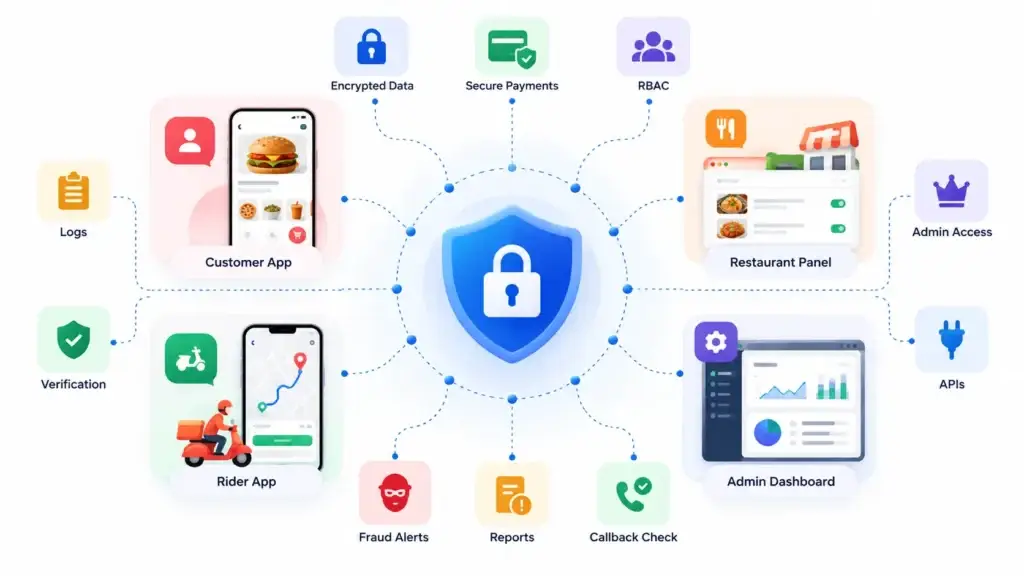
Food delivery platforms handle customer profiles, addresses, payment activity, restaurant data, delivery partner records, and operational reports. Security should be part of the foundation.
Important security layers include:
- Encrypted data transfer
- Secure payment gateway integration
- Role-based access control
- Admin permission management
- Activity logs
- Restaurant and delivery partner verification
- Secure API integration
- Fraud monitoring signals
- Abuse reporting
- Payment callback validation
For founders, security is not only a technical concern. It protects trust across customers, restaurants, delivery partners, and platform operators. A detailed food delivery app security architecture should cover payment safety, admin permissions, restaurant access, delivery partner verification, secure APIs, activity logs, and controlled access to sensitive customer data.
Monetization Architecture
Food delivery monetization should be built into the platform logic from the beginning. Once the technical workflows are clear, founders should connect them with a practical food delivery business model that covers commissions, delivery fees, featured listings, subscriptions, service fees, restaurant payouts, and delivery partner earnings.
Common revenue streams include:
| Revenue Stream | How It Works | Why Architecture Matters |
|---|---|---|
| Restaurant Commission | Platform takes a percentage from each order | Needs accurate order and payout records |
| Delivery Fees | Customer pays delivery charges based on distance or zone | Needs location and fee calculation logic |
| Subscription Plans | Restaurants pay for premium visibility or platform access | Needs billing and plan management |
| Featured Listings | Restaurants pay for higher placement | Needs controlled promotion rules |
| Advertising | Brands or restaurants pay for in-app placements | Needs campaign and reporting controls |
| Service Fees | Platform adds a small fee to each order | Needs transparent checkout calculation |
| Wallet Revenue | Users preload funds or receive credits | Needs wallet ledger accuracy |
A food delivery platform should not hard-code monetization into one fixed model. Founders may need to adjust revenue streams as they learn how customers, restaurants, and delivery partners behave.
Ready-Made vs Custom Food Delivery Architecture
Founders usually face two build paths: start from zero or use a launch-ready foundation. A white-label food delivery app can be useful when founders want branded customer ordering, restaurant management, delivery workflows, live tracking, payment flows, and admin controls without building every standard module from zero.
A fully custom build gives maximum flexibility, but it takes longer because every core workflow must be designed, developed, tested, and connected. A ready-made food delivery foundation can reduce launch time because major workflows already exist and can be customized around branding, business rules, integrations, and market needs.
| Build Option | Best For | Main Advantage | Main Risk |
|---|---|---|---|
| Custom Development | Complex or highly unique delivery models | Deep flexibility | Longer timeline and higher execution risk |
| Ready-Made Platform | Founders who want faster market validation | Faster launch with proven modules | Needs careful customization to match business rules |
| SaaS Tool | Small restaurants testing basic ordering | Low initial setup complexity | Limited backend control and ownership |
| White-Label Source-Code-Owned Platform | Operators who want branding, control, and faster deployment | Strong balance of speed and ownership | Requires proper setup, training, and operational planning |
For many founders, the smartest approach is not to rebuild standard ordering, dispatch, payment, and restaurant workflows from zero. It is to start with a working foundation and customize the parts that make the business different. If budgeting is a key decision factor, founders can review the main food delivery platform development cost factors before choosing between custom development, white-label deployment, or a ready-made delivery foundation.
Miracuves helps founders build white-label food delivery platforms with customer, restaurant, delivery partner, and admin modules. For suitable ready-made scopes, Miracuves can support 6-day solution delivery, giving founders a faster path to launch, validate demand, and improve based on real market feedback.
Founder Decision Signals
Speed
If your goal is to test demand quickly, a ready-made delivery foundation can reduce the time spent rebuilding standard ordering, dispatch, tracking, and payment workflows.
Control
If you need to manage restaurants, zones, commissions, payouts, and delivery rules yourself, admin control and source-code ownership become important.
Scalability
If you expect peak-hour order spikes, the backend should support queues, payment callbacks, dispatch logic, and order status updates without operational breakdowns.
Market Fit
If your market has cash payments, local delivery zones, multi-branch restaurants, or language requirements, the platform should be configurable from day one.
Mistakes Founders Should Avoid
Building Only the Customer App
A customer app without restaurant, delivery, admin, and payment workflows is not a complete delivery platform. The customer interface creates demand, but the backend fulfills it.
Ignoring Restaurant Operations
If restaurants cannot update menus, manage availability, accept orders, track payouts, or control preparation workflows, the platform becomes difficult to operate at scale.
Treating Dispatch as an Afterthought
Dispatch affects delivery time, rider productivity, customer satisfaction, and order cost. Poor assignment logic can damage the business even when demand is strong.
Not Planning Payment Reconciliation
Payment collection, refunds, cash handling, restaurant payouts, and delivery partner earnings must be traceable. Manual reconciliation becomes risky as order volume grows.
Using a Platform Without Admin Flexibility
Founders need to change zones, fees, commissions, restaurant settings, payment methods, and promotions. If every change requires development work, growth becomes slower.
When Should Founders Choose a Launch-Ready Delivery Platform?
A launch-ready delivery platform is useful when the founder already knows the business model and wants to move faster without rebuilding standard delivery workflows from zero. Working with a focused food delivery platform development partner can help align the architecture with real operating needs such as delivery zones, restaurant onboarding, rider workflows, payment reconciliation, admin reporting, and post-launch customization.
It is especially useful for:
- Food delivery startups
- Cloud kitchen networks
- Restaurant chains
- Multi-restaurant marketplaces
- Regional delivery operators
- Grocery and essentials delivery businesses
- Local delivery entrepreneurs
- Franchise-based food businesses
- Operators expanding into multiple service zones
A ready-made platform does not mean every business becomes identical. The foundation handles common workflows. The differentiation comes from branding, restaurant supply, delivery operations, pricing strategy, local market positioning, customer retention, and operational execution.
Founders exploring a branded, launch-ready delivery marketplace can review Miracuves’ready-made multi-market delivery platform to understand how ordering, delivery zones, restaurant workflows, live tracking, payments, and admin control can work together inside one source-code-owned system.
Miracuves Perspective: Build the Operating System, Not Just the App
The strongest food delivery platforms are not built around screens alone. They are built around operational flow.
A customer order should trigger restaurant preparation, delivery assignment, payment confirmation, live tracking, support visibility, payout records, and reporting without manual chaos.
That is the real value of platform architecture.
Miracuves helps founders launch food delivery platforms with ready-made and white-label app foundations that can include customer apps, restaurant panels, delivery partner workflows, admin dashboards, payment integrations, source-code ownership, and faster deployment. For suitable ready-made delivery scopes, the solution can be delivered in 6 days, helping founders move from planning to market testing faster.
After the platform architecture is ready, founders also need a clear acquisition and retention plan. A practical food delivery app growth strategy can help connect product readiness with customer acquisition, restaurant onboarding, repeat orders, and local market expansion.
Final Thoughts
An on-demand food delivery platform is not just a mobile app. It is a connected operating system for customers, restaurants, delivery partners, payments, support teams, and platform operators.
The customer sees a simple order flow. The founder needs a reliable architecture behind that flow.
Ordering must be location-aware. Restaurants need control over menus and preparation. Dispatch must assign the right delivery partner. Tracking must build trust. Payments must reconcile accurately. Admins need visibility and control. Without these layers, the business becomes harder to scale.
For founders, the better decision is not always the longest build. It is the build that gives the business enough control, speed, and flexibility to launch, learn, and improve.
FAQs
What is on-demand food delivery platform architecture?
On-demand food delivery platform architecture is the structure that connects customer ordering, restaurant operations, delivery dispatch, tracking, payments, admin control, and backend workflows inside one system.
What modules are needed in a food delivery platform?
A complete platform usually needs a customer app, restaurant panel, delivery partner app, admin dashboard, backend APIs, payment integrations, dispatch logic, tracking, notification workflows, and reporting tools.
Why is restaurant operations architecture important?
Restaurant operations architecture allows restaurants to manage menus, item availability, order acceptance, preparation status, staff access, and payout history. Without it, platform teams are forced to manage too many workflows manually.
How does dispatch work in a food delivery platform?
Dispatch assigns orders to delivery partners based on factors such as rider availability, location, delivery zone, restaurant pickup point, customer address, workload, and order priority.
Why do food delivery platforms need real-time tracking?
Real-time tracking improves customer trust, helps support teams handle delays, and gives admins visibility into order movement from restaurant acceptance to final delivery.
What payment features should a food delivery platform include?
A food delivery platform should support online payments, cash payments where relevant, wallet balances, refunds, payment callbacks, commission calculation, restaurant payouts, delivery partner earnings, and admin-level reporting.
Is a ready-made food delivery platform better than custom development?
A ready-made platform is useful when founders want faster launch and already need standard delivery workflows such as ordering, dispatch, tracking, restaurant management, and payments. Custom development is better when the business model is highly unique and requires deep product invention from zero.
Can Miracuves help launch a food delivery platform quickly?
Yes. Miracuves provides ready-made and white-label food delivery platform solutions with source-code ownership, admin control, delivery workflows, payment integrations, and 6-day solution delivery where the selected scope fits.
Miracuves is an independent software development company. We are not affiliated with, connected to, sponsored by, or endorsed by any company or product named in this article.
Terms such as “X Clone” are used descriptively. It is how the software industry refers to building a platform with functionality comparable to a known service, and how clients search for it.
The entire design and codebase of our products is built by our own team. Our products contain no code, design, graphics, or content originating from any third-party website or applications.
All third-party names and marks referenced in this article are the property of their respective owners, referenced solely to identify the services discussed.



