


Key Takeaways
- Two platforms can serve the same city and the same restaurants and still be different businesses, because the cost of an order is decided by the path the diner took to arrive.
- A discovery-led platform spends on engineers and catalogue operations and keeps an indexable asset; a logistics-led platform spends on media and discounts and keeps a delivery operation that must be funded again next month.
- Halve the marketing budget and look at order volume ninety days later: a discovery-led platform degrades slowly, a logistics-led platform degrades within a fortnight, and that single test tells you which business you actually own.
- Supply behaves differently too, because a discovery-led platform can list a restaurant before it partners with one, while a logistics-led platform needs a signed, live and integrated partner before anything works.
- Start the discovery engine first in most markets, because paid acquisition can be switched on in a week at any point while catalogue age can never be purchased, only accumulated.
Growth Engine Signals
- Run the ninety-day test on paper before you commit a year of hiring to one engine.
- Track weekly the share of orders that arrived through an unpaid channel with no promotional credit.
- Start the catalogue on day one, because calendar time is the only input you cannot buy later.
- Fix a thin destination page before you increase the budget pointing traffic at it.
- Hire for the engine you chose, not for the engine you personally admire.
Real Insights
- The order table cannot tell you which orders were earned and which were bought, which is why founders misread their own growth for years.
- Ratings and rankings accumulate while impressions evaporate, so the two engines are not fast and slow versions of the same thing.
- A compounding asset that begins compounding after you run out of money is worth nothing, so the discovery route is cheaper only if you can wait.
- Delivery speed is a real advantage that a funded competitor can match in one quarter, while a catalogue and a ranking position take years to overtake.
- Miracuves builds restaurant discovery and delivery platforms with indexable listings and catalogue structure in place from the start, deployed in 6 days for eligible ready-made scopes.
Two platforms operate in the same city. They carry largely the same restaurants, the same menus and the same Friday evening. A diner opens one, a diner opens the other, and both get a biryani in thirty five minutes. From the street, they look like the same business.
Behind the first order they are nothing alike. On the first platform, the diner arrived from a search for the best biryani in a named neighborhood, landed on a cuisine page that has been indexed for eight months, read four recent ratings and ordered. The platform spent nothing that evening to win that order.
On the second platform, the diner arrived from a paid click and used a first-order discount. The platform paid twice, once for the click and once for the discount, before a single rupee of commission existed. Both orders look identical in the order table. They are not identical in the ledger, and they are not remotely identical in what they leave behind.
That difference is the whole subject here. A food delivery and restaurant discovery app earns its traffic and compounds it. A hyperlocal delivery platform buys its traffic and defends it with speed. Both models work. They need different teams, different balance sheets and different amounts of patience, and choosing the wrong one for your city is an expensive way to learn which is which.
Zomato and Swiggy built the same category in the same cities on two different growth models, and their cost structures diverged accordingly.
Zomato vs Swiggy: Two Cost Structures in One City
Zomato and Swiggy are the clearest illustration, because they competed in overlapping cities at a similar scale.
The cost of an order is decided long before checkout. It is decided by the path the diner took to arrive, and that path was either built once and reused, or bought fresh that evening.
The Order That Cost Nothing To Win
The indexed cuisine page was written once. It was structured so a search engine could read it, linked from a category, filled with listings that carry ratings and photographs, and then left alone. It has been returning diners for months.
The marginal cost of tonight’s order through that page is close to zero. The page was expensive to create and is nearly free to run. That is the definition of an asset rather than an expense, and it is the reason a food delivery solution built around a catalogue behaves so differently from one built around a campaign.
The Order That Cost a Click and a Coupon
The paid order is the mirror image. The click was auctioned that evening at whatever the market demanded, the discount came out of the platform’s own pocket, and neither cost is recoverable if the diner never returns.
What is worse, the cost does not fall with repetition. The thousandth paid order costs roughly what the first one did, and often more, because the cheapest audience is bought first. The catalogue page gets cheaper per order every month. The campaign does not.
Both orders appear in the same table with the same fields. Nothing in the order record tells an operator which one was free and which one was bought. That blindness is the single most common reason founders misread their own growth for the first two years.
Why the Restaurant Discovery Engine Compounds Over Time
A discovery-led platform treats organic search as a first-class channel and the catalogue as the thing that earns it. Every listing is a page. Every cuisine, every category, every neighborhood is a page. The build is designed so those pages can be read, indexed and ranked, which is a product decision rather than a marketing task.
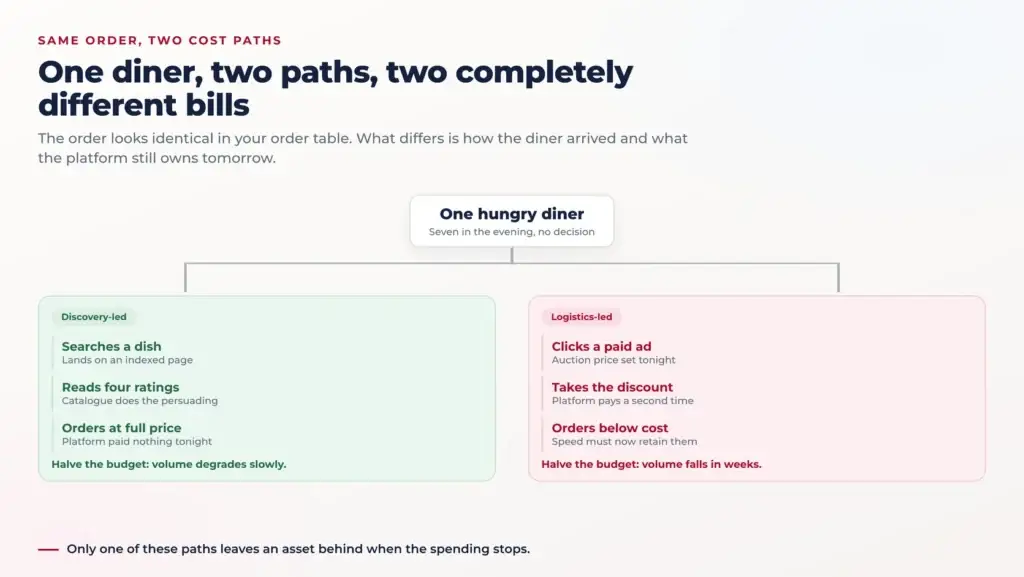
Image Source: AI-generated visual by Miracuves
The Catalogue Is the Marketing Budget
On this model, money that would have gone to media goes to engineers, editors and catalogue operations instead. Somebody writes the cuisine descriptions. Somebody structures the taxonomy so a restaurant sits in the right categories. Somebody keeps opening hours honest so a ranked page does not send a diner to a closed kitchen.
The output of that spending is an indexable storefront that keeps working after the people who built it have gone home. The features page describes how listings, filters and ratings are wired together to make that possible.
Ratings Accumulate, Advertising Does Not
Ratings are the clearest example of compounding. A listing with two hundred reviews is not twice as good as one with a hundred. It is qualitatively different, because it now survives one bad night, it ranks better inside your own filters, and it gives a hesitant diner a reason to choose it.
Nothing in a paid campaign behaves that way. Last month’s impressions do not make this month’s impressions cheaper. The two engines are not slow and fast versions of the same thing. One accrues and one evaporates.
Why the Logistics-Led Engine Starts Faster Than Discovery
A hyperlocal delivery platform solves the same problem from the other end. It does not wait to be found. It buys attention, converts it with an offer, and then tries to make the experience good enough that the diner comes back without being paid for a second time.
The Promotion Is the Front Door
The first-order discount is not a marketing flourish on this model. It is the front door. It exists because a new platform has no reputation, no reviews and no reason to be trusted, and a discount is the cheapest available substitute for all three.
It works, and it works quickly. A funded operator can go from zero to several hundred orders a day in a single neighborhood inside a quarter. No discovery-led platform can match that timeline, and pretending otherwise is dishonest.
Speed Is the Retention Mechanism
Once the discount is gone, something has to keep the diner. On a logistics-led platform that something is arrival time. Food that shows up hot and early is the entire retention argument, which is why the operational effort concentrates there and why a slow week reads immediately as churn.
That is a legitimate strategy with a real product behind it. The practical work of holding it together at volume is covered in How to Keep Restaurants, Riders, and Customers Happy Simultaneously, and there is no need to repeat it here.
What founders miss is that the spend curve does not bend down on its own. Growth stays proportional to budget. The line on the chart looks like progress, but it is a rented line, and the rent is due again next month.
The Ninety-Day Test That Tells You Which Business You Own
One test settles the question, and it needs no consultant, no model and no benchmark. Cut marketing spend in half and look at order volume ninety days later. Nothing else separates the two models as cleanly.
Halve the Budget and Wait
Ninety days is chosen deliberately. It is long enough for the paid channel to fully unwind and short enough that nothing else about the business changes. Thirty days is too short, because habit carries the first few weeks and flatters a paid platform badly.
Run it properly. Hold pricing steady, hold the restaurant roster steady, change only the media budget, and do it in a normal month rather than a festival month.
Why the Discovery-Led Platform Degrades Slowly
The discovery-led platform barely notices at first. The indexed pages still rank, the ratings are still there, and the diners who found the platform through search still find it. What degrades is the top of the funnel, slowly, as new pages stop being added and existing ones age.
That is a decline you can see coming two quarters out and correct. It is a business that can be starved, but not one that switches off.
Why the Logistics-Led Platform Degrades Immediately
The logistics-led platform feels it inside a fortnight. Half the acquisition stops, the returning cohort is smaller than anyone modelled because part of it was discount-attached rather than loyal, and order density falls in exactly the neighborhoods where speed depended on density.
Say this plainly to yourself before an investor says it to you. If halving the budget halves the orders, you are running an arbitrage on media prices with a delivery operation attached. That can be a fine business. It is simply not the business most founders believe they are building.
What Discovery-Led and Logistics-Led Growth Each Pay For
Neither route is free, and it is worth being precise about what the money buys, because the two expenses land in different places on the balance sheet and behave differently when times get hard.
One Payroll Builds an Asset
The discovery-led platform pays engineers, content operations and catalogue staff. What it gets back is a structure that persists: pages, taxonomy, accumulated ratings, internal links, a crawl history. If the company were sold tomorrow, a buyer would be buying that.
Payroll feels heavier than media spend because it is harder to stop. That is precisely why it produces something durable. Commitments that cannot be switched off easily tend to be the ones that build assets, and the ones that can be switched off in an afternoon tend not to.
The Other Rents Demand by the Week
The logistics-led platform buys demand at a market price it does not set. When a larger competitor enters the same auction, the price rises and nothing about your product changed. You are a price taker in the one input your growth depends on.
The honest conclusion is narrower than the usual argument. The discovery-led route is cheaper only if you can wait. If you cannot wait, it is not cheaper at all, because a compounding asset that compounds after you run out of money is worth nothing.
Time to First Meaningful Traffic Is the Real Constraint
Founders consistently underestimate this one number, and it decides more outcomes than any other input on the discovery route. Not time to launch. Time to the first month where organic arrivals move the order graph.
What a Catalogue Needs Before It Earns Anything
Before a catalogue earns, it needs breadth, accuracy and age. Breadth so there is something to rank for. Accuracy so the pages are worth ranking. Age because trust in a domain is slow to establish and there is no way to purchase the calendar.
Most of the disappointment comes from underestimating breadth. A platform with forty listings has forty pages and a thin category structure. A platform serving several hundred listings has meaningful cuisine pages, neighborhood pages and comparison surfaces, and that is roughly where organic search starts behaving like a channel instead of a trickle.
How to Fund the Waiting Period
The waiting period has to be paid for by something, and the sensible answers are unglamorous. Launch in a narrow geography so the catalogue looks complete at a small scale. Earn from restaurant-side revenue lines that do not require a checkout. Keep the operating footprint small enough that a flat quarter is survivable.
Founders who plan a twelve-month runway for a discovery-led build and then spend eight months on features rather than catalogue coverage run out of road at precisely the moment the asset was about to start paying. Build time is not the constraint here. The delivery facts page sets out what a ready-made build covers and what sits outside it.
Where the Margin Actually Comes From
The two engines do not just acquire differently. They earn differently, and the shape of the margin explains most of the other differences between them.
Attention Monetizes Twice on One Side
A discovery-led platform sells commission on orders and sells visibility to restaurants that want to be found. Two revenue engines run on one audience, and two of the revenue lines earn when nobody checks out at all. Browsing is not wasted traffic on this model, it is inventory.
That is also where the conflict of interest lives, because the operator who sells placement also decides ranking. How that is priced and governed is its own subject, and the business model page lays out the full set of revenue lines.
Fee Margin and Order Density on the Other
A logistics-led platform earns on the delivery itself, which means margin is a function of how many orders fit inside a courier hour. Browsing earns nothing. A visitor who looks and leaves is pure cost on that model and pure inventory on the other.
How the Two Engines Earn
| Question | Discovery-led platform | Logistics-led platform |
|---|---|---|
| Who pays first | The restaurant, for visibility | The diner, for delivery |
| Revenue when nobody orders | Advertising and store subscriptions still earn | Nothing earns until checkout |
| What raises margin | More attention on the same catalogue | More orders inside the same radius |
| What a browsing visitor is | Inventory | Cost |
| The scarce resource | Ranking and reader attention | Courier hours at peak |
Supply Costs Different Money in Each Model
Customer acquisition gets all the attention, but supply acquisition is where the two models diverge earliest, and it changes what a launch actually costs.
A Listing Can Exist Before a Contract Does
A discovery-led platform can list a restaurant, show its cuisine and let diners rate it without that restaurant having signed anything. Supply arrives first, cheaply, and in volume. A small team can build a credible city catalogue before a single commercial conversation happens.
That is a growth advantage before it is anything else, because pages exist early and pages are what rank. The mechanics of unclaimed listings and converting presence into partnership are a subject of their own and not the point here.
A Delivery Order Needs a Live, Integrated Partner
A logistics-led platform cannot do that. Before the first order exists, a restaurant has to be signed, its menu structured, its prices agreed, its acceptance flow trained and its payout details verified. Nothing works until all of it is in place for that one outlet.
Every additional restaurant is a sales cycle plus an onboarding cycle. That is a linear, salaried cost of growth, and it is the reason a logistics-led launch concentrates into a small area with a short list of committed partners rather than spreading thin across a city.
Defensibility: What a Competitor Can Copy by Friday
Ask a harder question than which model grows faster. Ask which one a well-funded rival can neutralize in a quarter.
Rankings, Reviews and a Catalogue Are Slow to Copy
Ranking cannot be bought outright. Neither can four years of accumulated ratings on ten thousand listings, or the crawl history of a domain that has been consistently useful. A competitor can copy every page you have written and still not occupy your position, because the thing they need is time and reputation rather than content.
That is an uncomfortable moat to own: invisible on a feature comparison, useless in a pitch deck. It is also one of the few a smaller operator can actually build.
Speed and Discounts Are Copied With a Cheque
Delivery speed is a real advantage and a fragile one. Any competitor with funding can hire the same couriers in the same neighborhood, match the promotion, and reach parity in weeks. There is no accumulated position to overcome, only a spending decision.
This creates the asymmetry that decides many markets. A discovery-led platform under attack loses slowly and can rebuild. A logistics-led platform under attack from a better-funded rival can lose its position in a single quarter, which is why that model tends to consolidate toward whoever has the deepest pocket.
Founder Decision Signals
Speed
A logistics-led launch produces orders in weeks. A discovery-led launch produces orders in quarters. If your runway is measured in months rather than years, that gap is the decision, not a detail inside it.
Cost
One model pays salaries to build something that persists. The other pays a market price it does not control, every week, forever. Both are real costs; only one leaves an asset behind when the spending stops.
Scalability
Catalogue pages scale without proportional cost because a published page serves the ten thousandth visitor as cheaply as the first. Paid acquisition scales linearly at best, and gets more expensive as the cheap audience is consumed.
Market Fit
A sprawling city with long distances rewards discovery. A dense district with a short radius and an impatient occasion rewards logistics. Read the geography before the growth plan, not after.
Most Operators End Up Running Both Engines
In practice almost nobody runs a pure version of either model for long. A discovery-led platform eventually buys traffic for the categories where it has not earned a position. A logistics-led platform eventually notices that its listing pages get found and starts treating them as a channel.
The hybrid is not a compromise or an admission of indecision. It is what a mature operator looks like. The real question is not whether you run both. It is which one you switch on first, because the first engine sets the hiring, the architecture and the expectations for years afterward.
The Sequencing Question
Sequencing matters because the two engines are asymmetric in how easily they can be added later. Paid acquisition can be switched on in a week at any point in a platform’s life. A catalogue and a ranking position cannot be switched on at all, only grown, and the growing starts from whenever you began.
An operator who starts discovery-led and later adds paid acquisition loses nothing. An operator who starts logistics-led and decides in year three to become discoverable is starting the slow engine three years late, usually while already carrying the fixed costs of the fast one.
The Recommendation, and Why
For most operators, build the discovery engine first and buy traffic only where you can name the gap it fills. Start the catalogue on day one, because it is the only input that requires calendar time you cannot purchase, and use paid channels deliberately for a specific cuisine, a specific neighborhood or a launch week.
The reasoning is simply about what is recoverable. A quarter of paid spend you did not run can be run next quarter. A quarter of catalogue age you did not accumulate is gone permanently. When one mistake is reversible and the other is not, sequence the irreversible one first. Our food delivery app development service is usually scoped that way for exactly this reason.
When Logistics-Led Is Genuinely the Right First Engine
The recommendation above has real exceptions, and they are not edge cases. In some markets starting with the slow engine is simply the wrong answer, and an operator who follows the general advice into the wrong city will lose to someone who read the geography properly.
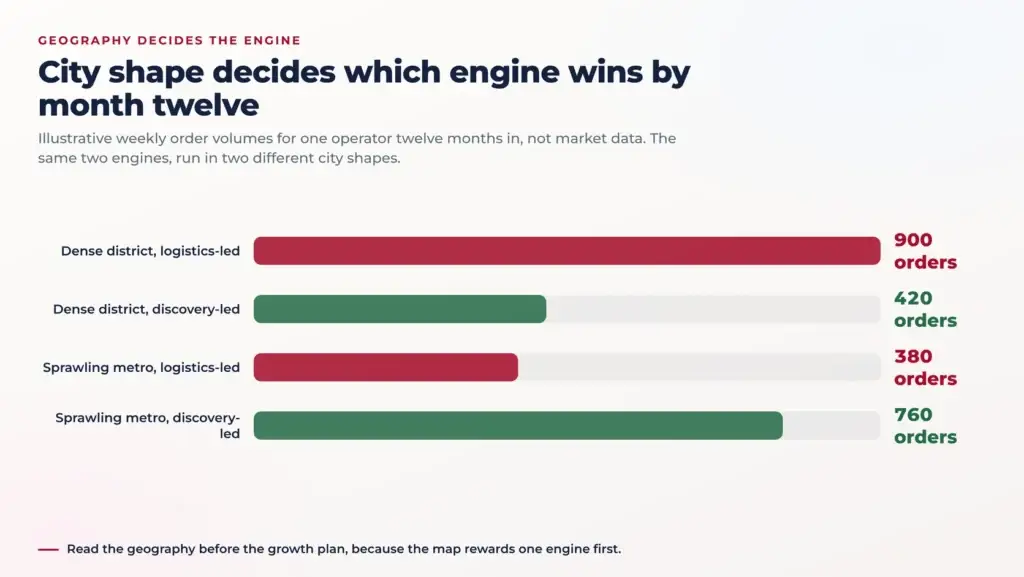
Image Source: AI-generated visual by Miracuves
A Dense District and a Narrow Radius
Where a few square kilometers contain enough restaurants and enough demand, the logistics engine becomes efficient almost immediately. Trips are short, couriers stay busy, arrival times are genuinely good, and the platform can deliver a better experience than an aggregator on its first day rather than its five hundredth.
In that setting, waiting two quarters for a catalogue to rank is not patience. It is surrendering a window where you could already have been winning.
When Speed Is the Product
Some occasions do not involve discovery at all. A late shift ending at one in the morning, an office lunch with twenty minutes left, a household with a hungry child. Nobody is browsing cuisine pages in any of those moments. They want something known, fast and reliable.
Serving occasions rather than decisions is a coherent business, and the technical demands are different too, as the load testing in Sub-2 Second Tracking: Load-Testing GPS Delivery Updates on Flutter and Laravel makes clear. If speed is the product, build for speed and stop apologizing for buying the first customers.
The Team Each Engine Needs
The models differ most visibly in who you hire, and a founder can usually tell which business a company is really running by looking at the first five names on the payroll.
Content, Search and Catalogue Operations
A discovery-led platform needs people who think about structure. Someone who owns the taxonomy. Someone who writes and keeps listing content accurate. Someone who reads search data and turns it into the next fifty pages. Engineers who treat indexability as a requirement rather than a plugin.
These hires produce nothing measurable for a quarter and then produce almost everything. They are the hardest roles to defend in a board meeting and the hardest to add late, which is discussed further on the development company page.
Performance Marketing and Fleet Operations
A logistics-led platform needs a completely different payroll. Someone who lives inside campaign dashboards and cost-per-order numbers. Someone who manages courier supply through a Friday peak. Someone who negotiates restaurant contracts in person, one outlet at a time.
These roles show results in the first month, which makes them easy to justify and easy to over-hire. Their output is also immediately visible when it stops, which is both their strength and their trap.
The Expensive Hiring Error
The common and costly mistake is hiring the wrong team first and then inheriting its instincts. A performance marketer hired into a discovery-led platform will do what they are good at and quietly convert the company into a paid business, because paid results arrive in time for the next review and catalogue results do not.
The reverse fails too. A catalogue team running a platform whose only real advantage is arrival time will optimize pages nobody reads while the courier network degrades. Hire for the engine you chose, not for the engine you admire.
Reading Your Own Channel Mix Honestly
Most operators cannot answer the question this article asks, because their reporting was never built to answer it. Fixing that is cheap and takes one reporting change rather than a rebuild.
The Share of Orders That Arrived Unpaid For
Track one number weekly: the share of orders from diners who arrived through a channel you did not pay for and used no promotional credit. That percentage is the honest measure of which engine is actually running, and watching it move over a year is more informative than any acquisition cost figure.
A blended average hides everything worth knowing. A platform where a quarter of orders are earned and three quarters are bought can report the same blended number as a healthier mix, right up until the budget is cut. The 36-Month TCO Comparison: SaaS Delivery Builders vs. Owned White-Label Engines makes a similar argument about costs that only separate over time.
Decisions That Are Hard to Reverse Later
Four build decisions quietly settle whether the discovery engine is available at all. Whether listings are real pages, whether filters produce addressable surfaces, whether a restaurant can be published before it signs, and whether ratings live inside search rather than beside it.
Each is inexpensive at the start and awkward to retrofit once a catalogue exists. An operator buying a white label delivery platform should ask about those four specifically, and the rest of the solutions catalogue is organized around the same distinction as the development cost page.
Mistakes That Make the Comparison Unfair
Most bad decisions here come from comparing the two models on the wrong timescale. These errors recur, and each one flatters whichever engine the founder already preferred.
Judging the discovery engine at month three
An indexed catalogue produces almost nothing in its first quarter and a meaningful share of orders by its second year. Measuring it against paid acquisition on a ninety day horizon compares a finished thing to an unfinished one.
Counting a discounted first order as a customer
A diner who arrived for a discount has not chosen the platform yet. Until they order a second time at full price, they are a purchased transaction. Cohorts that treat the first discounted order as retention will overstate the health of the business by a wide margin.
Treating search as a marketing task
Indexability is decided by the build. URL structure, rendering, filters that can be crawled, listing pages that exist as pages. A marketing hire cannot retrofit those decisions onto a platform that was architected as a single opaque application, whatever budget they are given.
Buying traffic for pages that do not convert
Paid acquisition into a thin catalogue is the worst of both models. The click is bought at market price and lands on a page with six listings and no ratings. Fix the destination before increasing the budget, not afterwards.
Assuming speed is a permanent advantage
Arrival time is a real advantage that a funded competitor can match in one quarter by hiring the same couriers in the same area. Planning as though a speed lead will persist without continued spending is the most common strategic error on the logistics side.
Running a hybrid without naming a primary engine
Splitting attention evenly usually produces a mediocre catalogue and an undisciplined media budget. Pick the primary engine, resource it properly, and let the second be a deliberate supplement rather than a hedge against deciding.
Final Thoughts: Decide Which Engine You Are Building
Neither Zomato nor Swiggy settled permanently on one model. The question for a new platform is which line it can afford first.
Two platforms in one city, carrying the same restaurants and the same meals, can be entirely different businesses. One earns its customers and keeps the machinery that earned them. The other buys its customers and keeps an operation that has to be fed every month. Neither is the noble choice; they are different bets on time, capital and geography.
The test stays simple. Halve the marketing budget and look ninety days later. Whatever survives is the business you actually own, and whatever disappears was rented. Run that test on paper before you commit a year of hiring to one answer, because the hiring is what makes it permanent.
If you are weighing which engine to start with for a specific city and a specific runway, that conversation is worth having before the build is scoped rather than after. Schedule a consultation and we will work through the geography, the catalogue depth you would need, and which of the two engines your market actually rewards first.
FAQs
Zomato vs Swiggy: what is the difference in growth strategy?
Discovery-led growth earns its customers through indexed listing and cuisine pages, ratings that accumulate and a catalogue that keeps working without further spending. Logistics-led growth buys customers through paid channels and first-order discounts, then uses delivery speed as the retention mechanism. Both produce orders. Only the first one leaves behind an asset that keeps producing orders after the spending stops.
Is my app running restaurant discovery or logistics-led growth?
Cut marketing spend in half and look at order volume ninety days later. A discovery-led platform barely moves at first and then declines slowly as new pages stop being added. A logistics-led platform feels it within a fortnight, because half the acquisition stopped and part of the returning cohort was attached to the discount rather than to the platform.
Why ninety days rather than thirty?
Thirty days is too short because habit carries the first few weeks and flatters a paid platform badly. Ninety days is long enough for the paid channel to fully unwind and short enough that nothing else about the business changes. Run the test in a normal month, hold pricing and the restaurant roster steady, and change only the media budget.
How long does restaurant discovery take to produce real traffic?
Longer than founders plan for. A catalogue needs breadth so there is something to rank for, accuracy so the pages are worth ranking, and age because domain trust cannot be purchased. Most of the disappointment comes from underestimating breadth: a platform with forty listings has a thin category structure, while several hundred listings produce cuisine and neighborhood pages that search can actually use.
Is restaurant discovery cheaper than paid logistics-led growth?
Only if you can wait. It replaces media spend with payroll for engineers, content and catalogue operations, and what that payroll produces is a structure that persists. But a compounding asset that begins compounding after your runway ends is worth nothing. If your runway is measured in months rather than years, the slower engine is not cheaper in any useful sense.
When is logistics-led genuinely the right first engine?
When the geography rewards it. A dense district with a short delivery radius makes couriers efficient immediately, so you can offer a better experience on day one rather than year two. The same is true for occasions where arrival time is the product, such as a late shift or a lunch break, where nobody is browsing cuisine pages at all.
Which team should I hire first?
Hire for the engine you chose. A discovery-led platform needs taxonomy ownership, content that keeps listings accurate, and engineers who treat indexability as a requirement. A logistics-led platform needs performance marketing, courier supply management and restaurant sales. A performance marketer hired into a discovery-led platform will quietly convert the company into a paid business, because paid results arrive before the next review.
Should I run both engines at once?
Most mature operators do, but the sequencing matters more than the mix. Paid acquisition can be switched on in a week at any point in a platform’s life, while a catalogue and a ranking position can only be grown from whenever you started. Build the discovery engine first, then buy traffic deliberately for a specific cuisine, neighborhood or launch week.
Miracuves is an independent software development company. We are not affiliated with, connected to, sponsored by, or endorsed by any company or product named in this article.
Terms such as “X Clone” are used descriptively. It is how the software industry refers to building a platform with functionality comparable to a known service, and how clients search for it.
The entire design and codebase of our products is built by our own team. Our products contain no code, design, graphics, or content originating from any third-party website or applications.
All third-party names and marks referenced in this article are the property of their respective owners, referenced solely to identify the services discussed.