




If your Elementor editor takes too long to load after clicking “Edit with Elementor”, feels laggy while editing, or struggles to open large pages—this is one of the most common WordPress pain points.
The good news: in most cases, the editor isn’t slow because Elementor is “bad”. It’s slow because the admin editor ends up loading far more widgets and addon resources than you actually use. Once you understand why that happens, fixing it becomes much easier.
In this guide, you’ll learn:
- The real reasons Elementor editor becomes slow in WordPress admin
- How “widget bloat” happens (even on good hosting)
- A practical checklist to speed up editing—especially for heavy pages
Common symptoms of a slow Elementor editor
You might be facing one or more of these:
- The editor takes a long time to open after clicking Edit with Elementor
- The panel and widgets load slowly
- Scrolling and selecting sections feels laggy
- Large pages (with many sections/widgets) freeze or crash
- On lower-spec laptops/PCs, Elementor becomes unusable
These symptoms usually increase as your site grows and more plugins/addons get installed.
Why Elementor editor gets slow (the real reasons)
1) Widget bloat from Elementor addon packs
Many sites install multiple Elementor addon plugins (widget packs). Each pack can add 50–200+ widgets to the Elementor panel.
Here’s the problem:
- You might use only 5–20 widgets from an addon pack
- But Elementor still loads the pack’s widgets/resources in the editor
- The editor panel becomes heavier, slower, and more memory-hungry
Over time, you can end up with hundreds of widgets loaded, even though your site uses only a small subset.
Result: slower editor loading and more lag during editing.
2) Editor loads more than you need (even for simple edits)
Elementor has to prepare the full editing environment:
- widgets list
- UI components
- templates and assets
- third-party addon integrations
That makes sense when you’re building a page from scratch.
But when you’re doing routine edits (text changes, image swaps), you don’t need a “fully loaded” environment with everything enabled.
Result: even simple edits feel heavy.
3) Heavy pages amplify the problem
If a page contains:
- many sections
- nested containers
- multiple widgets per section
- complex templates
…then Elementor needs more memory and processing to render and manage that page.
When heavy pages combine with widget bloat, the editor becomes much slower and sometimes unstable.
4) Limited resources on low-spec systems (or strict hosting limits)
Even if your site is fine on a powerful machine, Elementor editing can struggle on:
- low RAM laptops/PCs
- older CPUs
- hosting environments with tighter memory limits
Result: editor delays, freezes, or white screens.
The “Used vs Unused Widgets” reality (why most Elementor installs get slow)
This is the biggest insight that changes everything:
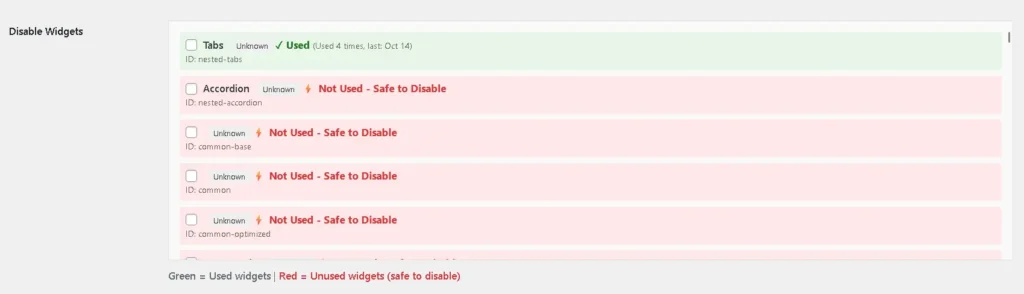
On most sites, unused widgets massively outnumber used widgets.
A typical widget usage scan often shows something like:
- Used Widgets: ~30–50
- Unused Widgets: ~300–600+
That means the editor is carrying a huge amount of “dead weight”.
Widget Usage Analytics (Used vs Unused + Potential Speed Gain)
When you reduce this bloat, the editor usually becomes noticeably faster and smoother.
Quick fixes you can do (even without any tool)
Before you do anything advanced, try these practical fixes:
1) Remove duplicate addon packs
If you have multiple addon packs doing similar things, keep only the one you actually rely on.
Examples of duplicates:
- multiple icon box widgets
- multiple button widgets
- multiple post grids
Tip: One good addon pack is often enough.
2) Update Elementor + addon plugins
Outdated addon packs can cause slowdowns, conflicts, or heavy editor scripts.
- Update Elementor
- Update Elementor Pro (if used)
- Update widget addon packs
- Remove abandoned plugins
3) Reduce unnecessary admin overhead
Even plugins unrelated to Elementor can slow the admin environment.
- disable unused plugins
- remove heavy dashboard widgets
- reduce admin bloat
4) Break giant pages into templates (if your page is huge)
If a single page is extremely long and complex:
- split sections into Elementor templates
- reuse templates
- reduce nesting where possible
This improves editor stability.
The scalable fix (best long-term solution)
Quick fixes help, but the best long-term approach is a workflow like this:
Scan → Review → Disable unused widgets (in batches)
- Scan your site to identify what widgets are actually used
- Review unused widgets (start with addon widgets)
- Disable unused widgets in small batches (20–50 at a time)
- Test key pages after each batch
- Keep only what your site uses
This reduces the editor load dramatically—especially on sites with multiple addon packs.
Instead of manually guessing which widgets to disable, the Free open-source Elementor editor optimizer gives you a structured, data-driven way to reduce editor bloat safely.
You can combine this with our Installation & usage guide to follow the correct workflow and avoid breaking layouts.
The first step is always to Scan used vs unused widgets, review the results, and then disable only what’s safe.
If you want an open-source tool to do this faster, we released:
MCX Elementor Editor Optimizer (Free + Open Source)
GitHub: https://github.com/miracuves/MCX-Elementor-Editor-Optimizer
It helps you:
- scan used vs unused widgets
- disable unused widgets safely
- manage editor-side bloat for smoother editing
Testing checklist (don’t skip this)
After disabling widgets or changing your setup, test:
- Home page
- 2–3 key pages (services/landing pages)
- 1 heavy page that previously lagged
- Elementor editor opens smoothly and widgets used on those pages still work
If anything is missing, simply re-enable the specific widget and retest.
Best practices for agencies and teams
If you work with multiple client sites, this workflow saves a lot of time:
- Run a widget usage scan on new projects
- Disable unused addon widgets first
- Keep your addon stack minimal
- Re-scan monthly (or after adding new addons)
- Use a lighter editing setup for routine edits
FAQ
Will disabling widgets break my design?
It can only if you disable a widget that’s actually used on a page. That’s why scanning and batch disabling (with testing) is the safest method.
Should I do this on staging first?
Yes, staging is best—especially for large sites. If you don’t have staging, disable in small batches and test key pages immediately.
How often should I rescan widget usage?
Re-scan whenever you:
install a new addon pack
start using new widget types
create new page templates at scale
Otherwise, once a month is a good habit.
Final thoughts
Elementor editor slowdowns are usually not a mystery—they’re often caused by widget bloat, heavy pages, and unnecessary editor-side load.
If you clean up your addon stack and disable unused widgets (with a careful workflow), Elementor editing becomes noticeably smoother—especially on heavy pages.
The Free open-source Elementor editor optimizer helps you implement this process in a structured and safe way.
Free open-source repo: https://github.com/miracuves/MCX-Elementor-Editor-Optimizer
If you find it useful, consider starring the repo and sharing feedback.