


Key Takeaways
What You’ll Learn
- A scalable TikTok clone requires backend architecture built for video-heavy traffic and real-time engagement.
- Core systems include APIs, media storage, transcoding, feeds, analytics, moderation, and notifications.
- CDN delivery, caching, and adaptive streaming are essential for smooth video playback.
- Microservices and event-driven systems help platforms scale independently across different workloads.
- The backend must handle rapid growth in uploads, views, creator activity, and viral traffic spikes.
Stats That Matter
- Short-video platforms process massive volumes of uploads, views, comments, shares, and watch-time signals daily.
- Video pipelines require upload handling, compression, transcoding, storage, and optimized streaming delivery.
- Recommendation feeds rely on fast data processing and scalable backend systems for personalization.
- Microservices architecture helps scale feeds, analytics, notifications, and moderation independently.
- Cloud infrastructure and CDN integration improve playback speed and reduce performance bottlenecks during traffic spikes.
Real Insights
- Backend architecture should be treated as a growth foundation from the beginning, not as a later upgrade.
- A modular backend makes it easier to scale video processing, feeds, moderation, and analytics separately.
- Caching frequently viewed videos helps reduce server load and improve playback performance.
- Real-time monitoring helps identify infrastructure bottlenecks before users experience lag or buffering.
- Long-term platform success depends on balancing scalability, user experience, operational efficiency, and infrastructure cost.
A scalable TikTok clone backend architecture does far more than store videos. It manages recommendation systems, media processing, engagement tracking, moderation workflows, analytics pipelines, and global video delivery simultaneously. Every user interaction — from watching a video to replaying, liking, skipping, or commenting — creates backend activity instantly.
That is why modern short-video platforms are infrastructure-first products. Frontend design may attract users initially, but backend architecture determines whether the platform can scale smoothly as traffic grows.
Today, many startups focus on scalable backend planning much earlier because infrastructure limitations quickly affect retention, playback quality, and user experience. Companies like Miracuves help startups build scalable video-first ecosystems designed for long-term growth rather than short-term MVP performance.
Why TikTok Clone Backend Architecture Matters
Short-video applications generate significantly heavier backend workloads compared to traditional social media platforms.
Unlike text-based applications, TikTok-style systems continuously process:
- Video uploads
- Streaming requests
- Feed personalization
- Recommendation updates
- Engagement tracking
- AI moderation
- Real-time analytics
Every swipe inside the app creates backend requests immediately.
As user traffic increases, infrastructure complexity grows rapidly.
Poor backend planning often causes:
- Playback buffering
- Feed lag
- Slow uploads
- Weak recommendations
- High server costs
- Platform instability
That is why scalable backend infrastructure becomes one of the most important technical foundations for modern short-video applications.
| Backend Component | Why It Matters |
|---|---|
| Video Processing | Handles uploads and streaming |
| Recommendation Engine | Personalizes feeds |
| CDN Infrastructure | Reduces playback latency |
| Analytics Pipeline | Tracks engagement behavior |
| Moderation System | Maintains platform safety |
Read More :- Best Monetization Models That Turn TikTok Clone Apps Into Revenue Engines
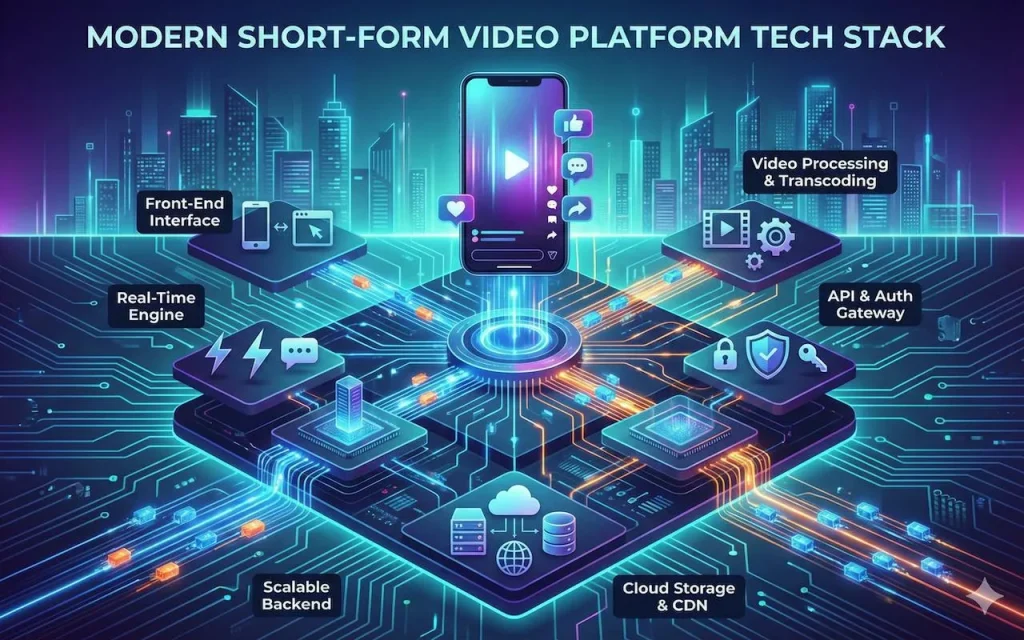
Core Layers of a Scalable TikTok Clone Backend
API Gateway Layer
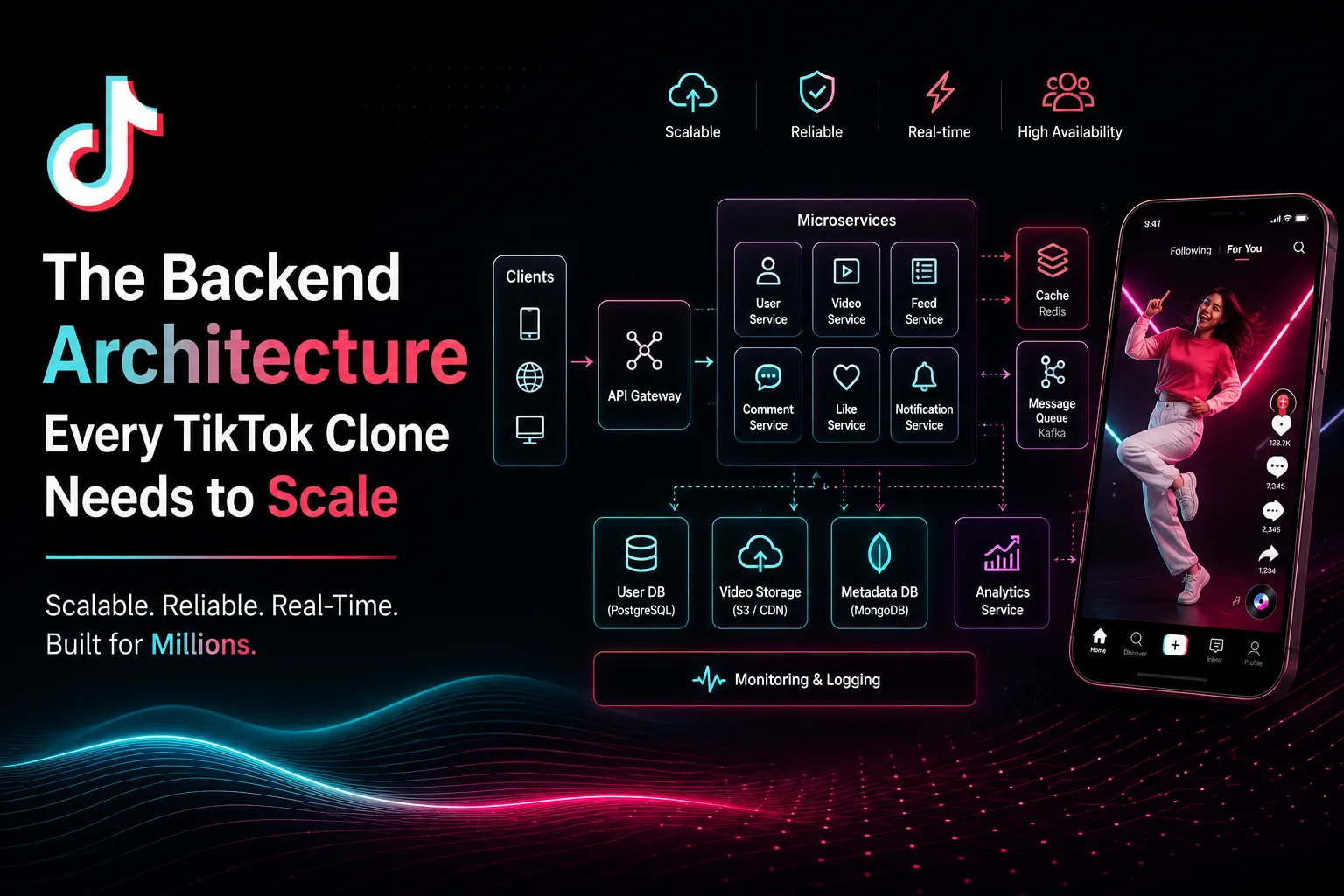
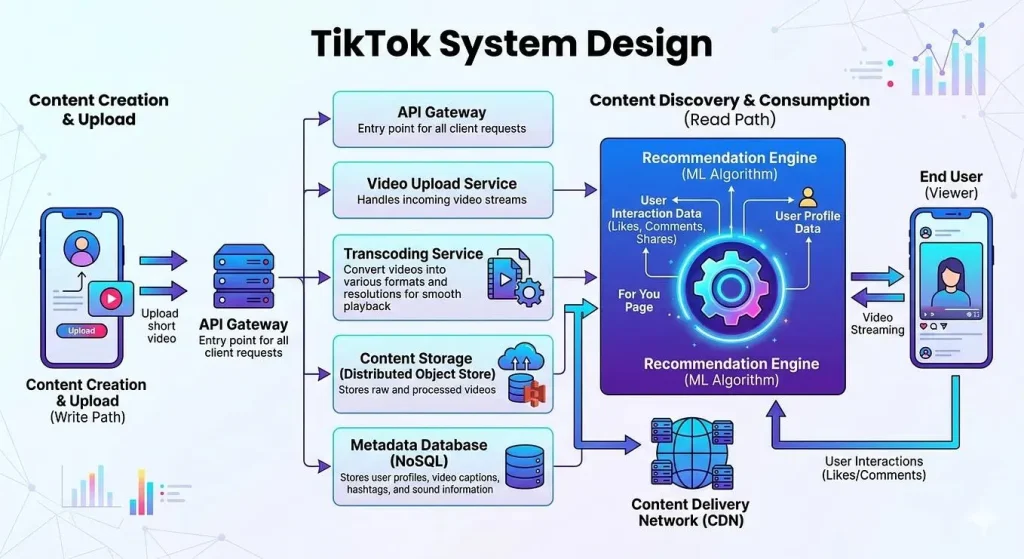
The API gateway acts as the central communication layer between users and backend services. Instead of allowing frontend applications to communicate directly with multiple systems, the gateway manages and distributes traffic more efficiently.
It handles request routing, authentication, traffic balancing, rate limiting, and security filtering. During viral traffic spikes, the API gateway helps maintain backend stability by distributing requests intelligently across services.
Microservices Architecture
Most scalable TikTok clone backend architecture systems use microservices instead of monolithic applications.
Monolithic systems combine every feature into one centralized backend. While this may work during MVP stages, scaling becomes difficult once traffic increases significantly.
Microservices separate functionality into independent services such as:
- Feed service
- Upload service
- Authentication service
- Recommendation engine
- Notification system
- Analytics service
- Moderation service
This structure allows each service to scale independently depending on workload demand.
For example, recommendation systems may require additional resources during heavy viewing hours, while upload systems may scale during peak creator activity.
This modular architecture improves deployment flexibility and long-term scalability.
Database Infrastructure
Scalable short-video platforms usually combine SQL and NoSQL databases because different workloads require different storage systems.
| Data Type | Recommended Storage |
|---|---|
| User Accounts | PostgreSQL |
| Feed Activity | Cassandra / DynamoDB |
| Media Metadata | MongoDB |
| Cache Layer | Redis |
SQL databases help maintain transactional consistency, while NoSQL systems handle massive engagement activity more efficiently.
Redis caching also improves feed responsiveness by reducing repeated database requests.
Read Also :- White-Label TikTok Clone vs Custom Development : Which Saves More Time and Cost?
Video Upload, Processing, and Media Storage Architecture
Video Upload Pipeline
Modern short-video applications require highly optimized upload systems capable of supporting unstable mobile networks and massive concurrent uploads.
Instead of uploading large files all at once, videos are divided into smaller chunks. This improves reliability and allows interrupted uploads to resume automatically.
The upload pipeline typically includes validation systems, retry handling, queue processing, and background optimization before videos move into asynchronous processing workflows.
Video Transcoding System
Uploaded videos must be optimized for multiple devices and internet conditions.
Most scalable TikTok system design infrastructures use FFmpeg-based transcoding systems to generate multiple resolutions such as 240p, 480p, 720p, and 1080p.
Adaptive streaming technologies like HLS and MPEG-DASH automatically adjust playback quality depending on network speed and device capability. This helps reduce buffering and improve playback stability.
Cloud Media Storage
Short-video platforms generate massive storage requirements because every uploaded video must remain globally accessible.
Scalable TikTok clone infrastructure commonly uses cloud object storage systems like AWS S3 because they provide durability, scalability, lifecycle management, and cost optimization.
Storage tiering also helps reduce infrastructure expenses for older content.
CDN and Global Delivery
CDN infrastructure plays a major role in scalable video streaming architecture.
Instead of delivering videos from one centralized server, CDNs distribute content through geographically distributed edge servers located closer to users.
This reduces playback latency, startup buffering, and origin server overload while improving global playback performance.
How Recommendation Feed Systems Work
User Behavior Tracking
Recommendation systems continuously analyze user engagement behavior to personalize feeds in real time.
Important signals include watch time, likes, replays, comments, shares, skip behavior, and session duration. Watch-time retention is often one of the strongest ranking signals inside TikTok clone backend architecture.
Feed Ranking Pipeline
Recommendation systems generally operate in multiple stages.
The backend first generates candidate videos based on user interests and behavioral relevance. Ranking systems then prioritize content most likely to improve engagement and retention.
These recommendation loops continuously evolve using fresh engagement data, which is why TikTok-style feeds feel highly personalized.
Real-Time Feed Processing
Real-time recommendation systems often rely on Kafka-based event streaming infrastructure.
Kafka processes massive engagement streams including user interactions, watch metrics, feed activity, recommendation updates, and analytics events. This enables real-time personalization at scale.
Admin Dashboard and Moderation Infrastructure
Admin Control Systems
Backend admin systems become increasingly important as platform traffic grows.
Administrative dashboards help platforms manage user accounts, content reports, creator verification, monetization tracking, analytics, and moderation workflows more efficiently.
Strong admin infrastructure improves operational visibility and platform control significantly.
AI Content Moderation
Modern TikTok clone backend architecture requires scalable moderation systems capable of processing large amounts of user-generated content.
AI moderation tools help detect harmful media, spam activity, NSFW content, copyright violations, and fake engagement automatically. This reduces manual moderation workload and improves moderation speed.
Human + AI Hybrid Moderation
AI moderation alone cannot accurately handle every moderation scenario.
Scalable platforms usually combine automated moderation systems with human review teams to manage appeals, edge-case violations, and context-sensitive reports. This hybrid approach improves moderation quality while maintaining scalability.
Analytics and Engagement Tracking Architecture
Real-Time Analytics Pipelines
Scalable short-video platforms continuously track engagement data in real time.
Core analytics metrics include watch time, replay behavior, audience retention, session duration, and feed abandonment rates. These insights help improve recommendation systems and overall platform retention.
Creator Analytics Infrastructure
Creators rely heavily on performance insights to understand audience behavior and content reach.
| Metric | Importance |
|---|---|
| Watch Time | Measures engagement quality |
| Audience Retention | Tracks content performance |
| CTR | Measures feed effectiveness |
| Follower Growth | Shows creator momentum |
| Revenue Analytics | Tracks monetization performance |
Strong analytics infrastructure improves creator retention and monetization opportunities.
Infrastructure Needed for High Scalability
Load Balancing and Auto Scaling
Traffic on short-video platforms fluctuates constantly.
Load balancers distribute incoming requests across multiple backend servers, while auto-scaling systems automatically increase infrastructure capacity during traffic spikes.
This helps maintain stable performance during viral growth periods.
Caching Systems
Caching significantly improves backend efficiency and feed responsiveness.
Redis is commonly used to cache trending feeds, recommendations, user sessions, and frequently accessed content. Efficient caching reduces repeated database queries and improves scalability.
Queue-Based Processing
Background queues help process heavy workloads asynchronously.
These queues are commonly used for video transcoding, notifications, feed generation, analytics aggregation, and AI moderation tasks. This prevents resource-heavy operations from slowing down user-facing systems.
Containerization and Deployment
Modern scalable TikTok clone infrastructure often relies on Docker and Kubernetes.
Containerization improves deployment flexibility, distributed scaling, infrastructure portability, and service isolation. Kubernetes helps orchestrate large-scale backend environments more efficiently.
Common Backend Mistakes TikTok Clone Startups Make
Building a TikTok-style platform is not only about creating an engaging interface with short videos and smooth scrolling feeds. The real challenge begins when the platform starts handling increasing uploads, recommendation requests, analytics processing, and real-time engagement simultaneously.
Many startups launch quickly with basic backend systems that work during the MVP stage but struggle once traffic begins scaling. As user activity increases, backend inefficiencies start affecting playback quality, feed responsiveness, recommendation accuracy, and overall platform stability.
Without scalable infrastructure planning, even a well-designed short-video app can quickly face performance bottlenecks that damage retention and growth.
Relying Too Much on Monolithic Architecture
One of the biggest mistakes TikTok clone startups make is depending on monolithic backend systems for too long.
In the early stage, monolithic architecture may simplify development because every feature operates inside one centralized backend. However, once traffic increases, services like recommendations, uploads, analytics, notifications, and moderation begin competing for the same infrastructure resources.
This eventually creates slower deployments, backend instability, and scalability limitations.
Modern TikTok clone backend architecture usually relies on microservices because individual systems can scale independently depending on workload demand. This makes infrastructure more flexible, stable, and easier to optimize during rapid growth stages.
Weak Video Delivery and CDN Planning
Short-video platforms rely heavily on instant playback experiences. Even small buffering delays can reduce engagement significantly.
Many startups focus heavily on frontend design while overlooking how videos will actually be delivered globally. Without optimized CDN infrastructure, platforms often experience slower playback startup times, inconsistent streaming quality, and geographic latency issues.
Strong CDN planning helps improve:
- Video delivery speed
- Playback consistency
- Feed responsiveness
- Global streaming performance
Scalable video delivery infrastructure becomes especially important once platforms begin serving large international audiences.
Poor Recommendation System Optimization
Recommendation systems are the core engagement engine of modern short-video platforms.
Some startups initially launch with simple chronological feeds or lightweight recommendation logic that cannot scale with growing engagement data. However, TikTok-style recommendation systems continuously analyze watch time, replay behavior, likes, comments, shares, skip patterns, and session duration in real time.
Without scalable recommendation infrastructure, platforms often struggle with:
- Weak personalization
- Lower session duration
- Poor content discovery
- Reduced engagement retention
Recommendation quality directly affects how long users stay on the platform.
Ignoring Moderation Infrastructure Early
Another common mistake is delaying moderation planning until content uploads become difficult to manage.
As user-generated content increases, platforms quickly face spam activity, harmful media, fake engagement, and copyright violations. Manual moderation alone cannot scale efficiently once traffic grows rapidly.
Modern TikTok clone infrastructure requires scalable AI moderation systems combined with admin dashboards and human review workflows to maintain platform quality and user trust.
Platforms that ignore moderation infrastructure early often face operational challenges much later.
Weak Database Architecture
Many startups attempt to manage every workload using a single database system, which eventually creates performance bottlenecks as traffic increases.
Scalable short-video applications typically separate:
- Transactional data
- Engagement activity
- Media metadata
- Recommendation signals
- Caching systems
Using distributed database architecture improves backend efficiency and long-term scalability while reducing infrastructure pressure during heavy workloads.
Scaling Infrastructure Too Late
Perhaps the most expensive mistake is waiting too long to improve backend infrastructure.
Many startups delay scalability planning until visible performance issues begin affecting users. By that stage, migrations become significantly more complex, risky, and expensive.
Infrastructure-first planning helps platforms reduce technical debt much earlier while supporting smoother long-term scalability and better user experiences during growth.
Recommended Tech Stack for TikTok Clone Backend Architecture
Modern short-video platforms require high-performance backend frameworks, distributed databases, real-time streaming systems, caching layers, and cloud-native deployment infrastructure to support large-scale workloads efficiently.
| Layer | Recommended Technologies |
|---|---|
| Backend Framework | Node.js / Go / Python |
| Databases | PostgreSQL, Cassandra |
| Caching | Redis |
| Streaming | Kafka |
| Storage | AWS S3 |
| CDN | CloudFront |
| Containers | Docker, Kubernetes |
| Video Processing | FFmpeg |
The ideal backend architecture depends on scalability goals, recommendation complexity, monetization strategy, and expected traffic growth.
Why Choose Miracuves for TikTok Clone Infrastructure
Building scalable short-video infrastructure requires much more than standard application development. Backend systems must continuously support recommendation pipelines, video delivery, analytics processing, moderation workflows, and high concurrent traffic simultaneously without affecting platform performance.
Miracuves helps startups build scalable TikTok clone backend architecture using modular backend systems, AI-ready infrastructure, and cloud-native deployment strategies designed for long-term platform growth.
Scalable Infrastructure Built for Growth
Instead of treating scalability as a future upgrade, Miracuves focuses on infrastructure planning from the early development stage itself.
This helps startups prepare for:
- Viral traffic spikes
- Real-time engagement growth
- Recommendation scaling
- Large media workloads
- High concurrent streaming
Early scalability planning helps reduce long-term infrastructure limitations and technical debt.
Optimized Video Streaming Infrastructure
Short-video platforms depend heavily on smooth playback experiences and fast content delivery.
Miracuves supports scalable video infrastructure through adaptive streaming systems, optimized upload pipelines, FFmpeg transcoding, CDN integration, and cloud object storage architecture.
This helps platforms maintain:
- Faster playback startup
- Better feed responsiveness
- Reduced buffering
- Improved streaming stability
Even during high traffic conditions.
Cloud-Native Deployment Architecture
Modern TikTok clone infrastructure also requires highly flexible deployment systems.
Miracuves uses cloud-native deployment strategies powered by Docker containerization, Kubernetes orchestration, distributed scaling systems, and queue-based processing architecture.
These technologies help platforms scale more efficiently while maintaining infrastructure stability during rapid growth stages.
AI-Ready Recommendation and Moderation Systems
Recommendation quality and content moderation play a major role in platform engagement and user retention.
Miracuves helps startups build AI-ready backend ecosystems capable of supporting recommendation engines, real-time personalization, scalable moderation workflows, and analytics-driven engagement systems designed for long-term scalability.
Read More :- 10 Best TikTok Alternatives to check out in 2026: Apps Like TikTok
Conclusion
A scalable TikTok clone is fundamentally an infrastructure-first platform where backend architecture plays a much bigger role than frontend design alone. While the interface improves user experience visually, the backend controls playback quality, recommendation performance, feed responsiveness, moderation efficiency, analytics processing, and long-term scalability. As user activity increases, platforms must continuously manage uploads, real-time engagement, and personalized content delivery without affecting overall performance.
Miracuves helps startups build scalable TikTok clone backend architecture using modular backend systems, AI-ready infrastructure, cloud-native deployment strategies, and optimized video streaming pipelines. From recommendation systems to scalable media delivery and real-time analytics infrastructure, Miracuves helps businesses prepare for rapid platform growth much earlier.
Schedule a consultation with Miracuves to build scalable short-video infrastructure designed for high-performance streaming, real-time engagement, and long-term platform scalability.
FAQs :-
What backend architecture is best for a TikTok clone?
Microservices architecture is generally the best approach because uploads, feeds, analytics, moderation, and recommendation systems can scale independently.
Which database works best for short-video platforms?
Most scalable platforms combine PostgreSQL, Cassandra, MongoDB, and Redis together to handle different backend workloads efficiently.
Why do TikTok clones need CDN infrastructure?
CDNs reduce playback latency and buffering by delivering video content through geographically distributed edge servers.
How does TikTok-style recommendation architecture work?
Recommendation systems analyze watch time, likes, replays, comments, shares, and skip behavior to personalize feeds continuously.
Can a TikTok clone scale with monolithic architecture?
Monolithic systems may support MVP launches initially, but large-scale growth usually requires microservices for better scalability and performance.
Why is Redis important in TikTok clone infrastructure?
Redis improves backend speed by caching trending feeds, recommendations, user sessions, and frequently accessed content.
What role does Kafka play in short-video app backend systems?
Kafka processes real-time engagement streams including user interactions, feed activity, analytics events, and recommendation updates.
How does video transcoding improve playback performance?
Video transcoding creates multiple optimized resolutions that automatically adjust depending on internet speed and device capability.
Why do scalable TikTok clones need AI moderation systems?
AI moderation helps detect harmful content, spam, copyright violations, and NSFW media at scale while reducing manual moderation workload.
When should startups start planning backend scalability?
Scalability planning should begin during the MVP stage because infrastructure migration becomes much more difficult after rapid traffic growth begins.