

Short-form video platforms are not only about vertical feeds, filters, likes, comments, and creator discovery. Once real users start uploading videos, engaging with creators, sending gifts, subscribing to content, or making payments, the platform becomes a trust system.
For founders, that trust system matters as much as the app experience itself. A smooth feed may attract users, but weak safety controls can damage retention, creator confidence, advertiser interest, payment reliability, and long-term platform reputation.
This is why short-form video platform security should not be treated as a final development checkbox. It needs to be built into the product foundation from the beginning, covering creators, viewers, uploaded content, payments, admin access, and operational workflows.
For founders planning to launch faster, Miracuves helps create ready-made, white-label short-video platforms with admin control, source-code ownership, and 6-day solution delivery where the launch scope fits the ready-made product foundation. The key is not just launching quickly, but launching with the right safety and control layers in place.
Key Takeaways
- Short-form video platform security protects more than login screens. It covers creators, viewers, videos, payments, payouts, moderation, and admin operations.
- Creator safety depends on account protection, copyright workflows, abuse reporting, payout monitoring, and fair moderation systems.
- Viewer protection requires privacy-conscious data handling, reporting tools, comment controls, age-aware workflows, and secure account access.
- Content safety needs a combination of automated review, manual moderation, policy enforcement, copyright handling, and repeat-offender tracking.
- Payment protection should use secure payment gateway integration, tokenized payments where applicable, transaction monitoring, payout checks, and audit logs.
- Miracuves helps founders move from idea to launch faster with ready-made and white-label app solutions designed for branding, admin control, and faster deployment.
Why Security Matters More in Short-Form Video Platforms Than Founders Expect
A short-form video platform looks simple from the outside. Users open the app, scroll through videos, follow creators, react to posts, and upload their own clips. But behind that experience, the platform is constantly handling sensitive workflows.
It may process user registration data, device data, login sessions, creator uploads, comments, private messages, moderation reports, virtual gifts, wallet balances, subscription access, payout history, and admin decisions. Every one of these workflows creates a potential trust risk if it is not controlled properly.
Security becomes even more important when the platform grows from a simple content app into a creator economy ecosystem. Once creators can earn money, viewers can pay, brands can run campaigns, and admins can manage disputes, the business needs stronger protection across identity, content, payments, and operations.
The Real Founder Risk Is Not Just Hacking
Many founders think app security only means preventing hackers from breaking into the system. That is part of it, but it is not the whole picture.
In a creator-led video platform, risk can also come from fake creators, stolen content, spam comments, harmful uploads, payout abuse, chargebacks, fake engagement, unauthorized admin access, weak password recovery flows, exposed API endpoints, or unclear moderation decisions.
Founder question: Can this platform protect users, creators, content, money, and operational decisions as the business grows?
The Four Protection Layers Every Short-Form Video Platform Needs
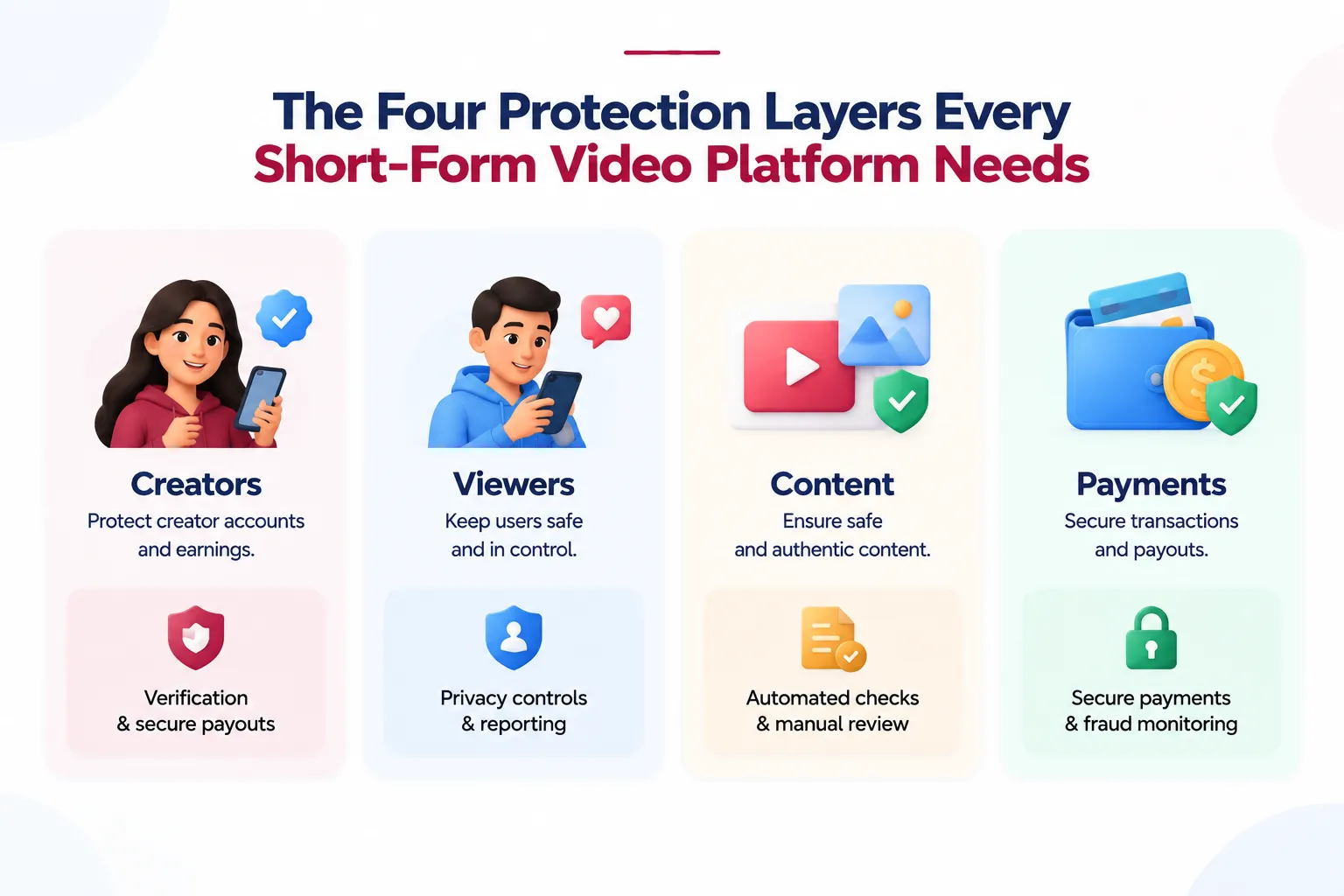
A secure short-form video platform should be evaluated across four practical layers: creators, viewers, content, and payments. Each layer has different risks, different workflows, and different admin responsibilities.
| Protection Layer | What Can Go Wrong | What the Platform Should Control |
|---|---|---|
| Creators | Account takeover, impersonation, payout abuse, copyright disputes, harassment | Creator verification, secure login, payout review, abuse reporting, account recovery, moderation history |
| Viewers | Privacy concerns, unsafe interactions, spam, harmful comments, weak account protection | Privacy controls, reporting tools, block/mute options, comment moderation, secure authentication |
| Content | Harmful uploads, copyright misuse, policy violations, misleading media, spam videos | Automated checks, manual review queues, copyright reporting, takedown workflows, content status tracking |
| Payments | Fraud, failed payouts, chargebacks, unauthorized transactions, inaccurate creator earnings | Secure gateway integration, tokenized payments, transaction logs, payout monitoring, dispute handling |
How to Protect Creators on a Short-Form Video Platform
Creators are the supply engine of a short-form video platform. If they do not feel protected, they will not consistently upload, promote, monetize, or bring their audiences into the app.
Creator protection starts with account security, but it should also include identity confidence, content ownership workflows, payout transparency, and abuse handling.
Secure Creator Accounts Before Monetization Begins
Once creators begin earning through gifts, subscriptions, brand collaborations, live sessions, or creator rewards, their accounts become more valuable targets. A creator account is no longer just a profile. It becomes a business asset.
- Strong authentication and secure session handling
- Two-factor authentication for creator and admin accounts
- Suspicious login alerts
- Device/session management
- Secure password reset workflows
- Rate limits for login and OTP attempts
- Role-based permissions for creator dashboards
These controls reduce the risk of account takeover, payout manipulation, and unauthorized access to creator settings.
Support Creator Verification Without Creating Friction Too Early
Not every short-video platform needs heavy verification on day one. But if the platform supports creator payouts, brand deals, age-restricted communities, paid access, or high-value accounts, some level of creator verification becomes important.
Founder decision logic is simple: the more money and reputation attached to a creator account, the stronger the verification workflow should be.
Verification may include email and phone checks, identity review, document verification where relevant, payout account matching, business profile review, or manual approval for high-reach creators. Final requirements depend on the operating model and target jurisdiction.
Protect Creator Content With Ownership and Reporting Workflows
Short-form video platforms depend on remix culture, trending audio, reaction formats, challenges, edits, duets, stitches, and user-generated video. These formats can drive engagement, but they also increase ownership and copyright complexity.
- Copyright reporting
- Duplicate content review
- Creator takedown requests
- Manual moderation escalation
- Content status visibility
- Repeat violation tracking
- Policy-based content removal
This protects creators from misuse while giving the platform operator a clearer record of decisions.
How to Protect Viewers Without Hurting User Experience
Viewers drive watch time, engagement, comments, shares, subscriptions, and revenue. But they also expect the platform to handle their data, interactions, and safety responsibly.
Viewer protection should feel invisible when everything is normal and easy to use when something goes wrong.
Build Privacy-Conscious Data Handling Into the App
A short-video platform may collect user profile data, device data, engagement signals, watch behavior, location signals where enabled, payment metadata, and content interaction history. This data helps improve recommendations and operations, but it also increases responsibility.
- Clear privacy policy and user consent flows
- Encrypted data transfer
- Encrypted data storage for sensitive information
- Limited access to personal data inside admin dashboards
- Data retention controls
- User account deletion workflows
- Permission-based access for internal teams
For platforms targeting children or younger audiences, child privacy, parental consent, and age-aware workflows may apply depending on the target market. Founders should confirm legal requirements before launch.
Give Viewers Practical Safety Controls
Viewer safety is not only about removing harmful content. It is also about giving users control over their own experience.
- Report video
- Report profile
- Report comment
- Block user
- Mute creator
- Restrict comments
- Hide sensitive content where applicable
- Appeal moderation decisions where relevant
These tools reduce platform dependency on manual admin intervention and help users manage low-level safety problems before they become serious trust issues.
How to Protect Content in a User-Generated Video Platform
Content safety is one of the hardest parts of running a short-form video platform because uploads happen continuously. The platform may receive videos, captions, comments, hashtags, profile bios, thumbnails, live interactions, and creator audio.
Manual review alone is rarely enough once the platform starts scaling. Automated checks alone are also not enough because context matters. A strong content safety system usually combines automated detection, manual review, user reporting, and clear policy enforcement.
Use Automated Moderation as the First Filter
Automated moderation can help identify obvious policy risks before content spreads widely. This may include checking visual content, captions, hashtags, audio transcripts, spam signals, duplicate uploads, and suspicious posting behavior.
- Explicit or harmful visual content
- Spam captions and repetitive hashtags
- Abusive comments
- Copyright or duplicate content signals
- Suspicious upload frequency
- Bot-like engagement patterns
- Misleading profile behavior
Automation helps reduce review workload, but founders should avoid treating it as the final judge. A practical platform needs review queues where human moderators or admins can evaluate edge cases.
Create Manual Review Queues for High-Risk Decisions
Manual review becomes important when a decision affects creator reach, payout eligibility, account status, or content visibility. A platform operator should be able to review flagged videos, see the report reason, inspect account history, check previous violations, and apply a consistent action.
- Approve content
- Limit visibility
- Remove content
- Age-gate content where applicable
- Warn creator
- Temporarily restrict posting
- Suspend account
- Escalate for legal or policy review
Do Not Let Moderation Live Only in Spreadsheets
Early-stage founders sometimes manage reports manually through email, chat, or spreadsheets. That may work for testing, but it becomes risky as upload volume grows.
A scalable short-video platform should bring moderation into the admin dashboard. The admin team should be able to view flagged content, review reports, track actions, assign moderation roles, manage policy categories, and maintain audit logs for important decisions.
This is where a ready-made short-video foundation can reduce operational complexity. Instead of building every feed, upload, moderation, and admin workflow from zero, founders can start with a structured product base and customize rules around their audience, content category, and market.
How to Protect Payments, Wallets, Gifts, and Creator Payouts
Payments add commercial power to a short-form video platform, but they also add operational risk. Once users can buy coins, send virtual gifts, unlock paid content, subscribe to creators, or fund live sessions, the platform needs reliable transaction controls.
Payment security is not only about checkout. It includes wallet logic, gateway integration, transaction records, payout approvals, refund handling, chargeback management, and fraud monitoring.
Security also affects monetization strategy. If your platform plans to use virtual gifts, creator subscriptions, paid live sessions, brand campaigns, or payout commissions, review the short-video platform business model guide so revenue workflows are planned together with wallet safety, payout records, and dispute handling.
Use Secure Payment Gateway Integration Instead of Storing Card Data Directly
Founders should avoid unnecessary exposure to sensitive card data. For most short-video platforms, the practical approach is to integrate trusted payment gateways and design the app so sensitive payment details are handled by the payment provider wherever possible.
Monitor Wallet and Creator Earnings Activity
If the platform uses coins, credits, wallet balances, rewards, gifts, or creator earnings, founders need clear ledger logic. Every credit, debit, refund, gift, subscription, payout, and adjustment should have a traceable record.
- Transaction history for users and admins
- Creator earning statements
- Payout request approval workflows
- Fraud flags for unusual activity
- Refund and chargeback records
- Admin-only wallet adjustment permissions
- Audit logs for payout changes
Without this control layer, payment disputes become harder to resolve and creator trust becomes harder to maintain.
Separate Payment Access by Role
Not every admin should have access to payment controls. A content moderator may need to review videos, but not approve payouts. A finance manager may need payout visibility, but not change recommendation settings. A support user may need dispute notes, but not wallet adjustment access.
Role-based access control helps reduce internal risk by limiting what each team member can view or change. This is especially important as the platform grows beyond the founder and adds moderators, support agents, finance staff, campaign managers, and agency partners.
Founder Decision Signals
Speed
If you want to launch quickly, make sure the ready-made foundation already includes user, creator, content, payment, and admin workflows. Speed should not come at the cost of missing control layers.
Cost
Security becomes more expensive when it is added after launch. Building moderation, payment logs, access controls, and dispute workflows early can reduce costly rework later.
Scalability
A short-video app must handle growing uploads, reports, transactions, and admin actions. Scalable safety depends on automation, review queues, audit logs, and permission-based dashboards.
Market Fit
Different markets need different safety rules. A fitness creator app, regional entertainment app, learning community, or social commerce platform may require different moderation and payment workflows.
Admin Controls That Make a Short-Form Video Platform Safer
The admin dashboard is where platform safety becomes operational. Without a strong admin layer, even a well-designed user app can become difficult to manage.
A practical admin dashboard should help the platform operator control users, creators, videos, reports, payments, payouts, roles, analytics, disputes, and settings without depending on developers for every minor operational change.
- User management: View accounts, status, history, verification state, and reported activity.
- Creator management: Review creator profiles, monetization access, payout settings, and content history.
- Content moderation: Approve, remove, restrict, or escalate videos, comments, hashtags, and profiles.
- Payment oversight: Track purchases, refunds, creator earnings, wallet balances, and payout requests.
- Role-based access: Limit sensitive controls to approved team members.
- Audit logs: Track important admin actions such as account suspensions, payout approvals, and content removals.
- Dispute management: Maintain records for user complaints, creator claims, refunds, and moderation appeals.
- Platform settings: Configure app rules, content categories, monetization access, and safety thresholds.
For founders who want to check how user, creator, brand, and admin capabilities connect in a launch-ready platform, the short-video platform feature breakdown gives a clearer view of the modules behind moderation queues, creator tools, engagement loops, live streaming, analytics, and payout management.
Security Checklist for a Short-Form Video Platform
| Security Area | What to Check | Why It Matters |
|---|---|---|
| Authentication | Secure login, password reset, OTP limits, session handling, optional 2FA | Protects user, creator, and admin accounts from takeover risk |
| Data Protection | Encrypted data transfer, protected storage, privacy-conscious access controls | Reduces exposure of sensitive account, payment, and behavioral data |
| API Security | Authorization checks, rate limits, secure tokens, restricted admin endpoints | Prevents unauthorized access to user, creator, and payment functions |
| Content Moderation | Automated checks, manual review, report queues, takedown workflows | Helps protect viewers, creators, and platform reputation |
| Creator Protection | Verification, payout review, copyright reports, abuse reporting | Builds creator trust and reduces impersonation or earnings abuse |
| Payment Security | Secure gateway integration, tokenized payments, transaction logs, payout controls | Protects revenue flows, user payments, and creator earnings |
| Admin Access | Role-based dashboards, activity logs, restricted financial actions | Reduces internal misuse and improves accountability |
| Dispute Handling | Refund records, report status, appeal workflows, moderation notes | Improves user trust and gives operators a defensible process |
White-Label Short-Video App Security: What Founders Should Ask Before Buying
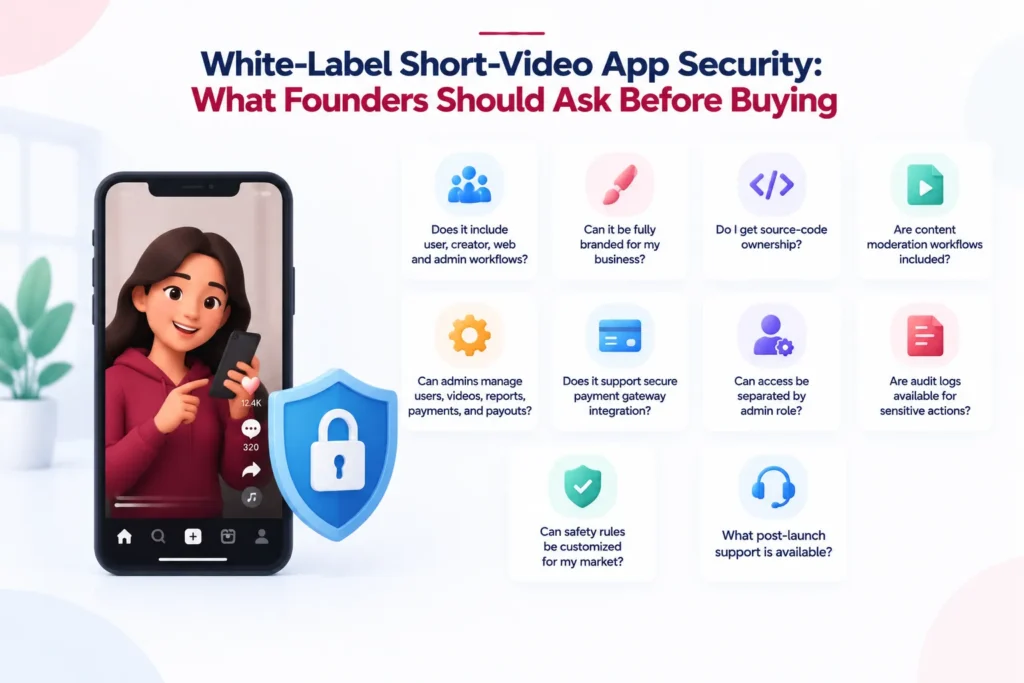
A white-label platform can help founders launch faster because the core product foundation is already built. But speed should be evaluated together with security, ownership, customization flexibility, and operational control.
- Does the platform include user, creator, web, and admin workflows?
- Can the app be fully branded for my business?
- Do I get source-code ownership?
- Are content moderation workflows included?
- Can admins manage users, videos, reports, payments, and payouts?
- Does the platform support secure payment gateway integration?
- Can access be separated by admin role?
- Are audit logs available for sensitive actions?
- Can safety rules be customized for my market?
- What post-launch support is available?
If your priority is to launch under your own brand with rebranding, source-code ownership, creator workflows, and admin control already planned, a white-label short video app can be a practical foundation. The key is to review whether the platform also supports moderation, secure payments, creator protection, viewer safety, and role-based admin access before going live.
Miracuves’ short-video launch solution is designed for founders who want a faster route to market with branded apps, admin control, creator workflows, monetization options, and source-code ownership. You can explore the platform foundation here: Miracuves’ short-video launch solution.
Mistakes Founders Should Avoid
Treating Security as a Post-Launch Task
Security becomes harder to fix once users, creators, videos, and payments are already active. Account controls, moderation workflows, payment logs, and admin roles should be planned before launch.
Launching Monetization Without Payout Controls
Creator earnings need clear transaction history, payout approvals, fraud checks, and dispute records. Without these controls, even small payout issues can damage creator trust.
Depending Only on Automated Moderation
Automation helps with speed, but context-heavy decisions still need human review. A balanced review system protects users while reducing unfair enforcement.
Giving Every Admin Full Access
As the team grows, unrestricted admin access becomes a risk. Role-based access helps separate moderation, support, finance, and owner-level controls.
How Miracuves Helps Founders Launch Safer Short-Video Platforms Faster
Building a short-form video product from zero can take significant time because the platform needs more than a feed. It needs upload workflows, creator profiles, engagement tools, content moderation, payment flows, admin dashboards, analytics, infrastructure, and brand customization.
Miracuves helps founders reduce that starting complexity with a ready-made and white-label short-video app foundation that can be customized around the business model, audience, monetization strategy, and operational rules.
For ready-made launch scopes, Miracuves highlights 6-day solution delivery, helping founders move faster without waiting months to validate their market. Final timelines depend on branding, integrations, custom features, app-store requirements, and the selected deployment scope.
Founders who want to understand the performance side of video delivery can also read Miracuves’ guide on video streaming infrastructure for short video apps. For backend workloads such as encoding, notifications, and moderation queues, this related guide on background processing for creator platforms is also useful.
Final Thoughts: A Secure Platform Is a Better Growth Foundation
Short-form video platforms grow when creators feel protected, viewers feel safe, content rules are clear, payments work reliably, and the operator can manage the ecosystem from a strong admin dashboard.
Security is not only a technical layer. It is a business foundation that affects creator trust, user retention, moderation quality, monetization, compliance readiness, and investor confidence.
For founders, the smarter path is not simply to launch fast or build everything from scratch. The stronger decision is to launch with a product foundation that already supports creator workflows, viewer controls, content moderation, payment protection, and admin visibility.
If you are planning a short-form video business, Miracuves can help you start with a ready-made, white-label platform foundation and customize it around your brand, safety rules, monetization model, and market strategy.
FAQs
What is short-form video platform security?
Short-form video platform security refers to the systems and workflows that protect users, creators, uploaded videos, payments, payouts, admin controls, and platform data. It includes technical security, content moderation, creator verification, payment protection, abuse reporting, and operational audit logs.
Why do creator platforms need stronger safety controls?
Creator platforms involve user-generated content, public profiles, audience engagement, monetization, and sometimes payouts. This creates risks around impersonation, harassment, stolen content, payout abuse, account takeover, and moderation disputes. Strong safety controls help protect both creators and the platform operator.
How can a short-video app protect viewer privacy?
A short-video app can protect viewer privacy through encrypted data transfer, secure authentication, privacy-conscious data handling, limited admin access, clear consent flows, account deletion options, and careful handling of behavioral and payment-related data.
What content moderation features should a video platform include?
A video platform should include user reporting, automated moderation signals, manual review queues, content removal workflows, policy categories, appeal handling where relevant, repeat-offender tracking, and admin logs for important moderation decisions.
How should creator payouts be protected?
Creator payouts should be protected with verified payout details, transaction records, earning statements, payout approval workflows, fraud monitoring, refund records, dispute handling, and restricted admin permissions for financial actions.
Are white-label short-video platforms safe to launch?
A white-label short-video platform can be safe to launch when it includes secure authentication, protected APIs, admin access controls, content moderation workflows, secure payment gateway integration, audit logs, and customization support. Founders should review the product foundation carefully before launch.
Miracuves is an independent software development company. We are not affiliated with, connected to, sponsored by, or endorsed by any company or product named in this article.
Terms such as “X Clone” are used descriptively. It is how the software industry refers to building a platform with functionality comparable to a known service, and how clients search for it.
The entire design and codebase of our products is built by our own team. Our products contain no code, design, graphics, or content originating from any third-party website or applications.
All third-party names and marks referenced in this article are the property of their respective owners, referenced solely to identify the services discussed.