




You’ve heard the horror stories about data breaches, leaked customer addresses, stolen card details, and food delivery apps being hacked overnight. Now imagine launching a Goldbelly-style food marketplace app where users trust you with their payments, home addresses, and personal preferences. One security failure can destroy that trust in seconds.
In 2025, app safety is no longer just a technical decision—it is a business survival decision. With rising cybercrime, stricter data protection laws, and increasing user awareness, any white-label Goldbelly app must be built with enterprise-grade security from day one.
Many founders worry:
- Is a white-label Goldbelly app actually secure?
- Can it meet global compliance standards?
- Who is responsible if a data breach happens?
This guide gives you an honest, practical security assessment of white-label Goldbelly apps—covering real risks, global compliance rules, and how to protect your users, revenue, and brand. You’ll also see how Miracuves approaches security as a core business foundation, not an optional add-on.
Promise: By the end of this guide, you will clearly understand what makes a white-label Goldbelly app safe in 2025 and how to choose a provider that won’t compromise your business or your customers.
Understanding White-Label Goldbelly App Security Landscape
What “White-Label App Security” Actually Means
White-label app security refers to the complete framework of protections that safeguard user data, payments, platform infrastructure, and business operations in a ready-made Goldbelly-style food marketplace app. Unlike custom-built apps, security here depends heavily on:
- Core platform architecture
- Vendor security practices
- Update and patch management
- Infrastructure and cloud security controls
Your security strength is only as strong as the provider’s weakest layer.
Common Security Myths vs Reality
Many founders assume:
- White-label apps are automatically insecure
- Custom development is always safer
- Security can be added later
The reality in 2025 is different:
- Properly engineered white-label apps often outperform custom builds in baseline security
- The biggest breaches now come from poor configuration, not platform type
- Security must exist before user onboarding, not after growth
Why People Worry About White-Label Apps
Security concerns around white-label Goldbelly apps usually stem from:
- Limited visibility into source code
- Dependency on third-party vendors
- Shared infrastructure fears
- Unclear responsibility during breach events
These fears are valid and must be directly addressed with documented security controls.
Current Threat Landscape for Goldbelly-Type Platforms
Food marketplace apps face multiple threat vectors in 2025:
- Payment fraud and card-skimming attacks
- Account takeover via credential stuffing
- Fake vendor and ghost kitchen infiltration
- API abuse through review and order bots
- Location and delivery address exploitation
Because these platforms handle payments, physical delivery, and personal data, they are high-value targets for cybercriminals.
Security Standards in 2025
Modern white-label Goldbelly apps are expected to follow:
- Zero-trust architecture
- Cloud-native security controls
- Automated vulnerability scanning
- Continuous compliance monitoring
- Secure DevOps pipelines (DevSecOps)
Security is no longer a one-time setup. It is a continuous operational discipline.
Real-World App Security Statistics (2024–2025)
- Over 62 percent of mobile app breaches now originate from API vulnerabilities
- More than 48 percent of fintech-enabled marketplaces experienced payment fraud attempts
- Regulatory fines related to data privacy rose by over 40 percent globally
- Average breach recovery time for marketplace apps exceeds 9 months
These numbers clearly show why security must be designed as a permanent business function, not a technical checkbox.
Key Security Risks & How to Identify Them
Data Protection & Privacy Risks
User Personal Information
A Goldbelly-style food marketplace app collects highly sensitive user data including names, contact numbers, home addresses, and order history. If improperly handled, this data becomes a prime target for identity theft, phishing, and fraud operations. Weak database configuration, unencrypted storage, and improper access control are the most common exposure points.
Payment Data Security
White-label Goldbelly apps process card payments, wallets, and sometimes international transactions. If PCI DSS standards are not strictly followed, attackers can intercept card details using:
- Man-in-the-middle attacks
- Skimming malware
- Compromised third-party payment SDKs
One single payment breach can shut down an app permanently due to financial liability.
Location Tracking Concerns
Live delivery tracking exposes real-time user movement and addresses. If APIs are unsecured, attackers can:
- Track high-value customers
- Exploit delivery routes
- Map user behavior patterns
This introduces both cyber and physical security threats.
GDPR and Global Data Protection Compliance
Failure to properly implement consent management, data minimization, and user data deletion rights can result in massive regulatory penalties, especially in the EU, UK, and expanding Asian privacy jurisdictions.
Technical Vulnerabilities
Code Quality Issues
Poorly written or outdated code increases the risk of:
- SQL injection
- Cross-site scripting (XSS)
- Remote code execution flaws
- Authentication bypass
White-label apps reused without proper hardening are especially vulnerable if code reviews are skipped.
Server Security Gaps
Most breaches occur at the infrastructure level due to:
- Weak firewall rules
- Open admin panels
- Misconfigured cloud storage buckets
- Shared hosting without isolation
API Vulnerabilities
APIs are the most exploited attack surface for food marketplace apps. If rate limiting, token validation, and encryption are weak, attackers can:
- Scrape entire databases
- Manipulate orders and pricing
- Flood systems with fake requests
Third-Party Integrations
Payment gateways, logistics APIs, CRM tools, and analytics platforms introduce indirect attack routes. A breach in a single third-party integration can compromise the entire ecosystem.
Business Risks
Legal Liability
In case of data leakage or payment fraud, the business owner—not the software vendor—faces lawsuits, consumer claims, and regulatory sanctions.
Reputation Damage
Trust once lost in a food delivery ecosystem is nearly impossible to rebuild. App store ratings, media coverage, and social trust collapse rapidly after a breach.
Financial Losses
Losses include:
- Regulatory fines
- Refunds and chargebacks
- Infrastructure recovery expenses
- Business downtime losses
Regulatory Penalties
Data protection violations in 2025 can trigger:
- GDPR fines up to 4 percent of global turnover
- CCPA consumer compensation actions
- Cross-border data transfer restrictions
Risk Assessment Checklist
Use this checklist before launching any white-label Goldbelly app:
- Is all user and payment data encrypted at rest and in transit?
- Are APIs protected with authentication tokens and rate limits?
- Are cloud servers isolated with role-based access control?
- Is PCI DSS compliance validated for all payment flows?
- Are admin dashboards protected with multi-factor authentication?
- Is vulnerability scanning conducted regularly?
- Are third-party integrations individually security-audited?
- Is breach response time formally defined?
If even one item above fails, the business is at measurable risk.
Security Standards Your White-Label Goldbelly App Must Meet
Essential Certifications
ISO 27001 Compliance
ISO 27001 is the global benchmark for information security management systems. A white-label Goldbelly app provider with ISO 27001 certification proves that:
- Data security policies are formally documented
- Risk assessments are conducted regularly
- Incident response frameworks are operational
- Continuous security improvement is enforced
Without ISO 27001, there is no independently verified proof of security governance.
SOC 2 Type II
SOC 2 Type II certifies how securely customer data is handled over time. It validates:
- Access control mechanisms
- Encryption practices
- System availability
- Change management
- Operational integrity
For food marketplace apps handling payments and addresses, SOC 2 compliance is no longer optional in 2025.
GDPR Compliance
If your Goldbelly-style app serves users in Europe, GDPR compliance is mandatory. This includes:
- Right to data access and erasure
- Explicit consent management
- Data minimization principles
- Breach reporting within regulated time frames
Non-compliance exposes businesses to multimillion-dollar penalties.
HIPAA (If Applicable)
If your food marketplace app supports dietary health data, wellness nutrition programs, or medical meal deliveries, HIPAA compliance becomes relevant for protecting sensitive health-related information.
PCI DSS for Payments
All payment transactions must comply with PCI DSS standards. This ensures:
- Secure card storage
- Encrypted transaction processing
- Regular vulnerability scans
- Strict access control to financial systems
Any payment app without PCI DSS certification is a direct financial liability.
Technical Security Requirements
End-to-End Encryption
All communication between users, vendors, drivers, and servers must be encrypted using TLS 1.3 or higher. Data stored in databases must use AES-256 encryption at rest.
Secure Authentication
Modern white-label Goldbelly apps must implement:
- Two-factor authentication
- OAuth 2.0 login frameworks
- Token-based session management
- Biometric login support on mobile devices
Weak password-only authentication is no longer acceptable in 2025.
Regular Security Audits
Quarterly vulnerability assessments and annual full security audits are now industry minimums. Audits help identify:
- New exploit paths
- Dependency vulnerabilities
- Infrastructure misconfigurations
Penetration Testing
Professional penetration testing simulates real-world hacker attacks to expose:
- API weaknesses
- Business logic flaws
- Authorization bypass vulnerabilities
- Data exfiltration paths
Testing must be conducted before launch and after every major update.
SSL Certificates
Every domain, subdomain, API endpoint, and admin panel must be protected with valid SSL certificates to prevent data interception.
Secure API Design
APIs must follow strict security design principles:
- Token-based authentication
- IP whitelisting
- Rate limiting
- Encrypted payloads
- Automatic throttling during abuse attempts
Security Standards Comparison Table
| Security Standard | Mandatory for Goldbelly App | Risk if Missing | Business Impact |
|---|---|---|---|
| ISO 27001 | Yes | Weak governance | Regulatory exposure |
| SOC 2 Type II | Yes | Data mishandling | Enterprise clients decline |
| GDPR | Yes (EU users) | Heavy legal penalties | Global expansion blocked |
| PCI DSS | Yes | Payment fraud | Financial shutdown risk |
| SSL Encryption | Yes | Data interception | User trust collapse |
| Penetration Testing | Yes | Hidden vulnerabilities | Breach probability increases |
| Secure APIs | Yes | Data scraping attacks | Platform manipulation |
If even one of these standards is missing, the app operates under elevated cyber and legal risk.
Red Flags – How to Spot Unsafe White-Label Goldbelly App Providers
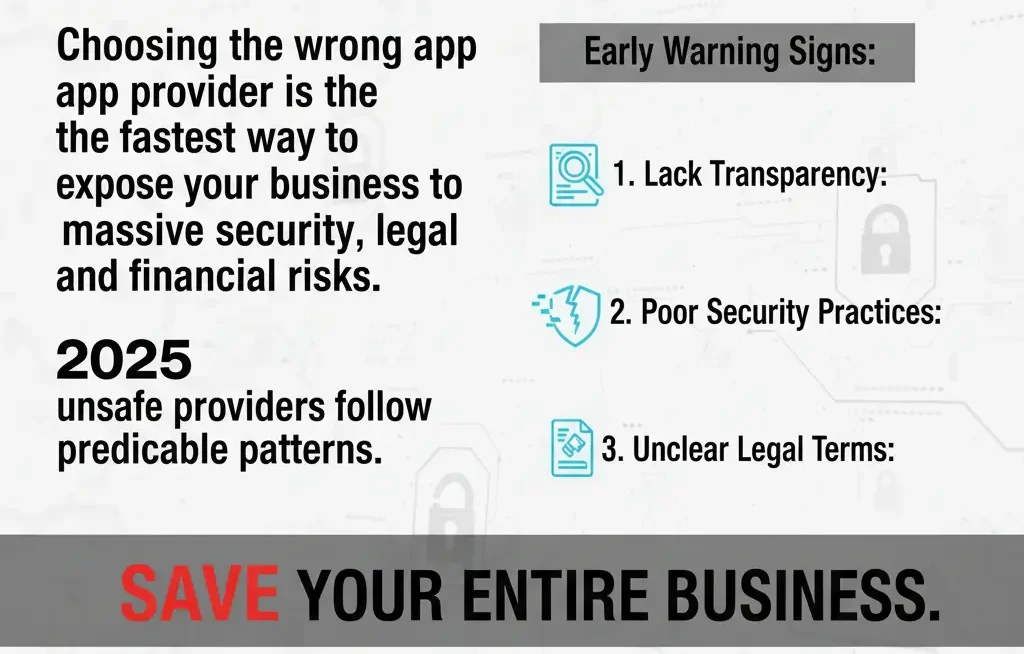
Choosing the wrong app provider is the fastest way to expose your business to massive security, legal, and financial risks. In 2025, unsafe providers follow predictable patterns. Knowing these early warning signs can save your entire business.
No Security Documentation
If a provider cannot share:
- Security architecture overview
- Data protection policy
- Breach response procedures
It means security is either undocumented or completely absent.
Unreasonably Cheap Pricing Without Explanation
Extremely low prices usually indicate:
- Shared insecure infrastructure
- No dedicated security team
- No ongoing updates or audits
- Copied source code without hardening
Security investments cost money. Unsafe providers hide this by cutting corners.
No Compliance Certifications
Absence of ISO 27001, SOC 2, GDPR mapping, or PCI DSS documentation is a major red flag. It confirms:
- No independent security validation
- High legal exposure
- Weak internal controls
Outdated Technology Stack
Old frameworks and unsupported libraries often contain publicly known vulnerabilities. These apps are easy targets for automated attacks.
Poor Code Quality
Signs of weak code quality include:
- Slow app performance
- Frequent crashes
- Inconsistent features across platforms
- No version control transparency
Poor code quality directly correlates with higher breach probability.
No Security Updates Policy
If the provider cannot clearly define:
- Update frequency
- Patch timelines
- Emergency fix procedures
Your app will eventually run on vulnerable, outdated software.
Lack of Data Backup Systems
Without automated backups and disaster recovery:
- Ransomware attacks become fatal
- Data loss becomes permanent
- Business continuity collapses
No Insurance Coverage
Cyber insurance is now a standard risk control layer. Providers without insurance shift 100 percent liability to you.
Evaluation Checklist
Before finalizing any white-label Goldbelly app provider, validate the following:
Questions to Ask Providers
- How is user and payment data encrypted?
- How often are security audits conducted?
- Who is responsible during a security breach?
- What certifications does your infrastructure hold?
- How are third-party integrations secured?
- What is your breach detection time?
Documents to Request
- ISO 27001 or SOC 2 audit reports
- PCI DSS compliance certificates
- GDPR data processing agreements
- Incident response playbooks
- Cyber insurance proof
Testing Procedures
- Independent penetration testing reports
- API vulnerability testing results
- Load and stress testing reports
Due Diligence Steps
- Verify past security incidents
- Ask for customer security references
- Review update and patch history
- Inspect hosting and cloud provider security layers
- Validate admin access control mechanisms
If a provider resists sharing these details, it is a direct indicator of elevated operational risk.
Read more : – Goldbelly App Features You Should Know
Best Practices for Secure White-Label Goldbelly App Implementation
Building a secure white-label Goldbelly app is not a one-time setup. It is a continuous security lifecycle that starts before launch and continues throughout the app’s operation. Following the right implementation practices dramatically reduces breach risks and compliance failures.
Pre-Launch Security
Security Audit Process
Before going live, the entire app ecosystem must undergo a full security audit that includes:
- Source code vulnerability scanning
- Infrastructure configuration review
- Database security validation
- API penetration testing
- Admin access control verification
This ensures that no critical vulnerabilities are exposed to live users.
Code Review Requirements
Every module of the app must be reviewed for:
- Secure coding standards compliance
- Input validation and output sanitization
- Authentication and authorization logic
- Error handling and logging mechanisms
Even high-quality white-label code becomes risky if it is customized without security review.
Infrastructure Hardening
A secure Goldbelly-style app infrastructure must include:
- Firewall-protected cloud environments
- Network segmentation between app, database, and admin systems
- Secure containerization for microservices
- Role-based access control for every system layer
This prevents a single breach from spreading across the platform.
Compliance Verification
Before onboarding real users:
- GDPR and data consent flows must be validated
- PCI DSS compliance must be activated for all payment routes
- Regional data residency rules must be verified
- Privacy policy and data retention rules must match operational behavior
Compliance without technical enforcement is legally invalid.
Staff Training Programs
Security failure often happens due to human error. All operational staff must be trained on:
- Phishing attack detection
- Secure password policies
- Admin access discipline
- Incident reporting procedures
Technology alone cannot protect a platform without trained human processes.
Post-Launch Monitoring
Continuous Security Monitoring
A live Goldbelly-style app must operate under:
- Real-time intrusion detection systems
- API traffic anomaly monitoring
- Fraud detection engines
- Automated alerts for unusual behavior
This allows attacks to be detected within minutes, not weeks.
Regular Updates and Patches
Security patches must be released:
- Immediately for critical vulnerabilities
- Monthly for dependency updates
- Quarterly for infrastructure upgrades
Delaying patches is one of the primary causes of large-scale data breaches.
Incident Response Planning
A formal incident response framework must define:
- Breach identification steps
- Containment procedures
- User and authority notification timelines
- Forensic investigation process
- Recovery and public communication plan
Without a defined response plan, even small breaches become brand disasters.
User Data Management
Secure operational practices must include:
- Data minimization policies
- Automated data deletion schedules
- Controlled access to sensitive records
- Secure data exports and reporting tools
Excessive data storage only increases breach impact.
Backup and Recovery Systems
A resilient Goldbelly app must implement:
- Encrypted daily backups
- Multi-region disaster recovery storage
- Regular recovery testing drills
- Ransomware-resistant backup separation
This protects business continuity under cyberattacks, system failures, or natural disasters.
Security Implementation Timeline
| Phase | Security Actions | Business Outcome |
|---|---|---|
| Pre-Development | Security architecture design | Breach-resistant foundation |
| Development | Secure coding and internal testing | Reduced logic flaws |
| Pre-Launch | Full audit and penetration testing | Safe public deployment |
| First 90 Days | Continuous monitoring and patching | Real-time threat defense |
| Ongoing Operations | Quarterly audits and training | Long-term compliance stability |
Following this timeline ensures that security evolves alongside user growth and revenue scale.
Legal & Compliance Considerations
Security in a white-label Goldbelly app is not only a technical responsibility but also a legal obligation. In 2025, regulatory enforcement has become stricter across every major digital economy. Non-compliance now leads to direct business shutdowns, frozen payment gateways, and cross-border operational bans.
Regulatory Requirements
Data Protection Laws by Region
Different regions impose different legal duties on app owners:
- European Union and UK: GDPR and UK GDPR mandate strict user consent, data minimization, breach reporting within fixed timeframes, and the right to be forgotten.
- United States: CCPA and CPRA govern user data access, deletion rights, and strict consent transparency.
- India: The Digital Personal Data Protection Act introduces penalties for unauthorized data processing and cross-border data misuse.
- Middle East: Data localization rules in several jurisdictions require local hosting and controlled transfers.
- Asia-Pacific: Countries like Singapore, Australia, and Japan enforce PDPA-style frameworks with strong breach disclosure mandates.
A Goldbelly-style food marketplace app operating globally must comply with the most restrictive region it serves.
Industry-Specific Regulations
Food platforms introduce additional regulatory overlap:
- Consumer protection laws for online marketplaces
- Financial compliance for digital payments
- Advertising and pricing transparency laws
- Vendor verification and food safety accountability
Security controls must connect directly to these regulatory layers.
User Consent Management
Consent must be:
- Explicit and provable
- Logged and auditable
- Granular by data category
- Revocable at any time
Silent or bundled consent is now considered legally invalid in many regions.
Privacy Policy Requirements
Your privacy policy must:
- Match real technical operations
- Clearly define data usage
- Explain third-party data sharing
- Describe breach response procedures
- Define data retention timelines
Any mismatch between policy and system behavior creates legal exposure.
Terms of Service Essentials
Proper terms of service must define:
- User responsibilities
- Platform liability limits
- Payment and refund governance
- Vendor accountability
- Dispute resolution mechanisms
- Jurisdiction and governing law
These documents act as your first legal defense during a cyber incident.
Liability Protection
Insurance Requirements
Cyber insurance is now a standard operational necessity for marketplace apps. Coverage should include:
- Data breach response costs
- Regulatory fine assistance
- Legal defense expenses
- Business interruption losses
- Ransomware attack recovery
Operating without cyber insurance in 2025 exposes founders to unlimited personal and corporate liability.
Legal Disclaimers
Legally vetted disclaimers protect against misuse-related liability but must never be used as a substitute for real security controls.
User Agreements
All user and vendor agreements must:
- Define data ownership
- Establish acceptable use boundaries
- Specify breach handling terms
- Outline refund and chargeback rights
Clear legal alignment reduces post-incident litigation damage.
Incident Reporting Protocols
Law now mandates:
- Immediate internal breach escalation
- User notification within regulated time limits
- Reporting to data protection authorities
- Public disclosure in severe incidents
Failure to follow these protocols often triggers compounded penalties.
Regulatory Compliance Monitoring
Legal compliance is no longer static. Continuous legal audits are required to track:
- Law amendments
- Cross-border data transfer rule changes
- Payment regulation updates
- Consumer safety enforcement shifts
Without monitoring, apps become non-compliant even without technical failure.
Compliance Checklist by Region
| Region | Core Law | Key Requirements | Non-Compliance Risk |
|---|---|---|---|
| EU & UK | GDPR | Consent, data access, breach reporting | Severe financial penalties |
| United States | CCPA / CPRA | Data access and deletion rights | Consumer lawsuits |
| India | DPDP Act | Data purpose limitation and security | Platform blocking |
| Middle East | Data localization laws | Local hosting and restricted transfers | Operational bans |
| Asia-Pacific | PDPA frameworks | Breach reporting and transparency | Heavy regulatory scrutiny |
Meeting these compliance obligations is non-negotiable for any serious Goldbelly-style app business.
Read more : – How to Hire the Best Goldbelly Clone Developer
Why Miracuves White-Label Goldbelly App is Your Safest Choice
When security failures destroy food marketplace businesses overnight, the difference between survival and collapse lies in the strength of your app’s security architecture. Miracuves approaches security as a core engineering principle, not a premium add-on. Every white-label Goldbelly app is designed to withstand modern cyber threats, regulatory scrutiny, and enterprise compliance requirements from day one.
Miracuves Security Advantages
Enterprise-Grade Security Architecture
Miracuves apps are built on hardened cloud infrastructure with multi-layer security controls:
- Isolated production and admin environments
- Network-level firewalls and intrusion prevention
- Role-based access control across all systems
- Continuous traffic inspection and anomaly detection
This ensures attackers cannot move laterally even if one layer is targeted.
Regular Security Audits and Certifications
All Miracuves platforms undergo:
- Scheduled vulnerability assessments
- External penetration testing
- Continuous code security scanning
- Infrastructure configuration audits
This prevents hidden vulnerabilities from remaining undetected during scale.
GDPR and CCPA Compliance by Default
Every white-label Goldbelly app includes:
- Built-in user consent management
- Data access and deletion workflows
- Region-based data handling configurations
- Automated audit logging
Compliance is integrated directly into the system design rather than implemented through manual workarounds.
24/7 Security Monitoring
Miracuves operates continuous monitoring systems that:
- Track API abuse attempts in real time
- Detect suspicious login patterns
- Monitor payment fraud signals
- Trigger instant security alerts for abnormal activity
This allows threats to be blocked before they become public incidents.
Encrypted Data Transmission
All communication across user apps, vendor dashboards, delivery systems, and admin panels is protected using:
- TLS 1.3 encryption
- Secure token-based sessions
- Encrypted internal service-to-service communication
No sensitive data travels in plain text at any stage.
Secure Payment Processing
Miracuves integrates only PCI DSS-compliant payment gateways with:
- Tokenized card processing
- Fraud detection engines
- Chargeback risk monitoring
- Secure webhook validation
Your business never directly stores raw card data, eliminating the most dangerous attack vector.
Regular Security Updates
Security updates are deployed through:
- Automated patch pipelines
- Emergency zero-day response procedures
- Dependency update monitoring
- Infrastructure hardening upgrades
This ensures your Goldbelly-style app never runs on outdated or exposed software.
Insurance Coverage Included
Miracuves solutions are backed by cyber liability protection frameworks that help mitigate:
- Breach response costs
- Legal defense expenses
- Financial recovery risks
- Business interruption exposure
This adds a critical financial safety net beyond technical controls.
Conclusion
A white-label Goldbelly app can be just as secure as a custom-built platform—but only if security is treated as a foundational business investment, not a technical afterthought. In 2025, users expect airtight data protection, regulators demand strict compliance, and cybercriminals actively target food marketplace platforms. The real risk is not choosing a white-label app—the real risk is choosing the wrong security-first provider. With the right architecture, controls, and monitoring, your Goldbelly-style app can scale with confidence, trust, and long-term resilience.
Don’t compromise on security. Miracuves white-label Goldbelly app solutions come with enterprise-grade protection built into every layer of your platform. With more than 600 successful projects delivered and zero major security breaches across production systems,Miracuves is trusted globally for building safe, compliant, and resilient digital marketplaces.
Get a free security assessment and discover how Miracuves can secure your food marketplace app for long-term success.
FAQs
1. How secure is a white-label Goldbelly app compared to custom development?
A properly secured white-label Goldbelly app can be as secure as, or even more secure than, custom development when it includes enterprise-grade encryption, audits, and compliance from day one.
2. What happens if there is a security breach?
A structured incident response plan is activated that includes breach containment, forensic investigation, user notification, and regulatory reporting within legal timelines.
3. Who is responsible for security updates?
The app provider is responsible for core platform updates, while the business owner must ensure operational security policies and user access controls are followed.
4. How is user data protected in a white-label Goldbelly app?
User data is protected through end-to-end encryption, secure cloud storage, role-based access control, and continuous monitoring.
5. What compliance certifications should I look for?
You should always verify ISO 27001, SOC 2 Type II, GDPR compliance, and PCI DSS for all payment systems.
6. Can a white-label Goldbelly app meet enterprise security standards?
Yes, when built on hardened cloud infrastructure with continuous audits, penetration testing, and compliance automation.
7. How often should security audits be conducted?
Quarterly vulnerability scans and annual full security audits are the recommended industry standard.
8. What is included in the Miracuves security package?
Encrypted data handling, PCI-compliant payments, GDPR-ready architecture, real-time monitoring, regular patching, and breach response support.
9. How is security handled across different countries?
Security frameworks are adapted to meet regional laws such as GDPR, CCPA, and India’s DPDP Act with region-wise data handling.
10. What insurance is needed for app security?
Cyber liability insurance covering data breaches, regulatory fines, legal defense, and business interruption is essential.
Related Articles: