
Key Takeaways
- A mixed basket looks like one order to the buyer and is three vendor orders underneath, each with its own status, commission rate and fulfilment plan.
- When three items in one basket have three different lead times, splitting the fulfilment is the only response that never makes an item worse than it would have been alone.
- Fulfilment is chosen per vendor, so a single basket can arrive by your rider, by a maker’s own van and by collection in person, inside the local zones you draw.
- One authorization creates several obligations: each maker is owed a different amount, on a different day, after a different commission rate stamped onto the order at placement.
- The buyer bought from you, not from three strangers, so one maker’s failure is yours to refund immediately and recover from the payout afterwards.
Mixed Basket Readiness Signals
- Group the basket page by maker and show each group’s own arrival date before the Pay button.
- Model the vendor order as a real record with its own status, commission and fulfilment, not a column on a line item.
- Scope cancellation rights to the vendor order and give cross-basket power to support alone, with a logged reason.
- Write down how service and delivery fees refund when only part of the basket is fulfilled, before your first dispute.
- Refund the buyer first, investigate second, and recover from the vendor’s next payout third.
Real Insights
- Buyers assemble mixed baskets from maker pages, not from category pages, so discovery design decides whether you ever need this machinery.
- Any single status word applied to a mixed basket is either wrong about part of it or too vague to mean anything.
- Three independent vendor lifecycles generate three of every event, and sending them all trains the buyer to turn notifications off.
- The confirmation email stops being a document the moment a line is cancelled, so it has to be a live view of the basket instead.
- This build delivers locally through zones, riders, vendor delivery or collection rather than shipping goods, and Miracuves can deploy that ready-made scope in 6 days of build time.
A sourdough loaf from a bakery two miles away. A wheel of washed-rind cheese from a dairy on the other side of the city. A jar of chilli oil from a woman who makes forty jars a week in a kitchen she rents by the hour. Three makers who have never heard of each other. One basket, one total, one Pay button.
On the buyer’s screen this is unremarkable. It looks exactly like ordering from one place, and that is the point: the buyer shops across a roster without doing the work of three separate transactions.
Underneath, almost nothing behaves the way a normal order behaves. Three lead times, three delivery methods, three commission rates, three payouts on three days, and three chances of a failure the buyer will experience as one failure by you. If you are evaluating a multi-vendor speciality food marketplace and have only run single-vendor ordering, this screen is where the difference lives.
A basket on a marketplace like Goldbelly looks like one order to the buyer and is several underneath.
What a Food Marketplace Buyer Sees and What Exists
What a buyer sees on a marketplace like Goldbelly is one basket. What exists is one sub-order per maker.
There are two descriptions of a mixed basket and both have to be true at once. The buyer’s is short: I chose some things, I paid once, I got a confirmation. The system’s is longer, and every extra thing in it is a place where the two can drift apart.
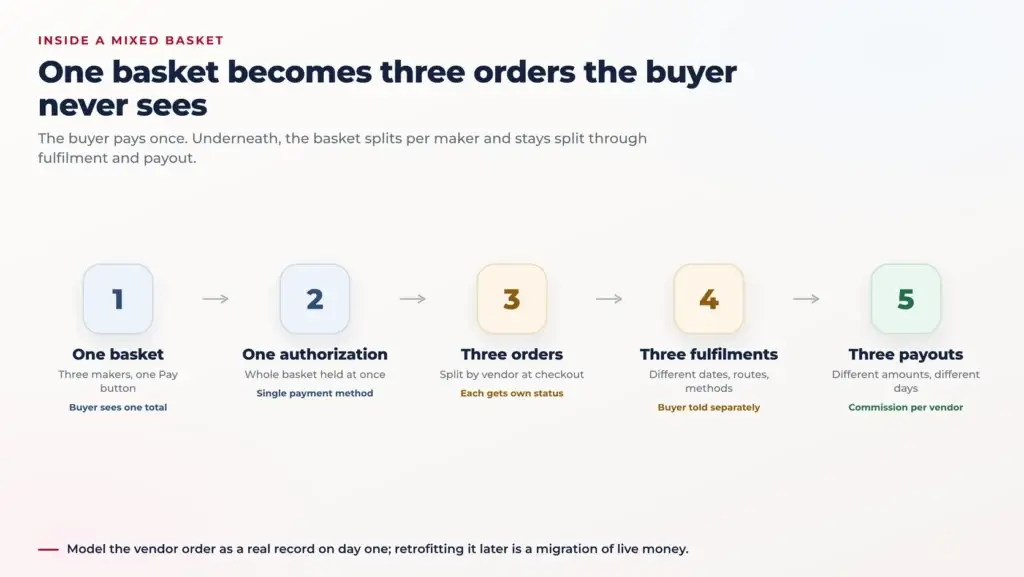
Image Source: AI-generated visual by Miracuves
One basket, one payment, one confirmation
The buyer side should be boring. One running total, one address, one payment method, one confirmation email. If a buyer ever pays twice or reads two emails for one shopping session, you have leaked your internal structure onto them and they will assume the platform is broken.
Three orders underneath
What gets written when that button is pressed is not one order. It is one basket record and three vendor orders, one per maker, each with its own line items, status, commission rate captured at that moment, and fulfilment plan.
The bakery never sees the cheese. Each maker gets a ticket containing only their own lines, totals and delivery instruction, because showing a vendor the rest of the basket exposes what a competitor on your own roster is selling and at what price.
The parent record and the child records
The basket record holds what is true about the whole purchase: buyer, address, payment, total charged. The vendor orders hold what is true per maker. Nothing should be duplicated across both, because the moment a fact lives in two places a cancellation will update one and not the other.
Every question asked later resolves to one of those two levels. How much did the buyer pay is a basket question. How much does the dairy get is a vendor order question.
Building the split on day one is cheap. Retrofitting it after launch is a migration of live money. The features page shows how the ordering spine is arranged around this.
Discovery Before the Basket in a Food Marketplace
Nobody assembles a mixed basket from a category page. A category page is a comparison surface: it lines up eleven sourdough loaves, invites you to pick the best one, and sends you to checkout with a single item. Comparison surfaces produce single-vendor baskets, because the buyer arrived with a specific thing in mind and left as soon as they found it.
A maker page is a different surface. It has a person on it, a story, a shelf of eight or nine things from the same hands. Buyers who land there do not compare, they browse, and browsing is what puts a second item in a basket. Then a neighbouring maker is suggested and browsing puts a third.
Maker-first discovery is not a nicer way to present the same catalogue. It is the mechanic that produces the mixed basket, which means a platform organizing discovery around categories has built multi-vendor machinery for a buyer who never uses it.
Should a Food Marketplace Allow a Mixed Vendor Basket
This is a real product decision with a defensible answer either way, and it is worth making deliberately rather than inheriting from whatever the software did by default. Plenty of serious marketplaces refuse mixed baskets and enforce one vendor per order.
The case against allowing it
One vendor per order makes every downstream problem disappear. One lead time, one delivery, one commission rate on one total. Refunds are whole-order refunds. Support sees what the buyer sees.
Your engineering surface shrinks by close to half and your support load by more, because most multi-vendor tickets are about the relationship between items rather than any single item. The scope and cost breakdown shows where that second dimension lands.
The cost is that your marketplace now behaves like a directory of separate shops. The buyer who wanted bread and cheese pays two delivery fees, gets two confirmations, and concludes the bundling value you promised is not there.
The case for allowing it
Average basket value is the whole argument. A buyer who can only order from one maker at a time buys from one maker. A buyer who can combine spends more and meets more of your roster. Cross-maker baskets are also the strongest retention signal you will get: a buyer with three favourite makers has three reasons not to leave.
The position worth taking
Allow it, and pay for it properly. Bundling is the reason a maker marketplace beats the makers’ own websites, and giving it up hands your buyers back to the shops. But allow it with the split made visible before payment rather than discovered afterwards.
Concretely: group the basket page by maker, and show each group’s own arrival estimate and delivery method above the Pay button, in ordinary language. The buyer still makes one payment, but is no longer surprised by its consequences. Almost every complaint a mixed basket generates comes from a buyer who did not know they had built one.
Founder Decision Signals
Speed
Grouping the basket by maker and splitting fulfilment is a configuration-level decision in a ready-made build that already has a vendor order model. Deciding it after launch is not.
Cost
Mixed baskets do not cost more to display. They cost more to support, refund and reconcile, which is an operations budget rather than a build budget, and it recurs every month.
Scalability
A basket record with vendor orders under it survives the fifth maker and the five hundredth. A single flat order record stops working at two.
Market Fit
If your roster is makers with narrow shelves, allow mixing, because no single maker can fill a basket. If it is a few vendors with deep catalogues, one vendor per order may serve buyers better.
Three Lead Times in One Food Marketplace Basket
This is the problem with no clean answer, and the one most often discovered in production. The three items in that basket are not available on the same day, and they are not available for reasons that are entirely legitimate.
Ready tomorrow, made on Thursday, gone until next month
The bakery bakes daily and can have the loaf ready tomorrow. The dairy makes that cheese in a batch on Wednesday and releases it on Thursday, so a Monday order waits three days by design.
The chilli oil maker has sold out her current run and the next is scheduled for the following month, but the listing is up because she takes pre-orders.
None of that is a fault. A maker is not a restaurant, and a marketplace insisting everything arrives within forty minutes ends up with a roster of reheated food. Variable lead times are the cost of interesting supply, and the basket has to carry them.
Three things the platform can do about it
There are exactly three responses available, and every marketplace picks one whether or not anyone wrote the decision down.
- Split the fulfilment. Three arrivals on three days, each announced in advance. You pay for it in delivery movements and notifications.
- Hold the whole basket. One arrival, on the date of the slowest item. The fresh things sit and degrade while they wait.
- Refuse the combination. The slow item cannot be added while the fast one is in the basket. You lose the basket value instead.
Split it, and say so before the Pay button
Split the fulfilment. Holding a basket for its slowest item means the loaf that was ready on Tuesday is stale by the time the chilli oil exists, which turns one delay into three ruined items and a refund conversation you started yourself. Refusing the combination is worse, because it punishes the buyer for the exact behaviour the marketplace exists to encourage.
Splitting is the only response that never makes an item worse than it would have been alone. What it demands is honesty at the basket page: three lines, three dates, stated before payment. A buyer who reads “arriving Tuesday, Thursday and the fourteenth of next month” and pays anyway has consented to what would otherwise be a support ticket.
Delivery When the Makers Are in Different Parts of Your Zone
Here is where the obvious assumption goes wrong. This platform does not ship goods. Coverage is drawn as local delivery zones and orders are carried by riders you run, by the makers themselves, or collected in person. That constraint shapes how a mixed basket arrives.
Zones are drawn per vendor, not per platform
Each maker sits somewhere on your map and can be reached from some parts of it and not others. A bakery in the north may cover eight neighbourhoods; a dairy on the southern edge covers a different eight. The overlap is where a mixed basket from those two is even possible.
So the availability question is not whether the platform delivers to you, but whether this maker reaches you. Answer it when an item is added to the basket, using the address the buyer already gave you.
That single check prevents the most infuriating failure in the category: a full basket that collapses at checkout because one item was never deliverable to that street. The food delivery solution is built around zones for exactly this reason.
Riders you run, vendor staff, or collection
Fulfilment is chosen per vendor. The bakery might be on your rider fleet. The dairy might deliver in its own van because it has one and does not want a stranger handling a fragile wheel. The chilli oil maker might only offer collection on Saturday mornings.
All three can sit in one basket. What they cannot do is share a single tracking view, because there is nothing to share: one has a rider with a location, one has a van with a time window, one has an address and a Saturday.
Several fulfilments, several things the buyer is told
One basket produces as many fulfilments as it has vendor orders, and each gets its own communication. Live tracking where a rider exists. A time window where a maker is driving. A collection reminder where the buyer is coming to get it.
Do not flatten these into one progress bar. A bar reading “2 of 3 delivered” says nothing about the one they are waiting for. Tracking that holds up under real load is an engineering subject of its own, covered in Sub-2 Second Tracking: Load-Testing GPS Delivery Updates on Flutter and Laravel.
Collection and Vendor Delivery Are Options, Not Fallbacks
Platforms built by people who have only seen rider-fleet delivery treat collection as what happens when delivery fails. In a maker marketplace it is often the primary channel, and designing it as a degraded state is a mistake you pay for in vendor churn.
A basket that is half delivered and half collected
Bread and cheese arrive by rider on Tuesday. The chilli oil is collected from the kitchen on Saturday. That is an ordinary basket, not an exception. The collected line needs a pickup window, an address, a code the buyer shows, and a state meaning “waiting for the buyer” rather than “waiting for us”.
What the buyer chooses, and when
The choice belongs at the maker group in the basket, not at the end of checkout. By the time a buyer reaches a single delivery step they already believe one thing is arriving. Asking per group, earlier, also lets them trim a fee by collecting one item, which they do more often than you expect.
Collection also solves lead times for a maker who will never join a rider fleet: the one making forty jars a month who would rather hand them over herself. Losing her because your basket insists on delivery is losing supply, and supply is the constraint that actually limits a marketplace. The business model behind the roster covers why that constraint outranks everything else.
One Payment In, Several Payouts Out
The buyer made one payment. You now owe three separate businesses three different amounts on three different schedules, after deducting three different commission rates. That asymmetry is the defining financial property of a multi-vendor marketplace.
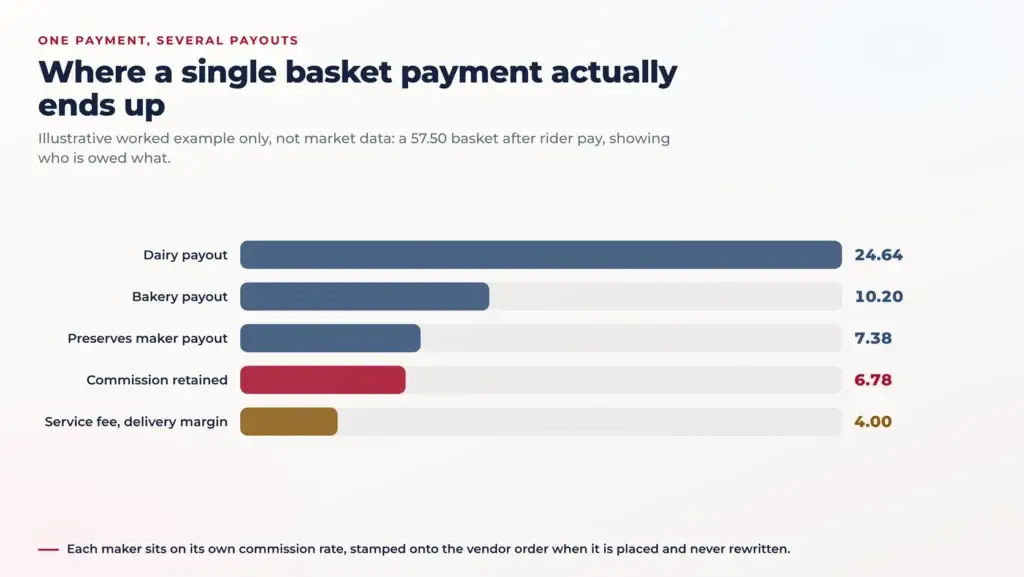
Image Source: AI-generated visual by Miracuves
One authorization, several obligations
At the Pay button you take a single authorization against a single card for the whole basket. From that instant the money is one pool with three claims on it, and the claims mature at different times because the fulfilments do.
Capture the whole amount up front and you are holding funds for a jar that will not exist for a month, which is defensible but has to be said in your terms.
Capture per fulfilment and you get cleaner accounting plus a new problem: authorizations expire, and a four-week lead time will outlive one. Pick before launch, because it changes what your refund logic must be capable of.
Different amounts, different days, different rates
Each maker can sit on a different commission rate. A high-volume bakery might be on a lower rate than a maker who joined last week. That rate has to be stamped onto the vendor order when it is placed, so a rate change next quarter never reaches back and rewrites what was already owed.
Payout timing then follows fulfilment, not payment. The bakery is owed once the bread is delivered on Tuesday. The dairy on Thursday. The chilli oil maker next month. Three obligations from one basket, none falling due together.
The payout run is a machine of its own
How those obligations actually leave your account, in batches, with holds, reserves, retries on failed transfers and protection against paying a maker twice, is a separate subject with its own failure modes. It is not something to reason about from inside the basket, and the team that builds this should treat it as its own component.
Partial Everything
Single-vendor ordering has two outcomes: the order happened or it did not. A mixed basket has a spectrum, and every point on it needs a defined behaviour before you take the first real payment.
Partial fulfilment
Two vendor orders complete, one is still open. The basket is neither delivered nor outstanding. If your status model holds only those two words you will pick one and be wrong for the buyer either way. The basket needs a state meaning partly done, derived from the vendor orders rather than set by hand.
Partial cancellation
A maker can cancel their own lines. A buyer can cancel a line that has not started production. Neither can cancel the whole basket, because the whole basket is not theirs to cancel. The bakery has no standing to cancel the dairy’s work, and the buyer cannot recall a wheel of cheese already in a rider’s bag.
Cancellation permissions therefore scope to the vendor order, with one exception: your support staff can act across the basket, and that action is logged with a reason and an operator name. Role scoping is a build-time concern, and an owned white-label platform is where it is yours to set.
Partial refund, and the fee that does not divide
Refunding goods is simple: give back the line value and reverse the commission taken on it. The hard part is the money never attached to a single maker. A service fee charged once on the whole basket does not obviously belong to any one vendor order. Neither does a delivery fee when three deliveries were planned and two happened.
Write the policy down before you need it. A workable default: refund the goods in full, refund the delivery fee attached to the fulfilment that did not happen, and keep the service fee only if the basket was in fact serviced. Make it visible, because a refund the buyer cannot reconcile is a chargeback with extra steps.
A Worked Cancellation
Tuesday morning. The bread is with a rider. The cheese is boxed and waiting for the Thursday run. The chilli oil maker messages to say her next batch has slipped six weeks. She cancels her lines.
What has to happen in the next sixty seconds
Her vendor order moves to cancelled. The other two are untouched, because nothing about her batch schedule affects a loaf already in transit. The refund is calculated on her lines alone, plus whatever delivery portion was allocated to a fulfilment that will never leave. The basket moves to partly fulfilled and stays there until Thursday.
One message goes to the buyer, naming what was cancelled, what is unaffected, what is being refunded and roughly when it lands. Not three messages. Not a generic “your order has been cancelled” that will terrify someone whose bread is thirty seconds from the door.
What the confirmation email now says
The original confirmation is now wrong, and this is the detail that gets missed. Buyers open that email, not your app, when they want to know what they bought. If it still lists three items and one total, your own record contradicts you.
Stop treating the confirmation as a document and treat it as a view: a stable link to the live basket, where cancelled lines are struck through with the refund against them and the total reflects what was actually charged. Buyers forgive a maker who ran out. They do not forgive paperwork that disagrees with their bank statement.
Where the Platform’s Promise Actually Sits
This is the obligation founders underestimate, so it is worth saying without hedging. The buyer did not buy from three strangers. They bought from you. Your name is on the basket, on the card statement, and in the sentence they say when they tell someone the food did not turn up.
Resolve first, recover afterwards
When one maker fails, the buyer’s problem is solved by you, immediately, and whose fault it was is settled later and privately with the maker. Refund first. Investigate second. Recover from the vendor third, if your agreement allows it, through the payout you have not yet made.
What your vendor agreement has to carry
Resolving fast depends on having written down in advance that you may offset a buyer refund against a vendor’s next payout, and under what conditions. Software gives you the controls: holds, reserves, adjustments against a pending balance. The right to use them is commercial, and the wording belongs with your own counsel in your own market.
The Status Language a Mixed Basket Needs
Status is where all of this becomes visible, and where most multi-vendor builds quietly fall apart. The vocabulary that worked for one order per vendor does not describe what is happening any more.
One order status is a lie
“Preparing” is true of the dairy and false of the bakery. “Out for delivery” is true of one third of a basket. Any single word applied to a mixed basket is either wrong about some of it or so vague it says nothing.
The working model is a status per vendor order plus a derived basket state that only ever summarizes them.
Never let an operator set the basket state directly. The moment it can disagree with the lines beneath it, it will, and support will trust neither. Cheap platforms that never modelled this are the ones described in The Out-of-Stock Trap: Why Cheap Delivery Scripts Ruin Restaurant Relationships.
Notifications that do not fire three times
Three vendor orders with independent lifecycles generate three of every event. Accepted, preparing, ready, collected, delivered. Send them all and the buyer gets fifteen messages for one shopping trip, turns notifications off, and misses the one that mattered.
Pick the small set of events a buyer acts on, which is roughly: something is arriving today, something has arrived, something has gone wrong. Everything else lives in the basket view for anyone who goes looking. When several events land close together, collapse them into one message.
Treating the basket as the order
One flat order record with a vendor column on each line looks fine in a demo and cannot express a partial cancellation. The vendor order has to be a real record with its own status, commission and fulfilment.
Hiding the split until after payment
A buyer who learns at the confirmation screen that their basket arrives on three separate days feels tricked. The same information above the Pay button is simply how a marketplace works.
Holding the whole basket for the slowest item
It feels tidy and it ruins food. Waiting four weeks to send bread turns one late item into a basket of write-offs and a refund you initiated yourself.
Letting anyone cancel everything
Cancellation rights scoped to the whole basket mean one maker can cancel another maker’s work. Scope them to the vendor order and give cross-basket power to support alone, with a logged reason.
Pointing the buyer at the maker
Telling a buyer to contact the vendor about a failed line ends the relationship you spent money acquiring. Resolve it yourself and recover from the payout afterwards.
What This Is Not: A National Shipping Marketplace
Said plainly rather than in the small print: this build delivers locally, inside zones you draw, using riders you run or vendors delivering themselves or buyers collecting in person. It does not ship perishable goods across a country. Carrier shipping, cold-chain packaging, insulated boxes, label generation and multi-day transit are not part of it.
That is a different business with different logistics and different unit economics, and pretending otherwise only moves the disappointment from the sales call to the first week of operations.
Everything above about mixed baskets holds either way, because the split is a property of having several vendors, not of how far goods travel. What changes is the fulfilment layer underneath. If your plan genuinely requires national shipping, scope it as custom work rather than assuming it is a setting. The facts page sets out which scopes are ready-made and which are not.
The Four Parties in a Mixed Basket
Four parties touch every order here: the buyer, the maker, whoever carries the goods, and you. In single-vendor ordering each role is filled once. In a mixed basket the maker role is filled three times and the fulfilment role by three different arrangements, while the buyer and the platform stay singular.
That asymmetry is the whole article in one line. One buyer, one platform, many makers, many carriers. Every difficult thing above follows from it: lead times differ because the makers differ, payouts differ because the makers differ, refunds go partial because the fulfilments differ.
You are the only party who sees all of it. The buyer sees one purchase. Each maker sees one ticket. Each rider sees one job. Absorbing that complexity so nobody else has to is not an implementation detail. It is the service the marketplace sells, and it is why a roster-based platform is worth more to a buyer than a list of links to nine maker websites.
Final Thoughts: Build for the Second Maker on Day One
Goldbelly’s single basket is a presentation. The orders underneath it are separate, and they have to be.
Almost every painful multi-vendor migration starts the same way. A team builds single-vendor ordering because the first ten vendors were fine that way, then a buyer puts bread and cheese in one basket and the order model gets rebuilt underneath live money. Modelling the vendor order correctly at the start costs a week of thinking. Adding it later is measured in reconciliations.
If you are choosing between building this and starting from something that already has the vendor spine in it, the honest comparison is total cost over three years, the subject of The 36-Month TCO Comparison: SaaS Delivery Builders vs. Owned White-Label Engines, alongside Migrating from SaaS to Owned Infrastructure: A Peak-Hour Performance Comparison. Either way the mixed basket is the test case to run first: a platform that handles it cleanly handles almost everything else.
The buyer will never see any of this, and that is the measure of success. They will see bread, cheese and a jar of chilli oil, paid for once. If you want to walk through how the basket, the split and the payouts are wired in a working build, our team does that as a food delivery development engagement or on a call. Book a consultation with Miracuves and bring your worst basket with you.
FAQs
What is Goldbelly and how does a food marketplace order work?
The buyer makes one payment and gets one confirmation. Underneath, the platform writes one basket record plus three vendor orders, one per maker. Each vendor order carries only its own line items, its own status, the commission rate captured at that moment and its own fulfilment plan. Each maker receives a ticket containing only their own lines, because showing a vendor the rest of the basket exposes what a competitor on your roster is selling.
Should a food marketplace allow baskets from several vendors?
Allow it. One vendor per order removes most of the engineering and support burden, but it makes your marketplace behave like a directory of separate shops, and the buyer who wanted bread and cheese pays two delivery fees. Bundling is the reason a maker marketplace beats the makers’ own websites. The condition is that the split is shown before payment, grouped by maker, rather than discovered afterwards.
How does a food marketplace handle three lead times in one basket?
Split the fulfilment and say so before the Pay button. Holding the whole basket for its slowest item means fresh food sits and degrades while it waits, turning one delay into several write-offs. Refusing the combination punishes the buyer for exactly the behaviour the marketplace exists to encourage. Splitting is the only response that never makes an item worse than it would have been ordered alone.
How does food marketplace delivery work across several makers?
Coverage is drawn as local delivery zones, and each maker reaches some parts of the map and not others. Fulfilment is chosen per vendor: riders you run, the maker delivering with their own staff, or collection in person. One basket can use all three. Check deliverability when an item is added, using the address you already have, so a basket never collapses at checkout.
How is one payment turned into several payouts?
A single authorization covers the whole basket, and from that moment the money is one pool with several claims on it. Each maker can sit on a different commission rate, stamped onto their vendor order when it is placed so a later rate change never rewrites history. Payout timing follows fulfilment rather than payment, so three obligations from one basket fall due on three different days.
What happens to a refund if only one maker cancels?
Only that vendor order moves to cancelled; the others continue untouched. The refund is calculated on the cancelled lines plus the delivery portion allocated to a fulfilment that will never leave. The basket moves to a partly fulfilled state. Decide in advance how a basket-level service fee behaves, because it does not divide neatly by vendor and a refund the buyer cannot reconcile becomes a chargeback.
Who is responsible when one maker in the basket fails?
You are. The buyer did not buy from three strangers, they bought from your platform, and your name is on the card statement. Refund first, investigate second, and recover from the vendor third if your agreement allows you to offset against their next payout. Making a buyer wait for an internal investigation tells them your marketplace is a directory rather than a shop.
Does this platform ship food across the country?
No. It delivers locally inside zones you draw, using riders you run, vendors delivering themselves, or buyers collecting in person. Carrier shipping, cold-chain packaging, insulated boxes, label generation and multi-day transit are a different business with different logistics and are not part of this build. Everything about mixed baskets still applies, because the split comes from having several vendors rather than from distance.
Miracuves is an independent software development company. We are not affiliated with, connected to, sponsored by, or endorsed by any company or product named in this article.
Terms such as “X Clone” are used descriptively. It is how the software industry refers to building a platform with functionality comparable to a known service, and how clients search for it.
The entire design and codebase of our products is built by our own team. Our products contain no code, design, graphics, or content originating from any third-party website or applications.
All third-party names and marks referenced in this article are the property of their respective owners, referenced solely to identify the services discussed.