






















Key Takeaways
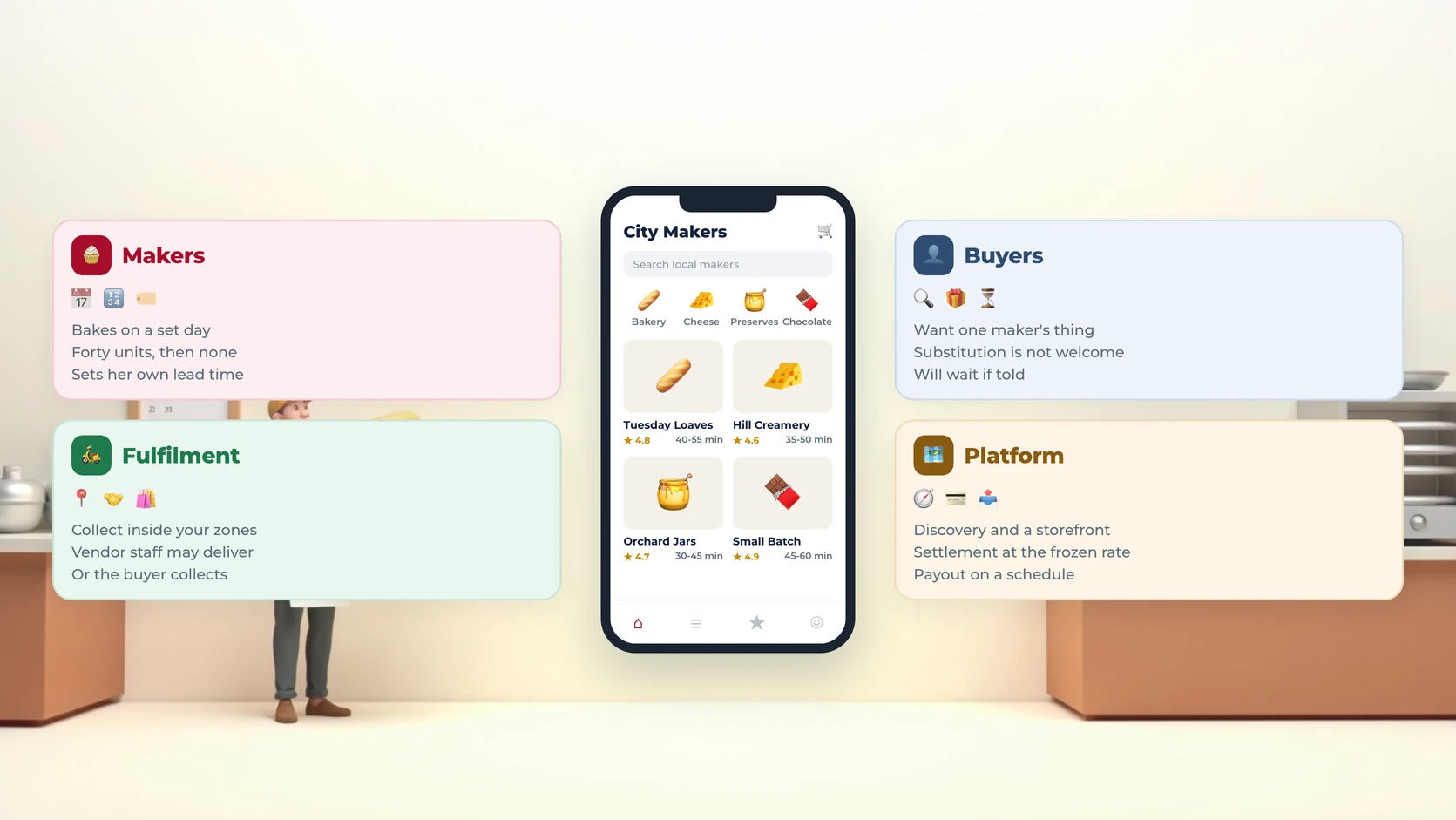
- A speciality food maker produces in batches, so availability is a quantity against a production run rather than a flag that resets every night.
- Lead time is a property of the product rather than a failure of the delivery, and the buyer has to see the date beside the price rather than after paying.
- A cut-off is a calendar calculation worked backwards from a production day in the vendor’s timezone, not a countdown timer on the listing.
- Sold out is a state worth designing, because the waiting list it collects is the only reliable way a small maker learns how much to make next time.
- Every vendor process is performed by the person who also made the food, so anything costing more than a few minutes a day quietly turns into stale data.
Model the Batch First
- Attach stock to a production run with a make date, not to the product listing.
- Calculate cut-offs backwards from the production day in the vendor’s own timezone.
- Show the delivery date next to the price, before the buyer reaches checkout.
- Split vendor hours into trading hours and handover hours from the first release.
- Budget five minutes a day of vendor attention and design every screen against it.
Real Insights
- A marketplace that deletes sold-out listings throws away both its search equity and the demand signal its vendors need most.
- Substitution logic borrowed from grocery misreads this market entirely, because the buyer chose a specific maker rather than a category.
- Support cost here tracks vendor count and production events rather than order volume, which makes a hundred small makers heavier to run than twenty busy kitchens.
- Fulfilment is a per-vendor choice between your riders inside your zones, her own delivery, or collection in person, and forcing one method on everybody reads as churn.
- Miracuves builds the batch, cut-off and payout machinery as one spine, and eligible ready-made scopes are white-labelled and deployed on a 6-day build path.
She bakes on Tuesdays. Forty loaves, from a starter fed on Sunday evening, which means the week begins two days before anything goes into an oven. By Wednesday the forty are gone. There is no forty-first, and asking for one is not a matter of paying more.
Now put her on a marketplace built for restaurants. The catalogue asks whether the item is in stock, yes or no. The checkout promises arrival inside the hour. The dashboard wants opening hours, and wants items toggled off when the kitchen runs out. Every one of those assumptions describes a business that can make another of anything within minutes, staffed by somebody whose job is to watch a screen.
She is none of that. Her production is a batch, her availability is a calendar, her stock is a countdown, and the person who would update the dashboard is holding a proving basket. A speciality food marketplace that does not model those four facts will misrepresent her to every buyer, and will spend its own week correcting orders it should never have taken.
The makers on a marketplace like Goldbelly produce in batches rather than in services, and that breaks every restaurant assumption.
Why a Food Marketplace Maker Does Not Repeat a Restaurant Week
A maker selling through a marketplace like Goldbelly has a production week, not a dinner service.
A restaurant’s week is seven copies of a day. The same menu, the same hours, the same ability to produce whatever is listed for as long as the doors are open. Variation is noise around a repeating pattern, and most food ordering software encodes that pattern too deep to reach.
What Tuesday actually contains
Sunday is feeding the starter and ordering flour. Monday is shaping and the first cold prove. Tuesday is baking, cooling, wrapping and labelling. Wednesday is handover, to a rider or to buyers at the door. Thursday is the cut-off for next week. Friday she works her other job, because the loaves alone do not yet pay a mortgage.
What the platform asks her for
Most systems ask for three things she cannot give: continuous availability, immediate fulfilment, and constant attention. She answers by lying slightly. She marks herself open because being closed hides her from search. She accepts a delivery window she will miss. She leaves stock high rather than log in twice a day to lower it.
Each of those small dishonesties is a design failure, not a character failure. The software asked a question whose truthful answer had nowhere to go. Modelling her properly is why the vendor side is where the engineering sits, as the features page sets out.
How Stock Works in a Speciality Food Marketplace
The most consequential data decision here is what type the availability field is. A restaurant platform makes it a boolean: available, or sold out for today, reset overnight by a scheduled job. That reset is the assumption that breaks everything.
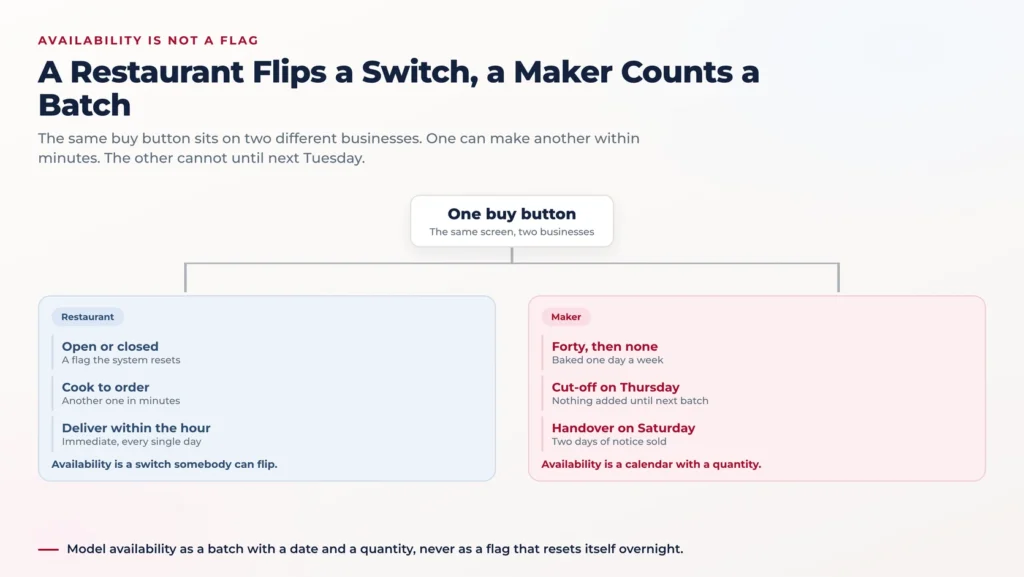
Image Source: AI-generated visual by Miracuves
Why a yes or no flag is the wrong data type
A flag can only say that something is orderable right now. It cannot say that eleven of forty remain, that the batch closes on Thursday, or that the next chance is nine days away. Those three facts decide whether the buyer orders at all, and a boolean carries none of them.
Worse, a flag that resets by default puts her back on sale on Wednesday morning with nothing to sell. A scheduled job somewhere assumed a kitchen.
Stock belongs to a batch, not to a product
The workable model attaches quantity to a production run. A batch has a make date, a quantity, a cut-off, and a window in which its output is collected or delivered. The product is the recipe. The batch is what is actually for sale.
Several hard questions then answer themselves. A second bake in the same week is a new row, not an edit. A burnt tray is an adjustment against that run, with a reason attached. The buyer sees a real date and a remaining count, not a vague in-stock badge.
What has to happen at zero
At zero the listing does not disappear. It changes state. The page still ranks, still carries her story, and offers the only useful action left: tell me when the next batch opens. A marketplace that removes sold-out listings from search discards the signal that tells her to make sixty next time.
Selling what is not there is how vendor relationships end, as in The Out-of-Stock Trap: Why Cheap Delivery Scripts Ruin Restaurant Relationships, and a maker who cannot replace the stock feels it several times harder than a kitchen that can.
Why Lead Time Is a Product Property in a Food Marketplace
Ask a delivery platform how long an order takes and it answers with logistics: distance, traffic, riders, kitchen throughput. Ask a maker and she answers with a process. Two days, because that is how long the thing takes to exist.
Two days of notice is the thing being sold
This is the reframe most founders resist. The forty-eight hours are not a delay attached to a product. They are the product. Slow fermentation, a long cure, a set that needs a cold night: the waiting is why the buyer wanted this and not a supermarket version.
Platforms that treat elapsed time as failure paper over it: an estimate, a countdown, an apology when it ends. All three are wrong here. Nobody is late.
Where lead time has to live
Lead time sits on the product and feeds the availability calculation, rather than sitting in the description as a note. A jar with a one-day lead time and a cake with a five-day lead time cannot share a basket delivery date, and the basket has to know that before the buyer reaches payment.
It also has to take more than one shape. Some makers work to a fixed number of days, some to named production days, some take one order a week and need exactly one date offered. A single integer field satisfies the first and misrepresents the rest.
The buyer has to see it before paying
Every expectation problem here is preventable at the listing and almost none is repairable after payment. The date belongs next to the price, not in a confirmation email. Buyers accept a wait they were told about and resent an identical wait they discovered afterwards.
That one piece of copy placement is worth more to your refund rate than any support process you will write. It is why the order spine matters more than the storefront skin, a theme running through how the business model works.
Cut-Offs and Production Windows in a Food Marketplace
Order by Thursday evening for a Saturday delivery. That sentence contains three separate mechanisms, and platforms routinely implement one of them and call it done.
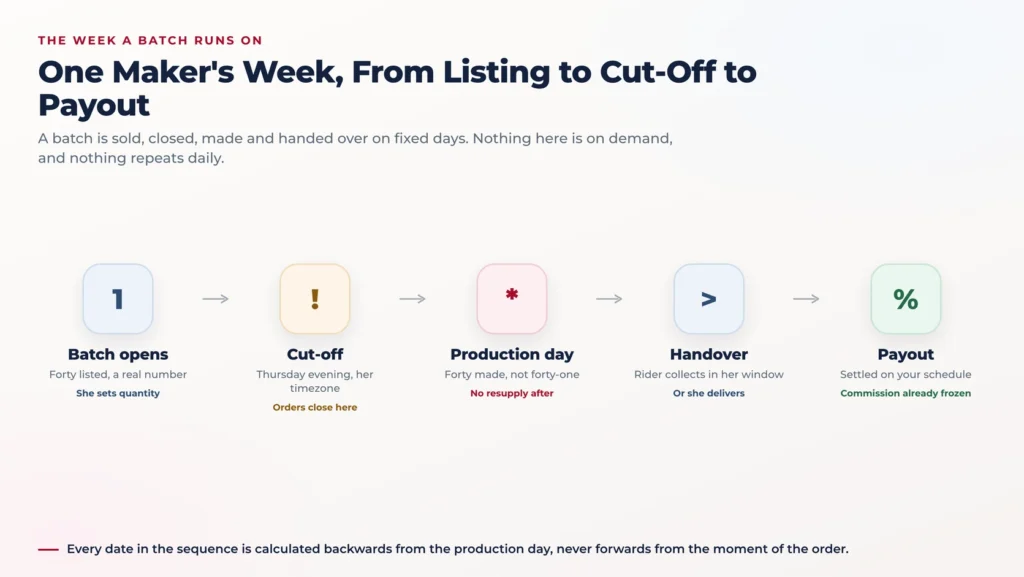
Image Source: AI-generated visual by Miracuves
A cut-off is a calendar calculation, not a countdown
The naive implementation is a timer: orders close in six hours. The correct one works backwards from a production date, through the lead time, to a moment in her local timezone, then decides which delivery dates are still reachable as the buyer looks at the page.
The difference shows at the edges. A buyer in another timezone. An order placed a minute before cut-off. A basket assembled on Wednesday and paid on Friday. Each breaks a countdown.
Treat the checkout date as provisional and revalidate at the moment of payment. If the cut-off passed while the buyer was deciding, offer the next reachable date rather than taking the money and finding out later.
The refund neither party wanted
When a cut-off is wrong the outcome is always the same. An order lands that she cannot make, she finds it on the morning of the bake, and somebody cancels. The buyer gets money back they never wanted, because they wanted the cake. She loses a sale she would have taken a day earlier.
These refunds are more corrosive than ordinary ones because neither side did anything wrong and both blame the platform, correctly. They are also preventable in software, which makes them the clearest test of whether a build understands its vendors.
Scarcity Is the Product, Not a Supply Failure
An aggregator treats a sold-out item as leakage. Somebody wanted to spend money and could not, so a metric goes red and a growth team is assigned. On a maker marketplace that instinct destroys the thing you are selling.
Limited runs and seasonal windows
Twelve jars of a marmalade made from one tree’s fruit. A pudding that exists for six weeks a year. A cheese that is only right at a certain age. These are not inventory failures to be engineered away. They are why a buyer pays a premium and tells somebody else about it.
Your catalogue therefore needs a first-class notion of a season: a window in which a product can be ordered, outside of which it stays visible but is not. Deleting the listing in the off season discards everything it earned in search and every buyer who would have waited.
Sold out is a state worth designing
A good sold-out page does three jobs. It tells the buyer this was real and she missed it. It says when the next chance is, or that the maker has not set one yet. And it captures an intention, which is the only artefact of the visit worth keeping.
Collected intentions are the most valuable number your platform produces for a vendor. They turn an anxious guess about batch size into a count. A maker who learns she has thirty waiting buyers before deciding how much to make is a maker who grows, and she will credit you.
She Is Not Open From Nine Until Ten
Vendor hours look like a settings page and behave like core business logic. On a restaurant platform they govern whether orders can be placed. Here they govern something more complicated, because ordering and fulfilment are separated by days.
Trading hours and handover hours are different things
She can take orders at any hour, because an order costs her nothing until the batch closes. What she cannot do is hand food over at any hour. The hours that matter are the ones where a rider can collect or a buyer can arrive, and those may be a two-hour slot on one day.
If your model has a single hours field it will be used for both, and the result is a platform that stops her selling at nine in the evening for no reason, or sends a rider to a locked door.
Closures, holidays and the week off
She will take a week off in August and two in winter. She will cancel a bake because a child is ill. She will close for a public holiday your platform has never heard of, because your zones span several countries.
Closures have to be expressible in one action, reach forward through the calendar to remove dates that are no longer reachable, and be reversible without her rebuilding her catalogue. A vendor who breaks her own shop by taking a holiday does not come back cheerfully, a dynamic that shows up across the wider food delivery solution family too.
There Is No Operations Team Behind Her
This constraint quietly decides which features are real. Every process you design is performed by the person who also made the food, packed it, answered a message about allergens, and is due to collect a child at four.
The few minutes a day budget
Assume she has five minutes a day for your software, on a phone with flour on the screen. Anything costing more will not happen. It will not be refused, argued about or escalated. It will simply not happen, and your data will be wrong in a way nobody reports it.
That budget is the acceptance criterion for every vendor-facing feature. If confirming tomorrow’s orders takes eleven taps, the feature does not work, however correct the screens are.
A restaurant has somebody to keep the system honest. A maker does not, so the system has to keep itself honest: batches that repeat until she says otherwise, stock that decrements without being told, cut-offs that arrive on their own, closures that propagate to every affected date.
Stale information is a design outcome
When a maker marketplace shows wrong availability, the temptation is to blame vendor discipline and send a reminder. The reminder will be read while she is shaping dough and forgotten by the time her hands are clean.
Treat every piece of stale data as a missing default. Ask what the system could infer from the batch, the calendar or the last order, and make it infer that instead of asking her. What genuinely needs a human decision should fit in one daily notification.
What Her Week Costs Your Operation
Founders arriving from restaurant aggregation bring a support model calibrated to businesses with a manager, a landline and a printer. It does not survive contact with a roster of makers, and the difference is structural rather than a matter of effort.
Support load per vendor, not per order
A restaurant doing two hundred orders a week may generate fewer support contacts than a maker doing fifteen. Her questions differ in kind: how do I close for a holiday, why has my batch not opened, can I move Saturday to Sunday for one buyer, what happens to my payout if I refund.
Model support cost against vendors and production events, never order volume. A roster of a hundred low-volume makers is operationally heavier than twenty busy kitchens, whatever the revenue says.
The manual correction queue
You will edit things on her behalf. Moving a delivery date she agreed over the phone. Reducing a quantity after a failed bake. Reopening a batch for one buyer who begged. That is not a failure state, it is the job, and it needs building rather than improvising in a database client at midnight.
So admin actions need the same rigour as vendor actions: a reason, an actor, a timestamp, and a trail that survives into the statement she receives. Intervening without a record is how a payout dispute becomes unwinnable.
The Buyer Is Buying One Person’s One Thing
Demand here is unusually specific. Nobody arrives wanting a jar of chutney in the abstract. They want her chutney, because somebody brought it to a dinner, or because they read the paragraph about her grandmother’s recipe.
Substitution is usually unacceptable
A grocery platform can swap a brand and most buyers shrug. A restaurant can offer a different side dish. Here the maker is the product, so substitution is not service recovery. It is a different purchase entirely, and offering it can read as an insult to both parties.
Design failure paths accordingly. The acceptable recoveries are a later date from the same maker, a place in the next batch, or a refund with an apology that does not pretend an equivalent exists. Substitution logic copied from a grocery build is worse than no logic at all.
A gift has a date attached
A meaningful share of these orders are for somebody else and arrive with a date that cannot move: a birthday, an anniversary, the Saturday the family is together. The lead time that felt generous in the listing becomes unforgiving when the occasion is fixed.
That raises the stakes on every cut-off calculation above, and it is why the ordering spine has to treat a date as a promise rather than an estimate.
Four Parties and What Actually Moves Between Them
It is worth being concrete about who is in this market and what each hands over. The usual diagram, buyers on one side and sellers on the other, hides the two parties that make the model expensive to run.
What each side gives and takes back
The maker gives scarce inventory and a story that cannot be manufactured, and takes back reach she could not buy and a payment she need not chase. The buyer gives attention and money, and takes back something specific and a date to look forward to.
Who Gives What, and What Breaks First
| Party | Gives | Needs back | Fails when |
|---|---|---|---|
| The maker | A limited batch and a story | Reach, a correct calendar, a predictable payout | The platform sells stock that does not exist |
| The buyer | Attention, money, patience for a lead time | An accurate date, and no substitution | The date was discovered after payment |
| Riders or vendor staff | Local collection inside your zones | Clear windows and proof of handover | Collection is attempted outside her hours |
| The platform | Discovery, settlement, support, a storefront | Commission, subscriptions, the other revenue lines | It models a maker as a small restaurant |
Riders or her own staff give local fulfilment inside the zones you drew. The platform gives discovery, settlement and a payout on a schedule, and takes back commission and the other lines the build scope is sized against.
Founder Decision Signals
Speed
If your catalogue cannot express a batch, a cut-off and a season by vendor number ten, you will be correcting orders by hand every week after that.
Cost
Support cost tracks vendors rather than orders, because a maker with fifteen weekly orders can ask more questions than a kitchen with two hundred.
Scalability
Growth means more production events on more calendars, not throughput on one. Automate closures, repeats and stock decrements before chasing roster size.
Market Fit
If buyers accept a substitute when their maker sells out, you are running a grocery business. If they wait nine days for the next batch, you have the real thing.
Fulfilment Is Chosen Per Vendor, Not Per Platform
Because production is scheduled rather than continuous, how the food reaches the buyer is a separate decision from when it is made, and each vendor makes it for herself rather than inheriting yours.
Riders inside the zones you draw
The default is a fleet you run, inside delivery zones you define. For a maker this is usually a scheduled collection rather than a dispatch: a rider arrives in her handover window, takes eleven parcels for eleven buyers, and works through them. The assignment problem looks nothing like a lunchtime rush.
Design for that rather than inheriting the other. Slot-based collection, several orders from one vendor in one run, and a window she can rely on beat an engine tuned for immediate food, and the white-label delivery engine underneath has to support both shapes.
Her own delivery, and collection in person
Many makers already deliver. They have a car, a Saturday route and customers who expect them. Others prefer collection: buyers come to a market stall, a kitchen door or a pickup point at a stated time. Both must be selectable per vendor, with their own windows, fees and proof.
Forcing every vendor onto your fleet looks like consistency and behaves like churn. The maker who has delivered her own bread for six years will not hand that relationship over because your dashboard prefers it.
One limit is worth stating plainly in your own marketing: this build delivers locally, through zones and riders. Carrier-based national fulfilment of perishable goods is a different business with different packaging, transit risk and insurance. Buyers understand local, and so do makers. The candour is a positioning asset, roughly the argument in Migrating from SaaS to Owned Infrastructure: A Peak-Hour Performance Comparison.
A Catalogue Model That Survives All of This
Pull these sections together and the catalogue stops being a list of products with prices. It becomes a small scheduling system, and the question it answers is not whether something is available but whether this buyer, in this place, on this day, can still get this thing.
Four product shapes, one resolver
Four shapes cover almost every maker you will onboard. Always available, made ahead and held in a cupboard. Batch, made on named days in fixed quantities. Made to order, with a lead time and a daily capacity. Seasonal, which is any of the first three wrapped in a window.
The mistake is to build four features. Build one availability resolver that takes the product, the batches, the lead time, the cut-off, the vendor calendar, the closures and the buyer’s zone, and returns a set of dates. Every surface asks the same question and gets the same answer.
Why bolt-ons disagree with each other
When pre-orders, gifting and scheduled deliveries are added separately, each grows its own idea of what is available. The listing says Saturday, the basket says Friday, the vendor app says the batch is closed, and support decides which screen is telling the truth.
One resolver, queried everywhere, is the cheapest correctness you will ever buy. It is also the difference between a configurable platform and a codebase full of special cases, the same structural choice examined in The 36-Month TCO Comparison: SaaS Delivery Builders vs. Owned White-Label Engines.
Six Ways This Goes Wrong
Each of the following has sunk a real speciality marketplace, and none is exotic. They are one mistake in different clothes: a restaurant assumption left in place because nobody asked what the vendor’s week looks like.
Nightly stock resets
A scheduled job puts every vendor back in stock at midnight, because that is what a kitchen needs. A maker with an empty shelf is now selling loaves she cannot bake until Tuesday.
Treating lead time as lateness
Elapsed time is counted as a service failure, so the platform apologizes for the fermentation the buyer paid for, and trains everybody to see the product as slow.
One hours field for everything
Trading and handover hours share a setting, so she either disappears from search at six in the evening or has riders knocking while she is at her other job.
Deleting sold-out listings
The page vanishes to keep the catalogue tidy, taking its ranking and every waiting buyer with it, and the vendor loses the signal that would have told her to make more.
Designing for a vendor at a desk
Processes that assume somebody is watching a tablet produce stale data, because the person who would watch it is elbow deep in a bowl until four.
Copying substitution logic from grocery
Offering a similar product from another maker misreads the purchase. The buyer wanted this person’s work, and the offer reads as a platform that does not understand its market.
Read them as a specification rather than a warning list. A build that handles all six gets most of the vendor experience for free, and the team you build with should be able to tell you which of the six their platform already solves.
Three Operator Shapes and Which One You Are
The business model page sets out three shapes this platform gets operated in, and the maker’s week hits each differently. Which one you are building determines how much of the machinery above you need on day one.
The curated local roster
Thirty to eighty makers in one city, personally approved, fulfilled by a small rider fleet inside a handful of zones. Batch logic and handover windows matter from week one. Support is a person who knows every vendor by name, affordable precisely because the roster is small.
This shape lives or dies on curation. The catalogue is the editorial product, and the platform’s job is to make a small roster look inevitable rather than sparse.
The category specialist and the existing supply owner
The second goes deep on one category across several zones: bakers only, or preserves only. Product shapes are consistent, which simplifies the catalogue, but seasonality dominates and the calendar work gets harder, not easier.
The third already owns supply: a collective, a market operator or a food hall putting its existing makers online. Onboarding is solved, so the value sits in the order spine, settlement and payouts, and it can launch with a thinner discovery layer. Whichever shape you are, the six-day path for eligible ready-made scopes covers build and deployment rather than the whole calendar, and the detail is on the facts page.
Final Thoughts: Build for the Batch, Not the Kitchen
Goldbelly is not a restaurant app with more sellers on it. The unit of supply is a different thing.
Almost every mistake in this article comes from one inherited assumption: that the vendor can make another one. Remove it and the design decisions stop being arguments. Stock becomes a quantity against a production run. Lead time becomes a property of the product. Hours split into trading and handover. Sold out becomes a state you invest in.
What you get back is a marketplace that describes its vendors accurately, the only durable advantage available here. Accuracy is why a maker recommends you to three others, and why a buyer who waited nine days comes back. Neither is a growth tactic you can buy, and both are downstream of software that understood the week she actually has, the same discipline seen in Sub-2 Second Tracking: Load-Testing GPS Delivery Updates on Flutter and Laravel, where the promise and the system have to match.
If you are scoping one of these, start with a single vendor’s calendar rather than a feature list, and check whether the platform in front of you can represent it without a workaround. Our food delivery app development work and the wider solution catalogue start from that question. When you are ready, book a working session with our team and bring one maker’s week with you.
FAQs
How does the Goldbelly business model differ from a restaurant app?
Because a restaurant can make another one within minutes and she cannot. A restaurant availability flag means orderable now and is reset overnight by a scheduled job. Her stock is a countdown against a batch she baked on a named day, and when it reaches zero nothing replaces it until the next production run. The flag quietly puts her back on sale with nothing to sell.
Why does a food marketplace attach stock to a batch, not a product?
The product becomes the recipe and the batch becomes the thing actually for sale. A batch carries a make date, a quantity, a cut-off and a window in which its output is collected or delivered. A second bake in the same week is a new batch rather than an edit, and a failed tray is an adjustment against one run with a reason recorded against it.
Is lead time a problem in a speciality food marketplace?
No. On this kind of marketplace the waiting is the product. Slow fermentation, a long cure or an overnight set is why the buyer chose a maker over a supermarket shelf. Treating elapsed time as a service failure trains everybody to see the product as slow. Show the lead time on the listing, beside the price, and the wait stops being a complaint.
How should a food marketplace calculate order cut-off times?
Work backwards rather than forwards. Start from the production date, subtract the lead time, and land on a moment in the vendor’s own timezone. Then decide which delivery dates are still reachable at the moment the buyer is looking at the page. Treat the chosen date as provisional until payment and revalidate at payment, offering the next reachable date if the cut-off passed while the buyer was deciding.
What should a listing do when the batch has sold out?
Change state rather than disappear. The page keeps its ranking, keeps the maker’s story, and offers the only useful action left, which is to be told when the next batch opens. Those collected intentions are the most valuable number the platform produces for a vendor, because they turn an anxious guess about batch size into a count of people who already said yes.
How do vendor hours work when the vendor is not open every day?
Split them in two. Trading hours govern when orders can be placed, and taking an order costs her nothing until the batch closes, so these can be generous. Handover hours govern when a rider can collect or a buyer can arrive, and those may be a two-hour slot on one day. One shared hours field will misuse both and send riders to a locked door.
Why is support load higher per vendor than on a restaurant marketplace?
The questions differ in kind rather than in number. A maker asks how to close for a holiday, why her batch has not opened, whether Saturday can become Sunday for one buyer, and what a refund does to her payout. She has no operations team, so you answer directly. Model support cost against vendor count and production events, never against order volume.
If the platform does not ship, how does the food reach the buyer?
Locally, and the method is chosen per vendor. Riders you run collect inside the delivery zones you draw, usually as a scheduled pickup in her handover window rather than an on-demand dispatch. She may deliver with her own staff on her existing route, or buyers may collect in person. Carrier-based national fulfilment of perishable goods is a different business and is not part of this build.
Miracuves is an independent software development company. We are not affiliated with, connected to, sponsored by, or endorsed by any company or product named in this article.
Terms such as “X Clone” are used descriptively. It is how the software industry refers to building a platform with functionality comparable to a known service, and how clients search for it.
The entire design and codebase of our products is built by our own team. Our products contain no code, design, graphics, or content originating from any third-party website or applications.
All third-party names and marks referenced in this article are the property of their respective owners, referenced solely to identify the services discussed.