


Key Takeaways
- A multi-vendor marketplace is not one shop with sections; it is N small businesses sharing a checkout, a reputation and a bank account.
- Every capability a single-vendor store needs once, a marketplace needs N times, and the multiplier is the size of your roster.
- Code multiplies at almost no marginal cost, while onboarding, catalogue moderation and vendor support multiply with every maker you sign.
- Because the labour is the same either way, the only variable you truly control is how soon that labour starts.
- The decision to make before build versus buy is whether you are ready to operate a roster, and that question has no software in it.
Before You Choose
- Measure how many hours one onboarding takes you, then multiply by your target roster.
- Name the single person who owns the roster, the approval queue and the lapsed documents.
- Sort every projected cost by whether it rises with vendor count or stays flat.
- Judge any platform on its vendor dashboard before you look at its storefront.
- Run a six-vendor, ninety-day pilot on deployed software instead of debating a specification.
Real Insights
- The founder who pictures a shop with sections budgets for software and is ambushed by staffing.
- Commission, payouts, admission and availability are all concepts that exist only because you added a second vendor.
- A vendor dashboard nobody designed converts one unclear line into a message from every maker in the same week.
- Custom is genuinely right for an unusual settlement model, an authoritative finance system, or a regulated context, and for little else.
- Miracuves deploys the vendor spine as an owned, source-code-delivered build, with eligible ready-made scopes on a six-day deployment window so the roster work can start immediately.
The spreadsheet has forty-one rows. Each is a person who makes something worth buying: a bakery two towns over, a woman who cures fish in a converted garage, a family that has produced one sauce since 1974. The founder spent four months collecting them, and supply that good is hard to find.
Then the conversation turns to software, and the picture in his head is a shop. One shop with forty-one sections. Add filters, a vendor login and a commission field, and it becomes a marketplace. Quote it out, or buy it ready-made, and the hard part is behind him.
That picture is where the money goes. A multi-vendor speciality food marketplace is not a shop with sections. It is forty-one small businesses sharing a checkout, a reputation and a bank account. Almost everything hard about this business follows from that sentence, and almost none of it is a feature you can point at.
Founders costing a marketplace like Goldbelly usually price a shop and then discover they have bought a marketplace.
The Food Marketplace a Founder Pictures Versus the Real One
The picture in a founder’s head is usually a single-vendor shop wearing the logo of a marketplace like Goldbelly.
The drawing a founder carries decides what they budget for and which parts of the build they treat as details. Getting it wrong produces every other error.
A shop with sections is the wrong drawing
In a single-vendor store, one person decides everything. One person writes the descriptions, so they sound alike. One person photographs the goods, so they match. One person sets hours, stock and lead times, and whether today is a good day to take an order for Friday.
That consistency is invisible because it is free. It comes from there being exactly one decision-maker. No policy on tone of voice is needed when only one voice exists, and no moderation queue when nobody else can publish.
Add a second vendor and consistency stops being free. It becomes something you produce on purpose, forever. Add thirty-nine more and producing it is a full-time job.
Forty businesses, one bank account
The accurate drawing is uncomfortable. You run a front office for forty independent businesses with their own costs, capacity, tax positions and opinions about how they are represented. Buyers’ money lands in your account first and belongs to them.
That single fact reorganizes the project. You are not selling food. You are holding other people’s revenue, accounting for it correctly, and returning it on a schedule they can plan around. The expensive machinery sits behind the vendor login.
What Multiplies in a Multi-Vendor Food Marketplace
The phrase multi-vendor hides the whole argument inside a hyphen. It sounds like a setting. It is a multiplier applied to every operational capability you have, and the multiplier is your roster.
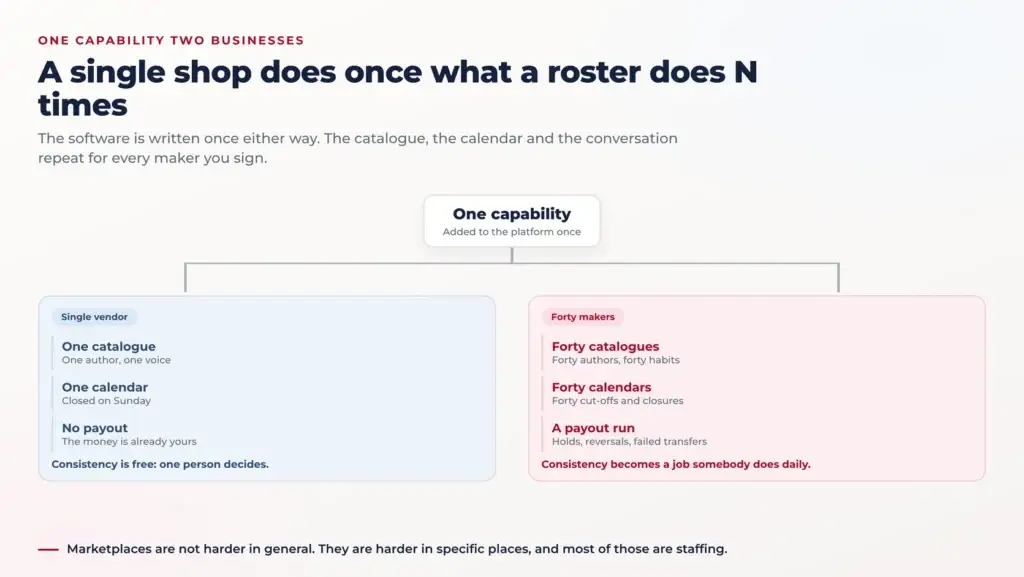
Image Source: AI-generated visual by Miracuves
One catalogue becomes forty you do not control
A single-vendor catalogue is a list you own. You fix the mistakes, and when something sells out you change one number.
A marketplace catalogue is forty lists owned by forty people busy making things. They update stock when they remember, forget to remove a seasonal item in March, and write descriptions at eleven at night. All reasonable from a small producer, and all live on your storefront unless something sits in between.
Catalogue control is part of the vendor spine set out on the features page: who may publish what, what needs approval, what goes live immediately.
One commission rate becomes a table of them
You will not run one rate. You will intend to, and then your anchor maker negotiates, a thin-margin category needs a different number, and a vendor on a subscription plan expects a lower one.
Now the rate is per vendor, and every order must carry the rate that applied when it was placed, not the rate current when you generate a statement six weeks later. Change a rate today and last month’s statements must not move. A single-vendor store has no version of this problem at all.
One payout becomes a run
In a single-vendor store, money arrives and it is yours. There is no payout.
In a marketplace, one payment in becomes many payments out on a cycle, each with commission deducted, refunds clawed back, holds for disputed orders and a chance of bank rejection. The run must be repeatable without paying anybody twice. The business model page treats the roster as the asset for this reason: every revenue line sits downstream of makers who trust it.
One set of opening hours becomes forty calendars
In a single-vendor store, opening hours were a text field. Across a roster it is forty schedules, forty sets of holiday closures, forty cut-off times, and forty people who will occasionally vanish for a week without marking themselves unavailable. Availability is computed per vendor, per day, per product, and the buyer learns what it means for their basket before they pay. None of that is exotic engineering, and none of it exists until the second vendor arrives.
Food Marketplace Costs That Multiply in Code and in Labour
This is the distinction that decides whether you build or buy, and it is almost never the one founders are handed. The question is not which features you need. It is which costs rise with vendor count and which do not.
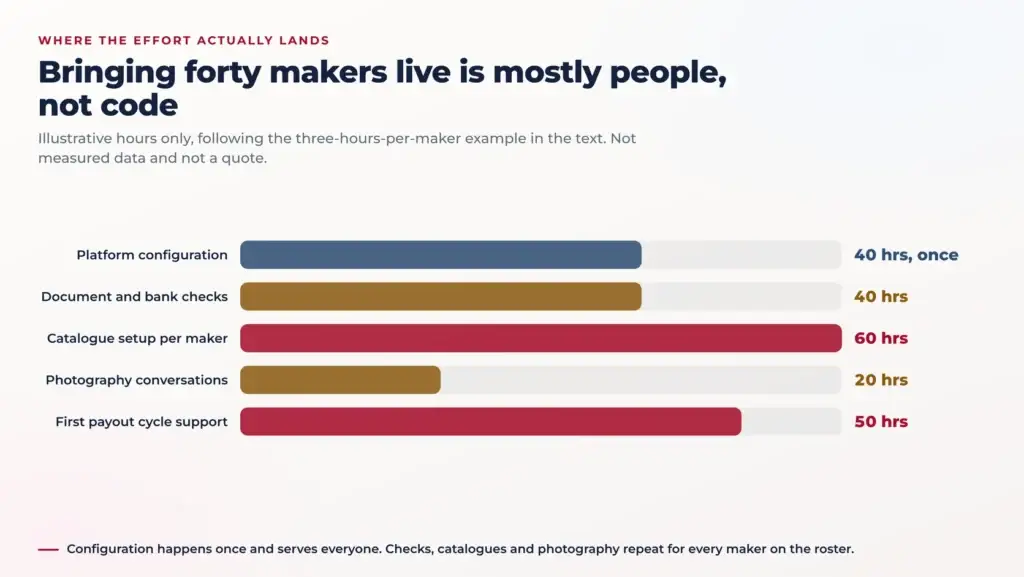
Image Source: AI-generated visual by Miracuves
Code multiplies at almost no marginal cost
A commission engine that handles one vendor handles two hundred. A payout run that pays ten makers pays a thousand with a longer runtime and no new logic. An approval queue does not get harder because more things enter it.
There are real engineering costs at volume, and they are the ordinary ones: read-heavy browse paths, index freshness, availability recomputed across a large catalogue. Those are tractable, and Sub-2 Second Tracking: Load-Testing GPS Delivery Updates on Flutter and Laravel shows what measuring them looks like. The code is written once, so the tenth vendor costs almost nothing in software. That is the entire economic case for a platform.
Labour multiplies linearly, and sometimes faster
The tenth vendor costs exactly as much human attention as the first. Someone reads their documents. Someone checks the name on the account matches the registration. Someone sits with them through their first twelve products, explains why a photograph taken on a dark counter will not sell, and answers the question every maker asks about when they get paid.
Some of it multiplies faster than linearly. Two makers in one category will eventually argue about placement. A basket spanning three makers creates coordination work no single order does. A dispute involves a buyer, you, and one maker with a firm opinion about whose fault it was.
The question this actually settles
If most of your marginal cost per vendor is labour, spending nine months building software is spending nine months on the half that was going to be cheap. You arrive at launch with a bespoke platform, no roster, and no idea how long a document check takes your team.
Buying the machinery does not remove the labour. Nothing removes the labour. It moves the start date of that labour forward by most of a year, which is the only variable here you genuinely control.
Where the Second Food Marketplace Vendor Costs More
Every row below is something a single-vendor operator never thinks about. Marketplaces are not harder in general. They are harder in specific, nameable places, and those places are staffing decisions as often as software ones.
The same capability, in two different businesses
| Capability | Single-vendor store | Marketplace of N makers |
|---|---|---|
| Catalogue | One list, one author | N lists, approval rules, moderation |
| Margin | You set it and keep it | Per-vendor commission, frozen at settlement |
| Money out | None: it is already yours | A run with holds and reversals |
| Availability | One set of opening hours | N calendars, N cut-offs |
| Admission | Not applicable | Checks, a queue, re-checks |
| Support | Buyers only | Buyers, plus N owners on income |
| Quality | Free: one decision-maker | Produced deliberately, never finished |
Read the right-hand column as a hiring plan rather than a backlog. Four of those seven rows are mostly people, yet scoping conversations spend their time on the other three, which is why the development cost breakdown is best settled quickly instead of dominating the discussion.
Onboarding Throughput Is the Constraint Nobody Budgets
Ask a founder how many vendors they want at launch and you get a number. Ask how many they can bring live per week and you get a pause. The second number sets the launch date, and the platform barely affects it.
Forty makers is forty conversations
Each one is a document check against the business as it is actually registered. Each one is a bank account confirmation, because paying the wrong account is the mistake no apology covers. Each one is a catalogue setup: products, variants, lead times, what they will not sell in July.
And each one is a conversation about photography, which runs longer than anyone plans for. The maker has photographs. They are of the food at a market stall under a canopy, and they will not survive beside a maker who paid for a shoot.
Multiply honestly. If that sequence takes a competent person three hours per maker, forty makers is a hundred and twenty hours before a single order exists, and that assumes nobody goes quiet for two weeks. Some will.
What a platform genuinely removes
A good vendor spine does not make onboarding fast. It makes it finite and repeatable. The application asks for the right things in the right order. Documents land in a queue with a state, not in somebody’s inbox. Approval is an action with a record, not a message saying yes.
A platform stops onboarding getting worse as the roster grows. It does not stop it costing what it costs.
The queue that quietly stalls
The failure mode is not rejection. It is drift. A maker signs up enthusiastically, uploads two of three documents, and waits. Nobody chases them because nobody owns the queue. Three weeks later the enthusiasm has cooled and somebody else has called them.
Time to first live product is the number that matters most in year one, and it turns on whether one named person opens the approval queue every morning. That is a management fact wearing a software costume.
Catalogue Quality at N
A marketplace storefront is written by its vendors. The most visible asset in the business is produced by people who do not work for you and who are optimizing for their own time, not your conversion rate.
Everyone writes differently
One maker writes forty words of family history and never mentions the weight. Another writes the weight and the ingredients and nothing else. A third writes in capitals. A fourth files a chilli oil under condiments while a fifth files the same thing under pantry, so the category page looks half empty.
Left alone for six months, this turns a curated marketplace into a directory. Nothing broke. No bug was filed. The site simply stopped feeling like one place.
Photography is the difference that shows
Speciality food sells on appetite. Buyers who cannot taste anything decide with their eyes, and a grid where three cards are lit and nine are not does not read as variety. It reads as a site that does not check.
Operators who take this seriously either pay for a shoot at onboarding, set a hard minimum and reject below it, or send makers a one-page guide and a rejection reason referencing it. All three are labour. Only the third is cheap, and it is the weakest.
What moderation actually costs
Moderation is not a launch task. It is a permanent rate. Every new product, every edit, every seasonal swap is a small decision about whether this goes live now or waits for a look.
The pragmatic settlement is tiered trust: new vendors have edits held, established vendors publish straight through with spot checks, and anything touching allergens or ingredient claims is reviewed regardless of tenure. A platform should record and route here, never adjudicate. Labelling, licensing and local rules belong with the operator’s own counsel and the relevant authority, and your job is making sure the record exists.
Stock accuracy costs money directly. A product that sells after the maker ran out is a refund, an apology and a review, and The Out-of-Stock Trap: Why Cheap Delivery Scripts Ruin Restaurant Relationships covers how fast that erodes a supplier relationship.
The Vendor-Facing Surface Is a Product in Its Own Right
There is a screen nobody demos, nobody screenshots for the deck, and nobody budgets design time for. It is the one your vendors open every morning. Measured in minutes of use by the people the business depends on, it is your most important interface.
Used daily by people who did not choose it
Your buyers chose you. Your vendors were recruited. They did not evaluate the software, they were handed it, and they use it between batches with flour on their hands on a phone propped against a mixer.
That audience needs a few things done well: see today’s orders, mark something out of stock in two taps, change a price, see what is owed and when it lands. A dashboard of twenty equally weighted options is a failure even if every option works.
Every confusing screen becomes a phone call
This is where vendor-side design quality converts into operating cost. A payout statement that does not plainly show gross, commission, refunds and net draws a message from every vendor in the first cycle. Forty vendors, one unclear line, forty conversations in one week.
Custom teams underinvest here, because the vendor surface has no launch glamour and the founder is not the one using it. Judging a platform on its vendor screens rather than its storefront tells you more than any feature list, and it is the right lens for a conversation with any development partner.
Vendor Support Is a Relationship, Not a Ticket Queue
Buyer support is transactional. Something went wrong with one order, you fix it, the interaction ends. Vendor support is nothing like that, and treating it as the same function with a different inbox is an expensive category error.
They are calling about their own income
When a maker messages you about a payout, they are not reporting a bug. They are asking whether the money they counted on to buy next week’s ingredients is coming. The register is different, the acceptable response time is much shorter, and makers talk to each other far more than buyers do.
Somebody on your side owns the roster
At ten vendors this is the founder and it works. At forty it is a named person whose job is the roster: onboarding, chasing lapsed documents, working the approval queue, and noticing a maker has had no order in three weeks before they conclude the marketplace does not work.
Budget that role in the same sentence as the platform. A marketplace with excellent software and nobody watching the roster loses vendors quietly, and a lost maker takes their following with them.
Founder Decision Signals
Speed
The build is not your bottleneck; onboarding throughput is. Measure how many makers one person takes from application to first live product in a week, then multiply. That sets your launch date, not the sprint plan.
Cost
Sort costs by whether they rise with vendor count. Software mostly does not. Document checks, catalogue setup, moderation and vendor support do, every month you operate rather than only at launch.
Scalability
Code scales by running more often. Labour scales by hiring. A plan that grows the roster tenfold without a second person owning vendor relationships breaks by vendor thirty.
Market Fit
Your supply is the product. If you cannot name twenty makers who would sign this quarter, the build-versus-buy question is premature. Prove the roster, then argue about the platform.
The Three Parts That Must Be Correct Rather Than Good
Most of a marketplace can be merely good. Browse improves later. Search can start crude. Three things cannot, because a mistake in any of them is not a bug report. It is a breach of the arrangement with the people whose goods you sell.
Admission
Who may sell, what you checked before saying yes, and what happens when that document expires. Approving a vendor is a decision whose consequences outlive whoever made it, so it needs a record rather than a memory, and suspending one mid-order must not strand buyers.
Commission at settlement
The rate that applied when the order was placed is the rate that appears on the statement, permanently. A system that looks the rate up live rewrites history the first time you renegotiate with anybody, and the maker who notices will be the one you least want to lose.
The payout run
Running it twice must not pay twice. A failed transfer leaves a balance rather than vanishing. A refund issued after a payout creates a recoverable position, not an argument. Custom teams underestimate these mechanics most consistently, because they look like plumbing until the week they are not.
All three are documented on the solution’s own feature pages rather than re-argued here. The narrow point for this article: these are where exercised code is worth more than fresh code, because fresh code has never met a real edge case.
The Honest Case for Ready-Made
The usual argument for a ready-made platform is a feature count. That argument is weak, because any competent team can build anything on a list given enough months.
The machinery exists and has run
Vendor admission, per-vendor commission, catalogue control, scheduled payouts and the ordering spine that carries gifting and standing orders together already exist, in a form that has processed orders and produced statements. An exercised payout run has met a failed bank transfer. A fresh one has met a test suite. That difference never appears in a comparison table.
The same logic sits behind every product in the food delivery solutions range, and behind the narrow scope of this one. Fulfilment here is local: zones you draw, riders you or your vendors run, or collection in person, chosen per vendor. National carrier shipping of perishable goods is a different business with cold-chain problems this build does not solve, and knowing which one you are starting matters.
A configuration and a pilot instead of an unknown
A custom build converts a business question into a schedule risk. You find out whether your roster assumptions hold in month nine, at the point where changing them is most expensive.
Deploying something that already works converts the same question into configuration and a pilot. You set commission structures, draw zones, onboard six makers, and learn in three weeks what a custom path would have told you in three quarters. Eligible ready-made scopes deploy on a six-day build window covering white-labelling, deployment to your hosting and publishing to your own developer accounts; gateway onboarding and store review sit outside it, and the facts page sets out what is included. A white-label deployment is the usual shape. Being wrong early is cheap.
The Honest Case for Custom
Ready-made does not always win, and pretending otherwise is how founders end up fighting a platform for two years. Three situations make a custom build, at two to eight weeks of scoped development or more, the correct answer rather than the expensive one.
An unusual settlement model
If your economics are not commission on an order, the assumptions underneath a marketplace platform stop fitting. Consignment where title passes at a different moment, a split across three parties on one line item, or a co-operative sharing a surplus rather than paying a balance all bend the model out of shape. A settlement you had to trick the software into producing is one you will not trust at audit.
A finance system that must stay the source of truth
Operators extending an existing business often have an accounting or ERP system that already owns supplier records, tax treatment and payment runs. If that must stay authoritative, the marketplace is a front end and an order source, not the owner of the money. That is an integration project, not a packaged one, and custom development is the honest recommendation.
A regulated or unusual context
Some categories, jurisdictions and institutional buyers impose requirements on record-keeping, data residency or approval workflows that a general platform will not satisfy without structural change. Where that applies, your counsel and the relevant authority define the requirement and the build follows it.
All three exceptions are about money, records and obligations. None is about features. If your reason for going custom is a feature, it is probably not a reason.
Ownership Is What Stops Ready-Made Being a Trap
The reasonable objection to buying is dependency. You launch fast, and then your growth belongs to somebody else: a percentage of every order, a per-vendor licence that rises with the roster you built, or a platform you cannot change when your model does.
That objection is correct about subscription marketplace builders and wrong about owned deployments. With source code delivered and no revenue share, ready-made is a head start rather than a tenancy. You can change settlement logic when your model evolves, move hosting, and bring maintenance in-house the month you hire for it.
Two posts work through the arithmetic and the operational side properly: The 36-Month TCO Comparison: SaaS Delivery Builders vs. Owned White-Label Engines and Migrating from SaaS to Owned Infrastructure: A Peak-Hour Performance Comparison. A revenue share taxes exactly the outcome you are working towards, and it gets heavier as you succeed.
The Failures That Appear Around Vendor Twelve
Almost nothing below breaks at vendor three. The founder is still personally involved, the roster fits in their head, and the gaps are covered by attention. Somewhere between ten and fifteen makers, attention runs out and the structural problems surface together.
Budgeting the build and not the roster
The platform is a one-time cost with a maintenance tail. Onboarding, moderation and vendor support are recurring headcount. Plans that fund the first and assume the second stall exactly when supply should be accelerating.
Treating vendor support as buyer support
A buyer asks about an order. A maker asks about their income. The same response time reads as helpful to one and negligent to the other, and the second group compares notes.
Letting vendors publish unreviewed from day one
It feels generous in week one. By month six the categories disagree, half the photography is unusable, and the cleanup costs more than the review would have.
Designing the storefront and shipping the vendor dashboard
The screen your makers open every morning gets whatever time is left. Every ambiguity becomes a message from every vendor in the same week, and that support load is permanent.
Deferring payout mechanics as plumbing
Idempotency, holds, reversals and failed transfers look like details during scoping and become existential in the first cycle where a maker is paid twice. Correct here is the minimum, not a quality bar.
Are You Ready to Operate a Roster?
This is the question to answer before the build-versus-buy one, and it has no software in it. A founder who can answer it confidently will decide about the platform in an afternoon. A founder who cannot will pay either way.
Six questions that are not about features
Can you name twenty makers who would sign this quarter, with a person and a phone number against each? Who owns the roster, by name, not by department? How many hours does one onboarding take when you do it yourself, measured rather than estimated?
What is your standard for a product photograph, written down, and will you reject against it? Who checks documents, and what happens the day one expires? And when a maker calls on a Friday afternoon asking where their money is, who picks up?
The shape of a pilot that tells you something
Six vendors, one delivery zone, ninety days, one named person owning the roster. That produces real numbers: hours per onboarding, share of catalogue edits needing intervention, vendor messages per cycle, and how many makers were still actively listing at day ninety.
Those four numbers tell you what a hundred vendors costs to operate, the only forecast in this business worth having. They also tell you whether your roster likes the vendor dashboard, which internal review never answers. Running that pilot on deployed software rather than a specification is why the ready-made route wins so often, and the wider solutions catalogue exists to make starting one a short conversation.
Final Thoughts: The Software Is the Cheap Half
What makes a marketplace like Goldbelly expensive is everything that exists only because there is more than one seller.
Go back to the spreadsheet with forty-one rows. Nothing here makes those rows easier to collect or to keep. That work is yours whichever way you go, and it decides whether the marketplace exists in two years.
What the build-versus-buy decision changes is when you start it. A custom build spends its first months producing software while the roster waits, then learns its onboarding rate afterwards. A deployed platform spends those months producing a roster, and keeps the option to change the software once you know something true about your operation.
Decide the roster question first. Then take the shortest path to real makers, real orders and real payout statements, and treat everything else as configuration. If it would help to work through the multiplication against your own numbers, and what your first ninety days should measure, book a consultation and we will map it out together.
FAQs
Ready-made or custom for a speciality food marketplace build?
Almost nothing in the software and almost everything around it. The catalogue becomes forty catalogues written by forty people. One commission rate becomes a table of rates. A payout appears where none existed. One set of opening hours becomes forty calendars. Each of those is cheap to write in code and expensive to operate, because operating them means reading documents, reviewing listings and talking to business owners every week.
Does a ready-made food marketplace remove the onboarding work?
No, and any vendor who says it does is overselling. Signing forty makers is forty document checks, forty bank confirmations, forty catalogue setups and forty conversations about photography. A good platform makes that work finite and repeatable rather than fast: applications arrive in order, documents land in a queue with a state, and approval leaves a record. It stops onboarding getting worse as the roster grows. It does not stop it costing what it costs.
Which food marketplace costs scale with vendor count?
A commission engine that handles one vendor handles two hundred. A payout run that pays ten makers pays a thousand with a longer runtime and no new logic. Those costs are flat. Document checks, catalogue setup, listing moderation and vendor support are per maker and never stop. Some grow faster than the roster, because disputes and placement arguments involve pairs of vendors rather than one. Sort your plan by this line before anything else.
Am I ready to operate a food marketplace vendor roster?
Answer six questions without mentioning software. Can you name twenty makers who would sign this quarter, with a phone number each? Who owns the roster by name? How many hours does one onboarding take when you do it yourself, measured rather than guessed? What is your written standard for a product photograph? Who checks documents when one expires? And who picks up when a maker calls on a Friday about money?
What does catalogue moderation really cost once the roster grows?
It is a permanent rate rather than a launch task. Every new product, every edit and every seasonal swap is a decision about whether it publishes now or waits. Most operators settle on tiered trust: new vendors have edits held, established vendors publish straight through with spot checks, and anything touching allergens or ingredient claims is reviewed regardless of tenure. The platform records and routes. Labelling and licensing rules belong with your own counsel.
When is a custom build genuinely the right answer?
Three situations. An unusual settlement model, such as consignment, a three-way split on one line item, or a co-operative surplus rather than a payable balance. An existing accounting or ERP system that must remain the source of truth for supplier records and payment runs. Or a regulated context with requirements on record-keeping, data residency or approvals. All three are about money and obligations. If your reason is a feature, it is probably not a reason.
Why does the vendor dashboard matter more than the storefront?
Because your buyers chose you and your vendors were handed the software. They use it every morning between batches, on a phone, and they need four things done well: see today’s orders, mark something out of stock in two taps, change a price, and see what is owed and when it lands. A payout statement that does not plainly show gross, commission, refunds and net generates a message from every maker in the first cycle.
What should a first pilot look like?
Six vendors, one delivery zone, ninety days, and one named person owning the roster. That produces four numbers worth having: hours per onboarding, the share of catalogue edits that needed intervention, vendor messages per payout cycle, and how many makers were still actively listing at day ninety. Those four tell you what a hundred vendors will cost to operate. Running the pilot on deployed software rather than a specification is what makes them real.
Miracuves is an independent software development company. We are not affiliated with, connected to, sponsored by, or endorsed by any company or product named in this article.
Terms such as “X Clone” are used descriptively. It is how the software industry refers to building a platform with functionality comparable to a known service, and how clients search for it.
The entire design and codebase of our products is built by our own team. Our products contain no code, design, graphics, or content originating from any third-party website or applications.
All third-party names and marks referenced in this article are the property of their respective owners, referenced solely to identify the services discussed.



