


Key Takeaways
- A commission rate that lives only on the vendor record silently reprices every order that vendor has ever placed the moment somebody edits it.
- Per-vendor rates are the normal case on a maker marketplace, because early concessions, category economics and expired promotions all leave permanent arrangements behind.
- The rate alone cannot reproduce a figure, so the fee basis, the discount sequence, the funding split and the tax treatment have to be frozen with it.
- A platform-funded offer and a vendor-funded offer look identical to the buyer and produce completely different statements, which is why the split belongs on the order.
- A refund against a settled order must be priced at that order’s frozen rate, or it returns the wrong amount and leaves a residue nobody can name.
Settlement Record Readiness
- Change a vendor rate, reopen a three-month-old statement, and check whether a single figure moves.
- Write the rate, basis, discount funding split and tax treatment onto the order at settlement.
- Quote every rate alongside exactly what it applies to, in the same sentence.
- Enter rate changes as dated versions visible in the vendor panel before they take effect.
- Price every refund and partial refund at the frozen rate, never at today’s.
Real Insights
- Marketplace disputes are almost never about the current rate; they are about a past order that the system can no longer price.
- Two marketplaces quoting the same percentage can be far apart in what a maker actually clears, because the difference lives in the basis.
- Commission on tips is the one deduction no vendor and no rider will ever accept, and it is noticed within a week.
- Makers choose between marketplaces on predictability as much as on rate, so a statement they can reconcile line by line is a retention feature.
- Miracuves builds the speciality food marketplace with per-vendor commission frozen at settlement from the first order, with eligible ready-made scopes deployed in 6 days.
The email lands on the fourth of the month, a day after statements go out. A baker who joined the marketplace in its second week writes three lines. Her statement shows commission at eighteen percent. She was onboarded at twelve. She would like the difference back, this week.
The operations lead opens the admin panel. The vendor record says eighteen. Nobody remembers changing it, though somebody did, probably in the spring tidy-up when category rates were standardized. Last month’s orders are all there, each with a total and a payout figure. What is missing is the rate that produced them, because the screen recalculates on the way to the page.
There is no way to answer her. Not because anyone was dishonest, but because the platform never wrote down what it charged at the moment it charged it. She received a formula run against current settings, and the settings had moved. This is the failure the multi-vendor speciality food marketplace build answers with one phrase: commission frozen at settlement.
A marketplace like Goldbelly settles with many vendors at once, and the rate that applies has to be the one that applied on the day.
Vendor Statements in a Speciality Food Marketplace
A vendor statement on a marketplace like Goldbelly is a record of what was owed, not a view recalculated on request.
Most marketplace panels ship with a statement screen that looks convincing. Vendor selector, date range, a table of orders, a total. It is wrong in a way that takes months to surface, because until something changes a live calculation and a stored one agree.
What she was actually asking
She was not asking what her rate is. She was asking what her rate was on the twelfth of last month, when order 40912 for eighty-two pounds of sourdough went out the door. Different questions, and only one of them a report can answer.
Every vendor dispute you receive is of the second kind. Nobody writes in to ask what the current settings say. They write in because a number they were paid does not match a number they expected, and both are in the past.
What the admin could prove
It could prove the order happened, the total, and the amount transferred. It could not prove the rate, the basis, who funded the discount, or which tax treatment applied. All of those were inputs to a calculation that left no trace of itself.
An audit log on the vendor record helps a little. It shows somebody set eighteen on a Tuesday in April. It cannot tell you which orders were priced at which rate, because the orders and the change log are joined by nothing.
A calculation that leaves no trace is an opinion
The distinction is between a system that stores results and one that stores reasons. A stored result says six pounds was deducted. A stored reason says why: fifteen percent, on a forty pound subtotal, after a vendor-funded discount of two pounds, before tax, on a rate version effective from the first.
The second survives a dispute. The first survives until somebody changes a setting. Everything below is that argument applied to one field after another.
Why Per-Vendor Commission Is Normal in a Food Marketplace
Founders model commission as one number. The deck says fifteen percent, the spreadsheet multiplies gross sales by 0.15, and the software stores a site-wide setting. Clean, and it survives roughly as long as your first serious negotiation.
Where the rates actually come from
Your earliest makers joined when the marketplace had no traffic. You gave them a lower rate for taking a risk on an empty storefront, and that was correct. It is also permanent in practice, because taking it back is a conversation nobody wants with the vendor whose following built your first thousand orders.
Then a category arrives with different economics. Preserves carry high margin and small baskets. Whole roasted birds carry thin margin and large ones. One percentage produces wildly different pain, and eventually you set a category rate rather than lose a supply segment.
Then a promotion. For six weeks around a gifting season you drop commission for participating makers, because you want their best products in the campaign. When it ends somebody has to put the rates back, and that person is working from a spreadsheet.
Within a year, as many rates as you have stories
Add an anchor vendor who negotiated hard, a recovery rate for a maker who threatened to leave, two accounts set up wrong. A hundred-vendor marketplace realistically carries eight to fifteen distinct arrangements. That is what a working roster looks like, and the business model behind a maker marketplace assumes it rather than treating it as debt.
The design consequence is direct. If rate variation is normal, rate lookup at report time is a guess dressed as arithmetic. The place for a commercial term is not a settings screen. It is the transaction it governed.
Why a Food Marketplace Writes the Commission Onto the Order
There are two places the number can live. On the vendor, as a current setting read whenever someone needs it. Or copied onto the order at the moment that order settles, where it becomes a historical fact nothing afterwards can move.
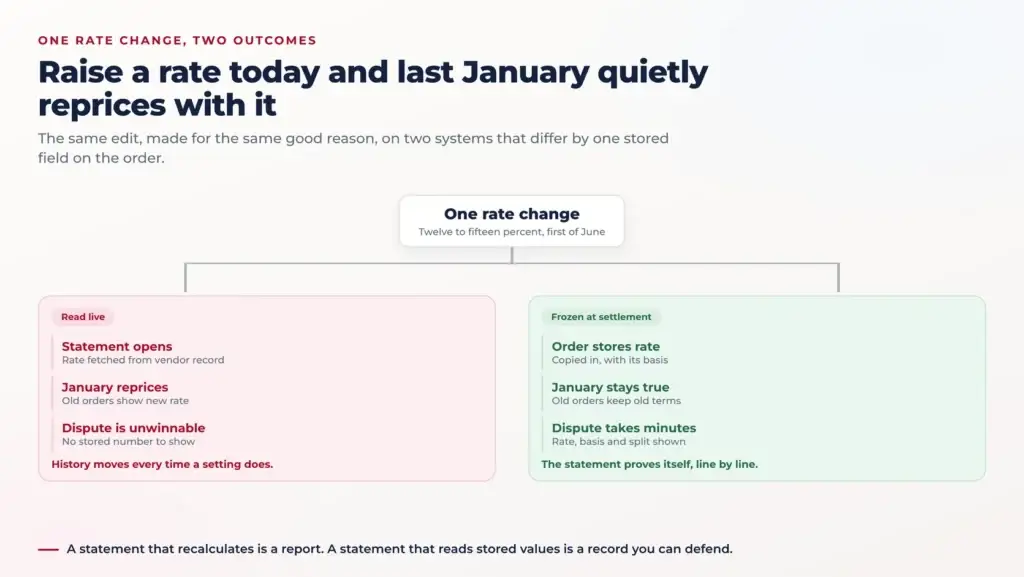
Image Source: AI-generated visual by Miracuves
The live read rewrites history silently
Suppose the rate lives only on the vendor. You raise one maker from twelve to fifteen percent in June, for good reasons. You have also changed what every order she has ever placed now appears to have cost her.
Her January statement, reopened in June, no longer matches the January payment. Your own revenue reporting for January moves with it. Nobody edited a past record. The past record was never there.
Frozen means copied, not referenced
Freezing is not a foreign key pointing at a rate row, because a reference can still be edited at the other end. The value is written into the order’s own record at settlement, and the order is never recomputed again.
Run the test on any platform you are shown. Change a vendor’s rate, then reopen a statement from three months ago. If one figure moves, the system reads live and your history is not history. That is a question the features breakdown for the marketplace build exists to let you ask.
What a Food Marketplace Freezes Alongside the Commission Rate
The rate is the famous part and the smallest part. A percentage with nothing attached cannot reproduce a figure. What has to be captured is the commercial context, because every input is also a setting somebody can change.
The fee basis
Fifteen percent of what. The item subtotal alone, the subtotal plus delivery, or the full order value including packaging and service. Two marketplaces quoting fifteen percent can be far apart in what the vendor clears, and the difference is the basis.
Discount order of operations
Whether commission is taken before or after discounts is a second decision hiding inside the first. On a forty pound order with a five pound offer, commission before the discount is six pounds and after it is 5.25. Everybody notices across a campaign.
Tax treatment at that moment
Whether commission is calculated on the tax-inclusive or tax-exclusive figure, and whether your commission itself carries tax, depends on where the vendor is registered and what the rules were that day. Both move. Record the treatment that applied, and route the question of which treatment is correct to your own accountant and tax authority.
What the order has to carry after settlement
| Frozen onto the order | Why it cannot be read live | What breaks without it |
|---|---|---|
| Commission rate as a number | Vendor records get edited, standardized and corrected | Every past statement silently reprices |
| Fee basis | A policy change alters which components are charged | The rate reproduces but the amount does not |
| Discount sequence and funding split | Campaigns end and their configuration is deleted | Promotion cost lands on whoever is convenient |
| Tax treatment applied | Registration status and local rules move | Filings cannot be reconstructed from the ledger |
| Effective date of the rate version | Rates are changed mid-cycle by real people | No way to answer when a rate started applying |
| Resulting amounts, to the cent | Rounding rules and currency settings drift | Statement totals stop matching bank credits |
Commission On What, Exactly
An order is not one number. It is a stack of components owed to different parties, and for each one you decide whether commission touches it. Take an illustrative basket: forty pounds of goods, a five pound delivery fee, 1.50 for insulated packaging, a two pound tip.
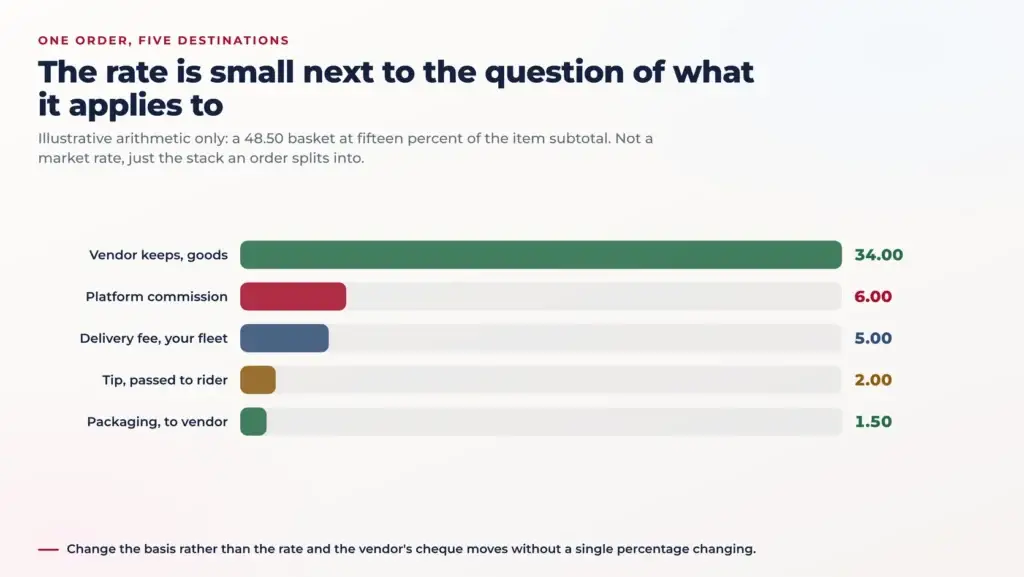
Image Source: AI-generated visual by Miracuves
The item subtotal
The uncontroversial one. The goods are the vendor’s product, you introduced the buyer, and commission on the subtotal is what every maker expects when they sign. Fifteen percent of forty pounds is six, and the vendor clears thirty-four on the goods.
The delivery fee and the packaging charge
Delivery is where the argument starts, and the answer depends on who did it. Fulfilment here is local and chosen per vendor: your riders inside the zones you draw, the vendor’s own staff, or collection in person. If your fleet carried the order, commission on the delivery fee is charging yourself. If the vendor delivered, that fee is theirs.
Packaging is similar and smaller. A maker charging 1.50 for a chilled box is recovering a cost, not earning margin. Taking a percentage of a cost recovery means the vendor pays to protect your reputation for arriving intact.
The tip is not yours
Commission on tips has no defensible version. The money was given by a buyer to a specific person for a specific act. It passes through your balance and belongs to the rider or the vendor’s staff in full. Exclude it from the basis and never let a configuration screen make it optional.
Each decision changes what the maker clears on the same displayed order value. Frozen settlement means you can tell a vendor in year three which of them applied to order 40912, without reconstructing what your policy was that spring.
The Honest Way To Quote a Rate
Rate is the first thing a maker asks about. The temptation is to lead with the smallest true number and let the basis emerge in the contract. It works once, and then the first statement arrives and the relationship starts from a deficit.
A rate without a basis is not a quote
“Twelve percent” is not an offer. “Twelve percent of the item subtotal, after any discount you funded, excluding delivery, packaging and tips” is an offer. Eleven extra words, and the only version a maker can compare against another marketplace.
Makers talk to each other constantly. A rate that sounds generous and clears badly is discovered within one season, and the vendor who discovers it explains it to eleven others at the next market.
Show the clearing figure during onboarding
The strongest thing to put in front of a maker at signup is a worked example on their own typical basket: every deduction named, and what arrives in their account. One number at the bottom, no percentages arguing with each other.
That calculator should be the same code path as the statement. If the onboarding preview and the month-end statement can disagree, one of them is lying and a vendor will find out before you do.
Discounts and Who Paid For Them
A ten percent offer looks like one feature. It is two different commercial events that happen to produce the same basket total for the buyer, and a platform that cannot tell them apart will misallocate the cost of every campaign it runs.
Same price to the buyer, two different statements
Take the illustrative forty pound basket with a four pound discount. If the vendor funded it, the vendor sold at thirty-six and commission applies to thirty-six. If the platform funded it, the vendor sold at forty and the four pounds comes from your marketing budget.
The buyer paid thirty-six either way. At fifteen percent the vendor clears 30.60 in one case and 34.00 in the other. That gap is the difference between a promotion that recruits makers and one that quietly taxes them.
Record the funding split, not just the discount
Real campaigns are frequently shared. You fund half of a seasonal offer, the maker funds half, and neither should have to take the other’s word afterwards. The order carries the discount amount and the split that produced it, so the statement can show both halves as separate lines.
Free delivery is a funded discount too
Waived delivery gets treated as a setting rather than a cost, because no line item disappears from the basket. Somebody still paid the rider. Record it as a funded reduction with an owner, or your cheapest-looking campaign will carry the largest hidden bill.
Refunds, and Where Commission Gets Complicated
Everything above concerns an order that went well. Refunds are where this logic earns its keep, because a refund is a second money movement against a settlement that already happened, and the rate governing it has to be the old one.
Proportional reversal as the default
If the buyer is refunded in full, the fair default is that commission reverses in full. You took a fee for a sale that did not stand. Partial refunds reverse proportionally, at the frozen rate rather than today’s.
Here a live rate does visible damage. A refund processed in July against a June order, priced at July’s rate, returns the wrong amount and leaves a residue in your accounts nobody can name.
When the vendor was not at fault
The harder case is a refund the maker did not cause: the goods were correct and a rider dropped them, or a buyer disputed an order you chose not to fight. Reversing commission proportionally still leaves the vendor down the ingredients and labour for food that was made and lost.
Whatever you decide, decide it as policy and record which policy applied. The options are reverse only, reverse and absorb the goods value, or reverse and apply a partial credit. What destroys trust is having all three in use with no way to tell a vendor which one they got.
Chargebacks are not refunds
A chargeback arrives weeks later, carries a processor fee, and the money is taken from you rather than issued by you. Model it as its own event against the frozen settlement, with its own decision about who carries that fee.
Goodwill credits need the same care. A voucher issued by support to keep a buyer is a platform-funded discount on a future order, not a retroactive adjustment to a past one. Never reach back into a settled order to make a support gesture balance.
The Statement a Vendor Can Actually Reconcile
A maker does not read a statement for pleasure. They read it because their accountant asked, or the bank credit looked light, or they are deciding whether this marketplace is worth the oven hours. It is the most-read screen on the vendor side.
Per order, not per month
A monthly total with a commission figure under it is unverifiable by design. The vendor either trusts it or leaves. A reconcilable statement lists every order with the date, the gross, the frozen rate, the basis it applied to, each deduction named, and the net.
Listing the rate per order looks odd the first time, because most rows carry the same number. The rows that do not are the ones that prevent a dispute, and the format has to accommodate them to mean anything.
Three totals that have to agree
The sum of the order net figures, the statement total, and the amount that arrived in the bank must be the same number, or the difference must be a named line. Holds, a prior-period adjustment, a plan fee, a transfer charge: all legitimate, none acceptable as a silent gap.
Rounding belongs to the same discipline. Round once at the order, by a stated rule, and store the result. A statement that rounds per line and a payout that rounds on the total differ by a few cents a month, which is exactly large enough to make a careful vendor doubt every other number.
Give them the export
Every maker of any size has bookkeeping software or an accountant with a preferred format. A downloadable per-order file carrying the same fields as the screen ends the monthly ritual of a vendor retyping your dashboard and finding a discrepancy that is really a typing error.
Transparency here is cheap to build and disproportionately valuable in retention, which is why the vendor spine is treated as the product rather than as admin scaffolding in this food marketplace and delivery solution.
Changing a Rate Without Rewriting History
Rates do change. A vendor moves from a launch arrangement to a standard one, a category is repriced, an anchor maker renegotiates. The question is never whether to allow changes. It is what a change does to the orders on either side of it.
Effective dates instead of save time
In most admin panels a rate takes effect when someone presses save. That couples a commercial agreement to an operational accident: whether the update happened Thursday afternoon or Monday morning decides which orders were charged what.
A rate should be entered as a version with a start date, scheduled ahead, and visible in the vendor’s own panel before it applies. The maker sees the new rate, the date it begins, and the rate in force until then. Nobody is surprised by a statement.
Mid-cycle changes and the boundary
If a change lands on the eleventh, that period’s statement carries orders at two rates. With frozen settlement this is unremarkable: each order shows the rate that applied on its own date. Without it, the statement picks one rate and picks the wrong one for half the orders.
Aligning changes to period boundaries is still the kinder practice, because a statement with one rate on it can be read in ten seconds. Kindness is a policy choice though, and the system has to stay correct on days policy is not followed.
Who is allowed to change one
A commission rate is a contract term, so the people who can alter one should be few, named, and logged with a reason. The spring standardization that started this article was almost certainly a well-intentioned bulk update nobody reviewed vendor by vendor.
Scoping staff permissions to what each role needs is ordinary discipline, and it is worth confirming that a white-label marketplace engine you own outright lets you define those roles rather than handing every operations login the same access.
What the Buyer Sees, and Does Not
Commission is the most consequential number on the platform for the vendor and an invisible one for the buyer. A buyer sees goods, delivery, tax and possibly a service charge. Commission appears nowhere, and raising it changes nothing on their screen that day.
What it changes, slowly, is the catalogue. A maker whose margin has thinned re-prices upward, drops their weakest lines, or stops restocking your best seller. Buyers experience that as a marketplace getting more expensive and less interesting, months later, with no single cause to point at.
Three points of commission is not three percent of a maker’s profit. That is why the record matters more than the rate: a maker can build around a rate they consider high, provided it is predictable and documented and the same next month.
Where the Other Five Revenue Lines Sit
Commission is one line of six in this build. The others are vendor subscription plans, onboarding and setup fees, featured placement, delivery fee margin and buyer membership. Each has its own mechanics and failure modes, and they belong to their own article, which also answers a different question from this one: how a marketplace earns anything before it has the volume to take a percentage of.
They share the settlement discipline. A plan fee deducted from a payout, a placement charge, a membership credit applied to delivery: each lands on the same statement and each needs its amount and its reason recorded at the moment it was taken. Freezing commission and then applying a plan fee from a live lookup solves half the problem. The six lines are laid out on the operator and revenue model page.
Mistakes That Only Surface in Month Four
None of these is visible during a demo. All appear once a rate has changed, a campaign has ended, and a vendor has read a statement carefully. That is usually the fourth month, late enough that the data is wrong and early enough to fix.
Storing the rate only on the vendor
The single decision that produces every dispute in this article. The order must carry its own copy of the rate and the amounts, written once at settlement and never recalculated.
Quoting a rate without its basis
A maker who hears twelve percent and discovers it includes delivery and packaging concludes you misled them, and they are not entirely wrong. Quote the rate and what it applies to in the same sentence.
Treating a discount as one thing
Platform-funded and vendor-funded offers look identical to the buyer and are opposite events commercially. Without a funding split on the order, campaign cost lands wherever the code happens to put it.
Charging commission on tips
The money was given to a person for an act. Taking a percentage of it is the one fee no vendor and no rider will ever accept as reasonable, and it is noticed immediately.
Letting a rate change apply on save
An operational accident then decides which orders were charged what. Enter rate changes as dated versions, show them in the vendor panel before they apply, and log who made them.
Refunding at today’s rate
A refund against a settled order must use that order’s frozen rate. Anything else returns the wrong amount and leaves an unexplained residue that grows quietly for a year.
Repair after the fact is possible and unpleasant. You backfill frozen values from payment records and a change log, and you find a window of orders where the evidence does not exist. Those become a commercial decision, which means you pay whatever the vendor claims.
Buying This Rather Than Discovering It
Every marketplace operator learns this eventually. The only variable is whether they learn it from an architecture decision or from a vendor with a spreadsheet and a good memory.
What to ask any platform you are shown
Ask to see the stored order record, not the statement screen. If the order carries a rate, a basis, a funding split and a tax treatment, the platform has the right shape. Then ask how a refund is priced and how a rate change is scheduled, much as The Out-of-Stock Trap: Why Cheap Delivery Scripts Ruin Restaurant Relationships interrogates a different subsystem.
Hosted builders generally support one rate with a category override. The moment your roster needs per-vendor terms with effective dates, you are outside the product. That arithmetic is worked through in The 36-Month TCO Comparison: SaaS Delivery Builders vs. Owned White-Label Engines and in Migrating from SaaS to Owned Infrastructure: A Peak-Hour Performance Comparison. Settlement records are what you can least afford locked in another schema, which is why the custom marketplace development route exists and why the team that builds and hands over the marketplace also runs the migration.
Founder Decision Signals
Speed
Freezing settlement values is a schema decision, not a feature. Made at the start it costs a few fields on the order table. Retrofitted at two hundred vendors it becomes a recovery project with a window of orders nobody can price.
Cost
The expense of getting this wrong is not engineering time. It is settling disputes in the vendor’s favour because you cannot prove your own number, and it recurs every time a rate moves.
Scalability
Per-vendor rates with effective dates scale to any roster size without new code. A single global rate with manual exceptions stops working at roughly the tenth negotiated arrangement.
Market Fit
Makers choose between marketplaces on predictability as much as on rate. A statement they can reconcile line by line is a retention feature no discount matches.
Final Thoughts: Commission Is a Record Before It Is a Rate
Goldbelly, or any marketplace, pays against a frozen rate. A live lookup is a dispute waiting to happen.
The baker was owed an answer, not a refund. She would have accepted eighteen percent if the platform could have shown her when it started, who approved it, and that her January orders were still priced at twelve. What she could not accept was a system that had quietly restated her history.
Everything here follows from one decision made early. Write the commercial terms onto the transaction at the moment it settles, never read them live afterwards, and a whole class of dispute stops existing. The rate is a commercial question you will revisit many times. The record of it is an engineering question you get one clean chance at. If you are weighing ready-made against custom, the scope and honest timelines sit on the delivery and scope facts page, the cost and scoping breakdown covers where the work lands, and the wider catalogue of marketplace and delivery platforms is there if the maker model is one of several.
If you are deciding how your roster’s commercial terms should be stored, have that conversation before the schema is set rather than after the first rate change. Book a consultation and we will walk through your rate structure, your refund policy, and what your statements need to prove.
FAQs
How does the Goldbelly revenue model handle marketplace commission?
It means the commission rate, and the amounts it produced, are copied onto the order at the moment that order settles, and the order is never recalculated afterwards. The statement then reads stored values rather than running a formula against current settings. A rate change made today applies to future orders only, and every past order still carries the terms that were in force when it happened.
Why should a food marketplace not store one commission rate?
Because the vendor record is a current setting and settings get edited, standardized and corrected. If the statement reads the rate live, changing a vendor’s rate today rewrites what every order they have ever placed appears to have cost them. Last January’s statement stops matching last January’s payment, and your own revenue reporting for that month moves with it, without anybody editing a record.
Are per-vendor commission rates normal in a food marketplace?
They are normal. Early makers joined an empty storefront and were given a lower rate, a category with different margins was repriced, and a seasonal promotion changed a handful of rates for six weeks. Within a year a hundred-vendor marketplace realistically carries eight to fifteen distinct arrangements. The software should assume that from the start rather than treat each one as an exception.
Should food marketplace commission apply to delivery and packaging?
That is a decision, not a default, and it should follow who did the work. If your own riders carried the order, the delivery fee is revenue for work you did and taking commission on top of it is charging yourself. If the vendor delivered with their own staff, that fee is theirs. Packaging is usually a cost recovery rather than margin, so a percentage of it comes straight out of the maker’s pocket.
Can a marketplace charge commission on tips?
It should not. A tip is money given by a buyer to a specific person for a specific act, and it passes through your balance on its way to the rider or the vendor’s staff. Exclude tips from the commission basis, show them excluded on the statement, and do not expose the choice as a configuration toggle that somebody can switch on during a revenue push.
How should commission work on a discounted order?
It depends on who funded the discount, and the order has to record that. If the vendor funded a four pound offer on a forty pound basket, they sold at thirty-six and commission applies to thirty-six. If the platform funded it, they sold at forty, commission applies to forty, and the four pounds is a marketing cost. The buyer pays the same either way while the vendor clears very different amounts.
What happens to commission when an order is refunded?
The fair default is proportional reversal at the frozen rate: a full refund reverses the commission in full, a quarter refunded returns a quarter of it. Pricing that refund at today’s rate returns the wrong amount and leaves an unexplained residue in your accounts. Refunds the vendor did not cause need a stated policy, recorded per refund, so a maker can always be told which rule applied.
What should a vendor statement contain so a maker can reconcile it?
Every order listed with its date, the gross, the frozen rate, the basis that rate applied to, each deduction named, and the net for that order. The sum of those nets, the statement total and the amount that reached the bank must be the same number, or the gap must be a named line. Add the bank reference and a downloadable per-order export and most statement tickets disappear.
Miracuves is an independent software development company. We are not affiliated with, connected to, sponsored by, or endorsed by any company or product named in this article.
Terms such as “X Clone” are used descriptively. It is how the software industry refers to building a platform with functionality comparable to a known service, and how clients search for it.
The entire design and codebase of our products is built by our own team. Our products contain no code, design, graphics, or content originating from any third-party website or applications.
All third-party names and marks referenced in this article are the property of their respective owners, referenced solely to identify the services discussed.



