
Key Takeaways
What You’ll Learn
- SaaS applications help businesses scale without heavy infrastructure costs.
- Cloud-based access supports remote teams and flexible work.
- Subscription models reduce large upfront software investment.
- Automatic updates improve security, features, and performance.
- Scalable platforms support growing users, teams, and operations.
Stats That Matter
- SaaS tools improve collaboration across departments and locations.
- Pay-as-you-grow pricing supports business flexibility.
- Centralized data management improves accessibility and control.
- API integrations connect multiple business systems smoothly.
- Analytics dashboards help track operations, sales, and performance.
Real Insights
- Businesses prefer SaaS for speed, flexibility, and lower maintenance.
- Cloud access supports faster decision-making and team productivity.
- Scalable software reduces the need for repeated infrastructure upgrades.
- Automation helps teams save time on repetitive tasks.
- The best SaaS strategy combines scalability, accessibility, automation, and cost efficiency.
Growing a business today is not just about having a good product or service. It is about how efficiently you operate, scale, and adapt to changing market demands. This is where technology plays a crucial role. Many startups and growing companies struggle with high infrastructure costs, slow development cycles, and limited scalability when using traditional software systems.
At this stage, adopting the right technology can define the future of your business. This is where SaaS applications come in. Platforms built on the Software-as-a-Service model help businesses operate faster, smarter, and more efficiently without heavy upfront investment.
At Miracuves, we have seen how SaaS-based platforms help startups and enterprises launch faster, reduce costs, and scale without technical limitations. Understanding the real benefits of SaaS applications can help you make better decisions before investing in software.
What Are SaaS Applications and Why They Matter
Before understanding the benefits, it is important to clearly understand what SaaS applications are and why they are becoming the backbone of modern businesses.
SaaS (Software as a Service) is a cloud-based software delivery model where users access applications through the internet instead of installing them locally on their systems. Businesses pay on a subscription basis instead of purchasing software outright.
Examples include CRM tools, project management software, accounting platforms, and even marketplace systems.
The importance of SaaS lies in its ability to remove complexity. Businesses no longer need to manage servers, handle updates manually, or invest heavily in infrastructure.
Why SaaS Adoption Is Growing Rapidly
Understanding the rise of SaaS helps you see why it has become essential for growing businesses.
Over the past few years, businesses have shifted from traditional software to cloud-based solutions due to flexibility, cost-effectiveness, and speed. Startups especially prefer SaaS because it allows them to launch quickly without large capital investment.
SaaS is no longer optional. It has become a strategic advantage.
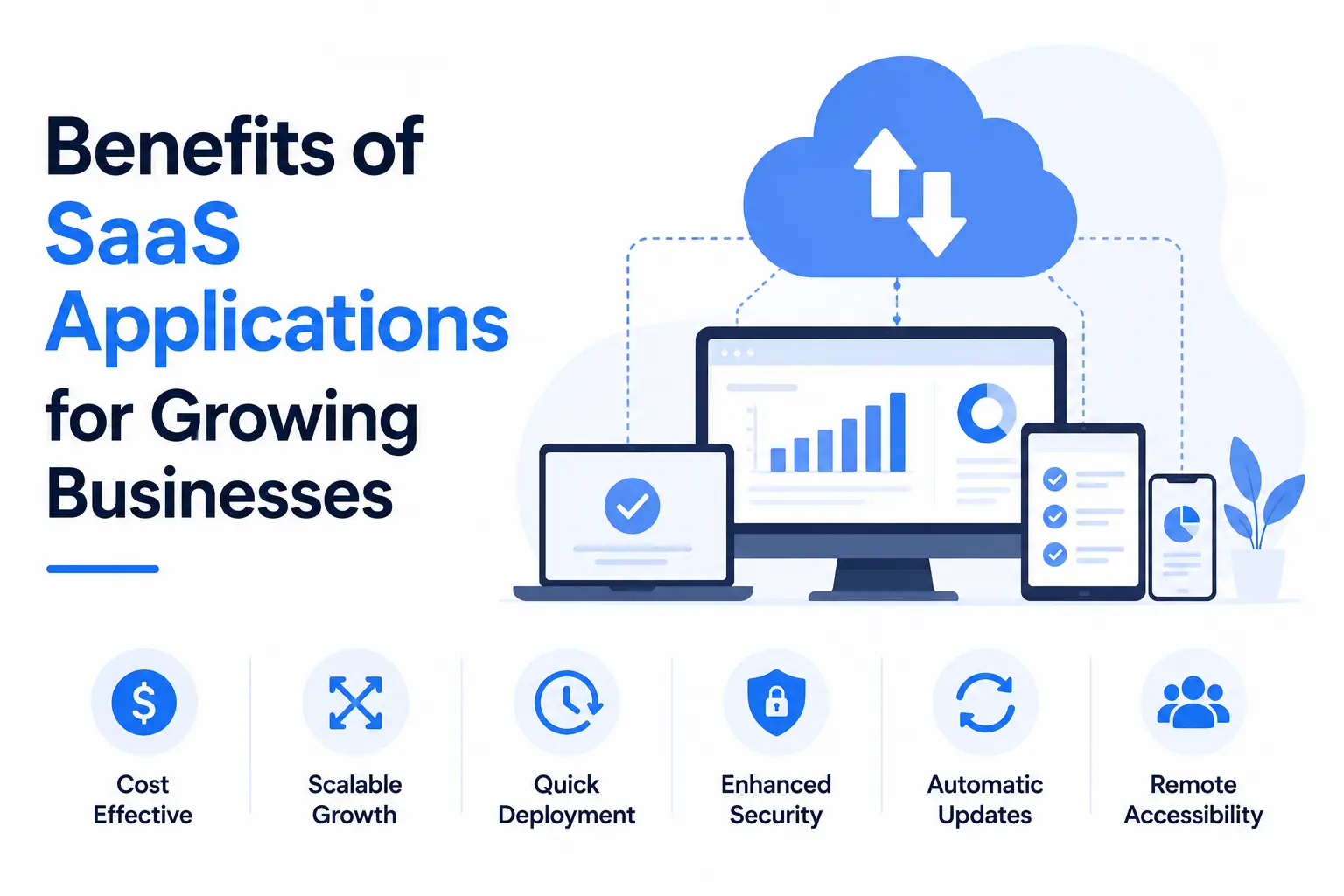
Key Benefits of SaaS Applications for Growing Businesses
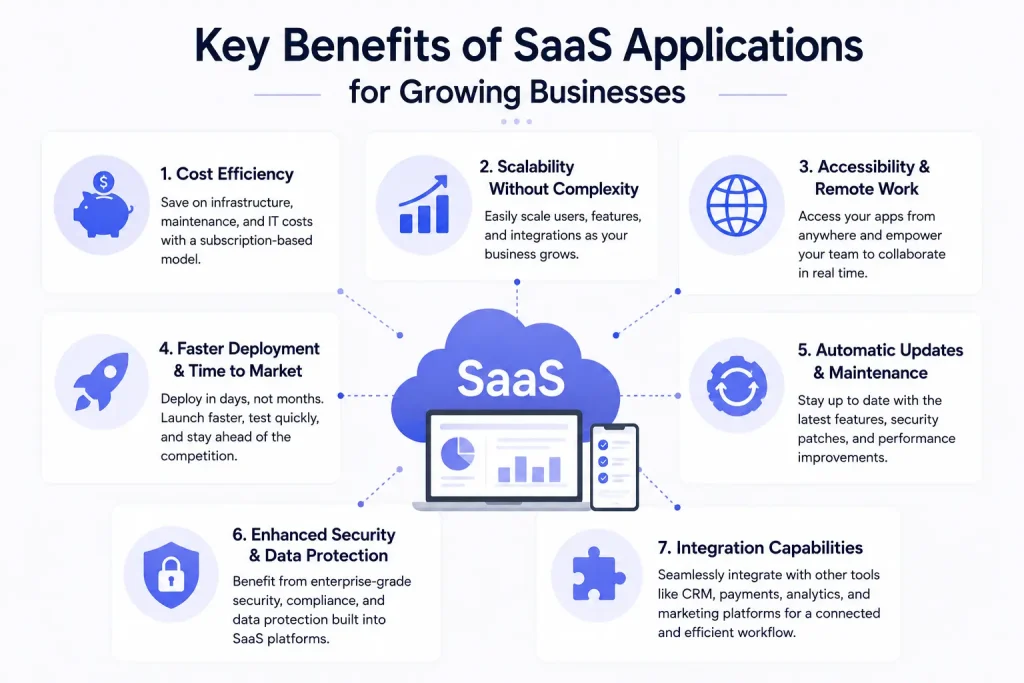
This is the most important section of the article because it directly answers what business owners want to know. Each benefit plays a critical role in business growth.
Cost Efficiency
One of the biggest advantages of SaaS applications is cost savings. Traditional software requires large upfront investments in licenses, servers, and maintenance.
With SaaS, businesses pay only for what they use. This subscription-based model reduces financial risk and allows better budget control.
There is no need for hardware, dedicated IT teams, or expensive upgrades.
Scalability Without Complexity
As your business grows, your software should grow with it. SaaS platforms allow you to scale easily without rebuilding systems.
You can add users, features, or integrations as needed. This flexibility is crucial for startups and growing businesses that cannot predict future demand.
Accessibility and Remote Work Enablement
SaaS applications are accessible from anywhere with an internet connection. This allows teams to work remotely, collaborate in real time, and manage operations efficiently.
This is especially important in today’s global work environment where teams are distributed across different locations.
Faster Deployment and Time to Market
Traditional software can take months to set up. SaaS applications can be deployed in days or even hours.
This speed gives businesses a competitive advantage. You can launch faster, test ideas quickly, and adapt based on market feedback.
Automatic Updates and Maintenance
SaaS providers handle updates, bug fixes, and maintenance. Businesses do not need to worry about software upgrades or downtime.
This ensures that you are always using the latest version with improved features and security.
Enhanced Security and Data Protection
Many business owners assume that cloud-based systems are less secure, but the reality is the opposite.
SaaS providers invest heavily in security, encryption, and compliance. This often results in better protection compared to in-house systems.
Integration Capabilities
SaaS platforms can easily integrate with other tools such as payment gateways, CRMs, analytics platforms, and marketing tools.
This creates a connected ecosystem where data flows seamlessly across systems, improving efficiency and decision-making.
Read more : – Top Features Every Marketplace App Needs
SaaS vs Traditional Software: Key Differences
Understanding the difference between SaaS and traditional software helps businesses make informed decisions.
| Feature | SaaS Applications | Traditional Software |
|---|---|---|
| Cost | Subscription-based | High upfront cost |
| Deployment | Instant | Time-consuming |
| Scalability | Easy | Complex |
| Maintenance | Managed by provider | Managed internally |
| Accessibility | Anywhere | Limited to system |
| Updates | Automatic | Manual |
This comparison clearly shows why SaaS is the preferred choice for modern businesses.
How SaaS Helps Growing Businesses Scale Faster
This section is important because it connects SaaS benefits directly to real business growth.
Growing businesses need speed, flexibility, and efficiency. SaaS provides all three.
For example:
- A startup launching a marketplace can use SaaS-based infrastructure to go live quickly
- A growing company can manage customer relationships using SaaS CRM tools
- Businesses can automate operations using SaaS-based workflow systems
SaaS reduces friction in operations, allowing businesses to focus on growth instead of technical challenges.
Real-World Use Cases of SaaS Applications
Understanding practical use cases makes the concept clearer and more relatable.
Startup Launch
Startups use SaaS platforms to launch MVPs quickly without investing heavily in development.
E-commerce Platforms
Online stores use SaaS tools for inventory management, payments, and analytics.
Enterprise Automation
Large businesses use SaaS for HR management, accounting, and customer support systems.
When Should a Business Choose SaaS
Choosing SaaS is a strategic decision. This section helps readers decide if it is the right fit.
However, businesses with highly customized requirements may still need hybrid or custom solutions.
Read more : – The Ultimate Guide to Pricing a Custom Website Builder SaaS Solution
Challenges of SaaS Applications
Providing a balanced view increases trust and credibility.
Vendor Dependency
Businesses rely on the SaaS provider for uptime and performance.
Limited Customization
Some SaaS platforms may not offer deep customization.
Data Control Concerns
Businesses may have concerns about data storage and ownership.
Despite these challenges, the benefits often outweigh the limitations.
Future of SaaS Applications in 2026 and Beyond
Understanding future trends helps businesses make long-term decisions.
The future of SaaS is being shaped by:
- AI-powered automation
- Microservices architecture
- No-code and low-code platforms
- Industry-specific SaaS solutions
Businesses that adopt SaaS early gain a significant competitive advantage.
Key Takeaways for Growing Businesses
This section helps summarize important insights for quick readers.
- SaaS reduces costs and improves efficiency
- It enables faster scaling and flexibility
- It supports remote work and global teams
- It simplifies operations through automation
SaaS is not just a technology choice. It is a growth strategy.
Read more : – How to Market a Website Builder SaaS Platform App Successfully After Launch
Why Choose Miracuves for SaaS Application Development
Growing businesses often struggle with choosing the right technology partner, especially when it comes to building scalable SaaS platforms. This is where working with an experienced and reliable development partner becomes critical.
Miracuves helps startups, entrepreneurs, and enterprises build powerful SaaS applications that are designed for performance, scalability, and long-term growth. With 9k+ successful deployments across industries like fintech, marketplaces, logistics, and on-demand platforms, Miracuves focuses on delivering real, production-ready systems—not just prototypes.
What makes Miracuves different is its approach to building future-ready platforms. Every SaaS solution is developed with a microservices-ready architecture, ensuring that your application can scale as your business grows without requiring a complete rebuild.
Key advantages of working with Miracuves:
- Full source code ownership with no hidden restrictions
- Faster deployment timelines (6 Days for ready-made solutions)
- Enterprise-grade security and scalable infrastructure
- Customization flexibility based on your business model
Conclusion
SaaS applications have transformed how modern businesses operate. For growing businesses, they provide a powerful combination of cost efficiency, scalability, and flexibility.
Instead of spending time managing infrastructure, businesses can focus on innovation and growth. This shift is what makes SaaS one of the most important technological advancements for startups and enterprises.
If you are planning to scale your business or build a new platform, choosing the right SaaS solution can save time, reduce costs, and accelerate your growth journey.
Contact us to build scalable SaaS solutions tailored to your business needs.
FAQs
1. What are SaaS applications?
SaaS applications are cloud-based software solutions that users access through the internet without installing them locally.
2. Why are SaaS applications important for growing businesses?
They reduce costs, improve scalability, and allow faster deployment compared to traditional software.
3. Are SaaS applications secure?
Yes, most SaaS providers use advanced security measures, encryption, and compliance standards to protect data.
4. Can SaaS applications scale with business growth?
Yes, SaaS platforms are designed to scale easily by adding users, features, and integrations.
5. What is the main difference between SaaS and traditional software?
SaaS is cloud-based and subscription-driven, while traditional software requires installation and upfront investment.
Related Articles
Miracuves is an independent software development company. We are not affiliated with, connected to, sponsored by, or endorsed by any company or product named in this article.
Terms such as “X Clone” are used descriptively. It is how the software industry refers to building a platform with functionality comparable to a known service, and how clients search for it.
The entire design and codebase of our products is built by our own team. Our products contain no code, design, graphics, or content originating from any third-party website or applications.
All third-party names and marks referenced in this article are the property of their respective owners, referenced solely to identify the services discussed.