

Key Takeaways
- Multi-Vendor Ecommerce Marketplace Planning should begin with niche, seller supply, buyer demand, category strategy, fulfilment, revenue, payments, and admin control before development starts.
- Founders should validate buyers and sellers separately because marketplace demand depends on both sides becoming active.
- Launching with focused product categories usually creates stronger inventory depth, search relevance, and early marketplace liquidity.
- The first release should prioritize the complete transaction loop rather than adding advanced features before the core workflow is stable.
- Payments, seller wallets, refunds, payouts, fulfilment, and admin rules should be defined early because they directly affect trust and operational scalability.
Planning Signals
- Define the marketplace niche before finalizing features so product flows match the real category and customer problem.
- Choose initial categories using seller availability, buyer demand, repeat purchase potential, margin, delivery complexity, and return risk.
- Revenue logic should be planned before development because commissions, subscriptions, ads, fulfilment margins, and seller services affect backend workflows.
- Vendor onboarding should include the right balance of registration, verification, catalog setup, payout details, approval, and seller access.
- Admin requirements should cover vendors, products, orders, commissions, payments, refunds, delivery, disputes, reports, roles, and activity logs.
Real Insights
- A marketplace should not be planned as a standard ecommerce store with extra sellers because multi-vendor operations require different order, payment, and payout logic.
- Too many categories at launch can dilute catalog quality, seller activity, buyer discovery, and marketing focus.
- Payout transparency and refund logic should be designed before launch because unclear deductions can quickly damage seller trust.
- A strong admin dashboard reduces dependence on developers when commission rules, vendor restrictions, delivery settings, or marketplace policies change.
- The strongest planning flow is: define niche → validate sellers and buyers → choose launch categories → select revenue model → define MVP → plan onboarding → structure catalog → choose fulfilment → map payments and payouts → define admin control → prepare launch strategy.
Starting a marketplace sounds simple at first: bring sellers onto one platform, attract buyers, process orders, and earn from commissions or fees.
But in reality, Multi-Vendor Ecommerce Marketplaces are not just ecommerce websites with more sellers. They are operating systems for buyers, vendors, products, payments, disputes, fulfilment, and admin control. If founders skip planning, the platform may launch with attractive screens but weak operations behind them.
Before development begins, founders should answer the hard business questions first. Who are the first sellers? What categories will the marketplace start with? How will orders be fulfilled? How will vendors get paid? What happens when a buyer requests a refund? Which features are essential for launch, and which ones can wait?
This guide breaks down what founders should plan before starting a multi-vendor ecommerce platform so the build becomes clearer, leaner, and easier to scale.
Why Planning Matters Before Building a Multi-Vendor Ecommerce Platform
A single-brand ecommerce store can start with products, checkout, and delivery. A marketplace needs more layers because the platform operator does not control every product, seller, price, inventory update, fulfilment action, or customer issue directly.
That is why marketplace planning is not just a technical step. It is a business-risk reduction step.
A founder should know:
- Which buyer problem the marketplace solves
- Which seller segment will join first
- What makes sellers trust the platform
- How buyers will discover products
- How the marketplace will earn
- How payments and payouts will work
- How disputes, refunds, and cancellations will be handled
- Which features are required for launch
- Which features should be delayed until traction is proven
The stronger the planning, the fewer expensive changes happen during development.
1. Define the Marketplace Niche Before Planning Features
Many founders start with features too early. They list product pages, filters, checkout, wallets, coupons, vendor panels, delivery tracking, and analytics before deciding what market they are actually serving.
That creates a generic platform.
A stronger approach is to define the niche first.
For example:
- A fashion marketplace needs size, color, returns, visual discovery, influencer campaigns, and seasonal promotions.
- A grocery marketplace needs inventory freshness, delivery slots, substitutions, and location-based availability.
- An electronics marketplace needs warranty information, seller verification, product specifications, and return controls.
- A B2B marketplace needs bulk pricing, quote requests, purchase approval, and invoice workflows.
- A local retail marketplace needs store-level inventory, hyperlocal delivery, and regional payment preferences.
The niche determines the feature set. The feature set should not be copied blindly from large marketplaces.
Founder Planning Question
What specific buyer problem are you solving better than existing ecommerce options?
If the answer is only “more products in one place,” the concept is still weak. A marketplace needs a sharper reason to exist.
2. Validate Buyer Demand and Seller Supply Separately
Multi-Vendor Ecommerce Marketplaces have two sides: buyers and sellers. Both must work, but they do not grow in the same way.
Buyers want product variety, trust, good pricing, fast discovery, safe checkout, and reliable delivery. Sellers want demand, visibility, fair commission, easy catalog tools, fast payouts, and platform support.
A founder should validate both sides before development begins.
For sellers, ask:
- Are vendors actively looking for new online sales channels?
- Do they already sell on other marketplaces?
- What commission are they comfortable paying?
- Can they manage catalog uploads themselves?
- Do they need fulfilment support?
- How fast do they expect payouts?
- What would make them switch or join another platform?
For buyers, ask:
- What category do they currently struggle to buy online?
- Are existing platforms too expensive, too broad, too slow, or not localized enough?
- What would make them trust a new marketplace?
- Do they prefer home delivery, store pickup, or both?
- Which payment methods matter in the target region?
A marketplace fails when founders assume both sides will arrive automatically after launch.
3. Choose the First Product Categories Carefully
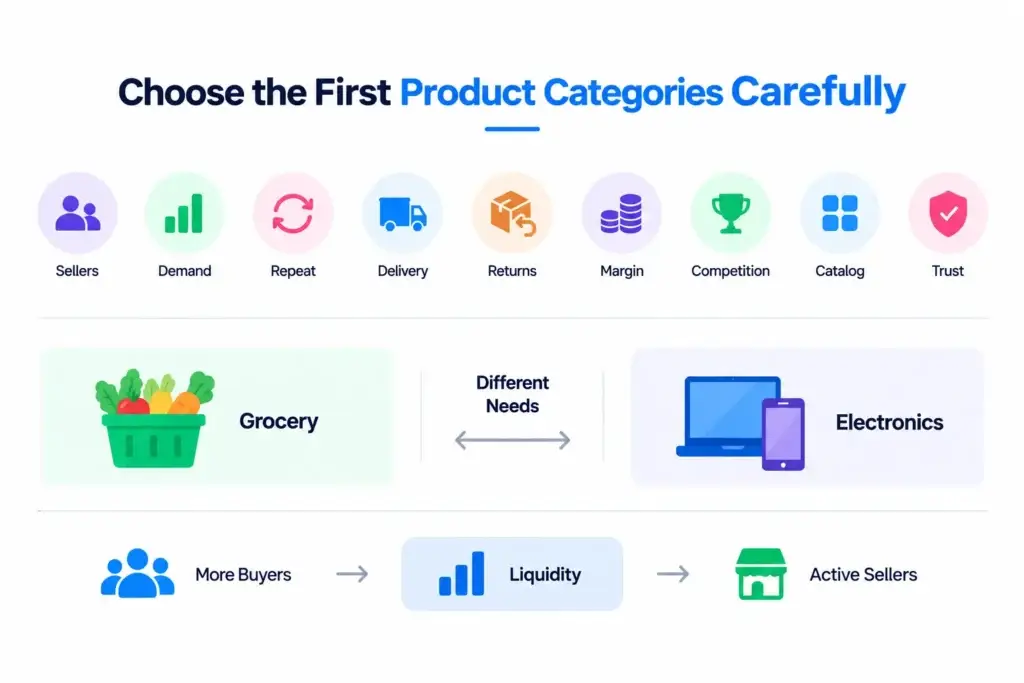
A marketplace does not need every category on day one.
In fact, launching with too many categories can create weak inventory depth, poor search results, and scattered marketing. A focused category strategy is usually stronger.
Founders should plan the first category based on:
- Seller availability
- Buyer demand
- Repeat purchase potential
- Delivery complexity
- Return risk
- Product margin
- Competition level
- Catalog complexity
- Trust requirements
A grocery marketplace and an electronics marketplace may both be ecommerce businesses, but their operational requirements are completely different.
The first category should help the marketplace create liquidity. Liquidity means buyers can find enough relevant products and sellers can receive enough demand to stay active.
4. Plan the Revenue Model Before Development Starts
Revenue should not be added after launch. It should shape the platform from the beginning.
Most Multi-Vendor Ecommerce Marketplaces earn through a mix of:
- Commission on each successful order
- Seller subscription plans
- Listing fees
- Featured product placements
- Sponsored seller campaigns
- Delivery or fulfilment margin
- Payment or convenience fees where appropriate
- Seller support services
- Catalog, marketing, or analytics tools
The right revenue model depends on seller margins and buyer expectations. If commissions are too high, sellers may increase prices or leave. If fees are introduced too early, onboarding slows down. If ads are introduced before search quality is strong, buyer trust may decline.
For a deeper breakdown of commission, seller plans, delivery margin, and sponsored placement logic, founders can review this marketplace business model.
5. Decide What the First Launch Version Must Include
A founder does not need every advanced feature before launch. But the first version must support the core transaction loop.
The core marketplace loop includes:
- Seller joins the platform.
- Seller lists products.
- Buyer discovers products.
- Buyer adds products to cart.
- Buyer checks out.
- Seller receives the order.
- Product is fulfilled.
- Buyer receives the order.
- Payment is settled.
- Refunds, disputes, or support requests are handled if needed.
If any part of this loop is weak, the marketplace becomes difficult to operate.
Launch Planning Checklist for Multi-Vendor Ecommerce Marketplaces
| Planning Area | What Founders Should Decide | Why It Matters |
|---|---|---|
| Marketplace Niche | Category, geography, buyer segment, seller type, and positioning. | Prevents the platform from becoming too broad too early. |
| Vendor Onboarding | Seller registration, approval, documents, store setup, and catalog upload flow. | Determines how quickly supply can grow without losing quality control. |
| Product Catalog | Categories, variants, SKU logic, images, pricing, stock, and approval rules. | A weak catalog structure creates search, inventory, and checkout problems later. |
| Revenue Model | Commission, subscriptions, ads, listing fees, delivery margin, and seller services. | Revenue logic affects admin settings, vendor payouts, and platform profitability. |
| Payments and Payouts | Payment gateways, vendor wallet, settlement frequency, refunds, and withdrawal flow. | Seller trust depends heavily on payout transparency. |
| Fulfilment | Seller shipping, marketplace-managed delivery, third-party logistics, or hybrid fulfilment. | Fulfilment decisions affect customer experience, cost, and operational workload. |
| Admin Control | User control, vendor approval, commission rules, order monitoring, disputes, and reports. | The admin dashboard decides whether the platform can scale without manual chaos. |
6. Plan Vendor Onboarding as a Business Workflow, Not Just a Signup Form
Vendor onboarding is one of the most important systems in a marketplace.
A seller does not simply create an account. They may need to submit business details, tax information, payment details, product categories, brand information, fulfilment preferences, and return policies.
A practical vendor onboarding flow may include:
- Seller registration
- Email or mobile verification
- Business profile setup
- Document upload where relevant
- Bank or payout details
- Storefront setup
- Product catalog upload
- Admin approval
- Seller dashboard access
- Training or onboarding checklist
Founders should decide how strict onboarding should be. Too much friction can reduce seller signups. Too little control can reduce marketplace quality.
The right balance depends on the product category. A handmade craft marketplace may need lighter verification, while electronics, wellness, or regulated categories may need stronger seller checks.
7. Map Product Catalog, Search, and Inventory Rules Early
The product catalog is the foundation of marketplace discovery.
If the catalog is poorly planned, buyers will struggle to find products and sellers will struggle to manage inventory. Founders should define catalog rules before development starts.
Important questions include:
- Will products have variants such as size, color, model, or pack size?
- Can multiple sellers sell the same product?
- Will each seller manage their own price and stock?
- Does the admin approve products before they go live?
- Can sellers bulk upload catalogs?
- How will duplicate products be handled?
- What filters are needed by category?
- Will products support reviews, ratings, Q&A, or comparison?
- What image standards should sellers follow?
A strong multi-vendor marketplace feature set should connect catalog, checkout, vendor operations, delivery, wallet, and admin workflows instead of treating them as separate modules.
8. Decide the Fulfilment Model Before Building Order Flows
Fulfilment decisions directly affect checkout, delivery fees, seller operations, and customer support.
A marketplace can use different fulfilment models:
| Fulfilment Model | How It Works | Best For |
|---|---|---|
| Seller-managed delivery | Vendors ship orders themselves. | Low-control marketplaces and early-stage launches. |
| Marketplace-managed delivery | The platform coordinates delivery partners or its own fleet. | Local commerce, grocery, pharmacy, and hyperlocal retail. |
| Third-party logistics | External logistics partners handle pickup and delivery. | Regional ecommerce with broader shipping needs. |
| Hybrid fulfilment | Some sellers ship directly while others use marketplace delivery. | Marketplaces with different seller types or categories. |
Founders should not delay this decision. Fulfilment affects cart logic, shipping fees, delivery tracking, refund handling, seller SLAs, and buyer expectations.
9. Plan Payments, Wallets, Refunds, and Seller Payouts
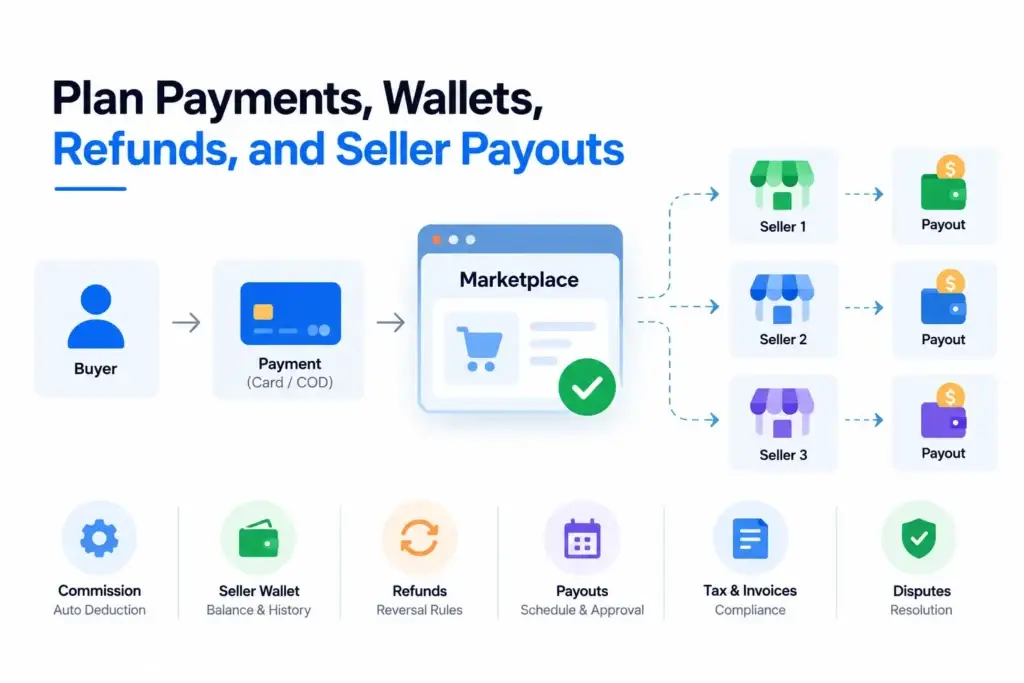
Payments are more complex in a marketplace than in a single-vendor ecommerce store.
In a single-vendor store, the buyer pays the business. In a marketplace, one buyer order may include products from multiple sellers. The platform may need to split order value, deduct commission, calculate delivery charges, reverse refunds, and settle vendor balances.
Before development starts, founders should plan:
- Payment gateway requirements
- Cash-on-delivery support if relevant
- Seller wallet logic
- Platform commission deduction
- Refund reversal rules
- Seller withdrawal flow
- Payout frequency
- Admin approval for withdrawals
- Payment dispute handling
- Tax and invoice workflows
- Transaction history and audit logs
Payout transparency is a trust issue. Sellers should be able to understand how every deduction, refund, commission, and settlement was calculated.
10. Define Admin Dashboard Requirements Before Launch
The admin dashboard is where the marketplace operator controls the business.
A founder should avoid treating the admin panel as a back-office extra. It is the command center for marketplace operations.
The admin should be able to manage:
- Customers
- Sellers
- Products
- Categories
- Orders
- Payments
- Commissions
- Refunds
- Coupons
- Sponsored placements
- Delivery settings
- Disputes
- Reports
- Content
- Notifications
- Role-based access
- Activity logs
If the admin dashboard is weak, the founder becomes dependent on developers for every small operational change.
Miracuves helps founders plan these control layers through white-label marketplace software that can be aligned with vendor workflows, product categories, payment logic, and monetization needs.
11. Decide the Development Route: Ready-Made Foundation or Custom Build
Founders usually have two broad options: start from a ready-made marketplace foundation or build everything from scratch.
A custom build gives deep flexibility, but it also requires more time, planning, testing, and budget. A ready-made foundation can be faster when the core workflows already match the business model.
The decision should depend on:
- How unique the marketplace workflow is
- How quickly the founder needs to launch
- Whether the platform needs buyer, seller, admin, and delivery flows
- How much customization is required
- Whether source-code ownership matters
- Which integrations are essential
- How much post-launch iteration is expected
For founders comparing broader ecommerce options, Miracuves offers white-label ecommerce marketplace solutions designed for faster launch, custom branding, seller workflows, admin control, and monetization-ready marketplace operations.
12. Plan the Launch Strategy Before the Platform Is Finished
Marketing should not begin after development is complete. Marketplace launch planning should start while the platform is being built.
Before launch, founders should prepare:
- First vendor list
- Product catalog readiness
- Buyer waitlist
- Category landing pages
- Launch offer
- Seller onboarding material
- Customer support process
- Refund and return policy
- Delivery service rules
- Social proof plan
- Local or niche marketing campaigns
- Feedback collection process
A marketplace launch should not depend only on paid ads. It should begin with a focused supply side, a clear buyer promise, and a small but active starting market.
Founder Decision Signals Before Starting Development
Speed
If you need to test the market quickly, start with the core transaction loop instead of building every advanced feature before launch.
Cost
If the budget is limited, define must-have workflows first: vendor onboarding, catalog, checkout, orders, payments, payouts, and admin control.
Scalability
If you expect many sellers, plan catalog structure, commission rules, payout automation, search, reports, and role-based access early.
Market Fit
If sellers are not ready to join or buyers do not have a strong reason to switch, pause feature expansion and validate demand first.
Common Mistakes Founders Should Avoid
Building before validating sellers
A marketplace without seller supply has no inventory depth. Founders should speak to vendors, understand their pain points, and confirm onboarding interest before heavy development.
Launching with too many categories
Too many categories can weaken search, catalog quality, and marketing focus. A focused launch helps the marketplace create stronger buyer-seller liquidity.
Ignoring payout and refund logic
Seller trust depends on clear payout records, commission deductions, refund reversals, and withdrawal workflows. These should be planned before launch.
Treating admin control as optional
The admin panel decides how easily the operator can manage vendors, commissions, products, disputes, coupons, reports, and customer support without constant developer involvement.
How Miracuves Helps Founders Move From Concept to Launch
Planning a marketplace is easier when the product foundation already supports the right business workflows.
Miracuves helps founders launch marketplace platforms with white-label branding, source-code ownership, seller dashboards, customer flows, admin control, payment workflows, commission logic, and faster deployment. Instead of building every module from zero, founders can start with a launch-ready foundation and customize the product around their niche, category strategy, seller model, and monetization plan.
For founders who want to explore a ready-made route, Miracuves provides a launch-ready ecommerce marketplace foundation that supports multi-vendor catalog, checkout, seller operations, payments, and admin workflows.
Before selecting a technology partner, founders can also review how to choose the right ecommerce marketplace development partner based on source-code ownership, launch support, customization flexibility, vendor workflows, and long-term platform control.
Related reading: Managing a Million Products Is a Tech Nightmare. Here Is the Solution.
Final Thoughts
Multi-Vendor Ecommerce Marketplaces need more than a good idea and a development team. They need a clear plan for niche selection, seller onboarding, buyer acquisition, catalog structure, payments, payouts, fulfilment, revenue, admin control, and launch sequencing.
The strongest founders do not start by asking how many features they can build. They start by asking which workflows must work perfectly for the first sellers and buyers.
A marketplace becomes easier to launch when the business logic is clear before development begins. With the right planning, founders can reduce rework, launch with stronger control, and build a marketplace foundation that supports real operations instead of just attractive screens.
FAQs
What should founders plan before starting Multi-Vendor Ecommerce Marketplaces?
Founders should plan the niche, target sellers, buyer demand, product categories, revenue model, vendor onboarding, catalog structure, fulfilment model, payment flows, payout rules, admin controls, and launch strategy before starting development.
Why is seller validation important before building an ecommerce marketplace?
Seller validation helps founders confirm whether vendors are willing to join, list products, follow platform rules, pay commission, and manage orders. Without seller supply, buyers have no reason to use the marketplace.
What features are essential for the first launch version?
The first version should include vendor onboarding, product listing, category management, search, cart, checkout, order management, payments, seller payout logic, refund handling, customer support, and admin dashboard controls.
Should founders launch with many product categories?
Not always. A focused category launch is often better because it improves catalog quality, search relevance, vendor management, and marketing clarity. Too many categories can dilute early traction.
How should a marketplace choose its revenue model?
The revenue model should depend on seller margins, buyer expectations, category type, delivery complexity, and marketplace maturity. Common options include commission, seller subscriptions, listing fees, sponsored placements, fulfilment margins, and seller services.
Why are payouts important in multi-vendor ecommerce platforms?
Payouts affect seller trust. Vendors need clear records showing order value, commission, refunds, deductions, wallet balance, and withdrawal status. Poor payout transparency can create disputes and seller churn.
What is the role of the admin dashboard in marketplace planning?
The admin dashboard helps the platform operator manage vendors, customers, products, orders, payments, commissions, refunds, disputes, coupons, reports, and access permissions from one control layer.
Is a ready-made marketplace foundation better than custom development?
It depends on the business scope. A ready-made foundation can help founders launch faster when the required workflows are standard marketplace flows. Custom development may be better when the business model requires highly unique logic, integrations, or operational rules.
Miracuves is an independent software development company. We are not affiliated with, connected to, sponsored by, or endorsed by any company or product named in this article.
Terms such as “X Clone” are used descriptively. It is how the software industry refers to building a platform with functionality comparable to a known service, and how clients search for it.
The entire design and codebase of our products is built by our own team. Our products contain no code, design, graphics, or content originating from any third-party website or applications.
All third-party names and marks referenced in this article are the property of their respective owners, referenced solely to identify the services discussed.