


Key Takeaways
- Multi-Vendor Ecommerce Marketplace Revenue works best when commissions, seller fees, advertising, subscriptions, logistics margins, and seller services are added in the right sequence.
- Commission is usually the strongest starting model because sellers pay after generating sales rather than before proving marketplace demand.
- Sponsored listings and advertising become more valuable once buyer traffic is strong enough for sellers to compete for visibility.
- Seller subscriptions should unlock meaningful benefits such as analytics, more listings, lower commissions, premium placement, or priority support.
- Revenue logic must stay connected to refunds, seller wallets, payouts, discounts, commissions, and admin reporting to prevent leakage and disputes.
Revenue Signals
- Early marketplaces should prioritize seller acquisition, product quality, checkout reliability, and simple commission before introducing aggressive fees.
- Growing marketplaces can add featured listings, seller plans, campaign fees, analytics, and delivery-related revenue.
- At scale, fulfilment, premium vendor plans, advertising tools, enterprise seller services, and advanced analytics can create additional revenue layers.
- Seller services become more defensible when they help vendors improve catalog quality, logistics, advertising, reporting, or day-to-day operations.
- Payment and settlement fees require clear disclosure, accurate transaction records, refund reversals, and compliance with applicable payment rules.
Real Insights
- More revenue streams do not automatically create a stronger marketplace; each fee must deliver visible value to sellers or buyers.
- Advertising should improve product discovery rather than allow irrelevant paid listings to weaken buyer trust.
- Depending only on commission can pressure margins when refunds, support, logistics, payment costs, and seller operations become expensive.
- A strong admin layer should make commission rates, subscription plans, sponsored placements, refunds, seller statements, and payouts configurable without constant developer involvement.
- The strongest progression is: launch with commission → prove seller demand → introduce visibility products → add recurring seller plans → expand seller services and fulfilment → optimize revenue through centralized reporting and admin control.
Multi-Vendor Ecommerce Marketplaces are not profitable simply because they connect buyers and sellers. They become sustainable when the platform operator understands how money flows across every transaction, seller activity, promotional placement, and operational service.
For founders, this matters because a marketplace can look successful from the outside while still struggling internally. High order volume does not automatically mean strong margins. More sellers do not always mean better revenue. More product listings do not guarantee liquidity. The real strength of a marketplace comes from how carefully the revenue model is designed.
A strong ecommerce marketplace monetization strategy usually combines commissions, seller fees, advertising, subscriptions, logistics margins, and seller services. The goal is not to charge sellers at every step. The goal is to create revenue streams that are transparent, valuable, and connected to platform growth.
What Makes the Multi-Vendor Marketplace Revenue Model Different?
A normal ecommerce store earns by selling its own inventory. A marketplace earns by enabling many independent sellers to sell through one shared platform.
That difference changes the entire business model.
The platform operator does not need to own every product, but they do need to control the operating system behind the marketplace. That includes seller onboarding, product approvals, commission rules, order splitting, refunds, payouts, dispute management, ad placements, and performance reporting.
This is why Multi-Vendor Ecommerce Marketplaces need more than a storefront. They need a financial control layer.
A good marketplace revenue model answers five questions:
- Who pays the platform?
- When does the platform earn?
- Is the fee charged before, during, or after a sale?
- Does the seller clearly understand the value of the fee?
- Can the admin dashboard track, reverse, settle, and report the revenue correctly?
If these answers are unclear, revenue leakage starts early. Sellers dispute deductions. Refunds become messy. Ad slots are sold manually. Commission changes require developer support. Payouts become slow. That is where a revenue model becomes an operational risk.
1. Commission on Every Completed Sale
Commission is the most common revenue stream for Multi-Vendor Ecommerce Marketplaces because it is directly connected to seller success.
The model is simple: a customer buys a product, the seller receives the order value after deductions, and the marketplace keeps a percentage or fixed fee.
For example, a marketplace operator may charge:
- A percentage-based commission on every completed order
- A fixed fee per transaction
- A category-specific commission
- A seller-tier-based commission
- A lower commission for high-performing vendors
- A different rate for marketplace-managed fulfilment
The biggest advantage of commission is trust. New sellers are more likely to join when they do not need to pay heavily before seeing orders. This makes commission useful during the early supply-building stage.
However, commission alone is not always enough. If payment gateway fees, refunds, customer support, seller onboarding, logistics issues, and promotional costs are high, the platform may need additional income streams to protect margins.
Founder Insight
Start with a commission model when your first goal is seller acquisition. Add more revenue layers only after sellers can see real demand, order flow, and platform value.
2. Seller Registration, Listing, and Platform Fees
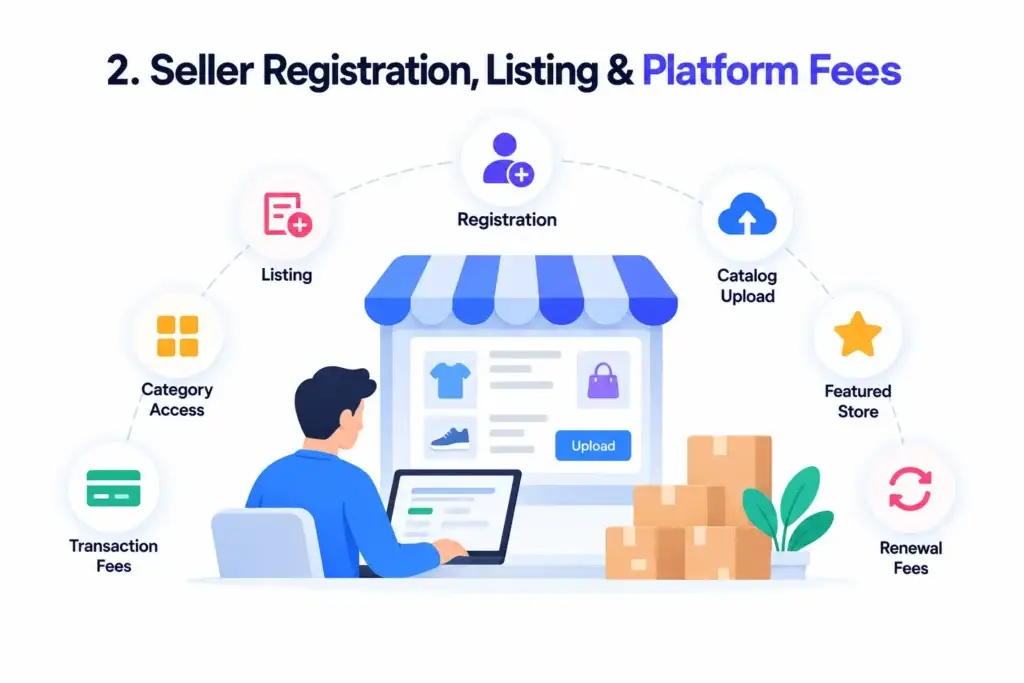
Fees give the marketplace a way to earn from seller participation, not just completed orders.
These may include:
- Seller registration fees
- Product listing fees
- Category access fees
- Transaction processing fees
- Convenience fees
- Catalog upload fees
- Featured store setup fees
- Renewal fees for inactive or low-volume sellers
This model works best when the marketplace already has buyer demand or a strong niche position. Sellers will not pay listing fees just because a platform exists. They pay when the marketplace offers visibility, credibility, or access to a buyer segment they cannot easily reach alone.
For early-stage platforms, aggressive listing fees can hurt onboarding. A better approach is to keep entry simple, then introduce paid upgrades once sellers understand the platform’s value.
3. Sponsored Listings and In-App Advertising
Advertising is one of the strongest monetization layers for growing ecommerce marketplaces.
Once a marketplace has enough products and buyer traffic, sellers begin competing for visibility. That creates an opportunity to monetize attention.
Advertising options may include:
- Sponsored product placements
- Featured seller sections
- Homepage banners
- Category page promotions
- Search result priority placement
- Deal-of-the-day participation
- Flash sale placement fees
- Push notification promotions
- Email campaign inclusion
The key is relevance. Ads should not damage the buyer experience. If low-quality sponsored products dominate the search page, customers lose trust. If ad placement is transparent and performance-based, sellers see it as a growth tool rather than a hidden tax.
Practical Example
A fashion marketplace can allow sellers to promote seasonal collections during festivals. A grocery marketplace can promote weekly essentials. An electronics marketplace can sell sponsored placement during launch campaigns. In each case, ads work because seller intent and buyer demand meet at the right moment.
4. Seller Subscription Plans
Seller subscriptions create predictable recurring revenue.
Instead of relying only on order-based commission, the marketplace can offer monthly or yearly seller plans. Each plan can unlock different levels of access, tools, and visibility.
A simple seller plan structure may look like this:
| Seller Plan | What Sellers Get | Marketplace Benefit |
|---|---|---|
| Free Plan | Basic listing access, standard commission, limited products | Helps onboard new sellers faster |
| Growth Plan | More listings, analytics, campaign participation, lower commission | Creates recurring revenue |
| Premium Plan | Featured placement, priority support, advanced reports, bulk upload tools | Monetizes serious sellers |
| Enterprise Seller Plan | Dedicated support, custom catalog workflows, API access | Supports high-volume vendors |
Subscription plans work best when sellers clearly understand what they are paying for. The value should come from better tools, better visibility, better reporting, or lower friction — not just access to the platform.
5. Seller Services and Value-Added Tools
Seller services are where many Multi-Vendor Ecommerce Marketplaces become more defensible.
Instead of acting only as a listing platform, the marketplace can help sellers run better online businesses. These services can become separate revenue streams.
Examples include:
- Catalog creation support
- Product photography services
- SEO-friendly product descriptions
- Sponsored campaign management
- Inventory management tools
- Seller analytics dashboards
- Pricing recommendations
- Packaging support
- Warehousing or fulfilment support
- Return handling
- Customer support assistance
- Seller training and onboarding
This model works because many sellers want ecommerce growth but do not have internal teams. If the marketplace helps them sell better, sellers are more willing to pay for support.
For founders, seller services also increase retention. A vendor who uses your platform for catalog, ads, logistics, and reporting is less likely to move away quickly.
6. Delivery, Fulfilment, and Logistics Margin
Marketplace revenue can also come from logistics.
If the platform supports delivery coordination, fulfilment, or shipping partnerships, the operator may earn through delivery fees, fulfilment markups, packaging charges, cash-handling fees, or logistics service margins.
Before choosing a build partner, founders should understand how to choose the right ecommerce marketplace development partner based on source-code ownership, admin control, vendor workflows, payment logic, and post-launch flexibility.
This is especially useful for marketplaces dealing with:
- Grocery and essentials
- Fashion
- Electronics
- Pharmacy and wellness
- Local retail
- Regional ecommerce
- Multi-location inventory
- High-frequency repeat orders
Delivery revenue must be handled carefully. If shipping fees feel unfair, buyers abandon checkout. If delivery margins are too low, the platform absorbs operational cost. The right balance depends on order value, geography, fulfilment model, and seller expectations.
7. Payment, Wallet, and Settlement-Based Revenue
Some marketplace operators also monetize payment-related workflows where permitted by the operating model and local rules.
This may include:
- Payment processing service charges
- Cash-on-delivery handling fees
- Wallet withdrawal fees
- Settlement service fees
- Currency conversion support
- Buyer convenience fees
- Seller payout acceleration fees
These fees require careful transparency. Payment-related charges should be visible, explainable, and aligned with applicable payment regulations. The platform should also support accurate transaction logs, refund reversals, seller statements, and audit-ready reporting.
Revenue Streams Comparison for Multi-Vendor Ecommerce Marketplaces
Marketplace Revenue Streams and Founder Use Cases
| Revenue Stream | How It Works | Best Stage to Use | Founder Impact |
|---|---|---|---|
| Commission | The marketplace takes a percentage or fixed fee from each completed order. | Early stage and growth stage | Low seller resistance because vendors pay after earning. |
| Listing Fees | Sellers pay to list products, categories, or premium storefronts. | After buyer demand is visible | Creates revenue from seller participation, not only transactions. |
| Sponsored Ads | Sellers pay for higher visibility across search, category, homepage, or campaigns. | Growth stage | Monetizes buyer attention without increasing commission pressure. |
| Seller Subscriptions | Vendors pay monthly or yearly for tools, reports, limits, and support. | After seller value is proven | Improves recurring revenue and seller segmentation. |
| Seller Services | The platform charges for catalog, marketing, analytics, fulfilment, or support services. | Growth and scale stage | Builds deeper seller dependency and long-term retention. |
| Delivery Margin | The marketplace earns from shipping, fulfilment, packaging, or handling fees. | When logistics is controlled or partnered | Adds a second margin layer beyond product commission. |
How Founders Should Choose the Right Revenue Mix
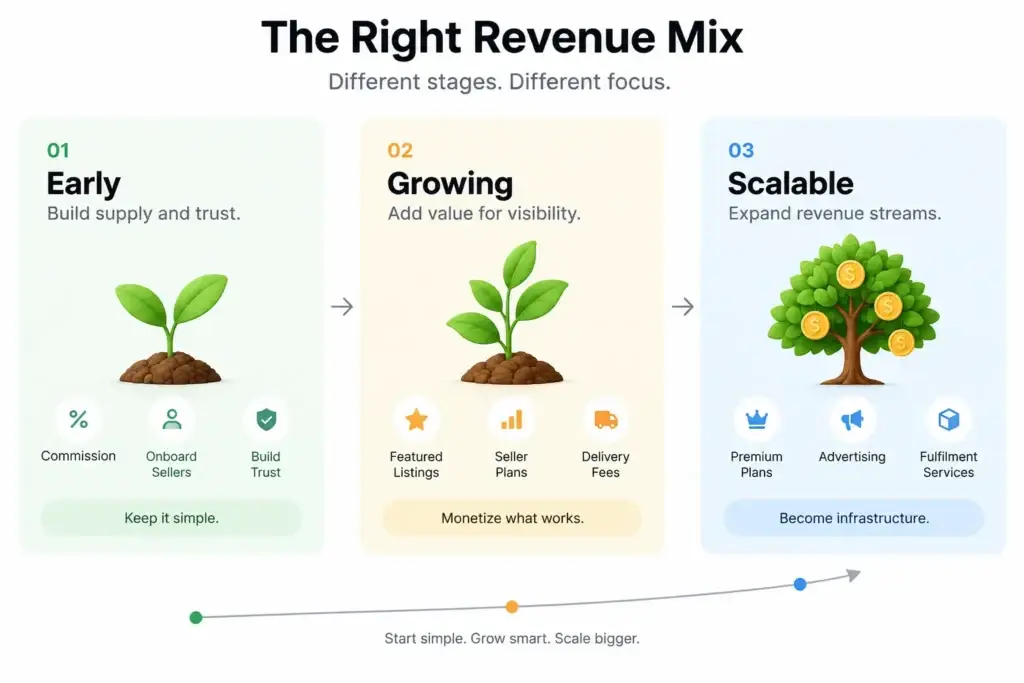
The best marketplace monetization model depends on the platform’s stage.
A new marketplace should not overload sellers with too many charges. At launch, the priority is usually supply. You need quality sellers, enough product depth, and a reason for buyers to return.
As the platform grows, the operator can introduce stronger monetization layers.
Stage 1: Early Marketplace
Focus on:
- Simple commission
- Seller onboarding
- Product quality
- Category depth
- Trust-building
- Smooth checkout
- Reliable payouts
Avoid aggressive fees before sellers see value.
Stage 2: Growing Marketplace
Add:
- Featured listings
- Seller subscriptions
- Campaign participation fees
- Category-based commission rules
- Analytics dashboards
- Delivery fee logic
At this stage, sellers are more willing to pay because visibility has value.
Stage 3: Scalable Marketplace
Introduce:
- Advanced seller services
- Fulfilment revenue
- Premium vendor plans
- Advertising dashboards
- Automated payout reporting
- Performance-based seller tools
- Custom enterprise seller support
At scale, the marketplace becomes more than a sales channel. It becomes operating infrastructure for vendors.
For founders who want to compare these monetization levers in more detail, Miracuves has a detailed marketplace business model breakdown that explains how commissions, seller plans, logistics, ads, and operator-controlled revenue lines work together.
Founder Decision Signals
Speed
If you need to validate seller demand quickly, start with a simple commission model before adding complex monetization layers.
Cost
If operational costs are high, combine commission with ads, seller plans, or service fees instead of raising the seller cut aggressively.
Scalability
If the marketplace will support many sellers, choose a platform with automated commission rules, refunds, payouts, and vendor reporting.
Market Fit
If sellers are price-sensitive, monetize through performance-based visibility and services rather than heavy upfront fees.
Why Admin Control Matters for Marketplace Revenue
Revenue models fail when they are not supported by the admin dashboard.
A founder may decide to charge 12% commission, but the platform still needs to calculate it correctly across vendors, categories, refunds, cancellations, discounts, taxes, shipping, and seller settlements.
Revenue logic should also be connected to the platform’s multi-vendor marketplace feature set, including vendor dashboards, catalog control, checkout, commission rules, refunds, wallet statements, and payout workflows.
A revenue-ready admin panel should support:
- Global commission settings
- Category-wise commission
- Vendor-wise commission
- Subscription plan management
- Sponsored listing control
- Coupon and discount rules
- Refund and reversal logic
- Seller wallet statements
- Payout approval workflows
- Revenue analytics
- Dispute management
- Role-based access control
- Activity logs
Without this control layer, marketplace monetization becomes manual. Manual revenue operations increase errors, delay payouts, and reduce seller trust.
This is where a ready-made platform foundation can help. For founders who want to move faster, Miracuves offers a launch-ready ecommerce marketplace solution that supports multi-vendor operations, seller workflows, admin control, and monetization logic without forcing businesses to start from zero.
Security and Trust in Marketplace Monetization
Revenue is not only about earning. It is also about trust.
Sellers need to trust that commissions are calculated correctly. Buyers need to trust that payments are secure. Admins need to trust that refunds, disputes, and payouts are traceable.
Important trust layers include:
- Secure payment gateway integration
- Encrypted data transfer
- Encrypted data storage
- Role-based access control
- Seller verification
- Product moderation
- Audit logs
- Refund workflows
- Dispute management
- Fraud monitoring signals
- Permission-based dashboards
- Activity logs
For Multi-Vendor Ecommerce Marketplaces, trust directly affects monetization. If sellers do not understand deductions, they churn. If buyers face payment issues, they abandon checkout. If admins cannot audit transactions, scaling becomes risky.
Mistakes Founders Should Avoid
Charging too many fees too early
New sellers need proof of demand before accepting platform fees, listing charges, and paid promotions. Start simple, then add monetization layers as marketplace value becomes visible.
Depending only on commission
Commission is useful, but it may not cover support, marketing, refunds, payment costs, and seller operations. A stronger model adds subscriptions, ads, logistics, or seller services over time.
Ignoring payout transparency
Sellers need clear statements showing order value, commission, fees, refunds, taxes, shipping, and payout status. Poor payout clarity creates disputes and damages retention.
Selling ads before search quality is stable
Sponsored listings should improve discovery, not weaken buyer trust. If paid products dominate irrelevant searches, customers may stop using the platform.
Once the revenue model is clear, founders should also review marketplace development cost factors because commissions, ads, delivery workflows, seller dashboards, and payment logic can all affect the final build scope.
How Miracuves Helps Founders Build Monetization-Ready Marketplaces
A marketplace should not treat monetization as an afterthought. The commission engine, seller dashboard, payment flows, ad placements, subscription plans, and admin controls should be planned before launch.
Miracuves helps founders build ready-made and white-label marketplace platforms with source-code ownership, branded design, admin dashboards, vendor workflows, and monetization-ready modules. This gives founders a faster way to validate the market while still keeping control over how the business earns.
Miracuves helps founders explore white-label marketplace software and broader white-label ecommerce marketplace solutions that can support vendor onboarding, catalog management, commission rules, admin control, and seller monetization workflows.
The stronger decision is not always to build the biggest platform first. It is to launch with the right revenue foundation, test seller behaviour, understand buyer demand, and then expand the monetization stack based on real marketplace activity.
Final Thoughts
Multi-Vendor Ecommerce Marketplaces generate revenue through more than one income stream. Commission may be the starting point, but strong platforms eventually layer in seller fees, sponsored visibility, subscriptions, fulfilment margin, payment workflows, and value-added seller services.
For founders, the real question is not “Which revenue model makes the most money?” The better question is “Which revenue model creates value for sellers, protects platform margins, and can be managed cleanly from the admin dashboard?”
A marketplace becomes stronger when buyers get variety, sellers get demand, and the operator gets a revenue system that is transparent, scalable, and built for long-term control.
If you are comparing different marketplace categories beyond ecommerce, you can also explore Miracuves’ marketplace and listings solutions to understand how different two-sided platforms manage listings, bookings, vendors, payments, and commissions.
FAQs
How do Multi-Vendor Ecommerce Marketplaces make money?
Multi-Vendor Ecommerce Marketplaces usually make money through sales commissions, seller subscriptions, listing fees, sponsored product placements, delivery margins, payment-related charges, and value-added seller services.
Is commission the best revenue model for a new marketplace?
Commission is often the easiest starting model because sellers pay only after receiving orders. However, as the platform grows, founders may add ads, subscriptions, logistics services, or seller tools to diversify revenue.
What are seller services in an ecommerce marketplace?
Seller services are paid tools or support options that help vendors sell better. These may include catalog creation, product photography, advertising support, analytics, fulfilment, packaging, customer support, and seller training.
Can marketplace ads become a major revenue stream?
Yes, but only when the platform has enough buyer traffic and product depth. Sponsored listings, featured products, category placements, and campaign promotions work best when sellers can clearly connect visibility with sales potential.
Why do marketplace operators charge listing fees?
Listing fees help marketplaces earn from seller participation. They work best when the platform already has buyer demand or strong niche authority. For early-stage marketplaces, high listing fees may slow seller onboarding.
What features are needed to manage marketplace revenue?
A marketplace needs commission settings, seller wallets, subscription management, ad placement controls, refund logic, payout workflows, revenue reports, dispute handling, and role-based admin access.
How can founders avoid revenue leakage in marketplace platforms?
Founders can reduce revenue leakage by automating commission rules, tracking refunds properly, maintaining payout logs, using clear seller statements, monitoring discounts, and keeping admin controls centralized.
Should a marketplace use one revenue model or multiple models?
Most marketplaces start with one simple model and expand later. A hybrid model can be stronger, but adding too many fees too early may reduce seller trust and slow supply growth.
Miracuves is an independent software development company. We are not affiliated with, connected to, sponsored by, or endorsed by any company or product named in this article.
Terms such as “X Clone” are used descriptively. It is how the software industry refers to building a platform with functionality comparable to a known service, and how clients search for it.
The entire design and codebase of our products is built by our own team. Our products contain no code, design, graphics, or content originating from any third-party website or applications.
All third-party names and marks referenced in this article are the property of their respective owners, referenced solely to identify the services discussed.