


Key Takeaways
- A multi-vendor ecommerce marketplace must connect buyer, seller, product, order, payment, delivery, and admin workflows.
- Core features include seller onboarding, catalogue management, inventory control, search, checkout, commissions, payouts, and reporting.
- Development cost depends on platform coverage, integrations, customization, automation, security, scalability, and support.
- Source-code ownership gives founders greater control over branding, workflows, hosting, and future product expansion.
- Founders should evaluate operational completeness instead of comparing only initial pricing or total feature counts.
Marketplace Evaluation Signals
- Confirm whether customer, seller, delivery, and administrator interfaces are included in the quoted scope.
- Test seller registration, product approval, inventory updates, order processing, returns, and payout workflows.
- Review buyer search, recommendations, cart, checkout, payment, tracking, ratings, and customer-support journeys.
- Check admin controls for commissions, sellers, products, orders, disputes, refunds, promotions, permissions, and reports.
- Clarify costs for payment gateways, logistics integrations, app publishing, hosting, customization, maintenance, and post-launch support.
Real Insights
- An attractive storefront cannot compensate for weak seller operations, inaccurate inventory, or unreliable order processing.
- Marketplace complexity increases when products from multiple sellers appear within the same cart and order.
- Advanced search and recommendations become valuable only when product data and catalogue structure are accurate.
- A low initial price can create higher long-term costs when integrations, source code, documentation, or essential modules are excluded.
- Miracuves develops customizable multi-vendor ecommerce marketplaces with buyer, seller, delivery, payment, commission, and admin workflows.
Launching a multi-vendor ecommerce marketplace is not just about putting products online. A founder has to think about sellers, buyers, product catalogs, payments, commissions, delivery workflows, refunds, inventory accuracy, admin control, and long-term scalability.
This is where many marketplace projects become risky. The storefront may look simple, but the business logic behind a real marketplace is layered. One customer order may involve multiple vendors, different shipping rules, separate commissions, wallet entries, refund conditions, delivery updates, and support tickets.
That is why founders should evaluate marketplace features and cost factors before choosing a development path. A good platform foundation should not only help customers browse and buy. It should also give sellers operational control and give the platform owner enough visibility to manage transactions, disputes, payouts, promotions, and growth.
This guide explains what founders should check before launching a multi-vendor ecommerce marketplace, which features matter most, what affects development cost, and when a ready-made foundation from Miracuves may be a faster path to market.
What Is a Multi-Vendor Ecommerce Marketplace?
A multi-vendor ecommerce marketplace is an online platform where multiple independent sellers list products and customers purchase from those sellers through a shared storefront. The platform owner controls the ecosystem, while vendors manage their own products, pricing, stock, and order fulfillment depending on the operating model.
Unlike a single-brand ecommerce store, a marketplace has more moving parts. It needs seller onboarding, catalog approval, commission rules, order allocation, payout logic, delivery coordination, product reviews, refund workflows, and admin-level reporting.
For founders, the main decision is not simply “Which platform should I use?” The stronger question is:
Can this marketplace foundation handle real operations after the first sellers and customers arrive?
A marketplace may start with a few sellers, but the architecture should be ready for more products, more categories, more payment methods, more disputes, and more fulfillment complexity over time.
Why Founders Should Evaluate Marketplace Features Before Pricing
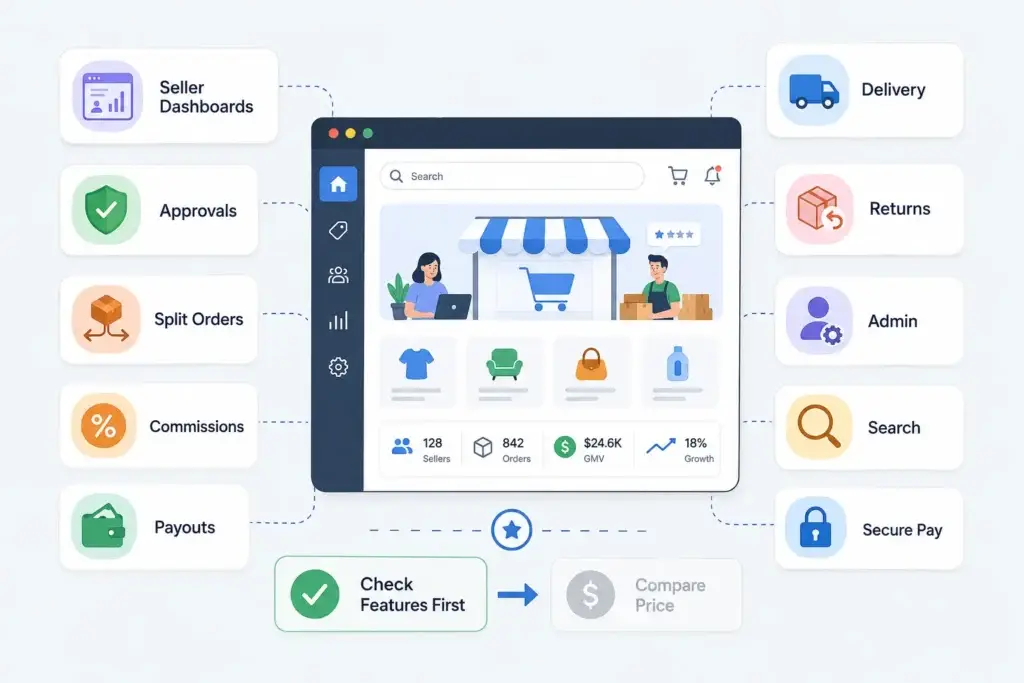
Image Source: AI-generated visual by Miracuves
Many founders compare marketplace software only by upfront cost. That is understandable, especially when the goal is to launch quickly. But the cheapest-looking option can become expensive if the platform lacks core workflows.
A low-cost marketplace setup may work for a simple catalog, but it can create problems when the business needs:
- Multiple seller dashboards
- Product approval workflows
- Split order handling
- Commission tracking
- Seller payouts
- Delivery partner coordination
- Return and refund management
- Role-based admin access
- Scalable product search
- Coupon and promotion control
- Secure payment gateway integration
This is why feature evaluation should come before price comparison. Pricing only makes sense when the founder understands what is included, what needs customization, and what will affect operations after launch.
A founder planning a general ecommerce marketplace should also review a ready-made marketplace foundation from Miracuves to understand how buyer, seller, delivery, and admin workflows can fit together in one launch-ready system.
Read More: What Is a Multi-Vendor Ecommerce Marketplace and How Do Buyers, Sellers, Orders, and Payouts Work?
Core Marketplace Panels Every Founder Should Check
A scalable ecommerce marketplace is usually built around multiple panels or apps. Each panel supports a different role in the business.
Essential Marketplace Panels and Their Business Value
| Panel or App | What It Should Include | Founder Impact |
|---|---|---|
| Customer App / Storefront | Product browsing, search, filters, cart, checkout, order tracking, reviews, wishlist, offers, and account management. | Improves buyer experience and directly affects conversion, repeat orders, and customer trust. |
| Seller Panel | Product upload, inventory control, price updates, order management, sales reports, payout visibility, and return handling. | Helps sellers operate independently without depending on the platform owner for every update. |
| Delivery Partner App | Order assignment, pickup details, delivery status, route visibility, proof of delivery, and cash collection where relevant. | Supports last-mile control when the marketplace manages or coordinates deliveries directly. |
| Admin Dashboard | User control, seller approval, product moderation, commission setup, payments, refunds, reports, promotions, and dispute handling. | Gives the founder operational control over the marketplace ecosystem. |
The admin dashboard is especially important. A founder should be able to approve vendors, adjust commissions, manage categories, resolve disputes, monitor transactions, and review performance without waiting for developers for every small business change.
Customer-Side Features That Improve Marketplace Conversion
The customer experience decides whether buyers trust the marketplace enough to place an order. Founders often focus on visual design, but conversion depends on usability, speed, product clarity, and checkout confidence.
Important customer-facing features include:
- Easy registration and login
- Product categories and subcategories
- Smart product search
- Filters by price, rating, brand, availability, and delivery option
- Product detail pages with images, variants, descriptions, seller information, and reviews
- Wishlist and saved products
- Cart and multi-item checkout
- Multiple payment options
- Coupon and promo code support
- Real-time order status
- Push notifications and email alerts
- Return and refund request flow
- Ratings and reviews
For a marketplace, product discovery is more complex than a basic online store. Customers may compare similar products from different sellers, check delivery options, review seller ratings, and look for offers before buying.
A weak browsing experience can reduce trust even if the product supply is strong. A strong customer interface should help buyers find products quickly, understand the seller, trust the checkout, and track the order after payment.
Seller Features That Decide Marketplace Supply Quality
A marketplace cannot grow without sellers. The seller experience determines how easily vendors can join, upload products, manage stock, fulfill orders, and track earnings.
A strong seller panel should support:
- Seller registration and approval
- Business profile management
- Product listing and bulk upload
- SKU and inventory management
- Variant control for size, color, model, or package type
- Pricing and discount management
- Order acceptance and processing
- Return request handling
- Sales reports and payout history
- Seller ratings and performance tracking
- Notifications for new orders and low stock
Founders should evaluate seller workflows carefully because vendor friction affects marketplace liquidity. If sellers find the platform difficult to use, they may delay uploads, make stock mistakes, or avoid the marketplace entirely.
The seller panel should make it easy for vendors to operate independently while giving the platform owner enough control to approve products, monitor quality, and enforce marketplace rules.
Admin Features Founders Should Not Ignore
The admin dashboard is the command center of a multi-vendor marketplace. It is where the platform owner manages users, sellers, products, payments, commissions, disputes, content, and analytics.
Important admin features include:
- User and seller management
- Seller approval and verification
- Category and product control
- Product approval or rejection
- Commission management
- Order management
- Payment and payout tracking
- Refund and return oversight
- Coupon and promotion management
- Delivery zone and shipping settings
- Review moderation
- Dispute management
- Role-based access control
- Sales reports and analytics
- Notification management
- CMS and banner control
A marketplace without a strong admin layer becomes difficult to operate as soon as transactions increase. Founders should avoid platforms where every operational adjustment needs developer involvement.
For founders who want a launch-ready setup with buyer, seller, delivery, and admin workflows already connected, Miracuves offers a white-label ecommerce marketplace solution that can be customized around the target business model.
Marketplace Cost Factors Founders Should Evaluate
The cost of building a multi-vendor ecommerce marketplace depends on feature depth, user roles, integrations, customization, platform coverage, and operational complexity.
The final cost is not determined only by the number of screens. It is shaped by how the marketplace handles real transaction logic.
| Cost Factor | Why It Affects Pricing | Founder Decision Question |
|---|---|---|
| Platform Scope | Web, Android, iOS, seller panel, delivery app, and admin dashboard each add development and QA work. | Do you need all platforms at launch or a phased release? |
| Vendor Workflows | Seller registration, product upload, inventory control, and payout visibility require dedicated backend logic. | Will sellers manage their own operations independently? |
| Checkout Complexity | Cart, taxes, shipping, coupons, multi-seller orders, and payment status must work together. | Can the system handle one order involving multiple sellers? |
| Payment Integrations | Payment gateways, cash collection, refunds, wallet logic, and payout workflows increase complexity. | Which payment methods are essential for your launch market? |
| Logistics and Fulfillment | Delivery partner apps, shipping zones, tracking, and order assignment affect cost. | Will sellers ship orders or will the platform control delivery? |
| Admin Dashboard Depth | Commission rules, moderation, reporting, roles, and dispute controls require careful architecture. | Can the operator manage the marketplace without developer dependency? |
| Custom Branding | UI changes, theme adjustments, app icons, store assets, and brand-specific layouts affect scope. | How much visual differentiation is needed before launch? |
| Scalability Needs | Large catalogs, peak sale traffic, search performance, and database optimization add engineering work. | Are you launching small or preparing for high-volume growth? |
| Security and Compliance Workflows | Payment security, access control, audit logs, and verification workflows add trust and risk-management layers. | What trust controls are required for your category and region? |
| Post-Launch Support | Bug fixes, updates, deployment help, and app publishing support affect the total engagement. | What support do you need after the first version goes live? |
A ready-made approach can reduce development effort when the foundation already includes essential marketplace modules. Custom builds may still be useful for highly unique operating models, but they usually require more time, planning, QA, and iteration.
Ready-Made Marketplace Foundation vs Custom Development
Founders often compare ready-made marketplace software with custom ecommerce marketplace development. The right choice depends on speed, budget, differentiation, and technical ownership.
| Build Approach | Best For | Advantages | Watchouts |
|---|---|---|---|
| Ready-Made Marketplace Foundation | Founders who want faster launch with proven buyer, seller, admin, and delivery workflows. | Faster deployment, lower initial engineering effort, tested core modules, source-code ownership when provided. | Must confirm customization flexibility, code access, support, and included modules. |
| Fully Custom Development | Businesses with unique workflows, complex enterprise requirements, or heavily differentiated product logic. | Maximum flexibility, fully tailored architecture, custom user experience. | Higher cost, longer timeline, more planning risk, and more QA effort before launch. |
| Generic Ecommerce Plugin Setup | Small catalogs, single-vendor stores, or simple experiments. | Lower setup effort for basic commerce. | Often limited for multi-vendor operations, commission rules, seller workflows, and marketplace-scale logic. |
The real decision is not whether ready-made or custom is universally better. The better question is which route gives the founder enough control, speed, and flexibility for the current launch stage.
If the goal is to validate a marketplace model faster, a ready-made solution from Miracuves can give founders a stronger starting point because core marketplace flows are already available and can be branded for the business.
Founder Decision Signals
Speed
If your priority is testing seller supply and buyer demand quickly, a ready-made marketplace foundation may reduce the time spent building standard workflows from zero.
Cost
Cost should be judged by included modules, not just the starting price. Missing seller, payout, refund, or admin features can increase total project cost later.
Scalability
A marketplace should be evaluated for catalog size, checkout load, vendor growth, order history, reporting, and future integrations before launch.
Market Fit
The first version should help you test vendor onboarding, product discovery, checkout confidence, and fulfillment reliability with real users.
Marketplace Monetization Models to Plan Before Launch
Marketplace monetization should be considered before development begins because revenue logic affects commissions, dashboards, payouts, invoices, and reporting.
Common monetization models include:
Commission on Orders
The platform takes a percentage or fixed fee from each successful transaction. This is one of the most common models for multi-vendor marketplaces.
Seller Subscription Plans
Vendors pay monthly or yearly fees to access the platform, list more products, use premium tools, or unlock higher visibility.
Featured Listings and Promotions
Sellers pay to promote products, appear in highlighted sections, or get visibility during campaigns.
Delivery Fees
The platform may charge customers delivery fees or earn margins through platform-managed logistics.
Advertising Revenue
As traffic grows, marketplaces can offer sponsored product placements, banner ads, or brand promotion slots.
Convenience or Service Fees
Some platforms add small buyer-side fees for checkout convenience, packaging, premium service, or faster delivery options.
Founders should avoid adding too many monetization models too early. The first priority is usually liquidity: enough sellers, enough products, and enough buyers completing orders. Monetization can expand once the platform proves operational reliability.
Security and Trust Features for Ecommerce Marketplaces
Trust is a core part of ecommerce marketplace growth. Buyers need payment confidence, sellers need payout transparency, and the platform owner needs control over fraud, disputes, and misuse.
Important trust and security layers include:
- Secure payment gateway integration
- Encrypted data transfer
- Role-based access control
- Seller verification
- Customer account protection
- Order history and transaction records
- Refund and dispute workflows
- Review moderation
- Admin activity logs
- Fraud monitoring signals
- Permission-based dashboards
Security should not be treated as a decorative feature. It should be part of the product foundation. A marketplace handling payments, customer information, seller data, and order records needs careful access control and reliable transaction visibility.
Final compliance requirements may vary based on country, payment gateway, data policy, product category, and operating model. Founders should confirm legal and compliance needs before launch.
Mistakes Founders Should Avoid When Choosing Marketplace Software
Choosing only by the lowest upfront price
A low starting cost can become expensive if the platform lacks seller tools, payout logic, refund workflows, or admin controls. Evaluate total launch readiness, not only the initial quote.
Ignoring seller experience
If sellers cannot upload products, manage inventory, process orders, and track earnings easily, marketplace supply will suffer even if the customer app looks polished.
Underestimating order and refund complexity
Multi-seller carts, partial cancellations, returns, cash collection, and refunds can create accounting problems if they are not planned in the backend.
Launching without admin control
Founders need the ability to manage vendors, categories, commissions, disputes, promotions, and reports from the admin dashboard. Without this, daily operations become developer-dependent.
How to Evaluate Marketplace Pricing Before You Commit
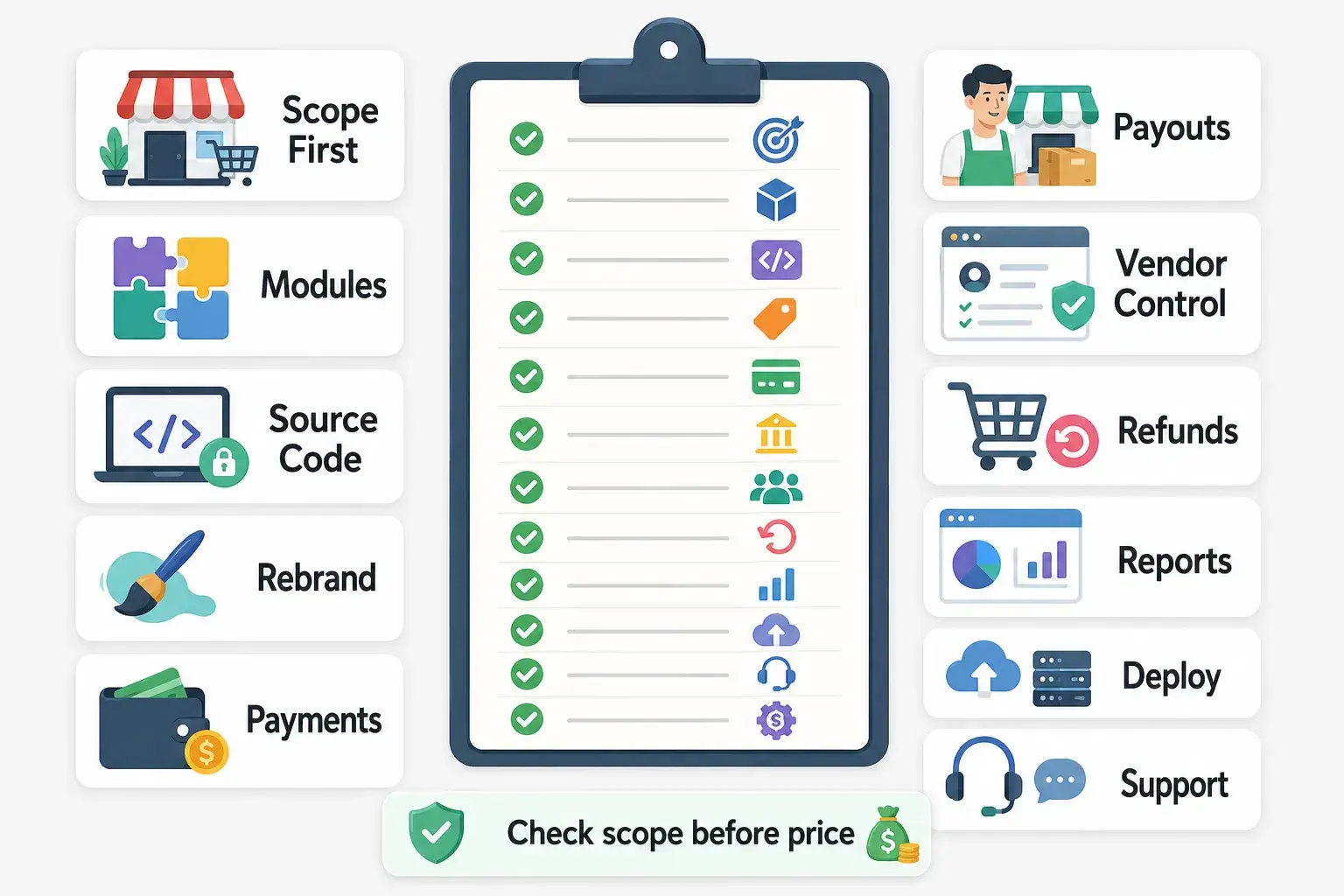
Image Source: AI-generated visual by Miracuves
Before choosing a development company or marketplace platform, founders should ask detailed questions about scope.
Useful questions include:
- Does the solution include customer, seller, delivery, and admin modules?
- Is source code included?
- Can the platform be rebranded for my business?
- Which payment gateways are supported?
- Does it support seller commissions and payouts?
- Can vendors manage products and stock independently?
- Does the admin dashboard support refunds, disputes, and reports?
- Are app publishing and deployment included?
- What support is available after launch?
- What customizations are included and what costs extra?
Pricing depends on features, integrations, branding, tech stack, support, and customization requirements. Founders should ask for a clear scope document before payment so they know exactly what is included.
For teams comparing options, Miracuves provides a launch-ready ecommerce marketplace platform that can help founders evaluate the practical difference between building from zero and starting with a ready-made foundation.
When a Ready-Made Marketplace Solution Makes Sense
A ready-made marketplace solution makes sense when the founder already understands the marketplace category and wants to move quickly into validation.
It is especially useful when:
- The business model follows a proven marketplace pattern
- The founder wants buyer, seller, delivery, and admin workflows together
- The launch goal is speed plus customization
- Source-code ownership matters
- The business wants white-label branding
- The team wants to avoid building every standard marketplace module from zero
- The first priority is testing demand, seller supply, and fulfillment operations
A custom build may still be better when the marketplace logic is highly unusual or when the business requires deep enterprise integrations from day one.
The stronger founder decision is to separate standard marketplace infrastructure from unique business differentiation. Product catalog, checkout, seller tools, admin control, and commission logic are usually foundational. Differentiation often comes from category focus, pricing strategy, vendor quality, customer experience, logistics execution, and marketing.
Final Thoughts: Evaluate the Marketplace Engine, Not Just the Storefront
A multi-vendor ecommerce marketplace is more than a shopping app. It is a business system that connects buyers, sellers, payments, inventory, delivery, commissions, refunds, and admin decisions.
Founders should evaluate features and cost factors based on operational readiness. A beautiful storefront is useful, but the real test begins when sellers upload products, customers place mixed orders, payments need reconciliation, refunds happen, and support requests start arriving.
The safest approach is to understand your required workflows first, compare what is already included, and choose a build path that supports speed, control, and future customization. For founders who want to launch faster, Miracuves offers ready-made, white-label ecommerce marketplace foundations designed to reduce development effort while giving businesses source-code ownership and admin control.
FAQs
What features should a multi-vendor ecommerce marketplace include?
A multi-vendor ecommerce marketplace should include customer browsing, product search, cart, checkout, seller dashboards, product management, inventory control, order tracking, payment integration, commission management, refund workflows, admin reporting, and role-based access control.
What affects the cost of building an ecommerce marketplace?
The main cost factors include platform scope, number of user roles, seller workflows, payment integrations, logistics requirements, custom branding, admin dashboard depth, security features, scalability needs, and post-launch support.
Is a ready-made marketplace platform better than custom development?
A ready-made marketplace platform is useful when founders want faster launch and standard marketplace workflows already built. Custom development may be better for highly unique business logic, complex integrations, or enterprise-level customization.
Why is the seller panel important in a marketplace?
The seller panel allows vendors to manage products, inventory, orders, pricing, and earnings independently. Without a strong seller panel, the platform owner may need to manually support every vendor update, which slows growth.
What should founders check before buying marketplace software?
Founders should check included modules, source-code access, customization options, payment gateway support, seller workflows, admin controls, support terms, deployment process, app publishing help, and whether the platform can scale with future business needs.
How do marketplace platforms make money?
Marketplace platforms can earn through order commissions, seller subscriptions, featured listings, ads, delivery fees, convenience fees, and premium seller tools. The right model depends on category, customer behavior, seller margin, and market maturity.
Why does admin dashboard depth matter?
The admin dashboard gives the platform owner control over sellers, customers, categories, products, payments, commissions, promotions, refunds, disputes, and reporting. Strong admin control reduces operational dependency on developers.
Can a marketplace be launched quickly with a ready-made solution?
Yes, a ready-made marketplace foundation can reduce launch time when core workflows such as buyer app, seller panel, checkout, payments, and admin control are already built. The final timeline depends on branding, integrations, customization, QA, and deployment scope.
Miracuves is an independent software development company. We are not affiliated with, connected to, sponsored by, or endorsed by any company or product named in this article.
Terms such as “X Clone” are used descriptively. It is how the software industry refers to building a platform with functionality comparable to a known service, and how clients search for it.
The entire design and codebase of our products is built by our own team. Our products contain no code, design, graphics, or content originating from any third-party website or applications.
All third-party names and marks referenced in this article are the property of their respective owners, referenced solely to identify the services discussed.