


Most founders begin marketplace planning with the visible parts: product listings, category pages, cart, checkout, and payment gateways. Those features matter, but they do not make a multi-vendor ecommerce marketplace scalable by themselves.
The real complexity starts after the buyer clicks “place order.”
Which vendor receives which item? How is commission calculated? What happens if one seller cancels but the other ships? Who manages refunds? How are payouts released? Can vendors update stock without breaking buyer trust? Can the platform operator track disputes, delivery issues, cash payments, reviews, and revenue from one admin layer?
That is where a marketplace becomes different from a normal ecommerce store.
For founders, the stronger question is not “Can buyers browse and pay?” The stronger question is: “Can the platform operate smoothly when hundreds of vendors, thousands of SKUs, multiple payment flows, fulfilment issues, and support tickets are moving at the same time?”
This guide explains the features a multi-vendor ecommerce marketplace should include beyond basic product listings and checkout, especially if you want a platform that is ready for real operations, not just a demo.
Key Takeaways
- Multi-vendor ecommerce marketplace features should go beyond catalog, cart, and checkout.
- The most important layers include vendor onboarding, catalog governance, order splitting, commission rules, payout workflows, delivery management, refunds, disputes, analytics, and admin control.
- A marketplace needs separate experiences for customers, vendors, delivery teams, and platform operators.
- Founders should prioritize operational control early because weak backend logic creates refund errors, vendor conflicts, delayed payouts, and customer support pressure.
- Miracuves helps founders move from idea to launch faster with ready-made and white-label marketplace app solutions built for admin control, monetization, and source-code ownership.
Why Product Listings and Checkout Are Only the Starting Point
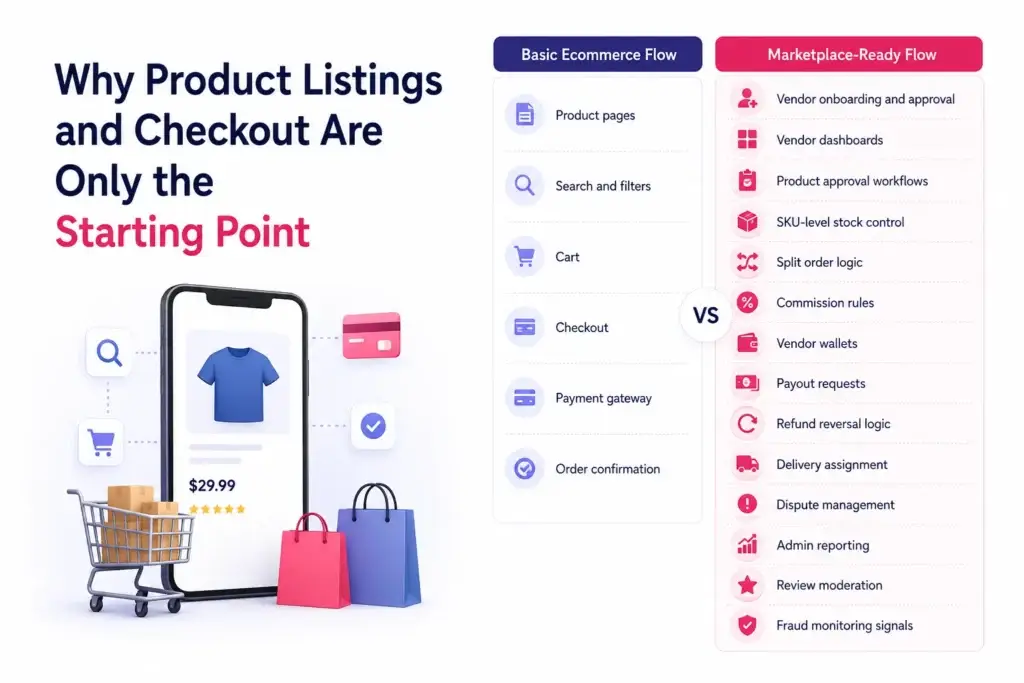
A single-vendor ecommerce store is usually controlled by one business. The same team manages inventory, pricing, fulfilment, customer support, returns, and refunds.
A multi-vendor marketplace is different. The platform operator does not control every product directly. Sellers manage their own catalogs, customers expect one smooth shopping journey, and the backend must coordinate several independent parties behind the scenes.
That means a marketplace needs more than a storefront. It needs an operating system for commerce.
A basic ecommerce flow may include:
- Product pages
- Search and filters
- Cart
- Checkout
- Payment gateway
- Order confirmation
A marketplace-ready flow must also include:
- Vendor onboarding and approval
- Vendor dashboards
- Product approval workflows
- SKU-level stock control
- Split order logic
- Commission rules
- Vendor wallets
- Payout requests
- Refund reversal logic
- Delivery assignment
- Dispute management
- Admin reporting
- Review moderation
- Fraud monitoring signals
Without these layers, the platform may look ready from the customer side but become difficult to manage once orders, sellers, refunds, and fulfilment problems begin to scale.
Vendor Onboarding and Verification Features
A marketplace succeeds only if the supply side is reliable. That begins with vendor onboarding.
A strong vendor onboarding system should help the platform operator approve the right sellers, collect business information, assign selling permissions, and prevent low-quality or risky sellers from going live without review.
Important vendor onboarding features include:
- Vendor registration
- Business profile setup
- Store name and branding fields
- Document upload where required
- Bank or payout details
- Tax information fields where relevant
- Admin approval workflow
- Vendor status control
- Category-level selling permissions
- Store policy setup
- Vendor support contact details
This feature is not just administrative. It protects buyer trust. If anyone can start selling without review, the marketplace may face fake products, poor fulfilment, refund pressure, and customer complaints.
For founders, vendor onboarding should be treated as a trust feature, not just a registration form.
Vendor Dashboard Features That Reduce Operational Dependency
Vendors should not depend on the platform operator for every small update. A marketplace becomes difficult to scale if the admin team has to manually upload every product, update every stock count, reply to every order question, or handle every vendor request.
A vendor dashboard gives sellers controlled independence.
A useful vendor dashboard should include:
- Product creation and editing
- Bulk product upload
- Inventory updates
- Order management
- Order status updates based on permissions
- Coupon or offer management
- Sales reports
- Wallet or earnings history
- Payout request option
- Product approval status
- Customer review view
- Refund request response
- Store profile management
- Notification center
The key word is controlled. Vendors should have enough access to manage their business, but not so much access that they can damage the customer experience or manipulate platform rules.
That is why permission-based dashboards matter. The platform operator should decide what vendors can create, edit, publish, discount, refund, or withdraw.
Catalog Governance and SKU-Level Inventory Control
Product listings are visible. Catalog governance is the control layer behind them.
In a multi-vendor ecommerce marketplace, different sellers may sell the same product, similar products, or product variants with different sizes, colors, pricing, stock levels, delivery times, and return rules.
Without strong catalog governance, the marketplace can quickly become messy.
Important catalog and inventory features include:
- Category and subcategory management
- Product approval workflow
- Variant management
- SKU-level stock tracking
- Brand and attribute management
- Product image rules
- Duplicate product handling
- Restricted category control
- Low-stock alerts
- Bulk import and export
- Product status control
- Featured product placement
- Search visibility controls
- SEO fields for product and category pages
For example, if one product has five color options and four size options, the platform should not treat that as one flat item. Each variant needs accurate stock, pricing, images, and availability.
This is especially important for fashion, electronics, grocery, pharmacy, beauty, books, and multi-category retail businesses where stock mistakes can directly create cancellations.
Multi-Vendor Cart and Split Order Logic
A normal cart is simple. A customer adds products and checks out.
A marketplace cart is more complex because one cart may contain items from multiple vendors. The customer wants one checkout experience, but the backend may need to create separate fulfilment flows for each seller.
A marketplace-ready cart should support:
- Items from multiple vendors in one cart
- Vendor-wise shipping calculation
- Vendor-wise tax or fee handling where relevant
- Split order creation
- Separate order status per vendor
- Partial cancellation
- Partial refund
- Separate delivery assignment
- Unified customer order view
- Vendor-specific order visibility
This is one of the most important features beyond checkout.
From the customer side, the order should feel simple. From the backend side, the platform must know exactly which vendor is responsible for each item, which commission applies, which payout is pending, and which refund rule should be triggered.
If split order logic is weak, support teams will struggle to answer basic questions such as:
- Which seller delayed the shipment?
- Which item was cancelled?
- Which amount should be refunded?
- Which vendor should receive payment?
- Which commission should be reversed?
A scalable marketplace cannot leave these answers to manual tracking.
Commission, Wallet, and Payout Management
A marketplace earns by controlling the transaction layer. That is why commission and payout features are central to the business model.
The platform operator should be able to define how revenue is earned and how sellers are paid.
Important monetization and payout features include:
- Global commission settings
- Category-wise commission
- Vendor-wise commission
- Product-wise commission
- Fixed or percentage-based fees
- Vendor subscription plans
- Featured listing fees
- Delivery fee markup
- Wallet-based settlement
- Payout request approval
- Payout history
- Refund-based commission reversal
- Transaction logs
- Exportable finance reports
This layer should be transparent for vendors. Sellers need to see what they earned, what fee was deducted, which orders are pending, and when payouts are released.
For founders, payout clarity directly affects vendor retention. If sellers do not trust the earning and withdrawal flow, they may leave even if the customer side of the marketplace looks strong.
For deeper monetization planning, founders can explore Miracuves’ marketplace revenue model breakdown here: multi-vendor marketplace business model.
Delivery, Fulfilment, and Last-Mile Control
Many marketplace founders underestimate fulfilment. They assume delivery can be handled later through a courier integration or manual coordination.
That may work for a small test, but it becomes risky when order volume grows.
A strong marketplace fulfilment layer should include:
- Vendor-wise fulfilment status
- Delivery assignment
- Delivery agent dashboard or app
- Live tracking where required
- Delivery proof such as OTP or image confirmation
- Failed delivery reason tracking
- Cash collection tracking where relevant
- Delivery fee control
- Zone or distance-based delivery rules
- Pickup and drop status updates
- Customer delivery notifications
- Admin delivery monitoring
For grocery, pharmacy, electronics, fashion, and local retail marketplaces, delivery is not just a cost center. It affects trust, repeat purchase, cancellation rate, customer support workload, and platform reputation.
If the business model includes its own delivery team, the marketplace needs delivery operations inside the product foundation, not as an afterthought.
Returns, Refunds, and Dispute Management
Returns and refunds decide whether a marketplace remains trusted after something goes wrong.
A weak refund system creates confusion for customers, sellers, and platform operators. A strong refund system creates clear rules and traceable decisions.
Important return and refund features include:
- Return request flow
- Refund request flow
- Vendor response workflow
- Admin approval control
- Return reason selection
- Evidence upload
- Refund status tracking
- Partial refund support
- Commission reversal
- Wallet adjustment
- Refund history
- Customer notification
- Vendor notification
- Dispute escalation
The platform should also support different return rules by category. For example, fashion, electronics, grocery, and personal care products may need different return windows or approval logic.
For founders, the goal is not to avoid every dispute. That is impossible. The goal is to make every dispute trackable, fair, and manageable from the admin dashboard.
Reviews, Ratings, and Marketplace Trust Features
Trust is a marketplace growth feature.
Customers do not only buy products. They also judge vendors, delivery experience, pricing, reviews, refund policies, and platform reliability.
Useful trust features include:
- Product reviews
- Vendor ratings
- Verified purchase badge
- Review moderation
- Abuse reporting
- Vendor badges
- Product quality flags
- Customer complaint tracking
- Store enquiry option
- Seller response to reviews
- Admin control over fake or abusive reviews
Trust features help buyers make better decisions and help good vendors stand out.
They also help the platform operator detect quality issues early. If one vendor repeatedly receives complaints, late shipment reports, refund requests, or low ratings, the admin should be able to act before the issue damages the wider marketplace.
Search, Filters, Recommendations, and Merchandising Controls
A marketplace with thousands of products can fail if customers cannot find the right item quickly.
That is why product discovery features are more than UI improvements. They influence conversion, retention, and vendor revenue.
Important discovery and merchandising features include:
- Keyword search
- Autocomplete
- Category filters
- Price filters
- Brand filters
- Rating filters
- Attribute filters
- Sorting options
- Recently viewed products
- Related products
- Trending products
- Featured products
- Sponsored placements
- Deal sections
- Personalized recommendations where relevant
The platform operator should also be able to control merchandising from the admin panel. This includes deciding which products appear in featured areas, which vendors get promoted, which offers run during campaigns, and which categories are highlighted.
For marketplaces, discovery is both a customer experience feature and a revenue feature. Paid placements, featured listings, and campaign visibility can become meaningful monetization layers when handled carefully.
Promotions, Loyalty, and Customer Retention Features
Checkout completes one transaction. Retention creates future transactions.
A marketplace should include features that encourage buyers to return, especially when the platform has repeat-purchase categories such as grocery, beauty, fashion, electronics accessories, books, pharmacy, or home essentials.
Useful retention features include:
- Coupons
- Promo codes
- Referral rewards
- Loyalty points
- Wallet credits
- Wishlist
- Restock alerts
- Price drop alerts
- Abandoned cart notifications
- Push notifications
- Email notifications
- Personalized offers
- Festival or seasonal campaign banners
However, founders should avoid adding too many promotions without margin control. Discounts can increase orders but damage profitability if commission, delivery fees, vendor funding, and coupon rules are not configured properly.
The admin panel should make promotion rules clear, limited, and measurable.
Customer Support and Communication Features
Marketplaces involve multiple parties, so communication must be structured.
A customer may need support from the platform, a vendor may need clarification from the buyer, and the operator may need to intervene when something goes wrong.
Support features may include:
- In-app support
- Customer ticket system
- Vendor support inbox
- Buyer-vendor enquiry flow
- Order-based chat
- Refund communication thread
- Notification history
- FAQ management
- Admin response templates
- Escalation rules
The goal is to reduce scattered communication. If support happens across phone calls, WhatsApp messages, emails, and manual spreadsheets, the platform loses visibility.
A structured support layer keeps conversations tied to orders, users, vendors, refunds, and delivery events.
Admin Dashboard Features for Marketplace Operators
The admin dashboard is the control room of a multi-vendor marketplace.
It should allow the platform operator to manage users, vendors, products, orders, payments, refunds, commissions, delivery, marketing, and reports from one place.
A strong admin dashboard should include:
- Customer management
- Vendor management
- Product approval
- Category management
- Order monitoring
- Refund and dispute control
- Commission settings
- Wallet and payout management
- Delivery team management
- Coupon and promotion control
- Banner management
- Review moderation
- Notification management
- Role-based access
- Activity logs
- Sales analytics
- Vendor performance reports
- Product performance reports
- Revenue reports
For founders, the admin dashboard matters because it reduces dependency on developers for everyday business decisions.
If the operator needs developer help to change commission, approve vendors, manage refunds, update banners, or review payout requests, the business becomes slower than it needs to be.
Marketplace Features Beyond Listings and Checkout
| Feature Layer | Business Value | Founder Impact |
|---|---|---|
| Vendor onboarding and approval | Improves seller quality and reduces marketplace risk. | Helps founders build trust before scaling supply. |
| SKU-level inventory control | Reduces overselling, cancellations, and catalog errors. | Protects customer experience as product volume grows. |
| Split order management | Routes items correctly when one cart includes multiple vendors. | Prevents fulfilment confusion and support pressure. |
| Commission and wallet logic | Controls how the platform earns and how vendors get paid. | Creates clearer monetization and vendor trust. |
| Return and refund workflows | Keeps disputes traceable and financially accurate. | Reduces manual correction and unresolved complaints. |
| Delivery management | Improves fulfilment visibility and customer communication. | Helps founders control last-mile experience where relevant. |
| Admin analytics | Shows sales, vendor performance, product trends, and revenue signals. | Supports better category, pricing, and growth decisions. |
Security, Access Control, and Fraud Monitoring Features
Marketplace trust depends on identity, payments, permissions, and records.
Security should not be treated as a final checklist item. It should be part of the product foundation.
Important security and control features include:
- Secure payment gateway integration
- Encrypted data transfer
- Role-based access control
- Vendor verification
- Customer account protection
- Admin permission levels
- Activity logs
- Refund approval logs
- Payout approval logs
- Fraud monitoring signals
- Suspicious order flags
- Abuse reporting
- Review moderation
- Secure API integration
For marketplaces handling cash payments, high-value products, regulated categories, or vendor payouts, transaction visibility becomes even more important.
The founder does not need every advanced security workflow on day one, but the platform should have enough structure to support safer operations as the marketplace grows.
Analytics and Reporting Features Founders Should Not Ignore
Many founders think analytics can be added later. In reality, analytics should be available early because the first launch phase is when founders need the clearest feedback.
Useful marketplace reports include:
- Total orders
- Gross sales
- Net revenue
- Commission earned
- Vendor-wise sales
- Product-wise sales
- Category performance
- Refund rate
- Cancellation rate
- Delivery delays
- Repeat purchase rate
- Coupon usage
- Wallet usage
- Vendor payout status
- Customer acquisition source where integrated
The purpose of analytics is not just reporting. It helps founders decide what to improve.
For example:
- If one category sells well but has high refunds, quality control may be weak.
- If one vendor sells often but ships late, fulfilment needs intervention.
- If many users add products to cart but do not pay, checkout friction may exist.
- If discounts drive orders but reduce margin, promotion rules need adjustment.
A marketplace without analytics forces founders to guess. A marketplace with analytics helps them operate with evidence.
Read more: What Is a Multi-Vendor Ecommerce Marketplace and How Do Buyers, Sellers, Orders, and Payouts Work?
Customer, Vendor, Delivery, and Admin Panels Should Work Together
A marketplace is not one app. It is a connected ecosystem.
The customer side may look polished, but the platform will still fail if the vendor panel is weak, the delivery workflow is manual, or the admin dashboard cannot control finance and disputes.
A practical multi-vendor marketplace should include four connected layers:
Customer Layer
This includes browsing, search, filters, cart, checkout, wallet, wishlist, order tracking, reviews, support, notifications, and return requests.
Vendor Layer
This includes store setup, product management, inventory, order queue, earnings, payout requests, reviews, refund responses, and notifications.
Delivery Layer
This includes delivery assignment, route support, status updates, handover confirmation, cash collection records where relevant, and delivery earnings.
Operator Layer
This includes user management, vendor approval, category control, commission setup, payment configuration, delivery monitoring, refunds, disputes, reporting, promotions, and role-based permissions.
When these layers share the same backend logic, the marketplace becomes easier to manage. When they are disconnected, every issue becomes a manual reconciliation problem.
For founders reviewing platform options, Miracuves offers a white-label multi-vendor ecommerce marketplace solution designed around customer, vendor, delivery, and admin workflows.
Founder Decision Signals
Speed
If you need to launch quickly, prioritize a ready-made foundation that already includes vendor, order, payment, delivery, and admin workflows instead of building each layer from zero.
Cost
Cost is not only development expense. Weak refund, payout, and fulfilment workflows can create support costs after launch.
Scalability
A scalable marketplace should handle more vendors, SKUs, orders, payouts, and support cases without forcing every process into spreadsheets.
Market Fit
The first market version should help you validate vendor supply, buyer demand, repeat purchase behavior, and monetization rules with enough admin control to iterate fast.
Which Features Should You Prioritize First?
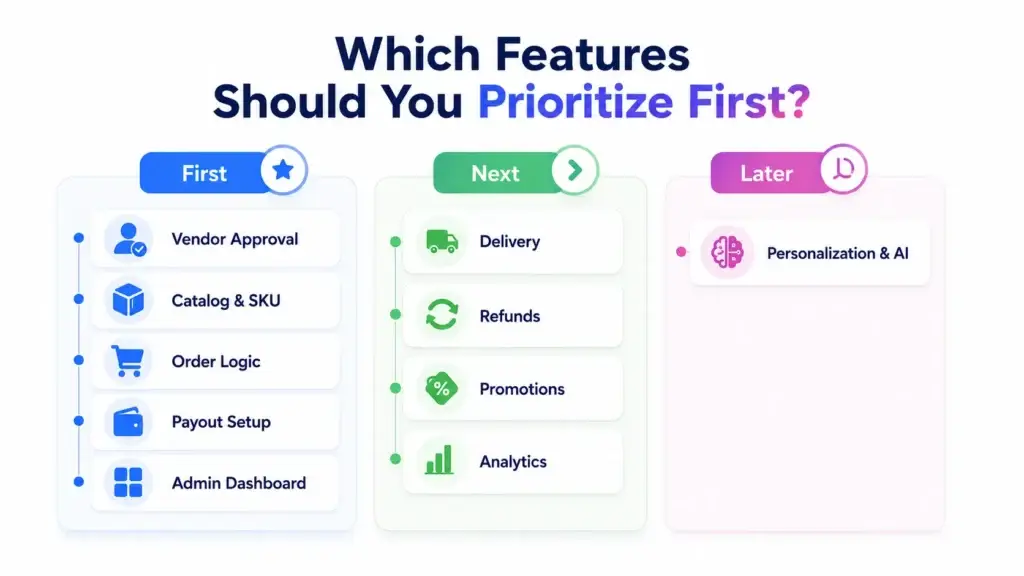
Not every marketplace needs every advanced feature on day one. The right priority depends on category, geography, vendor maturity, delivery model, payment behavior, and launch budget.
For most founders, the priority order should look like this:
| Launch Priority | Feature Area | Why It Matters |
|---|---|---|
| First | Vendor onboarding and approval | Controls supply quality from the beginning. |
| First | Catalog and SKU management | Prevents product, pricing, and inventory confusion. |
| First | Multi-vendor order logic | Keeps checkout simple while backend fulfilment stays accurate. |
| First | Commission and payout setup | Makes monetization and vendor earnings clear. |
| First | Admin dashboard | Gives the operator control over daily marketplace decisions. |
| Next | Delivery management | Important when fulfilment is controlled by the platform or local partners. |
| Next | Refund and dispute workflows | Becomes critical as order volume increases. |
| Next | Promotions and loyalty | Helps increase repeat purchases once operations are stable. |
| Next | Advanced analytics | Helps optimize category, vendor, and revenue strategy. |
| Later | Personalization and AI features | Useful after enough user and product data exists. |
A founder building a grocery marketplace may prioritize delivery, stock movement, substitutions, and restock alerts earlier. A fashion marketplace may prioritize variants, returns, size filters, and seller quality. A B2B marketplace may prioritize bulk pricing, vendor verification, invoice workflows, and negotiated orders.
The feature roadmap should follow the business model, not a generic checklist.
Mistakes Founders Should Avoid
Building only the storefront
A polished customer interface is not enough. If vendor operations, refunds, payouts, and admin control are weak, the platform becomes difficult to run after launch.
Ignoring split order logic
One cart can involve multiple vendors. Without proper order splitting, fulfilment, refunds, and payouts become confusing very quickly.
Adding promotions before margin control
Coupons and discounts can increase order volume, but they can also damage profitability if commission, vendor funding, and delivery cost rules are unclear.
Leaving payouts manual for too long
Manual payout tracking may work for a few sellers, but it creates trust issues when vendors expect transparent earnings, deductions, and withdrawal history.
How a Ready-Made Marketplace Foundation Helps Founders Move Faster
Building every marketplace workflow from zero can take significant planning, design, development, testing, and operational correction.
A ready-made marketplace foundation can reduce launch complexity because the core flows are already structured. Founders can focus on branding, category strategy, vendor onboarding, payment configuration, fulfilment model, and growth instead of rebuilding standard marketplace logic from scratch.
A launch-ready foundation is especially useful when the founder already knows the business model and needs speed, admin control, source-code ownership, and customization flexibility.
Miracuves helps founders create white-label marketplace platforms with customer, vendor, delivery, and admin workflows. The goal is not to copy another company’s brand. The goal is to launch your own commerce ecosystem with the operational modules required to manage sellers, orders, payments, fulfilment, and growth.
To understand the deeper feature structure, review the multi-vendor ecommerce feature breakdown.
Final Thoughts: Build the Marketplace Operations Layer, Not Just the Shopping Flow
Product listings and checkout may help you present the marketplace idea, but they do not make the business operationally ready.
A strong multi-vendor ecommerce marketplace needs vendor control, catalog governance, split order logic, commission management, wallets, payouts, delivery workflows, refund handling, trust features, analytics, and admin visibility.
For founders, these features are not optional extras. They are the difference between launching a storefront and running a marketplace business.
The better approach is to define the operational layer early, prioritize the workflows that match your category, and choose a platform foundation that gives you enough control to adapt after launch. Miracuves can help founders move faster with a white-label, source-code-owned marketplace foundation built for real marketplace operations.
FAQs
What features are needed beyond product listings and checkout in a multi-vendor ecommerce marketplace?
A multi-vendor ecommerce marketplace needs vendor onboarding, vendor dashboards, product approval, inventory control, split order management, commission settings, wallet and payout workflows, delivery management, refunds, disputes, reviews, analytics, and admin controls beyond basic listings and checkout.
Why is split order management important in a marketplace?
Split order management is important because one customer checkout may include products from multiple vendors. The platform must route each item to the correct seller, track fulfilment separately, calculate commissions correctly, and still show the customer one clear order experience.
What should a vendor dashboard include?
A vendor dashboard should include product management, inventory updates, order management, earnings history, payout requests, store profile settings, customer reviews, refund responses, notifications, and sales reports. Permissions should be controlled by the platform operator.
Why do marketplace platforms need commission and payout features?
Commission and payout features help the platform operator define how revenue is earned and how vendors receive money. Without clear commission rules, wallet records, payout history, and refund reversal logic, vendor trust can become difficult to maintain.
Should delivery management be included in a multi-vendor ecommerce platform?
Delivery management should be included when the marketplace controls fulfilment, works with delivery partners, or offers local delivery. Useful features include delivery assignment, tracking, status updates, proof of delivery, cash collection records, and delivery performance monitoring.
What admin features are most important for marketplace operators?
Important admin features include vendor approval, user management, category control, product moderation, order monitoring, commission setup, refund control, payout approval, delivery tracking, review moderation, promotion management, and analytics dashboards.
How do reviews and ratings help a multi-vendor marketplace?
Reviews and ratings help customers choose reliable products and vendors. They also help the platform operator identify seller quality issues, product complaints, fulfilment problems, and fake or abusive activity.
Can Miracuves help launch a multi-vendor ecommerce marketplace faster?
Yes. Miracuves helps founders build ready-made and white-label marketplace app solutions with source code, branding, admin control, vendor workflows, delivery operations, and monetization-ready modules for faster market validation.
Miracuves is an independent software development company. We are not affiliated with, connected to, sponsored by, or endorsed by any company or product named in this article.
Terms such as “X Clone” are used descriptively. It is how the software industry refers to building a platform with functionality comparable to a known service, and how clients search for it.
The entire design and codebase of our products is built by our own team. Our products contain no code, design, graphics, or content originating from any third-party website or applications.
All third-party names and marks referenced in this article are the property of their respective owners, referenced solely to identify the services discussed.



