A multi-vendor ecommerce marketplace is not just a storefront with more sellers. It is a connected operating system where catalog data, seller workflows, buyer orders, payment rules, commissions, refunds, delivery updates, and admin controls must work together without creating confusion.
For founders, this matters because early architecture decisions decide how easily the platform can scale later. A simple store setup may work when one business owns all products, inventory, and fulfillment. But once multiple sellers enter the system, every order creates more relationships: buyer to seller, seller to platform, platform to payment gateway, platform to delivery partner, and sometimes seller to customer support.
That is why multi-vendor ecommerce marketplace architecture needs to be planned around operations, not just screens. The product page may look simple. The backend must handle seller-owned catalogs, split orders, commission rules, payout records, stock changes, delivery assignments, cancellations, returns, and dispute history.
For founders exploring a launch-ready commerce marketplace foundation, Miracuves helps structure buyer, seller, delivery, and admin workflows so the platform can move faster without ignoring the operational details that decide long-term stability.
Key Takeaways
- Multi-vendor ecommerce marketplace architecture defines how buyers, sellers, products, orders, payments, delivery, and admin controls work together.
- A marketplace needs seller-owned catalog logic, not just a single product database.
- One buyer order may need to split into multiple seller-level orders for fulfillment, payouts, refunds, and reporting.
- Payment architecture must manage commissions, vendor earnings, platform fees, refunds, payout schedules, and audit records.
- Delivery workflows should support vendor fulfillment, platform-managed delivery, third-party logistics, or a hybrid model.
- Miracuves helps founders move from idea to launch faster with ready-made and white-label app solutions.
Why Marketplace Architecture Is More Than a Storefront and Checkout
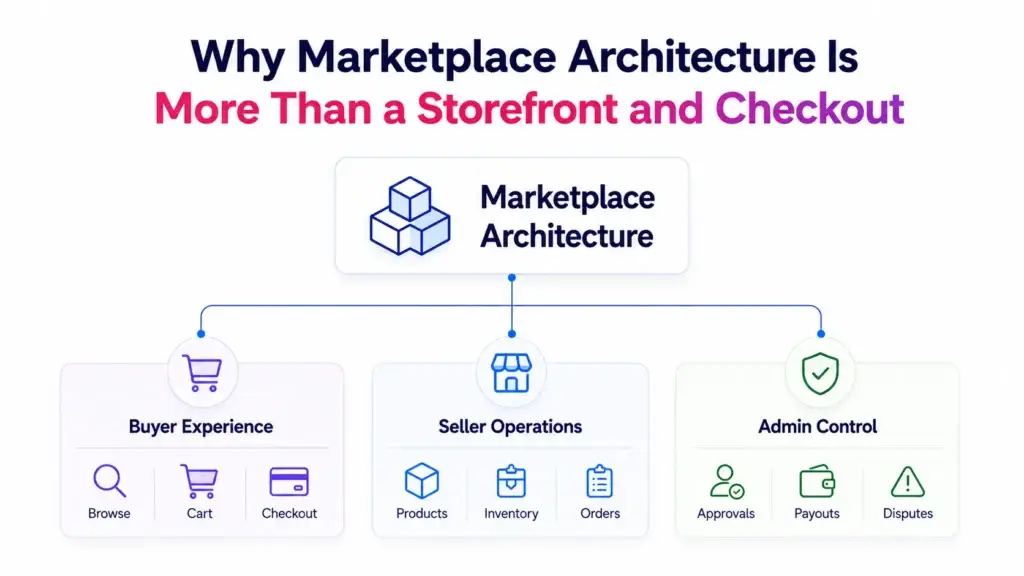
Many ecommerce builds begin with visible features: product pages, search, cart, checkout, user login, and order tracking. These are important, but they are only the buyer-facing layer.
A true multi-vendor marketplace needs separate operating layers for sellers and platform administrators. Sellers need to upload products, manage inventory, accept orders, track earnings, respond to customer issues, and view performance. Admins need to approve sellers, moderate listings, set commission rules, resolve disputes, monitor payments, manage delivery logic, and control platform-wide policies.
This is where marketplace architecture becomes a business decision. If seller, order, payment, and delivery workflows are not separated properly, the platform may face issues such as incorrect inventory, delayed payouts, refund confusion, order tracking gaps, and manual reconciliation.
A founder should not ask only, “Can users buy products?” The stronger question is, “Can the platform manage many sellers, many product rules, many order states, and many financial records without breaking trust?”
Core Architecture Layers in a Multi-Vendor Ecommerce Marketplace
A scalable marketplace works through connected layers. Each layer has its own responsibility, but all layers must exchange clean data.
Core Marketplace Architecture Layers
| Architecture Layer | What It Controls | Founder Impact |
|---|---|---|
| Buyer Experience | Product discovery, cart, checkout, order tracking, reviews, support | Improves conversion and customer retention when the buying journey is clear. |
| Seller Operations | Seller onboarding, product upload, pricing, inventory, order handling, earnings | Helps sellers operate independently without depending on admin support for every task. |
| Catalog System | Products, categories, variants, attributes, images, seller offers, stock | Prevents catalog duplication, pricing errors, and inconsistent product discovery. |
| Order Management | Buyer orders, seller sub-orders, order status, cancellations, returns, refunds | Keeps fulfillment, customer support, and financial records aligned. |
| Payment and Ledger | Checkout payments, commissions, vendor earnings, refunds, payout records | Protects vendor trust and reduces manual accounting risk. |
| Delivery Operations | Delivery assignment, tracking, delivery fees, handover, failed delivery, returns | Improves fulfillment reliability and customer visibility after checkout. |
| Admin Governance | Approvals, policies, disputes, reports, role access, settings, moderation | Gives the operator control over marketplace quality and risk. |
Catalog Architecture: The Foundation of Product Discovery and Seller Control
The catalog is one of the most important parts of a marketplace because it decides how products are stored, discovered, filtered, compared, approved, and sold.
In a single-seller store, the product usually belongs to one business. In a multi-vendor marketplace, different sellers may offer the same product at different prices, stock levels, shipping speeds, return policies, or service areas. That means the system should separate product identity from seller-specific offers.
For example, the marketplace may have one product record for a smartphone model, but five sellers may offer it with different prices, quantities, delivery locations, and warranty conditions. If the architecture does not separate the product master from seller offers, the catalog can become messy very quickly.
A practical catalog architecture should manage:
- Product categories and subcategories
- Product attributes such as size, color, brand, material, model, or specifications
- SKU and variant logic
- Seller-specific pricing
- Seller-specific inventory
- Product approval workflows
- Bulk product uploads
- Product image and media management
- Search indexing
- Featured products and promotional placement
- Product-level reviews and seller-level ratings
This is also where SEO and marketplace growth connect. Clean product structure helps buyers search and filter better. It also helps admins manage category pages, product feeds, and marketplace merchandising without manually fixing every seller listing.
For deeper database planning, editors can internally link to the Miracuves guide on multi-vendor marketplace database architecture.
Order Architecture: Why One Checkout Can Create Multiple Seller Orders
Order architecture is where many marketplace builds become complicated.
From the buyer’s perspective, the flow is simple: add products to cart, pay once, and track the order. But behind that one checkout, the platform may need to create separate seller-level order records.
Imagine a buyer purchases three products from three different sellers in one cart. The customer sees one payment and one checkout experience. The backend may need to create:
- One buyer order
- Three seller-level order records
- Three inventory deductions
- Three commission calculations
- Three fulfillment workflows
- Three seller notifications
- Three refund possibilities
- One or more delivery assignments
- One platform-level financial record
This is why order management should be designed as a state-based workflow. Each order should move through clear stages such as placed, confirmed, packed, assigned, picked up, out for delivery, delivered, cancelled, returned, or refunded.
The more vendors and delivery flows the platform supports, the more important this state logic becomes. Without it, customer support teams may not know whether an issue belongs to the seller, the delivery team, the payment gateway, or the platform operator.
Seller Operations Architecture: Giving Vendors Control Without Losing Governance
A marketplace grows only when sellers can operate with confidence. If every product upload, price change, stock update, or order issue requires admin intervention, the platform becomes operationally heavy.
Seller operations architecture should give vendors enough control to run their store while giving the marketplace operator enough governance to protect quality.
A strong seller dashboard usually includes:
- Seller onboarding and profile setup
- Business verification or document upload where needed
- Product listing creation
- Bulk import options
- Inventory and stock updates
- Order acceptance and fulfillment actions
- Return and refund visibility
- Earnings and payout reports
- Customer review visibility
- Product performance analytics
- Support and dispute communication
- Notification management
The admin layer should still control approval rules, restricted categories, commission settings, quality standards, seller suspension, and payout release conditions.
This balance is important. Too much seller freedom can reduce marketplace quality. Too much admin dependency can slow seller growth.
Payment Architecture: Commissions, Vendor Earnings, Refunds, and Payouts
Payment architecture in a multi-vendor marketplace is more complex than simple checkout integration.
A normal ecommerce store collects money for one merchant. A marketplace collects money from the buyer and then needs to calculate how funds should be divided between the platform, sellers, delivery partners, and sometimes tax or settlement records.
A practical payment architecture should support:
- Secure payment gateway integration
- Multiple payment methods based on target market
- Platform commission rules
- Seller earnings records
- Delivery fee logic
- Refund adjustments
- Cancellation handling
- Payout schedules
- Vendor wallet or ledger records
- Cash-on-delivery reconciliation where relevant
- Audit logs for financial movements
The key is to treat payments as a ledger, not just a transaction confirmation screen. Every financial movement should have a record: what the buyer paid, what the seller earned, what the platform retained, what was refunded, and what remains payable.
This is also where founders should think carefully about their revenue model. Commission, seller subscription, featured placement, delivery margin, and payout-related fees can all affect architecture. For more business-side planning, use the internal page on the marketplace monetization model only where it naturally fits the reader journey.
For payment-specific technical planning, editors can also add the related Miracuves blog on ecommerce payment gateway architecture.
Delivery Architecture: Connecting Orders to Fulfillment Reality
Delivery is where the marketplace promise becomes visible to the customer. A clean product page and smooth checkout do not matter if the delivery workflow creates confusion.
There are usually four fulfillment models a marketplace may support.
| Fulfillment Model | How It Works | Architecture Requirement |
|---|---|---|
| Seller-fulfilled | Seller packs and ships the order independently | Seller dashboard, shipment update fields, tracking integration, admin visibility |
| Platform-managed delivery | Marketplace assigns delivery partners or fleet | Delivery partner app, assignment logic, route visibility, delivery fee rules |
| Third-party logistics | External logistics provider handles shipment | API integration, tracking sync, webhook handling, failure-state management |
| Hybrid fulfillment | Different categories or sellers use different fulfillment methods | Flexible order routing, seller-level fulfillment rules, admin configuration |
Delivery architecture should not be treated as an afterthought. It affects shipping fees, delivery promises, cancellation windows, return pickup, customer notifications, and support workflows.
For example, if one buyer order contains products from different sellers, the platform must decide whether delivery is split, grouped, assigned to different partners, or handled by sellers separately. That decision affects what the customer sees in tracking and what each seller sees in their order dashboard.
Admin Architecture: The Control Layer Founders Should Not Ignore
The admin dashboard is the marketplace operator’s control room. It decides whether the business can manage growth without depending on developers for every operational change.
A strong admin architecture should support:
- User and seller management
- Seller approval and suspension
- Product approval and moderation
- Category and attribute management
- Commission configuration
- Order monitoring
- Refund and dispute management
- Delivery partner management
- Payment and payout reports
- Coupon and promotion management
- Featured listing controls
- Role-based access control
- Activity logs and audit records
- Business analytics and reporting
Admin control matters because marketplaces are rule-driven businesses. The operator must be able to update commission rates, approve categories, investigate complaints, manage refunds, monitor sellers, and adjust delivery settings as the market changes.
Miracuves’ commerce marketplace feature planning page can support readers who want to see how core marketplace modules are grouped across buyer, seller, delivery, and admin workflows.
Founder Decision Signals
Speed
If your team needs to validate a marketplace quickly, start with architecture that already supports buyer, seller, admin, payment, and delivery workflows instead of patching them later.
Cost
Marketplace cost is not only design and development. It also includes the cost of fixing bad order logic, manual payouts, weak seller tools, and delivery confusion after launch.
Scalability
A scalable marketplace should separate catalog, order, payment, seller, and fulfillment responsibilities so one growing area does not destabilize the full platform.
Market Fit
Architecture should match the marketplace model: retail products, B2B wholesale, hyperlocal delivery, niche categories, vendor-fulfilled orders, or platform-managed logistics.
How Data Should Flow Across the Marketplace
A practical marketplace data flow may look like this:
- Seller creates or imports products.
- Admin approves the seller or product based on marketplace rules.
- Product data becomes searchable in the buyer storefront.
- Buyer adds items from one or more sellers to the cart.
- Checkout validates stock, delivery availability, coupons, taxes, and payment method.
- Payment is captured or marked according to the payment flow.
- The system creates buyer order and seller-level order records.
- Seller receives order notification and prepares fulfillment.
- Delivery is assigned based on the selected fulfillment model.
- Customer receives order and tracking updates.
- Order completion triggers commission and payout logic.
- Refunds, returns, disputes, and cancellations update the financial ledger and order history.
This flow helps founders see why architecture should be designed from the first transaction onward. Each step affects another layer. A weak catalog structure affects checkout. Weak checkout affects orders. Weak order records affect payouts. Weak payout logic affects vendor trust.
Security and Trust Layers in Marketplace Architecture
Marketplace trust depends on identity, payment safety, transparent records, and clear dispute workflows.
Important security and trust layers include:
- Seller verification
- Customer account protection
- Encrypted data transfer
- Secure payment gateway integration
- Tokenized payments where supported by the gateway
- Role-based access control
- Admin permission levels
- Audit logs
- Refund and dispute workflows
- Fraud monitoring signals
- Review moderation
- Activity logs for sensitive actions
- Secure API integration with payment and delivery systems
Security should be treated as a foundation, not a marketing add-on. Final compliance requirements depend on the target market, legal review, payment partners, logistics model, and operating policies. But the platform should still support the workflows founders need for safer operations.
Modular Monolith vs Microservices: What Should Founders Choose?
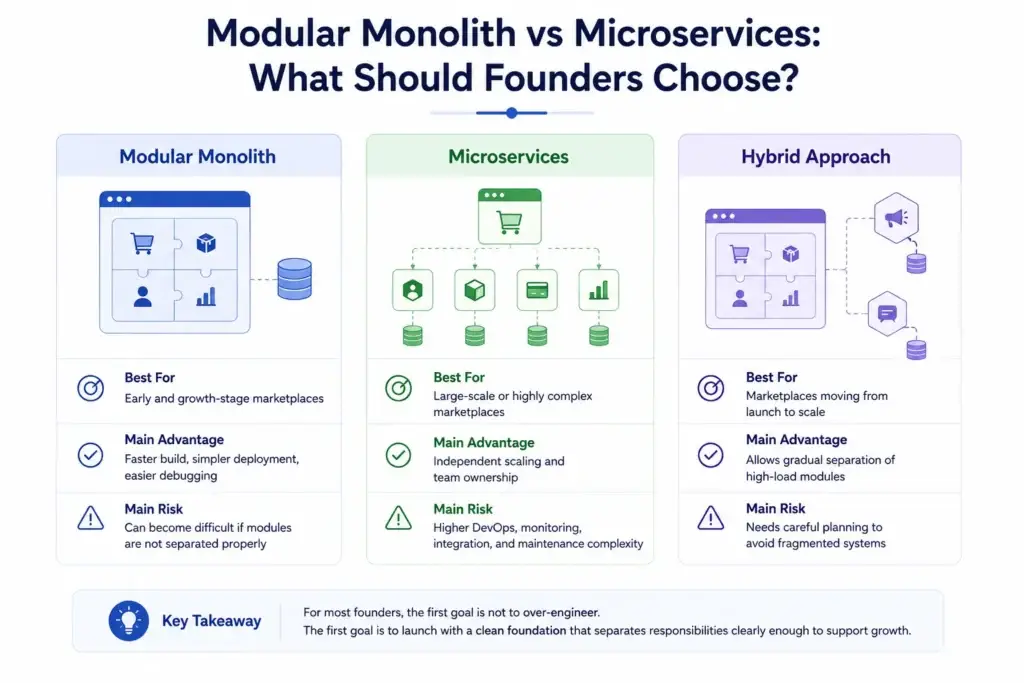
Not every marketplace needs a complex microservices architecture from day one. A modular monolith can be a practical starting point when the product needs faster deployment, clear code structure, and easier maintenance.
Microservices may make sense when the marketplace has very high traffic, separate engineering teams, independent scaling needs, multiple external integrations, or complex enterprise workflows.
The better decision depends on the business stage.
| Architecture Option | Best For | Main Advantage | Main Risk |
|---|---|---|---|
| Modular monolith | Early and growth-stage marketplaces | Faster build, simpler deployment, easier debugging | Can become difficult if modules are not separated properly |
| Microservices | Large-scale or highly complex marketplaces | Independent scaling and team ownership | Higher DevOps, monitoring, integration, and maintenance complexity |
| Hybrid approach | Marketplaces moving from launch to scale | Allows gradual separation of high-load modules | Needs careful planning to avoid fragmented systems |
For most founders, the first goal is not to over-engineer. The first goal is to launch with a clean foundation that separates responsibilities clearly enough to support growth.
Business Model Fit: Architecture Should Support Monetization From the Start
Marketplace architecture should match the revenue model. If monetization is added later as a patch, reporting and seller trust can suffer.
Common ecommerce marketplace revenue streams include:
- Commission on each order
- Seller subscription plans
- Featured product placements
- Sponsored category visibility
- Delivery fee margin
- Payment or withdrawal-related fees where appropriate
- Service fees on selected order types
- Premium seller tools or analytics
Each revenue stream creates architecture requirements. Commission needs order and seller mapping. Subscriptions need seller plan limits. Sponsored placement needs catalog ranking controls. Delivery margin needs fulfillment pricing logic. Refunds need reversal rules.
This is why founders should define monetization early, even if they activate only a few revenue streams at launch.
Common Mistakes Founders Should Avoid
Building a single-store system and adding sellers later
A single-store setup may not support seller-owned catalogs, split orders, vendor payouts, and seller dashboards without heavy rework.
Treating payments as a basic checkout feature
Marketplace payments require commissions, refunds, vendor earnings, payout schedules, cash reconciliation where relevant, and audit records.
Ignoring delivery state complexity
Delivery workflows affect customer trust, refund windows, seller responsibility, and support tickets. They should be part of the architecture plan from the beginning.
Giving sellers control without admin governance
Sellers need operational freedom, but the platform still needs approval workflows, category rules, dispute controls, and performance monitoring.
When a Ready-Made Marketplace Foundation Makes Sense
A ready-made marketplace foundation makes sense when the founder wants to launch faster but still needs serious operational workflows: buyer app, seller panel, admin dashboard, payments, order management, delivery logic, and source-code ownership.
It is especially useful when the business model is already clear and the main requirement is customization around branding, categories, payment methods, seller policies, and market-specific delivery flows.
Custom development may still be useful when the marketplace has unusual workflows, enterprise integrations, advanced automation, or highly specific backend logic. But for many founders, starting with a ready-made foundation can reduce avoidable development risk and help the team focus on launch, vendor acquisition, and market validation.
Miracuves supports founders with a source-code-owned ecommerce marketplace platform that can be customized around catalog, seller operations, payments, delivery, and admin workflows. For budgeting decisions, readers can also review marketplace platform cost planning before finalizing their launch scope.
Final Thoughts: Build the Marketplace Around Operations, Not Just Product Pages
A multi-vendor ecommerce marketplace succeeds when the architecture supports real operating complexity. Product discovery, seller dashboards, order routing, payment records, delivery updates, refunds, commissions, and admin governance all need to work as one system.
For founders, the goal is not to build the most complicated architecture. The goal is to build the right foundation for the business model. A niche marketplace, B2B product network, hyperlocal retail platform, or broad ecommerce marketplace may each need different catalog rules, delivery logic, seller controls, and payment workflows.
The stronger decision is to plan architecture around how the marketplace will actually operate. When catalog, orders, payments, seller tools, and delivery workflows are connected properly, the platform becomes easier to manage, easier to scale, and easier for vendors and buyers to trust.
FAQs
What is multi-vendor ecommerce marketplace architecture?
Multi-vendor ecommerce marketplace architecture is the technical and operational structure that connects buyers, sellers, product catalogs, orders, payments, delivery, and admin controls inside one marketplace platform. It defines how each workflow interacts with the others.
Why is marketplace architecture different from normal ecommerce architecture?
Normal ecommerce architecture usually supports one business selling its own products. Marketplace architecture must support multiple sellers, seller-owned catalogs, split orders, commissions, payouts, refunds, delivery workflows, and platform governance.
How should catalog architecture work in a marketplace?
Catalog architecture should separate product information from seller-specific offers. This allows different sellers to list the same or similar products with different prices, stock levels, delivery areas, and fulfillment rules.
Why do marketplaces need split order logic?
Split order logic is needed when a buyer purchases products from multiple sellers in one checkout. The platform must create seller-level order records so each seller can fulfill their part while the buyer still sees a simple purchase experience.
What should payment architecture include in a multi-vendor marketplace?
Payment architecture should include checkout payments, commission rules, seller earnings, delivery fees, refunds, payout schedules, vendor wallet or ledger records, and audit logs for financial transparency.
Which delivery model is best for an ecommerce marketplace?
The best delivery model depends on the business. Seller-fulfilled delivery is simpler for distributed sellers, platform-managed delivery gives more control, third-party logistics can scale faster in some markets, and hybrid fulfillment offers flexibility.
Does every marketplace need microservices?
No. Many early and growth-stage marketplaces can begin with a modular monolith if the code structure is clean. Microservices are useful when the platform has high traffic, complex integrations, independent scaling needs, or separate engineering teams.
How can Miracuves help with ecommerce marketplace architecture?
Miracuves helps founders build ready-made, white-label, source-code-owned ecommerce marketplace solutions with buyer, seller, delivery, payment, and admin workflows. This gives founders a faster foundation for launch while keeping room for customization.
Miracuves is an independent software development company. We are not affiliated with, connected to, sponsored by, or endorsed by any company or product named in this article.
Terms such as “X Clone” are used descriptively. It is how the software industry refers to building a platform with functionality comparable to a known service, and how clients search for it.
The entire design and codebase of our products is built by our own team. Our products contain no code, design, graphics, or content originating from any third-party website or applications.
All third-party names and marks referenced in this article are the property of their respective owners, referenced solely to identify the services discussed.