

Written by the Miracuves Editorial Team. Reviewed by Aditya Bhimrajka, Founder & CEO, Miracuves.
Key Takeaways
- Every control has to act before the signature A confirmed on-chain transfer cannot be recalled, so policy, whitelists and approvals must stop a bad payment before anyone signs it.
- Multi-sig and MPC put trust in different places Multi-sig relies on public contract code and visible rules; MPC relies on your own off-chain coordination layer. Many companies use both, in tiers.
- Write the policy as data, and make “no match” a rejection Rolling velocity caps, a stricter quorum for policy changes and a fail-closed price feed matter more than per-payment limits.
- Whitelists and a rehearsed runbook do the heavy lifting Verified counterparty addresses defeat address poisoning, and a tested pause, rotation and recovery wallet decide how a compromised signer ends.
- Build only the layer that makes you different Rent if treasury is back office; build when it is part of your product. A common split keeps custody simple and owns the operational layer.
If your company holds stablecoins or tokens, whoever controls the signing keys controls the money, and once a transfer confirms there is no fraud department to call. A finance lead setting up controls for company funds and a product team building treasury features into an exchange or fintech face the same question: who is allowed to move this money, under which rules, and how do we prove afterwards that the rules held?
This guide answers that at the level a builder needs. By the end you should be able to choose a custody model, write your approval policy as rules a system can enforce, specify payment runs, whitelists, reporting and an incident runbook, and decide whether to rent a hosted tool, build your own platform or split the two. Tax is out of scope, and accounting comes up only where it changes what the platform must record.
Where company crypto actually leaks
Treasury losses rarely come from broken cryptography. They come from the process around it: one person who can both create and approve a payment, an overfunded hot wallet, an address copied from old history, or a signer approving a transaction they cannot read.
The amounts can be enormous. In a public service announcement dated February 26, 2025, the FBI attributed the theft of about $1.5 billion in virtual assets from a cryptocurrency exchange, on or about February 21, 2025, to North Korean actors it tracks as TraderTraitor. Your company is unlikely to be that kind of target, but the lesson scales down to any treasury: an approved on-chain transfer is final, so every control has to act before the signature, not after it.
A practical threat model for a company treasury has four failure points:
- Key loss: a device, seed backup or key share is destroyed or forgotten, and funds become unreachable.
- Key theft: an attacker obtains enough key material to sign without anyone else.
- Deceived or coerced approval: a legitimate signer approves a malicious transaction because the screen, the request or the person asking was faked.
- Insider abuse: someone with legitimate access moves funds outside policy, alone or with a colleague.
Judge every design choice below against all four. A setup that resists theft but makes loss likely, such as a five-of-five quorum where one missing signer freezes everything, is just a different way to lose the money.
Multi-sig, MPC or both: where the quorum lives
The quorum is the rule for how many independent parties must cooperate before funds move, such as two of three or three of five. Where that rule is enforced is the first architecture decision, and policy, recovery and incident response all follow from it.
On-chain multi-sig
With on-chain multi-sig, each signer holds a complete private key and the blockchain enforces the quorum. On Bitcoin the rule is expressed in script. On Ethereum and other EVM chains it lives in a smart contract wallet that checks the required signatures before executing a call. Safe, the smart account many companies and DAOs use for treasuries, works this way: a set of owners and a threshold, with owner and threshold changes executed as transactions of the Safe itself, so they need the current quorum. The exception is an enabled module, which can execute transactions without owner signatures, so treat adding a module as seriously as adding a signer.
The strength is transparency: auditors can verify the signer set and threshold on-chain, and no third-party server sits in the signing path. The costs: each chain needs its own implementation, a bug in the wallet contract is a bug in your vault, and changing a signer on Bitcoin generally means moving funds to a new address.
MPC threshold signing
Multi-party computation (MPC) splits one private key into shares held by different people or devices. The shares jointly produce a signature without the full key ever existing in one place. NIST runs a threshold cryptography project on this idea of distributing trust across the parties that operate a cryptographic function.
On-chain, an MPC wallet looks like an ordinary single-key address. That gives privacy about how many people approve, coverage on any chain whose signature scheme your signing service supports, and cheaper signer rotation, because shares can usually be refreshed without changing the address. The price is that the quorum and the policy are enforced off-chain by your own software, so that coordination layer becomes the thing you must protect, monitor and audit.
Tiers instead of one wallet
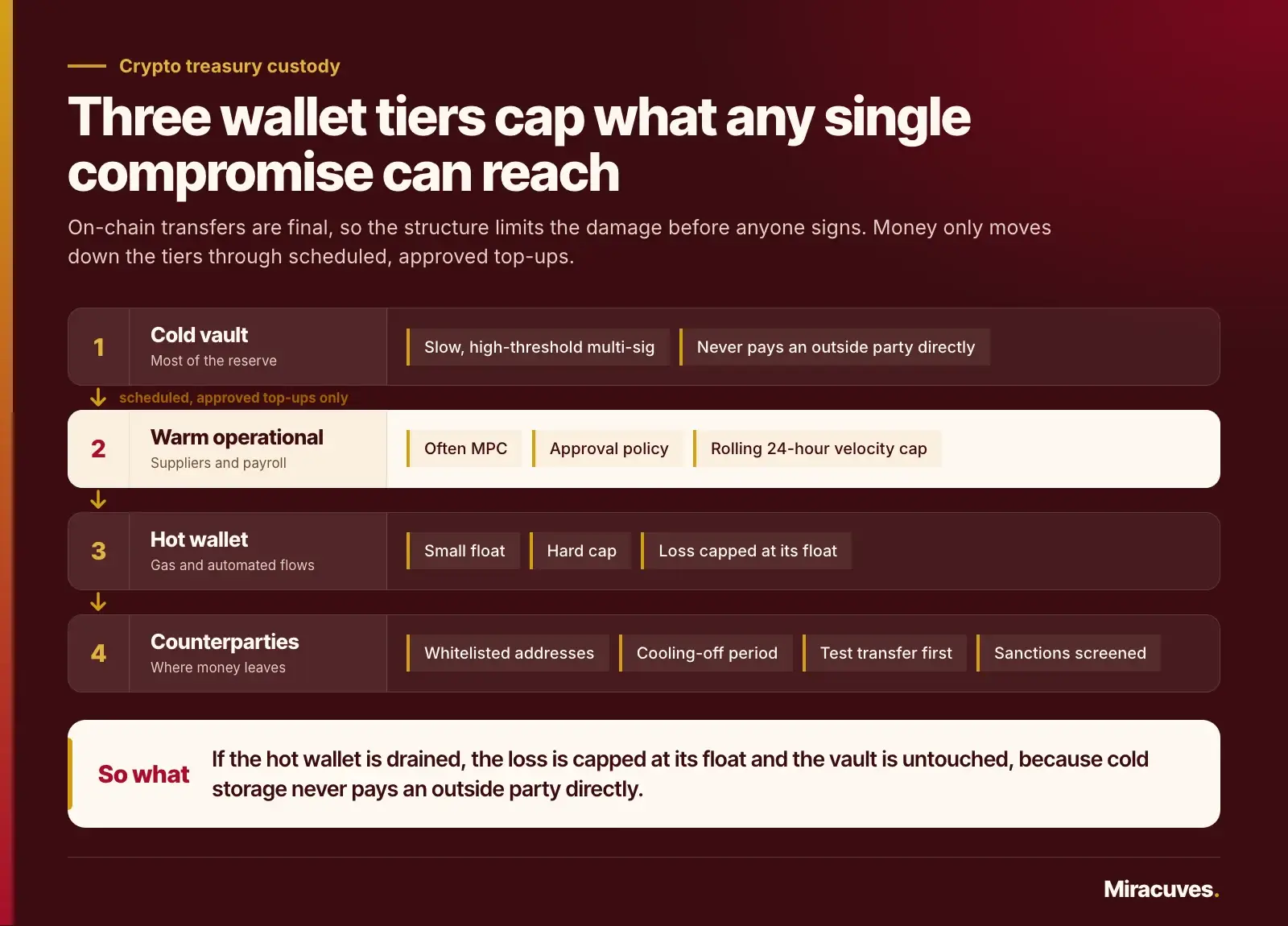
Many companies use tiers: a cold vault holding most of the reserve under a slow, high-threshold multi-sig; a warm operational wallet, often MPC, paying suppliers and payroll under policy; and a small hot wallet for gas or automated flows under a hard cap.
Money moves down the tiers only through scheduled, approved top-ups, never straight from cold storage to an outside party. If the hot wallet is drained, the loss is capped at its float and the vault is untouched.
| Decision point | On-chain multi-sig | MPC threshold signing | Tiered hybrid |
|---|---|---|---|
| Where the quorum is enforced | On the blockchain, in script or a wallet contract | Off-chain, in your signing and policy services | On-chain for the vault, off-chain for operations |
| Visibility of signer set | Public and verifiable by anyone | Private; looks like a single address | Vault public, operational wallets private |
| Chain coverage | Separate implementation per chain | Any chain whose signature scheme is supported | Broad, with extra integration work |
| Rotating a signer | Contract update, or moving funds on Bitcoin | Share refresh, address usually unchanged | Depends on the tier affected |
| Main thing to protect | Contract code and each signer’s full key | The coordination layer and every share holder | Both, plus the top-up rules between tiers |
| Best fit | Long-term reserves, transparent governance | Frequent payments across many chains | Companies with both a reserve and daily payouts |
Where keys and shares physically live
Auditors ask early what physically holds each key or share. Most treasuries mix three answers:
- Hardware security modules (HSMs). Server-side devices, on premises or as a cloud service, that generate and use keys without exporting them. Ask for the module’s validation under FIPS 140-3, which replaced FIPS 140-2 and defines four security levels, and look the module up on the NIST Cryptographic Module Validation Program list. Level 3 adds identity-based operator authentication and stronger physical tamper protection over Level 2, and is a common bar for keys that guard a reserve.
- Secure enclaves on approver devices. Phones and laptops can protect an MPC share in secure hardware behind biometrics. This suits frequent approvers, but the share is only as safe as the device’s enrollment and recovery process.
- Hardware wallets. Dedicated signing devices are common for multi-sig signers and cold-vault keys. Each needs a named custodian, firmware update rules and a tamper check before every ceremony.
Keys and shares are created in a key ceremony: a scripted, witnessed session on clean devices where backups are made and each holder confirms what they received. Record who attended, each device model with its firmware version or validation certificate number, each public key or share identifier and where every backup went. Store backups in separate physical locations, never next to the device they back up, and run a test signature and a test recovery before any funds arrive. A backup that has never been restored is an assumption, not a control, which is the same discipline behind running a crypto wallet business that users trust.
Approval policy written as data, not a group chat
In many young companies the real approval policy is a chat message saying “looks good, send it”. A treasury platform replaces that with rules stored as structured data and evaluated before any signing request exists. If a request matches no rule, it never reaches a signer.
Each rule pairs conditions with requirements. Conditions cover asset, chain, amount in token and fiat terms, source wallet, destination category (whitelisted vendor, internal wallet, exchange deposit or unknown), time of day and the initiator’s role. Requirements cover the number of approvers, which roles must be among them, a mandatory delay and whether a test transfer must go first.
A small company’s first policy might look like this. The amounts are example values, not recommendations:
- Rule A: stablecoins from the operational wallet to a whitelisted vendor, up to $25,000 per payment and $100,000 per rolling 24 hours, need any two finance approvers.
- Rule B: any payment to an address that is not whitelisted needs three approvals including one executive, a 24-hour delay and a confirmed test transfer.
- Rule C: top-ups from the cold vault need the vault’s full multi-sig threshold and may only go to the operational wallet.
- Rule D: any change to rules A to D needs the strictest quorum in the system, a waiting period and notice to every existing approver.
- Default: a request that matches no rule is rejected.
Two engine details decide whether this holds. When several rules match, apply the strictest, not the first found. And no match must fail closed, or every gap in your rules becomes an open door.
Velocity limits and price feeds
Per-transaction limits are easy. The more useful rule is velocity: a cap on the fiat value that can leave a wallet in a rolling 24-hour window, so one large transfer cannot be split into many small ones that each pass.
Fiat values need a price source, and the policy must say what happens when that feed is stale or missing. The safe default treats the amount as above every threshold until a fresh price arrives, which pushes the request to the strictest approval path instead of the loosest.
Changing the policy itself
Raising a limit, adding an approver or removing a delay is the most sensitive transaction in the system, which is why Rule D exists. If one administrator can quietly lower the quorum to one, every other control is decoration.
What approvers actually see
A policy is only as good as the screen in front of the approver. On EVM chains, signing requests should use EIP-712 typed structured data where the wallet supports it, and the platform should decode calldata into plain language: recipient, token, amount and the contract function being called.
Nobody should be asked to sign an opaque hex string. Where possible, show the same decoded summary on a second device, such as the approver’s phone, so a compromised laptop cannot alter both the request and the confirmation screen.
Separating roles so no single person can move money
Role separation is the old finance control of segregation of duties, applied to keys. The minimum set:
- Initiator: drafts payments and payment runs and attaches invoices or references, but cannot approve their own requests.
- Approver: approves or rejects within policy. Each approval is recorded with identity, time and the exact transaction payload approved.
- Signer: holds a key or share and signs only requests that have already passed policy. In small teams approvers and signers are often the same people, but the platform should still treat them as separate permissions.
- Viewer or auditor: read-only access to balances, history, policies and evidence, for internal finance staff and external reviewers.
- Administrator: manages users, devices and policy proposals, holds no signing power and cannot change policy alone.
Two cases catch teams out. The first is the founder who holds every role because the company is small. The fix is a quorum that always includes at least one party outside the founder’s own devices: a co-founder, a board member or a recovery key in separate custody.
The second is offboarding. When someone leaves, their key or share is rotated out under policy the same day, their pending approvals are voided and any payment run they started returns to review. A former employee’s share left active for a few weeks is one of the most common gaps in small treasuries.
Everyone in the chain signs in with phishing-resistant multi-factor authentication on devices registered to named users, with no shared accounts anywhere between draft and broadcast.
Payment runs: from an invoice list to a signed batch
The daily job of a treasury system is paying contractors, vendors, liquidity partners, stablecoin payroll and refunds. Approving these one at a time tires approvers until they stop reading. A payment run groups them into one reviewed batch:
- Draft: an initiator imports or enters line items, each with a counterparty, asset, chain, amount and reference.
- Validation: the system checks every destination against the whitelist, flags new or changed addresses, confirms balances including network fees, and tests the run against limits as a whole, not only line by line.
- Review: approvers see totals by asset, number of payees and any exceptions, plus each line, and can reject single lines without rejecting the run.
- Approval: the quorum approves a frozen version. Any edit afterwards sends the run back to review.
- Signing and broadcast: the platform builds the transactions, batching where the chain allows, collects signatures and broadcasts.
- Settlement: each line is marked confirmed after the chosen number of block confirmations, failed or replaced transactions are surfaced, and the run closes with a complete record.
The details that hurt in production are nonces, fees and partial failure. On account-based chains a stuck low-fee transaction blocks everything queued behind it from the same account, so the platform needs a controlled way to speed up or cancel, and that action needs approval too.
If three of forty payments fail, finance needs to know exactly which three, and the retry must never double-pay the other thirty-seven. Every line carries an idempotency key from draft to settlement, and the system reconciles against the chain rather than trusting its own send log.
Counterparty whitelists and address hygiene
Crypto addresses are long, look alike and are usually copied rather than typed. Attackers exploit this with address poisoning: they send tiny or zero-value transfers from an address that shares the first and last characters with one you use, hoping someone later copies it from the transaction history. A whitelist turns “is this the right address” from a judgement call into a lookup.
A useful whitelist entry stores much more than an address: the legal counterparty name, chain, asset, purpose, who added it, who approved it, how it was verified (for example, a call-back to a known contact) and when it was last used. Rules worth enforcing:
- Adding or changing an address goes through approval, with a cooling-off period before first use.
- A change of payment details requested by email or chat is treated as likely fraud until confirmed through a separate, previously known channel.
- The first payment to a new address starts with a small test transfer that the recipient confirms.
- Each address is tied to one chain, because the same address format on another network may be unreachable or controlled by someone else.
- Entries unused for a set period expire, so the list does not become a pool of forgotten destinations.
Sanctions screening belongs in the same workflow. OFAC states that compliance obligations are the same for digital currency as for fiat, and it adds some digital currency addresses to the Specially Designated Nationals list while warning that those listings are not likely to be exhaustive. So the platform should screen each new address against the SDN list before approval, add an on-chain analytics check for indirect exposure, rerun screening when lists change and keep each result in the audit log. Your counsel sets the screening policy; the software enforces it.
Payments outside the whitelist can still be allowed for real business reasons. They take the stricter path from Rule B above, and the approver should see an unmistakable warning screen instead of the normal one.
Reporting a finance team can reconcile
Finance needs answers, not a block explorer. The core reports are a balance snapshot by wallet, chain and asset at any chosen time; a movement ledger linking every on-chain transaction to its internal request, payment run and approvals; and an exceptions view. The exceptions view lists anything that happened outside the platform, such as deposits from unknown senders or transfers signed elsewhere. Funds that moved without a matching request mean someone signed outside the process, and that should raise an alert the same day.
Every approval, policy change, login, device registration and whitelist edit lands in an append-only audit log with timestamps and user identity, exportable in formats your finance team already uses. Fiat valuations record the price source and time, so a reviewer can reproduce any number months later.
The same data feeds live alerts to more than one person: sharp balance drops, outgoing transfers from a dormant wallet, token approvals granted to unknown contracts and repeated failed sign-ins.
What US GAAP now asks the data to support
Booking is the accountant’s job, but one standard shapes what the platform must capture. Under FASB ASU 2023-08, effective for all entities for fiscal years beginning after December 15, 2024, in-scope crypto assets such as bitcoin and ether are measured at fair value, with changes recognized in net income. Assets that give the holder an enforceable claim on underlying assets fail the scope test, which is why fiat-redeemable stablecoins are generally accounted for under other GAAP. Tag each asset by its treatment rather than assuming one rule fits all. For in-scope assets the platform should provide:
- Name, units, cost basis and fair value for each significant holding at every reporting date, with the price source and timestamp recorded.
- Cost basis tracked by lot, plus a record of which method the company uses, such as specific identification or first-in, first-out.
- An annual rollforward of holdings in aggregate: additions, dispositions, gains and losses.
- Flags for holdings under contractual sale restrictions, such as a token lock-up, with the restriction’s nature, remaining duration and the conditions for lifting it.
Whoever does the books then starts from complete, consistent facts instead of reconstruction. Confirm the treatment of each asset with your auditor.
When a signer is compromised: the first hours
Plan now for the day a signer’s laptop is infected, a phone holding a key share is stolen, or an approver reports signing something they did not recognize. Write the runbook and rehearse it.
- Freeze: any approver can trigger an emergency pause that blocks new signing requests and cancels pending ones, without a quorum. Pausing is cheap; a missed theft is not.
- Assess the quorum: work out how many keys or shares might be exposed. Below the threshold, funds are still safe, but the margin has shrunk.
- Rotate: remove the compromised signer and add a replacement under the policy-change rules. On some chains a multi-sig rotation means migrating funds to a new wallet; with MPC it usually means a share refresh that makes old shares useless.
- Sweep if needed: if the attacker could reach the threshold, move funds to a recovery wallet with a different signer set. That wallet must exist and be tested in advance, because building one under pressure is where mistakes happen.
- Review history: check every approval the signer gave in the relevant window, plus every pending whitelist or policy change.
- Report and preserve: notify leadership, insurers and, where funds were taken, law enforcement. Keep logs and device images for forensic work.
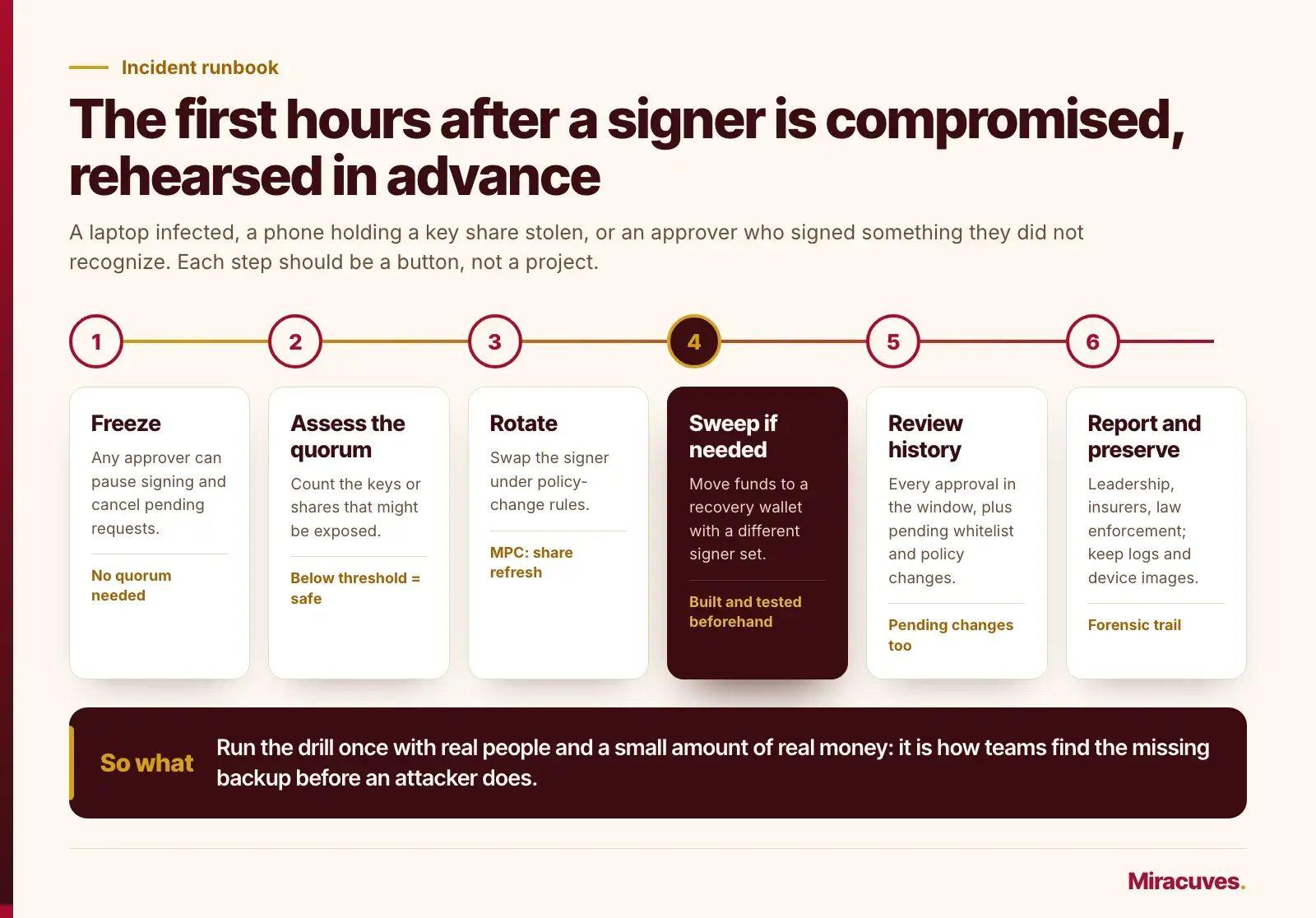
The software should make each step a button, not a project: a tested pause control, pre-approved recovery destinations, fast signer rotation, and an incident view showing everything a given user or device touched in a chosen time window.
Rehearse it at least once with real people and a small amount of real money. Teams that have never run a rotation usually discover during the drill that a backup is missing, a recovery signer has changed phones, or nobody remembers who holds the third share.
Rent, build or split the layers
Often a hosted tool is the right answer. If you hold a few assets on mainstream chains, pay a modest number of counterparties and have no unusual approval logic, a hosted product gives you working controls quickly and spreads security engineering costs across many customers.
Owning the platform starts to pay when one or more of these is true:
- Treasury is part of your product. Exchanges, payment companies, crypto payroll providers and fintechs holding funds for their own customers need treasury controls inside their own systems and user experience.
- Your policy logic is unusual. Multi-entity approval chains, board-level thresholds, regulator-driven rules or links to your ERP and payout systems can be awkward to fit into someone else’s policy model.
- Your assets or chains are poorly supported. You need direct control over nodes, transaction construction or newer networks that hosted tools have not added.
- You need ownership for diligence. Investors, partners or your security team want the code, infrastructure and key ceremonies under your control and open to their review.
Owning is a poor choice when treasury is purely back office or nobody will operate and monitor the system after launch. A custom system nobody maintains is riskier than a rented one.
The middle path is common and often the best one: keep the cold reserve with a regulated custodian or a simple, widely reviewed on-chain multi-sig, and build the operational layer yourself, meaning policies, payment runs, whitelists, reporting and the integrations into your product. Engineering effort then goes where your business is different.
An illustrative estimate from roles and weeks
The table below is an illustrative estimate for an in-house US team shipping a first release: one MPC operational wallet plus an on-chain multi-sig vault on two chains, the policy engine, payment runs, whitelists with sanctions screening, approver apps and a finance admin panel. The base rate is the BLS median wage for software developers, $135,980 a year in May 2025, or about $65 an hour over 2,080 hours. Wages and salaries were 70.0% of private-industry employer compensation costs in June 2026 (BLS, released September 2026), which grosses that up to a loaded rate of about $93 an hour, applied to every role for simplicity.
| Role | People | Weeks | Person-weeks |
|---|---|---|---|
| Backend engineers (signing service, policy engine, ledger) | 2 | 16 | 32 |
| Mobile engineer (approver apps for Android and iOS) | 1 | 12 | 12 |
| Web engineer (finance and admin panel) | 1 | 14 | 14 |
| Security engineer (threat model, key ceremonies, HSM setup) | 1 | 8 | 8 |
| QA engineer, including test-network payment runs | 1 | 12 | 12 |
| Product designer | 1 | 6 | 6 |
| Product or project manager (half time) | 0.5 | 18 | 9 |
| Total | 93 (3,720 hours) |
At $93 an hour, 3,720 hours comes to about $346,000. A narrower build on one EVM chain that uses an existing audited multi-sig contract instead of its own MPC service, near 55 person-weeks, lands around $205,000. A multi-chain platform with ERP integration and multi-entity approvals, near 140 person-weeks, lands around $521,000. Running costs continue after launch: monitoring, chain upgrades and policy changes typically need part of an engineer year-round.
These are illustrative estimates, not quotes. They exclude recruiting, external audits, HSM or custody fees, hosting and legal review. Use the structure to compare proposals line by line, not the totals.
On timing, a first release of this scope typically takes 14 to 24 weeks with work running in parallel, and external audit slots and key ceremony scheduling cause more delay than code does. That range is typical, not a commitment for any particular project.
Where Miracuves fits
Miracuves takes on this kind of system as a custom build, and we fit best where treasury is part of your product, or where you take the split approach and need the operational layer built around custody you already have. That means the policy engine with velocity caps and time locks, signer onboarding and offboarding, payment runs with idempotent retries, whitelist and screening workflows, reconciliation exports, the emergency pause, approver apps for Android and iOS that show decoded transactions, and a web panel for finance. Your company receives the complete source code for everything we write. Wallet, smart contract and chain work sits under our blockchain development service.
On audits, we build to the controls and take the client through the audit with a partner. For SOC 2 or ISO 27001 that means access reviews, change approval, log retention and incident handling built into the platform, with the independent audit firm working with your company and any resulting report or certificate issued in your company’s name. The detail is in our compliance record.
If you are scoping this, start with a policy workshop, not a feature list: bring your signer list, your largest recurring payments and your worst-case scenario, and map who may do what, at which limits and on which chains, before any code is written.
Frequently Asked Questions
Is multi-sig or MPC better for a company treasury?
Neither wins in every case. On-chain multi-sig enforces the quorum in public code anyone can verify, which suits long-term reserves. MPC looks like a single address, works on any chain your signing service supports and makes signer rotation cheaper, but the quorum is enforced by your own off-chain software. Many companies combine them: a multi-sig vault for reserves and an MPC wallet for daily payments.
How many signers should a small company treasury have?
Two of three or three of five is a common starting point. Make sure at least one signer sits outside the founder’s own devices, such as a co-founder, board member or a recovery key in separate custody. Avoid quorums where losing one signer freezes the funds, like requiring every signer, and test a recovery from backup before real money arrives.
What is address poisoning and how do you stop it?
An attacker sends tiny or zero-value transfers from an address that shares the first and last characters with one you use, hoping someone later copies it from your transaction history. A whitelist of verified counterparty addresses stops it: payments only go to entries that were checked and approved in advance, with a cooling-off period and a small test transfer before the first full payment.
Do companies have to screen crypto payments for sanctions?
OFAC says US sanctions obligations are the same for digital currency as for fiat, and it lists some crypto addresses on the SDN list while warning those listings are not likely to be exhaustive. A treasury platform should screen each new counterparty address before approval, add an on-chain analytics check for indirect exposure, rescreen when lists change and log every result. Your legal counsel should set the policy.
How are crypto assets accounted for under US GAAP?
Under FASB ASU 2023-08, effective for fiscal years beginning after December 15, 2024, in-scope crypto assets such as bitcoin and ether are measured at fair value with changes in net income. Stablecoins that give a claim on the issuer generally fall under other GAAP. The treasury platform should record fair value with its price source, lot-level cost basis, an annual rollforward and any sale restrictions.
How much does it cost to build a crypto treasury platform?
As an illustrative estimate, an in-house US team building a two-chain first release with an MPC wallet, a multi-sig vault, policy engine, payment runs and approver apps needs about 93 person-weeks, or roughly $346,000 at a loaded rate of about $93 an hour derived from BLS data. A single-chain build on an existing multi-sig contract can be near $205,000. External audits and custody fees are extra.
What should you do first if a signer’s device is compromised?
Pause signing at once, then work out whether the attacker could reach the quorum. Rotate the compromised signer out under your policy-change rules and, if the threshold is at risk, sweep funds to a recovery wallet you prepared and tested in advance. Then review everything that signer approved, check pending whitelist and policy changes, and report the incident.
Miracuves is an independent software development company. We are not affiliated with, connected to, sponsored by, or endorsed by any company or product named in this article.
Terms such as “X Clone” are used descriptively. It is how the software industry refers to building a platform with functionality comparable to a known service, and how clients search for it.
The entire design and codebase of our products is built by our own team. Our products contain no code, design, graphics, or content originating from any third-party website or applications.
All third-party names and marks referenced in this article are the property of their respective owners, referenced solely to identify the services discussed.