Key Takeaways
- Why Startups Fail RAG Enterprise Knowledge Base often comes down to unreliable source data, weak retrieval, outdated knowledge, permission failures, unsupported answers, and insufficient production monitoring.
- Clean document extraction and structure-aware chunking are essential because tables, headings, clauses, and scanned documents can lose important context during ingestion.
- Enterprise RAG should combine semantic retrieval with keyword matching, metadata filters, and reranking where appropriate instead of relying on vector search alone.
- Permissions and document freshness must be enforced during retrieval so restricted or outdated information does not reach the generation stage.
- A reliable knowledge base needs evidence sufficiency checks, grounded answers, appropriate abstention, evaluation datasets, monitoring, and clear ownership for ongoing maintenance.
Failure Signals
- The correct document is missing from retrieval even though it exists in the enterprise knowledge base.
- The system retrieves an old policy, archived document, or conflicting version instead of the authoritative source.
- Relevant evidence is retrieved, but the model adds unsupported claims or ignores important exceptions.
- Restricted documents are filtered after retrieval rather than before they enter the generation context.
- The system continues answering questions confidently even when sufficient evidence is unavailable.
Real Insights
- A better language model cannot fix a retrieval system that consistently fails to find the correct evidence.
- Citations alone do not guarantee accuracy because a response can cite a valid document while adding unsupported conclusions.
- Enterprise knowledge should be treated as a governed system with document ownership, versions, permissions, freshness requirements, and deletion workflows.
- RAG quality should be measured continuously using retrieval accuracy, groundedness, completeness, abstention quality, freshness, access-control testing, latency, and cost.
- The strongest improvement path is: establish authoritative sources → validate extraction → preserve document structure → improve retrieval → enforce permissions → verify evidence → ground answers → monitor quality continuously.
An enterprise team launches an AI knowledge assistant after weeks of successful testing. During the demonstration, the assistant finds policies, summarizes internal documents, and answers employee questions within seconds.
The initial feedback is encouraging.
Then the system enters production.
A support employee asks about a recently updated refund policy and receives an answer based on an older document. A finance team member searches for a specific contractual clause and receives a confident but incomplete explanation. Another employee asks a question that the available knowledge base cannot answer, yet the system generates a plausible response anyway.
The language model is functioning. The interface is responsive. The vector database is available.
But the answers cannot be trusted.
This is the challenge behind many enterprise RAG production failures.
Retrieval-augmented generation is designed to improve AI responses by supplying relevant information from documents and knowledge sources. However, retrieving text does not automatically guarantee that the correct evidence was found, that the evidence is current, or that the final answer faithfully represents it.
The problems become more complex when enterprise knowledge is scattered across PDFs, support tickets, internal wikis, policies, spreadsheets, and systems with different access permissions.
For founders, CTOs, and AI product teams, the key question is not simply whether a RAG Development Company chatbot can answer questions.
It is whether the system can consistently retrieve authorized, current, relevant evidence and produce answers that can be verified.
This guide examines why enterprise RAG systems fail after deployment, how hallucinations arise despite document retrieval, and how to build a more reliable knowledge retrieval process.
Why Enterprise RAG Works in a Demo but Breaks in Production
A demonstration usually operates under controlled conditions.
The documents have been selected carefully. The questions may be familiar to the development team. Most files are well structured, and the demonstration rarely includes complicated permission changes, deleted policies, or conflicting versions of the same information.
A conversational interface can create the impression of a complete AI product even when the underlying system lacks governed data ingestion, reliable retrieval, and production monitoring. Our article explaining why basic AI wrappers struggle to become reliable products examines the difference between a working interface and a dependable application foundation.
Production environments are different.
A retrieval system may perform well independently but encounter additional failures when connected to existing enterprise applications, identity systems, and data sources. Teams working with internal CRMs, ERPs, or helpdesks can explore Miracuves’ AI integration services to understand how AI functionality can connect with established business software while respecting existing access controls.
This destination discusses permission-scoped connectors, model gateways, personally identifiable information (PII) masking, and operational testing.
Employees use inconsistent terminology. Important information may appear in scanned documents, tables, archived tickets, or internal notes. Some knowledge sources change every day, while others contain years of outdated material.
A production system also needs to handle different access rights and answer questions it has never encountered before.
A successful answer does not prove reliable retrieval
Suppose a pilot contains 50 carefully prepared policy documents.
An assistant successfully answers a question about employee travel reimbursement.
That proves the system can answer that particular question under the tested conditions.
It does not establish whether the assistant can distinguish between regional policies, interpret effective dates, or refuse an answer when the policy is missing.
The difficulty emerges when retrieval must select the correct evidence from thousands of documents containing similar but conflicting statements.
Production introduces four kinds of uncertainty
Document uncertainty: Is the source complete, readable, current, and authoritative?
Retrieval uncertainty: Did the system find the evidence needed to answer the question?
Generation uncertainty: Did the model use that evidence accurately without inventing additional details?
Operational uncertainty: Did permissions, indexing, latency, or integration failures affect the response?
A reliable RAG platform should be able to identify which type of uncertainty caused an incorrect answer.
Without that separation, teams may repeatedly change prompts or models while leaving the underlying retrieval problem unresolved.
The Hidden Problem: Enterprise Knowledge Is Rarely Clean Enough for AI Retrieval
A major reason enterprise RAG systems underperform is that the underlying documents were created for people, not retrieval pipelines.
A human reader can interpret a complex PDF, recognize a footnote, compare a table with its heading, and notice that a document is outdated.
An automated extraction pipeline may not preserve those relationships.
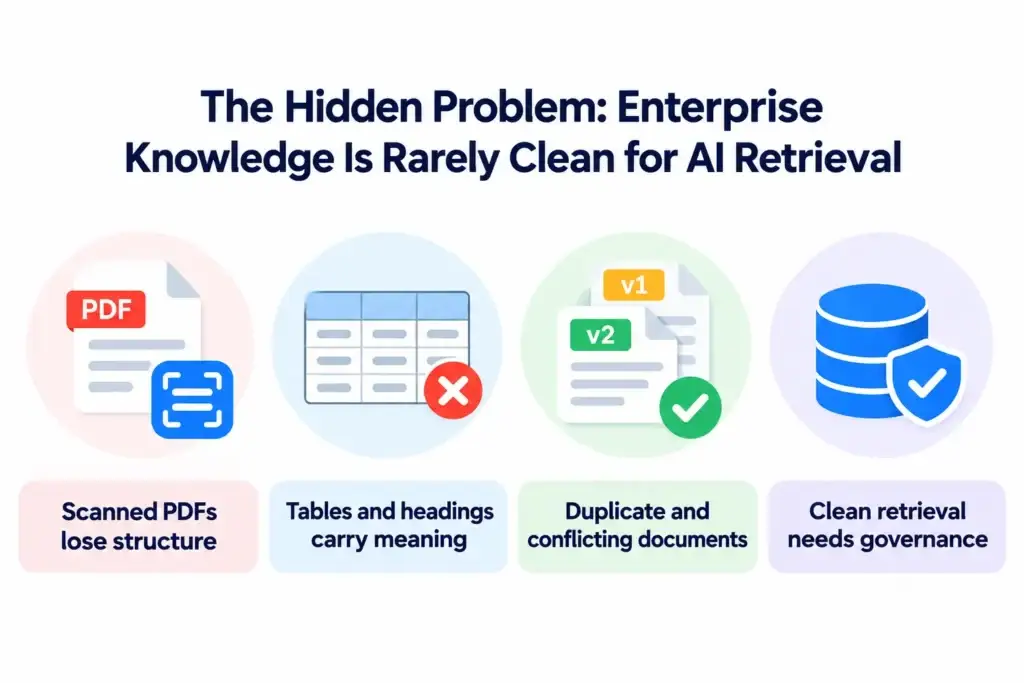
Scanned PDFs can lose structure
Scanned contracts, invoices, and policy manuals may require text extraction before indexing.
If the extraction process misreads a number, omits a column, or combines unrelated paragraphs, the resulting text can become misleading.
For example, a reimbursement table may list different limits for domestic and international travel.
If extraction separates the limits from their categories, retrieval may find the correct number without the information needed to interpret it.
The generated answer can appear grounded while actually relying on corrupted context.
Tables and headings carry essential meaning
Consider a policy section titled “Exceptions for Senior Management.”
If a chunking process removes the heading and stores only the exception text, the retrieval system may return that passage for an ordinary employee’s question.
The model may then apply a restricted exception as though it were a general rule.
This is not necessarily a failure of language understanding.
It may be a failure to preserve document structure during ingestion.
Duplicate and conflicting documents create authority problems
Enterprise repositories frequently contain draft policies, archived versions, local copies, and approved documents.
A search system may find several passages that appear equally relevant but describe different rules.
Without reliable metadata, the assistant may not know which source is authoritative.
A practical knowledge record should include information such as document owner, version, effective date, source location, document status, and applicable access permissions.
Clean retrieval begins with knowledge governance
Before optimizing embeddings, organizations need to decide which sources should be searchable.
That includes identifying approved documents, retiring obsolete material, assigning ownership, and defining how updates are published.
Otherwise, the system may become a fast search interface over an unreliable collection of information.
Founder insight: A knowledge assistant cannot reliably resolve contradictions that the organization itself has never clarified.
Seven Reasons Enterprise RAG Projects Fail in Production
The following failure patterns are especially important because each requires a different corrective action.
1. Documents are indexed without quality checks
A pipeline extracts text, generates embeddings, and stores document chunks.
The process completes without technical errors.
However, some tables are missing, important clauses are truncated, and scanned pages contain incorrect text.
The index is operational but not trustworthy.
Better approach: Test extraction against representative difficult documents, including scans, tables, nested headings, and multi-column layouts.
Do not treat successful ingestion as evidence that the knowledge was extracted correctly.
2. Chunking breaks the context needed to answer
Chunking divides documents into smaller pieces for retrieval.
But arbitrary boundaries can separate a statement from its exception, an amount from its unit, or a clause from its heading.
Suppose a document states:
“Employees can claim travel expenses up to the approved category limit.”
The next paragraph explains that the limit applies only to preapproved travel.
If those statements are separated, retrieval may return an incomplete rule.
Better approach: Preserve semantic and structural boundaries, including headings, clauses, tables, and parent-child relationships.
Chunk size should be evaluated against the actual question patterns, not selected solely because it matches a convenient token count.
3. Vector search misses exact information
Semantic search is useful for finding conceptually related passages.
However, enterprise employees often search for exact product codes, policy IDs, contract clauses, error messages, or regulation references.
A semantically similar passage may be insufficient when the exact identifier determines the correct answer.
Better approach: Combine semantic retrieval with keyword or exact-match retrieval where the corpus and query types justify it.
Hybrid retrieval can broaden candidate coverage, while reranking can help prioritize evidence relevant to the actual question.
No single retrieval technique should be assumed superior for every enterprise dataset.
4. The system retrieves outdated knowledge
A policy changes, but the index still contains the previous version.
The assistant returns a well-written response with a source citation.
The citation points to a document that was once correct.
This is a freshness failure, not necessarily a conventional hallucination.
Better approach: Track source changes, indexing status, effective dates, and deletion events.
When a document is replaced or removed, the searchable representation must reflect the change according to the organization’s defined freshness requirements.
5. Access permissions are applied too late
An employee asks a question, and the retrieval system finds a restricted document.
The platform attempts to hide the source link after generating the answer.
By then, sensitive content may already have entered the model context.
Better approach: Enforce applicable user permissions during retrieval, before restricted passages are passed into the generation step.
Access revocations, group membership changes, shared documents, and cached results should also be included in security testing.
6. The model is encouraged to answer without enough evidence
A model receives loosely relevant passages and is asked to provide a confident answer.
Rather than acknowledge missing information, it fills gaps with plausible language.
The result may be fluent, useful-looking, and unsupported.
Better approach: Define evidence sufficiency rules, instruct the model not to invent missing details, and implement a tested abstention or escalation path.
Prompt instructions help, but should not be the only safeguard.
7. Nobody measures retrieval quality after deployment
The project team checks that the application responds quickly and that the model produces readable answers.
But it does not regularly evaluate whether retrieved documents contain the correct evidence.
Gradually, source updates, new document categories, and changes in employee questions degrade quality.
Better approach: Maintain a representative evaluation dataset and monitor retrieval quality, answer groundedness, response completeness, freshness, latency, and error patterns.
Production performance needs repeated measurement rather than a one-time launch assessment.
Enterprise RAG Failure Diagnosis: Match Each Symptom to the Right Fix
A common mistake is treating every inaccurate AI answer as a model hallucination.
Some failures occur before the model generates anything. Others occur because the model misinterprets correct evidence.
Separating these causes can save significant engineering effort.
RAG Failure Symptoms and Corrective Actions
Investigate the failing layer before changing models, prompts, or retrieval settings.
| Production Symptom | Likely Failure Layer | What to Investigate | Recommended Action |
|---|---|---|---|
| Correct document never appears | Retrieval | Query matching, index coverage, filters | Evaluate hybrid search, metadata and recall |
| Answer ignores a policy exception | Parsing or chunking | Headings, clause boundaries, context loss | Preserve document structure and linked context |
| Response uses an old rule | Knowledge freshness | Versions, update events, stale index entries | Reconcile the index with authoritative sources |
| Restricted information appears | Access control | Retrieval filters, group memberships, caches | Enforce permissions before generation |
| Correct evidence, incorrect answer | Generation | Groundedness, unsupported claims, prompt behavior | Test evidence use and apply answer validation |
| Answer sounds confident despite no evidence | Abstention policy | Evidence sufficiency and fallback behavior | Introduce calibrated refusal or escalation |
| Production quality drops over time | Operations | Corpus changes, query drift, evaluation coverage | Monitor quality and maintain regression tests |
How to Build a Clean Enterprise Knowledge Retrieval Pipeline
A reliable knowledge retrieval system should not begin with selecting the most powerful language model.
It should begin with understanding which questions users need answered, where the authoritative information exists, and what evidence is required to answer correctly.
The following process helps teams move from a document collection toward a more dependable retrieval system.
Step 1: Establish authoritative knowledge sources
Start by identifying the repositories that contain approved information.
These may include internal wikis, product documentation, operating policies, support systems, contracts, and department-specific knowledge bases.
For each source, establish:
- Who owns and maintains the information.
- Whether the material is authoritative, draft, or archived.
- Which employees or groups may access it.
- How often information changes.
- Which document version is currently effective.
- How corrections and deletions are communicated.
This gives the retrieval pipeline more than text. It gives the system a basis for deciding which evidence is appropriate.
Step 2: Validate document extraction before indexing
Sample the most difficult document types before processing the entire repository.
Include scanned files, multi-column documents, spreadsheets, policy tables, and files with nested sections.
Compare extracted content against the source and verify that important relationships have been preserved.
For instance, a table containing price tiers should retain the link between each tier and its corresponding amount.
The pipeline should flag extraction failures rather than silently index incomplete text.
Clean document extraction is closely related to the quality of the organization’s underlying data pipelines. Businesses managing large collections of documents, structured records, and changing information can explore Miracuves’ data engineering and knowledge pipeline capabilities for additional context on reliable information processing.
Step 3: Create chunks that preserve meaning
Chunking should follow document structure wherever practical.
A policy clause should retain the context needed to interpret it. A product specification should retain relevant identifiers. A table row should not lose its column headings.
Each chunk should carry useful metadata such as document identity, section, source reference, version, and access classification.
When smaller chunks are used for precise matching, the system may retrieve a larger parent passage to restore the surrounding context.
The appropriate chunking strategy depends on how the documents are written and the questions users ask.
Step 4: Use the right combination of retrieval methods
Semantic retrieval can identify passages that are conceptually related to a question.
Keyword retrieval can help with exact names, identifiers, technical terminology, and specific phrases.
Metadata filters help narrow the eligible corpus by factors such as department, region, product version, document status, and access rights.
A practical search system may combine these techniques rather than depend on embeddings alone.
The next stage can rerank retrieved candidates to determine which passages are most likely to answer the user’s actual question.
Importantly, more retrieved passages are not automatically better. Irrelevant context can distract the generation model and increase latency.
Step 5: Check evidence sufficiency before generation
Finding relevant material does not necessarily mean finding enough information to answer.
Suppose an employee asks:
“Does our enterprise contract permit refunds after renewal?”
The search process returns a generic refund policy but not the contract-specific renewal clause.
The retrieved passage is relevant to refunds, yet insufficient to answer the question.
A robust system should recognize that distinction.
Evidence sufficiency can be evaluated using query-specific rules, retrieval signals, document authority, and appropriately tested model-based checks.
When sufficient evidence is unavailable, the system should request clarification, return a limited answer, or escalate to a human rather than invent a conclusion.
Step 6: Generate answers tied to specific evidence
Once appropriate passages are available, the generation step should distinguish between supported facts and unsupported inference.
For higher-stakes knowledge, citations should identify the relevant document and passage rather than simply link to a general repository.
The answer should not add policy conditions, numbers, exceptions, or contractual obligations that the evidence does not establish.
If sources conflict, the assistant should not silently choose one without an agreed authority rule.
Step 7: Test retrieval and answer generation separately
The final step before deployment is to evaluate both the evidence found and the answer produced.
A correct-looking answer does not prove the correct documents were retrieved.
Likewise, a relevant document does not prove the response faithfully represents it.
Separate evaluation allows teams to improve the specific component responsible for a failure.
Why Better Retrieval Reduces Hallucinations but Cannot Eliminate Them
RAG supplies a model with external evidence.
It does not fundamentally change the fact that a language model generates responses by predicting text.
When relevant evidence is successfully retrieved but the generated answer remains inaccurate, the problem may lie in prompt behavior, response validation, or model orchestration rather than search quality. Miracuves’ LLM application development capabilities provide additional context on evaluating language-model pipelines, grounding responses, and monitoring generation quality.
Even when correct documents are retrieved, the model may misread a passage, combine unrelated statements, overgeneralize an exception, or introduce information that was never present.
The risks become particularly visible in customer-facing applications, where an unsupported policy or discount claim can affect customer trust and operating costs. Our guide to reducing AI hallucinations in customer support explores the importance of verified knowledge and appropriate fallback behavior.
This is why hallucination prevention requires more than improving search relevance.
Retrieval failure versus generation failure
Consider two scenarios.
Scenario A: The wrong document is retrieved.
The system answers an employee’s question about a new travel policy using an archived version.
The model may summarize that archived document accurately, but the final answer is still wrong.
This is primarily a knowledge retrieval and freshness problem.
Scenario B: The correct document is retrieved.
The system finds the current policy, including a statement that reimbursement requires manager approval.
The generated answer says approval is optional.
Here, the evidence was present, but the model did not use it faithfully.
This is primarily a generation-grounding problem.
Understanding the difference is essential because the corrective actions are different.
Citations are necessary but not sufficient
A citation improves transparency by showing where an answer supposedly came from.
However, citing a document does not prove that the document supports every claim.
The system should ideally evaluate whether important claims are actually entailed by their cited passages.
If a source contains only a general statement, the response should not claim it establishes a specific exception.
Abstention is a reliability feature
Many AI teams worry that refusing to answer will frustrate users.
But in enterprise environments, a clearly stated limitation can be more useful than a confident fabrication.
For example:
“I found the general reimbursement policy, but not the department-specific exception needed to confirm this amount.”
This response tells the user what evidence is missing.
The goal is not to refuse every uncertain question. It is to establish a tested balance between answer coverage and the risk of unsupported claims.
High-risk responses may require human review
Some queries involve legally significant contracts, financial obligations, safety procedures, or regulated information.
In these cases, a system can assist with finding and summarizing evidence while requiring qualified human review for the final decision.
A retrieval system should not be presented as automatically eliminating the need for professional judgment.
How to Measure Enterprise RAG Quality Before and After Launch
An enterprise RAG system needs evaluation criteria that reflect how employees will actually use it.
Technical guidance distinguishes retrieval evaluation from final-response evaluation, including groundedness, relevance, and completeness.
Production performance also depends on managing repeated queries without introducing outdated or unauthorized responses. For a related technical perspective, explore our guide to safe caching for repeated AI queries and the trade-offs between reuse, freshness, and cost.
A practical evaluation program should combine labeled examples, automated checks, and human review.
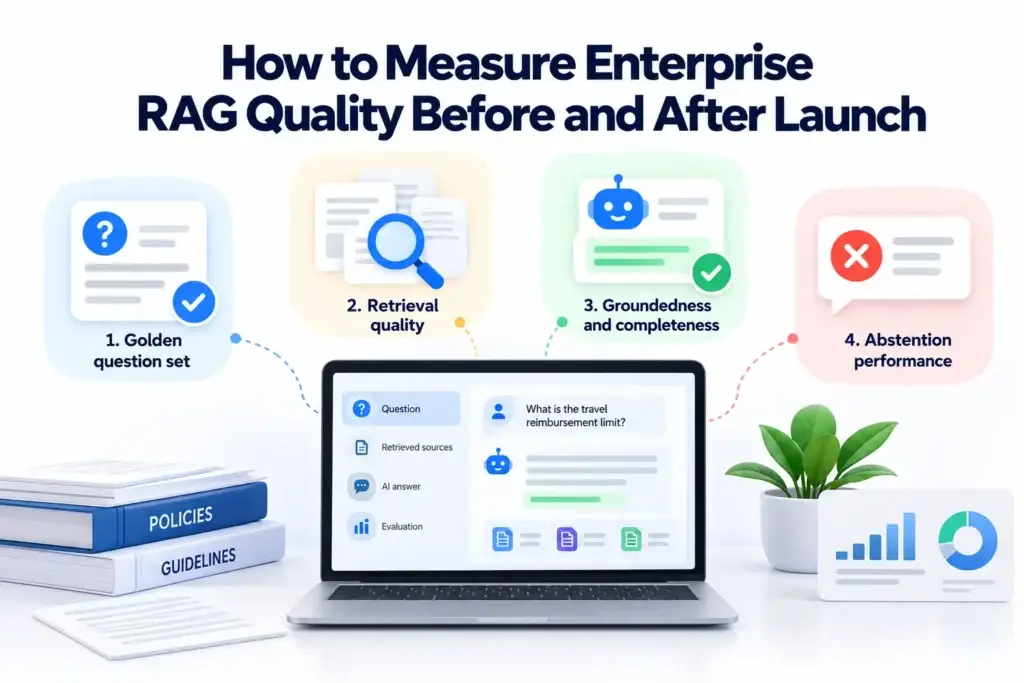
Build a representative golden question set
A golden question set is a curated collection of real or representative questions with known evidence and expected outcomes.
It should contain more than easy factual lookups.
Include questions involving multiple documents, conflicting policies, exact identifiers, missing answers, outdated versions, department-specific permissions, and ambiguous terminology.
For each question, record the authoritative sources and the expected response behavior.
Some test cases should explicitly require the assistant to abstain.
Measure retrieval quality
Retrieval evaluation asks whether the search system found the evidence needed to answer.
Relevant metrics can include recall at a specified result depth, precision, ranking quality, and the rate at which the correct source is missing from retrieved candidates.
For example, Recall@5 evaluates whether relevant labeled evidence is included within the first five retrieval results, under the evaluation’s chosen relevance definition.
A high semantic similarity score alone is not proof of factual relevance.
Measure groundedness and answer completeness
Groundedness checks whether the generated response is supported by the provided context.
Completeness considers whether the answer includes the required information.
These properties are related but different.
An answer can be grounded while omitting an essential exception.
It can also be detailed but contain unsupported assertions.
Both need evaluation.
Track abstention performance
A system that always refuses to answer may produce few hallucinations but little business value.
A system that answers every question may achieve high coverage while making unsupported claims.
Teams should measure both appropriate abstentions and unnecessary refusals.
The goal is to meet a risk-appropriate quality threshold rather than maximize one number without regard to other outcomes.
Enterprise RAG Evaluation Scorecard
Production RAG Quality Scorecard
Use these measurements to separate retrieval, generation, operational, and security concerns.
| Metric | What It Tells You | When to Investigate |
|---|---|---|
| Retrieval Recall@K | Whether required evidence appears in the retrieved results | Correct sources are routinely missing |
| Context Precision | How much retrieved content is actually useful | Irrelevant passages dominate the context |
| Groundedness | Whether answer claims are supported by retrieved evidence | Responses add facts not present in sources |
| Completeness | Whether important expected details are included | Answers omit clauses or exceptions |
| Abstention Quality | Whether insufficient evidence triggers appropriate responses | Model invents answers or refuses valid queries |
| Index Freshness | Whether searchable content reflects current sources | Updated or deleted documents remain stale |
| Access-Control Tests | Whether users retrieve only authorized knowledge | Restricted content becomes accessible |
| Latency & Cost | Response speed and resource use | Real-world workloads become slow or expensive |
How to set meaningful acceptance thresholds
There is no universal percentage that establishes whether every enterprise RAG system is production-ready.
A low-risk internal document assistant and a system summarizing high-impact contractual obligations should not necessarily share identical tolerances for errors.
Teams should define thresholds based on the intended use, consequences of incorrect responses, representative evaluation results, and human-review requirements.
Automated evaluators should also be checked against human judgments, because model-based scoring can itself be inconsistent.
The Enterprise Challenge Most Teams Miss: Permission-Aware Retrieval
Enterprise knowledge is rarely available to every employee equally.
A support agent may access public product documentation, while a finance employee can access confidential financial records.
These permission requirements become even more important when an AI assistant moves beyond answering questions and begins interacting with enterprise tools or performing actions. Our AI agent development approach covers related considerations such as tool access, memory systems, workflow control, and error recovery.
This link is relevant only if you want to introduce the distinction between knowledge retrieval and action-taking AI agents.
A manager may see internal compensation policies that another employee cannot.
Enterprise knowledge retrieval also depends on how businesses manage document permissions, employee access, failed queries, and answer governance. Our guide to controlled corporate knowledge assistants explores the relationship between internal knowledge access, permission filtering, administrative oversight, and trustworthy AI responses.
This is one of the closest supporting articles because it discusses permission filtering, company knowledge access, and governance.
These permissions are not merely interface settings. They determine which content the retrieval system is permitted to use when generating an answer.
Access controls belong in the retrieval process
Suppose an employee asks a question that matches a confidential contract.
If the system retrieves the restricted clause and passes it to the model, hiding the source citation afterward may not prevent sensitive details from appearing in the answer.
Appropriate access rules need to be applied before unauthorized passages reach the generation context.
This means retrieval needs reliable information about the user’s identity and current permissions.
Cached responses can create permission risks
Caching may improve response speed, but a cached answer created for one user may contain information another user is not authorized to receive.
Cache design should account for identity, permission scope, document versions, and invalidation requirements.
A shared cache cannot safely assume that identical questions always have identical authorized answers.
Permission changes need timely propagation
An employee changes departments. A document’s access policy is updated. A contractor’s account is revoked.
If the retrieval index continues using outdated authorization metadata, the system may expose knowledge that the user can no longer access.
Permissions should be tested after relevant changes, and their propagation should be monitored.
Retrieved documents can contain malicious instructions
Enterprise content can also contain untrusted text.
A document, ticket, or external knowledge source might include instructions intended to manipulate an AI assistant.
The system must treat retrieved material as evidence, not as an authority that can override its operating rules.
This distinction is particularly important when an assistant can access internal information or invoke additional tools.
Founder insight: A knowledge assistant should not be granted more information access simply because it can answer questions faster than a human.
Knowledge Freshness: Why an Accurate Answer Today May Be Wrong Tomorrow
Enterprise knowledge changes continuously.
A new policy replaces an old one. A support article receives a correction. A product version introduces different requirements. A legal team updates contractual language.
If the retrieval index does not reflect these changes, the assistant may continue returning outdated information.
Updating files is not the same as updating the index
A document can be corrected in the original repository while its old embedding remains searchable.
In other cases, an indexing job may fail silently or process only part of the changed document.
This creates inconsistency between the authoritative source and the retrieval system.
Operators need mechanisms for detecting updates, processing changed files, recording indexing status, and verifying that the expected searchable content is available.
Deletions require special attention
Deleting a document from a knowledge repository should not leave its content indefinitely accessible through stale retrieval entries, old cached answers, or disconnected indexes.
The architecture needs a defined process for propagating deletions and permission revocations to the relevant storage and serving layers.
Actual deletion and retention obligations depend on the operating environment and legal requirements.
Version metadata prevents misleading answers
Some knowledge is valid only for a particular time period or product version.
For example, the correct onboarding process may differ between two software releases.
If users can ask version-specific questions, the retrieval system should preserve version information and use it during search and response generation.
Where the question is ambiguous, asking the user which version they mean may be safer than selecting one silently.
Freshness should become a measurable service objective
Teams should decide how quickly different knowledge categories need to appear in retrieval after source updates.
Critical operating policies may require faster propagation than infrequently used historical manuals.
The objective is not to reindex every document continuously without considering cost.
It is to maintain an appropriate, measurable relationship between the source of truth and the searchable knowledge base.
A Practical Production RAG Improvement Framework
Organizations with an unreliable RAG implementation do not always need to replace the entire system.
A targeted improvement process can identify whether the main weaknesses lie in ingestion, retrieval, generation, permissions, or ongoing operations.
Phase 1: Establish a failure baseline
Collect a representative sample of real questions and categorize existing failures.
Separate missing evidence, outdated sources, poor chunking, incorrect answer generation, permission problems, and slow responses.
Avoid judging the platform solely by general user satisfaction.
A system can receive positive feedback for easy questions while failing important edge cases.
Phase 2: Repair the knowledge foundation
Identify high-value documents and check their extraction quality, current status, ownership, metadata, and permissions.
Remove unintended duplicates and ensure superseded material is handled correctly.
Confirm that tables, clauses, headings, and other important structures remain interpretable.
Phase 3: Improve retrieval using test results
Evaluate whether current search methods find the expected evidence.
Test keyword matching, semantic retrieval, metadata filters, chunking approaches, and reranking against the same representative dataset.
Keep changes that demonstrate measurable improvement rather than adopting more complex techniques simply because they are available.
Phase 4: Strengthen grounding and abstention
Test generated answers against retrieved passages.
Identify unsupported claims, missing qualifications, and inappropriate certainty.
Introduce clear handling for unanswered or ambiguous questions.
Evaluate how these changes affect both answer quality and useful response coverage.
Phase 5: Validate enterprise security
Test role-based access using accounts with different permissions.
Include restricted documents, permission revocations, cached responses, and source content containing untrusted instructions.
Verify that authorization requirements are enforced throughout retrieval and serving workflows.
Phase 6: Add monitoring and ownership
Assign responsibility for document quality, retrieval performance, model behavior, and incident response.
Track production errors and use them to update the evaluation dataset.
This turns RAG from a one-time software project into a maintained enterprise knowledge service.
Founder Decision Signals: Is Your RAG System Ready for Production?
A pilot may establish technical feasibility.
Production readiness requires stronger evidence that the system can operate reliably on real data, answer real questions, and respect organizational boundaries.
Five Signals of a Production-Ready Knowledge System
Use these questions to identify hidden risks before employees rely on generated answers.
Source Quality
Are important documents complete, readable, current, and connected to an authoritative owner?
Retrieval Accuracy
Does the system consistently locate the right evidence across realistic and difficult questions?
Answer Grounding
Can important claims be verified against cited passages, with appropriate behavior when evidence is missing?
Permission Safety
Are restricted documents excluded before reaching generation, including after access changes?
Operational Ownership
Who investigates retrieval failures, maintains the corpus, updates evaluations, and manages incidents?
Common Mistakes to Avoid When Moving Enterprise RAG Into Production
Production problems frequently become expensive because teams address visible symptoms without understanding their underlying causes.
The following mistakes are worth checking before committing to a major system rebuild.
Six Mistakes That Keep Enterprise RAG Unreliable
Changing the Model Before Testing Retrieval
A stronger generator cannot recover facts that the search pipeline consistently fails to retrieve.
Indexing Every Document Without Governance
Drafts, duplicates, archived rules, and missing metadata can produce conflicting evidence.
Using a Single Retrieval Method for Every Query
Semantic similarity alone may miss exact identifiers and critical technical or policy terms.
Assuming Citations Guarantee Accuracy
An answer can cite a source while adding unsupported conclusions or omitting important exceptions.
Filtering Restricted Content After Generation
Sensitive passages should be excluded before they enter the context used to generate responses.
Launching Without Evaluation and Monitoring
Knowledge changes, query patterns evolve, and quality can deteriorate without regular measurement.
When Should an Enterprise Improve Its Existing RAG System Instead of Rebuilding It?
Not every reliability problem requires a complete technology replacement.
If the main issues involve poor extraction, missing metadata, inappropriate chunking, or limited evaluation, the existing infrastructure may still be suitable.
Some organizations need to improve only the retrieval layer, while others also need changes to conversation handling, human escalation, session management, and customer-facing interactions. In those cases, broader AI chatbot development capabilities may also be relevant to the overall application scope.
The team may be able to improve results by repairing ingestion, reconfiguring retrieval, strengthening authorization, and introducing better testing.
Before rebuilding an enterprise AI system, organizations should determine whether the main problem involves data readiness, retrieval architecture, model behavior, or operational governance. Miracuves’ AI consulting and technical roadmap services can provide a broader framework for evaluating implementation priorities before committing to a larger engineering project.
A larger redesign may be justified when fundamental architectural constraints prevent the organization from meeting its requirements.
Examples include an index that cannot enforce required access policies, a system that cannot reliably propagate deletions, or infrastructure that cannot support essential availability and workload requirements.
Start with evidence, not assumptions
Before selecting a rebuild, engineering leaders should ask:
- Which failure categories occur most frequently?
- Is the underlying information correct and authoritative?
- Are the right passages retrieved for difficult questions?
- Can the system enforce permissions before generation?
- Are quality and freshness failures observable?
- What operational limits cannot be addressed within the existing architecture?
A structured diagnostic process can help determine whether the organization needs targeted remediation, additional integrations, or a more substantial redesign.
Translating the findings into implementation requirements
Once the failure patterns are understood, the next step is to define the required retrieval behavior.
That may involve stronger document ingestion, version-aware indexing, hybrid search, relevance evaluation, permission filtering, or monitoring workflows.
For organizations that need help implementing these changes, Miracuves provides enterprise knowledge retrieval implementation focused on connecting internal information to permission-aware, cited AI responses.
Miracuves’ standard ready-made AI platform offerings may be eligible for a 6-working-day delivery timeline, while custom enterprise RAG implementations are separately scoped and typically require a longer delivery period.
For enterprise teams, the more important consideration is whether the implementation can meet agreed evidence-quality, authorization, and operational acceptance requirements.
Final Thoughts: Reliable Enterprise RAG Begins With Reliable Knowledge
Enterprise RAG systems rarely become dependable simply because a more capable language model is added.
The quality of the final answer depends on a chain of decisions that begins long before generation.
Documents must be readable and authoritative. Chunks must preserve meaning. Retrieval must find relevant evidence. Permissions must be respected. Answers must accurately reflect their sources. Updates, deletions, and operational failures must be handled consistently.
When any part of that chain fails, an otherwise impressive AI assistant can produce responses that users cannot trust.
The strongest improvement strategy is to diagnose each layer separately, repair the knowledge foundation, evaluate retrieval on real questions, and establish clear operational responsibility for keeping the system reliable.
Miracuves helps organizations connect these technical requirements to practical knowledge retrieval implementations, while each business must establish the authoritative sources, access policies, and risk standards appropriate for its environment.
The goal is not an AI assistant that always produces an answer. It is a knowledge system that provides verifiable evidence when available, acknowledges uncertainty when necessary, and remains dependable as enterprise information changes.
FAQs
Why do enterprise RAG projects fail after reaching production?
Enterprise RAG systems may become unreliable because production introduces messy documents, conflicting knowledge versions, unfamiliar user questions, changing permissions, and higher workloads. Failures can occur during ingestion, retrieval, generation, or system operations. Separating these causes helps teams identify the correct remediation.
Can retrieval-augmented generation completely eliminate hallucinations?
RAG can reduce unsupported responses by providing relevant evidence, but a language model may still misinterpret a passage or introduce claims not supported by the retrieved material. Grounding checks, reliable citations, sufficient-evidence rules, and appropriate abstention can reduce risk.
How can developers improve RAG retrieval accuracy?
Developers should begin with authoritative, correctly extracted documents. They can then test structural chunking, semantic retrieval, keyword matching, metadata filters, and reranking against a representative set of questions. The best configuration depends on the documents and query patterns.
Why is document chunking important for enterprise knowledge retrieval?
Chunking determines which portions of a document are available to retrieval. Poor boundaries can separate policy exceptions from rules, numbers from table headings, or technical details from product identifiers. Structure-aware chunking helps preserve the meaning needed to answer correctly.
What is the difference between RAG retrieval quality and answer faithfulness?
Retrieval quality measures whether the system finds relevant evidence. Answer faithfulness evaluates whether the generated response stays within what that evidence supports. A system can retrieve the correct document but still generate an inaccurate answer, so both stages require separate testing.
How should enterprise RAG systems handle confidential documents?
They should enforce identity-based access policies before restricted content reaches the generation context. This includes considering permission changes, caches, document sharing rules, and access revocations. Security testing should verify that unauthorized users cannot retrieve or receive sensitive information.
How can organizations keep a RAG knowledge base current?
Organizations can track source updates, document versions, deletions, and indexing status. Relevant changes should propagate to search indexes and caches according to defined freshness requirements. Periodic reconciliation against authoritative sources helps identify missing or stale content.
What should enterprises measure before deploying a RAG assistant?
Useful measurements include retrieval recall, context relevance, answer groundedness, completeness, appropriate abstention, permission enforcement, index freshness, response latency, and cost. Evaluation should use realistic questions and be repeated after significant changes to the corpus or retrieval pipeline.
Miracuves is an independent software development company. We are not affiliated with, connected to, sponsored by, or endorsed by any company or product named in this article.
Terms such as “X Clone” are used descriptively. It is how the software industry refers to building a platform with functionality comparable to a known service, and how clients search for it.
The entire design and codebase of our products is built by our own team. Our products contain no code, design, graphics, or content originating from any third-party website or applications.
All third-party names and marks referenced in this article are the property of their respective owners, referenced solely to identify the services discussed.