
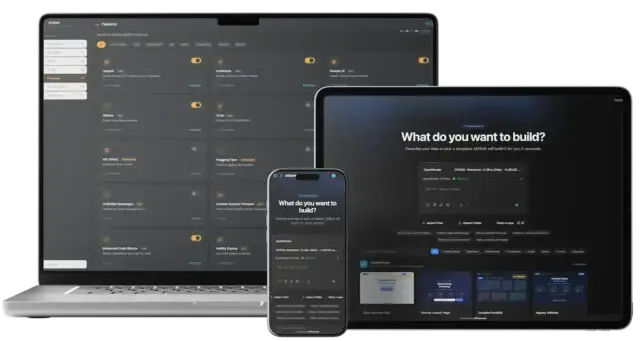
Media and creator platforms, built for the cost of the second million viewers.
Streaming, creator monetization and social platforms engineered around delivery economics, rights and moderation from week one, because all three get harder exactly when the audience arrives. Fifteen media platforms already in production, and a custom engineering team for everything beyond them.
Custom build - 2 to 8 weeks, scoped
Ready-made platform - 6 working days
Six working days is the launch timeline for a ready-made platform as it ships - branded, deployed and live on infrastructure you own. Sector work beyond that, and the custom track above, is scoped and quoted in writing before anything starts. Both tracks are the same engineering team. Every figure on this page is defined on our facts page.
What a media platform build actually contains
The sequence below is where streaming and creator platforms are won or lost. Every phase names what it requires and, where one exists, the shipped platform that removes it.
This sector has an unusual property: the technical problems and the commercial ones are the same problems. Your encoding ladder is a margin decision. Your moderation policy is a payment-processor relationship. Your rights model decides which territories you can sell in. Teams that treat these as separate workstreams discover the coupling at the worst possible moment, which is usually the week traffic arrives.
Three of the seven phases have no shortcut. What a shipped platform removes is the middle: ingest and transcode, playback with DRM, and the monetization stack, which together carry most of the build time and nearly all of the expensive mistakes.
Rights, catalogue and territory model
What you are licensed to show, to whom, where, and until when. This is the constraint every later decision inherits, and it is a data model long before it is a legal document. A title with different rights holders per territory, an availability window that opens and closes on a date, and a device restriction that applies in one country and not another are three separate dimensions that have to compose.
Creator platforms have the mirror-image problem: the creator owns the rights and grants you a licence, which means takedown, account closure and payout obligations all trace back to that grant. If a creator leaves, what happens to content their subscribers already paid for is a product decision with contractual teeth.
The output is a rights model that geo-enforcement and playback both read from, rather than a spreadsheet operations keeps separately.
Ingest, transcode and the delivery ladder
Every uploaded file becomes a ladder of renditions, and the shape of that ladder is the single largest lever on your delivery bill. Too many rungs and you pay to encode and store variants nobody selects. Too few and a viewer on a weak connection gets buffering instead of a lower bitrate, which is the failure they will describe as "your app is broken".
Per-title encoding, where the ladder is chosen from the complexity of the content itself, is the difference between an animation and a live sports feed being treated identically. It is also the optimization most platforms defer until the bill forces the conversation.
Ingest needs to be resumable, because creators upload from phones on poor connections and a failed two-gigabyte upload is a churn event.
Playback, DRM and the device matrix
Playback is where platform differences stop being abstract. Widevine, FairPlay and PlayReady are three DRM systems with three key-delivery flows, and supporting web, iOS, Android and television means supporting all of them. A licence request that works in Chrome and fails in Safari is not an edge case, it is half your audience.
The device matrix is where scope quietly doubles. Smart television applications in particular are a separate discipline with their own certification cycles, and a platform that says it supports television without naming which ones is describing an intention rather than a capability.
We state plainly which devices a platform ships with and which need building, before purchase rather than after.
Monetization, payouts and the processor relationship
Subscriptions, pay-per-view, tips, ad revenue and creator splits are five different money models and most platforms run at least three. Each has its own failure mode: a failed subscription renewal needs a dunning sequence, a tip needs to settle instantly, and an ad-revenue share cannot be calculated until the network reports.
Creator payouts carry obligations most teams meet late: tax documentation per jurisdiction, minimum payout thresholds, and a statement the creator can reconcile. Creators discuss payout accuracy publicly, and a platform that cannot explain a number loses supply.
The processor relationship deserves naming. Adult and high-chargeback categories are underwritten differently, and your moderation posture is part of that underwriting. Choosing the processor after building the platform is the wrong order.
Trust, safety and age assurance
Moderation is not a content-policy document, it is a queue with a service level and an audit trail. Automated classification catches volume; humans catch context; and every decision has to be attributable afterwards because regulators and payment processors both ask. A platform that cannot show who approved what, when, and on what basis has a compliance problem waiting.
Age assurance has moved from optional to mandatory across a growing list of jurisdictions, and the requirement is increasingly for verification rather than self-declaration. For creator platforms it applies to both sides: the creator uploading and the subscriber viewing.
Takedown handling needs a defined clock, because the obligations that matter are measured in hours.
Scale, caching and delivery economics
Delivery is usually the largest recurring line in a media platform's cost base, and it is decided by architecture rather than negotiation. Cache hit ratio, origin shielding, and whether your popular content is actually being served from edge are the levers, and most platforms have never measured the first of them.
Live adds a different shape again: latency targets, redundant ingest, and a failure mode where the event is unrepeatable. A recorded catalogue that stutters is a bad evening; a live event that drops is a refund.
Launch and day two
Launch in this sector is a supply problem before it is a demand one. A catalogue with nothing to watch or a creator platform with no creators does not benefit from traffic, so the sequence is content first, invite cohort second, open third.
Day two is where moderation load and delivery cost both become real, and both need someone watching them daily rather than monthly. Sixty days of dedicated support, six months of priority bug resolution, twelve months of updates.
Want any of these phases costed against your catalogue and territories?
Book a technical callWhere a stream actually goes
Every streaming platform is this pipeline with different names on the boxes. The hops are easy. What separates a platform with a defensible cost base from one that is quietly losing money on every view is what happens at each hop, and whether anybody is measuring it.
A cache miss storm is the failure that surprises teams. A newly published title has no edge copies, so a launch spike goes straight to origin, and the platform that survived a normal Tuesday falls over on the one night it mattered. Origin shielding and pre-warming are the answer, and both have to exist before the launch rather than after it.
Why the encoding ladder is a business decision
A ladder is the set of renditions you produce for each title, and it looks like an engineering preference until you multiply it by a catalogue. Every rung costs compute to produce, storage to keep and, if it is selected, bandwidth to deliver. A ladder with nine rungs where four would do costs you on all three lines forever.
The opposite failure is worse for retention. A viewer whose connection cannot sustain the lowest rung you offer does not see a lower-quality picture, they see buffering, and they attribute it to your product rather than their network. Per-title ladders, chosen from the complexity of the content itself, resolve both: a static talking-head clip does not need the same rungs as a fast-panning sports feed.
Want your delivery cost modelled against your own catalogue and audience?
Talk to an engineerEight operators, eight different builds
"Media platform" is not one buyer. The rights model, the money model and the moderation load change completely between them.
Subscription video
Licensed catalogue, territory windows and DRM across a device matrix. The hard parts are rights enforcement and the delivery bill, and neither is visible in a demo.
2 shipped platforms
Ad-supported video
Free to watch, monetized by inventory. Ad insertion has to survive adaptive bitrate switching, and the revenue model only works if fill rate and playback quality hold together at scale.
2 shipped platforms
Creator subscriptions
Many small sellers, recurring payments and payouts creators check line by line, where processor underwriting shapes the build. Seven shipped platforms sit behind this on our creator economy page.
See creator economy
Short-form video
Upload volume orders of magnitude above catalogue platforms, a ranking system that is the product, and moderation load that arrives with the first thousand users rather than the first million.
1 shipped platform
Live and tipping
Latency targets, redundant ingest and money moving during the broadcast. The unrepeatable nature of a live event changes the reliability standard entirely.
Custom build
Social and microblogging
Feed ranking, graph storage and abuse handling. Cost is dominated by read amplification: one post written, many timelines to update, and the strategy for that decides the architecture.
4 shipped platforms
Talent and personalized video
A marketplace where the product is a person's time, with booking, fulfilment deadlines and refunds on unfulfilled requests. Covered on our creator economy page.
See creator economy
Advice and consultation
Paid conversation by minute or session, with wallet balances, session recording and dispute handling. Money mid-session is the part generic marketplaces get wrong.
2 shipped platforms
Six of the eight can start from something already running. Two are custom builds because nothing off the shelf carries the domain properly, and we would rather say that than sell you an adaptation that fights you for two years.
Not sure which of these you are, or you sit across two of them?
Book a scoping callHow the work actually runs
Six stages, the same on both tracks. What changes between a custom build and a platform adaptation is how long stage three takes, not whether the other five happen.
Scoping against rights and audience
We start from what you are licensed to show, where your audience actually is, and the devices they watch on, because those three decide the architecture before any preference does. A creator platform and a licensed catalogue platform share almost no assumptions, and finding that out in month four is expensive.
Architecture and the cost model
Delivery cost gets modelled before the platform is built, not after the first invoice. Encoding ladder, storage tiering and cache strategy are chosen against your catalogue shape and audience distribution, and the resulting cost per stream becomes a number you can hold the build to.
Build against production-shaped load
Media platforms fail on concentration and on cold caches, so test environments carry realistic shapes: a launch spike against unwarmed edges, uploads from poor connections, licence requests across three DRM systems, and a moderation queue with real volume. A platform that has only served warm content to fast connections has not been tested.
Length varies by trackCompliance, moderation and processor readiness
Age assurance, takedown handling and the moderation audit trail are validated against the jurisdictions you operate in and the requirements your payment processor sets. Our platforms arrive with a VAPT and compliance document, so external review starts from a documented baseline rather than a blank page.
Content or creator onboarding
A platform with nothing to watch does not benefit from traffic. This stage runs the ingest of your launch catalogue or the onboarding of your first creator cohort, including the payout setup and tax documentation that has to exist before anyone can be paid.
Launch and day two
Invite cohort first, then open, with delivery cost and moderation load both watched daily through the first month. Those two numbers move fastest in the weeks after launch and are the ones that surprise operators. Sixty days of dedicated support, six months of priority bug resolution, twelve months of updates.
Want this sequence mapped against your catalogue and territories?
Book a technical callFifteen media platforms already in production
Every one ships with full source-code ownership, deployed on your infrastructure under your brand. Adapt one, or use it as the reference architecture for a custom build.
They fall into three groups, and which one you start from matters more than which name you recognise. Catalogue streaming platforms carry rights, DRM and the device matrix. Social and feed platforms carry graph storage and ranking, where read amplification decides the architecture. Consultation platforms carry booking, session billing and money moving mid-conversation. If your model is creators selling directly to an audience, that work sits on our creator economy page instead, with seven shipped platforms and a dedicated practice behind it.
What this sector requires
Rights enforcement
Territory, window and device restrictions read from one model by playback and geo-enforcement alike. Rights held in a spreadsheet beside the platform become a licence breach the first time the two disagree.
Delivery economics
Encoding ladder chosen per title, measured cache hit ratio and a cost per stream you can see. This is usually the largest recurring line in the business and the one most platforms never instrument.
Multi-DRM playback
Widevine, FairPlay and PlayReady with working licence delivery on every device you claim to support, plus offline download where the product promises it. Half-supported playback is a churn generator.
Age assurance
Verification rather than self-declaration, applied to both creator and viewer where the category requires it, and evidenced in a form a regulator and a payment processor will both accept.
Moderation with an audit trail
A queue with a service level, automated classification for volume, human review for context, and every disposition attributable to a named reviewer afterwards. Takedowns need a defined clock.
Creator payouts
Statements a creator can reconcile, tax documentation per jurisdiction, minimum thresholds and a dispute path. Payout accuracy is discussed publicly by creators and is a supply-retention issue.
Want to open any of these platforms and look inside before deciding?
See the live demosModeration is a queue with a clock, not a policy document
Every platform that carries user content ends up here. The question is whether the queue, the decision and the evidence exist before the first serious report arrives, or after.
Every disposition is attributable to a named reviewer. This is the record a regulator asks for, and increasingly the record a payment processor asks for too, which is why evidence retention is designed at upload rather than reconstructed under examination.
Want your moderation posture reviewed against your categories and processor?
Talk to an engineerBuilt custom when nothing off the shelf fits
The same team, working from zero. These are the capabilities we build into media platforms that no shipped product carries, because they are specific to how you operate.
Live streaming infrastructure
Redundant ingest, low-latency delivery and a failure model built for events that cannot be repeated, with tipping and interaction that settle during the broadcast.
Custom software developmentSmart television applications
Native applications for the television platforms you actually need, each with its own certification cycle. We name which ones are in scope rather than implying all of them.
Application developmentRecommendation and ranking
Feed and catalogue ranking trained on your own engagement data, with the controls to tune for retention rather than raw watch time.
Data engineeringAd insertion and yield
Server-side insertion that survives bitrate switching, with fill-rate and yield reporting that reconciles against the networks you sell through.
Backend engineeringRights and windowing engines
Territory, window and device rules held as data, so a new licensing agreement is a configuration change rather than a release.
Custom software developmentTrust and safety tooling
Review consoles, classifier integration and the evidence retention a regulator or processor will ask for, built for the categories you actually carry.
Compliance engineeringNeed something this list does not cover?
Ask about custom workWhat we built, and what it delivered
Three deployments in this sector, described by what was actually built rather than by a metric we cannot show you the working for.
Creator platform
Subscription and tipping platform
Creator subscriptions, pay-per-message and tipping with reconcilable payout statements, age assurance on both sides and a moderation queue with retained evidence.
Catalogue streaming
Regional VOD service
Licensed catalogue with territory windows, multi-DRM playback across web and mobile, and an encoding ladder chosen per title against a modelled cost per stream.
Consultation
Paid advice marketplace
Wallet balances, per-minute billing inside a live session, session records and a dispute path that resolves without engineering involvement.
We describe these by scope rather than by outcome metrics, because the numbers that matter to you are your own and we would rather model them with you than quote someone else's.
Want to speak to a reference operating in your format?
Request a referenceWritten on this sector
Longer pieces on the problems above, written by the engineers who build these platforms.
Why your encoding ladder is a margin decision
PlaybackMulti-DRM without a device support matrix that lies
Trust and safetyBuilding a moderation queue a regulator will accept
PayoutsCreator statements that survive a public dispute
If a question here is not covered, the fastest route to an answer is a call with the engineer who would run your build.
Want these as a briefing pack for your board or engineering team?
Request the packTwo vendors quoted us a video platform. Only one asked what our cache hit ratio would be, and that question saved us more than the build cost.
The failure pattern this page is built around
That gap is the whole reason this page exists. Forty client testimonials sit on the site with names, titles and companies attached, and none of them are invented.
Questions media buyers actually ask
The ones that come up in the first call, answered as we would answer them there.
Can we really launch in six working days?
Yes, for a shipped platform as it comes, on web and mobile. It does not cover licensing negotiations or creator recruitment, which are your commercial timeline and usually the longer one.
Do we own the source code?
Yes, in full, deployed on your infrastructure. No per-stream licence, no per-seat fee, no runtime dependency on us.
Do the platforms include smart television apps?
Not by default, and we say so before purchase. Television applications are a separate discipline with their own certification cycles, and we scope them explicitly when you need them.
Which DRM systems are supported?
Widevine and FairPlay ship working across web, iOS and Android. PlayReady is added where your device matrix requires it, and we confirm that in scoping rather than after.
How do you control delivery cost?
Encoding ladder chosen per title, storage tiered by access pattern, origin shielding, and a measured cache hit ratio. Cost per stream is modelled in stage two and tracked as a number you can hold us to.
Can we run subscriptions, tips and pay-per-view together?
Yes, and most creator platforms end up running all three. Each has its own settlement and refund behaviour, and the ledger keeps them separable.
What about age verification?
Verification rather than self-declaration where the category or jurisdiction requires it, applied to creators and viewers separately, with evidence retained in a form a processor will accept.
How is moderation handled at launch volume?
Automated classification for volume with a human queue for context, sized against your expected upload rate. The queue and its audit trail exist before launch, because retrofitting evidence retention is not possible after the fact.
Can creators be paid across jurisdictions?
Yes, with tax documentation per jurisdiction, minimum thresholds and statements a creator can reconcile. The payout provider is chosen with you, because coverage varies sharply by market.
How do you handle chargebacks?
As a first-class flow rather than an exception: evidence assembled at transaction time, creator earnings adjusted through the ledger rather than netted informally, and a dispute record retained.
What does support look like after launch?
Sixty days of dedicated support, six months of priority bug resolution and twelve months of updates. Delivery cost and moderation load both move fastest in the first month, so that is when we stay closest.
What if we are not ready to build yet?
We will say so. If your rights are not secured or your creator supply does not exist, a platform will not create either, and we would rather tell you that than scope work you cannot use.
Question not answered here?
Ask us directlyTell us what you are building.
Bring the rights position and the audience. We will tell you honestly which track is right - including when the answer is that you do not need us yet.
A first call takes about thirty minutes and covers four things
Rights position
What you are licensed to show, or what your creators grant you.
Audience and devices
Where they are, and what they watch on.
Money model
Subscription, advertising, tips, or a combination.
Existing systems
The CDN, payment and rights stack a platform must fit into.
Those four answers are usually enough for us to tell you which track fits, roughly what it costs, and what your delivery bill looks like at the scale you are planning for. If the honest answer is that your rights or your creator supply need to come first, we will say that instead of scoping work you are not ready to use.
