Key Takeaways
- A live-streaming agency network connects platform operators, talent agencies and content creators through a structured system for recruitment, performance management and revenue sharing.
- Successful agency networks require clear onboarding processes, creator eligibility requirements, agency responsibilities and transparent commission agreements.
- Agency management tools should help operators track creator activity, live-streaming hours, audience engagement, virtual gift earnings and agency performance.
- Long-term agency network growth depends on creator retention, fair incentive structures, consistent content moderation and reliable payment settlements.
Agency Recruitment and Creator Management Workflow
- Platform operators should establish agency registration, identity verification, approval workflows and defined responsibilities before allowing agencies to recruit creators.
- Agencies can recruit eligible hosts, support creator onboarding, provide streaming guidance and help creators maintain consistent broadcasting schedules.
- Creator management dashboards should display streaming duration, engagement metrics, virtual gift activity, earnings and progress toward agreed performance targets.
- Clear agency contracts should define creator ownership relationships, commission percentages, payment schedules, performance expectations and procedures for resolving disputes.
Revenue Sharing, Performance Tracking and Network Growth
- Live-streaming platforms should maintain transparent revenue-sharing calculations that distinguish virtual gift value, platform deductions, creator earnings and agency commissions.
- Agency performance reports should monitor active creators, broadcasting consistency, audience retention, revenue contribution and creator turnover to identify operational improvements.
- Content moderation, fraud prevention, age verification and payment compliance should be integrated into agency operations to protect creators, viewers and platform revenue.
- A scalable agency network should combine automated commission tracking, creator support, reliable settlements and consistent performance standards to support expansion into new markets.
Building a successful live-streaming business involves more than attracting viewers and recruiting popular creators. Behind an active broadcasting community is a network of people responsible for discovering talent, preparing hosts, coordinating live schedules, resolving problems, and maintaining consistent content quality.
For founders planning to expand beyond a small creator roster, a live streaming agency network can provide the operational structure needed to coordinate talent across different content categories, languages, and regions.
However, bringing several agencies together is only the beginning. Without clear responsibilities, measurable expectations, transparent reporting, and consistent governance, an expanding network can quickly become difficult to manage.
This guide explains how to establish an agency network, select suitable partners, define operational processes, measure performance, and build a management structure that supports sustainable creator growth.
What Is a Live-Streaming Agency Network?
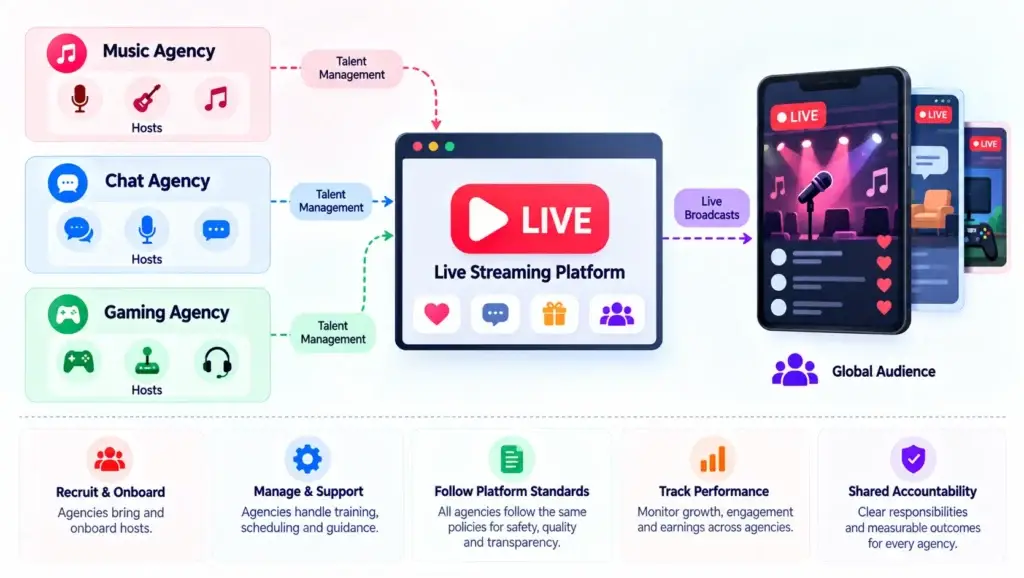
A live-streaming agency network is a structured group of talent management organizations that recruit, support, and coordinate broadcasters participating in a live entertainment platform.
Rather than having one internal team manage every creator individually, the platform operator works with approved agencies. Each agency maintains its own roster of hosts and handles defined responsibilities under shared operating policies.
For example, a regional entertainment platform might partner with one agency specializing in music performances, another focused on conversational broadcasts, and a third responsible for gaming creators.
These agencies may recruit different audiences and talent categories, but they all follow the platform’s core standards for onboarding, safety, earnings transparency, and performance reporting.
The important distinction is that an agency network is not simply a list of recruiters. It is an organized operating structure with shared expectations, accountability, and measurable outcomes.
Step 1: Define the Network’s Operating Model Before Recruiting Agencies
The first decision is how much responsibility the platform will delegate to external agencies.
A founder should define the boundaries between platform ownership, agency management, and individual host responsibilities before accepting recruitment partners.
Choose the Right Management Structure
Three common structures are useful.
| Structure | How It Works | Operational Consideration |
|---|---|---|
| Centralized | The platform directly supervises agencies and sets most operating rules | Strong oversight but higher internal workload |
| Regional | Agency managers oversee creators within specific markets or languages | Supports localization but requires consistent policies |
| Category-based | Agencies specialize in music, gaming, conversation, or other content | Enables specialized coaching but may create uneven category coverage |
A hybrid structure may work well for businesses expanding across several regions.
For instance, the platform could maintain central financial and safety policies while allowing regional agencies to determine recruitment channels, coaching schedules, and local content calendars.
The goal is to delegate day-to-day talent operations without losing control of financial records, platform rules, or user safety.
Agency responsibilities also influence how value moves between creators, audiences, and platform operators. A well-structured live-streaming creator economy</a> depends on balancing creator incentives, audience participation, agency support, and platform sustainability rather than treating recruitment as an isolated activity.
Establish Clear Operational Ownership
Every responsibility should have one accountable owner.
The platform operator should generally retain final authority over account restrictions, financial settlement rules, major disputes, and policy enforcement.
Agencies can manage recruitment, routine coaching, scheduling, creator communication, and performance improvement.
Hosts remain responsible for their broadcasts, professional conduct, and compliance with applicable platform policies.
Documenting these boundaries early prevents situations in which agencies promise benefits or make decisions they are not authorized to deliver.
Step 2: Build an Agency Qualification and Approval Process
An agency capable of recruiting a large number of hosts is not automatically a suitable long-term partner.
A founder needs to evaluate whether the organization can manage creators responsibly and consistently.
What to Check Before Approving an Agency
Review its recruitment experience, manager availability, content specialization, regional knowledge, communication processes, and ability to provide ongoing host support.
It is also useful to understand how the agency handles creator complaints, performance concerns, and account transitions.
A practical evaluation scorecard might look like this:
| Evaluation Area | What to Verify | Suggested Weight |
|---|---|---|
| Recruitment capability | Evidence of legitimate creator sourcing | 25% |
| Management capacity | Availability of managers and support staff | 20% |
| Training capability | Ability to coach and onboard new hosts | 20% |
| Operational reliability | Reporting discipline and communication | 20% |
| Safety readiness | Understanding of conduct and escalation rules | 15% |
These weights are an illustrative evaluation framework, not an industry standard.
Agencies should not be approved solely because they promise unusually high recruitment numbers.
A smaller organization with reliable managers and a clear coaching process may contribute more sustainable activity than a larger agency that provides little support after registration.
Introduce a Pilot Period
Before offering unrestricted recruitment access, consider a limited pilot.
During the pilot, evaluate whether the agency can onboard creators correctly, maintain communication, resolve routine problems, and submit accurate reports.
The purpose is to observe actual operating behavior rather than relying entirely on sales promises.
Step 3: Create a Repeatable Host Recruitment and Onboarding Process
Once agencies are approved, the next challenge is ensuring that new creators receive a consistent experience.
Without standardized onboarding, different agencies may communicate different rules, earnings expectations, or streaming requirements.
This creates confusion for hosts and increases the platform’s support burden.
Build a Standard Host Onboarding Journey
A practical process includes six stages:
- Application: The creator submits the required profile and eligibility information.
- Verification: The appropriate team reviews identity, age eligibility, and other applicable requirements.
- Agency assignment: The creator is linked to an approved agency or manager.
- Orientation: The host receives information about content policies, earnings, streaming expectations, and support channels.
- First broadcast: The creator completes an initial session with appropriate guidance.
- Early performance review: The agency evaluates activity, technical issues, and coaching needs.
Not every host will need the same amount of training.
Experienced broadcasters may be comfortable with audience interaction but need help understanding a new platform’s operating rules. New creators may require additional coaching on presentation, moderation, scheduling, and audience engagement.
The onboarding system should accommodate both.
A consistent onboarding process also depends on how agencies attract, evaluate, and support new broadcasters. Effective live-streaming talent recruitment and host growth requires more than filling creator rosters; agencies must identify suitable hosts, provide practical coaching, and maintain engagement beyond the first few broadcasts.
Measure Activation Instead of Registration Alone
A registered creator is not necessarily an active host.
Agency managers should distinguish between applicants, approved hosts, first-time broadcasters, and creators who maintain a regular schedule.
This gives founders a more accurate understanding of whether recruitment activity is producing usable content supply.
Step 4: Set Host Scheduling and Coverage Expectations
One of the most overlooked challenges in live entertainment operations is ensuring that suitable creators are available when viewers want to watch.
An agency may have a large roster but still leave important viewing periods underserved.
Plan Coverage Around Audience Demand
Instead of requiring every host to broadcast at the same time, group scheduling needs by audience segment.
Consider a hypothetical platform with music, gaming, and conversational entertainment categories.
Music creators might attract stronger evening participation, while conversational rooms could serve different time windows. The actual schedule should be determined from audience behavior, not assumptions.
Agency managers should maintain visibility into planned broadcasts, cancellations, substitute hosts, and recurring coverage gaps.
Create a Coverage Escalation Process
When a scheduled host is unavailable, the agency should know what happens next.
For example:
- The host informs the agency manager.
- The manager identifies whether a replacement is available.
- The content calendar is updated.
- Repeated attendance problems trigger a coaching review.
This reduces dependence on informal messages and last-minute coordination.
The founder’s objective is not to maximize broadcasting hours at any cost. It is to maintain dependable, relevant content availability while respecting creator well-being.
Step 5: Define Agency Agreements and Performance Expectations
Agency agreements should explain how the working relationship operates.
They should cover responsibilities, approved recruitment practices, compensation terms, reporting requirements, confidentiality, data handling, host transfers, dispute resolution, and termination procedures.
The exact legal language depends on the jurisdiction and the relationship between the parties. Agreements should be reviewed by qualified legal advisers before use.
Separate Performance Expectations From Compensation
A common mistake is assuming that financial incentives alone will produce reliable agency behavior.
Agencies also need clear expectations for operational quality.
These might include timely onboarding, accurate creator records, reasonable response times, consistent reporting, and adherence to content policies.
Performance expectations should be measurable and realistic.
For example, a founder could establish an internal service expectation that agency managers acknowledge urgent creator-support requests within a defined period.
That expectation should reflect actual staffing and operating hours rather than an arbitrary promise.
Protect Hosts During Agency Transfers
Hosts may wish to change agencies because of management quality, relocation, contractual changes, or personal preference.
The platform should document how transfer requests are submitted, reviewed, approved, and recorded.
Historical earnings should remain attributable to the correct periods and agreements.
Clear transfer procedures reduce disputes and discourage agencies from treating creator relationships as permanent ownership rights.
Step 6: Build a Performance Scorecard for Every Agency
A network becomes difficult to manage when performance is judged only by recruitment totals or gift-related activity.
These measures can be useful, but they do not show the complete operational picture.
A stronger scorecard combines recruitment efficiency, active creator supply, consistency, retention, audience engagement, and governance.
Essential Agency Performance Metrics
| Metric | What It Measures | Management Decision |
|---|---|---|
| Host activation rate | Approved hosts completing their first broadcast | Improve onboarding |
| Active host rate | Hosts broadcasting within a defined period | Evaluate roster health |
| Schedule adherence | Planned sessions completed as scheduled | Improve coverage |
| Host retention | Creators remaining active across periods | Identify support problems |
| Audience return rate | Viewers returning to hosted content | Evaluate content relevance |
| Earnings dispute rate | Frequency of contested earnings records | Review financial communication |
| Policy incident rate | Confirmed violations relative to activity | Improve coaching and oversight |
Example: Calculating Host Activation
Suppose an agency has 80 approved hosts, and 52 complete their first broadcast within the agreed activation window.
Host activation rate = (52 ÷ 80) × 100 = 65%
This does not automatically indicate good or poor performance.
The founder should compare the result with historical performance, creator categories, onboarding requirements, and the agreed measurement window.
If activation is low, the next step is to investigate why. Potential causes include unclear orientation, technical problems, scheduling difficulties, or unsuitable recruitment.
The purpose of measurement is to improve operations, not simply rank agencies.
Step 7: Create Transparent Earnings and Settlement Procedures
Financial transparency is essential when multiple agencies manage creators under different compensation arrangements. Understanding the live-streaming platform business model helps founders structure virtual gifting revenue, creator earnings, agency commissions, and platform deductions. Clearly defined revenue-sharing arrangements reduce misunderstandings between creators, agency managers, and platform operators.
Agency managers and creators need to understand how eligible earnings are recorded, when statements become available, which deductions apply, and how disputes are handled.
A useful settlement process should distinguish between gross activity, eligible earnings, adjustments, pending balances, approved withdrawals, and completed payments.
Maintain an Audit-Friendly Record
For each settlement period, the platform should retain relevant transaction references, applicable agreement terms, adjustments, approval history, and payout status.
Access to sensitive financial information should be restricted according to the person’s role.
Agencies should only see the financial information they are authorized to manage.
A clear process also needs an exception-handling workflow.
If a host disputes an amount, the issue should be logged, assigned, investigated, and resolved with an explanation.
Founders should avoid using informal chat messages as the only record of financial decisions.
For businesses considering how these processes can be supported by software, Miracuves provides a live-streaming platform with agency management tools that connects agency workflows with host activity and operator oversight.
The operational policies, however, must still be defined and maintained by the business.
Step 8: Build a Creator Support and Retention Program
Agency networks often concentrate on recruitment because new registrations are easy to count.
Retention requires more attention.
A creator who receives consistent guidance, understands expectations, and trusts the management process may have stronger reasons to remain active.
Create a Structured Coaching Cycle
Agency managers can organize regular check-ins covering content planning, broadcast consistency, audience feedback, technical difficulties, and creator concerns.
Coaching should be constructive rather than focused exclusively on earnings targets.
Some creators need help improving presentation skills. Others may need scheduling flexibility, better moderation support, or clearer explanations of platform policies.
Identify Early Warning Signals
Potential retention risks include repeated missed sessions, declining broadcast frequency, unresolved complaints, and long gaps between creator-manager communication.
These signals should trigger a supportive review rather than automatic penalties.
For example, a previously consistent creator who suddenly becomes inactive may be experiencing technical difficulties or personal constraints.
A manager who investigates the cause is more useful than one who simply demands additional streaming hours.
Recognize Sustainable Performance
Recognition programs can reward consistent participation, helpful community behavior, strong audience engagement, and positive coaching contributions.
Avoid creating incentives that encourage artificial gifting, unsafe broadcasting, excessive working hours, or misleading earnings promises.
A healthy creator network needs long-term trust as much as short-term activity.
Step 9: Establish Network-Wide Safety and Governance Rules
As the number of agencies grows, inconsistent policy enforcement becomes a serious operational risk.
Every agency should receive the same core standards for prohibited content, harassment, privacy, user reporting, creator eligibility, and account security.
Regional differences may require additional legal or cultural considerations, but fundamental platform safety policies should remain consistent.
Use a Clear Escalation Matrix
| Incident | Initial Responsibility | Escalation |
|---|---|---|
| Routine scheduling problem | Agency manager | Network operations lead |
| Host onboarding discrepancy | Agency onboarding team | Platform verification team |
| Earnings disagreement | Agency support | Finance or settlement team |
| Content safety report | Platform moderation | Trust and safety lead |
| Suspected financial abuse | Platform risk team | Authorized financial or compliance reviewer |
| Agency misconduct allegation | Network operations | Independent senior review |
The precise escalation structure will depend on organizational size.
The important requirement is that sensitive issues are not left entirely to the agency involved in the dispute.
Serious safety reports and financial concerns should receive appropriate independent review.
Step 10: Scale the Network Through Regional and Category-Based Expansion
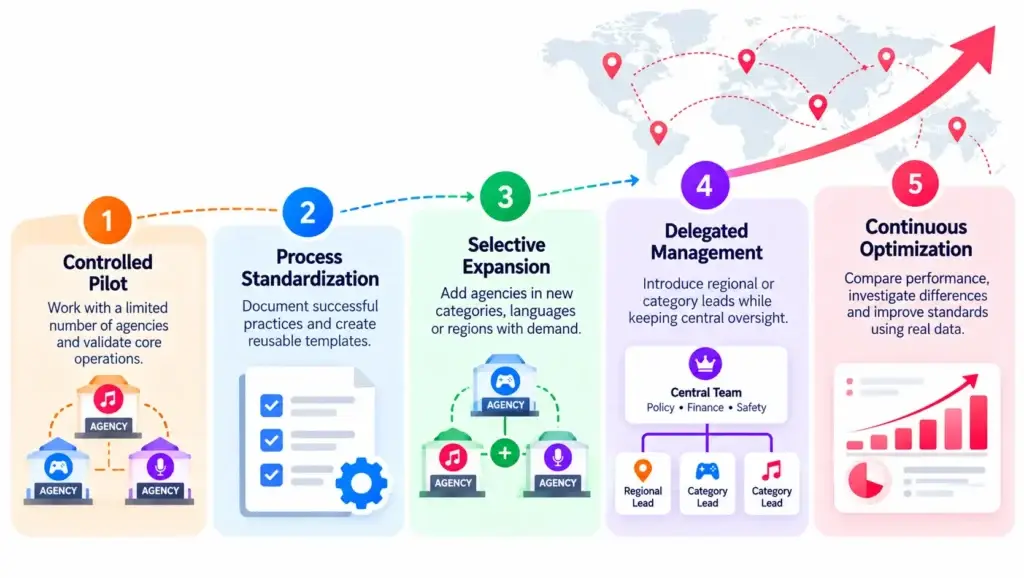
Expanding an agency network should be guided by creator supply, audience demand, and the platform’s broader live-streaming go-to-market strategy. Founders need to identify which regions, languages, and content categories offer meaningful growth opportunities before onboarding additional agencies, ensuring recruitment efforts align with actual audience behavior rather than expansion targets alone.
Adding agencies too quickly can increase creator registrations while also increasing support requests, unresolved disputes, and inconsistent content coverage.
Use a Phased Expansion Model
Phase 1: Controlled pilot
Work with a limited number of agencies. Validate onboarding, scheduling, reporting, support, and settlement procedures.
Phase 2: Process standardization
Document successful practices, improve training materials, and create reusable agency review templates.
Phase 3: Selective expansion
Add agencies in underserved content categories, languages, or regions where audience demand can be supported.
Phase 4: Delegated management
Introduce regional or category leads while retaining centralized policy, financial, and safety oversight.
Phase 5: Continuous optimization
Compare agency cohorts, investigate performance differences, and update operating standards using actual network data.
This approach helps founders scale the quality of their management system alongside the number of creators.
When Should a Founder Move Beyond Spreadsheets?
Spreadsheets can be useful during early planning, particularly when a founder works with a small number of trusted partners.
The problem begins when several people maintain separate records of the same creators, agreements, activity, and payments.
Warning signs include duplicate host assignments, conflicting commission records, missed approvals, delayed reports, and uncertainty about who authorized an agency transfer.
As agency operations become more complex, centralized software can help maintain consistent creator records, agency assignments, performance reports, and administrative oversight. A white-label live streaming app can provide a foundation for organizing host management, agency approvals, activity monitoring, and revenue administration, depending on its supported features and customization options. This allows founders to evaluate connected workflows rather than relying on disconnected records across multiple tools.
Founder Decision Signals
Is Your Agency Network Ready for Centralized Management?
Operational Complexity
When multiple agencies depend on the platform team to reconcile host assignments, schedules, and routine information, centralized management can reduce administrative workload and improve coordination.
Reporting Quality
If managers struggle to identify active hosts, missed broadcasts, unresolved support issues, or agency performance trends, prioritize unified reporting and clear operational dashboards.
Financial Transparency
When creator earnings, agency commissions, and payout disputes require manual investigation across disconnected records, centralized financial tracking can improve accuracy, accountability, and trust.
Governance & Control
As agency networks grow, approval histories, host transfers, policy enforcement, and access permissions become harder to track. Structured workflows and audit records help maintain consistent oversight.
Expansion Readiness
If onboarding each new agency requires extensive manual setup, repeated training, and fragmented communication, standardized processes can make regional and category-based expansion more manageable.
If several of these issues occur repeatedly, centralized workflows may offer more value than simply adding administrative staff.
The software should support the operating model rather than dictate every business policy.
A Practical 90-Day Agency Network Rollout Plan
The following is an illustrative operating plan, not a guaranteed timeline for business growth.
| Period | Main Objective | Expected Deliverable |
|---|---|---|
| Days 1–15 | Define agency eligibility, roles, and policies | Agency operating handbook |
| Days 16–30 | Select and prepare pilot agencies | Approved pilot roster |
| Days 31–45 | Onboard creators and validate scheduling | First activation report |
| Days 46–60 | Review support, reporting, and settlement procedures | Updated operating processes |
| Days 61–75 | Evaluate agency quality and creator retention | Agency performance scorecard |
| Days 76–90 | Decide whether to expand or improve the pilot | Evidence-based expansion plan |
Founders should adapt the sequence to local requirements, staffing capacity, and platform readiness.
Budget planning should also account for the technology required to support agency operations. Understanding live-streaming app development costs helps founders evaluate expenses associated with streaming infrastructure, creator management features, payment integrations, moderation systems, and ongoing maintenance. These technology expenses should be planned separately from agency recruitment and creator support budgets.
The key principle is to validate the operating model before committing to aggressive expansion.
How Miracuves Can Support Agency-Led Live Entertainment Operations
A well-managed agency network needs more than recruitment partners. It also needs dependable workflows for host assignments, agency approvals, activity visibility, earnings administration, and operational oversight.
Miracuves offers a ready-made, source-code-owned live entertainment product foundation with agency-related capabilities. Founders evaluating live-streaming app development services should consider agency management workflows, creator dashboards, revenue administration, platform scalability, and customization requirements. Its stated 6-day delivery timeline applies to the ready-made deployment offering, subject to the agreed scope and customization requirements.
An established live entertainment platform foundation can reduce the need to build common broadcasting and administrative workflows from scratch. However, sustainable agency growth still depends on selecting reliable partners, defining fair agreements, supporting creators, and maintaining consistent operational standards.
Founders can explore the available live entertainment solution to understand the platform capabilities and discuss how they fit the intended agency operating model.
Common Mistakes to Avoid When Managing a Streaming Agency Network
Expanding Before the Pilot Works
More agencies will not fix unclear policies or unreliable reporting. Expansion can magnify existing operational problems.
Rewarding Recruitment Volume Without Measuring Activity
An agency that registers many inactive creators may contribute less value than one that consistently supports a smaller, engaged roster.
Leaving Host Transfers Undefined
Without clear transfer rules, agencies and hosts may disagree about representation, earnings attribution, and contractual obligations.
Treating Creator Support as an Afterthought
Poor communication and unresolved problems can undermine retention even when recruitment is strong.
Giving Agencies Excessive Control Over Sensitive Decisions
Agency managers should not have unrestricted authority over financial adjustments, serious safety incidents, or disputed account actions.
Ignoring the Quality of Financial Records
Incomplete transaction histories and informal settlement procedures can create unnecessary disputes and damage trust.
Final Thoughts: Build an Agency Network That Can Operate Reliably
A live-streaming agency network becomes valuable when it creates dependable creator activity without sacrificing trust, operational clarity, or host well-being.
Founders should focus on selecting capable agency partners, standardizing onboarding, defining responsibilities, measuring meaningful performance, and maintaining transparent financial and safety procedures.
Technology can simplify the administration of these processes, but sustainable network growth depends on the quality of the people and operating decisions behind it.
The strongest starting point is not the largest possible agency roster. It is a manageable network with clear accountability, consistent creator support, and enough reliable information to make better expansion decisions.
FAQs
How do you start a live-streaming agency network?
Begin by defining the operating model, selecting the types of creators you want to support, establishing agency eligibility standards, and preparing clear agreements. Start with a controlled pilot before expanding into additional regions or content categories.
What is the difference between a live-streaming agency and an agency network?
An individual agency recruits and manages its own creator roster. An agency network brings multiple agencies together under shared operating policies, reporting standards, and platform oversight.
How can founders recruit reliable live-streaming agencies?
Evaluate prospective agencies based on recruitment practices, management capacity, communication, training ability, and safety awareness. A pilot period can provide better evidence of operational reliability than recruitment promises alone.
What metrics should an agency manager track?
Useful metrics include host activation, active host rate, schedule adherence, creator retention, audience return activity, support resolution, earnings disputes, and confirmed policy incidents.
How should agencies handle inactive hosts?
Managers should first identify the reason for inactivity. Depending on the circumstances, the response may involve technical support, coaching, scheduling changes, or a review of the creator’s continued participation.
Can one platform work with agencies in multiple regions?
Yes. A multi-region network can operate with centralized financial and safety policies while delegating recruitment, language support, and local scheduling to regional managers. Local legal and regulatory requirements must also be considered.
When does an agency network need dedicated management software?
Dedicated tools become useful when agency assignments, approvals, creator records, earnings reports, or performance reviews become difficult to manage accurately through manual processes.
How long does it take to establish a functioning agency network?
There is no universal timeline. Recruiting reliable partners, training hosts, validating procedures, and building stable audience activity depend on the market and operating model. Software deployment and successful network development are separate milestones.
Miracuves is an independent software development company. We are not affiliated with, connected to, sponsored by, or endorsed by any company or product named in this article.
Terms such as “X Clone” are used descriptively. It is how the software industry refers to building a platform with functionality comparable to a known service, and how clients search for it.
The entire design and codebase of our products is built by our own team. Our products contain no code, design, graphics, or content originating from any third-party website or applications.
All third-party names and marks referenced in this article are the property of their respective owners, referenced solely to identify the services discussed.