A food delivery business can attract hundreds of drivers and still struggle to fulfill orders consistently. The real challenge is not always recruitment. It is keeping reliable delivery partners active, motivated, and available when customers need them.
Drivers may register for a platform, complete a few orders, and gradually stop accepting deliveries. Others continue working but reduce their availability because payouts feel unpredictable, incentives are difficult to achieve, or shift rules interfere with their personal schedules.
For founders and marketplace operators, this is more than a workforce issue. High driver churn can increase recruitment expenses, reduce delivery coverage, create fulfillment delays, and make it harder to maintain service quality.
Effective food delivery driver retention strategies address three operational priorities: transparent earnings, fair loyalty incentives, and flexible yet predictable scheduling. For founders building a delivery marketplace, choosing a ready-made food delivery platform with rider management and payout workflows can provide a foundation for implementing these strategies.
Understanding how these mechanisms work together helps operators build a delivery network that remains dependable as order volumes grow.
Key Takeaways
- Driver retention depends on earnings predictability, fair treatment, schedule flexibility, and operational support.
- Transparent payouts help drivers understand what they earn, why adjustments occur, and when money will arrive.
- Loyalty tiers should reward sustainable participation without encouraging unsafe working hours or penalizing legitimate absences.
- Flexible scheduling works best when drivers have visibility into demand and realistic earnings opportunities.
- Operators should measure driver inactivity, repeat participation, payout disputes, and reactivation—not just registrations.
Why Driver Churn Is a Serious Challenge for Food Delivery Platforms
Driver churn occurs when delivery partners stop participating in a platform over a defined period. Some leave permanently. Others become inactive temporarily, switch between delivery services, or accept fewer orders than before.
These behaviors are not identical, which makes driver churn harder to measure than traditional employee turnover.
An inactive driver may return next week. A newly registered rider might complete only one delivery. Another may remain active but stop working during peak demand.
Platforms need to understand those differences before designing retention campaigns.
The Operational Cost of Losing Active Drivers
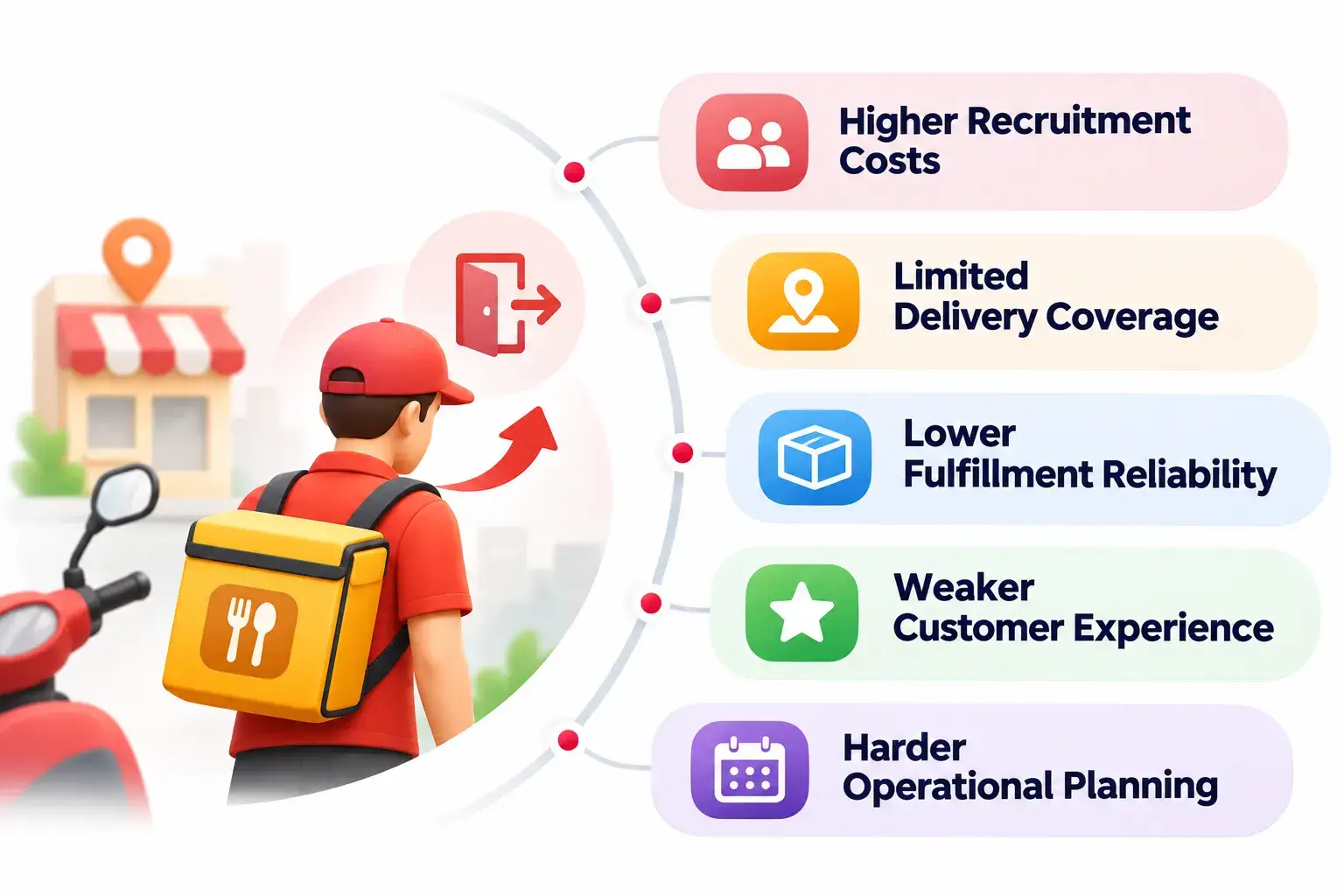
Driver attrition can affect several areas of a delivery business.
Recruitment and onboarding costs: Platforms may need to continually attract and verify new delivery partners.
Delivery coverage: Fewer available couriers can make certain delivery zones difficult to serve during busy periods.
Fulfillment reliability: Inexperienced drivers may need more support with pickup procedures, navigation, and order handovers.
Customer experience: Limited courier availability can contribute to longer delivery times and more frequent cancellations.
Operational planning: High turnover makes it harder to estimate how many drivers will be available for upcoming shifts.
Consider a delivery marketplace with strong demand every Friday evening. If experienced drivers stop taking those shifts, the platform may have enough registered couriers on paper but insufficient active coverage.
That is why driver retention should be evaluated alongside dispatch performance, earnings satisfaction, and delivery demand.
How Payout Transparency Helps Reduce Driver Churn
Earnings are central to delivery partner satisfaction, but the total payout amount is only one part of the experience.
Drivers also want to understand how that amount was calculated.
When a courier completes an order, several factors may influence compensation: delivery distance, base payment, peak-hour incentives, customer tips, waiting-time allowances, and applicable adjustments.
If these components are unclear, drivers may struggle to estimate the value of accepting an order.
Over time, repeated discrepancies or unexplained changes can weaken trust.
Research published in Social Policy & Administration in 2024 examined the predictability and transparency of working conditions on food delivery platforms, including information about earnings and schedules. The findings reinforce the importance of giving workers clear information about essential job conditions.
Display Earnings Before Order Acceptance
Where the operating model permits it, a platform should communicate relevant compensation details before a driver accepts a delivery.
Useful information may include:
- Estimated earnings for the delivery.
- Pickup and drop-off locations.
- Estimated delivery distance and travel time.
- Applicable peak-demand incentives.
- Conditions affecting final compensation.
An estimate should be labeled as an estimate, with any possible adjustment explained.
For example, if additional waiting compensation becomes available after a defined restaurant delay, the driver should be able to understand the eligibility rule.
This reduces uncertainty without requiring operators to promise earnings that cannot be guaranteed.
Provide an Itemized Earnings Statement
A clear payout record helps drivers reconcile completed deliveries against actual earnings.
| Earnings component | Amount |
|---|---|
| Base delivery payment | $4.00 |
| Distance adjustment | $1.50 |
| Peak-hour incentive | $2.00 |
| Customer tip | $3.00 |
| Applicable adjustment | −$0.50 |
| Total earnings | $10.00 |
A useful earnings record should also identify the order reference, completion date, adjustment reason, and expected settlement date.
Drivers should be able to distinguish between earnings already confirmed and amounts still pending settlement.
Make Payout Timing Predictable
The payout schedule matters almost as much as the calculation itself.
Platforms may use daily, weekly, or other settlement cycles depending on their financial infrastructure and operating policies.
Whatever schedule is selected, it should be clearly communicated.
Drivers should know when a payout is initiated, when it is expected to arrive, and what happens if a bank transfer fails.
If payout delays occur, operators should provide a visible status and a clear support process rather than leaving drivers uncertain.
Resolve Payout Disputes With Traceable Records
A transparent payment system must support corrections.
Drivers should be able to raise a dispute about missing incentives, incorrect adjustments, unpaid waiting time, or disputed deliveries.
Operators should maintain records of the original calculation, the adjustment history, the reason for a decision, and the resolution outcome.
This is especially important when payment adjustments are automated.
A 2025 study in Manufacturing & Service Operations Management, examining a last-mile delivery platform, found regular compensation had a stronger effect on retention than initial support payments in the studied setting. Although that research was not specific to restaurant delivery, it offers a useful reason to prioritize sustainable earnings policies over temporary bonuses.
How Loyalty Tiers Encourage Drivers to Stay Active
Loyalty programs are commonly associated with customer rewards, but delivery platforms can also use structured recognition programs to encourage consistent participation.
A driver loyalty program may reward completed deliveries, service reliability, customer feedback, experience, or other relevant measures.
However, the purpose should not simply be to push drivers into completing more orders.
A sustainable program creates meaningful benefits while preserving fair access to earning opportunities.
Design Loyalty Tiers Around Clear Criteria
An illustrative program might have three tiers:
| Loyalty tier | Suggested qualification approach | Potential benefits |
|---|---|---|
| Starter | Newly onboarded or recently active delivery partners | Onboarding guidance, transparent earnings summaries, support access |
| Active | Consistent participation with qualifying service standards | Advance visibility into selected opportunities, training, recognition |
| Established | Sustained participation and reliable service over time | Additional support options, optional reward programs, development opportunities |
These are design examples, not verified features of a particular delivery platform.
Tier thresholds should be published in advance. Drivers should know how progress is calculated, which activities qualify, when the status is reviewed, and how to challenge an incorrect rating.
Reward Reliability Without Creating Unfair Pressure
An incentive system becomes counterproductive when drivers believe they must accept every order or work excessive hours to maintain their status.
For example, rewarding only the highest delivery counts may disadvantage drivers who work part-time, have caregiving responsibilities, or operate in lower-demand neighborhoods.
A more balanced program may consider a combination of completed assignments, reliability within accepted shifts, verified service quality, and participation over a longer period.
Metrics should account for circumstances outside a driver’s control, such as restaurant delays, unavailable orders, app outages, or legitimate safety concerns.
No loyalty reward should depend on unsafe driving or discourage necessary rest.
Use Rewards That Deliver Practical Value
Potential loyalty benefits include optional training, equipment support, recognition, access to assistance programs, or clearly defined monetary rewards.
The most effective reward is not necessarily the most expensive one.
An operator should first understand what drivers value.
For example, a courier who works a few hours after another job may value flexible scheduling more than a bonus tied to an extensive weekly order target.
Another driver may prioritize settlement predictability or vehicle maintenance support.
This is why feedback should inform loyalty program design instead of relying entirely on assumptions about rider motivation.
Why Flexible Shift Scheduling Matters for Driver Retention
Food delivery demand fluctuates throughout the day.
Lunch, dinner, weekends, holidays, and local events can create concentrated periods of activity. At other times, order volume may fall substantially.
Operators need sufficient courier coverage during demand peaks without requiring drivers to remain online through unproductive periods.
This creates a balance between operational reliability and workforce autonomy.
Offer Scheduling Models That Fit Different Drivers
Different scheduling models create different trade-offs.
| Scheduling model | Advantages | Risks to manage |
|---|---|---|
| Open availability | High driver flexibility | Unpredictable peak-hour coverage |
| Pre-booked shifts | Clearer staffing expectations | Reduced freedom if slots are restrictive |
| Hybrid scheduling | Combines optional shifts with flexible availability | Requires careful allocation rules |
| Demand-based invitations | Helps address anticipated order surges | Earnings can remain uncertain if demand forecasts are inaccurate |
A hybrid approach may suit platforms serving both full-time and part-time couriers.
Drivers could reserve preferred working periods while retaining opportunities to participate outside scheduled blocks, subject to local operating rules.
Publish Demand Forecasts and Shift Opportunities
Where reliable forecasting is available, sharing expected demand can help couriers plan their availability.
For example, an app might indicate that a delivery zone is expected to experience higher demand during an evening meal window.
However, demand forecasts should not be presented as guaranteed order volumes or earnings.
Historical demand, restaurant activity, weather, local events, and seasonal patterns can support forecasts, but actual order volumes may differ.
Avoid Punitive Schedule Rules
Scheduling policies can undermine retention when drivers face disproportionate penalties for cancellations, emergencies, or circumstances outside their control.
An effective system should distinguish between repeated avoidable no-shows and legitimate absences.
It should also explain any consequences before the driver commits to a shift.
Research published in the European Journal of Operational Research in 2025 explored workforce sizing and scheduling for last-mile delivery. Its findings indicate that incorporating limited flexibility into relatively stable schedules can balance operational cost and worker well-being.
The lesson for food delivery operators is not that every rider needs a fixed shift. It is that predictable opportunities and reasonable flexibility can coexist.
How Payouts, Loyalty Tiers, and Scheduling Work Together
These three mechanisms are often managed separately. In practice, they influence each other.
A platform might offer attractive loyalty rewards but schedule too few opportunities for drivers to qualify.
It might publish peak-hour bonuses without clearly explaining eligibility.
Or it might display daily earnings while making adjustments that drivers cannot understand.
The result is a fragmented experience in which individual incentives appear attractive but the overall working relationship feels unpredictable.
A coordinated retention strategy should connect all three.
The Driver Retention Framework
Clear earnings
Trust
Fair rewards
Recognition
Flexible shifts
Control
A more dependable foundation for delivery coverage and customer service
A Practical Scenario
Consider a driver who prefers working three evening shifts each week.
A well-designed platform can allow that driver to review available shifts, see applicable incentive conditions, understand estimated earnings per offer, and track progress toward any optional loyalty rewards.
After completing deliveries, the driver can review each payment component and identify when the final payout will occur.
If an incentive is missing, the driver can raise a dispute without needing to reconstruct the entire working day.
That experience combines transparency, choice, and accountability.
The retention benefit is not guaranteed, but it gives drivers fewer reasons to disengage because of avoidable uncertainty.
How Food Delivery Operators Can Measure Driver Churn
A retention initiative needs measurable outcomes.
Counting registered drivers alone does not reveal whether a marketplace has a healthy delivery workforce.
Operators should distinguish between onboarding, activation, repeat participation, inactivity, and permanent exits.
Establish a Consistent Churn Definition
A practical first step is defining when a driver becomes inactive.
For example, an operator may classify a previously active courier as inactive after 28 consecutive days without a completed delivery.
The appropriate threshold depends on whether the workforce primarily consists of daily, weekly, or occasional drivers.
Churn Rate = (Drivers who became inactive ÷ Drivers active at period start) × 100
In this example, measure exits from the starting cohort. Newly onboarded drivers should be tracked separately, and drivers who reactivate should be identified rather than silently combined with new registrations.
Suppose 400 drivers were active at the beginning of a measurement period and 60 met the defined inactivity threshold.
The resulting cohort churn rate would be 15%.
That number is only meaningful when the definition and observation window remain consistent.
Track Retention Metrics That Explain Behavior
| Metric | What it measures | Why it matters |
|---|---|---|
| Driver cohort retention | Share of a starting group remaining active | Shows whether participation is sustained |
| Time to first delivery | Time from approval to first completed order | Identifies onboarding friction |
| Weekly active drivers | Unique couriers completing deliveries each week | Indicates practical workforce availability |
| Payout dispute rate | Disputes relative to eligible payouts or orders | Reveals potential earnings friction |
| Shift fulfillment rate | Completed scheduled shifts relative to booked shifts | Helps evaluate scheduling reliability |
| Incentive qualification rate | Drivers meeting published reward criteria | Highlights whether targets are realistic |
| Reactivation rate | Previously inactive drivers returning to activity | Measures recovery of the courier base |
These metrics should be segmented by city, delivery zone, onboarding cohort, and participation pattern.
For example, drivers working only on weekends should not automatically be judged against the same activity thresholds as drivers who choose daily shifts.
Identify Early Warning Signals
A drop in completed deliveries may indicate disengagement, but it does not establish the cause.
Potential warning signs include fewer logins, declining shift bookings, repeated earnings inquiries, reduced participation after payout adjustments, and increasing inactivity following support complaints.
Operators should combine operational analytics with voluntary driver feedback before concluding why participation has changed.
This avoids confusing temporary availability changes with actual dissatisfaction.
Building a Driver Retention Strategy Around Operational Data
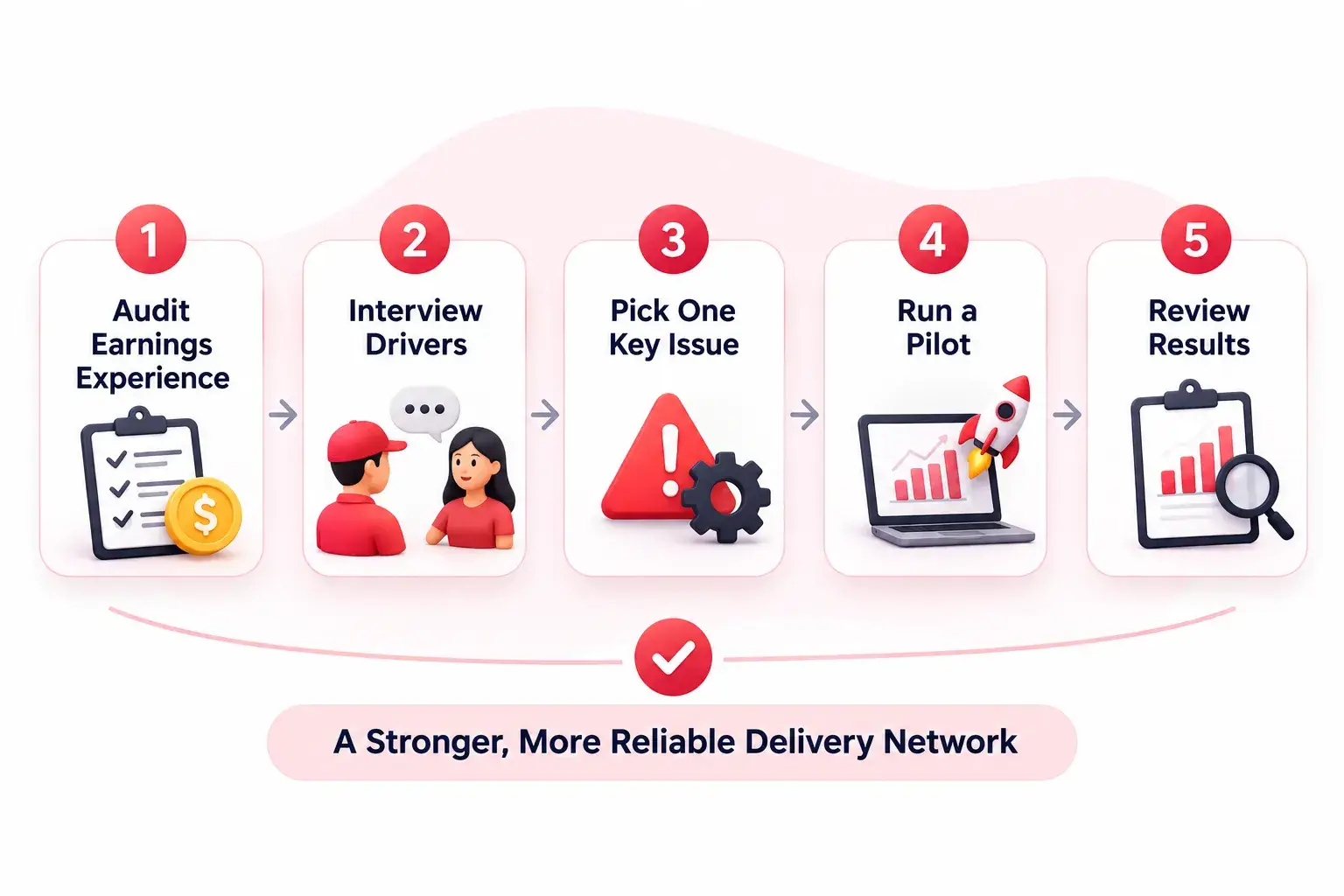
Once the platform understands its workforce patterns, it can begin testing improvements.
Step 1: Audit the Earnings Experience
Review how drivers see offer compensation, completed-order earnings, incentive eligibility, adjustments, and payout status.
Identify situations in which a driver must contact support simply to understand a payment.
Step 2: Interview Drivers Across Different Cohorts
Collect feedback from newly onboarded drivers, consistent participants, occasional couriers, and drivers who recently became inactive.
Ask about earnings clarity, scheduling preferences, dispute resolution, and perceptions of fairness.
Avoid using only feedback from the highest-volume drivers.
Step 3: Select One Operational Problem to Improve
For example, if disputes frequently concern peak-hour incentives, improve the eligibility explanation and payment records before introducing additional bonus programs.
If churn is concentrated among part-time drivers, investigate whether current shift rules conflict with how they want to work.
Step 4: Pilot the Change
Test the adjustment within a clearly defined operational scope.
Monitor changes in driver participation, payout disputes, fulfillment reliability, and support workload.
A pilot should include a baseline and, where feasible, a comparable group not exposed to the change.
Step 5: Review Results Before Expanding
An improvement should be evaluated across multiple outcomes.
Higher participation is valuable, but not if it comes from excessive incentive spending, unfair dispatch rules, or pressure to work longer hours.
The objective is a healthier and more sustainable delivery network.
What Technology Is Needed to Support Driver Retention?
Retention strategies depend on business policies, but technology determines how consistently those policies are applied.
Drivers should not need to contact an operator for every earnings question, and administrators should not have to manually reconstruct every payout adjustment.
A well-organized delivery operation needs accurate records across order completion, incentive calculation, settlement, driver availability, and support cases.
For example, payout records should reconcile with completed orders, while schedule allocation rules should be visible and consistently applied.
Administrative access controls, audit logs, and privacy-conscious handling of location and earnings data are also important.
These requirements create a natural connection between retention planning and the underlying delivery platform.
For founders reviewing the operational foundation, Miracuves provides a ready-made food delivery platform that brings together rider workflows, dispatch, earnings visibility, payout operations, and administrative control.
Advanced loyalty tiers or specialized workforce scheduling rules should be assessed against the required customization scope rather than assumed to be included automatically.
A ready-made foundation can accelerate market entry. Miracuves advertises a six-working-day launch process for its standard ready-made delivery solution, while additional retention-specific customizations may require separate planning.
Common Driver Retention Mistakes Operators Should Avoid
Paying Acquisition Bonuses While Ignoring Existing Drivers
Recruitment incentives can help attract new couriers, but they cannot compensate for persistent operational problems.
If established drivers experience unclear payouts or poor support, new registrations may simply replace those who leave.
Setting Loyalty Targets That Drivers Cannot Realistically Achieve
Targets should account for varying order density, part-time schedules, and legitimate delivery constraints.
Otherwise, a rewards program can create frustration rather than recognition.
Restricting Flexibility Without Explaining the Benefit
Rigid attendance requirements may increase short-term coverage but discourage drivers who value control over their working time.
Scheduling decisions should reflect demand requirements and the workforce’s preferences.
Using Automation Without a Fair Dispute Process
Automated payout adjustments, performance ratings, and assignment rules should remain explainable and reviewable.
Drivers need a meaningful way to challenge incorrect decisions.
Treating Every Inactive Driver as a Permanent Exit
Some couriers work seasonally or intermittently.
Retention reporting should distinguish temporary inactivity from confirmed departures whenever the available data allows.
A Practical Driver Retention Checklist for Founders
Before investing in additional recruitment, delivery operators can review the following questions.
- Can drivers understand the earnings associated with a delivery?
- Are payout adjustments documented and explainable?
- Are settlement dates and payment statuses visible?
- Are loyalty criteria achievable, published, and open to review?
- Can drivers work under scheduling arrangements suited to different participation patterns?
- Are cancellations, emergencies, and safety concerns handled fairly?
- Can operators identify churn by driver cohort and delivery zone?
- Is there a clear process for investigating earnings and scheduling disputes?
If several answers are unclear, the next step should be an operational audit rather than another short-term incentive campaign.
Final Thoughts: Driver Retention Starts With a Better Working Experience
Managing delivery driver churn requires more than paying occasional bonuses.
Drivers need understandable earnings, fair opportunities for recognition, and schedules that allow them to balance delivery work with their other responsibilities.
Payout transparency helps create trust. Thoughtfully designed loyalty tiers can encourage continued participation. Predictable, flexible scheduling can make the platform easier to work with.
Together, these practices can support a more resilient courier network and better operational planning.
For founders, the important decision is to treat driver retention as a core part of the delivery business model—not an issue to address only after recruitment costs begin rising.
Build Delivery Operations Around Long-Term Driver Participation
Miracuves helps founders launch food delivery marketplaces using ready-made, white-label solutions with rider applications, order management, payout workflows, and admin control.
Its standard ready-made delivery foundation is advertised with a six-working-day launch timeline. More specialized retention rules, loyalty programs, or scheduling requirements should be confirmed during solution planning.
If you are evaluating your delivery platform’s operational requirements, discuss your project with Miracuves to identify the capabilities and customizations that fit your business model.
Frequently Asked Questions About Food Delivery Driver Retention
What causes driver churn in food delivery apps?
Driver churn can result from unpredictable earnings, payment disputes, inconsistent order availability, restrictive scheduling, poor support, and perceived unfairness in platform rules. Some inactivity is also caused by seasonal work patterns or personal circumstances. Operators should analyze these causes separately rather than assuming every inactive driver is dissatisfied.
How can food delivery platforms reduce driver turnover?
Platforms can improve retention by making earnings calculations transparent, maintaining reliable payout schedules, offering fair incentive programs, supporting flexible working arrangements, and resolving disputes promptly. Consistent communication and measurement are equally important.
Why is payout transparency important for delivery drivers?
Payout transparency helps drivers understand how much they earn from each completed delivery, which incentives apply, whether adjustments have occurred, and when payment will arrive. It can reduce confusion, improve trust, and make payment discrepancies easier to resolve.
Do loyalty tiers improve delivery partner retention?
Loyalty tiers may encourage retention when rewards are meaningful, qualification rules are clear, and drivers are treated fairly. However, restrictive thresholds or disproportionate penalties can undermine the program. Operators should measure outcomes rather than assuming a tier system automatically improves retention.
What is the most effective shift scheduling model for food delivery drivers?
There is no universal scheduling model. Open availability provides flexibility, pre-booked shifts improve staffing predictability, and hybrid approaches combine elements of both. The right choice depends on demand patterns, local rules, and driver preferences.
How do food delivery apps calculate driver churn rate?
One approach divides the number of drivers who become inactive from a starting cohort by the number of drivers active at the beginning of the measurement period, then multiplies the result by 100. The platform must establish a consistent inactivity threshold and account for reactivations and occasional workers.
Can incentive programs increase driver churn instead of reducing it?
Yes. Incentive programs can create frustration when targets are unrealistic, eligibility rules change unexpectedly, or drivers feel pressured to accept unsafe or unprofitable assignments. Transparent rules, attainable objectives, and fair review mechanisms are essential.
What should founders prioritize before introducing a driver retention program?
Founders should first establish accurate earnings records, reliable payment processes, clear driver support procedures, and consistent churn measurement. Once these foundations are in place, loyalty incentives and scheduling improvements can be introduced based on observed workforce needs.
Miracuves is an independent software development company. We are not affiliated with, connected to, sponsored by, or endorsed by any company or product named in this article.
Terms such as “X Clone” are used descriptively. It is how the software industry refers to building a platform with functionality comparable to a known service, and how clients search for it.
The entire design and codebase of our products is built by our own team. Our products contain no code, design, graphics, or content originating from any third-party website or applications.
All third-party names and marks referenced in this article are the property of their respective owners, referenced solely to identify the services discussed.